BSR and GlobeScan’s 2026 State of Sustainable Business survey reveals a dramatically different landscape from our last edition in 2019.
At that time, survey respondents saw sustainability as a top priority, with widespread support from CEOs and significant integration across the business.
Less than a decade later, the sustainable business landscape feels markedly different.
Today, sustainability professionals report that companies are shifting their focus from ambition to implementation—but with a narrower scope, tighter resources, and new governance challenges.
Executive Summary

Sustainability Enters a More Focused, Pragmatic Era

Compliance Demands Are Crowding Out Strategic Value Creation

Implementation Ambitions May Be Outpacing Investment

Climate Risk Assessment Not Followed by Meaningful Adaptation

AI Adoption Is Accelerating Faster Than Governance
This year’s survey gathered insights from 124 BSR members and other sustainability professionals at large companies, offering a snapshot of sustainability professionals’ views on operationalization, internal alignment, and external influences driving sustainability today.
Key Findings
Most respondents expect the next phase of corporate sustainability will focus on delivering fewer, clearer priorities over the next five years.
Next Phase of Sustainability
Q: Looking ahead to the next five years, which of the below best describes your view of the next phase of corporate sustainability?
n=124
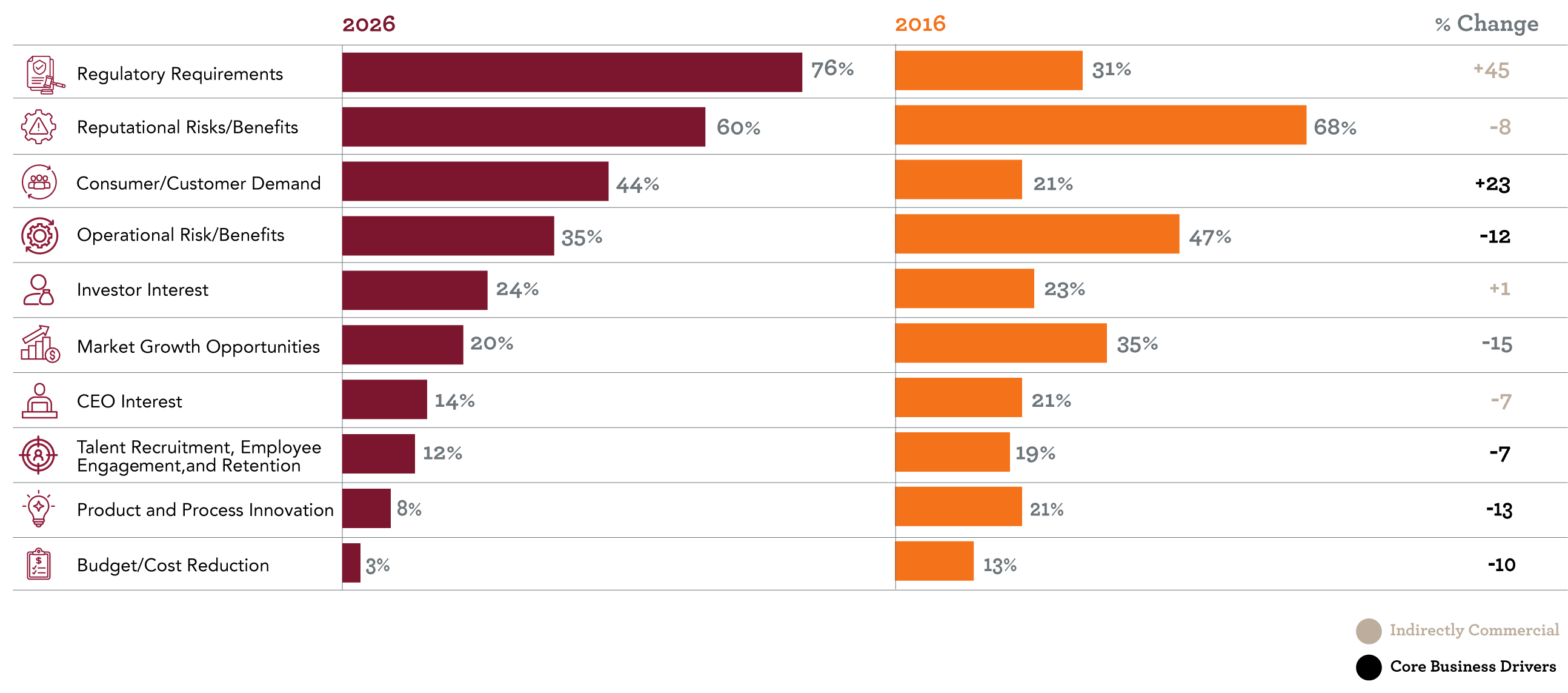
In a marked shift from 2016, corporate sustainability today is driven by regulatory requirements, reputational risks/benefits, and consumer/customer demand, with some core business drivers becoming less influential.
Sustainability Drivers
Q: Which of the following are the most important drivers for your company’s sustainability efforts?
2026, n=124; 2016, n=287
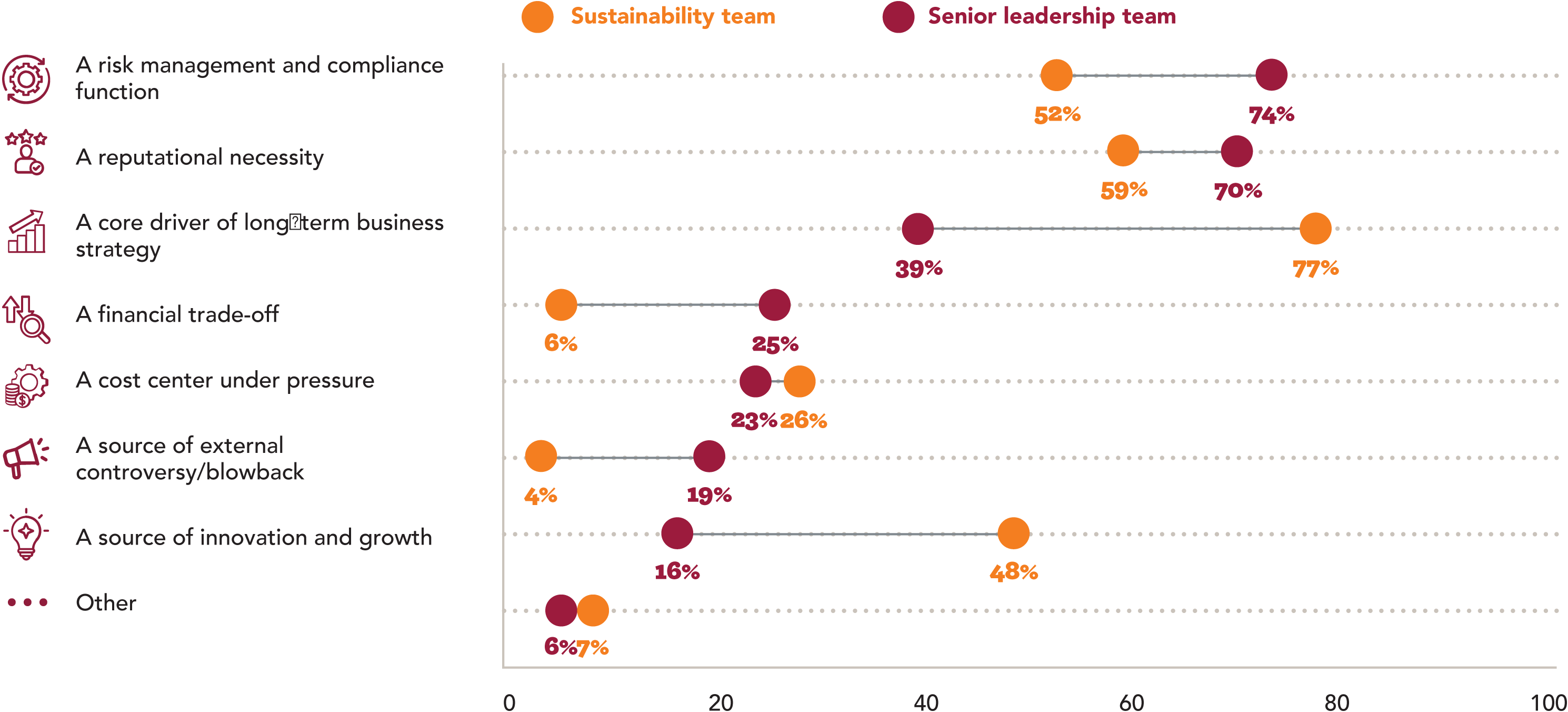
Respondents say senior leadership teams view sustainability mostly as risk management or compliance, while sustainability teams view it as a core driver of long-term business strategy.
Views on Sustainability by Senior Leadership and Sustainability Teams
Q: We are interested to know how sustainability is viewed by sustainability teams and by wider leadership at your company. From the list below, please select up to three that best reflect how sustainability is seen by your company.
n=124
Most respondents say their companies are maintaining or accelerating sustainability implementation, but without the resource investment to match. This sets up the potential for a large say/do gap in the future.
Recent Approach to Sustainability
Q: Thinking about your company’s approach to sustainability over the past 12 months, how would you describe its ambition, investment, and implementation using the scale below?
n=124
Implementation
Investment
Ambition
Physical climate risk is widely integrated into risk management among companies, but adaptation plans and solutions are still nascent.
Physical Climate Risks
Q: Is your company taking action on physical climate risks to business?
n=124
Yes
We have developed climate adaptation plans in our supply chain.
We are investing in climate adaptation solutions.
We have developed or integrated climate adaptation plans in our operations.
We have integrated physical climate risk into enterprise risk management.
No
We have not taken action on physical climate risks to the business.
We are planning to act but have not yet started.
Don't Know
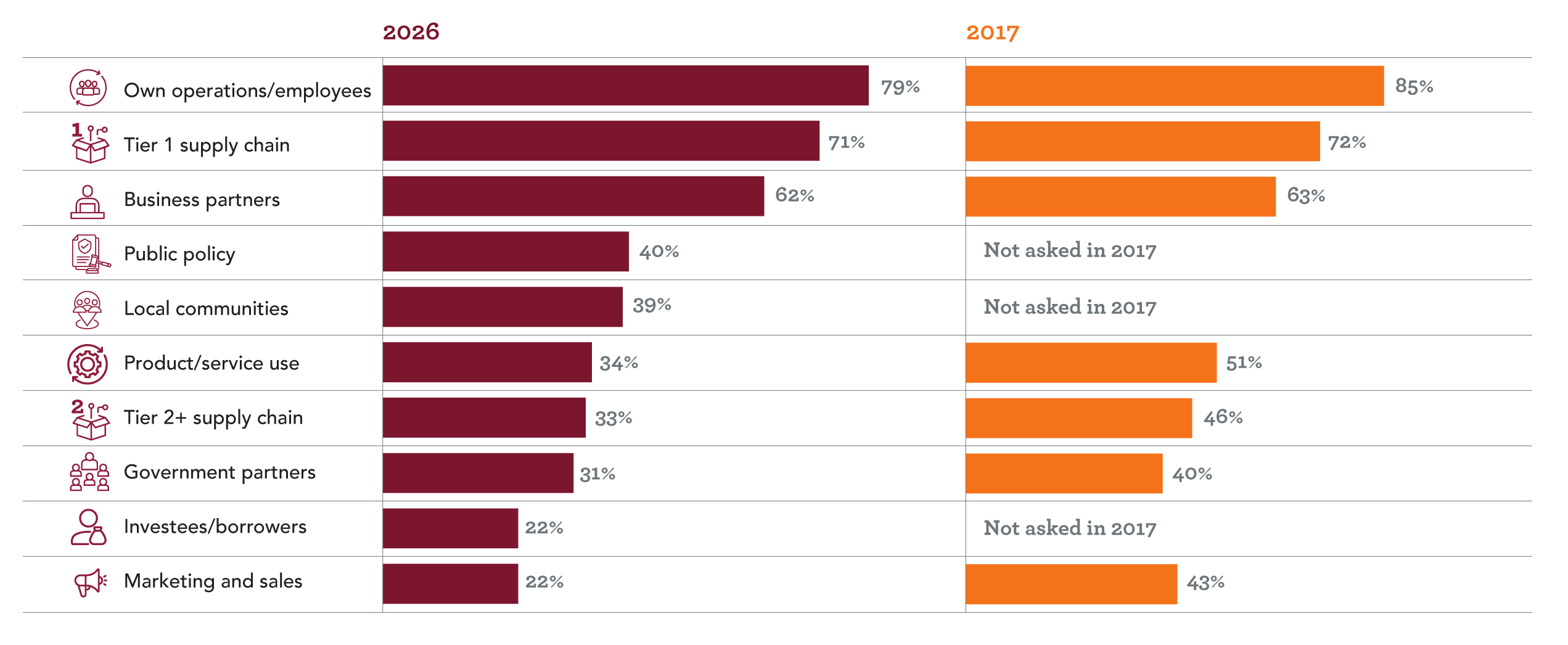
Companies’ management of human rights is less comprehensive, and narrowing to focus only on direct employees, Tier 1 suppliers, and other business partners compared with 2017.
Human Rights Management Throughout the Value Chain
Q: How much, if at all, does your company assess and manage human rights through each of the following elements of the value chain?
All Respondents, % (4+5) on a 5-point Scale, 2026 vs 2017
Managing environmental and social impacts of AI appears to be an ongoing development, with only one in three respondents saying their company has formal governance in place.
Managing Environmental and Social Impacts of AI
Q: How is your company managing the potential environmental and social impacts of AI?
n=124
16%
By tracking and managing AI’s environmental footprint (e.g., energy, emissions, water)
24%
Informally or on a case-by-case basis.
26%
By addressing social or human rights risks (e.g., bias, privacy, workforce impacts).
34%
Through formal responsible AI governance that includes sustainability considerations.
12%
Don’t know.
26%
We are not currently managing these impacts.
4%
Other
Companies are beginning to set formal AI policies in place to manage potential social and environmental impacts of AI, but AI adoption appears to be moving faster than the corresponding governance.
This presents a potential risk for any organization using AI without the guardrails that formal governance can provide.
As sustainability enters a more pragmatic era defined by narrower priorities, more focus on implementation, tighter budgets, and greater scrutiny, corporate leaders must focus on delivering impact with greater efficiency and effectiveness. The time to act—and deliver—is now.
Make Fewer Priorities Matter More: As companies narrow their sustainability efforts to a smaller set of strategic priorities, this can be viewed either as a rollback or as an opportunity for real, tangible progress aligned with the business. Make it the latter with disciplined execution, clear accountability, collaboration with internal and external partners, and transparency about progress and challenges. Those that can translate focus into credible results will be better positioned to maintain momentum, secure continued investment, and strengthen stakeholder confidence.
Build the Capacity to Deliver: As sustainability priorities shift toward implementation, compliance, and delivery, organizational capacity is becoming a critical determinant of success. Companies that align resources, capabilities, and investment with implementation demands will be better positioned to translate commitments into real action and progress.
Make Sustainability Strategically Indispensable: While sustainability professionals often view sustainability as a driver of long-term value creation and innovation, senior leaders increasingly view it through the lens of risk management and compliance. Closing this gap will be critical to sustaining executive support and investment. Sustainability teams can do so by starting with enterprise priorities rather than a list of ESG topics, identifying where sustainability is a critical enabler, dependency, or source of competitive advantage. Companies that anchor sustainability in performance, resilience, growth, and competitiveness will be better positioned to demonstrate strategic relevance and mobilize organizational action.
Methodology
- The online survey gathered views of 124 sustainability professionals between April 14 and May 15, 2026
- Survey respondents received direct invites from BSR member engagements and were also invited to participate by GlobeScan, drawing from both extensive networks of qualified senior corporate sustainability professionals.
- Survey questions confirmed that all respondents are in senior positions and employed at companies earning USD 1 billion or more in revenue.
- The distribution across sectors, regions, and job level is below:
Sector
- Consumer Products/Retail 27%
- Technology 26%
- Financial Services 10%
- Healthcare 9%
- Energy and Extractives 7%
- Food, Agriculture, and Beverage 6%
- Industrials 6%
- Travel and Tourism 2%
- Other 7%
HQ Region
-
North America48%
Canada, USA (95%) -
Europe39%
Denmark, Finland, France, Germany, Guernsey, Luxembourg, Netherlands, New Zealand, Norway, Sweden, Switzerland, UK -
Other Regions13%
Australia, Hong Kong, Indonesia, Japan, New Zealand, São Tomé and Príncipe, Singapore, Thailand
Job Level
- Vice President or Above 24%
- Director 34%
- Manager or Below 38%
- Other 4%
Next Steps
JOIN the Webinar
Authors



Christine Lamontagne
Principal, GlobeScan Incorporated

James Morris
Director, GlobeScan Incorporated

Resilient business strategies for a complex world.