Searching for:
Search results: 381 of 1255
Blog | Wednesday April 19, 2023
Nine Ways to Activate Your Board on Climate
Board oversight on climate-related risks and opportunities is increasingly important. Explore three strategies for activating boards on climate.
Blog | Wednesday April 19, 2023
Nine Ways to Activate Your Board on Climate
Preview
Recent years have seen an astonishing uptake of ambitious corporate climate goals. And recent weeks have seen an even more dramatic rise in activist action to boards and leadership on the very climate goals set by organizations.
Many companies have adopted climate change as a topic for board oversight—either directly or via climate commitments and reporting. As of early 2023, 2489 companies set Science-Based Targets, and 1748 made net-zero commitments through the Science Based Targets initiative (SBTi). These commitments represent prudent business and vital ambition. They also entail a level of corporate disclosure, risk management, and business transformation that should put net zero-aligned transformation squarely on the agenda for the Board of Directors.
The major challenge for today’s boards and the companies they oversee is how to fulfill these commitments.
Climate Transformation on the Agenda
Boards are facing increased liabilities, lawsuits, resolutions, and elections on all aspects of sustainability, especially climate. This is driven by various increasingly well-known factors, including:
- Rising investor interest, especially institutional investors who expect board oversight and fluency on climate.
- Growing regulations such as the Corporate Sustainability Reporting Directive, the Corporate Sustainability Due Diligence Directive, the upcoming requirements from the US Securities and Exchange Commission (SEC), and the release of sustainability-related standards by the International Sustainability Standards Board, which include disclosures related to board oversight, expertise, and sign-off on targets and performance.
- Increased scrutiny on “greenwashing,” with a recent wave of rules across various jurisdictions, including Australia, the US SEC, the EU, and the UK Competition Markets Authority bringing about a zero tolerance on net-zero greenwashing.
These factors combined are rallying for a changed mindset by boards to act on climate-related risks and opportunities, as part of the company’s transformation strategy and growth over the short, medium, and long term.
Lessons Learned from Board Engagement
BSR has worked closely with corporate boards on climate topics. In doing so, three lessons stand out.
First, make climate relevant for the individual business, not just generic training on keywords. We recently conducted a training for a global beverage and agriculture company. After highlighting systemic climate and nature-related risks, BSR led a discussion on how they are relevant to the individual company and its board. The company could then meaningfully consider board oversight of risk management, strategy, and assurance of financial statements.
Second, respect the role of the board vs. management. For instance, BSR recently conducted a training for directors on the boards of private equity-owned companies regarding board oversight of management-led materiality process. It was essential to delineate respective roles, as well as to equip boards with enough knowledge to provide effective oversight.
Third, create shared leadership. In another example, we conducted a joint climate scenario exercise with the executive team and board of a European healthcare company. The exercise demonstrated the importance of getting key parties around the table to build a baseline understanding of climate issues, identify the relevance of climate for business, and agree on a coordinated plan for executive action and board oversight.
Climate Transformation is Not a One-Shot Effort
In March 2023, BSR engaged a small group of cross-industry members from our Transform to Net Zero (TONZ) collaborative initiative who are committed to enabling the business transformation needed to achieve net zero.
We explored the following questions and challenges:
- How are you engaging with your board on climate transformation?
- What steps has your board taken to create support for managing a net-zero transformation?
- Does it engage in related scenario exercises?
- How does your board sign off on climate targets?
- How does it monitor progress?
Member companies shared strategic insights on how they engaged their boards on climate:
- Transformation must be driven by the CEO and board with “tone at the top.”
- ESG and sustainability teams are the fastest growing internally, impelling more cross-company collaboration, continuous training, and upskilling, including for executives and boards.
- Board committee structure is important, with cross-committee terms of reference and focus. For some members, a dedicated sustainability committee provides oversight across the strategy and programs, with continuous reviews from audit and risk committees.
- Scenario analysis is a key tool to test the resilience of business strategy, and it’s important to tailor the conversation to a board audience.
Climate oversight is a continuous leadership journey for chief sustainability officers (CSOs), executives, and boards alike. Some company leaders are engaging in fireside chats with employees and stakeholders to inspire transformative change. It takes heart and humanity, as well as continuous direction.
Nine Key Steps to Building a Climate-Competent Board
From experience with member company executive teams, BSR has identified three strategies to activate boards:
1. Competencies and structure:
- Build capacity through tailored training and education for the company’s specific circumstances.
- Incorporate climate competencies into the board skills matrix.
- Understand which board committees are charged with climate oversight and adapt messaging to their respective purviews.
2. Strategy and risk:
- Emphasize company risks associated with climate change and with failure to meet climate commitments (e.g., litigation risk, public relations risk, regulatory risk).
- Use scenario analysis to build shared understanding of material climate issues, identify business implications and foster joint problem solving.
- Elevate expert/stakeholder perspectives and impacts through briefings, direct engagement, advisory councils, etc.
3. Oversight:
- Anticipate governance risks related to climate oversight (including board elections, proxy votes, shareholder resolutions).
- Encourage rigorous audit committee oversight and verification in disclosures.
- Evaluate executive remunerations tied to climate and integrate with sustainability across social, human rights, and governance.
Since companies have disclosed and committed to board oversight of climate-related risk and targets, now they are on the hook to live up to those commitments.
Moreover, the latest Intergovernmental Panel on Climate Change (IPCC) synthesis report shows that we must speed up the scale and pace of climate action commensurate to the latest science. Business can take effective, credible action to meet the moment. And this includes an important active role for boards on climate and sustainability at large, in a continuously uncertain world where climate-related risks, opportunities, and the associated net-zero aligned business transformation need urgent attention by all, including from the top.
Sustainability FAQs | Tuesday April 18, 2023
Governance and Oversight of Just and Sustainable Business
This FAQ sets out BSR’s perspective on the governance and oversight of just and sustainable business at companies. We believe that engaged boards, empowered executive leadership, and clear roles and responsibilities throughout companies are essential for the creation of long-term value for investors and society.
Sustainability FAQs | Tuesday April 18, 2023
Governance and Oversight of Just and Sustainable Business
Preview
This FAQ sets out BSR’s perspective on the governance and oversight of just and sustainable business at companies. We believe that engaged boards, empowered executive leadership, and clear roles and responsibilities throughout companies are essential for the creation of long-term value for investors and society.
Defining Governance and Oversight
Why is governance and oversight important?
A clear system of governance and oversight ensures that strategies relating to just and sustainable business will be created, implemented, and actioned.
What is the difference between governance and management?
Governance is the system by which business operations are directed and controlled. The governance structure of a company specifies the distribution responsibilities among different participants, such as the board, managers, and shareholders, and spells out the rules and procedures for making corporate decisions.
Management is the deployment of resources to achieve business goals. The management of a company includes running the day-to-day operations of a company, coordinating the efforts of staff to achieve strategic objectives, and ensuring that the company’s resources are used effectively and efficiently.
Governance is about direction, accountability, and oversight, whereas management is about execution, implementation, and operations. It is important to distinguish between these two different concepts when defining how to advance sustainability and social justice goals with companies by not (for example) assigning “management” expectations to boards.
Who leads governance and management, and who are they accountable to?
The company board is accountable to the company’s shareholders. The company’s board chair leads the board in keeping with the organization’s vision, mission, and strategic planning goals. Duties of boards include choosing the CEO, reviewing / approving company strategy, approving major policies, making major decisions, and overseeing performance.
The company management is accountable to the company’s board. The CEO leads the company in keeping with the board’s direction. The duties of management include making operational decisions, making operational policies, keeping the board educated and informed, creating the company strategy for Board review / approval, implementing the strategy, and bringing well-documented recommendations and information to the board.
What are the key elements of governance and oversight for just and sustainable business?
Governance and oversight for just and sustainable business is the formal integration of social and environmental goals into a company’s corporate governance and operating mode and ensures that material social and environmental issues are effectively managed at all levels of the company. Governance and oversight can be complex because social and environmental issues cut across many different components of a business.
BSR believes that a governance and oversight system should include the following five elements: (1) board level oversight, accountability, and sign-off; (2) executive leadership; (3) a core sustainability team (or similar); (4) clear roles and responsibilities for employees integral to the success of just and sustainable business; and (5) a system for understanding external perspectives via meaningful stakeholder engagement.
Structures for Governance
How should a company board engage on the topic of just and sustainable business?
Best practices include incorporating just and sustainable business into the board mandate, designating a board committee (or committees) for relevant social and environmental issues, training board members on material social and environmental topics, and hiring experts to the Board.
BSR believes there are four critical areas for boards to address:
- Stucture: Formalizing the board’s mandate for just and sustainable business via inclusion in relevant board committee charters and / or creating a new board committee to oversee just and sustainable business.
- Competencies: Recruiting board members with the right knowledge, competencies, and expertise in relevant topics, and with diverse backgrounds.
- Strategy: Developing a strategy with clear consideration for how material topics, emerging issues, and stakeholder impacts shape business success over the short, medium, and long-term.
- Oversight: Establishing goals, incentives, and accountability for management. Meaningful disclosure (e.g., formal approval of annual disclosures on social and environmental topics) is a key aspect of achieving oversight.
How are regulations changing board oversight of just and sustainable business?
Regulations and other emerging global standards are substantially increasing expectations and requirements for board oversight of just and sustainable business. The main implications include: (1) board oversight (e.g., of specific topics); (2) responsibilities outlined in board mandates; (3) board expertise and knowledge; (4) how risks and opportunities are considered in strategy; (5) incentive and remuneration considerations; (6) the board’s role setting up and overseeing due diligence processes; and (7) signing off sustainability reports and disclosures.
For example, the proposed EU Corporate Sustainability Due Diligence Directive (CSDDD) is expected to establish a “duty to act” on the consequence of their board decisions relating to sustainability, climate change, and human rights impacts, while the EU Corporate Sustainability Reporting Directive (CSRD) will require boards to be a part of the company’s due diligence process and sign off sustainability information within a company’s management report. Further, the International Sustainability Standards Board (ISSB) will require climate disclosure and an explanation of board governance and oversight.
These regulations and standards redefine the role of the board implicitly (by creating new corporate standards) and explicitly (by specifically obliging boards to oversee sustainability and human rights at their companies).
What are the best practices for establishing and maintaining board competency on just and sustainable business?
There is increasing awareness of the need to fill the gap in expertise and skills at board and management levels on social and environmental topics, such as climate change, human rights due diligence, and social justice. Best practices include training board members on material topics and emerging trends through formal means (such as executive education) or informal means (such as regular briefings and inviting the participation of external speakers).
It is important to ensure diversity of skills and experience at board level, including consideration of diversity or race / ethnicity, gender, and age. Ideally at least one board member has expertise on material social and environmental topics.
Should there be a separate board committee dedicated to just and sustainable business, or should matters of just and sustainable business be integrated into other board committees?
Assigning social and environmental issues to a board committee (or committees) allows for key issues to be considered systematically and in greater depth. However, there is no “one size fits all” approach to how this is achieved—every company board is uniquely structured, and different issues may be suited to different committees.
For example: an audit committee may oversee human rights due diligence overall or specific topics (such as privacy); a compensation committee may oversee diversity, equity, and inclusion; a nominating and governance committee may ensure that appropriate sustainability skills and experience are present on the board; a public policy committee may consider matters relating to government relations or social impact; a dedicated sustainability or corporate responsibility committee may oversee a company’s materiality assessment process and ensure that social and environmental risks are being appropriately identified, tracked, and addressed.
As a matter of principle, the entire board should have the opportunity to engage with matters of just and sustainable business that impact company strategy and have the right level of understanding required for informed decision making. The audit committee can play an important role in assigning issues to board committees and clarifying when the responsibility extends to the full board.
Structures for Management
What are best practices for executive oversight and leadership?
The “tone from the top” and good executive leadership helps build a culture of just and sustainable business throughout a company; if just and sustainable business is on the leadership agenda, it will be prioritized.
Clear roles and responsibilities provide clarity, alignment, and expectations to those executing the work on just and sustainable business, and enable effective communication between different functions, business units, and teams.
Rewarding performance and creating consequences for non-performance on a set of clearly defined goals helps ensure that just and sustainable business is placed on the same level as other aspects of business. For example, social and environmental performance can be linked to executive compensation and employee bonuses more broadly via key performance indicators linked to issues such as health and safety, CO2 emissions, or diversity.
How should just and sustainable business be organized inside companies?
The most effective organizational structure for just and sustainable business will be different across companies and industries, though most can be categorized as “centralized”, “embedded”, or “distributed” structures:
- Centralized: A larger team (e.g., 15+ staff) acts as the center of expertise and implementation at the company. This team will implement key aspects of just and sustainable business, such as strategy, reporting, and stakeholder engagement, while relying on other functions to implement the strategy and improve performance. Centralized structures are often associated with joined up approaches to just and sustainable business, such as leadership for climate change, human rights, and labor issues being jointly assigned to a single chief sustainability officer.
- Embedded: A smaller team (e.g., 5 or fewer staff) implements core elements of just and sustainable business (such as reporting and disclosure) but relies more on other functions to lead strategy development and implementation.
- Disitributed: A variety of different teams (e.g., sustainability, human rights, civil rights, DEI, product responsibility) lead different elements of just and sustainable business, often in different functions of the company. In this model there are often multiple rather than single executive leads—for example, there may be a chief sustainability officer for climate change, a VP for human rights, and a VP for supplier responsibility all leading different programs.
BSR believes that a dedicated “head” of just and sustainable business can be a best practice for some companies but not others; more important is the existence of a joined-up and cohesive approach that is accountable to the company board. We note that terms such as “sustainability”, “ESG”, and “social impact” have taken on different meanings in different industries and can be associated with very different team and individual mandates.
Which department or function should just and sustainable business be part of?
The most effective function for just and sustainable business will vary across companies and industries. BSR has seen both successful and unsuccessful teams located in departments as diverse as strategy, commununications, risk, government affairs, legal, product, and procurement; for this reason, we have concluded that department or function on its own this is not an important variable determining success. Far more important is that the team (or teams) reside in a part of the company where they can make, shape, and influence the decisions, actions, and implementation priorities most relevant for the company’s material social and environmental issues and have a direct line to CEO / executive leadership decision making.
Should there be a chief sustainability officer, and what should their brief be?
For many companies a chief sustainability officer can be a very effective role, provided the chief sustainability officer is resourced, empowered, and supported effectively. The precise role will vary depending on the company’s material issues—for example, it may focus on value creation where the company is in the business of providing sustainability solitions, or it may focus on risk mitigation where the company is faced with material risks; in both cases, being a change agent and coalition builder are common themes. For some companies a chief sustainability officer may be focussed on a constrained set of issues (e.g., climate change and nature), while in other companies a chief sustainability officer may have a broader brief that also encompasses human rights, labor issues, and ethics. There may be other leaders inside companies (e.g., a VP human rights) with chief sustainability officer-like roles. In all cases, direct access to the CEO and Board is essential.
How should other functions and teams be engaged?
A core sustainability team (even a large one) cannot fulfill a company’s just and sustainable business strategy alone, and a broader group of employees should take on roles and responsibilities to help implement the strategy, achieve goals, and improve performance. This is particularly true for companies with “embedded” and “distributed” approaches.
Many companies create cross functional working groups (or similar, such as councils and networks) to provide a platform for validating programs and initiatives, implement and support strategic initiatives, and engage a broader base of employees. These cross functional working groups can be composed of multiple functions, operations, and geographies, and it is important to establish clear meeting frequencies, agendas, and communications channels.
These cross functional working groups can be formal (e.g., defined membership, formal charter, regular meeting cadence) or informal (e.g., shifting membersip, flexible charter, and meeting “as needed”), with different approaches suiting different company cultures. In all cases an effective support staff or “secretariat” is needed for success.
How should external stakeholders be engaged?
Effective approaches to just and sustainable business require a deliberate, strategic, and structured approach to securing the insights, perspectives, and involvement of affected stakeholders (such as customers, civil society organizations, and local communities) and other experts (such as academics) and to embedding them into company decision making. This is the subject of a different BSR FAQ on meaningful stakeholder engagement.
Should companies establish external stakeholder advisory councils?
An external advisory council can help bring diverse thinking, improved rigor, and greater determination into programming and strategy. When doing so it is important to develop clear terms of reference, including:
- Objective: Determine the objective of the group (e.g., review policies; input into strategy; provide emerging issue knowledge; guide industry best practice etc.).
- Composition: Determine the makeup of the group, roles and responsibilities, and term limits.
- Meeting frequency and agenda: Set clear meeting frequency, agendas for each meeting, and communication channels.
- Transparency: Establish clarity on whether / where the external advisory council is publicly known and / or whether the external advisory council can issue its own communications.
Sustainability FAQs | Tuesday April 18, 2023
Stakeholder Engagement
This FAQ sets out the BSR perspective on stakeholder engagement. We believe that meaningful stakeholder engagement is an essential foundation for just and sustainable business and a core element of processes such as decision making, strategy development, materiality assessment, human rights due diligence, and reporting. Without meaningful stakeholder engagement, any…
Sustainability FAQs | Tuesday April 18, 2023
Stakeholder Engagement
Preview
This FAQ sets out the BSR perspective on stakeholder engagement. We believe that meaningful stakeholder engagement is an essential foundation for just and sustainable business and a core element of processes such as decision making, strategy development, materiality assessment, human rights due diligence, and reporting. Without meaningful stakeholder engagement, any approach to just and sustainable business would be constrained by a company’s self-interest and inward focus.
Defining Stakeholder Engagement
What is the definition of a stakeholder?
A stakeholder is someone who affects or is affected by a company’s operations, activities, products, or services, and can be either inside or outside the company. Common stakeholders include employees, customers, users, consumers, suppliers, business partners, investors, trade unions, civil society organizations, policy makers, regulators, and the communities impacted by operations.
The OECD defines stakeholders as “persons or groups who have interests that are or could be impacted by an enterprise’s activities.”1 The Global Reporting Initiative adopts this same definition and clarifies that stakeholders may not always have a direct relationship with the company—for example, workers in the supply chain or future generations can also be considered stakeholders.2
What is the distinction between a rightsholder and a stakeholder?
The term rightsholder is used for individuals or groups whose individual human rights or collective rights are or could be directly impacted by business activities, products, or services. This is distinct from other stakeholders (such as civil society organizations) who may have insights, expertise, and awareness relevant for rightsholder interests, but who may not themselves be rightsholders. All rightsholders are stakeholders. The term “affected stakeholder” is also used to refer to an individual whose human rights has been affected by a company’s operations, activities, products, or services.3
As a matter of principle companies should engage with potentially affected stakeholders (i.e., rightsholders) by consulting them directly; in situations where such consultation is not possible, companies should engage reasonable alternatives, such as independent experts, civil society organizations, and human rights defenders.4
In practice, this can often mean that companies should engage both large international / national organizations and grassroots / local organizations; the relevant stakeholders to engage with may not always be the “usual suspects” of prominent organizations.
What is meaningful stakeholder engagement?
Meaningful stakeholder engagement is characterized by two-way communication based on the good faith of participants on both sides. Meaningful stakeholder engagement is proactive, responsive, and ongoing, and is often conducted before decisions are made.5
Stakeholders that choose to engage with companies generally expect the interaction to generate change, so engagement should be treated as a dialogue, not a one-way information dissemination process. This means that the company engages with the genuine intention to understand how stakeholders are affected by its activities and is prepared to both pursue opportunities identified and address adverse impacts.
What is a multi-stakeholder initiative?
The term “multi-stakeholder” is often used to describe collaborative efforts where no single organization has the authority or resources to address a particular issue. However, the term “multi-stakeholder” is used to convey different meanings.
In BSR’s view, a “multi-stakeholder initiative” (sometimes referred to as an MSI) is characterized by a decision-making structure where no single constituency (e.g., companies, civil society organizations, investors, governments) has a majority of the votes. By contrast, a “multi- stakeholder approach” implies the formal involvement of different constituencies, and “multi-stakeholder engagement” implies informal engagement with different constituencies; however, in the latter two cases, a single constituency (typically companies) retains exclusive or majority decision-making power.
Which rightsholders may be at heightened risk of becoming vulnerable or marginalized?
The UN Guiding Principles on Business and Human Rights state that companies should pay particular attention to the rights and needs of, as well as the challenges faced by, individuals from groups or populations that may be at heightened risk of becoming vulnerable or marginalized.6 Vulnerability can have four dimensions:
- Formal Discrimination: Laws or policies that favor one group over another.
- Societal Discrimination: Cultural or social practices that marginalize some and favor others.
- Practical Discrimination: Marginalization due to life circumstances, such as poverty.
- Hidden Groups: People who might need to remain hidden and consequently may not speak up for their rights, such as undocumented migrants and sexual assault victims.
Vulnerability is not limited to discrimination and can manifest in heightened risk for several harms, such as bodily integrity, psychological safety, and economic exclusion. Vulnerability is context-specific, and someone may possess a privileged identity in one context that is marginalized in another; vulnerability is also intersectional, and possessing multiple vulnerable identities may compound impacts on a rightsholder.
These features of vulnerability mean that companies should consider which stakeholders are most vulnerable for the relevant context, such as project, product, or service. Engagement with individuals from groups or populations that may be at heightened risk of becoming vulnerable or marginalized may necessitate specific approaches that remove barriers for participation (e.g., language, location, cost).
Purpose of Stakeholder Engagement
Why should companies engage stakeholders?
There are several reasons for companies to undertake meaningful stakeholder engagement:
- Gaining insights: Engaging with stakeholders can help companies gain valuable insights about stakeholder needs, expectations, and concerns. These insights can help companies refine their operations, products, and services to better meet the needs and expectations of their stakeholders.
- Trust building: Engaging with stakeholders can help companies build trust and credibility with their stakeholders. When companies listen to stakeholder feedback and act upon it, stakeholders are more likely to view the company as trustworthy and reliable.
- Risk and impact management: Engaging with stakeholders can help companies identify risks and challenges before they escalate into major concerns.
- Enhancing reputation: Engaging with stakeholders in a meaningful and authentic way can help companies enhance their reputation and brand image, leading to increased customer loyalty, employee retention, and investor confidence.
- Meeting legal and regulatory requirements: Many companies are required by law to engage with certain stakeholders, such as employees, customers, and communities. Failure to do so can result in legal and financial consequences.
What projects are most relevant for stakeholder engagement?
The following projects are not mutually exclusive, and stakeholder engagement can serve multiple purposes at the same time:
- Environmental and human rights due diligence: When undertaking environmental or human rights assessments companies should seek to understand the concerns of potential affected stakeholders by consulting them directly in a manner that takes into account language and other potential barriers to effective engagement. Engagement with stakeholders should influence other due diligence steps too, such as determining appropriate action, tracking effectiveness, and defining external communications.7
- Materiality assessments: Companies should engage stakeholders when identifying actual and potential impacts, assessing the significance of impacts, and prioritizing the most significant impacts for reporting. Stakeholders can have insights into both financial materiality (i.e., what is material to investors from a financial perspective) and impact materiality (i.e., impacts on people and the environment).
- Creating strategy: Meaningful stakeholder engagement can inform the creation of strategies for just and sustainable business—both stand-alone strategy and the embedding of social justice, human rights, and sustainability factors into business strategy.
- Reporting and disclosure: Companies should communicate their approach to just and sustainable business externally and address concerns raised by or on behalf of affected stakeholders. This communication should be in form and frequency that reflects the companies impacts and accessible to intended audiences; for this reason, stakeholder engagement can usefully inform reporting strategies, channels, and forms.
When should companies undertake stakeholder engagement?
Companies should undertake stakeholder engagement prior to major decisions, such as a new activity or relationship, market entry, product launch, or policy change. However, investment in trusted stakeholder relationships over time can improve the quality of engagement quality at moments when timelines and decision-making processes are compressed (e.g., prior to product launch or response to a new crisis).
Meaningful stakeholder engagement is important throughout the due diligence process: identifying actual or potential adverse impacts; devising responses to risks of adverse impacts; tracking and communicating how impacts are being addressed; and identifying forms of remedy for adverse impacts. During due diligence it may be necessary to distinguish between stakeholders whose interests have been affected (i.e., “affected stakeholders”), and those whose interests have not yet been affected but could potentially be affected (i.e., “potentially affected stakeholders”).
Is stakeholder engagement solely taken for the purpose of risk management?
No. While stakeholder engagement can inform risk management (e.g., meaningful engagement of stakeholders during due diligence), stakeholder engagement can also be undertaken to identify value creation opportunities, such as designing new products and services, undertaking more inclusive research and development, and testing new strategic priorities.
Stakeholder Engagement Best Practice
What are the principles of meaningful stakeholder engagement?
Stakeholder engagement methods will vary by context. However, all engagement should satisfy the following principles:
- Focused: Engagement goals should be focused and relevant, and expectations for both the company and the stakeholder should be shared, clear, and realistic.
- Timely: Engagement should be conducted in a timely manner to ensure that the perspectives of stakeholders can inform the outcome of business decisions that might affect them (e.g., at relevant points in a product or project lifecycle).
- Representative: The engagement should be structured in a way that enables the perspectives of diverse stakeholders to be considered.
- Inclusive: Companies should ensure that engagement reaches individuals from groups or populations that may be at heightened risk of becoming vulnerable or marginalized, such as human rights defenders, political dissidents, women, young people, minorities, and indigenous people.
- Respectful: In the context of stakeholder engagement, respecting means listening as well as sharing, and using an engagement approach that is culturally sensitive and accessible to all participants. This means considering context, location, format, and language.
- Candid: The process of selecting participants should be transparent, and engagement notes, actions, and outcomes should be shared with participants. If full disclosure to the wider public is impossible—given potential risks to participants and to the confidentiality of business decisions—summary outcomes should be disclosed.
What are some of the stakeholder engagement best practices?
The specifics of stakeholder engagement practice will vary by context. Some best practices for stakeholder engagement include:
- Help stakeholders prepare: Making sure that participants are aware of goals, format, envisaged contribution, and any useful background information so the discussion will be as productive as possible.
- Share and address stakeholder expectations: Inviting stakeholders to share their expectations for the engagement, and be clear whether, when, and how these may be addressed after the engagement.
- Allow for equal contribution: Encouraging less-vocal stakeholders to participate in the conversation, creating a space in which this is possible and comfortable, and respecting each party’s right to observe quietly if they choose.
- Focus the discussion: Dialogues can veer off-topic if not properly focused. Sticking to an agenda, remaining within the issue’s scope, and assessing when / how any exciting out-of-scope issues should be addressed.
- Manage cultural dynamics: Participants should be wary of potential cultural misunderstandings and be prepared to manage any that arises. There are various approaches (e.g., local partners, translators) that can help.
- Mitigate tension: Some topics can prove controversial or provocative, and unexpected dynamics or rivalries may surface among participants. Thorough preparation will help, but anticipating a range of outcomes is essential.
- Effective communication: Communication should be tailored to the stakeholders' needs and preferences.
- Transparency: Being transparent with stakeholders about a company’s goals, performance, and challenges can contribute to trust building.
What are the skills needed to conduct meaningful stakeholder engagement?
Meaningful stakeholder engagement requires a good level of cultural competency, especially when conducting interviews or facilitating dialogue with rightsholders. Cultural competency means bringing empathy, awareness, and sensitivity to cultures other than one’s own, and requires actively avoiding inclinations to just see from one’s own experience and perspective. This can be especially important when dominant cultures exist or where there is power asymmetry between the company and stakeholders. It is crucial to not make assumptions, but rather to ask questions, learn, and listen to lived experiences.
The subtlest (and perhaps most important) skill for engagement is understanding that each stakeholder will always harbor certain perceptions of both the company and the other stakeholders involved, and that each is just one player in a dynamic system.
What are some of the main risks associated with stakeholder engagement?
There are contexts where stakeholders may face risks to their personal safety and security and those of their families, friends, and associates if their engagement with the company becomes known—for example, in the form backlash, retaliation, or harassment. Companies should be aware of these risks when recording the engagement (e.g., whether to attribute comments when taking notes), communicating about the engagement (e.g., in sustainability reports), or choosing the engagement location (e.g., selecting a safe / private location).
Should the company board be involved in stakeholder engagement?
While stakeholder engagement should normally be led by company management, it is important for Boards to (1) be informed of insights gained through stakeholder engagement and (2) be involved in discussions about the strategic and risk mitigation implications feedback provided by stakeholders. An external stakeholder advisory council is one method that can be used for Boards to gain regular insight into stakeholder perspectives, alongside executive leadership and relevant teams.
What are some of the biggest stakeholder engagement mistakes?
There are several common mistakes that companies make with stakeholder engagement.
First, there can be a mismatch of expectations for the engagement, such as the perception that it may lead to immediate action by the company for mitigation and remediation.
Second, companies can sometimes view engagement as the end goal, rather than the foundation for an ongoing dialogue or mutually beneficial relationship. Companies sometimes fail to report back on decisions made or actions taken following the engagement, don’t “close the loop” on engagement, and don’t view the engagement as the start of a longer-term relationship.
Third, companies can often view stakeholder engagement as an opportunity to convince the stakeholder of perspective or “tell a good story” about the company’s work, rather than as an opportunity for listening, learning, and dialogue.
Finally, stakeholder engagement can be undertaken in ways that are “extractive”, “transactional”, or “procedural”, with little benefit for participating stakeholders. The best stakeholder engagement builds and nurtures long-lasting and trusted relationships.
Are there power imbalances in stakeholder engagement?
Yes. Company relationships with stakeholders are often asymmetrical, and there can be power imbalances between companies and stakeholders that may be smaller, less influential, and less well-resourced. These power imbalances can be informational (e.g., the company has technical expertise or product knowledge that stakeholders don’t have), resource based (e.g., the company has resources for research that stakeholders don’t have), or time-based (e.g., companies having more time to prepare for the engagement than stakeholders).
Power imbalances can be addressed in various ways, such as timely provision of information needed by stakeholders to participate effectively, the provision of resources (e.g., travel expenses, honoraria), and use of subtitle or translation services.
What is “stakeholder fatigue”?
The risk of “stakeholder fatigue” arises when stakeholders are asked to participate in multiple duplicative and repetitive engagements by many companies operating independently. This can be addressed by companies in similar contexts (e.g., same industry, product, country, value chain) engaging stakeholders via multi-stakeholder initiatives / forums or other collaborative approaches to engagement.
Footnotes
- OECD (2018) OECD Due Diligence Guidance for Responsible Business Conduct
- Global Reporting Initiative (2021) GRI 1: Foundation.
- For example, in United Nations (2012) UN Guiding Principles for Business and Human Rights Interpretive Guide
- UN Guiding Principles for Business and Human Rights, Principle 18; Global Reporting Initiative (2021) GRI 3: Material Topics.
- For example, see OECD (2018) OECD Due Diligence Guidance for Responsible Business Conduct and Global Reporting Initiative (2021) GRI 2: General Disclosures.
- UN Guiding Principles for Business and Human Rights, General Principles
- UN Guiding Principles on Business and Human Rights, Principles 18 (Assessment), 19 (Appropriate Action), 20 (Tracking), and 21 (Communications)
Blog | Tuesday April 18, 2023
A Human Rights Impact Assessment of Twitch
BSR and Twitch undertook a human rights assessment of Twitch, an interactive live streaming service. Today, we are pleased to publish the final report in full.
Blog | Tuesday April 18, 2023
A Human Rights Impact Assessment of Twitch
Preview
From late 2021 to mid-2022, BSR and Twitch undertook a human rights assessment of Twitch, an interactive live streaming service for content spanning gaming, entertainment, sports, music, and more. Today, we are pleased to publish the final report in full.
The goal of the assessment was to identify and prioritize Twitch’s human rights risks and make recommendations for actions to address these risks, including via collaboration with other organizations. BSR and Twitch wish to thank all Twitch employees, rightsholders, and stakeholders who participated in this assessment.
Consistent with the UN Guiding Principles on Business and Human Rights, this assessment is based on risks to people (i.e., risks to rightsholders) rather than risks to the business (i.e., risks to enterprise value creation). This people-oriented approach enables a meaningful human rights program and a sophisticated approach to addressing business risks.
The assessment focuses on human rights most relevant to Twitch service policy, partnerships, and impacts, rather than Twitch’s broader operations and supply chain. This was agreed with Twitch at the outset given the likely greater salience of these human rights impacts and the increasing stakeholder interest in them. Off-service harassment issues are important but were not in scope for this assessment.
BSR would like to emphasize the following three points alongside the assessment:
- This is an assessment, not an audit. The value of this assessment is to consider human rights risks that may emerge or grow over time as Twitch evolves, such as content and users that extend beyond the gaming community or Twitch becoming more popular in more locations, cultures, and languages. The assessment makes 24 recommendations for how risks may be addressed across content policy, implementation of content policy, product development, system-wide approaches, and tracking and transparency. While understanding how Twitch is used today was hugely important, our primary focus was on preparing Twitch for the future.
- System-wide approaches are important. Many of Twitch’s human rights risks (such as policy-violating live streamed content being recorded and shared elsewhere) are beyond the ability of Twitch to address alone, and multi-stakeholder efforts offer important opportunities to collaborate with others. Developing moderation tools and approaches that address live streaming risk is one area where Twitch can usefully collaborate with others, including via existing multi-company and multi-stakeholder efforts.
- Live streaming presents content policy dilemmas that would benefit from further dialogue with stakeholders and experts. Examples include the privacy rights of those incidentally captured in live streaming, the live streaming of major events (such as protests, conflict, and other gatherings) where violating content may exist in the context of otherwise valuable streaming, and content policy enforcement challenges with live streaming, such as the limited reliability of tools for automated detection of potentially violating content. Community moderators play an essential role in identifying potentially violating content on chat and in livestreams, and they will benefit from resources, training, and investment that include human rights priorities, such as on transphobia, gender, and hate speech.
Taking a human rights-based approach consistent with the UNGPs will help social media companies address the content policy challenges of today and tomorrow. We hope the assessment provides this foundation for Twitch.
Reports | Tuesday April 18, 2023
Twitch Human Rights Impact Assessment
A human rights assessment of Twitch products, service offerings, and location growth.
Reports | Tuesday April 18, 2023
Twitch Human Rights Impact Assessment
Preview
Twitch partnered with BSR's and Amazon’s central human rights team to undertake a human rights assessment of Twitch. The goal of the assessment is to:
- Identify and prioritize human rights risks with which Twitch is involved, and the vulnerable groups impacted
- Recommend appropriate action for Twitch to address these risks (i.e., avoid, prevent, mitigate, and remedy)
- Describe the roles and responsibilities of other actors in the Twitch value chain, and identify how Twitch could partner with these actors to address these risks
This assessment focuses on the human rights most relevant to Twitch platform policy, partnerships, and impacts (including safety operations), rather than Twitch’s broader operations and supply chain. This focus was agreed with Twitch at the outset given the likely greater salience of these human rights risks and the increasing stakeholder interest in them. Off-service harassment issues were not in scope for this assessment.
Blog | Thursday April 13, 2023
Why Every Business Needs to Think about Responsible AI
As more companies use AI in their products, services, and operations, it’s time for business to take a human rights-based approach to AI.
Blog | Thursday April 13, 2023
Why Every Business Needs to Think about Responsible AI
Preview
AI technologies are transforming the way we engage with the world and the way companies conduct business. From generative AI technologies like ChatGPT, to facial recognition, to AI solutions for hiring, distribution, or research and development, evolutions in AI are transforming business operations at a startling pace.
This transformation presents complex, system-wide human rights opportunities and risks.
Tech companies are taking steps to integrate responsible AI practices to address these issues for some time. However, the risks and opportunities associated with AI are related to both the design and development of technologies, as well as how technologies are deployed and used by companies outside of the tech sector.
It’s time for all companies utilizing AI in their products, services, and operations to take a human rights-based approach to the deployment and use of AI.
BSR has worked with member companies to explore the potential human rights impacts of AI in four key industries: retail, extractives, financial services, and healthcare. We focused on identifying the current use cases of AI in these industries, assessing the potential human rights impacts, and recommended initial steps to address adverse impacts.
The findings are summarized in four industry briefs that we hope will serve as a starting place for companies.
The Use of AI in Different Industries
Retail, extractives, healthcare, and financial services companies are deploying and using AI systems in ways that may be connected to significant human rights risks. A few examples of AI use cases include:
- Retail: Personalization of customer experience, improved product search, in-store assistance, demand forecasting, and inventory management in the retail sector.
- Financial Services: Facial and voice recognition for account access, fraud detection, and credit risk assessment in the financial services sector.
- Healthcare: Patient care personalization, care delivery, and research and development in the healthcare sector.
- Extractives: Data collection and analysis, exploration, workplace management, and advanced monitoring in the extractives sector.
The use of AI technologies can alleviate or exacerbate human rights impacts, including but not limited to:
- Violations of the right to privacy through the collection, storage, and use of customer personal data;
- Discrimination by race, gender, age, disability, or other protected categories. This can manifest due to biases present in training data or using AI-generated insights in discriminatory ways.
- A positive impact on labor rights, via improved labor planning and better health and safety measures. However, the use of AI technologies may also result in loss of employee autonomy or privacy.
Regulatory Landscape
To date, there’s been limited focus on the responsibility of non-tech companies to address human rights impacts of their AI technologies. However, this is changing, in part due to upcoming regulations such as the EU Artificial Intelligence Act, which sets out a risk-based approach to assessing the potential risks AI solutions may pose to people’s rights, and the Corporate Sustainability Due Diligence Directive, which will require companies to take appropriate measures to identify the actual and potential human rights impacts arising from their operations.
To help companies outside the tech sector respond to upcoming regulations and act in accordance with their responsibilities under the UN Guiding Principles on Business and Human Rights, BSR is working with members across different industries to help them identify their human rights impacts related to AI.
BSR’s Industry Briefs on AI and Human Rights
Over the next few months, we will publish briefs for specific industries setting out potential human rights impacts of AI solutions and recommendations to mitigate them. These briefs are intended to help companies bring a human rights-based approach to the way they design, develop, and deploy AI technologies.
- AI and Human Rights in Retail
- AI and Human Rights in Extractives
- AI and Human Rights in Financial Services
- AI and Human Rights in Healthcare
For further information, including how BSR can support you with the responsible deployment of AI technologies, please contact the team.
Blog | Tuesday April 11, 2023
Call to Action for Businesses on the Medication Abortion Rulings
Restricting access to comprehensive reproductive care, including abortion, is a business and economic issue that employers are already navigating. We share recommendations for business action.
Blog | Tuesday April 11, 2023
Call to Action for Businesses on the Medication Abortion Rulings
Preview
Full access to Mifepristone (part of the two-drug regimen for medication abortion in America) remains legal after the US Supreme Court blocked new restrictions from taking effect. The Supreme Court’s order on Friday, April 21 was a decision about whether the lower court’s stay could remain in place—litigation on the merits of the case will continue in the Fifth Circuit Court of Appeals with oral arguments on May 17.
For background, on Friday, April 7, two federal judges issued opposing rulings in litigation regarding access to Mifepristone (Mife), a safe, effective prescription drug utilized in medication abortion and miscarriage care. Mife has been FDA approved for 23 years and is how more than half of patients in the US access abortion care. A federal judge in Texas ruled that the FDA's initial authorization of Mife was improper and sought to suspend the pill’s FDA approval. Less than an hour later, another federal judge in the state of Washington issued a ruling that directly conflicted with the Texas ruling, ordering the FDA to make no changes to the availability of mifepristone in the 18 states that filed that lawsuit. These two rulings set up a legal standoff that will need to be resolved by higher courts. The Fifth US Circuit Court of Appeals granted the Biden administration's request to put on hold part of the Texas judge's order blocking the FDA's approval of the pill.
The rulings have created confusion about whether the drug is still legal and accessible despite having been safely and effectively used by millions of people since it was approved in 2000. This has been a rapidly evolving situation over the last several weeks, but we now know that patients will continue to be able to access Mifepristone pending any further court rulings this summer.
Access to medication abortion is even more important since the Supreme Court overturned Roe v. Wade last summer. According to new research on Talent and Social Policies conducted by Morning Consult, on behalf of BSR:
- By a 2:1 margin, workers want to live in a state where abortion is legal and accessible.
- Nearly half of workers are concerned for themselves or their partner being criminally charged or going to prison for having an abortion in a state where it is illegal.
- More than a third of workers are concerned about having enough money for themselves or their partner to travel out of state for an abortion.
Restricting access to comprehensive reproductive care, including abortion, is a business and economic issue that employers are already navigating. A ban or further restrictions on medication abortion will result in workers needing to take more time off to find and access healthcare, increase travel and logistical burdens, raise healthcare costs and potentially additional medical follow-up, and increase trauma for employees seeking time-sensitive services and facing unexpected hurdles. In the number of states where abortion is legal, reproductive healthcare systems could potentially be overwhelmed by people traveling to them for care.
These restrictions harm women ages 18 to 45 and have disproportionate impacts on lower-income people, people who live in rural counties, those with disabilities, and families navigating fertility treatments as well as higher-risk pregnancies. Companies need to support efforts to ensure that workers have access to essential healthcare. This is a matter of safety, privacy, and workforce well-being.
Understand the Impact of This Case
BSR is a signer of Don’t Ban Equality which provides the following background and recommendations.
- This case will impact employers of all sizes, in every state, and its potential outcomes represent uncharted territory.
- In addition to safe, effective, and widely used medication abortion care, the case would impact the safest, most effective form of early miscarriage care, and potentially fertility care.
- Employers should evaluate and commit resources (time, travel, and expenses) to support their workforce and dependents to get care, which may increase as employees need to travel further for abortion and miscarriage care.
- Employers should be aware that a nationwide ban on mifepristone would compound gender, economic, and racial inequities, and that providers are already stretched thin. 10 US States Would Be Hit Especially Hard by a Nationwide Ban on Medication Abortion | Guttmacher Institute and Where Restrictions on Abortion Pills Could Matter Most in the U.S. - The New York Times (nytimes.com)
Recommendations for Business Action
- Be vocal now. Speak up about how this ruling could impact the workforce and the benefits you provide to your workers and their families. Eliminating access for this abortion and miscarriage management translates into more logistical burdens, more time away from work, and an additional threat to employee safety and well-being. Speak to the business press, including on background, so they can understand and amplify business concerns, what steps businesses are taking to protect workers/employees, and what challenges employers are facing. Businesses should communicate actions they are taking with their workforce—as employees will ask about how their employers’ existing commitments, programs and policies are affected.
- Stand up in business associations. Business associations that your company belongs to can also stand up—they can sign amicus briefs, engage privately with officeholders, and provide safety in numbers. Hundreds of pharmaceutical and biotech companies as well as individual executives signed an open letter opposing the Texas judge’s ruling. The BIO industry association alongside companies and other executives in industry ultimately filed an amicus brief at the Fifth Circuit and the Supreme Court citing threats to pharmaceutical innovation and industry standards. The Pharmaceutical Research and Manufacturers of America (PhRMA) filed an amicus brief with the Supreme Court citing concerns about widespread industry disruption if a ban on Mifepristone went into effect.
- Communicate with lawmakers. Talk with office holders that represent your operational locations about the need to codify access to reproductive care into law, including the federal Women's Health Protection Act, and any efforts for codification in supportive state environments. Reach out privately to lawmakers in states where new restrictions are advancing right now to oppose them, including North Carolina and Florida (also see the State policy bill tracker and What US Abortion Legislation Looks Like in 2023).
- Understand business impacts on customers and affected stakeholders. Identify how your business’ actions, products, and services might impact those seeking reproductive healthcare, including data tracking and surveillance, financial services for health care providers, pharmaceutical sales policies and practices, etc. Shareholders are already demanding more from companies post-Roe.
- Align corporate political giving heading into the 2024 election cycle. Employers that support diversity, equity, and inclusion need to consider the bottom-line and personal consequences of providing uncritical support to lawmakers that are advancing dangerous policies that are opposed by a majority of workers in the US. Companies can do self-assessments and use tools like the Erb Principles for Corporate Political Responsibility to help companies respond to new questions and pressures related to their political influences – from employees, investors, customers, and the public.
BSR’s Center for Business and Social Justice is tracking the developments of this case and continuing to help companies navigate this chaotic environment. Reach out to BSR’s Center for Business and Social Justice to learn more about resources, practices and ways companies can get involved.
Originally appeared on LinkedIn.
Case Studies | Thursday April 6, 2023
Leather-Linked Soy Deforestation
In partnership with Trase, the Responsible Luxury Initiative (ReLI) investigated the deforestation risk linked to its members’ leather supply chains via soy in cattle feed.
Case Studies | Thursday April 6, 2023
Leather-Linked Soy Deforestation
Preview
Introduction
Companies offering leather products can face direct and indirect risks of deforestation and land conversion. Businesses that supply them with leather goods might be sourcing leather from farms where forests have been cleared or natural lands have been converted to make way for cattle farming—a direct deforestation risk. Or, if the leather was sourced without direct deforestation or conversion from cattle rearing, the company could still be indirectly exposed to deforestation or conversion on land that was used to grow cattle feed.
The member companies of the Responsible Luxury Initiative (ReLI) in aggregate source significant volumes of leather from European countries compared to volumes from countries in other regions (e.g., South America). For cattle raised in European countries, direct deforestation or land conversion is not a primary concern. However, cattle raised on European ground could be fed with soy cultivated in South America, where forests have been cleared or lands converted to make space for agriculture. This creates an indirect link from European cattle leather sourcing to deforestation and land conversion. Because indirect links have not been well studied or understood, ReLI members decided to explore this topic.
Furthermore, the impending EU Deforestation-Free Supply Chain Regulation makes this a legal requirement. According to the regulation, deforestation-free expectations will apply to products that contain, have been fed with, or have been made using the commodities in scope. Operators placing in-scope products (referring to products in Annex 1 of the European Union Deforestation-Free Supply Chain Regulation) on the EU market must ensure that the feed is deforestation-free as part of their due diligence. When it comes to the leather supply chain, there are several products in scope, including live cattle and leather, at various stages of processing. In our interpretation, the operators responsible for due diligence related to soy feed will include cattle farmers, slaughterhouses, tanneries, leather producers of unfinished products, and brands who own any of these value chain stages.
Leather is likely to be one of the luxury industry’s raw materials with the highest deforestation risk; cattle production was identified as the largest driver of global deforestation by World Wildlife Fund. Although leather is a by-product of the beef industry and is not solely driving deforestation from cattle, leather buyers remain key supply chain players, are exposed to deforestation risk, and have a responsibility to address it.
ReLI investigated the deforestation risk linked to its members’ leather supply chains via soy in cattle feed. This research is focused specifically on soy that is embedded in leather sourced from Europe. Its objectives were to:
- Build a stronger understanding of the various implications of members’ sourcing activities
- Consider the most effective role members can play in working toward elimination of soy deforestation and land conversion given their downstream position.
The investigation entailed three key research steps:
- In partnership with Trase, we sought to understand the deforestation risk of soy embedded in the leather supply chains of ReLI members.
- We leveraged desk-based research to complement the Trase results to better characterize the risk for priority leather-producing countries (France, the Netherlands, Italy) and discuss opportunities to tackle soy deforestation and land conversion.
- We discussed our findings with deforestation experts to develop a view on the actions the industry can take to address soy deforestation and land conversion.
In this case study, we share the high-level results of that research and proposed next steps for action.
Establishing Transparency
In 2020, ReLI worked with Trase, a supply chain transparency initiative led by the Stockholm Environment Institute and Global Canopy, to gain better transparency into the levels of soy deforestation risk linked to their leather supply chains. In November 2022, Trase replaced the term "deforestation risk" with "deforestation exposure" as a measure of the exposure of supply chain actors to deforestation from commodity production based on their sourcing patterns.
Five ReLI member companies provided supply chain data to Trase, including the locations where they source leather, associated volumes of material, and locations of related actors in their supply chains. Location can refer to a farm, slaughterhouse, or a tannery, depending on the level of traceability of a given member company. The level of traceability was mixed, similar to the broader industry—some companies had visibility to farm level, others to tanneries or slaughterhouses. As expected, traceability to feed level was lacking. ReLI learned that France, the Netherlands, and Italy were the top leather-sourcing countries in aggregate for its members that provided supply chain data to Trase.
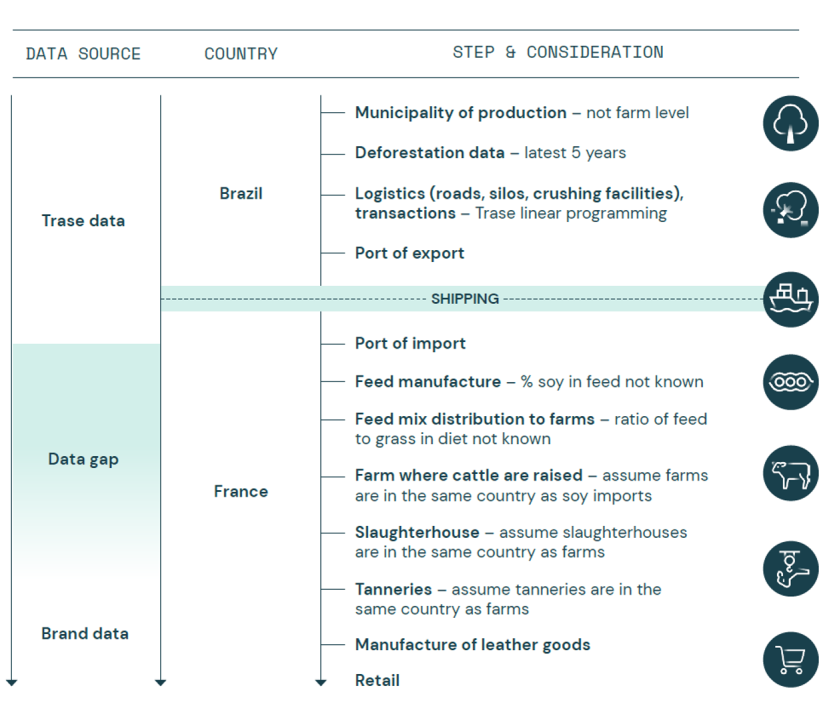
Trase's database has information on commodity flows, including data on production of soy in Brazil, Paraguay, and Argentina (three of the major soy producing countries with risk of deforestation), deforestation rates in these locations, and trade/export data to link soy deforestation to leather-producing (soy-importing) countries of interest. Members' supply chain data was combined with the Trase data, resulting in an estimate of soy deforestation risk exposure (at an aggregate and for each brand) associated with soy sourced from Brazil, Paraguay, and Argentina. This data was used to identify deforestation risk “hotspots” that would be priorities for supply chain or landscape-level attention. Figure 1 shows the data considered in the calculation and presents the analysis’ data gaps. These data gaps required making assumptions in the calculation of deforestation risks. For example, if companies were not able to provide data on the farm where cattle were raised, where reasonable, Trase assumed that downstream processing suppliers (e.g., abattoirs) were themselves sourcing locally.
Source: Trase
The Trase analysis identified clear differences in relative risk exposure across producer countries (those producing soy) and supplier countries (those potentially using/importing soy and supplying leather), but also areas of overlap around “hotspots” of risk. ReLI learned that the risk exposure is quite variable across source regions and countries importing soy. For example, the average deforestation risk in Paraguay (11.7m² per tonne) was higher than in Brazil (6.6m² per tonne) or Argentina (0.58m² per tonne), but European countries tend to source proportionally less soy from Paraguay (see Figure 2 for the sourcing percentages). Brazilian soy imported into Europe had a higher deforestation risk than the average deforestation level attached to soy produced in Brazil. This could be because Europe’s historic trade routes were linked to areas in the country that had higher deforestation rates. For example, for France, the deforestation risk attached to soy imports from Brazil was 9.08 m² per tonne, compared to 6.6m² per tonne on average. The details are summarized in the Figure 3.
Source: Trase
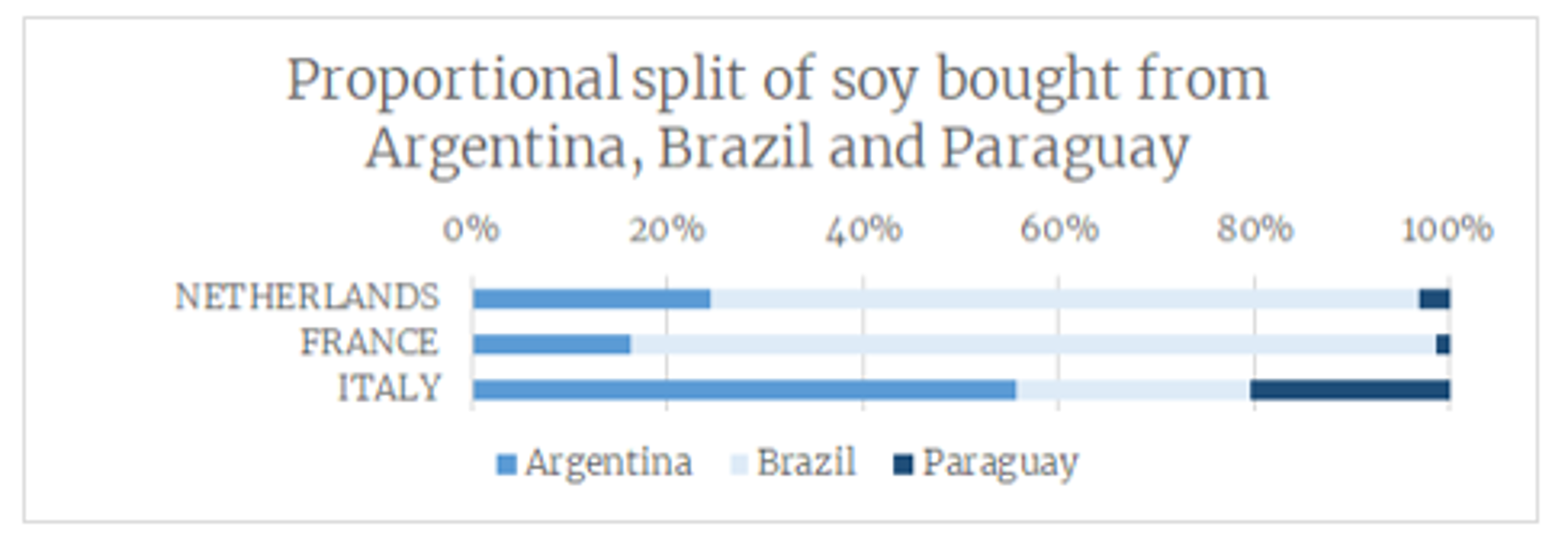
Figure 3: Deforestation Risk per Country
Source: Trase
|
Soy Production Country |
Average Deforestation Risk (m² per tonne) |
Deforestation Risk for Soy Imports |
||
|
France |
The Netherlands |
Italy |
||
|
Brazil |
6.6 |
9.08 |
7.12 |
9.91 |
|
Argentina |
0.58 |
0.66 |
0.60 |
0.69 |
|
Paraguay |
11.6 |
9.8 |
11.6 |
14.8 |
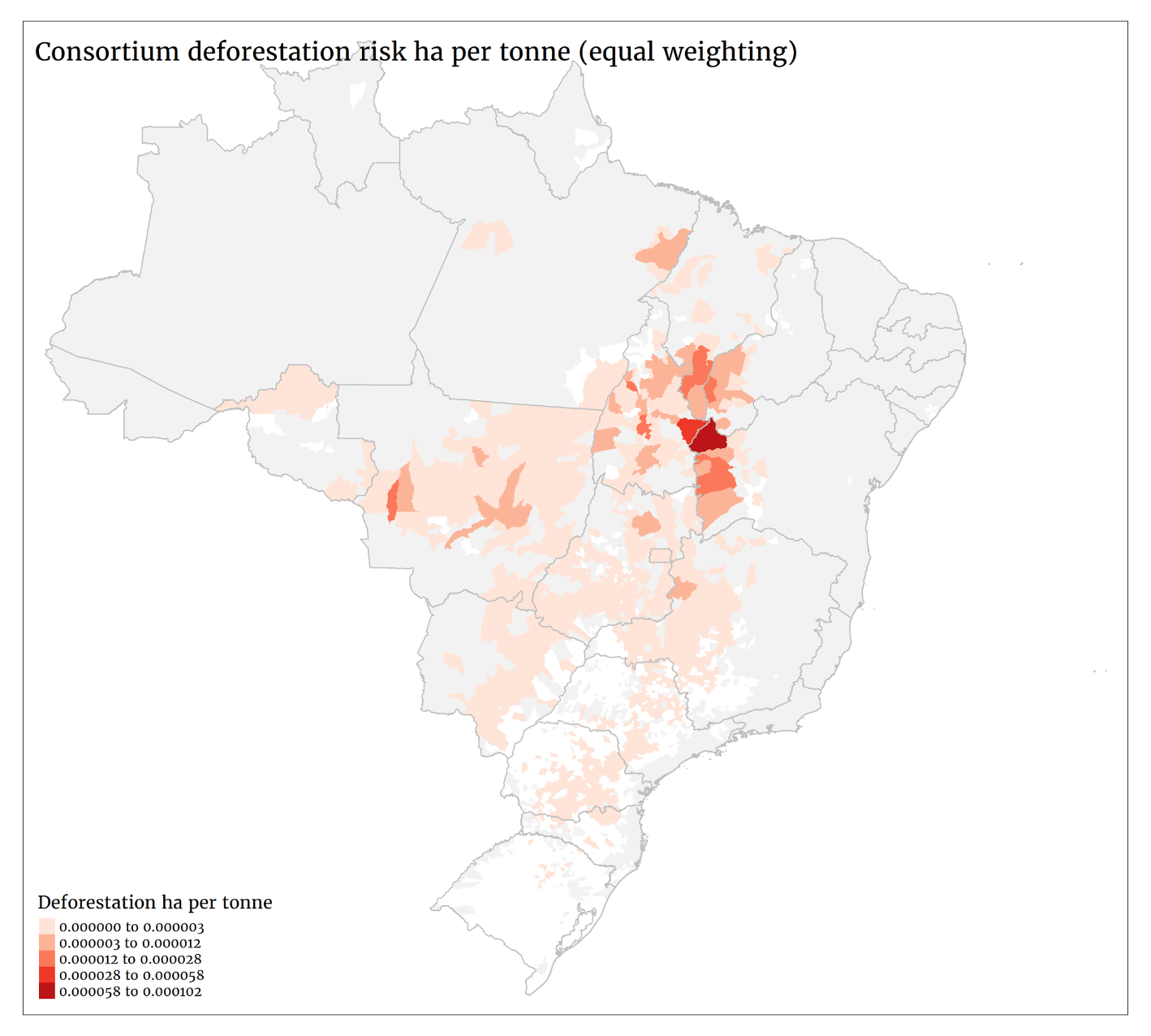
Figure 4 depicts the type of information we received from the Trase analysis of company data. The map indicates the deforestation risk in hectare per tonne for the ReLI consortium. In other words, it presents the distribution of deforestation linked to one tonne of soy bought in proportion to the ReLI companies’ sourcing patterns (i.e., weighted by volume of leather sourcing). Similar maps were provided for soy from Brazil, Argentina, and Paraguay at an individual company level and collective group level. Without traceability to feed level, it is not possible to be certain on the deforestation risk associated with members’ supply chains. However, by drawing on a science-based metric to assess exposure to deforestation in supply chains, Trase can provide a plausible map based on information on production, trading, and other data from countries in members’ supply chains. Such findings are useful for targeting engagement with suppliers on deforestation.
More information on the Trase analysis can be found here.
Figure 4: ReLI Consortium Deforestation Risk per Tonne Bought from Brazil
Source: Trase
Characterizing the Risk
The ReLI team complemented the Trase analysis by studying cattle farming systems, feed profiles, and use of soy for the top leather-producing countries for the ReLI members that provided data (France, the Netherlands, and Italy).
First, we wanted to supplement the Trase data with additional quantification. From Trase, we received an estimation of the deforestation risk (m² of land per tonne of soy) for soy imported from Brazil, Paraguay and Argentina into France, the Netherlands, and Italy. However, not all imported soy is used for cattle feed—it may also be used for other livestock feed or for humans. One element of this research was to explore how imported soy is used in ReLI’s three priority leather-producing countries so that we could understand how important the risk of leather-linked deforestation via soy might be.
A key challenge was that publicly available data on the amount of imported soy that leather-producing countries used for cattle feed was difficult to find and/or rely on. As a result, we could not make an accurate estimation of the soy deforestation risk linked to cattle in these countries, though we feel confident in the general takeaway: While general global risk of deforestation due to soy production may be high, leather-linked soy deforestation risk across countries and companies is extremely fragmented. All companies sourcing forest-risk commodities in their supply chains have a responsibility to protect forest landscapes, but fragmentation of impact will limit individual influence. Collective action is needed.
Second, we developed a better qualitative understanding of the farming systems in the prioritized leather-producing countries to help us contextualize the soy use in cattle feed. For example, understanding the extent of intensive farming systems (high inputs compared to land area) versus extensive (more land under cultivation with lower inputs), or indoor versus outdoor cattle rearing, can help inform the best approach to engaging farmers on changing feed inputs.
Since the luxury industry commonly uses calf leather, we also investigated any unique considerations for calf rearing. For example, we confirmed that soy is used in calf feed and that the Netherlands is an important focal country for industry deforestation efforts considering its high levels of veal production and likely higher soy-related deforestation risk.
Finally, we identified several existing programs in France, the Netherlands, and Italy working to address soy deforestation, allowing us to think through opportunities for our members to work on farm-level initiatives in their supply chains.
Some sample high-level results of this research can be found in Figure 5.
|
France |
The Netherlands |
Italy |
||
|
France has the largest cattle farming system in Europe, meaning the most beef and dairy cows in the system, and is the second largest production country for veal (28 percent). Both beef and dairy cows are mainly fed grass over their lifetimes, though soy makes up anywhere from 0.6-2.5 percent of the cattle feeding system. France has a highly extensive system. The average farm in France has 56 cows, with more than half of the farms having 5-49 cows. |
The Netherlands is the top production country for veal in Europe (36 percent). The Netherlands has had intensive cattle farming systems—more than 3 in 10 Dutch cows were kept permanently indoors in 2012—but legislation is pushing the evolution toward extensive techniques. The dairy farming sector is the largest land user in the country, taking up 0.9 million hectares of land. The Dutch dairy sector collectively committed to 100 percent responsible soy and achieved this by requiring the purchase of Round Table on Responsible Soy (RTRS) credits in delivery terms. Only animal feed suppliers that buy credits for responsible soy are permitted to supply feed to Dutch dairy farmers. |
Italy is the fourth largest beef producer in Europe and the third largest production country for veal in Europe (13 percent). Farm sizes vary between regions, though there is a notable intensive system. Italy has been known for its role in the fattening stage. The Italian strategy of “safety from farm to table” from the Ministry of Health aims to ensure transparency of the supply chain to the farm level and between various actors, whether produced in the EU or imported. |
||
|
|
|
|
||
Impact
The completed research helped ReLI members better understand, define, and raise the visibility of the risk of embedded deforestation and land conversion related to their leather supply chains—a topic that previously was not fully understood. Companies indicated that this research is helpful for informing steps to expand the scope of individual deforestation and conversion commitments to include embedded materials, supporting companies in addressing all areas of significant risk. Companies also indicated that it has been helpful in establishing comprehensive corporate biodiversity strategies (e.g., aligned with SBTN).
The ReLI team presented this study to NGOs and deforestation experts to get their perspectives on the most effective role ReLI members can play in addressing soy deforestation. Stakeholders highlighted the brand influence of luxury companies and of groups such as ReLI, especially when working collectively, and the importance of them playing a role. Still, they did recognize that luxury companies are far downstream, and thus ReLI brands should clarify why they want to engage in soy-related deforestation and that collaboration with major sector players such as beef, dairy, and food retail will be key to enabling action.
Next Steps
First, ReLI would like to acknowledge the Call to Action released from Textile Exchange and Leather Working Group for companies to commit to deforestation- and conversion-free leather by 2030 or earlier. ReLI is supportive of this Call to Action; several ReLI members will align their leather deforestation commitments to those expectations. Based on the findings of this case study, ReLI also encourages companies to look beyond direct deforestation risk and expand the scope to embedded materials in leather supply chains, using the work described in this case study to inform their approach.
Recognizing the remaining data and traceability challenges, in 2023, ReLI will engage with key supply chain players (which may include France-, Netherlands-, and/or Italy-based slaughterhouses, farmer groups, feed initiatives, or other trade associations) to identify and evaluate ways that downstream companies like luxury brands can support tanneries, slaughterhouses, farmers, or other relevant players in the due diligence needed to achieve deforestation-free feed. These engagements will also prioritize opportunities for coordination with downstream players in the meat industry. ReLI will share additional relevant insights for the industry as this work continues.
This case study reviews a piece of work completed by the Responsible Luxury Initiative (ReLI) in 2022. ReLI is a collaboration of luxury sector companies. Its mission is to provide a platform to discuss, explore, and develop collaborative solutions for persistent and emerging sustainability issues in their value chains.
This case study was written by Cliodhnagh Conlon, Ricki Berkenfeld, and Sarah Cornelles, with guidance and insights provided by select ReLI members. The authors wish to thank Trase for collaborating on the research presented in this case study.
Please direct comments or questions to Cliodhnagh Conlon.
Blog | Wednesday April 5, 2023
Decoding Nature’s Soundscapes
Scientists are getting closer to understanding how organisms and ecosystems use sound (known as bioacoustics) to communicate. We share how bioacoustics can impact business.
Blog | Wednesday April 5, 2023
Decoding Nature’s Soundscapes
Preview
Using new technologies and artificial intelligence (AI)-powered analysis, scientists are getting closer to understanding how organisms and ecosystems use sound, or “bioacoustics,” to communicate. This new data could increase our understanding of adverse environmental impacts, support restoration efforts, and accelerate environmental monitoring. Business can anticipate increased scrutiny of the environmental impacts of their industry, including noise disturbance, as well as implications for sustainability reporting and ethical data use.
Listening to Nature
Can humans have interactive conversations with nature? Can we decode the language of animals, plants, or entire ecosystems? What would we hear and how would we use this information if we could?
Leveraging new technologies and AI, researchers are making headway toward interspecies communication. By recording and analyzing bioacoustics, or how organisms use and respond to sound, scientists are decoding complex communication in other species. With these new insights comes the potential to understand more fully the impacts of human systems in the natural world.
As it turns out, nature is leveraging sounds in remarkable ways. What was once considered silent, like marine organisms, plants, and even forests, are now known to use sound to listen to and communicate with the world. For example, when choosing a home, coral larvae use sound to identify healthy and unhealthy reefs from miles across the ocean. Plants use acoustic vibrations to send their roots toward water sources.
Further still, scientists are already finding ways to use bioacoustics research to break barriers between interspecies communication. For example, researchers are now deciphering the sounds of tomatoes to determine whether plants are dehydrated or wounded. Others have used AI and natural language processing to encode honeybee robots with honeybee language, enabling them to enter hives and communicate simple commands. They can even successfully share information around the hive to tell the bees where they should go to harvest nectar.
“As businesses grapple with how to assess, monitor, and mitigate damage to nature—particularly in upstream production—leveraging science such as bioacoustics can present a credible means to address degradation and biodiversity loss.”
-Laura Donnelly, Director, Nature
How Noise Impacts Nature
Among the intricate lessons from listening to natural systems, we are discovering the overarching macro impacts of human-generated noise on nature.
Studies have connected loud environments to increased risks of heart disease, heart attacks, and even dementia in people. Increasingly, research into bioacoustics is improving our understanding of how noise impacts nature as well.
Under the ocean, where species depend on sound to navigate their worlds, noise disturbance is particularly disruptive and even deadly. Noise from shipping, recreational boating, mining, and energy exploration can impact the ability of ocean animals to find mates, locate food, avoid predators, and communicate with each other.
For example, studies have shown that noise can disrupt the migration routes of whales, isolate them from their mates and peers, and even cause hearing loss. Even plants, like seagrass, are affected by noise: a recent study found that they suffer significant damage when exposed to even low-frequency artificial sounds. Combining this with the fact that noise can travel hundreds of miles from the source, marine noise disturbance can injure species far from its epicenter, including the species that live in the deep sea. In fact, extremely loud noises, like drilling, have been found to kill zooplankton almost three-quarters of a mile away.
Above ground, the acoustic chaos of industry is no better for the nature around it. At airports, for example, birds are losing their songs. They are also becoming more aggressive, which could indicate that noise disturbance can cause behavior changes and physiological stress in other species, just as it does with people. Similarly, studies have shown that drones can increase heart rates and impact the behavior of wildlife. Wind turbines are also found to produce noise that can impact wildlife and nearby habitats. One study suggests that mapping the presence of species and their auditory sensitivity should be required before constructing wind turbine farms.
Leveraging Bioacoustics for Good
Not only can decoding how natural systems experience and use sound expose the depths of our impacts on the planet; it could also help us to restore what has been harmed or lost.
Scientists are already using digital bioacoustics to support efforts to protect and regenerate nature. For example, acoustics technology can pinpoint the location of whales and alert ships when they are on a collision course. Studies have also shown that playing with the sounds of healthy coral reefs can attract young fish to abandoned reefs.
Above the water, scientists have used sound recordings of rainforests to monitor rainforest biodiversity and how wildlife may be impacted by events such as logging, or cutting trees down for timber. We also have a better understanding of how changes in the environment can impact natural communication systems. For example, reduced cloud cover or the loss of plant life can reduce the absorption of sound, which can increase noise and reverberation, confusing and disorienting local species. This has implications for climate change and how we monitor harmful business practices that can lead to biodiversity loss.
How Bioacoustics Can Change the Game for Sustainable Business
With the emerging ability to listen to nature, we can better gauge the health of species, ecosystems, and the wider natural environment. We can also better track climate change, biodiversity loss, and improve environmental monitoring.
Business should expect increased scrutiny of how operations can impact the health of natural systems, particularly affecting noisy industries, like resource extraction, travel and transportation, manufacturing, and construction.
New evidence of impacts could be used in litigation to defend Nature’s Rights, while acquiring approval for new developments might require a new level of due diligence. This might deter proposed mining of ocean floors to source minerals critical to new energies, particularly under the recently adopted High Seas Treaty, through which United Nations member countries have agreed to protect the ocean outside national boundaries.
Environmental and sustainability monitoring and reporting may also become more precise in how business should avoid and mitigate impacts to nature. Science Based Targets for Nature (SBTN), for example, aims to present companies with another avenue for assessing and addressing environmental impacts.
Through the emerging field of bioacoustics, scientists are rediscovering what Indigenous communities have long known through ongoing dialogue with the nonhuman world. As we mine data to potentially reconnect with nature, there is an opportunity for business to elevate Indigenous teachings. This comes with the responsibility to respect Indigenous data sovereignty as we harvest data in territories under Indigenous ownership and stewardship.
Can business use data to further interfere with natural systems for commercial gain? Could ecosystems be acoustically hacked? Or might we make “bioacoustic engineering errors,” prompting nature to act in ways that are misguided? What are the risks of using AI to interpret what the natural world is telling us? Now is the time to ask whether the potential to communicate with the natural world might lead to new risks of exploitation.
Reports | Monday April 3, 2023
AI and Human Rights in Retail
Explore human rights issues associated with the increased use of AI technology in the retail sector and recommendations to companies on how they can address the human rights impacts of AI in retail in BSR’s new report.
Reports | Monday April 3, 2023
AI and Human Rights in Retail
Preview
Introduction
Technological transformation brings complex, nuanced, and systemwide risks and opportunities for the realization of human rights. These risks and opportunities are related to both the design and development of technologies, as well as how technologies are deployed and used by companies, such as retailers.
As the retail industry continues its digital transformation, retailers need to consider the human rights impacts that may be associated with the use of artificial intelligence (AI) systems across their business and value chain. This may include the use of AI in retail stores to automate self-checkout, to personalize product recommendations on e-commerce sites, or to forecast demand and optimize supply chain operations.
This report identifies salient human rights issues associated with the increased use of AI technology in the retail sector and makes preliminary recommendations to companies on how they can address the human rights impacts of AI in retail.
Human Rights Impacts of AI in the Retail Industry
With the digital transformation of the retail industry, an increasing array of digital technologies are being used in combination to create automated processes, both in retail stores and in the retail supply chain. This transformation brings risks and opportunities for the realization of human rights that retailers need to consider.
Below, we list six main categories of human rights risk that may be associated with the use of AI technologies in the retail industry.
Human Rights That May Be Impacted
Search Again?