Searching for:
Search results: 536 of 1219
Blog | Tuesday May 17, 2022
Harnessing the Power of Data to Combat Human Trafficking
Last week, Tech Against Trafficking (TAT) brought together technologists, nonprofits, academics, governments, and policy-makers from 60 countries in a virtual event to celebrate the close of its second Accelerator and discuss how tech advancements can be used to combat human trafficking.
Blog | Tuesday May 17, 2022
Harnessing the Power of Data to Combat Human Trafficking
Preview
Last week, Tech Against Trafficking (TAT) brought together technologists, nonprofits, academics, governments, and policy-makers from 60 countries in a virtual event to celebrate the close of its second Accelerator and discuss how tech advancements can be used to combat human trafficking.
Launched in 2019, the TAT Accelerator Program aims to identify promising uses of technology in the anti-trafficking field, harnessing the expertise and resources of member companies to advance and scale the work of organizations deploying technology that assists victims, law enforcement, business, and civil society.
“The gaps in partnerships are highlighted in many tech solutions. So many people talk about tech solutions for case management, for supply chains, but we’re not asking, ‘what have we done with what was developed yesterday? How can we build on each other’s invention?’ If we don’t figure out this partnership piece, we’re going to spend a lot of resources because tech solutions are not cheap.”
–Sophie Otiende, CEO, of the Global Fund to End Modern Slavery (GFEMS)
Tech Against Trafficking welcomed two new organizations to the program over the course of 2021-2022: The Lantern Project and Unseen UK.
The Lantern Project is dedicated to combating sex trafficking. Its online platform “Freedom Signal” enables anti-trafficking organizations that provide assistance to victims of trafficking to send targeted outreach to individuals who are advertised for sexual services online. In the Accelerator, TAT supported the Lantern Project to develop a go-to-market strategy for “Freedom Signal” and improve its victim identification process.
Unseen runs the Modern Slavery & Exploitation Helpline in the UK. TAT helped Unseen design a new data management platform that generates insights from case data, improved its process that matches cases to supply chain data, and developed a marketing strategy for its Business Portal, which helps businesses identify cases of human trafficking across their supply chains.
Making Sense of Human Trafficking Data
TAT supported both organizations in optimizing their data infrastructure and making sense of the human trafficking data they collect. In both cases, data was extracted and analyzed in a cloud environment hosted by Amazon Web Services. Leveraging technologies developed in the previous TAT Accelerator in partnership with the Counter-Trafficking Data Collaborative, the organizations created synthetic datasets from the human trafficking data they collect to share data responsibly and by preserving the privacy of victims. Dynamic graph technology developed by Microsoft Research was applied to these anonymized datasets, allowing the organizations identify patterns and generate insights. In turn, this will help the organizations improve operational efficiency and provide more effective services to reduce human trafficking.
“Unfortunately, there are still too many data silos, and the understanding of the issue is still limited. Data is powerful, but it’s only powerful if you do something useful with it, like the Lantern Project, like Unseen. We’ve been so delighted with the TAT Accelerator program to maximize the potential of our rich data, and all I can do is hope that others catch up with us in due course.”
–Justine Currell, Unseen UK
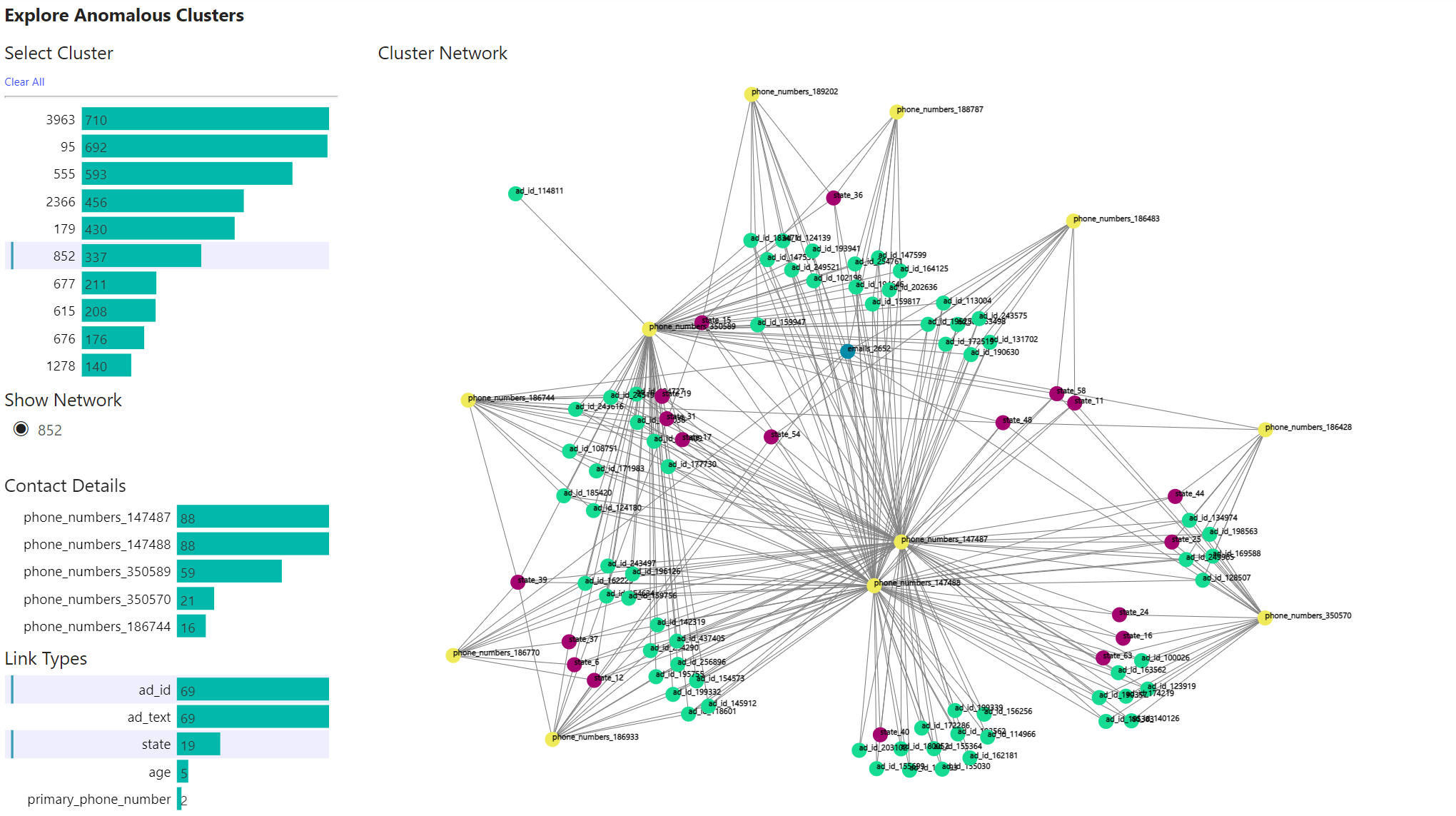
The Lantern Project’s “Freedom Signal” platform helps service providers identify potential victims of sex trafficking, by scraping online ads and making connections between these ads based on the phone numbers found in them. By applying dynamic graph technology, Freedom Signal can detect anomalies in the data that might represent automated spam, trafficking rings, and other schemes.
The image above shows a cluster of related phone numbers (yellow) connected by different ads (green) across many states (plum). A single email address (blue) is associated with most of these phone numbers. This cluster displayed anomalous behavior because of how the relationships between contact details (phone numbers, email addresses) and victim characteristics (state, age, orientation) vary over time. This means that these contact details are unlikely to represent individuals who might benefit from outreach.
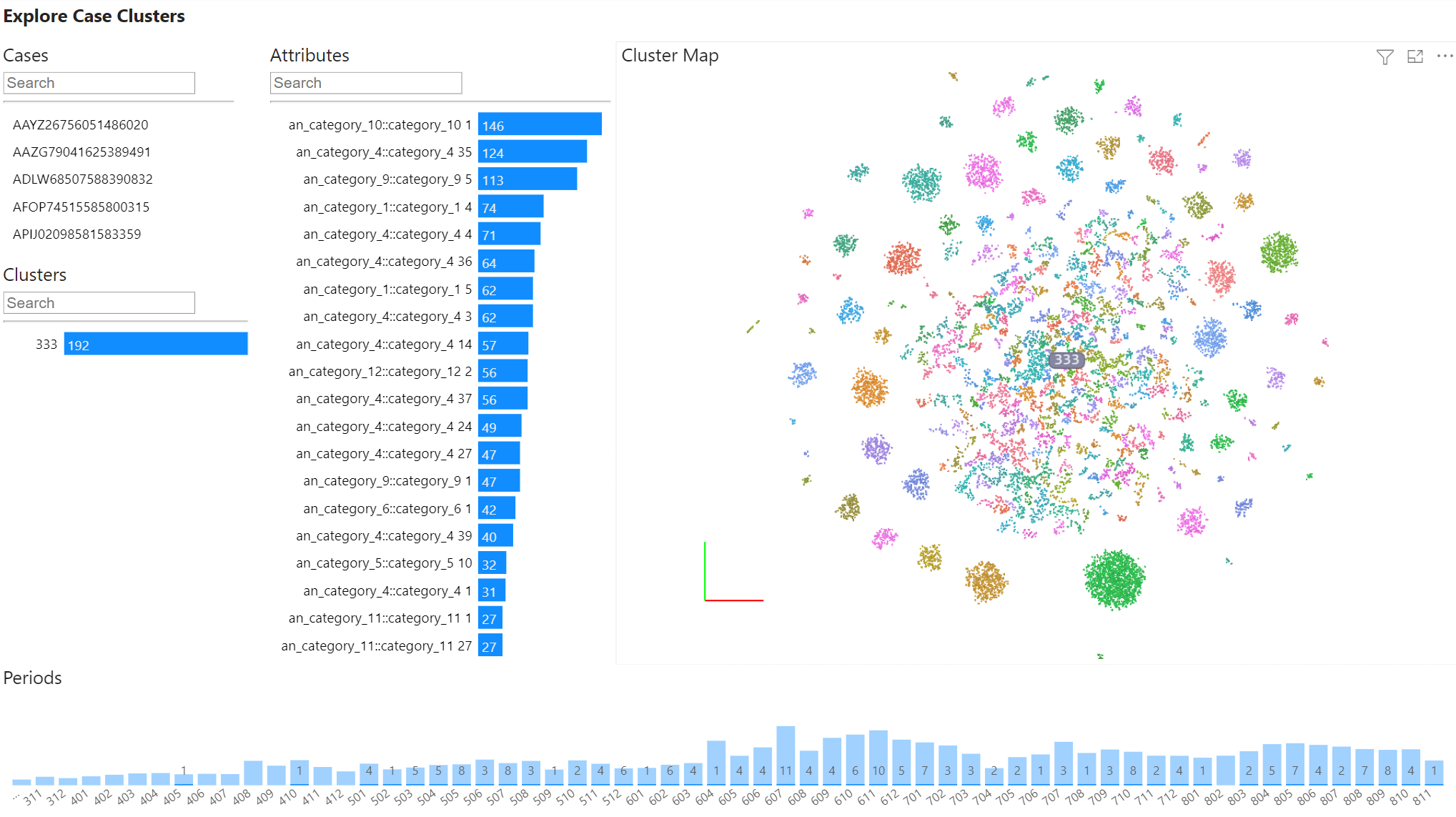
Unseen collects large amounts of data through their helpline that relates to specific cases of human trafficking. By applying dynamic graph technology, they can see how clusters of similar cases emerge over time (e.g., similar exploitation type, victim demographics, police force region). Understanding the different types of cases represented by these clusters allows for more informed decisions and targeted interventions.
The image above shows helpline cases (colored points) clustered by their connection to different case attributes over time. A single cluster of cases (cluster 333) is selected, with the attributes and time periods of cases in this cluster shown for reference. It is possible to see clear structure in the case data even though the attribute values themselves are anonymized.
“I’ve seen great initiatives that are utilizing data well but increasing the utility of data can bring risk if we’re not careful. During the process with TAT, at least half the time was spent working out how to interoperate with engineers, and how to implement safeguards on sharing data.”
–Phil Bennett, Technology Consultant
Looking Forward
As we conclude the second TAT Accelerator, we are excited to support the application of this work in the broader anti-trafficking field through collaboration with companies, civil society, law enforcement, academia, technologists, and survivors.
We are delighted to announce that TAT will launch its third Accelerator in September 2022 with a new cohort of participants. Anti-human trafficking organizations are invited to apply by filling out the application form until July 1, 2022.
TAT continues to recruit new members and partners to help provide greater support to anti-trafficking organizations and generate a wider impact in the anti-trafficking field. We invite all companies and anti-human trafficking organizations who are interested in being part of this to contact us to find out how to get involved.
Blog | Thursday May 12, 2022
Advancing Human Rights in the SaaS Sector
BSR worked with a group of SaaS companies to conduct a sector-wide human rights assessment of the SaaS sector focused on the use of B2B services and are publishing the report today. This assessment identifies the SaaS sector’s salient human rights risks and outlines ways in which SaaS providers may…
Blog | Thursday May 12, 2022
Advancing Human Rights in the SaaS Sector
Preview
Cloud computing has revolutionized the IT industry over the last two decades. As the largest segment of the cloud computing market, software-as-a-service (SaaS) has played a large role in this transformation. Businesses can use packaged software to address a range of solutions, from customer relationship management and cross-team collaboration to industry-specific applications such as electronic record management systems for healthcare, production scheduling software for manufacturing, and learning management systems for schools.
The SaaS model enables easier access to software for businesses of all sizes. Small and medium enterprises that were previously unable to access or afford advanced technology can now benefit from the latest technological advancements.
However, the proliferation of such technologies comes with ethics considerations and human rights responsibilities. Cases such as internet infrastructure companies removing extremist websites like “The Daily Stormer” from their services or CRM providers facing accusations of facilitating human trafficking show how B2B companies are increasingly confronted with the possibility that their products, services, and platforms may be misused or abused in ways that lead to harm.
During 2021, BSR worked with a group of SaaS companies to develop an approach to responsible product use. While it was clear that SaaS providers have a responsibility to address the harms associated with their products and services, there was a need for a deeper understanding of how their services can impact human rights and the appropriate actions that they can take to address these impacts.
To further explore the human rights impacts, we have subsequently worked with a group of SaaS companies to conduct a sector-wide human rights assessment of the SaaS sector focused on the use of B2B services and are publishing the report today. This assessment identifies the SaaS sector’s salient human rights risks and outlines ways in which SaaS providers may impact human rights—as individual companies, as a group of companies, or as a sector.
The Challenge of Size and Variability
Undertaking a sector-wide human rights assessment of the SaaS sector proved challenging due to the size and variability of the sector. As of 2021, there were approximately 15,000 SaaS companies in the US alone, addressing an infinite number of business needs. As such, we did not attempt to assess the potential impacts of every single type of SaaS service. Instead, we identified several differentiating characteristics related to the functionality and deployment of SaaS services that may surface various human rights issues and provide different degrees of leverage to address them.
For example, the level of customizability of a SaaS service may surface different implications for human rights. Highly customizable SaaS services make potential harms less foreseeable by SaaS companies since customers can change the services’ functionality and outcomes, which may also result in less (or different) leverage available to the SaaS company to address the harm. Identifying these differentiating characteristics helped us unpack company, cumulative, and sector-level strategies to address adverse impacts.
Limited Insight into End-Use
The most important considerations in evaluating the potential human rights impact of SaaS services are who uses the service and how it is used. For example, a company may use 3D modeling software to create illegal weapons, or a team collaboration software may be deployed by a company to monitor their employees. However, a common theme that emerged during BSR’s engagement with SaaS providers was that they often have little insight into how customers use their services—for example, for reasons of privacy-posing challenges to identifying downstream human rights impacts.
Appropriate Action to Address Human Rights Impacts
This assessment takes a first step in identifying the human rights impacts of SaaS providers–both individually and as a sector—and appropriate action to address these impacts. We hope it will help provide guidance for SaaS companies seeking to implement their human rights commitments.
SaaS providers can take action by defining what customers and users can and cannot do with their services, establishing technical limitations to service functionality, communicating the limitations or potential risks of the service, and collaborating with other companies to share insights and establish best practices.
The SaaS model has leveled the playing field for businesses and enabled access to technological advancements at a previously unimaginable scale. B2B SaaS services have tremendous potential to assist the realization of human rights. However, SaaS companies may be connected to harms and have a responsibility to establish appropriate measures to address these harms.
BSR’s report explores how the SaaS sector can both address human rights risks and pursue opportunities that promote the realization, enjoyment, and fulfillment of human rights for their individual services and the sector as a whole.
Reports | Thursday May 12, 2022
Human Rights Assessment of the Software-as-a-Service Sector
SaaS services address numerous business needs, and they are behind many of the consumer-facing products and platforms we use every day. This report identifies salient human rights risks and makes recommendations to SaaS providers on how to avoid, prevent, and mitigate adverse human rights impacts associated with their individual services…
Reports | Thursday May 12, 2022
Human Rights Assessment of the Software-as-a-Service Sector
Preview
Software-as-a-service (SaaS) makes up the largest segment of the public cloud market. SaaS services address numerous business needs, and they are behind many of the consumer-facing products and platforms we use every day. As these services become increasingly common, a deeper understanding of how SaaS services may impact human rights, and the appropriate actions to address those impacts, is needed.
To unpack the SaaS sector’s connection to human rights, BSR worked with seven business-to-business (B2B) SaaS providers to conduct a human rights assessment of the SaaS sector. This report identifies salient human rights risks and makes recommendations to SaaS providers on how to avoid, prevent, and mitigate adverse human rights impacts associated with their individual services and the sector as a whole.
Blog | Wednesday May 11, 2022
Advancing Multi-Stakeholder Collaboration: Four Governance Models for Business
Increased collaboration between business leaders, academics, and politicians is critical for driving impact in sustainable development. We share our framework to help guide companies on governance structures that respond to the specific needs of each partnership.
Blog | Wednesday May 11, 2022
Advancing Multi-Stakeholder Collaboration: Four Governance Models for Business
Preview
Multi-Stakeholder Collaboration Starts by Resolving Governance Questions
Increased collaboration between business leaders, academics, and politicians is critical for driving impact in sustainable development. The UN Department of Economic and Social Affairs claims such initiatives can “enhance global partnership for sustainable development, complemented by multi-stakeholder partnerships that mobilize and share knowledge, expertise, technology, and financial resources, to support the achievement of the sustainable development goals in all countries, in particular developing countries.”
The number of collaborative initiatives has been increasing steadily since the Rio 1992 UN conference, when the private sector started to address sustainability challenges. In fact, the UN Partnership Platform shows over 6,000 commitments and partnerships made by stakeholders in support of the implementation of the Sustainable Development Goals (SDGs) and other UN commitments.
Businesses, NGOs, and governments cannot drive real change alone due to the complexity of sustainability issues. As such, organizations run into roadblocks when embarking on multi-stakeholder initiatives since each party brings contrasting demands to the table. Common issues include how to set governance, how to work together, the role of each party, and how to make group decisions.
The BSR Collaboration Governance Framework
BSR has developed a framework that can help guide companies on governance structures that respond to the specific needs of each partnership. With over 30 years of experience in designing, implementing, and scaling effective business-led collaborations, we are well positioned to identify best practices and develop multi-stakeholder governance structures.
Governance is an important aspect of collaboration as it enables members and partners to work together. The framework is based on decision-making by either companies or stakeholders and the type of engagement with organizations, either representing themselves or various categories within the collaboration.
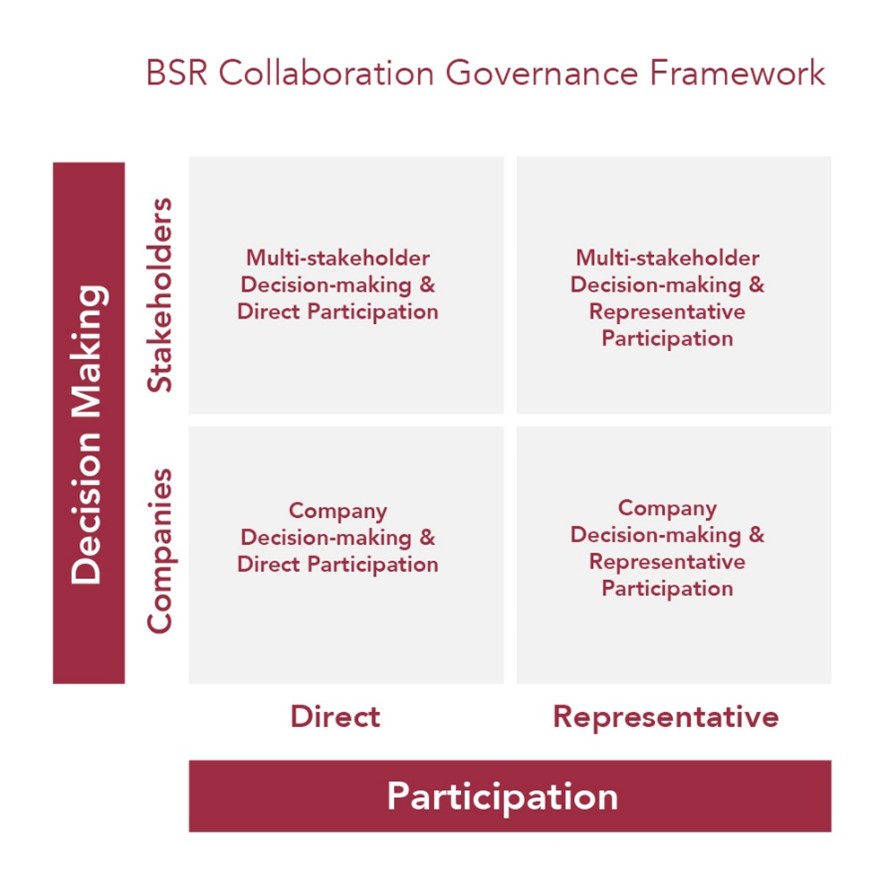
The framework applies specifically to business-led collaborations, in which companies can decide whether to open the collaboration and governance seats to other stakeholders. The four models are as follows:
- Multi-Stakeholder Decision-Making and Representative Participation Decisions are made by stakeholders. Participants represent diverse types of stakeholders, usually as part of a large collaboration. An example of this governance model is Better Cotton, in which various stakeholders are represented and all have a decision-making role.
- Company Decision-Making and Representative Participation: Decisions are made by companies in a “decision body,” while participation is based on a diverse group of stakeholders as well as larger groups with corporate control. An example is the Roundtable on Sustainable Palm Oil, in which different stakeholders are represented, but only companies make up the decision-making body.
- Company Decision-Making and Direct Participation: Decisions are made by companies only, given that participants are companies and do not include other organizations. An example of this model is The Fashion Pact, which has companies as members and decision-makers.
- Multi-Stakeholder Decision-Making and Direct Participation: Decisions are made by stakeholders, and participants represent their individual needs rather than as a group. A key example is The Partnership for Global LGBTQI+ Equality, whereby companies and other stakeholders are both members and decision-makers.
This framework will speed up a typically long, heavy process when considering a multi-stakeholder collaborative initiative. The chosen model will respond to the nature of the issues at hand and the appetite for companies and stakeholders to create a democratic and inclusive decision-making system.
A group of our partner organizations used this framework recently to make a critical decision around whether they would continue to be corporate-led or if they were open to multi-stakeholder governance. The framework helped them understand their options. After developing the four framework models with the actual companies and NGOs involved, they were able to see the differences and present the options to business leaders. Ultimately, the group decided to follow a model with multi-stakeholder decision-making and representative participation to guide companies’ actions.
Support to develop this governance framework comes from a multi-year program between BSR and the Swedish International Development Cooperation Agency (SIDA) to promote business-led multi-stakeholder collaboration. We will be sharing further information on best practices for setting up collaborative initiatives and key examples as part of this program.
Blog | Thursday May 5, 2022
Bridging the Supply Chain Gender Gap through Digital Training
HERessentials, a tablet-based learning app for workers and managers, started as a response to the COVID-19 crisis, but it has the potential to build digital capabilities for all workers. We share three key recommendations for businesses considering how to set up digital training in supply chains.
Blog | Thursday May 5, 2022
Bridging the Supply Chain Gender Gap through Digital Training
Preview
The COVID-19 pandemic impacted the lives of approximately 190 million women workers in global supply chains. Employees needed to access critical information on health, financial resilience, and tools for building harmonious relationships and handling stress. Since on-site training was no longer an option, HERproject kickstarted HERessentials, a tablet-based learning app for workers and managers, in Pakistan, India, Bangladesh, and Latin America.
Following the launch of HERessentials, we held in-depth interviews with key stakeholders and a webinar with our partners, Sarah Krasley, CEO of Shimmy, and Marc Beckmann, Project Director at GIZ, to identify practical recommendations on setting up digital training in global supply chains.
HERessentials started as a response to the COVID-19 crisis. However, the program shows us the potential for greater scale as a long-term project to build digital capabilities for all workers. Drawing on our experience, here are three key recommendations for businesses considering how to set up digital training in supply chains:
Combine Digital and In-Person Touchpoints
There are many benefits to digital training, especially as the past two years has demonstrated. Digital training enables program ownership, facilitates data collection, and contributes to empowering workers as they can learn autonomously.
However, standalone digital tools are not enough to guarantee a long-lasting impact and a positive learning experience. Gender inequalities in the training room can deepen if digital tools are not accompanied by in-person meetings. In fact, women are in a more disadvantageous position as they tend to have lower levels of digital literacy levels compared to their male counterparts. Sarah Krasley, CEO of Shimmy, observed that in countries where there is low digital literacy:
The human factor of digital training is critical. Trainers need to be in the room to set the tone and help workers, especially women, to approach technology.
A blended training approach, with the best of both worlds, in-person facilitation, and digital tools contribute to positive impact and program scalability.
Test, Repeat, and Acknowledge Setbacks
Building digital training requires constant testing and adaptation. As such, it is important to consider flexibility and risk-taking and always acknowledge setbacks. Creating the HERessential app took several iterations—we faced issues related to technical bugs and other elements that didn’t work as planned, which required constant change and troubleshooting. As such, open conversations to set expectations from the start should be accompanied by flexible timelines and realistic pilots.
We thought that big groups and numerous pilots would be manageable because the digital training requires fewer in-person touchpoints. However, pilots with smaller groups worked better in the end.
- HERessentials team
Following multiple iterations, we put in place a process to constantly capture feedback from end-users—in this case, farm and factory workers—to create a relevant digital product. It is important to set key indicators from the start to make sure the right data is collected. There is a high risk of comprehension difficulties when collecting large amounts of data if there isn’t a monitoring and evaluation structure in place.
Design with an Equity Lens
Marc Beckmann, Project Director at GIZ, emphasizes the need to include a bottom-up approach to make sure those in disadvantageous positions can benefit equally from increased digitalization.
In this case, illiterate workers and women generally felt less comfortable using the tablets with others in the same room. Facilitators played a relevant role in helping build confidence. To level the playing field, we incorporated animations and voice-overs to help navigate the app without the need to read or write. Likewise, considering the local needs of women was critical; in most regions, there was a gender gap in the use of technologies. Stakeholders saw improvement in the digital literacy of workers after participating in HERessentials. For example, women who at the beginning felt unsure about using the tablets had developed new tech skills and built their confidence midway through the program.
A key advantage of digital tool applications is that they enable data collection, but at the same time, this might represent a new risk for the most vulnerable workers. A protocol on who and how this data is accessed needs to be in place to guarantee workers' data protection and fair treatment.
As we scale up, the app-based training will expand to other geographies and industries, incorporating all lessons learned and reaching more vulnerable workers across global supply chains. The garment industry in Vietnam and Guatemala will be the next markets for HERessentials. If you are interested in learning more, please contact the HERproject team.
Blog | Wednesday April 27, 2022
How the Financial Sector Can Help Accelerate Access to Remedy
Despite the best efforts of governments and businesses to protect and respect human rights, there is clearly still a need to ensure people harmed by economic activities are able to raise issues and have them addressed.
Blog | Wednesday April 27, 2022
How the Financial Sector Can Help Accelerate Access to Remedy
Preview
When a group of banks financed a large construction project in the Middle East, it ensured the project included a system for migrant construction workers to report adverse impacts on their labor rights to management. Over the course of the multi-year project, this so-called “grievance mechanism” received and dealt with hundreds of issues. When I reviewed reporting on the mechanism as part of the project’s periodic social performance evaluation, a significant number of the complaints were about canteen food (don’t underestimate the importance of good food!)—but issues around wages, health and safety, and worker accommodation were also reported and subsequently remediated.
The project above is a good, but all too rare instance of “Access to Remedy” (AtR). Despite the best efforts of governments and businesses to protect and respect human rights, there is clearly still a need to ensure people harmed by economic activities are able to raise issues and have them addressed. It is also the third pillar of the UN Guiding Principles on Business and Human Rights (UNGPs) and an essential way to ensure that economic activity does no harm and is beneficial for as many affected people as possible. However, more than 10 years since the UNGPs set the standard for the intersection between business and human rights, there needs to be more progress when it comes to companies of all sectors providing AtR—and I believe the financial sector can help accelerate this progress.
There are a number of building blocks already established by individual financial actors. The IFC and other development banks, such as FMO and the EIB, all have mechanisms in place to receive grievances from affected communities. The Dutch banking sector agreement (a multi-stakeholder initiative aimed at more respect for human rights) published an influential report on AtR and the importance of a “remedy ecosystem.” The Australian commercial bank ANZ publicly launched its grievance mechanism in October 2021, while ABN AMRO Bank is exploring whether it can develop a similar grievance mechanism for its lending activities. Other types of financial sector organizations, like pension funds, asset managers, and insurance companies, have also started actively looking into their role when it comes to AtR, but ESG policy and practices when it comes to AtR is quite limited.
There are plenty of reasons for the financial sector to take a leading role in facilitating AtR. Firstly, it is our responsibility. As a sector, we are directly linked to most economic activity and therefore have a responsibility to also facilitate AtR for those negatively impacted by such activity. Secondly, it is in our interest to know when things are going wrong with the economic activity we finance—and grievance mechanisms provide an effective “early warning mechanism.” Research shows the costs of social conflict are extremely high when ignored for too long. Thirdly, upcoming (EU and national) due diligence legislation requires (large) companies to set up grievance mechanisms—and many of the companies we finance and/or invest in will be impacted by this.
Recognizing the systemic leverage financial actors have over the economy, how can we better facilitate AtR? A financial sector collaboration dedicated to enabling AtR, for example, could build awareness in the financial sector—from banks and investors to insurance companies, private equity, and others—that we all have a role to play. Such an initiative could also set up a “center of expertise” related to AtR and how to best apply whatever form of leverage is available—collecting best practice examples, encouraging transparency, conducting research on the existence and effectiveness of company grievance mechanisms, and connecting organisations.
Furthermore, the financial sector can collaborate with civil society to address two significant AtR issues. The current number of grievances we’re aware of is not correlated to the current number of negative human rights impacts. For example, from June 2020 to December 2021, the RMG Sustainability Council (set up in response to the Rana Plaza factory collapse nine years ago) received 2,000 complaints from workers. Given the organization’s focus on the Bangladeshi garment sector, it is highly likely there are many more grievances in other regions and sectors than we know about. In addition, a grievance procedure is often not a “level playing field” and can pit a community, trade union, or individual represented by an overworked and underpaid legal counsel against a highly professional, exorbitantly compensated legal team on behalf of the company. The financial sector can work directly with civil society to address these two systemic issues. Again, it is in our interest to ensure affected people are heard and there is a fair process in place for their issues to be treated in a timely and equitable manner.
If the banks previously mentioned had not insisted on establishing a grievance mechanism, the migrant construction workers would have received less pay, worked in more hazardous conditions, lived in more ramshackle dormitories and—last but not least—enjoyed their meals a lot less. There is great potential for the financial sector to ensure economic activity does no harm and benefits as many people as possible.
Originally appeared on BHRRC.
Reports | Tuesday April 26, 2022
Southeast Asian Reptile Conservation Alliance Progress Report 2022
SARCA’s first Update of Progress reflects on the developments of the Southeast Asian reptile trade and highlights key achievements and areas of continued focus, with information for interested companies and stakeholders on how to engage.
Reports | Tuesday April 26, 2022
Southeast Asian Reptile Conservation Alliance Progress Report 2022
Preview
The Southeast Asian Reptile Conservation Alliance (SARCA) is a multi-stakeholder, industry-led initiative and technical platform made up of luxury brands, manufacturers (tanneries, processing facilities), industry intermediaries, trade associations, nonprofits, and academic and government institutions participating in the trade of reptile skins coming from Southeast Asia.
Since its launch in 2018, SARCA has worked to advance a responsible and transparent reptile skin trade that maintains wild reptile populations, supports local livelihoods and national economies, and promotes animal welfare. Our vision is to advance responsible and transparent supply chains of reptile skins from Southeast Asia and drive improvements in the trade’s operating environment.
SARCA is pleased to share its first Update of Progress, which reflects on the developments of the Southeast Asian reptile trade and highlights SARCA’s key achievements and areas of continued focus, with information for interested companies and stakeholders on how to engage.
Blog | Thursday April 21, 2022
Transforming Finance: Priorities for Progress in Advancing Respect for Human Rights
The time for human rights-respecting finance is now. Our new report elaborates on the call to action set out in the UNGPs 10+ Roadmap for Financial Institutions, highlighting key areas where progress is needed to tackle global challenges and contribute to new systems grounded in respect for human rights.
Blog | Thursday April 21, 2022
Transforming Finance: Priorities for Progress in Advancing Respect for Human Rights
Preview
We live at a time in which both people and the planet face severe and often interconnected threats: the world’s richest 1 percent now has more than twice as much wealth as 6.9 billion people. Nearly 80 million children are subjected to hazardous work, considered a contemporary form of slavery. We are in the middle of the sixth mass extinction in terms of biodiversity and face catastrophic food and water shortages, as well as displaced populations due to conflict and climate change.
We are at a turning point—an inflection point—for the future we want. Is it a future of rising inequality, discrimination, climate crisis, pandemics, closed borders, and conflict? Or is it a path of resilience, inclusion, justice, peace, and prosperity?
If we are to achieve the latter, responsible business, including finance, must be part of the solution. By fueling economies, the financial services industry—from asset owners and managers to private equity, venture capital, and banks—has unique leverage to drive systemic change in the global economy so that people’s lives and the health of the planet are at the center.
The unanimous endorsement of the UN Guiding Principles on Business and Human Rights (UNGPs) by governments in 2011 clarified that all companies, including financial institutions (FIs), have a responsibility to respect human rights. The UNGPs provide a responsible business conduct framework that helps companies ground their operations in respect for human rights and guides them in practices to advance human rights internally and across value chains. For example, the UNGPs lay out the human rights due diligence process, which is essential for businesses to identify, prevent, mitigate, and account for how they address negative human rights impacts.
Since their adoption, BSR has witnessed growing recognition among FIs of the importance of the UNGPs for managing their human rights footprint. However, translating commitments into transformative action remains a challenge. In 2021, the UN Working Group on Business and Human Rights (UNWG) found that while there has been progress in implementing the UNGPs, the financial services industry is lagging behind other industries.
A decade after the adoption of the UNGPs, the UNWG released the UNGPs 10+ Roadmap for the Next Decade of Business and Human Rights (UNGPs 10+ Roadmap) in an effort to scale business action on human rights. The Roadmap makes an urgent call to action for FIs to raise their ambitions and pace on human rights—or else efforts to advance sustainable business will be hampered in the decade ahead. It stresses that human rights are central to the ESG agenda—the momentous growth of which is an opportunity to scale progress on human rights across the global economy.
While the growth of ESG has been a valuable development in efforts to advance responsible business, the ESG movement has notable blind spots and opportunities to improve, particularly in how it addresses social topics. A wave of legislative developments across Europe and beyond reflect this, with mandatory human rights due diligence regulations trending and requirements for financial industry disclosure of human rights risk management emerging.
The time for human rights-respecting finance is now. In our report, "Human Rights Roadmap for Transforming Finance," BSR elaborates on the call to action set out in the UNGPs 10+ Roadmap for FIs, highlighting key areas where progress is needed to tackle global challenges and contribute to new systems grounded in respect for human rights.
The Call to Action
BSR makes the following recommendations that FIs can adopt to integrate human rights into financial activities.
- Adapt Core Business Activities to Respect Human Rights. Adopt robust human rights policies in alignment with the UNGPs, and embed these commitments in FI business models, corporate governance, and business strategies. FIs should also challenge financial and business practices that are inconsistent with human rights and publicly disclose how they manage salient human rights risks.
- Drive Respect for Human Rights in Financial Markets. Conducting human rights due diligence prior to deal-making, lending, or investing and on an ongoing basis once a business relationship is established is essential. This involves assessing how business decisions impact people, not just business, and using leverage to embed human rights policies and processes among clients and portfolio companies.
- Use the UNGPs as a Compass for Meeting Global Challenges. By conducting human rights due diligence, FIs can better address challenges such as the just transition and digital transformation. FIs should also engage in multi-stakeholder platforms and collective action to tackle systemic challenges, such as societal inequality and weak regulatory environments that encourage a race to the bottom among FIs and other companies.
- Engage and Partner with People Affected by Finance. Stakeholder engagement is vital, and FIs should be innovative in their efforts, considering with whom to engage and how best to engage. FIs should be prepared to engage with critical voices in good faith and should assess client and portfolio companies’ policies and practices regarding stakeholder engagement, using leverage as needed to promote meaningful engagement.
- Enable Access to Remedy for Victims. FIs are expected to adopt or participate in effective grievance mechanisms that provide a channel for stakeholders to report concerns and adverse impacts connected to their activities and portfolios. Complaints should be viewed not simply as a source of reputational risk to be managed, but as a source of learning that is essential for improved performance, accountability, and social license to operate.
By addressing these priority areas, the financial services industry can take a leading role in seizing the transformative power of the UNGPs. While these steps will not happen overnight, they represent some of the crucial building blocks to meet stakeholder demands and expectations, avert serious human rights risks, and achieve a more just and sustainable global economy in time for the UNGPs’ 20th anniversary.
Blog | Wednesday April 20, 2022
Four Ways to Advance Mental Well-Being in the Workplace
What does an effective workforce mental health program look like? BSR’s Healthy Business Coalition, in partnership with One Mind at Work, identifies key aspects of such a program.
Blog | Wednesday April 20, 2022
Four Ways to Advance Mental Well-Being in the Workplace
Preview
As employees gain some respite from the pandemic through the protection offered by vaccines, the mental health issues exacerbated by the pandemic persist among American workers, particularly low-income and frontline workers. In our 2021 blog post on workers’ mental health and our corresponding Roadmap to Promote Mental Well-Being and Resilience, we note that mental health has been a rising concern in the US over the last decade. In fact, it has become such an important public health issue that its impact on the US population—especially in the context of equitable access to mental health services through employment—must be addressed.
BSR’s new report, “Tailoring Mental Health Efforts for Low-Income and Frontline Workers,” identifies concrete measures that employers can take to protect the mental health of essential workers.
“Mental health is an integral part of health; indeed, there is no health without mental health.”
Workers have experienced increasing levels of stress due to the COVID-19 pandemic. Employers often recognize that these challenges negatively impact productivity, absenteeism, and turnover. Despite this, many businesses are still at the stage of determining the mix of mental health offerings to meet the varying needs of an entire diverse workforce, including those of low-income and frontline workers. BSR’s Healthy Business Coalition, in partnership with One Mind at Work, has determined key aspects of an effective workforce mental health program that meets the needs of diverse groups and ensures health equity and inclusion.
The Role of Business
While many employers have begun to respond by deepening investments in workplace mental health and advancing culture change, their efforts are not universal, nor have they led to enough impact for frontline and low-income workers. 71 percent of employers with frontline employees rate themselves as supporting mental health well or very well, but only 27 percent of frontline employees agree.
Why Frontline and Low-Income Workers?
Businesses have made progress on addressing the mental health issues of the average employee. Even so, the needs of frontline and low-income workers are not like those of the average employee. Low-income and essential workers are more likely to experience depression and anxiety. They face time and resource constraints, and their job functions often result in increased stress levels. Essential workers often fear discriminatory treatment and job insecurity if they speak up. Given their circumstances, it is critical that low-income and frontline workers can access corporate mental health offerings.
Four Ways Employers Can Advance the Mental Well-Being and Resilience of Employees
1. Embed Mental Health into the Organizational Culture
- Develop a holistic mental health response to reach all employee populations.
- Examine how current ways of working can exacerbate risk factors for poor mental health.
- Approach mental health as a collective priority rather than placing responsibility for action on the individual.
- Build organization-wide policies and programs that tackle stigma and build empathy, such as mental health teams and formal accountability mechanisms.
2. Connect a Broad Continuum of Solutions Rather than a “One-Size-Fits-All” Approach
- Recognize that the mental health support resources offered to corporate executives may not meet the needs of low-income and frontline workers.
- Provide an array of approaches that match employee preferences, needs, and access points, such as providing services to those without access to a computer.
- Provide the flexibility for employees to engage based on their own preferences, schedules, and experiences.
3. Find and Integrate the Right Digital Tools
- Offer virtual behavior health services (known for being flexible and affordable) to low-income and frontline workers.
- Provide digital mental health tools to help address geographic, cultural, network, cost, and time constraints.
- Find what works specifically for your employees and embed those solutions into a broader mental health strategy.
4. Equip Leaders to Be Active Players
- Empower leaders at all levels with authority, resources, and training to shape an organizational culture that recognizes and supports mental health.
- Provide additional education to line managers on how to support low-income and frontline workers.
Opportunities for Business
The work environment is a major social determinant of health. Companies are directly impacted by the health of their workforce and are uniquely positioned to improve their mental well-being. We encourage companies to make mental health a business imperative and prioritize the mental health of their most marginalized and high-risk employees.
At the Healthy Business Coalition, we are interested in understanding your company’s primary concerns and challenges facing mental health in the workplace. We can work with you to review current practices and initiatives with the goal of sharing best practices and spurring collective action. We encourage you to reach out with any questions or to find out how to get involved.
Reports | Wednesday April 20, 2022
Human Rights Roadmap for Transforming Finance
The Human Rights Roadmap for Transforming Finance report elaborates on the call to action set out in the UNGPs, highlighting key areas where progress is needed to tackle global challenges and contribute to new systems grounded in respect for human rights.
Reports | Wednesday April 20, 2022
Human Rights Roadmap for Transforming Finance
Preview
The financial services industry—from asset owners and managers to private equity, venture capital, and banks—has a catalytic effect on the behavior of business and the economy. Its vast range of financial products, services, and client relationships ripples through every industry, value chain, and transaction.
With this backdrop, the industry has enormous potential to create a global economy that puts people’s lives and the health of the planet at the center, while contributing to the realization of the United Nations UN Sustainable Development Goals. Yet efforts to do so must be grounded in an evolved approach to doing business—one that respects human rights, in line with the UN Guiding Principles on Business and Human Rights (UNGPs).
In the "Human Rights Roadmap for Transforming Finance" report, BSR provides an overview of key areas where the industry must make progress to tackle global challenges and contribute to new financial systems that respect human rights. We highlight the materiality of human rights for financial institutions (FIs) and explain that adopting a human rights approach to finance can strengthen the impact of traditional environmental, social, and governance (ESG) practices. In particular, the report elaborates on the call to action set out in the UNGPs 10+ Roadmap for the next decade of business and human rights for FIs—from adapting core business and driving respect for human rights in financial markets to engaging with people affected by FI value chains and ensuring that victims of harm have access to remedy. The report concludes with next steps for transforming finance.