Searching for:
Search results: 126 of 1188
Blog | Friday September 20, 2024
Addressing the Conflict Between Growth and Sustainability: Q&A with Jo Swinson
Jo Swinson, Director at Partners for a New Economy, discusses the tension between traditional growth models and sustainability goals and how businesses can work together on measuring economic success.
Blog | Friday September 20, 2024
Addressing the Conflict Between Growth and Sustainability: Q&A with Jo Swinson
Preview
Ahead of Climate Week NY, Jo Swinson, Director at Partners for a New Economy (P4NE), discusses the tension between traditional growth models and sustainability goals and how businesses can work together to explore new ways of measuring economic success.
Can you introduce yourself, and tell us how your background as a political leader informed your decision to lead Partners for a New Economy?
Since the earliest days of my political career, I have been convinced of the need for alternative measures of economic success. Back in 2006, I explored the flaws of GDP growth as an indicator of quality of life, and in 2009, I co-founded the UK Parliament’s cross-party group on Well-Being Economics. This idea wasn’t new—as far back as 1968, Robert F. Kennedy memorably noted: “It [GDP] measures everything in short, except that which makes life worthwhile.”
Later, I saw that the disconnect between the promise of economic prosperity and the precarity of people’s lives can lead to resentment of the current system. The ensuing backlash has torn at the fabric of our society and undermined faith in our democracy.
In 2020, I was looking for a new challenge. Combining my political experience with my long-standing desire to change economics, leading P4NE was a perfect match. The goal of an economy that serves people and the rest of nature is ambitious, but possible.
Growth is the foundation of our current economic system. How does our economy need to transform for humanity to thrive in the long term?
We’re primed to think of growth as a good thing—it’s deeply embedded in our economics and culture. As a society, we need to support the growth of many things—living standards and food security, health and well-being, the skills and creativity of our people, access to nature and green spaces.
For humanity to thrive, we need to understand and measure not just the quantity of growth, but also the quality of that growth: Is it in the sectors, regions, and countries where the growth is needed? What environmental risks is it driving or mitigating? How are the benefits being shared, both within our societies now and with future generations?
The World Economic Forum Global Risks Report (2024) cited the top risks over the coming 10 years as all being environmental: from extreme weather events to natural resource shortages.
We are biological creatures, and we depend on earth’s life-giving processes. We cannot survive without a thriving natural world: an economic system that destroys it is doomed to fail.
What we measure determines what gets done. Business knows this—it’s why KPIs exist.
We need a regenerative economic system where our success metrics include planetary health, equity and the well-being of all people, now and in the future.
In BSR’s recent report, The Elephant in the Sustainability Room, we explore the tension between growth and sustainability targets. Why is this topic so important for business right now?
We know business leaders are wrestling with this question. The competing demands of a science-based approach to sustainability and shareholder expectations of an exponential growth model create a genuine, systemic tension.
We know it’s hard. Business leaders are operating within the constraints of the current system, while looking ahead to a future that will inevitably be very different. We know from recent experience with the pandemic how rapidly so many aspects of the economy can be upended. That gives some insight into a future world of "polycrisis," with all the uncertainty that will bring.
The Institute and Faculty of Actuaries 2023 report The Emperor’s New Climate Scenarios said we could expect 50 percent of GDP destruction by between 2070 and 2090, given current rates of climate change. That’s a massive disruption, a huge loss of value, that will shape the coming decades. This is why this topic is so important now. Business needs to be ready to be part of the solution.
We often hear about regulatory and legal barriers to companies exploring alternative business models. What concrete actions can business take given these constraints? Are there different implications for companies in different sectors?
Business is increasingly scrutinizing its role in protecting our planet and the need to make a net-positive contribution to people’s well-being. There are many tools available across all sectors to build such practices: Climate Scenario Analysis with BSR, international standards of best practice from B Corp, and Doughnut Economics Lab’s Business Tools, to name a few.
Where there are legal or regulatory barriers, one of the most important things business can do is to advocate for change. When I was a UK Business Minister, it was so much easier to build the political momentum for legal changes—on corporate transparency on emissions, or stronger protections for vulnerable workers—when business voices were speaking out in support.
The key question is what does a successful business of the future look like? Anticipating a more volatile world with ecological crises now baked in, businesses need to think about whether their purpose, business models, governance and ownership structures are fit for the future. An example of a business with a future-focused purpose is Natura & Co, who have put their "Commitment to Life" at the heart of every aspect of their business targets. On governance, Faith in Nature have innovated by giving nature a seat on the board.
Much of the work being funded in this field is supporting economists, academics, and activists. What would you say to your peers in philanthropy about the need to mobilize the business sector to move “Beyond Growth?” What more can philanthropy do to galvanize bold action from companies?
To mobilize, we need to build understanding. Whilst everyone’s stake in the future is clear, even the words "beyond growth" can be divisive and misunderstood.
At the moment, it’s the most forward-looking companies and philanthropists who are taking the lead. Patagonia’s 2022 announcement that "Earth is now our only shareholder" signaled a reimagining of their corporate structure. Still unapologetically for-profit, they give 98 percent of those profits to The Holdfast Collective—a philanthropic nonprofit dedicated to defending nature.
Of course, no single business or person has all the answers. Philanthropy can create space for business to engage with going "beyond growth," to show leadership, and be celebrated for that. We need business to work with investors to shape a truly sustainable future, and we need legislative and regulatory changes to support and encourage the business sector in their collective efforts.
BSR works with its network of 300 members, as well as civil society, philanthropy, and government to advance bold, meaningful action on key sustainability issues at a systematic level. To explore this topic in greater detail, join BSR and Forum For the Future during New York Climate Week, where we will be hosting a dialogue between business and philanthropy on “Addressing the Conflict Between Growth and Sustainability.”
People
Jo Swinson
Reports | Thursday September 19, 2024
Between Two Worlds: Sustainable Business in the Turbulent Transition
As we enter the second half of the decisive decade, strategic foresight is more essential than ever for business to navigate the rapid and complex changes to come. Our new report offers insights on developments over the last six years and how to prepare for what lies ahead.
Reports | Thursday September 19, 2024
Between Two Worlds: Sustainable Business in the Turbulent Transition
Preview
Between Two Worlds: Sustainable Business in the Turbulent Transition reflects on a report BSR published in 2018, Doing Business in 2030, which explored how sustainable business might change over the decade to follow through four alternate scenarios.
Almost halfway through the ensuing decisive decade, now is an opportune moment to reflect on the new developments in the world since our original report, how trends have matured, and new shocks have emerged to shape the context for sustainable businesses. Between Two Worlds: Sustainable Business in the Turbulent Transition offers insights on these changes and how to prepare for what lies ahead.
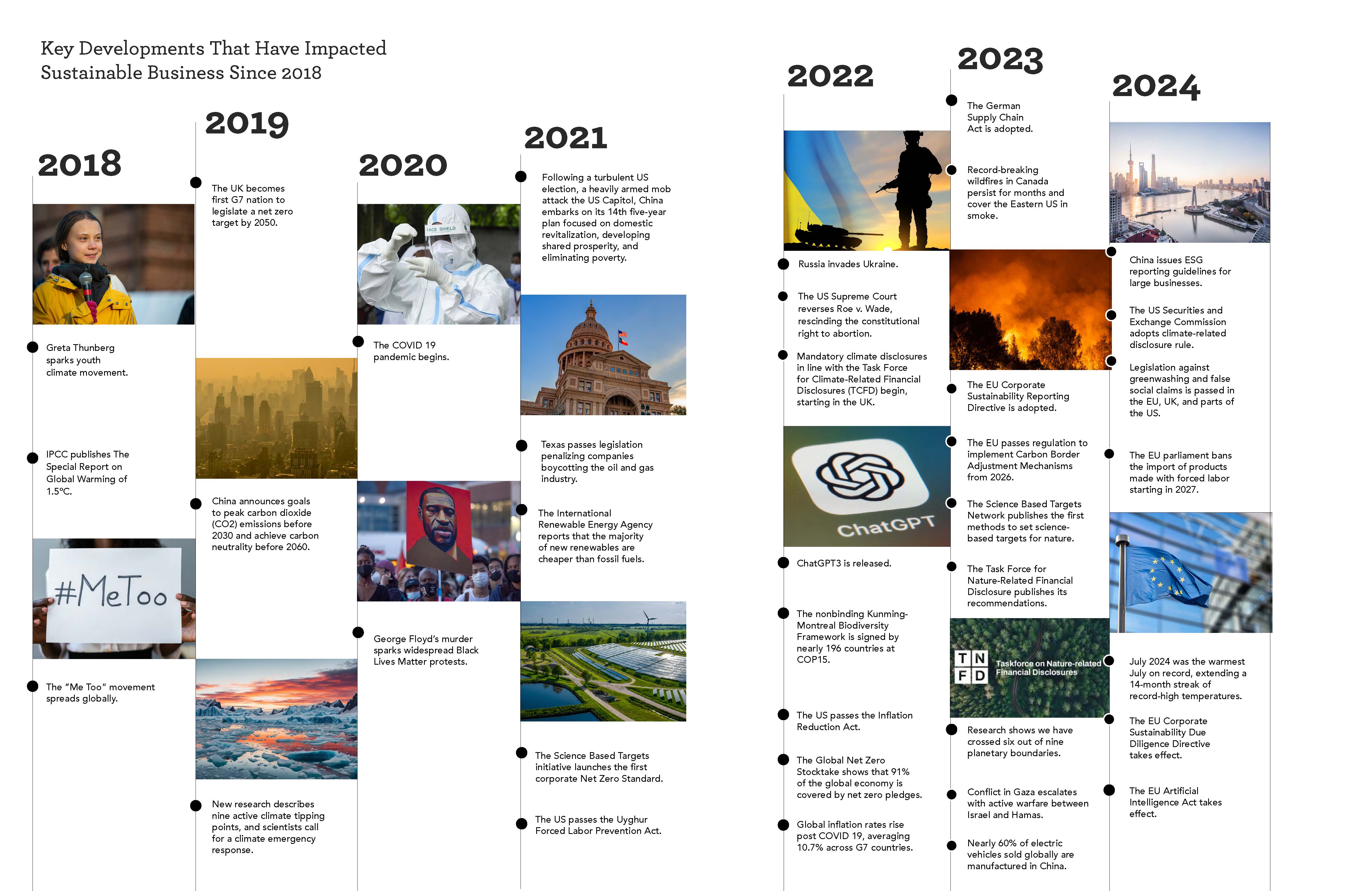
Click on the image to view a larger size
Blog | Wednesday September 18, 2024
Climate Week NYC: A New Set of Inconvenient Truths for Sustainable Business
Today, there is a new set of inconvenient truths that business needs to understand and address to successfully make good on myriad promises and targets.
Blog | Wednesday September 18, 2024
Climate Week NYC: A New Set of Inconvenient Truths for Sustainable Business
Preview
Climate Week and the United Nations General Assembly gathering in New York City—typically a time of optimism and promising announcements from a community of people committed to putting the world on a path to justice and sustainability—arrive in 2024 with a decidedly turbulent backdrop.
Unfortunately, this year is no time for optimism. Rather, it’s a moment of reckoning, a time to recommit to progress, and an opportunity to regain ownership of the narrative about why sustainability is the best and indeed only path forward. And, crucially, it’s time to sit down and have the hard conversations about the lack of progress from even the most committed companies.
To start, let us acknowledge that business action is achieving some impact. New technologies, partnerships, investments, and commitments are making a real difference, and we need more of it.
The problem is, this doesn’t make enough of a difference, and as Climate Week looms, there are reasons for concern in the global effort to mitigate and address the impacts of climate change.
Progress, and change, are hard! Many companies have learned that achieving their 2030 climate goals is challenging, with a changing economy, growth that brings higher emissions, complex supply chains that make Scope 3 emissions reductions difficult, and policy uncertainties and inconsistencies. Even where intentions are clear and strong, progress is falling short.
Political opposition to achieving a more sustainable economy, often well-funded but ill-considered, if not outright dishonest, is having an impact. The recent news that a new US$1 billion fund is being dedicated to reversing business efforts on climate, diversity, and other issues is just the latest example. Many companies concede privately—and some publicly—that they are walking back prior commitments in the face of these challenges.
The new regulatory environment has produced a level of caution inside business that is, overall, inconsistent with the purpose of the new compliance requirements. Companies are spending too much time focused on verifying past performance to address reporting rules, as opposed to investing in a more sustainable future.
And, many business leaders never bought in fully to the rising tide of action on climate, equity, and purpose, and they have gladly taken the off-ramp from a sustainable future at the first sign of economic, political, or other challenges.
But here’s the thing: we do not have the luxury of slowing down.
I’ve never been one to think that shouting louder and more often about the importance of just and sustainable business achieves very much.
But I do believe that speaking more honestly, and addressing the real barriers, in a real way, is precisely what we need.
Al Gore changed the way we think about climate change with his seminal movie, An Inconvenient Truth. That movie premiered almost two decades ago, in 2006. The original inconvenient truth truly catalyzed a new way of thinking about the existential stakes of climate change.
Today, there is a new set of inconvenient truths—not only on climate, but also on human rights, nature, equity, and the foundational question of democracy and rule of law—that must be understood and addressed if we are to successfully act to make good on the myriad promises and targets.
First, the underlying conditions prompting attention to climate, biodiversity loss, and diversity are accelerating, not declining. The planet is heating, species are in decline, and we are breaching planetary boundaries. On diversity, Western societies are growing more diverse, every minute of every day. If it is true that we are creating societal, economic, and environmental risk through unchecked climate change and nature loss, and in a more positive way, seeing our societies grow ever more diverse, it is only rational to respond with heightened business attention to the profound changes: denial is not a winning strategy.
Second, faith in markets and global trade has plummeted and is driven by the fact that for many, they represent risk and vulnerability, not human progress. This dynamic is reinforced by the pace of technological change: advances that delight us also create fear of human displacement. If the average person cannot see themselves thriving in the future—and many don’t—then faith in markets and business will not be where it needs to be for either business or society to thrive. Business can ill afford to avoid this fact and should reckon with the reasons why rising generations demonstrate falling support for the market economy.
Third, and related, healthy societies require healthy governance, and the democratic decline is real, global, and spreading. Businesses cannot assume that they will be able to operate successfully, fairly, or freely in a world where civic space is closing, where rule of law is applied unevenly, and where political divisions fester and grow. Business walks away from civic engagement at its peril—and ours.
Finally, it is also true that “greening” our existing models won’t get the job done in the face of the reality that unbridled growth and resource consumption simply be sustained. This means the inconvenient truth that existing models are not—literally—sustainable. In the best case, it means that the opportunity for innovation, delivering value in new ways, is greater than ever.
The solution here is not simply to care more, say more, or necessarily spend more.
These inconvenient truths mean that companies have both a responsibility, and an opportunity, to face the fact that the very foundations on which they rely—societies based on strong institutions, broad-based faith in the future, and resilient business and economic models—exist, but are under significant duress. No company can thrive if these framework conditions fail.
At this year’s Climate Week, then, though there are many good things to champion and celebrate, we would be wise to avoid the temptation to embrace a false sense of progress. It’s critical that we approach this year’s NYC gatherings with a laser focus on the challenges, risks, and opportunities that lay before us.
This year, it behooves all of us to reappraise our approaches, to rededicate ourselves to making the change that is needed, to have confidence in the fundamental principles on which we’re basing our decisions, and to transcend the challenges ahead.
Blog | Wednesday September 11, 2024
The Impact of Mandatory Sustainability Reporting on Corporate Functions
Explore the impact of rapidly changing regulations and standards on key functions across your organization, along with recommendations for how to adapt going forward.
Blog | Wednesday September 11, 2024
The Impact of Mandatory Sustainability Reporting on Corporate Functions
Preview
As businesses worldwide adapt to new sustainability reporting requirements, the landscape of corporate governance is shifting. The introduction of the EU Corporate Sustainability Reporting Directive (CSRD), European Sustainability Reporting Standards (ESRS), the International Financial Reporting Standards (IFRS) Foundation’s inaugural Sustainability Disclosure Standards, and the US Securities and Exchange Commission (SEC) climate disclosure rule represents a significant evolution in how companies are expected to report on their sustainability efforts.
This BSR policy brief explores the implications of these regulatory changes on various corporate functions. By synthesizing insights from companies from a range of sectors navigating this new terrain, the brief provides a comprehensive overview of how these requirements affect different functions and offers actionable recommendations for adaptation.
Below is a high-level glimpse into the impact on key corporate functions, with many more insights detailed in the full brief:
- Sustainability: Sustainability teams need to establish cross-functional committees and work closely with other departments to advise executive leadership and integrate financial and sustainability reporting.
- C-suite: Senior executives must build accountability for sustainability by aligning executive compensation with sustainability metrics, upskilling themselves on material sustainability issues, and staying informed on ongoing efforts.
- Board of Directors: Boards of Directors are required to sign-off on materiality and reporting, which requires enhanced oversight, updated governance structures, and expanded knowledge of sustainability topics.
- Finance: Finance departments must hold sustainability data to the same level of rigor as financial data, align reporting timelines and ensure data accuracy.
- Audit: Audit functions need to establish robust controls for sustainability data collection and verification, ensuring consistency and reliability.
- Risk: Risk management teams must incorporate ESG risks into their frameworks, in order to provide a comprehensive view that includes emerging sustainability issues.
- Legal/Compliance: Legal teams must stay abreast of new obligations, assess the scope of reporting requirements, and ensure compliance with various regulations.
- Procurement/Supply Chain: Procurement must assess and disclose impacts across the value chain, requiring increased transparency from vendors and improved supply chain due diligence.
- Human Resources/Diversity, Equity, and Inclusion: These teams must align regional and global reporting requirements, especially concerning employee data and diversity metrics.
- Marketing/Communications: Marketing and communications need to align sustainability narratives with those of regulated filings, ensuring consistency across all public communications and reports.
- IT/Cyber: IT departments must support both finance and sustainability teams, as well as other functions, by improving systems to collect data and disclosures.
How to use the brief:
- Use the recommendations provided as a starting point for navigating the complex landscape of mandatory sustainability reporting. Consider the extent to which the current state that we outline for each function applies to you and your company.
- Get familiar with the concept of cross-functional collaboration to address new reporting requirements. The brief is organized by function to ensure that each department has visibility into a critical role it plays in achieving compliance and advancing the company’s sustainability goals. However, we also advise looking across the sections to understand where and how joint efforts can ensure efficiency while reinforcing each other.
- Share these insights with colleagues across different functions and engage in discussions to explore how you can support one another in preparing for the upcoming reporting requirements.
- Use it to help us help you! If you have follow-up questions or require tailored support in a particular area, BSR has developed a range of service offerings that support companies on their sustainability and compliance journeys.
Companies interested in discussing the topic further are welcome and encouraged to join the Future of Reporting initiative, which has been closely tracking regulatory developments.
Blog | Wednesday September 4, 2024
The CSDDD: Implications for the Finance Industry
Learn more about the effects CSDDD will have on the finance industry and how financial institutions should prepare for downstream due diligence in compliance with the law.
Blog | Wednesday September 4, 2024
The CSDDD: Implications for the Finance Industry
Preview
In July 2024, the WBA’s Social Benchmark evaluated the world’s 2,000 most influential companies and found that approximately 90% of financial institutions assessed scored zero on human rights due diligence. This follows the 2022 WBA Financial Systems Benchmark findings that 80% of financial institutions did not acknowledge their impacts on the environment or society.
Despite the progress we have seen in the industry at BSR, these figures are sobering. They highlight the importance of mandatory measures that foster responsible finance industry conduct to drive the transition to a more just and sustainable green economy.
Inclusion of the finance industry in CSDDD was the subject of intense debate throughout the negotiation process and proved to be a major sticking point among EU governments. Despite intense lobbying, the finance industry is in scope of CSDDD, with downstream due diligence out of scope.
Adopted in May 2024, the CSDDD is the EU’s most ambitious attempt to reshape business practices in support of sustainability. It is grounded on globally agreed due diligence standards—the OECD Guidelines for Multinational Enterprises and the UN Guiding Principles on Business and Human Rights (UNGPs). It requires some 6,000 EU companies and 900 non-EU companies to conduct risk-based due diligence on their human rights and environmental impacts. This includes managing climate impacts through the adoption of climate transition plans covering scopes 1, 2, and 3 emissions. Companies may be held civilly liable for damages for failing to comply with the law.
Unpacking the Implications for the Finance Industry
Starting as early as 2027, “regulated financial undertakings” that operate or generate income in the EU and meet the relevant EUR€450 million and employee thresholds must conduct due diligence to assess, manage, and report on the actual and potential negative impacts of their operations, subsidiaries, and supply chains on human rights and the environment. Companies in scope include investment firms, alternative investment fund managers, insurance companies, credit institutions, central securities depositories, financial holding companies, and crypto companies.
The CSDDD requires shifting attention away from purely financial risks to the risks that business poses to people and the environment. It involves investing time and resources to embed concern for—and transparency on—human rights and environmental impacts into business cultures and creating channels for affected stakeholders to report harm. Where prioritizing action may be necessary, the most severe and likely impacts must be prioritized first.
In practice, banks, asset managers, and others must know and show that they manage the impacts of their operations on their workforce, on the individuals they serve, and on the environment. Key risks include paying some workers below the living wage, engaging in predatory lending to at-risk communities, or failing to prevent environmental harms of crypto-assets.
It also requires addressing supply chain impacts—ranging from privacy breaches and labor impacts associated with data management providers to office equipment and hardware tainted with modern slavery—through an ongoing process of assessment, engagement, and monitoring. It requires using responsible contracts and may involve providing support to small and medium-sized enterprises and collaborating with peers to address root-cause issues. While the CSDDD only applies to supply chain relationships, it recognizes the leverage tools available to the finance industry, such as shareholder resolutions and proxy voting, and expects them to consider these when seeking to influence direct and indirect business partners.
Preparing for Downstream Due Diligence
While downstream exclusion is a sign of misalignment with the spirit of the CSDDD’s risk-based due diligence approach (as the greatest risks to people and planet in finance are found downstream), it is critical for financial institutions to incorporate this approach into their downstream activities and relationships.
The CSDDD requires the EU Commission to submit a report to the EU Council on the need for expanded downstream due diligence requirements for financial undertakings within two years of its adoption.
Given the regulatory regime in which the CSDDD resides, financial institutions should already be assessing and reporting on how they manage downstream impacts. The CSDDD is part of a trio of EU laws that create a framework for sustainability due diligence. Companies in scope of the Corporate Sustainability Reporting Directive are required to report on the material negative impacts of their downstream business partners, such as corporate clients and portfolio companies. CSRD guidance further clarifies that materiality assessments of negative impacts should be informed by the OECD Guidelines and UNGPs due diligence approach. Meanwhile, the Sustainable Finance Disclosure Regulation requires finance companies to report on the alignment of portfolio companies in ESG-labelled funds with the OECD Guidelines.
At BSR, we also see growing attention to downstream due diligence. We work with private equity firms, insurance companies, and pension funds to conduct pre-deal, site-level human right assessments and assess portfolio-level human rights impacts, including those related to environment and biodiversity. We also support companies to embed human rights throughout the investment lifecycle and develop effective grievance mechanisms to address harms across value chains. These companies are not only preparing for compliance; they recognize that these measures provide them with better data to inform business decisions and enable them to navigate emerging human rights and environmental issues more effectively.
The Journey of Finance Industry Alignment with the CSDDD and Beyond
Financial institutions are encouraged to act by developing and implementing a due diligence approach that is grounded in the OECD Guidelines and the UNGPs. In June 2024, we published insights to help companies start on their journey to align with the CSDDD. While the journey may be different for each company, some key steps include assessing gaps in existing policies and management practices, upskilling and increasing collaboration across teams, mapping their value chains and identifying affected stakeholders, and establishing a roadmap for CSDDD alignment.
BSR takes a tailored and forward-looking approach to CSDDD compliance, helping finance companies develop strategies and processes to build their resilience and align with their sustainability goals. If you’d like further information, please reach out to us.
Blog | Wednesday August 28, 2024
Responsible Innovation in the Automotive Industry
Investors and civil society are calling on the automotive industry to recognize the potential risks to people as they invest in and grow new technologies like EVs and autonomous driving.
Blog | Wednesday August 28, 2024
Responsible Innovation in the Automotive Industry
Preview
For the past couple of decades, the automotive industry has been under considerable pressure to uncover and address adverse human rights impacts in their business and value chains. Recent regulations, such as the EU Corporate Sustainability Due Diligence Directive (CSDDDD) have introduced comprehensive human rights due diligence requirements for companies across their value chains, directly impacting many automotive companies with substantial market presence in Europe.
As these regulations come into effect, are you confident that your company fully understands the human rights risks within its value chain? Are you prepared to meet these new requirements?
The Corporate Human Rights Benchmark 2022 report, identifies the sector as the poorest performer in human rights, with civil society organizations revealing significant human rights violations within the automotive supply chain. Understanding these human rights concerns and adverse impacts are not just a regulatory necessity, but also a strategic imperative for safeguarding reputation, ensuring operational integrity, preventing litigation risks, and avoiding supply chain and production delays.
To help automotive companies understand adverse human rights impacts across their value chain, BSR has released a primer on the top 10 human rights issues impacting the sector.
Based on BSR’s engagement with the transport and logistics sector, and over 30 years of experience across human rights, the primer highlights the issues that automotive companies will likely need to manage in order to prepare to comply with emerging regulations, meet customer expectations, and avoid costly delays, fees, or litigation due to human rights incidents.
In addition to the primer, we outline below three key trends across the automotive sector value chain and their potential human rights impacts.
Human Rights Issues in Sourcing Raw Materials for Electric Vehicle Batteries
Amidst a slowdown in consumer adoption of electric vehicles, the sector continues to invest in advancing new Electric Vehicle battery (EV battery) technologies. Currently, competition has intensified with the entry of new players from China and India, aiming to carve out market share by offering cost-effective EVs.
The human rights and environmental concerns associated with mining the associated raw materials such as cobalt, lithium, manganese, graphite, and nickel is now well documented.
For instance, nickel mining in Indonesia and the Philippines has been linked to deforestation, water contamination, and adverse health impacts on local communities; cobalt mining in the Democratic Republic of Congo (DRC) has been marred by allegations of forced evictions and child labor; and there is continued concern about forced labor practices in Xinjiang, China, particularly in the processing of cobalt and the mining of key materials such as aluminum and graphite.
Beyond the risks associated with sourcing raw materials for EV batteries, emerging human rights challenges are arising in the maintenance and repair of EVs. Changes in technology and safety standards necessitate ongoing reskilling and retraining of technicians in production sites and repair workshops to mitigate potential job losses and ensure occupational health and safety standards are upheld.
Responsible Use of AI is Key to Mitigate Human Rights Risks
This year, we also see several businesses are gearing up to introduce advanced levels of automated self-driving technology.
Autonomous driving and other driving assistance technologies can pose various human rights challenges. Errors in AI-driven driver assistance technologies may compromise safety and security in the event of accidents. These technologies may also exhibit performance disparities for underrepresented groups in the dataset.
The implementation of higher levels of automated self-driving technology often involves the collection and utilization of larger volumes of sophisticated data to train algorithms and support decision-making processes. This also raises privacy concerns if automakers fail to clearly explain the types of data being collected, processed, and used, making it difficult to obtain proper user consent.
The Shift from Ownership to Subscription Models
There is a noticeable trend emerging within the transportation sector, particularly in car rental markets, towards offering Car-as-a-Service (CaaS) via an on-demand subscription model. This shift is fueled by in- vehicle connectivity and data on vehicle usage, facilitating easy and flexible real-time servicing. However, from a human rights perspective, compared to the traditional sale and ownership model, this trend may pose higher risks for CaaS providers. As the CaaS model allow a higher level of oversight and control over the vehicle’s location and data, as well as granting a higher leverage in selecting customers/users due to recurring contractual relationships.
Periodically, there are reports in the news about vehicles being intentionally misused for harmful purposes, such as facilitating armed operations or criminal activities like human trafficking. With the subscription model, the auto-providers track the geographical location and usage of the vehicles. This would lead to greater expectations and responsibilities to prevent and detect illicit use of vehicles, or usage in conflict prone and higher risk locations known for activities such as deforestation, illegal mining activities, or human trafficking hotspots.
This may also increase the probability of law enforcement agencies requesting real-time data from CaaS providers to support combating crimes. The increased ability for law enforcement to access vehicle position information could facilitate real-time tracing and surveillance of targeted individuals, such as dissidents or human rights defenders—and exacerbate further human rights risks.
BSR’s human rights team advises business from across sectors on human rights due diligence, assessment, and management of risks. Please get in touch to discuss how our team can help yours navigate these emerging trends and manage the key human rights risks in the sector.
Primers | Wednesday August 28, 2024
Top 10 Human Rights Priorities for the Automotive Sector
As the automotive industry embraces the green transition, new human rights risks will emerge and evolve. Explore the 10 most relevant, urgent, and probable human rights impacts for businesses operating in the automotive sector
Primers | Wednesday August 28, 2024
Top 10 Human Rights Priorities for the Automotive Sector
Preview
Human rights are inherent to all people, regardless of nationality, sex, national or ethnic origin, color, religion, language, or any other status. They are globally agreed upon standards of achievement for all people, covering a wide range of independent yet interconnected civil, political, economic, social, cultural, and environmental rights that serve as a “code of conduct” for all human beings.
All companies can impact human rights either positively or negatively through their action or inactions. The key document speaking to these impacts is the UN Guiding Principles on Business and Human Rights (UNGPs), the authoritative global standard on business and human rights. Though technically “soft law,” the UNGPs have been incorporated into the OECD Guidelines for Multinational Enterprises, ISO 26000, IFC Performance Standards, GRI, UN Sustainable Development Goals, and many other frameworks. They have also been endorsed by business and industry organizations representing thousands of companies, civil society organizations, NGOs, and member states of the United Nations.
As part of the corporate responsibility to respect human rights, the UNGPs require companies to actively identify and manage the negative human rights impacts they may cause or contribute to, or to which they are linked through their business relationships.
This primer identifies the 10 most relevant, urgent, and probable human rights impacts for businesses operating in the automotive sector. It is intended as a starting point and should be supplemented by robust internal human rights due diligence processes. The information here is gathered from BSR’s direct engagement with industrials sector companies, as well as our 30 years of experience helping companies in all sectors manage their human rights risks.
The automotive sector comprises a wide range of businesses and activities across its value chain, from sourcing raw materials and parts to manufacturing auto parts, such as tires, step bumpers, and chasses, to assembling a fully functioning vehicle and transporting finished vehicles to distributors, dealers, and, eventually, into the hands of end-users such as transport companies, truck drivers, or individual commercial and household drivers.
As the automotive industry embraces the green transition, incorporating electric vehicles (EVs) and sustainable materials and other green solutions, new human rights risks will emerge and evolve. These include, for example, sourcing new types of raw materials for EV batteries, shifting skill requirements for technicians in production sites and repair workshops, and increased occupational health and safety risks associated with EV battery handling. It's crucial for automotive companies to proactively address these risks together with their suppliers and business partners throughout the green and digital transformation, as this evolution reshapes the ecosystem, the industry’s human rights risk profile, and the future of automotives.
While each company has distinctive human rights risks based on their different value chain footprints and business models, this primer highlights common risks across the automotive sector to help companies in the automotive value chain identify, prevent, and mitigate adverse impacts on people in the course of doing business. As a sector that is both global and local and employs tens of millions of workers around the world, it also offers opportunities to advance the realization of human rights.
Blog | Tuesday August 6, 2024
Investing for Impact: A Leadership Framework for Private Equity Investors
What makes an effective leader in impact investing within private equity firms and what innovative methods are used by investors to develop impact value creation levers?
Blog | Tuesday August 6, 2024
Investing for Impact: A Leadership Framework for Private Equity Investors
Preview
In today’s landscape, businesses are increasingly recognizing the connections between social justice, climate impacts, and financial returns, which has driven a shift towards impact investing.
This shift is not just a trend but a significant movement reshaping the industry. The impact investing market reached US$495.82 billion in 2023, up from US$420.91 billion in 2022, reflecting a 17.8 percent compound annual growth rate. The Global Impact Investing Network (GIIN) reported that the market size amounted to US$1.164 trillion in assets under management in 2022. Private equity is at the forefront of this growth, with nearly half of all capital allocated to impact investments coming from private equity and private debt. Major players like KKR and TPG are making substantial commitments, with KKR raising nearly US$2 billion for its second impact fund and TPG closing its Rise Climate Fund at US$7.3 billion.
PE investors can provide critical capital, expertise and exert management influence across the sectors they invest in, initiating steps to drive positive impact. In addition, the holding period of investments, which is an average of about five years for PE firms, is crucial for creating significant value. During this time, asset managers can utilize their expertise to amplify environmental and social impacts. Effective impact leadership within private equity is characterized by proactive engagement, strategic vision, and the ability to drive substantial value through environmental and social initiatives.
Some of the leadership practices in impact investing are:
- Attributing and Contributing to Sustainable Development Goals (SDG) outcomes: Ensuring interventions contributing to the SDGs and attributing positive outcomes to their specific actions during the holding period provide building blocks toward impact accountability.
- Prioritizing Material Sustainability Issues: Integrating environmental, social, and governance into investment strategies, not only mitigates risks but also identifies opportunities for positive impact.
- Implementing Impact Measurement Frameworks: Developing impact measurement frameworks with clear impact goals, procedures for regularly tracking progress, and adjusting as needed to achieve desired outcomes.
- Ensuring Effective Governance: Setting the scene for long-term success by improving board structures and diversity, increasing accountability, and ensuring strategic oversight, which are key for long-term success.
- Embedding Operational Improvements: Implementing efficiency measures, process optimizations, and leveraging technology to enhance a twin financial and impact performance—enhancing efficiency and reducing costs.
Impact investors can use a variety of innovative methods to develop impact value creation levers.
Building on these leadership practices, PE investors employ a variety of methods and innovations to drive impact. Investor contributions could be both financial and non-financial, encompassing a range of strategies to create value. According to a report by Tideline Impact Capital Managers, impact value creation levers include:
- Impact Positioning: Strengthening market presence by positioning the brand as impact focused (e.g., by redefining the organization’s vision).
- Workforce Initiatives: Engaging employees to improve job culture and workforce (e.g., through employee engagement surveys).
- Impact Incentives: Aligning management incentives with impact goals (e.g., through compensation structures that are linked to impact performance).
- Impact Risk Management: Managing impact risks to avoid unintended consequences (e.g., by assessing physical and transition climate risk impact on the business).
Innovative approaches to investor contributions have emerged, particularly in areas like climate risks, technology, and geographic expansion.
Notable Examples of Impact Value Creation Levers
- Market Building: LeapFrog supported Redcliffe Labs in expanding its healthcare diagnostics services in India through strategic acquisition, resulting in substantial revenue growth and a broader impact reach.
- Product/Service Development: Rethink Capital Partners helped AllHere, an EdTech business, enhance its core product with an AI chatbot during the pandemic. This pivot allowed the business to maintain demand for its services and significantly increase its reach and revenue.
- Impact Risk Management: Nuveen assisted Annapuma, a microfinance business, in integrating physical climate risk data into its operations developing an alert system for customers during climate disasters, and reducing loan default risks.
Only a minority of investors monitor the results of their contribution, missing the opportunity to fully capture the true impact of their investment.
The initiatives below help investors document and validate their contributions, ensuring they are meaningful and impactful.
Innovative Tools for Tracking Impact
- Impact Frontiers' Investor Contribution 2.0: This tool helps investors better track and monitor their contributions with metric taxonomies and engagement tracking templates. British International Investment (BIL) participated in a pilot project for this initiative, enhancing its ability to track and report on impact contributions.
- MedAccess' Bespoke Counterfactual Framework: MedAccess developed a unique framework to assess and validate expected investor contributions to impact, particularly in the health sector. This framework helps determine where financial contributions will have the greatest impact.
There is the constant challenge of measuring these outcomes, with the need to move from simply measuring outputs to meaningful measurement indicators as to the depth of impact experienced by end-beneficiaries. Looking forward, massive opportunities exist for impact managers to innovate in this area, moving away from easy-to-measure indicators, to building meaningful indicators from the ground up.
BSR supports its private equity members in adopting effective leadership, and taking innovative approaches backed by rigorous tracking to drive progress toward a just and sustainable world.
For more information or support, please contact us.
Audio | Thursday August 1, 2024
Navigating U.S. Election Uncertainty: A Call to Action for Sustainable Business
In the United States, electoral uncertainty, threats to democracy, and the potential for instability and chaos are notably apparent as the country faces an enormously consequential election this fall. What are the risks for sustainable business, and what proactive steps can business leaders take to mitigate them? BSR President and…
Audio | Thursday August 1, 2024
Navigating U.S. Election Uncertainty: A Call to Action for Sustainable Business
Preview
In the United States, electoral uncertainty, threats to democracy, and the potential for instability and chaos are notably apparent as the country faces an enormously consequential election this fall. What are the risks for sustainable business, and what proactive steps can business leaders take to mitigate them? BSR President and CEO Aron Cramer chats with David Stearns about five topics central to the just and sustainable business agenda that will be affected by the outcomes of the election, followed by strategies for advancing sustainability objectives using BSR’s Act, Enable, Influence approach.