Searching for:
Search results: 866 of 1188
Blog | Thursday September 27, 2018
From the Global Climate Action Summit to UNGA Week
Action to address the social impacts of climate change and other disruptions is essential to reach the SDGs—and that action must be inclusive of those left behind by the many changes remaking the economy.
Blog | Thursday September 27, 2018
From the Global Climate Action Summit to UNGA Week
Preview
Over the past couple of weeks, the New American Road Trip traversed the United States, with zero emissions vehicles making the trek from the Global Climate Action Summit to UNGA/Climate Week in New York City.
A New Blueprint for Business
Join us at BSR18 for a conversation about bold business commitments to a just transition.
These events come at a crucial time. The intersection of business and society is a busy place. Companies are navigating a complex set of profound changes: the related challenges of urgent climate action, erosion of human rights protections, and innovations reshaping the world of work, not to mention ongoing reminders of the need to ensure that women are able to thrive in society without fear of discrimination, or worse. All this comes when faith in business and the global economy remains low, and when the competitive pressures in a changing economy are intense.
The New American Road Trip reminds us of the opportunities that all this change is creating for companies that dive headlong into the future. Crossing North America in an EV that didn’t require hourly recharging was unimaginable a decade ago and has shown how even our most familiar cultural icons are being remade.
The Global Climate Action Summit two weeks ago served a very important purpose. As intended, the Summit catalyzed a number of significant new climate commitments. More businesses—now nearly 500 in all—have committed to science-based targets; nearly a 40 percent increase from the number a year ago. A coalition of foundations committed US$4 billion in new commitments to combat climate change. And the lead Summit host, California Governor Jerry Brown, committed his state—the fifth biggest economy in the world if it were a nation-state—to achieving 100 percent climate neutral power by 2045. No entity of such size has made such an audacious commitment to date.
Crucially, the human dimension of our changing climate was also at the core of the action in San Francisco. We welcome this: BSR has released four reports that explore the intersection of climate and other sustainability issues: supply chain management, health, inclusive economies, and women’s empowerment. We also launched, along with Mars and Coca-Cola, the Climate Resilient Supply Chain Leaders Platform, which will grow in the coming months as large global companies aim to engage their business partners in creating business solutions—and human protections—in light of a less predictable operating environment.
I also had the opportunity to explore the human dimension of climate change in dialogues organized by the B Team with leaders from business, labor, and civil society, as well as other changemakers, to ensure that the just transition is firmly on the climate agenda. Attention must be paid to those displaced by the clean energy transition.
Action to address the social impacts not only of climate, but of the other massive changes remaking our world, will be essential if we are to reach the Sustainable Development Goals.
Action to address the social impacts not only of climate, but of the other massive changes remaking our world, will be essential if we are to reach the Sustainable Development Goals (SDGs); however, I always approach UNGA Week with a bit of a divided soul. While it is inspiring to be in the company of a global community committed to the vision of the SDGs, it is equally concerning that we seem to be speaking primarily to ourselves at a time when there is massive discontent and such a lack of public trust. For the sustainability agenda to resonate outside the community of people who come to New York this week, it is essential that it deliver economic opportunity for those who are being left behind by the many changes remaking the economy.
For global companies, this means going beyond discussions of the future of work to the creation of solutions. There is both an imperative to address those living in poverty and a need for commitments to economic opportunity and security in the global north. The productivity gains coming from technology and innovative business models will not come to full fruition if they don’t also address the needs for skill development, basic social protections, and lifelong learning.
The New American Road Trip was a great way to remake a 20th century social ritual. But the question before us is bigger than that. In light of the many changes redefining the economy, from climate to technology to longer lifespans, we need to redefine the social contract, and business has a crucial role to play in this.
The innovators that answer these questions will define the 21st century, and the time has come for us to do so.
In New York, there is increased recognition of this need, which I find encouraging, but there is not yet enough of a commitment to next steps. The SDGs remain front and center for all of us who are here, and there is growing recognition of the link between economic security and climate action. But it is what we choose to do after we leave that will determine the extent to which we are able to make our ambitions a reality.
Blog | Wednesday September 26, 2018
Event Summary: TCFD Recommendation and Climate Change Risk
Blog | Wednesday September 26, 2018
Event Summary: TCFD Recommendation and Climate Change Risk
Preview
Blog | Tuesday September 25, 2018
Climate Solutions Need Women at the Center
Companies can address climate risk more effectively and efficiently if they put women at the heart of their climate resilience strategies.
Blog | Tuesday September 25, 2018
Climate Solutions Need Women at the Center
Preview
The intersection of climate change and women, although rarely prioritized in decision-making or solutions, is not a new concept. But, as Mary Robinson said, “If we took away the barriers to women’s leadership, we would solve the climate change problem a lot faster.”
As Mary Robinson said, “If we took away the barriers to women’s leadership, we would solve the climate change problem a lot faster.”
In 2015, the international arena formally gave this women-climate nexus a platform within the Paris Agreement and the Sustainable Development Goals (SDGs). In 2017, UNFCCC countries adopted the Gender Action Plan at the climate negotiations. These international frameworks now recognize the intersection between gender inequality and climate change, as well as the need for the integration of women’s voices, skills, and knowledge in solutions. It is time for businesses to act by empowering women leaders to take climate action throughout their value chains.
Today, we are excited to launch a new report that highlights tangible ways of doing this. Companies can address climate risk more effectively and efficiently if they put women at the heart of their climate resilience strategies.
Women are disproportionately affected by climate change—not because they experience more climate impacts than men, but because women face underlying socioeconomic, political, and legal barriers that limit their choices in the face of climate change. Climate impacts exacerbate these barriers and ultimately hinder climate resilience activities from reaching their full potential.
For example, only 47 percent of women have an account at a formal financial institution, compared to 55 percent of men. Without bank accounts and financial resources, women cannot easily diversify their livelihoods or access financial capital before and after climate disasters. Additional barriers include norms related to unpaid work, limited access to income, discriminatory laws, land ownership restrictions, a lack of capacity-building resources, and a lack of voice. These barriers not only limit the adaptive capacity of women to climate impacts, but they also influence the adaptive capacity of communities and company value chains—in particular, agriculture (nearly 50 percent of smallholder farmers in some countries are women) and apparel (nearly 80 percent of apparel factory workers are women).
Despite these deeply rooted barriers, women possess unique and key skills, knowledge, and experiences critical for climate resilience solutions, making them powerful change agents. For example, women make different choices than men that can help an agricultural community within a value chain thrive and adapt to climate change. For generations, women have been land stewards and have maintained local climate, plant, and seed-planting knowledge. This makes them natural targets for involvement in the creation and use of climate adaptation tools and trainings, in particular as men continue to move to more non-farm jobs and climate impacts continue to worsen.
Climate resilience solutions with a specific focus on women are a win-win: They tackle climate risk and gender inequality simultaneously, with clear benefits for business, women, and communities. For businesses, empowering women and also making them leaders in the development and implementation of these solutions can drive productivity and innovation, especially within sectors like agriculture and apparel that depend heavily on a female workforce. Companies can also protect raw materials, increase financial stability and returns, strengthen the resilience of local communities, and deliver other co-benefits, like stabilizing livelihoods, improving food security, and making progress toward closing the global gender gap, as part of this approach.
Businesses that recognize this can play an important role in developing these solutions within their own operations, and they can also collaborate with others to make progress. More specifically, they can:
- Act to put women at the center of all internal climate resilience approaches and solutions. In particular, companies can provide women in supply chains access to relevant trainings, inputs, financing, and technologies.
- Enable women throughout the value chain and broader community to effectively respond to climate-related events by linking them with local networks and partners, which can serve as mutual support mechanisms to strengthen climate resilience.
- Influence policymakers and other organizations to help address underlying inequalities, such as the lack of decision-making power of women, which are particularly challenging in the context of a changing climate.
Through the Business Action for Women collaboration, BSR works with leading companies on climate change, including Mars, L’Oreal, and Coca-Cola, to share best practices and collectively develop innovative solutions that empower women to lead on climate resilience in agricultural supply chains from the ground up.
Real transformation for both climate resilience and gender equality will happen when companies tackle the structural and systemic barriers women face and involve women in solutions—putting women at the center of their climate strategies.
BSR’s climate and women nexus report is the fourth in our series, which also includes reports on the intersection between climate and supply chains, health, and inclusive economy. Stay tuned for more on the connections between climate resilience and human rights and a just transition to the low-carbon economy in the months to come.
Reports | Tuesday September 25, 2018
Climate and Women
This paper explores the connection between women’s empowerment and resilience to climate change and aims to drive corporate action to put women at the center of climate solutions.
Reports | Tuesday September 25, 2018
Climate and Women
Preview
Climate change affects every human around the globe, with profound implications for social justice and human rights. Health-related stresses, competition for natural resources, and the impacts on livelihoods, hunger, and migration warrant immediate global action.
This paper explores a relatively new and developing topic for business: the intersection between climate change and women’s empowerment. It uses compelling data, a clear business case, and company case studies to strengthen corporate understanding of the connection between women’s empowerment and resilience to climate change impacts and to drive corporate action to put women at the center of climate-resilience solutions. Ultimately, this paper aims to help companies prepare for the consequences of climate change and address material business risks, while simultaneously embracing opportunities that benefit business, women, and communities.
This report is part of a series of six climate nexus reports that cover human rights, inclusive economy, women’s empowerment, supply chain, just transition, and health.
Climate and Women
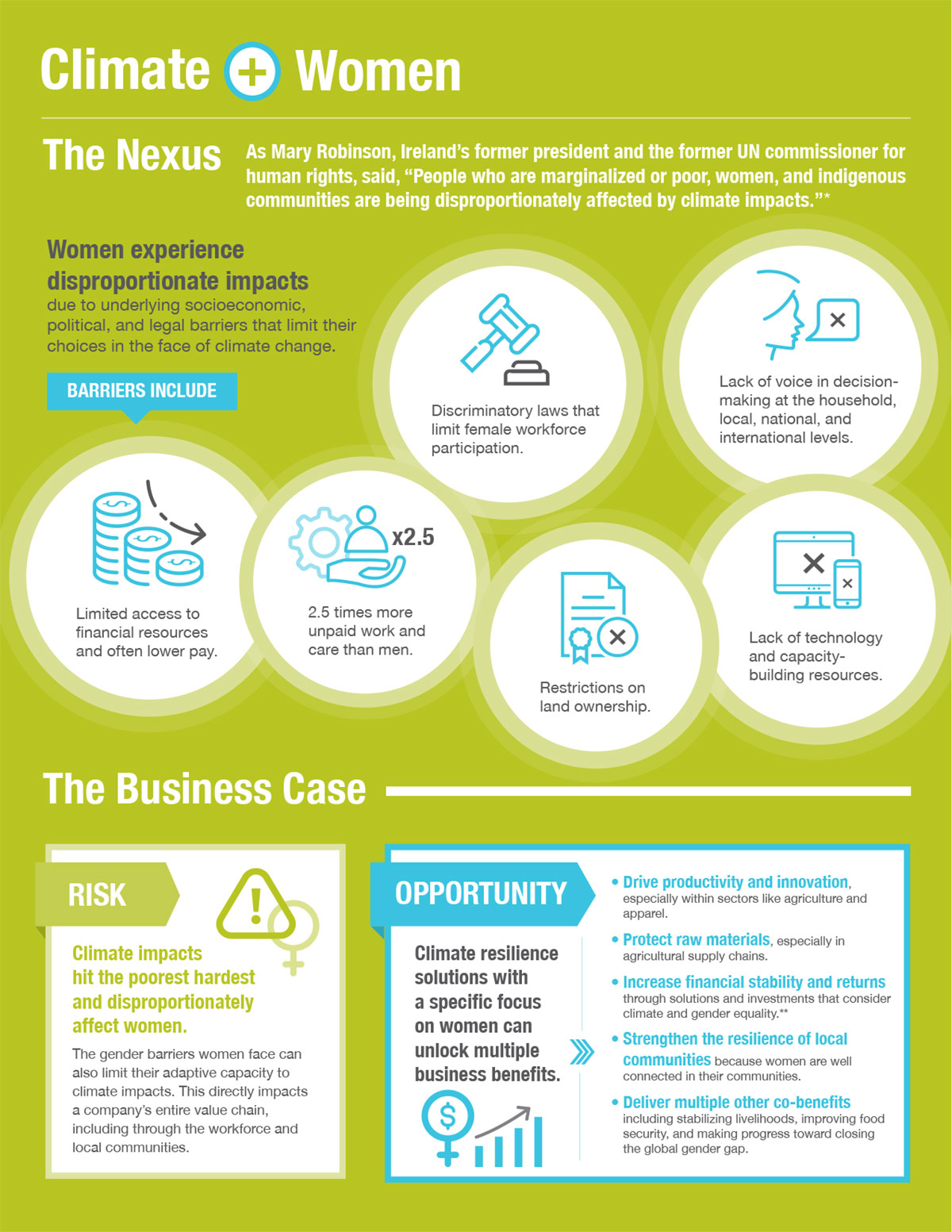
The Nexus
As Mary Robinson, Ireland’s former president and the former UN commissioner for human rights, said, “People who are marginalized or poor, women, and indigenous communities are being disproportionately affected by climate impacts.”
Women experience disproportionate impacts due to underlying socioeconomic, political, and legal barriers that limit their choices in the face of climate change.
Barriers Include
- Limited access to financial resources and often lower pay.
- 2.5 times more unpaid work and care than men.
- Discriminatory laws that limit female workforce participation.
- Restrictions on land ownership.
- Lack of voice in decision- making at the household, local, national, and international levels.
- Lack of technology and capacity-building resources.
The Business Case: Risk
Climate impacts hit the poorest hardest and disproportionately affect women.
The gender barriers women face can also limit their adaptive capacity to climate impacts. This directly impacts a company’s entire value chain, including through the workforce and local communities.
The Business Case: Opportunity
Climate resilience solutions with a specific focus on women can unlock multiple business benefits.
- Drive productivity and innovation, especially within sectors like agriculture and apparel.
- Protect raw materials, especially in agricultural supply chains.
- Increase financial stability and returns through solutions and investments that consider climate and gender equality.
- Strengthen the resilience of local communities because women are well connected in their communities.
- Deliver multiple other co-benefits including stabilizing livelihoods, improving food security, and making progress toward closing the global gender gap.
Climate and Supply Chain (continued)
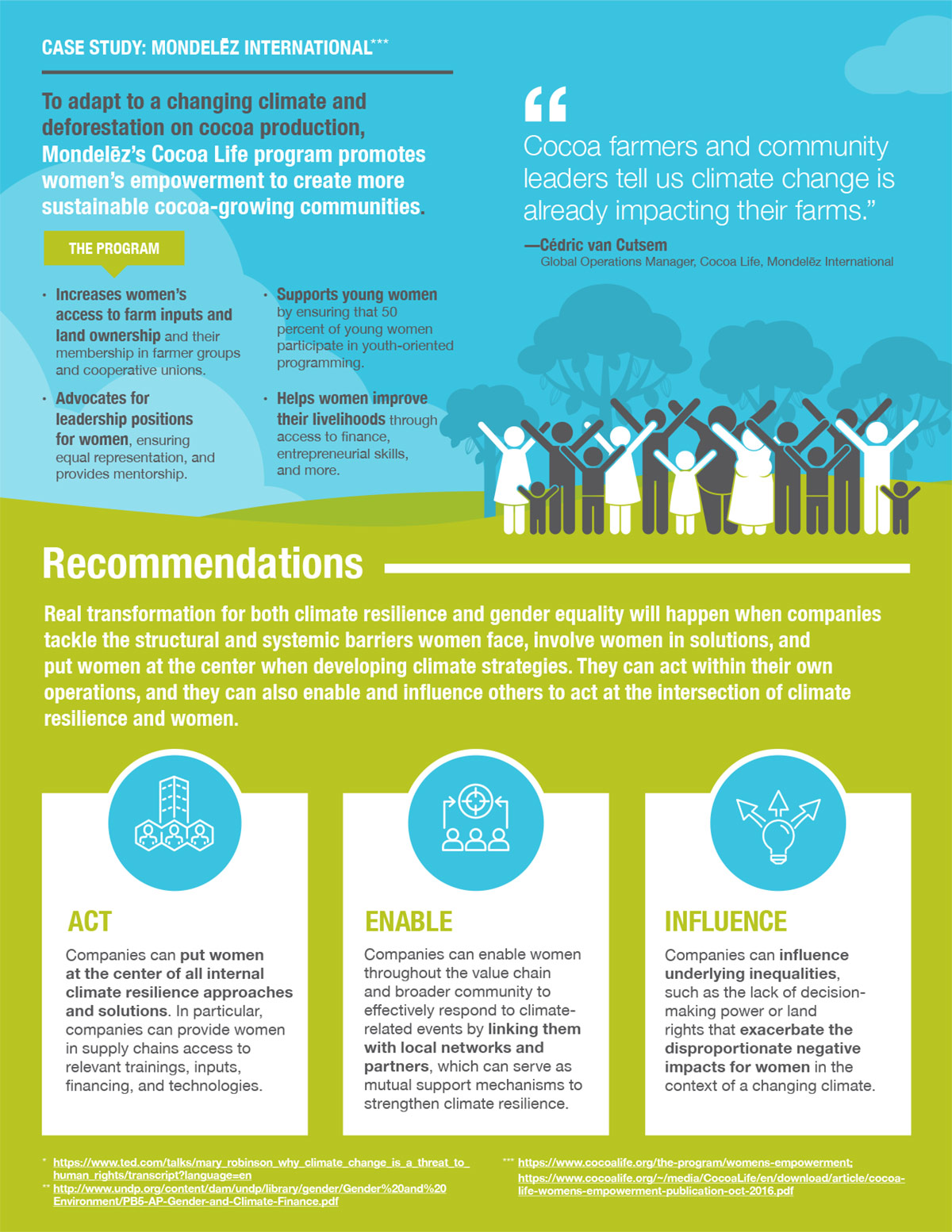
Cast Study: Mondelēz International
To adapt to a changing climate and deforestation on cocoa production, Mondelēz’s Cocoa Life program promotes women’s empowerment to create more sustainable cocoa-growing communities.
Cocoa farmers and community leaders tell us climate change is already impacting their farms. —Cédric van Cutsem, Global Operations Manager, Cocoa Life, Mondelēz International
The Program
- Increases women’s access to farm inputs and land ownership and their membership in farmer groups and cooperative unions.
- Advocates for leadership positions for women, ensuring equal representation, and provides mentorship.
- Supports young women by ensuring that 50 percent of young women participate in youth-oriented programming.
- Helps women improve their livelihoods through access to finance, entrepreneurial skills, and more.
Recomendations
Real transformation for both climate resilience and gender equality will happen when companies tackle the structural and systemic barriers women face, involve women in solutions, and put women at the center when developing climate strategies. They can act within their own operations, and they can also enable and influence others to act at the intersection of climate resilience and women.
-
Act
Companies can put women at the center of all internal climate resilience approaches and solutions. In particular, companies can provide women in supply chains access to relevant trainings, inputs, financing, and technologies.
-
Enable
Companies can enable women throughout the value chain and broader community to effectively respond to climate-related events by linking them with local networks and partners, which can serve as mutual support mechanisms to strengthen climate resilience.
-
Influence
Companies can influence underlying inequalities, such as the lack of decision-making power or land rights that exacerbate the disproportionate negative impacts for women in the context of a changing climate.
Climate Nexus Report Series




Blog | Monday September 24, 2018
Are You Ready to Incorporate Gender into Your Supply Chain Due Diligence?
New gender-sensitive auditing guidance provides recommendations, practical advice, and relevant examples on how to effectively integrate gender considerations into audits.
Blog | Monday September 24, 2018
Are You Ready to Incorporate Gender into Your Supply Chain Due Diligence?
Preview
In June 2019, the United Nations Guiding Principles (UNGPs) Working Group will present its report to the Human Rights Council on how to integrate gender more prominently into companies’ due diligence process so that the business impacts of human rights abuses specifically related to women are better identified and addressed.
A New Blueprint for Business
Join us at BSR18 this fall for a conversation about the future of supply chain transparency.
The systems currently used by brands and suppliers to verify that basic rights and working conditions are upheld in their supply chains rarely integrate a gender dimension. This is arguably evidence that companies have not paid sufficient attention to gender-specific human rights abuses and the broader spectrum of workplace practices harmful to women in their supply chains, where women constitute a majority of workers, especially for consumer products. In particular, women’s rights and workplace-specific challenges are often not reflected in supplier codes of conduct and are addressed in very limited ways, if at all, in the auditing methodologies used to verify compliance with such codes.
To help companies address this issue and prepare to meet the increased expectations associated with the UNGPs, BSR—with support from the Dutch Ministry of Foreign Affairs—is pleased to launch guidance that identifies the main improvements required for gender-sensitive social auditing and provides recommendations, practical advice, and relevant examples on how to effectively integrate gender considerations into audits. This new Gender Equality in Social Auditing Guidance is based on and complements the Gender Equality in Codes of Conduct Guidance published in 2017.
Social auditing is defined as the thorough formal examination of the labor practices of a workplace or company, based on corroborated evidence. It is appealing to companies as it provides a clear, easy-to-digest, quantitative picture that can be used as a basis for quick sourcing and business decision-making. However, it is still often considered a narrow “snapshot” exercise, predominantly using document checks to surface issues linked to workers’ employment relationships. The voices of workers do not figure prominently. As such, social auditing lacks the ability to uncover more complex, less visible social issues, such as freedom of association, discrimination, and sexual harassment.
Moreover, social audits focus on verifying elements within distinct categories, such as working hours or health and safety. This siloed approach makes it difficult for social auditors to analyze interlinkages between seemingly unrelated issues—a particularly important activity when considering gender-sensitive issues.
If social auditing is to remain relevant and to become better at capturing the underlying root causes of gendered issues and discrimination, providing meaningful corrective action plans to tackle them, and measuring progress toward better conditions for women workers, there is an urgent need to transform its objectives and methodology.
To understand the underlying root causes of gendered issues and discrimination, tackle them, and measure meaningful progress toward better conditions for women workers, there is an urgent need to transform social auditing systems.
BSR’s new guidance is designed to provide all actors involved in these audits with opportunities for individual and collective action to make social audits more gender-sensitive. The guidance will help companies and actors in the auditing ecosystem to:
- Understand and proactively address the structural constraints that prevent social audits from being more gender-sensitive, from the composition of auditing teams and their knowledge to the complexity of reporting gender-sensitive issues and capturing gender-disaggregated data.
- Integrate specific gender-sensitive verification measures across codes of conduct principles, verifying not just governance and policy structures, but also how these are embedded in operations and how they impact workers.
- Analyze the particularities of interviewing workers and apply a gender lens to (for example) sampling and interview techniques.
- Explore how to more effectively gather insights on women workers’ issues and needs through methodologies and techniques that are currently not part of traditional social auditing. The guidance shows how worker-driven feedback loops can capture risks and impacts in a way that traditional auditing mechanisms may not.
We hope that this guidance will serve as a significant first step in the transformation of social audits used in global supply chains. However, we recognize that this transformation is not straightforward: It will require proactive measures from key actors, including companies, standards bodies, certification schemes, supply chain initiatives, auditing companies, and auditors’ associations. BSR will convene a meeting on November 9 in New York to stimulate collaborative action amongst these various actors, and we would love for you to join us.
Further, we call on all actors to proactively review their systems and processes to enhance their ability to unearth gendered risks and positively impact women workers in global supply chains. Companies who integrate a gender lens into their auditing practices will be well equipped to respond to part of the UNGP Working Group’s increased gender expectations.
If you would like further assistance or guidance on improving your codes of conduct and auditing processes, please contact our team of women’s empowerment experts.
Reports | Monday September 24, 2018
Gender Equality in Social Auditing Guidance
Reports | Monday September 24, 2018
Gender Equality in Social Auditing Guidance
Preview
The resilience of supply chains is intrinsically linked to the status and wellbeing of women: When women’s health and access to opportunities are compromised, their productivity and efficiency suffers. Yet the systems currently used by brands and suppliers to verify that basic rights and working conditions are upheld in their supply chains do not integrate a gender dimension. In particular, women’s rights and workplace-specific challenges are often not reflected in supplier codes of conduct and are addressed in very limited ways, if at all, in the auditing methodologies used to verify compliance with such codes.
To help companies address this issue, BSR—with support from the Dutch Ministry of aForeign Affairs—is pleased to launch guidance that identifies the main improvements required for gender-sensitive social auditing and provides recommendations, practical advice, and relevant examples on how to effectively integrate gender considerations into audits. This new Gender Equality in Social Auditing Guidance is based on and complements the Gender Equality in Codes of Conduct Guidance published in 2017.
The Guidance:
- Considers the systemic barriers that prevent current social audits from being more gender-sensitive and provides recommendations for overcoming such barriers.
- Explores how best to integrate gender considerations within existing auditing verification measures and across the different principles in supplier codes of conduct.
- Highlights the vital process of worker interviews and considers how to maximize their effectiveness in picking up gender-sensitive issues.
- Evaluates methodologies, such as worker engagement approaches, that are not traditionally related to social auditing but that may enhance the ability of companies to identify gendered issues and effectively design remediation plans to improve workplace conditions for women.
- Assesses the broader range of strategies that companies should consider for monitoring their suppliers and whether such strategies may complement or partly replace social audits.
Blog | Thursday September 20, 2018
How Businesses Are Collaborating for the Sustainable Development Goals
For meaningful progress toward the SDGs, we need actors across entire value chains to take collective action on the issues that threaten business growth and social development.
Blog | Thursday September 20, 2018
How Businesses Are Collaborating for the Sustainable Development Goals
Preview
The Sustainable Development Goals (SDGs) provide both a stimulus and a framework for corporate sustainability efforts: This is reflected in the 2018 BSR/Globescan State of Sustainable Business Survey, where more than 70 percent of business leaders surveyed said that they are using the SDGs as their strategic north star in setting sustainability targets.
However, it has become increasingly obvious that to tackle systemic challenges like climate change, rising inequality, and exploitation of non-renewable resources, companies and other stakeholders need to work together. Businesses are increasingly creating and joining collaborative and multi-stakeholder initiatives to do this—which is aligned with SDG 17, to revitalize global partnership for sustainable development.
The trend toward private-sector led collaboration is encouraging—but it must accelerate, deepen, and broaden. For meaningful progress toward the SDGs, we need actors across entire value chains to pull together quickly and take collective action on the issues that threaten business growth and social development.
In our recent report on Private-Sector Collaboration for Sustainable Development, BSR investigated what motivates companies to join collaborations and what makes them successful. We found that collaborations are most effective at engaging and retaining corporate participants when they resolve an issue that is seen as critical to business continuity. In other words, we found that private-sector partnerships are most impactful when they are both good for society and good for business.
We also learned through the BSR/GlobeScan survey which specific SDGs companies are focusing on in their sustainability efforts. Climate action (SDG 13), decent work and economic growth (SDG 8), responsible consumption and production (SDG 12), and gender equality (SDG 5) topped the list.

In anticipation of Global Goals Week next week, we are sharing five examples of how private-sector collaborative initiatives are contributing to three of these four most-referenced SDGs—while simultaneously helping their participants create more resilient businesses.
- HERproject (SDG 5) unites over 50 brands—along with their suppliers, local NGOs, and international partners—to empower women in global supply chains with knowledge and skills related to health, financial inclusion, and gender equality. Over the past decade, HERproject has reached more than 800,000 women in 14 countries, with outcomes including increased use of family planning products and better financial practices. These outcomes in turn ensure a more productive and resilient workforce, leading to positive business outcomes for factories and farms around the world.
- The Global Impact Sourcing Coalition (GISC) (SDG 8) is a collaboration between leading companies to build more inclusive global supply chains through advancing wide-scale adoption of Impact Sourcing—a business practice where a company prioritizes suppliers that intentionally hire and provide career development opportunities to people who otherwise have limited prospects for formal employment. In 2018, GISC launched an Impact Sourcing Challenge, calling on its members to hire 100,000 impact workers by the end of 2020. Thirteen companies have already taken up the challenge: These inclusive employers benefit from the skills and talents of a more diverse set of employees and from building stronger relationships with clients, employees, and the communities in which they operate.
- The Maritime Anti-Corruption Network (MACN) (SDG 8) is a global business network of over 100 companies working toward the vision of a maritime industry free of corruption. In 2014, MACN members used the anonymous MACN reporting system to highlight a systemic issue with demands for payment for unclean grain holds in some Argentine ports. This included cases of extortion, where officials would not provide clearance to ships in good condition without a “facilitation payment”. After building a coalition of local and global stakeholders, MACN pursued a collective action in Argentina, which resulted last year in the successful adoption of a new regulatory framework for dry bulk shipping. The new framework increases the integrity and transparency of dry-bulk vessel inspections to the benefit of frontline crew, shipping companies, and the Argentine economy.
- Clean Cargo (SDGs 8, 13) brings together major brands, cargo carriers, and freight forwarders to reduce the environmental impacts of global goods transportation and promote responsible shipping. The Clean Cargo Methodology for carbon dioxide emissions calculations and benchmarking has become the global standard in the ocean container shipping sector, collecting data from 85 percent of container shipping. The data show that since 2009, Clean Cargo members have cut their carbon dioxide emissions by 35 percent per TEU-km. Clean Cargo is stepping up its collective efforts to innovate and drive change, aligning with the new target of the International Maritime Organization to halve shipping emissions by 2050.
- The Future of Internet Power (SDG 13) aims to increase the use of renewable energy to power the internet through collaboration with companies, power providers, developers, utilities, and policymakers. The group currently focuses on data centers, which account for more than two percent of total energy use in the United States. Together, members developed and launched the Corporate Colocation and Cloud Buyers’ Principles, six criteria that customers expect their data center service providers to meet. The Principles’ 18 signatories also commit to prioritizing providers who meet their criteria, thereby incentivizing increased investment in renewable energy solutions.
As these examples demonstrate, when business leverages its collective reach, expertise, and power, it can have impact beyond what one company could accomplish alone. What’s more, working together toward the SDGs contributes to an environment in which business can continue to thrive.
For more information on BSR’s wide range of collaborative initiatives and how to get involved, please contact us.
Blog | Tuesday September 18, 2018
The State—and Future—of Sustainable Business in 2018
The 10th annual BSR and GlobeScan State of Sustainable Business 2018 Survey provides insight into how business leaders are responding to a rapidly changing world.
Blog | Tuesday September 18, 2018
The State—and Future—of Sustainable Business in 2018
Preview
The past 10 years have seen incredible progress in sustainable business. There are global multi-stakeholder commitments on climate action and the SDGs, collaborations driving systemic change across value chains, and tremendous improvements in corporate and investor practices towards a more sustainable world. The BSR and GlobeScan State of Sustainable Business 2018 Survey is a great testament to the progress of corporate action and provides insight into how companies are preparing for the next 10 years as they respond to a rapidly changing world.
A New Blueprint for Business
Join us at BSR18 this fall for a conversation about 21st-Century Business Strategy.
The survey, released today, includes responses from business leaders representing 152 global companies—more than 60 percent of BSR’s global membership network. This is the perspective of the people who do sustainability and corporate social responsibility work every day, inside some of the largest and most influential companies in the world.
In recognition of our 10th year and the fact that BSR sees a changing global agenda, we updated the list of corporate sustainability priorities that we track. Interestingly, ethics/integrity and diversity/inclusion were on the list for the first time and jumped straight to the top two priorities for sustainability efforts over the next 12 months. While these are of course longstanding corporate issues, they are now increasingly viewed as part of the sustainability agenda—perhaps a reflection of global attention on these topics.

Climate change and human rights have been the top priorities in the survey throughout the past decade, and they round out the top four. There appears to be less interest in issues more closely related to public policy, with one third of respondents stating that public policy frameworks are a low priority and only 11 percent stating that they want to influence policy frameworks to address new global opportunities and challenges. Given the systemic nature of these issues, this may constrain meaningful impact: Companies should rethink how to appropriately use their influence as part of their evolving approaches to managing sustainability.
We also increasingly see that business is anticipating and responding to global mega-trends in order to create more resilient strategies for long-term success. Disruptive technologies like artificial intelligence, concern over data privacy and ownership, and the impacts of our changing climate are clearly the mega-trends currently shaping future business strategies.

That said, while 86 percent of technology/media companies recognize AI/automation as a mega-trend most impacting strategy, just over half of other sectors rated this as a “top three” trend. And in spite of its presence in the headlines today, data privacy, while a top trend influencing companies overall, was prioritized by less than one-third of consumer-facing companies. The implications of new technologies impact all aspects of society, and companies in non-tech sectors need to understand and prepare for this. Our recent series of working papers on this topic, Artificial Intelligence: A Rights-Based Blueprint for Business, explores how companies across industries can begin to do so.
Further, less than 20 percent of company respondents rated geopolitics, rising inequality, polarization, or mass migration as one of the top three mega-trends. It could be that these are seen as secondary trends or the purview of government. But given the impact that automation, artificial intelligence, and climate change are likely to have on employment and social upheaval and the disfunction in many government institutions, these trends are likely even more significant as they’ll shape the future context in which business operates.
Perhaps the most exciting finding is that three quarters of corporate sustainability professionals say that sustainability needs to be better integrated into business strategy to address these global mega-trends.
Perhaps the most exciting finding is that three quarters of corporate sustainability professionals say that sustainability needs to be better integrated into business strategy to the create resilient strategies necessary to address these global shifts. As one executive told us in interviews for our recent report on Redefining Sustainable Business, “Most big businesses have been working on sustainability with reasonable success for the last 10 to 15 years, but we have been picking the low-hanging fruit, and the next phase will be much more difficult. It is about what you buy and what you sell; it goes into the heart of your commercial operations and investment decisions.”

Despite the rhetoric about CEO activism and transparency, only 11 percent and 15 percent of respondents, respectively, viewed these as important actions to address these trends, focusing instead on core business activities, like strategy, value creation, and value chain collaboration. This focus on core strategy is comparatively lagging in North America, however, with 64 percent of those businesses selecting this option as an important opportunity for impact, compared to 86 percent in Europe and 89 percent elsewhere.
While recognition of the need to engage with the strategic planning function is growing—it increased from 23 percent to 33 percent in just one year—sustainability teams still struggle to get traction with such engagement. Less than one-third of respondents believe they are currently engaging with strategic planning. We look forward to seeing this number jump in next year’s survey as companies make progress in creating and implementing resilient business strategies.
This year’s survey findings reinforce that now is the time to embrace a New Blueprint for Business. Join us at BSR’s Annual Conference in New York this November, where together we will redefine business in pursuit of a more just and sustainable future.
Reports | Tuesday September 18, 2018
State of Sustainable Business 2018
[Infographic] The 10th Annual BSR/Globescan State of Sustainable Business survey reveals what sustainability issues and global mega-trends business leaders are most focused on.
Reports | Tuesday September 18, 2018
State of Sustainable Business 2018
Preview

The State of Sustainable Business
Takeaways from our 10th Annual Survey of Sustainable Business Leaders
The world is changing at a rapid pace. New technologies, shifting cultural norms, evolving economic structures, and unprecedented environmental threats are reshaping the planet.
Our survey's purpose is to communicate the sustainability issues that companies are most focused on today. The results of our 10th annual questionnaire also offer a perspective on how the major disruptions and trends shaping the broader ecosystem have influenced the business landscape. Let’s take a look.
Evolving Priorities
Corporate reputation was the #1 driver of sustainability efforts, and with social topics under a larger spotlight than ever, companies are focusing on diversity, ethics, and similar issues.
- 76% and 71% of respondents consider ethics/integrity and diversity/inclusion high priorities, respectively.
- Despite mass public attention #metoo through movements like #metoo, 41% of companies report no change in their approach to women’s empowerment issues.
- Only 20% of company leaders surveyed think efforts in the supply chain are effective, but 75% are working on approaches and technologies to make progress.
Tech and AI Are Top of Mind
Artificial intelligence (AI), automation, and disruptive tech led the way when it came to prioritizing issues surrounding megatrends, but rising inequality, migration, and polarization lagged behind.
- AI/Automation/Disruptive Technology: 62
- Rising Inequality: 11
- Mass Human Migration: 1
- Polarization: 5
This disconnect, in the table above, shows companies may not yet fully appreciate or be responding to the secondary impacts of these leading trends.
While companies have moved their human rights efforts beyond Tier 1 suppliers and their own operations, they are not generally focusing on the human rights implications of their products and services, a disconnect considering the many critical issues emerging around the use of technology and AI.
A New Sustainable Business Agenda
Companies are increasingly using the Sustainable Development Goals as their strategic north star in setting targets.
- 2016: 52%
- 2017: 54%
- 2018: 71%
| Climate Action | Decent Work and Economic Growth | Responsible Consumption and Production | Gender Equity | |
|---|---|---|---|---|
| Number of Mentions | 58 | 53 | 49 | 47 |
There is opportunity for more cross-functional collaboration: there is surprisingly limited engagement by the sustainability team with investor relations, marketing, or human resources—despite the recognized significance of investors, customers, and employees as key drivers of sustainability.
Sustainability leaders are working to get traction with strategic planning and core business functions.
Most practitioners say that companies must put sustainability at the center of business strategy.
Blog | Monday September 17, 2018
Climate and the Economy: The Relationship between Inclusion, Equality, Business, and the Planet
There is a critical need for business to support society in adapting to climate risk and to do so in a way that addresses inequality and structural inclusion.
Blog | Monday September 17, 2018
Climate and the Economy: The Relationship between Inclusion, Equality, Business, and the Planet
Preview
As the aftermath of extreme weather events around the globe has made clear, climate and the economy are intimately linked. For example, in 2017, the U.S. experienced Hurricanes Irma, Harvey, and Maria—three of the top five costliest hurricanes in U.S. history.
A New Blueprint for Business
Join us at BSR18 this fall for a conversation about how business is taking inclusive climate action.
Furthermore, an economy characterized by layers of exclusion and structural discrimination amplifies climate risk by exacerbating the social, economic, cultural, and political vulnerability of marginalized individuals and communities. In other words, the poorest are most likely to be hit the hardest by the impacts of climate change, and this will be particularly pronounced both within less inclusive societies and in less affluent communities around the globe.
Conversely, an inclusive economy with improved employment practices, job quality, and job access; increased affordability and access to critical products and services; and enhanced community and government engagement can boost our capacity to anticipate, absorb, accommodate, or recover from the effects of climate change. In essence, when a company learns to work at the “nexus,” or intersection, between climate and inclusion, it becomes more climate-resilient and ready to respond to climate impacts. That is one reason why today we are excited to publish Climate and Inclusive Economy: The Business Case for Action—the latest in our climate nexus report series that explores the intersection between climate resilience and key sustainability issues.
As we begin to experience the reality of our already-changing climate, there remains a critical need for business to support society in adapting to climate risk and to do so in a way that addresses inequality and structural inclusion.
The business case for undertaking this effort now is clear: While business has been working to address climate change for years now, much of the work done thus far has consisted of steps to mitigate greenhouse gas emissions. However, as we begin to experience the reality of our already-changing climate, there remains a critical need for business to support society in adapting to climate risk and to do so in a way that addresses inequality and structural inclusion.
What exactly does this look like? We applied our “Act, Enable, Influence Framework” to consider how companies are working across their value chains, collaboratively with partners, and to influence governments and policies to advance more inclusive economies that build climate resilience.
- Act: Businesses should improve enterprise risk management systems by investing in human, social, natural, physical, political, and financial assets, which provides a more holistic approach to climate risk, looking further than infrastructure and operations to consider how climate affects people. For example, businesses can build resilience by enhancing employment practices.
- Noting a decrease in crop yield and quality from farm suppliers, Woolworths developed an initiative aimed at providing additional assistance to farmers challenged by increasingly difficult growing conditions. The initiative provides guidance to producers on agricultural best practices, with a heightened focus on water conservation for South African producers. It also helps organize farm partners toward collective action and engagement with the broader ecosystems of partners needed to preserve the function of their community water resources.
- Enable: Businesses can enable greater resilience in part by increasing the affordability of and access to products and services.
- Sompo Holdings took a significant leadership role in the insurance industry by launching its Weather Index Insurance product that helps farmers cover the revenue losses caused by extreme weather events.
- Influence: Businesses can seek to create an enabling environment for inclusion and resilience through stronger community and government engagements.
- Allianz Re became a founding partner of a multi-stakeholder partnership aiming to provide governments and NGOs with improved agronomic data on rice production. This partnership intends to support new climate and food security policies in Southeast Asia, as well as support enhanced crop insurance programs.
It’s clear that companies can play a critical role in building corporate and community resilience through inclusivity. Considering inclusivity in everyday business practices and new programs, products, and services can both benefit climate resilience and create a more inclusive economy.
Addressing the underlying vulnerabilities that marginalized communities and populations face will help to build a more resilient society—one in which businesses can thrive. To learn about the “nexus” between climate and inclusive economy, read our new report, Climate and Inclusive Economy: The Business Case for Action.
BSR’s climate and inclusive economy nexus report is the third in our series, which also includes reports on the intersection between climate and both supply chains and health. Stay tuned for more on the connections between climate resilience and women’s empowerment, human rights, and a just transition to the low-carbon economy in the months to come.