Searching for:
Search results: 291 of 1255
Blog | Wednesday February 7, 2024
BSR and NACD: Activating Directors to Meet Boardroom Challenges
BSR and the NACD are proud to launch Oversight of Corporate Sustainability: A Board Primer .
Blog | Wednesday February 7, 2024
BSR and NACD: Activating Directors to Meet Boardroom Challenges
Preview
In the past decade, sustainability has moved from the glossy pages of corporate social responsibility brochures to the black-and-white disclosures of the 10k. With this increase in strategic importance, external scrutiny, and governance mandates, sustainability has become a crucial topic on the board agenda.
In light of these shifts, BSR and the National Association of Corporate Directors are proud to launch Oversight of Corporate Sustainability: A Board Primer. As BSR President and CEO Aron Cramer and NACD President and CEO Peter Gleason note in their forward to the report: “We hope that in combining our organizations’ resources, expertise, and reach we can jointly empower directors and transform boards to stay on the leading edge of corporate governance and efforts to build a just, sustainable, and thriving world.”
Understanding the Board’s Role in Sustainability Oversight
Boardroom focus on sustainability is essential for companies to anticipate and address profound and intertwined changes in the economy, society, and the environment that affect their businesses.
-
New technologies, such as artificial intelligence and advances in facial recognition, not only promise to unleash innovation but also hold the potential for massive economic disruption and impacts on human rights.
-
Geopolitical uncertainty and threats to democratic norms imperil global stability, freedom, and connectedness—along with the flow of trade, talent, and ideas.
-
A radically changing workforce and talent landscape shaped by a reinvigorated labor movement, new workplace technologies, and the changing expectations of rising generations.
-
Inequality continues to hold back human potential and harm individuals and communities.
-
The impacts of climate change are highly disruptive: 3.6 billion people are already living in areas highly susceptible to climate change, and it is estimated that the global cost of climate change will be between $1.7 and $3.1 trillion every year by 2050.
Each of these developments creates major risks and presents opportunities to the economy as a whole, to industries and value chains, and to individual companies.
The importance of these developments is also increasingly recognized by governments, regulators, investors, employees, and other stakeholders. Taken together these contribute to a broad set of drivers for board action on sustainability, including in response to
-
Investor expectations
-
Regulatory compliance and legal risk management
-
Customer demands
-
Employee attraction and retention
-
Civil society advocacy and public scrutiny
-
Business value protection and creation
-
Business resilience
These drivers have also propelled a wave of legal and regulatory action that affects companies and their boards. For example, the EU Corporate Sustainability Reporting Directive mandates extensive disclosures overseen by the board. Two new laws in California mandate corporate disclosure on climate emissions and related financial risk. According to a recent survey, “Nearly three-quarters (73%) of organizations say that ESG disputes will be a risk to them in 2024,” making it the “top litigation risk” in the study.
Consequently, boards of directors are recognizing the relevance of these topics to their long-standing duties and taking on more formal, direct, informed, and active oversight of how sustainability and ESG relate to corporate governance, strategy, and risk.
The 2022-2023 NACD Board Practices and Oversight Survey found that nearly 60 percent of public companies’ directors reported that their boards have increased the prioritization of ESG issues, and only 3 percent reported that their boards have decreased the prioritization of ESG issues.
As Ghita Alderman, Associate Director, ESG Content at NACD, explains: "Rooted in the traditional duties and role of the board, effective oversight of sustainability is now recognized as a fundamental part of good corporate governance, strategy, and risk management for all companies. That’s why we are seeing first-hand a surge in directors seeking more information and insight to bolster their ability to provide that effective oversight.”
Four Challenges for Boards
Oversight of Corporate Sustainability: A Board Primer examines four major challenges for boards to address and proposes a series of solutions and good practices for each.
-
Challenge 1: Setting Direction and Establishing Oversight for Your Organization
-
Challenge 2: Integrating Sustainability into Company Strategy
-
Challenge 3: Enhancing Ongoing Governance and Management
-
Challenge 4: Addressing Increasing External Expectation
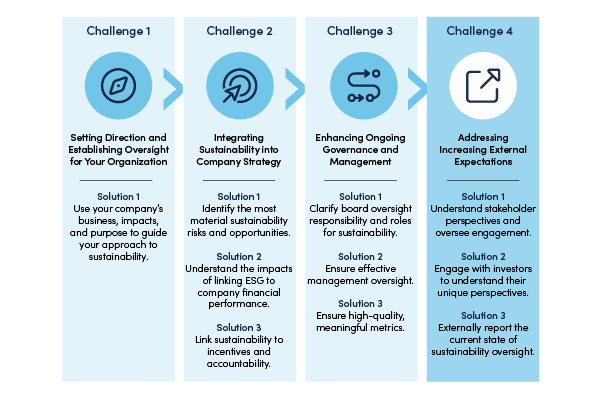
In responding to these challenges, boards may encounter a range of sustainability issues. Individual companies benefit from understanding which topics are “material” to the company—relevant both to business success and to impacts on society and the environment. To that end, the report provides guidance on board oversight of the process to identify material issues, as well as on key topic areas ranging from understanding climate risk to the role of the board in overseeing human rights.
By grounding board oversight in the solutions proposed in the Primer and a focus on “material” topics, directors can promote a robust approach to corporate sustainability, thereby helping to fulfill their duties as directors, stewards of long-term value creation, and overseers of the company’s impacts on society and the environment.
NACD members may access the full report via NACD; BSR members may access the report via the BSR member portal or by contacting their Relationship Manager.
Audio | Thursday February 1, 2024
What’s at Stake for Sustainable Business in 2024
Aron Cramer , BSR President and CEO, chats with David Stearns following his recent blog on the pivotal questions shaping sustainable business in 2024 to explore questions such as: What can and should business be doing to uphold the rule of law in light of elections that will impact nearly…
Audio | Thursday February 1, 2024
What’s at Stake for Sustainable Business in 2024
Preview
Aron Cramer, BSR President and CEO, chats with David Stearns following his recent blog on the pivotal questions shaping sustainable business in 2024 to explore questions such as:
- What can and should business be doing to uphold the rule of law in light of elections that will impact nearly two-thirds of the world’s population in 2024?
- Are businesses aware of what’s at-risk with these elections and are they taking steps to prepare?
- For fast-evolving technologies such as AI, what role can governance play in ensuring its responsible use and development?
- What gives you hope that we can emerge from 2024 in a better place?
Case Studies | Wednesday January 31, 2024
Conducting a DEI Assessment in Asia Pacific
BSR worked with Zuellig Pharma to conduct a Diversity, Equity, and Inclusion (DEI) Assessment using BSR methodology to gauge the effectiveness of Zuellig Pharma’s DEI efforts and determine its level of maturity and ability to continuously improve.
Case Studies | Wednesday January 31, 2024
Conducting a DEI Assessment in Asia Pacific
Preview
Introduction
In 2021, BSR worked with Zuellig Pharma, a healthcare solutions company increasing accessibility to healthcare in Asia Pacific (APAC), to conduct a Diversity, Equity, and Inclusion (DEI) Assessment. Using BSR's methodology, the assessment gauged the effectiveness of Zuellig Pharma's DEI efforts and determined its level of maturity and ability to continuously improve. This included an assessment of the company's DEI-related policies and procedures, internal DEI governance, and the existing level of external reporting on various DEI topics. The assessment revealed that Zuellig Pharma was in the early stages of its DEI maturity journey. BSR provided valuable recommendations for Zuellig Pharma to proactively address identified gaps and fortify its existing DEI initiatives. The strategic guidance helped Zuellig Pharma strengthen its DEI commitment and evolve its DEI program into a more robust and established framework.
Background
Zuellig Pharma is a healthcare solutions company covering 16 markets across Asia, with the mission of making healthcare more accessible to the communities it serves. The company provides distribution, digital and commercial services to support the growing healthcare needs in this region.
Zuellig Pharma's Sustainability Framework is built on four pillars. One of these is “Nurturing Talent,” which defines how the organization creates an inclusive and safe work environment that empowers employees to reach their full potential. This covers focus areas such as talent recruitment, development and retention, employee well-being, and DEI. Given the diverse cultural landscape within the region that its operations cover, there is a high level of diversity within the organization, leading to Zuellig Pharma identifying DEI as a material topic for the company.
The Challenge
Zuellig Pharma expressed a collective desire to operationalize and formalize its commitment to DEI to build upon its diverse environment and to comply with prevalent industry requirements and existing ad hoc DEI initiatives. Recognizing the pivotal role that DEI plays in the company's overall success, the senior leadership sought to enhance both internal and external DEI support across all offices in the APAC region, and the company prioritized fostering cross-cultural sharing and gaining insights into the varied interpretations of DEI across its different offices.
Prior to launching a comprehensive DEI program, which involves formalizing commitments at the highest levels and cultivating a DEI strategy and culture throughout the organization, Zuellig Pharma recognized the need to assess its existing internal DEI efforts. The company aimed to understand its current standing, identify best practices, and pinpoint opportunities for further engagement. Consequently, Zuellig Pharma enlisted the expertise of BSR to conduct a thorough DEI assessment.
BSR’s Response
The assessment’s objectives were to identify opportunities to integrate inclusive policies and practices across its business; understand the gaps, challenges, and opportunities by creating a diverse, equitable and inclusive workplace; improve stakeholder experience and engagement across Zuellig Pharma’s business; and identify opportunities for further engagement with a view to develop a DEI strategy via a clear roadmap. The intent of the findings from this assessment was to enable Zuellig Pharma to strengthen its commitment to DEI.
BSR's DEI Assessment methodology included a review and gap assessment of Zuellig Pharma’s internal policies and procedures, as well as a series of confidential discussions with the company's DEI taskforce (including senior management, which gave leadership buy-in for this exercise) on key DEI material topics, such as: LGBTIQ+ Allyship, Cross-Generational Exchange, Mental Health and Wellness, Race, Religion, Ethnicity, Cultural Awareness, Socioeconomic Empowerment, and Gender Equality.
An employment perceptions survey, deployed across 13 geographies/offices in the APAC region, gathered insights from employees across cohorts in the following geographies: Brunei Darussalam, Cambodia, China, Hong Kong, Indonesia, Korea, Macau, Malaysia, Myanmar, Philippines, Singapore, Taiwan, Thailand, and Vietnam.
The results of the employee perceptions survey (both qualitative and quantitative) offered in-depth insights and perspectives into the employee experience, including opportunities, challenges, and concerns. These insights and perspectives provided views around three key questions:
-
What are the key social issues that are important to you as an employee of Zuellig Pharma?
-
What is Zuellig Pharma doing well to foster DEI?
-
What activities could make the company more diverse, equitable, and inclusive?
Impact
The successful conclusion of the DEI assessment highlighted that Zuellig Pharma had a strong foundation for further developing its DEI program, and it helped the company understand the gaps and challenges. Through the DEI assessment, offices across 13 geographies were able to identify contextually and culturally specific priorities, and the internal regional assessment allowed teams from different countries to engage on similar goals related to DEI.
The DEI assessment established a baseline for Zuellig Pharma to not only identify best practices but also uncover opportunities for enhancing its commitment to fostering a diverse and inclusive workplace via the integration of inclusive policies and practices. With strong support and buy-in from senior leadership, Zuellig Pharma formed its DEI Core Committee, comprising six pillars and informed by the DEI assessment. This exercise was an important first step in informing Zuellig Pharma's subsequent DEI efforts in fostering a more inclusive workplace since it helped prioritize DEI topics that were important to its employees.
Building on the DEI assessment, Zuellig Pharma achieved several DEI milestones. It launched various initiatives informed by the priority areas from the DEI assessment: creating an inclusive environment for working mothers (addressing Gender Equality), bringing generations together to discuss ways to better work together and leverage each other’s strengths (Cross-Generational Exchange), normalizing talking about mental health issues at the workplace (Mental Health and Wellness), and conducting a survey to identify opportunities for further conversations to support the LGBTIQ+ community (Employee Engagement).
Key outcomes arising from the DEI assessment and the initiatives and improvements resulting from the assessment include:
-
More than 50 percent of Zuellig Pharma’s employee base and middle management positions are now occupied by women, and the company has made progress in increasing the representation of women in senior management roles over the years.
-
The average unadjusted gender pay gap at the company is 0.16 percent for equivalent roles and skill sets (in comparison, the global average is 20 percent).
-
100 percent of its employees has completed anti-discrimination and harassment training.
“BSR has been a steadfast partner of our Sustainability efforts, bringing to Zuellig Pharma the expertise and support to create meaningful impacts. In the field of DEI, our work with BSR sets us on the path of sustainable excellence, which can only be achieved through equal opportunity, cooperation, and a progressive mindset. With BSR we strive to foster a culture of continuous progress and a workplace where the success of our employees knows no bounds.”"
- Jean-Gaetan Guillemaud, VP, Corporate Affairs
Conclusion
Against a global backdrop where DEI approaches are increasingly used as a strategic tool to improve competitive advantage, elevate employee engagement, and foster a more supportive and inclusive workplace that values diversity, a similar trend is emerging in the APAC region. The growing interest in understanding and implementing DEI practices in APAC is underscored by the diverse maturity levels and ambitions of companies, coupled with varying perspectives on DEI across regions. Recognizing this diversity, there is no universal framework or 'one-size-fits-all' approach.
In this context, establishing an ambitious long-term vision and mission for DEI requires a strategic initial step. For companies embarking on their DEI journey, undertaking a DEI assessment becomes paramount. This first step allows organizations to comprehensively understand and evaluate their current internal DEI initiatives, while pinpointing opportunities for further engagement. In the case of Zuellig Pharma, the DEI assessment helped the company to recognize the diverse landscape of DEI perspectives and practices as the foundational step to establishing a baseline for its DEI roadmap.
Get in Touch
This case study was written by Kelly Scott and Jiajia Chen. Please direct comments or questions on working on DEI in the APAC region to the EIJ team.
Blog | Monday January 29, 2024
Ten Guiding Principles for Co-creating Climate Justice Interventions
Learn about the 10 principles that can guide businesses in co-creating climate justice interventions with affected communities.
Blog | Monday January 29, 2024
Ten Guiding Principles for Co-creating Climate Justice Interventions
Preview
While business leaders are starting to consider how climate change disproportionately affects people and communities, there are few examples of how the private sector is working with affected stakeholders. In fact, at a BSR hosted “Roundtable Discussion on Climate Justice and Authentic Collaboration”, 70 percent of business participants indicated that they need support in understanding how to approach climate justice.
By incorporating a co-creation process, business leaders can center communities most affected by climate change in ongoing discussions as they experience the injustice firsthand and can identify solutions that best fit their needs. Thoughtful and intentional co-creation facilitates conscious inclusion of those who historically were or are excluded from both policy and business decision-making processes; presents an opportunity to address disparities and systemic inequities; and enhances institutions and climate solutions through diversity of experience, thought, and expectations.
Co-creation can also offer a level of innovation and creativity in climate solutions that far exceeds what could be achieved if done alone. To deliver benefits to both affected communities and businesses, it is essential to work directly with affected communities and local community-based organizations at the onset—not separately or at later stages after decisions and investments have been made.
The following 10 principles can guide businesses in co-creating climate justice interventions with affected communities.
-
Listen First and Listen to Learn
When engaging communities, companies should come prepared to listen to learn and foster understanding of the affected stakeholders’ experiences, perspectives, needs, resources, and capacities.
-
Move at the Speed of Trust
Budget time and resources appropriately for thoughtful decision-making and manage expectations on the amount of time necessary to build mutual respect and trust. A timeline for the specific intervention should be agreed on, and regular checkpoints to reassess progress and comfortability will allow all parties to understand when timelines should be adjusted. While progress may be slower, outcomes are more likely to be just and sustainable for all parties.
-
Cultivate an Inclusive Environment
Inclusive representation and culturally sensitive, respectful language to cultivate an inclusive environment will promote trust-building. A culture of inclusivity will give stakeholders agency and a platform to voice their opinions and perspectives from lived experience, enhancing the business-community relationship.
-
Communicate Transparently
Stakeholders—from investors to consumers to workers—are calling on companies to provide increased transparency on climate action. To foster and maintain trust, ensure communication and feedback between the company and affected communities are open, honest, and timely and objectives are transparently shared.
-
Ensure Mutual Benefit
Affected communities have the most to lose from climate change but are often excluded from an equitable share of the benefits of climate solutions. Benefits should come from what the communities themselves are asking for, not what the business may imagine communities need or want.
-
Contend with Systemic, Historic, and Contemporary Injustices
Recognize, take responsibility for, and remedy past and current community harms for which businesses have caused or contributed, and use leverage to address harms to which the company is linked. Understand how existing structures, societal norms, and frameworks exclude the needs of disproportionately affected communities and consider how leadership, resources, and decision-making be redirected to those most affected and historically excluded.
-
Welcome Discomfort
Real and meaningful engagement on climate justice requires learning and reflection. By embracing dialogue and acknowledging feedback, businesses demonstrate that they are undertaking the necessary work, introspection, and accountability.
-
Include Last-mile Communities
Seek to involve last-mile communities—communities in rural, peri-urban, and urban areas that lack access to basic services such as water, sanitation, electricity, cellular devices, and transportation. Last-mile communities are often left out of stakeholder engagement and are isolated due to limitations like language barriers or inaccessible internet and communication tools.
-
Engage for the Long Term
Similar to other social justice efforts, climate justice requires companies to make a long-term commitment to the communities with whom they engage. From learning and listening to acting and fostering equitable partnerships, companies need to approach climate justice with the understanding that it requires sustained and deep engagement over time to enable trust-building and lasting change.
-
Continuously Evaluate and Adapt
Continuously monitor and evaluate interventions to ensure they are achieving desired outcomes and responding to shifting priorities and circumstances as well as the recommendations and needs of communities most affected by climate change. Adapt interventions as needed based on key learnings throughout the process and evolving pressures and challenges associated with addressing climate change.
The principles, while ambitious, are meant to inform and steer co-creation between businesses and affected communities. Business actions aligned with these principles can better forge relationships with affected communities, build trust, and make collective progress toward climate justice.
The 10 principles are summarized from a more in-depth BSR issue brief that provides additional context for co-creation as well as an approach that outlines recommended phases of activity for co-creating climate justice interventions between business and communities.
Blog | Thursday January 25, 2024
Leveling the Global Playing Field: A Binding Treaty on Business and Human Rights
A wave of mandatory human rights and environmental due diligence rules sweep across Europe. Learn more about how business can prepare for a globally binding treaty on business and human rights.
Blog | Thursday January 25, 2024
Leveling the Global Playing Field: A Binding Treaty on Business and Human Rights
Preview
As a wave of mandatory human rights and environmental due diligence rules sweep across Europe, governments are negotiating a globally binding treaty that would require governments to ensure that businesses respect and are accountable for human rights throughout their global value chains.
The negotiations began after the UN Human Rights Council—led by Ecuador and South Africa—created an open-ended intergovernmental working group (IGWG) in 2014 tasked with elaborating a legally binding instrument to regulate the activities of transnational corporations and other businesses. China and Russia have been strong supporters of the IGWG’s mandate while the United States and the European Union (EU) only recently started engaging in this process.
Released in July 2023, the latest draft treaty centers the rights of victims to access remedy and requires governments to ensure companies respect human rights and undertake and publish human rights impact assessments on a regular basis. Legal liability extends to natural and legal persons and includes criminal, civil, and administrative liability.
If approved, States that adopt the treaty would be required to transpose treaty commitments into domestic law, thereby making it binding on companies in their jurisdictions.
Closing the Global Governance Gap
The treaty effort follows five decades of growing awareness that companies have faced little accountability for human rights harms when operating transnationally. In 1972, President Salvador Allende of Chile spoke to the UN General Assembly about the growing impact of ‘transnational corporations’ on developing countries, stressing the need to address the global governance gap surrounding multinational companies and their impact on human rights and development.
The 2011 endorsement of the UN Guiding Principles on Business and Human Rights (UNGPs) by governments was a major milestone in the direction of closing this gap. A soft law instrument, the UNGPs have provided a critical foundation for advancing the integration of human rights in core business and emerging regulations.
At BSR, we have seen a rise in the number of companies implementing the UNGPs as well as multi-stakeholder initiatives that incorporate them.
Yet over twelve years since their adoption, gaps in business uptake remain. In 2023, the Corporate Human Rights Benchmark (CHRB) found that while most companies are making progress on human rights due diligence (HRDD), most “have only made small improvements, with an average increase of just 2–3 points over five years.” CHRB previously indicated that companies that improved on HRDD had done so on the initial steps of due diligence, rather than tracking and communicating human rights-related actions.
While the EU’s Corporate Sustainability Due Diligence Directive promises to move the needle, movement in one region is not movement everywhere. EU companies, soon to be tasked with upholding human rights in global supply chains, will have a gargantuan task ahead if governments in other regions do not create enabling environments for responsible business in their jurisdictions.
Negotiating the Treaty’s Scope
Signaling awareness that voluntary measures are not enough, the US, the EU, and European countries constructively participated in the latest round of negotiations in October 2023. The EU announced that it is developing a formal negotiation mandate, and the UK acknowledged the value of a binding instrument for strengthening business and human rights protections.
Meanwhile, China—recognizing the negative impacts of transnational business on human rights and the environment—expressed support for the negotiation process and the potential contribution of a binding instrument for strengthening corporate regulation and accountability and providing timely and effective remedy to victims.
Two of the regions most impacted by irresponsible business—Africa and Latin America—were also active and coordinated.
Article 3, on the scope of business covered, is proving most contentious in negotiations. Some States, such as China, Russia, and South Africa, argue for a focus on transnational companies, while others, including the US, the UK, Chile, Mexico, and Panama, call for the scope to encompass all businesses. States also called for explicit reference to the protection of the environment, conflict-affected areas, international humanitarian law, children’s rights, and peasants, as well as definitions of victims and effective remedy. Some proposed adding financial actors, such as investors and banks.
As in previous years, statements by States and other stakeholders during negotiations were compiled and form the basis for updating the draft moving forward. Over 2024, IGWG will host inter-sessional consultations with States and an updated draft for negotiation is expected mid-year.
How Business Can Prepare for a Binding Treaty
To date, the role of business in treaty discussions has been limited. While the exact implications of the treaty for business remain to be seen—binding treaty processes often take years, even decades—companies already conducting HRDD have every reason to support the development of a treaty that builds on the UNGPs and the best practices that have ensued.
In addition to creating enabling environments for responsible business across regions, a treaty can help address the root causes of human rights harms deep in value chains, create a baseline of legal certainty across jurisdictions, and level the playing field for those businesses already taking steps to respect human rights.
To prepare for the eventual adoption of the treaty, companies are encouraged to:
-
Begin, or continue to, implement the UNGPs with rigor and heightened attention to ensuring access to effective remedy for victims of harms across global value chains;
-
Prepare for emerging regulation in ways that focus on the desired human rights outcomes of the regulation, not simply the letter of the law;
-
Seek to understand the substantive content of the draft treaty and how it could enhance company efforts to respect human rights globally, such as through more supportive public policy frameworks; and
-
Constructively and transparently engage in the UN process such that the treaty is founded upon a theory of change that achieves the desired outcome for people and draws upon practical experience.
It’s been over 50 years since the impact of global business activities took center stage at the UN. The potential for closing the global governance gap in international law and rewarding business leaders who have taken meaningful—and often underappreciated—steps toward managing their impacts on human rights has never been closer.
Blog | Friday January 19, 2024
Seven Actions for Business in 2024 Post-Roe America
A year after the fall of Roe v. Wade , learn more about how businesses are naviagting an increasingly tumultuous national landscape and advice for moving forward.
Blog | Friday January 19, 2024
Seven Actions for Business in 2024 Post-Roe America
Preview
Since the fall of Roe v. Wade in June 2022, companies from the Fortune 1000 to small businesses have supported abortion access as part of workplace health, safety, and well-being—and as part of gender equity commitments. At a fundamental level, abortion access matters to business because it affects approximately half of the workforce (some 60 million women of reproductive age) and has significant economic impacts on a micro and macro level.
Currently, 21 states and the District of Columbia have enacted more than 80 new laws protecting abortion access while 14 states have made abortion illegal. However, bellwether ballot initiatives since Roe was overturned in seven states, including Ohio, Kansas, Kentucky, Montana and Michigan, affirm that the overwhelming majority want healthcare decisions to remain between patients and providers.
Restrictive public policies compound healthcare deserts in states that extend beyond reproductive care, create avoidable medical emergencies, and impose financial and travel burdens for those seeking abortion access.
Meanwhile, litigation in many states and courts continues to cause confusion alongside the introduction of policy proposals in the states seeking to restrict employers’ benefits.
This ongoing public health crisis sets up companies as a firewall when it comes to enabling access to abortion—a form of healthcare that one in four women may need over the course of their careers. Employees are aware of this fact. According to 2023 research on Talent and Social Policies conducted by Morning Consult, on behalf of BSR:
-
By a 2:1 margin, workers want to live in a state where abortion is legal and accessible.
-
Nearly half of workers are concerned for themselves or their partner being criminally charged or going to prison for having an abortion in a state where it is illegal.
-
More than a third of workers are concerned about having enough money for themselves or their partner to travel out of state for an abortion.
Stories are coming out about the severe impact and consequences since the overturn of Roe and state abortion restrictions on women and their families. Nationally, the number of people who crossed state lines to obtain abortion care more than doubled.
In Texas, Kate Cox, a 31-year-old mother of two had to flee the state to obtain an abortion as a result of unsuccessful litigation to clarify medical exceptions. According to Reed Smith, the law firm that filed an amicus on behalf of businesses that operate in Texas:
“This is why businesses will continue to struggle to recruit and retain talent [in Texas]. This is why pregnant women from other states are hesitant to travel to Texas for business meetings. This is why conferences are moving their events to other states. This is why doctors are leaving the state."
What actions can companies take in this environment?
1. Continue to Mitigate Harm on the Workforce
Audit the availability of abortion care to ensure coverage under all circumstances within networks through medical plans where the company operates, including remote workers.
-
Ensure that employees can go out of network, at no added cost if necessary, and that travel costs are covered in addition to access to paid sick days.
-
Revisit practices to support pregnant employees who travel for work to states where abortion is illegal and may need to access emergency care.
-
Close the gap on abortion access for workers who may not be eligible for regular benefits, such as hourly workers, contractors, and populations within the workforce already facing barriers to healthcare and financial security.
-
Strengthen reproductive health benefits to go beyond the minimum requirements of the Affordable Care Act when it comes to contraception, health screenings, and other prevention measures.
-
Communicate the benefits and other programs available to help workers access time-sensitive and confidential healthcare inclusive of reproductive healthcare as well as LGBTQ+ care.
The Pro Repro Playbook provides free guidance to companies on developing and implementing benefits to support the reproductive health of their employees.
2. Advocate
At the national level, support codifying abortion access and let members of Congress know that employers oppose national bans. Employers can make the case to officeholders to support efforts to reduce barriers to reproductive healthcare as a matter of worker wellbeing as well as implications for regulatory authority, interstate travel, and commerce.
-
Engage officeholders about the onerous impact on employers and the chilling effect that restrictions have on the state business climate. Case examples include Indiana, South Carolina, Ohio and North Carolina.
-
Work in coalition with metro, state, and national business associations to counter the advancement of abortion restrictions by officeholders before proposals are advanced.
-
Sign amicus briefs to signal an understanding of the greater stakes. Case in point, the pharmaceutical and biotech industry took a historic stance against a targeted effort to revoke access to an FDA-approved abortion medication given the potential to overturn the regulatory framework industries rely upon. Medication abortion accounts for more than half of all abortion care in the US and is also used to manage miscarriage. Cases are still pending that will determine medication access.
-
Join Don’t Ban Equality, a platform that enables companies to work with industry peers across the private sector as well as other influential organizations on the workforce impact and economic costs of abortion restrictions.
3. Align Political Contributions
Align—once and for all—public positions and political influence with operational and workforce policies. Abortion access is now legislated in every state, and a company’s public and internal commitments to worker health and well-being as well as gender equity may directly contradict political contributions and influence. This contradiction will increasingly become untenable for workers, customers, and other stakeholders.
-
Review and update the criterion for making political contributions and test what giving preference to candidates and organizations that support abortion access could look like. Be prepared to defend your position.
-
Measure internally how well the company’s (and any PAC) political contributions align with stated values and public policy priorities. Publicly report out metrics measuring this alignment, and approaches to reducing misalignment.
-
If reallocation is not possible, commit to educating recipients of political donations on how their positions on social issues harm the workforce and business environments. Appeal to them to reprioritize their agendas.
4. Audit Corporate Matching and Workplace Giving
Do not authorize corporate matching or workplace giving for anti-abortion organizations that infringe on reproductive health access. Consider criteria for organizations that receive corporate donations, including passive tools such as matching and payroll deduction.
5. Make Abortion Access Part of Event and Office Site Selection
Some corporate travel planners and HR leaders are quietly working to address a growing set of risks to employees. Companies are enacting travel policies that restrict or are acknowledging the risks of hosting events in places where abortion is illegal or inaccessible. Increased restrictions are prompting new questions relevant to site selection, including access to care and treatment for workers facing urgent health crises, let alone new threats of invasive law enforcement action.
6. Minimize Data Collection in Products and Services
The collection of user data by companies and tracking of users’ online activity about reproductive health creates significant risks to seekers and providers of healthcare services and unnecessary reputational risk for employers. Among the key actions companies can take include:
-
Undertake human rights due diligence to identify risks to sexual and reproductive health that may be associated with the development or use of new or existing platforms, devices, products / product features. Companies need to consider state restrictions on reproductive health when deciding on the location of offices, data centers, or other assets that might give a state jurisdiction over the user data.
-
Apply best practice privacy principles, such as data minimization, purpose limitations, purpose-based data retention, and user transparency and control.
-
Deploy end-to-end encryption on private messaging services.
-
Set default privacy settings to the highest level of privacy protection. Privacy protections should be based on an opt-out model, not an opt-in model.
7. Support Civic Engagement through Voting and Elections
A touchstone of American Democracy is safe and fair elections as well as robust engagement by all communities nationwide.
-
Provide paid time off to vote even if it is not required in all states where the company operates. Workers shouldn’t have to choose between earning a paycheck and voting.
-
Recruit and recognize employees serving as poll workers and poll monitors as part of workplace volunteerism. This is fundamental to how democracy functions in America.
-
Engage with officeholders to express support for elections through investment and reform to meet administrative challenges.
The fall of Roe added to an already tumultuous landscape, leaving employers to navigate an increasingly complex patchwork of new and proposed restrictions. The costs of insufficient action become more tangible while the impact of this ongoing public health crisis accelerates.
BSR’s Center for Business and Social Justice works with a network of civil society partners and experts in reproductive health to provide actionable guidance to business. All BSR members can contact the Center for specific inquiries.
Case Studies | Thursday January 18, 2024
Defining Ambition and a Pathway toward a Nature-Positive Future
BSR worked with Hafslund to 1) help provide a better understanding of the current nature landscape, including key regulations, initiatives, frameworks, and standards, and 2) define the company’s stated goal of, and pathway to, contributing to a nature-positive future .
Case Studies | Thursday January 18, 2024
Defining Ambition and a Pathway toward a Nature-Positive Future
Preview
Introduction
BSR worked with Hafslund, a Norwegian hydropower-focused renewable energy company, to 1) help provide a better understanding of the current nature landscape, including key regulations, initiatives, frameworks, and standards, and 2) define the company’s stated goal of, and pathway to, contributing to a nature-positive future. BSR conducted a nature landscape assessment of external global standards and initiatives, as well as those specific to the Nordics, around nature and renewable industries, benchmarking Hafslund against its peers and market leaders. Subsequently, BSR developed a high-level action plan to guide implementation and action on nature.
Background
Hafslund is a Norwegian renewable energy company that owns and operates hydropower plants throughout Norway. The group supports half of Norwegian households’ electricity needs and is one of the largest producers of renewable energy and district heating in the Nordic region, promoting responsibility toward nature within and beyond its operations.
Hafslund's work in supporting positive contributions to nature relies on protecting the environment and the biodiversity around its old and new facilities, reducing its encroachments on nature and efficiently using its materials and resources by promoting circular economy principles.
Striving to be a sustainability leader, Hafslund’s strategy focuses on key issues impacting the planet, including transitioning its business and operations to climate and nature positivity.
The Challenge
As a producer of renewable energy, Hafslund is dependent on natural resources. However, the development of renewable energy facilities has direct and indirect nature impacts and dependencies that the company needs to properly understand.
Although Hafslund was already quite advanced in its sustainability journey, as well as in its nature journey, the rising support of governments (e.g., REPowerEU), the nature momentum since COP15, and the current and future uptake of key frameworks such as the Science Based Targets for Nature (SBTN) and the Taskforce on Nature-related Financial Disclosures (TNFD) facilitated the company's decision to better define and advance its nature-positive commitment.
In working with BSR, Hafslund looked to leverage a combination of nature, strategy, and reporting expertise to gain a clearer understanding on how to strengthen its nature engagement while responding to current and emerging regulatory (e.g., the Corporate Sustainability Reporting Directive, or CSRD; EU Taxonomy; EU Strategy on Offshore Wind Renewable Energy; Norway Climate Action Plan 2021-2030; etc.) and investor expectations in the evolving nature landscape.
BSR’s Approach
Utilizing its nature and strategy expertise, BSR worked closely with Hafslund to develop a strategic vision and action plan for protecting nature, aligned with best practices and leading standards and frameworks, such as the Global Biodiversity Framework (GBF).
BSR's approach constructed a foundation based on three strands of research and analysis. First, the project focused on understanding and analyzing Hafslund's existing nature-related work and projects, future goals and commitments, and reporting. Second, this was followed by a landscape assessment, which provided insights into the standards, regulations, and initiatives at both a global scale as well as those most relevant to the renewable energy sector and the Nordic market. Finally, to better understand leading practices in the market and evaluate Hafslund's positioning, BSR benchmarked three market peers and one leader to analyze their approaches and best practices and assess their maturity on nature across various dimensions, such as governance, policies, and operations.
By bringing together an understanding of the landscape and trends in the external environment alongside a rigorous, topic-focused benchmark, BSR was able to analyze Hafslund's current performance alongside existing and future expectations in nature. To do this, BSR identified gaps as well as areas of relative strength in Hafslund's current nature work and developed tailored recommendations on how to define and advance its nature commitments.
To help turn the recommendations into reality, BSR developed a nature action plan for Hafslund, specifying the goals and suggested actions to take in the short, medium, and long term. These were accompanied by high-level timelines for implementation, identification of governance and management needs at each stage, and the partnerships and initiatives recommended to support each activity. The action plan aims to advance the development and the implementation of Hafslund's comprehensive nature strategy.
Impact
By analyzing the external landscape and leading peers alongside Hafslund's existing and envisioned performance in nature, BSR was able to develop a clear and tangible action plan focused on achieving its nature-positive goal.
By providing clear actions tied to overarching objectives and timeline, Hafslund has been well-positioned to advance quickly on its nature journey, taking the following steps:
- After BSR’s analysis, the Hafslund sustainability team conducted workshops with more than 20 stakeholders throughout the company to seek their input and buy-in on the long-term plan, with actions and priorities recommended by BSR aligning well with those of their internal stakeholders.
- The company has begun conducting a nature assessment of its direct operations and collecting data in line with both applicable regulations as well as prevailing frameworks.
- The focus on nature has led to important conversations across teams, as well as an upcoming conversation with the board, about how Hafslund staff can “lift” nature in every aspect that they work on and how the company can engage and inspire its employees in supporting its nature-positive goals in their day-to-day activities.
- As of writing, Hafslund was currently mapping out a short-term implementation roadmap—including key tasks, allocation, and KPIs—for review by its board.
Overall, Hafslund evolved from having a high-level ambition to reach a nature-positive future to taking steps to actually achieve it, thanks to its new robust action plan and clear path forward.
"Looking back, BSR’s work was critical for Hafslund to get ahead of all standards on the horizon, in what is a fast-paced and complex area of corporate sustainability."
- Otto Vik Mathisen, Strategic Advisor at Hafslund
Conclusion
Companies are adapting to an increasingly complex landscape, where key emerging frameworks are guiding corporate commitments and actions. Within this context, and with evolving stakeholder expectations, it is increasingly important for companies to understand and engage on nature. Organizations like Hafslund that have taken critical steps on their nature journey will be better prepared to navigate the shifting landscape while promoting long-term business resilience.
Get in Touch
This case study was written by Erin Leitheiser, Juliette Pugliesi, and Sarah Cornelles. If your team is also interested in nature support, from better understanding regulatory landscape and peer positioning to defining nature goals and strategy, please reach out to us to learn more.
Reports | Wednesday January 17, 2024
Co-creating Climate Justice Interventions between Business and Communities
Via a co-creation process in business activities related to climate action, companies can enable more effective climate solutions that address interconnected, systemic issues.
Reports | Wednesday January 17, 2024
Co-creating Climate Justice Interventions between Business and Communities
Preview
While businesses are starting to consider the ways in which climate change and climate solutions disproportionately affect people and communities, there are few examples of how the private sector is working with affected stakeholders and little guidance on how to co-create climate justice interventions with affected communities. Co-creation, in the context of climate justice, centers affected communities in identifying challenges and developing solutions to address systemic injustices and advance equitable social, environmental, and climate outcomes.
The issue brief shows business practitioners how to implement climate justice interventions by using a process of co-creation with affected stakeholders. By incorporating a co-creation process in business activities related to climate action, businesses can enable more effective and efficient climate solutions that holistically address interconnected, systemic issues. This issue brief builds a foundational understanding of co-creation with communities in the context of climate justice, specifically what it is, why it is important, and how companies can integrate co-creation into their approach to address climate change. Insights and discussions fostered during BSR-facilitated workshops and collaborative initiatives informed this report. BSR acknowledges 7-Eleven International for their generous support to create this issue brief.
Reports | Monday January 15, 2024
Action for Sustainable Derivatives: Annual Update on Progress, 2023
Explore ASD’s progress on its approach to action, deepening engagement with supply chain players, and scaling impact on the ground.
Reports | Monday January 15, 2024
Action for Sustainable Derivatives: Annual Update on Progress, 2023
Preview
The latest update from Action for Sustainable Derivatives (ASD), an industry-led collaboration aimed at achieving sustainable production and sourcing of palm oil derivatives, discusses its progress in 2023. This includes strengthening ASD’s approach to action through more proactive grievance monitoring and management, deepening engagement with supply chain players, and scaling impact on-the-ground.
Highlights include:
- Collective transparency for 1,100,000 tons of palm-based materials, representing 11% of the global palm-based oleochemicals market, including 47.5% transparency to plantation level.
- Proactive monitoring of deforestation grievances through a year-long pilot of Nusantara Atlas satellite monitoring tool, and working towards an understanding of % deforestation-free volumes.
- Trader engagement to discuss possibilities for stronger supply chain control mechanisms
- Demonstrated positive impact on-the-ground after a full year of collective support to the Kaleka Mosaik Initiative and continued progress with the ASD Respect in Palm pilot program.
Learn more about ASD's impact.
Blog | Wednesday January 10, 2024
CEO Outlook: Seven Pivotal Questions Shaping Sustainable Business in 2024
BSR President and CEO Aron Cramer poses seven questions for business that will define the scale of progress in the year ahead.
Blog | Wednesday January 10, 2024
CEO Outlook: Seven Pivotal Questions Shaping Sustainable Business in 2024
Preview
The multiple shocks and surprises affecting our world in the 2020s can easily lead us to think that we don’t know what’s coming next. It would be folly—and senseless—to diminish the impacts of a global pandemic, geopolitical conflict, and social upheaval.
And yet, as world-shaking as these disruptions are, the underlying questions at the heart of the role of business in society remain very clear. Our collective challenge is focused on three fundamental goals: accelerating the shift to an inclusive clean energy economy, ensuring that revolutionary new technologies are designed and deployed in service of society, and creating more equitable societies and economies.
These were all core questions in 2023 and they will continue to be for the foreseeable future. And they will be BSR’s focus in 2024. As we work with our 300+ member companies globally to support their ability to transform in service of these goals, we will be focusing our insights, advice, and collaborations on these areas.
While 2024 is in many ways a continuation of underlying changes that continue to reshape our world, the new year does present some unique questions. How we respond to them will shape not only how this year plays out, but also our lives for many years to come.
Here are the seven questions that will define how much progress is made in the year ahead.
1. What impact could the 2024 global elections have on just and sustainable business, and what can companies do about it?
Nearly two-thirds of the world’s population is living in countries with elections in 2024: more than any other year in human history. These elections are, in one way, a triumph for democracies that emerged and proved resilient in the 20th century. But many people are fearful of change, facing dislocation, and are on the receiving end of misinformation. This fertile ground for populist backlash risks undermining progress on climate action, diverse and equitable societies, and the international cooperation needed for truly shared prosperity. So, while this year will understandably have a significant focus on politics, the spate of elections is very much a business issue. The outcomes of these elections will help determine not only traditional policy questions, but also the degree to which the rule of law is respected, whether international cooperation on climate and other shared challenges is possible, and the degree of support for global trade. Companies therefore should stand up for free and fair elections, and the protection of democratic processes. This role is not natural or comfortable for many business leaders. The stakes, however, are too great for businesses to stand aside.
2. Will the COP28 agreement mark a real transition?
The fierce debate over whether the COP 28 agreement was sufficient is, to some degree, beside the point. The more salient question today is: will nations, businesses, and investors breathe life into the agreement, or render it a dead letter? Investments, innovation, and collaboration are continuing, but not at the pace that’s needed to achieve the rapid transformation required to limit global warming. The just transition is now firmly on the agenda, but too few companies have comprehensive approaches needed to ensure the transition is equitable and fair for all people. The legal considerations that come along with new reporting and disclosure requirements threaten to focus attention on delivering the data rather than delivering clean energy at scale. As we enter 2024, it is not so much a course correction we need, but rather redoubling efforts, without which the emissions reductions needed by 2030 won’t materialize.
3. Are DEI commitments flagging?
There is substantial evidence that the post-2020 efforts to strengthen diversity, particularly in the US, are fading. Data suggest that companies have pulled back on DEI staffing, and the backlash against such efforts, including legal challenges in the US, is accelerating a pullback. But the need for continued progress in the effort to achieve more inclusive companies, workplaces, and communities, remains as compelling as ever. Representation on Boards and in senior management continues to lag behind the overall workforce. Income inequality continues and is partly to blame for the populist movements that have limited public commitments to progress on other key issues like climate and nature. In fact, the business case for DEI remains as strong as ever, not least given the changing nature of the workforce and consumer base. History also teaches us that there will be more moments of reckoning when companies will face pressure to explain their follow-through on prior commitments. Boards and senior management need to send clear signals that they embrace and are ready to develop the diverse workforces of the future, and this remains crucial despite legal challenges.
4. Can we ensure that emerging technology is developed responsibly and sustainably?
The arrival of generative AI was bookended by the emergence of ChatGPT at the beginning of the year and the OpenAI drama at its close. As Winston Churchill said in a very different context, this is only “the end of the beginning” of complicated debates over new technologies and their social impacts. My advice is to believe neither the techno-utopians nor the doomsayers: AI will deliver both great opportunities while presenting us with profound questions and dilemmas, and they will both deepen as the technology advances. And more questions, on other technological innovations, are coming fast: the first approved treatment based on CRISPR gene editing technology also arrived, albeit with less fanfare, in 2023, and biotech will present new and complicated dilemmas. The existing mishmash of efforts to set guidelines will only confuse matters. Setting the rules of the road for the key actors involved will require both smart and flexible regulation, ideally synchronized between jurisdictions, as well as self-restraint on the part of business. Here again, business is going to need to get engaged—appropriately—in promoting regulatory frameworks with sufficient flexibility to enable innovation to flourish.
5. Will new regulations turn sustainability into a compliance exercise?
As we have written over the past year, the rise of regulatory requirements is a game changer for every business. This is undeniably a beneficial development. There are many reasons to believe that performance and transparency will increase on a wide range of topics: climate and nature, reporting and disclosure, human rights, and corporate governance primary among them. We also see a number of unintended consequences that deserve ongoing attention. We hear from many companies that resources are being dedicated to compliance rather than performance. Businesses are busy preparing for the EU’s Corporate Sustainability Reporting Directive (CSRD); that makes sense currently but should not crowd out ongoing ambition and innovation. The valuable caution in avoiding greenwashing claims is also being applied to tamp down ambition, both in communication and goal setting. There is also a growing focus on what can be quantified and verified, which applies well in some cases (measuring emissions) and misses the point on others (positive social impact). Compliance is of course non-negotiable, but no company ever complied to innovation, ambition, and excellence, and sustainability has to find a way to achieve all of the above.
6. How is the role of the Chief Sustainability Officer (CSO) changing?
In our discussions with Chief Sustainability Officers, it is also clear that the role of CSOs and their teams is at a crossroads. There is no doubt that the increased boardroom presence of the CSO is a major step forward. This advance should not come at the expense of the change agent role that CSOs can uniquely play. They should look to the future, and not focus too much on quantifying past performance. CSOs must also learn to see across interconnected issues, not serve merely as technical engineers in specific domains. And, finally, they must understand and deliver qualitative benefits, and not focus only on things that can be measured and verified with precision: the best and highest role the CSO can play is not as a compliance officer. Maintaining the essence—and even the soul—of the role is crucial in 2024.
7. How will business juggle so much interlocking change?
The final question could be dismissed as a process question, but it is crucial. The reality is that business leaders are juggling an immense number of profound questions. Business models, the very nature of work, technologies, environmental challenges, and societal expectations continue to intensify and change. That will only accelerate this year and in the years ahead. This is why principled leadership, strong governance, and clear vision have never been more important. The to-do list for business is replete with items that present both transformative opportunities and so-called “wicked questions.” The impulse to say “not my problem” won’t work. Today’s leaders will be judged by how well they embrace change, make sense of it for their colleagues and stakeholders, and stay true to principle, while continuing to focus on long-term value creation that brings shared societal benefits and respects natural resource boundaries.
These questions are interesting to debate. But more than that, they represent a priority list for every business. In the year ahead, we will be advocating and acting to achieve real progress on each of these questions, and tracking how well business, business leaders, investors, and the entire enabling community meets these challenges. So, while 2024 will undoubtedly deliver unexpected questions and challenges, we know in advance what the ultimate test of our actions will be at year end.
For more from Aron and Sustainable Business in 2024, check out the episode in our BSR Insights Audio Series:
Search Again?