Searching for: Our network
Search results: 101 of 136
Case Studies | Monday September 19, 2022
Climate Scenarios with the National Association of Corporate Directors
BSR and the National Association of Corporate Directors (NACD) collaborated on a joint climate scenarios workshop for NACD’s Climate Continuous Learning Cohort, demonstrating the potential and value of these scenarios to navigate risks and opportunities for boards.
Case Studies | Monday September 19, 2022
Climate Scenarios with the National Association of Corporate Directors
Preview
In June 2022, BSR and the National Association of Corporate Directors (NACD) collaborated on a joint climate scenarios workshop for NACD’s Climate Continuous Learning Cohort, a group of approximately 50 current and future corporate directors. The workshop demonstrated the potential and value of climate scenarios to navigate climate risks and opportunities for boards in an era of increased transparency and duty of care.
Context
NACD is a member organization for corporate directors aiming to expand their knowledge, grow their network, and maximize their potential. It has worked with members for over 40 years to help improve their performance and create long-term value for their businesses. In March 2022, NACD launched a Climate Continuous Learning Cohort, a year-long learning initiative for peers to connect, share knowledge, and learn from each other. The program offers thought leadership in collaboration with NACD's community of experts, leading directors, and trailblazing companies to advance climate proficiency in the boardroom.
The Challenge
Boards are increasingly aware that addressing climate change is essential to building resilient business strategies. The energy transition, commodity costs and availability, extreme weather disruptions, climate justice, regulatory shifts—all have the potential to pose existential risks and provide opportunities for business.
Investors are shining a spotlight on these risks, like when the world’s largest asset managers call on boards to oversee climate disclosures or when the largest banks implement aggressive plans for decarbonization and climate risk management. Regulators and standards-setters around the world are also stepping up expectations for boards, often in alignment with recommendations from the Task Force for Climate-Related Financial Disclosure (TCFD). The International Sustainability Standards Board (ISSB), the US Securities and Exchange Commission (SEC), the EU Corporate Sustainability Reporting Directive (CSRD), the EU Corporate Sustainability Due Diligence Directive (EU CSDDD), the Japanese Financial Services Agency, and others are all poised to implement mandatory corporate climate disclosures that lodge responsibility for oversight with boards.
In light of both the growing urgency of climate change on the board agenda and the prevailing lack of climate expertise on boards, NACD reached out to BSR to collaborate on a climate scenarios workshop, based on our sustainability and board advisory expertise, our work on futures and scenario planning, and the reach of our global membership.

BSR’s Response
Building on work by the Network for Greening Financial Services, BSR tailored three scenarios to imagine potential versions of the world in 2030 and what they would mean for a fictive healthcare company. (While BSR typically facilitates customized scenarios workshops for participants from a single company, BSR adapted the approach to train directors from multiple businesses.) The scenarios addressed direct climate impacts as well as cross-cutting social, technological, economic, environmental, and political factors. NACD workshop participants collaborated to discuss risks and opportunities that each scenario would pose for the healthcare company.
BSR facilitators then led the group into the most crucial part of the conversation: If the participants were on the board of the healthcare company, what steps would they take to govern the company for future success and resilience across all scenarios?
Participants shared ideas for enhancing the board’s composition, structure, strategic engagement, oversight, and accountability measures. They identified questions for management and for boards to consider.
Examples of questions from the Board to management included:
- How might climate-related developments affect our business model and value chain? What alternative business models or approaches can be used to mitigate climate risk and unlock value?
- How ambitious do we want to be and when? What are the advantages/disadvantages of being an early vs. late mover?
- What are our biggest climate risk areas? How does this fit into enterprise risk management?
- How are we preparing for new reporting guidance (EU CSRD, CSDDD, SEC, ISSB, etc.)?
Examples for the Board included:
- How do we ensure a threshold of climate and ESG knowledge across all board members? How can we embed climate/ESG across all board committee charters?
- Do we have the right skills to address climate, including how it relates to existing focus areas such as policy, supply chain, geopolitics, etc.?
- Do we have access to insights from outside experts and stakeholder perspectives?
- How do we maintain a holistic understanding of climate and ESG impacts so that we don't look at issues in a vacuum?
Impact
The exercise brought to life several keys to success in using scenario analysis:
- Create engagement and ownership among the participants. Arguably more important than the actual output is that the participants drive the process themselves and take ownership of their relevance.
- Use scenario analysis to build capabilities, expand vision, and reveal blind spots—not to choose “the most likely” scenario. Single-point forecasts are often wrong, and basing efforts on one scenario can potentially expose a company to risk.
- Tailor the exercise to the specific company, its value chain, business model, and stakeholders, based on commonly accepted, science-derived inputs.
- Consider climate scenarios with a broad range of outcomes and that consider social, technological, environmental, economic, and political developments. Narrow scenarios can fail to account for reality of risk.
- Consider physical and transition factors, as well as acute and chronic climate impacts. Climate risk is not “just” about storms and floods.
- Identify actions by the board and management that promote business resilience across a diversity of potential scenarios, aligned with respective roles. Scenarios should not be an intellectual exercise.
Participants hailed the exercise as invigorating, educational, and strategically valuable. One participant noted that, “When it comes to climate, an issue that can shape the strategic direction of the company in the long-term, this can get boards to think in more broad and diverse perspectives.” By engaging those perspectives, another participant commented, “It brings wide-ranging considerations to the table—from capital allocation to changes in talent development and complex reporting.” Another participant summarized: “It forces the discussion and thinking further, which should lead to a more robust strategy.”
One participant put it more plainly: a scenarios exercises for the board “helps minimize 'oh shit’ moments.”
Conclusion
Training on fundamentals of climate change—such as those conducted by NACD—are essential to build the knowledge base of board members. Scenario exercises for boards take that engagement a step farther to look at the specific company and the broad context, strategic implications, and the role of the board in building resilient business strategies.
[The] NACD and BSR partnership has proven to be a strong one, as the board members who participated in the workshop found it interactive, relevant, and practical. Through the breakout discussions, the BSR team was able to provide actionable knowledge on how to evaluate and navigate climate risks and opportunities, regardless of industry. I truly valued BSR’s expertise and enthusiasm while working on this project!
-Ghita Alderman, Associate Director, ESG Content, NACD
Case Studies | Friday May 3, 2013
Telefónica: Assessing Human Rights Risks and Opportunities
BSR worked with the Spanish telecommunications company Telefónica to assess its human rights impacts, risks, and opportunities in each of its 16 operating regions.
Case Studies | Friday May 3, 2013
Telefónica: Assessing Human Rights Risks and Opportunities
Preview
The Challenge
In today’s networked world, the information and communications technology (ICT) sector is facing increased scrutiny for its role in enabling and inhibiting human rights—including issues as diverse as privacy rights; labor standards in product manufacturing; resource extraction in conflict zones; and contributing to respect for rights such as freedom of expression, health, and education.
The Spanish telecommunications company Telefónica, which operates in 16 markets in Europe and Latin America, has an interest in applying the same level of human rights protections in all of its diverse regions.
Telefónica engaged BSR to assess its human rights impacts, risks, and opportunities in each of its operating regions—marking what may be the first time a company in the ICT industry has done this.
Our Strategy
BSR worked with Telefónica to build an organizationwide human rights strategy grounded in a firm understanding of the company’s risks and opportunities to enhance human rights and gain business value through market differentiation and social innovation. We started by conducting a corporate- and country-level human rights impact assessment (HRIA) that included three steps:
- Internal assessment: We reviewed the company’s corporate policies and procedures and developed a global tool to measure Telefónica’s human rights risks and opportunities across 16 markets.
- Local assessment: Next, Telefónica’s country-level markets completed an HRIA to uncover risks and opportunities. This was done by examining the company’s management systems and activities, addressing regional risks and opportunities, examining its history of performance on human rights issues, and evaluating local stakeholders’ perceptions about the company’s impacts.
- Analysis and strategy plan: Based on these assessments, BSR provided practical recommendations to help the company address stakeholder expectations, strengthen management systems where needed, and improve due diligence on human rights at the corporate and country levels.
Our Impact
Telefónica’s new human rights plan has helped the company align decision-makers across all markets as well as at the corporate level. Through the plan, the company also has developed a plan for corporate headquarters and country-level operations to improve due diligence, risk mitigation, and management of opportunities.
Lessons Learned
Working with Telefónica on its human rights strategy demonstrated why it is important for companies to look at human rights in a holistic way:
- By examining not only risks but opportunities to advance human rights, it is easier to gain support from senior management and improve performance as a whole.
- It is important to educate in-country staff on human rights issues so they can help identify and address local challenges. It is also important to develop a strategy that is comprehensive enough to be applied across country operations, but that is flexible enough to adapt to local needs.
- In an HRIA, stakeholder engagement helps ensure that decision-makers understand the local context and use that knowledge to assess the effects of existing management systems and initiatives.
Blog | Thursday March 23, 2017
Lessons in Technology and Convergence from SXSW 2017
Here are four trends that ran through this year’s South by Southwest (SXSW) in Austin, Texas.
Blog | Thursday March 23, 2017
Lessons in Technology and Convergence from SXSW 2017
Preview
Healthcare and social media platforms, dogs and tech wearables, environmental conservation and virtual reality—to many, these topics seem dramatically divergent. But while attending this year’s South by Southwest (SXSW) Interactive conference in Austin, Texas, I found that they are anything but.
SXSW brings together global professionals from across industries to network and explore diverse topics in the worlds of tech, entertainment, and culture. Tracks ranged from brands and marketing to health, and from web development and coding to government. And while these tracks attracted participants working in completely different arenas, one underlying theme ran throughout the event: convergence.
As Kevin Clark of the Center for Digital Media Innovation and Diversity at George Mason University put forth in a session on addressing gender norms in entertainment media, the world of technology and media is an ecosystem; it doesn’t operate in isolation. More and more, companies, particularly in the technology sector, are partnering with other companies, foundations, governments, and nonprofits to collaborate on global issues and use emerging technologies to drive social and environmental progress. In our increasingly connected world, businesses and others are finding that they, too, must find ways to come together.
Under the overarching theme of convergence, here are four trends from SXSW for companies in all sectors to keep an eye on.
1. The emergence of augmented and virtual reality (AR/VR)
These terms were everywhere, and you couldn’t walk more than a city block without an opportunity to play around with the latest gadgets. While AR and VR technologies are still nascent, many conversations revolved around the question of how they will be used—including as a tool for generating empathy and driving and scaling societal change. I put on VR goggles to go “under the canopy” in the Amazon rainforest as part of an effort led by Conservation International with support from HP Inc., Jaunt, Johnson & Johnson, the MacArthur Foundation, and the Tiffany & Co. Foundation to raise awareness of the region and its value to human well-being. In a session on VR as a tool for accelerating global policy change, I also learned about Merck For Mothers’ work using VR to immerse policymakers in maternal health issues in their countries and remind government officials of the healthcare for which they are responsible.
2. Connections between technology and journalism, activism, and politics
Following 2016’s Brexit vote and U.S. presidential election, much of SXSW was focused on what the current political climate means for big data tracking, communications and journalism, and the relationship between government and technology. As U.S. Senator Cory Booker stated in the Interactive opening keynote, “If we are silent in the face of injustice, we are complicit in that injustice.” Booker was joined on stage by Google’s Senior Counsel on Civil and Human Rights Malika Saada Sar, and they discussed the role technology played and will continue to play in politics and how it can be an essential tool for “re-stitching our fractured society.” Other sessions also focused on fake news and “alternative facts”—one speaker offered potential solutions for social media platforms to fix algorithms so that they eliminate echo chambers and show users more diverse views, with the aim of reducing political polarization. She also suggested that, as artificial intelligence (AI) expands, those companies will have more responsibility for their influence on users.
3. Partnerships between tech and other sectors
Innovation and disruption reign at SXSW, and this year emphasized how tech intersects with other sectors, particularly health and medicine. For example, David Karp, the CEO of Tumblr, is leading an initiative to create tech community support for Planned Parenthood—using #TechStandsWithPP as the rallying hashtag to generate support for access to healthcare in the United States. In his keynote, former U.S. Vice President Joe Biden celebrated the technology sector for its dedication to cancer research. He urged innovators to help with electronic data-sharing and to connect and empower cancer patients. Other notable discussions included lessons that healthcare can borrow from tech, including using rideshare apps to connect patients with medical services, using VR to alleviate pain after surgery, and even how technology can enhance veterinary medicine and the relationship between humans and dogs.
4. Machine learning and AI
Nearly every day, the SXSW program featured multiple sessions on the future of AI and its societal implications. While AI and automation will benefit society in many ways, they are also already negatively affecting jobs and changing the nature of work. With ubiquity of AI on the horizon, conversations throughout the week focused on everything from the ethical use of AI therapists to chat bots and other AI innovations in marketing to governance, policy, and transparency issues.
Innovation is everywhere, and SXSW showcased how previously separate worlds are converging to connect people to information and services, increase empathy for global societal issues, and affect policy change.
And now, thanks to the countless innovations exhibited at SXSW, I’m also one step closer to finally being able to “speak dog.”
Blog | Thursday December 5, 2019
Blockchain through the Whole Supply Chain: Traceability at the Source Depends on Trust
This blog is the second in a series where BSR and Envisible document their project to support a global brand and its supply chain partners to establish a blockchain-enabled traceable supply chain that delivers sustainability benefits to all the actors in the supply chain.
Blog | Thursday December 5, 2019
Blockchain through the Whole Supply Chain: Traceability at the Source Depends on Trust
Preview
This blog is the second in a series where BSR and Envisible document their project to support a global brand and its supply chain partners to establish a blockchain-enabled traceable supply chain that delivers sustainability benefits to all the actors in the supply chain. It follows up on this blog, originally published in July 2019.
In the green hills of a small village, a group of about 300 farmers and members of a smallholder co-op are gathered around a converted schoolhouse, waiting.
Inside the building, a team from the cooperative is managing a well-organized crop sale as farmers file in one by one to participate in the sale process: presenting their product, having it graded and sorted, weighing it, and agreeing to the price. Finally, they are issued a paper bill to show what they are owed, and then they watch as the cooperative team enter the details on an Excel spreadsheet.
Our team (BSR and Envisible) was there to digitize and simplify this last step—collecting data electronically—with the hope of building upon the trust-based relationship that already exists between the co-op and the farmers and then enabling this data to be shared downstream to the rest of the supply chain, ultimately a global corporation and its consumers.
“Card,” Léon said to the farmer standing before him. Léon is a member of the co-op team responsible for ensuring that the weight, quality, and price data are correct and accurately recorded at the last step of the process before the farmers are paid.
The farmer reached into his bag and pulled out a newly issued membership card that identified him as a card-carrying member of the cooperative. Léon scanned the QR code on the card with his mobile phone, prepopulating a Wholechain digital record with key information about the farmer, coop, and location, and then added the agreed weight of the product sold. Finally, he clicked “send” to electronically send the record to the trader. Léon looked up, pleased.
“We’ve done 200.”

Léon was amazed that the app worked on the limited connectivity of the mobile network in the village (just above 2G) in the jungle. And he liked it significantly better than the manual data entry that he was used to.
At the end of a long day, 227 records of farmer transactions were saved on the blockchain, all reinforcing the facts: 227 farmers had shown up that day in that village and had sold hundreds of kilos of a critical agricultural commodity to their cooperative. These transactions, now immutable records on the blockchain, would form the foundation of a traceable chain of custody, forever linking these farmers to the global supply chain and ultimately the products sold far away from the quiet villages.
The foundation of this traceable supply chain is now in place, and the next steps over the coming months will be critical to completing the picture. Digitization and blockchain alone do not improve farmers’ lives; traceability is not equal to sustainability. What they do is provide a gateway—an immutable view into the specific community providing the raw material, altering how we think about raw material supply chains. Involving smallholder farmers directly in a traceability system is a powerful way to lay the groundwork to ensure that sustainability requirements are aligned to the needs of this key community since every transaction ultimately links back to them as the source.
The traceability system needs to make sense for and provide value to the farmers at the source. We left the village and the sale not only with digitized records on the blockchain, but with the following lessons that are critical for success when digital tools are introduced into supply chains such as this one:
- Simplicity is critical. During the sale, the team members were doing multiple tasks at once that demanded their attention. The system needs to be simple, easy to use, and work in challenging network environments.
- Digital tools must fit into existing systems. Rather than creating new processes, applications must enhance and reinforce existing ones. In the case of this sale, Wholechain only served to simplify an existing system.
- Digitization can enhance trust, but certainly not replace it. What we saw that day in the village was a great reminder that blockchain does not create trust. Blockchain is not “trustless” either. Blockchain enhances and builds on trust that is already there.
There is no denying that digitization can provide value to players way upstream: the farmers and cooperative appreciated the enhancements and are looking forward to more. Technology and digitization was seen as a reward for good practice and hard work between the farmers and the buyer. The connection has been established between the brand and the farmers at the source of a critical raw material. Let’s see what we can build from here.

Blog | Tuesday August 31, 2021
Creating Opportunities for Action: Advancing Children’s Rights in the Palm Oil Industry
The number of children in child labor has increased from 152 to 160 million globally, and COVID-19 is expected to further obstruct efforts to eliminate child labor. Here’s how palm oil companies can respect child rights and address this complex issue.
Blog | Tuesday August 31, 2021
Creating Opportunities for Action: Advancing Children’s Rights in the Palm Oil Industry
Preview
In January of this year, we published a blog highlighting practical steps that palm oil companies can take to respect child rights and address child labor in their operations and supply chains. In June 2021, the ILO and UNICEF reported that the number of children in child labor had increased from 152 to 160 million globally—and these numbers are expected to rise as the COVID-19 pandemic continues to affect Southeast Asia. COVID-19 is expected to further obstruct efforts to eliminate child labor as more children are expected to drop out of school and fall into hazardous work.
We can see these impacts playing out in the palm oil industries in Indonesia and Malaysia. Companies wishing to eradicate child labor from their supply chains may be best served by looking beyond their own value chains to the wider context in which they source and manufacture products and by partnering with other actors to address structural drivers and systemic issues which require an industry-wide approach.
Why Industry Collaboration Is Critical
Companies cannot tackle child labor in isolation, given its entrenched nature and complexity. While greater progress is needed on engagement and collaboration with governments and civil society, forming partnerships across the palm oil industry can be an impactful way to systemically address the issue. Here’s why:
- Industry partnerships can be integral to the success of strategies needed to leverage companies and their suppliers to prevent or mitigate child rights violations through promoting awareness and understanding of complex issues, encouraging others to act, and developing solutions together.
- Greater collaboration between businesses can identify and scale effective solutions and facilitate shared learnings while avoiding potential duplicated efforts. Individual company responses may not be as effective in tackling an issue rooted in poverty, for example.
- Increased collaboration can enable companies to share the risk and create a more level playing field.
A wide range of voluntary, business-led, industry-wide, and cross-industry initiatives has emerged in recognition of this need for greater collaboration.
How Palm Oil Companies Can Act on Child Labor
While the UN Guiding Principles on Business and Human Rights acknowledge the complexity of addressing human rights issues, they encourage companies to engage with a wide range of stakeholders. In addition to conducting human rights due diligence in their own operations and supply chains, as well as adhering to national and international laws and standards, companies can address complex issues such as child labor in several ways:
- Raise standards through the creation of industry guidance on due diligence, remediation, and monitoring to define corporate behavior regarding child rights violations.
- Work with relevant, local stakeholders to understand risks, look at potential solutions, or address a specific impact. For example, companies could partner with peers and local civil society organization (CSO) networks to lobby the government to make legislative changes. They could also advocate for a national action plan on child labor.
- Use leverage to engage with less resourced companies within supply chains and build capacity, raise awareness, and share best practices and lessons learned through training. Companies could work in partnership with leading organizations to develop training and/or guidance for suppliers on child rights, challenges, and practical solutions.
- They could also join a leadership platform on child labor to build on and strengthen existing efforts for collective action and practical solutions.
At BSR, we work with key players in the palm oil industry, including producers and buyers, to tackle child labor by integrating children’s rights into plantation policies and practices. Last year, we supported the development of agribusiness group Wilmar’s Child Protection Implementation Manual, in collaboration with global buyers. This year, we’re continuing our work with Wilmar—in collaboration with The Centre for Child Rights and Business and the Earthworm Foundation and with the support of global palm oil buyers— to pilot and test the manual’s practical applicability with a participating supplier and share lessons learned with Wilmar’s supplier base and the wider industry. A key deliverable of this project will include a manual, which will be adapted for the Malaysia context aimed at addressing complex issues related to foreign workers.
The manuals will not only be used as a guideline for the industry to respect and promote child rights, but more importantly, the pilot also demonstrates proactive steps toward risk management, accountability, collective action and building a shared understanding of how to address child labor in different geographical contexts. This is an important opportunity to share lessons learned within the Indonesian and Malaysian palm oil industries with a view to expand learnings across other sectors. As we move into the next phase of work, we will continue to engage palm oil industry players to leverage collaborative efforts to invest in sustainable change for children.
For more information on BSR’s work on business and human rights, including children’s rights, please reach out to connect with our team.
Blog | Monday March 27, 2017
The Five Levels of Building an Ethical Culture
Companies seeking to understand and build an ethical culture should consider systems thinking and group dynamics theory.
Blog | Monday March 27, 2017
The Five Levels of Building an Ethical Culture
Preview
How to build and sustain an organization whose employees are happy, motivated, and ethical remains one of the most complex, elusive questions confronting business leaders. Organizational culture is determined by the interaction of systems, norms, and values, all of which influence behavior.
Much discussion of organizational culture still focuses on structural changes to corporate governance and compliance systems, along with drives to identify “bad apples.” Alternatively, we find glossy brochures, chief happiness officers, bonding exercises, and free beer. Still, public trust in business keeps falling and corporate scandals persist.
In a new BSR working paper, “The Five Levels of an Ethical Culture,” we argue that companies seeking to understand and build an ethical culture should consider systems thinking and group dynamics theory. In the paper, we define what a successful approach looks like, drawing on our experience helping companies create cultures of sustainability, reviewing a broad range of academic theories, and interviewing 23 ethics experts.
Our findings suggest that companies often overlook relationships among and within groups in the organization. Organizations are open systems: Their properties are greater than the sum of their parts, and these properties nest within other systems, forming a network of relationships. Efforts to change culture must therefore focus on every level in the system. These efforts should target individual engagement and motivation, interpersonal interactions, group dynamics, relationships among groups, and interactions with external organizations, including suppliers, customers, competitors, and civil society. Without a comprehensive, multilevel approach, employees will notice any mismatches in the signals an organization gives, and this will undermine efforts to build an ethical culture.
The paper explores five levels at which companies should build an ethical culture.
- Individual: How individual employees are measured and rewarded is a key factor that sustains or undermines ethical culture. In the face of pressure to meet growth targets by any means necessary—a belief that the ends justify the means—unethical behavior is to be expected. Therefore, the rewards system is an excellent place to start. And diversity and inclusion initiatives enable individual employees to bring their whole selves to work: Employees who feel it unnecessary to hide aspects of their social identity to fit into the dominant culture will experience less conflict between personal and organizational values and will express themselves more confidently—making them more inclined to raise concerns about ethics.
- Interpersonal: Organizations can also focus on how employees interact across the hierarchy. Abuse of power and authority is a key factor that degrades organizational culture. When decisions around promotions and rewards seem unfair and political, employees disregard organizational statements about values and begin pursuing their own agendas. Building an ethical culture from an interpersonal perspective requires meaningful protections that empower all employees and stakeholders, even the least powerful, to raise concerns and express grievances. Meanwhile, leaders must recognize the outsized role they play in setting culture and driving adherence to ethics, and they must learn to exercise influence carefully.
- Group: Socialization into group memberships and relationships is a core aspect of human culture. At work, the key determinant tends to be an employee’s group or team. As organizations become more geographically diffuse and loosely aligned, it becomes harder to set and define consistent organizational culture. Focusing on team conditions can empower middle managers to feel responsible for changing culture and group dynamics to foster more effective ways of working. While clarity in roles and tasks is key to a successful team, so is psychological safety. If employees feel secure in taking risks and expressing themselves, teams will be more creative, successful, and ethical.
- Intergroup: The quality of relationships among groups is critical to consider in any attempt to build an ethical culture. Celebrating a team whose high performance may stem from questionable conduct gives it power and a mystique that is difficult to challenge, and this can undermine values across the organization. Teams working in sustainability or compliance often need to scrape for power and resources; when members are attached to matrixed working groups, accountability can get watered down.
- Inter-organizational: Most discussions of organizational culture focus on internal relationships. Still, employees are keenly conscious of how a company treats suppliers, customers, competitors, and civil society stakeholders, so building and maintaining stakeholder trust will improve organizational culture. Moreover, companies need to ensure that their values and mission statements amount to more than words on a website. Business success and core values are not contradictory concepts. That said, building an ethical culture sometimes means walking away from lucrative opportunities. Companies can be sure their employees will notice.
However enormous the long-term rewards, there is no single, simple formula for building an ethical culture. We at BSR hope to gather ideas and continue this discussion. We’ll be grateful if you download this working paper and send us comments, criticisms, and real-world examples of approaches that you have found successful—or not.
Join BSR’s Alison Taylor at the OECD Integrity Forum, in Paris March 30-31, where she will speak on the plenary panel “Equality, Inclusion, Trust: The Real Value of Integrity.” Download BSR’s new working paper, “Five Levels of an Ethical Culture.”
Blog | Tuesday July 2, 2019
Scaling Impact: Tech Against Trafficking Launches Accelerator Program
Tech Against Trafficking has launched an Accelerator Program, which aims to identify promising uses of technology in the anti-trafficking field and to harness the expertise and resources of member companies.
Blog | Tuesday July 2, 2019
Scaling Impact: Tech Against Trafficking Launches Accelerator Program
Preview
There are few facets of modern life that are untouched by technology. Innovations in the industry have changed the way we communicate, the way we work, the way we conduct commerce, and the way we address global issues like human trafficking and modern slavery.
Modern slavery is a complex, thriving crime with a global foothold, affecting an estimated 40.3 million people. It manifests in a myriad of different forms, necessitating a wide range of increasingly creative responses and preventive approaches. Against this context, a coalition of technology companies have joined the collaborative initiative Tech Against Trafficking, for which BSR serves as the Secretariat and the RESPECT Initiative, comprised of Babson College’s Initiative on Human Trafficking and Modern Slavery, the International Organisation on Migration (IOM), and the Global Initiative Against Transnational Organized Crime, as Research Lead.
To further Tech Against Trafficking’s work, the collaborative initiative recently launched an Accelerator Program, which aims to identify promising uses of technology in the anti-trafficking field and to harness the expertise and resources of member companies to advance and scale the work of the organizations deploying technology to assist victims, law enforcement, business, and civil society.
Companies including Amazon, AT&T, BT, Microsoft, Nokia, Salesforce.org, and Vodafone aim to provide technical expertise, network access, mentorship, and training and educational components to accelerate the growth and impact of the organizations participating in the Accelerator.
Tech Against Trafficking and its member companies have invited two organizations deploying innovative technology solutions to participate in their initial Accelerator Program, which is set to launch July 2019:
- Counter-Trafficking Data Collaborative: The Counter-Trafficking Data Collaborative (CTDC), an initiative of the International Organization for Migration (IOM), is a global human trafficking data hub, publishing harmonized data from counter-trafficking organizations around the world. The goal is to reduce barriers to information-sharing and provide a mechanism for organizations to get data to public and policy audiences. In addition, CTDC helps to build a more complete picture of counter-trafficking trends based on up-to-date, reliable, and standardized data on human trafficking. CTDC hopes to further develop its partnership engagement process and continue to explore and promote best practices around data anonymization, privacy, and security.
- Unseen UK: Unseen operates the UK Modern Slavery Helpline and Resource Centre. In 2017, Unseen worked with partners to develop the Unseen UK App to make reporting to the UK Modern Slavery Helpline easier. It was designed to help the police and modern slavery groups understand how to respond to cases or suspected cases of human trafficking, create greater awareness on the issue, inform individuals on how to identify signs of exploitation, and report situations of concern. Unseen hopes to scale the impact of the app, while continuing to expand their efforts to create a Pan-European Victim Case Management System for organizations providing services in the anti-trafficking sector.
“We are delighted to have been chosen as one of the charity partners to benefit from the experience, tools, and skills afforded through Tech Against Trafficking,” stated Justine Currell, director at Unseen UK. “Developing our technological capabilities to better educate the public, law enforcement, and businesses—and reach more potential victims to get them the help they need through the Unseen App—is invaluable. Technology is the key to providing enhanced services to potential victims, and maximizing the data collated through the Helpline and the Victim Case Management System helps us to better support prevention activities. We are extremely excited to see the real difference we can make to those who are being abused and exploited through our collaboration with Tech Against Trafficking’s Accelerator Program.”
Harry Cook, data management and research specialist at IOM and lead of the CTDC, added, “A lack of good evidence has long hampered counter-trafficking efforts. The prospect of what can be achieved by bringing together the capacity and expertise of the counter-trafficking community and the private sector is exciting.”
Tech Against Trafficking plans to leverage collective resources to ensure that tech tools are deployed for preventing and combatting trafficking, keeping the most vulnerable populations safe, and ensuring human rights are protected in both the digital and analog worlds.
The two organizations were invited to join the Accelerator following a research and assessment process that considered over 200 technology tools being used to combat human trafficking. Following an initial evaluation which considered public information on each tool’s impact, scalability, sustainability, interoperability, and effectiveness against their own self-stated goals, the two organizations above were selected to move forward with the first iteration of the Accelerator. Tech Against Trafficking is grateful to CTDC and Unseen UK for their collaboration during this pilot and their support honing in on a model that can be built upon over time.
Tech Against Trafficking plans to leverage collective resources to ensure that tech tools are deployed for preventing and combatting trafficking, keeping the most vulnerable populations safe, and ensuring human rights are protected in both the digital and analog worlds. The intention is also to share learnings and outcomes from this pilot Accelerator with the broader anti-trafficking community.
Insights+ | Tuesday March 28, 2023
Back to Nature: A Call to Action
BSR’s Nature team dives into the Science-Based Targets for Nature and discusses how business can take immediate action if it is to keep pace with the market and mitigate nature-related risks before they become acute.
Blog | Tuesday November 6, 2018
Is Your Business Ready for a Radically Different Future?
During times of rapid change, the greatest danger lies in being unable to imagine radically different futures.
Blog | Tuesday November 6, 2018
Is Your Business Ready for a Radically Different Future?
Preview
With rapid automation putting millions out of work, a new “Humans First” movement emerges—determined to fight back. Saudi Arabia decides that emissions mitigation efforts are too slow to prevent severe climate disruption and announces plans to launch a risky geoengineering program, prompting threats of retaliation from other nations. The rate of Type 2 diabetes has dropped for the second year in a row, thanks to a powerful new health AI that guides consumers toward healthier behavior—and punishes those who make unhealthy choices.
None of these things have happened—yet. But what would it mean for your business if they did?
During times of rapid change, the greatest danger lies in being unable to imagine radically different futures.
BSR’s new report, Doing Business in 2030: Four Possible Futures, combines research with imagination to help you consider disruptive possibilities such as these. The report presents four scenarios describing alternate future contexts for business. These scenarios explore key factors that could reshape the world over the coming decade and describe how they might develop, interact, and transform.
From climate disruption to automation to artificial intelligence, these changes are rapid, complex, interconnected, uncertain, and nonlinear. They are creating an entirely new operating environment for business.
While the scenarios explore numerous factors reshaping the future, on a high level they are organized around two critical uncertainties: 1) whether the forces of centralization or decentralization prevail, and 2) whether we will stick with the current economic paradigm of endless growth and profit maximization or shift toward a new paradigm that views the purpose of the economy as providing for equitable prosperity on a healthy planet.
Each scenario, summarized briefly below, imagines different answers to those questions.
Scenario 1: A Tale of Two Systems
Automation and environmental disruption cause global turmoil. China promotes a vision of “prosperity, order, and sustainability” and draws emerging economies into its orbit. Western government and business leaders realize they need to radically reform the social contract if free market capitalism is to survive.
Scenario 2: Move Slow and Fix Things
Health concerns, misinformation scandals, and a global recession undermine trust. People become disillusioned with consumerism, big business, and social media. As more localized economies emerge, people rediscover the benefits of community, and a culture of healing starts to take root.
Scenario 3: Tribalism, Inc.
The notion that “all business is political” drives social, economic, and cultural fragmentation. New “tribes” emerge with profoundly different experiences of reality. As collective action becomes increasingly difficult, some of these tribes experiment with radical approaches to global challenges like climate change.
Scenario 4: Total Information Awareness
Highly personalized AI companions become an essential part of everyday life. Concentrated networks of huge businesses leverage extreme data to provide affordable, effective, and seamless services. Privacy is gone and much work is automated away, but most people embrace the new reality.
Scenarios are neither predictions nor forecasts, and none of these will “come true” exactly as written (although elements of each are likely to happen). Instead, they are a tool to help us think differently—and to consider truly radical changes that escape the bounds of our current models. Rather than providing us with a single answer about the future—which would almost certainly be wrong—they enable us to embrace uncertainty and develop more robust and resilient strategies.
So, how should you use them?
First, suspend disbelief and immerse yourself in each of these worlds. Imagine it is 2030, and the scenario you’re reading accurately describes the world you inhabit. What would your life be like? Where do you live, what do you care about, and how do you spend your time? Use questions like these to develop an intuitive understanding of what these worlds would be like to live in.
Second, explore what new challenges and opportunities each of these worlds would present for your business and for sustainability, and consider how your company would need to operate differently in 2030 to address these. How has your supply chain changed? What new competitors have entered the market? Who are your employees, and how is their work different from today? What do your customers need, and how are you meeting those needs sustainably?
Finally, consider how you could make your company’s strategy more resilient to the entire set of scenarios. Are there any elements of your current strategy that would fail in one of these scenarios, but which could be reconsidered? Are there any no-regrets actions you could take that would work well across all the scenarios? What sorts of hedging strategies could you use to avoid risking everything on one big bet? Once you’ve identified the most promising strategic initiatives, consider what you’d have to start doing today to bring them to life.
Much of what characterizes our current reality—from highly accurate facial recognition technology to Brexit—was not so long ago considered unlikely or even crazy. Scenarios offer us a unique opportunity to step outside of the box for a moment and consider truly different possibilities. While nobody can predict the future, thinking about the ways things might evolve can help us make wiser choices today. During times of rapid change, the greatest danger lies in being unable to imagine radically different futures.
Business—and the well-being of people and the planet—depend on new strategies for the future that account for the profound changes underway and imagine transformative new opportunities to create a more just and sustainable world.
Case Studies | Thursday December 17, 2015
Sharing Sustainability Best Practices Through Executive Workshops
BSR’s executive workshops help companies share best practices, work together to solve problems, and build camaraderie across global sustainability teams.
Case Studies | Thursday December 17, 2015
Sharing Sustainability Best Practices Through Executive Workshops
Preview
BSR’s executive workshops help companies share best practices, work together to solve problems, and build camaraderie across global sustainability teams.
The Challenge
Staff at global companies’ local offices are working on the front lines to produce and deliver products and services, manage employees, and interact with external stakeholders. The intensity and diversity of their work can be overwhelming. Given the demands of their daily jobs, there is not often time to reflect on, share, and learn from other offices that are implementing the same corporate standards.
To help global companies’ sustainability teams—including community and government relations, health and safety, environment, and security—share knowledge, identify and implement best practices, and solve common challenges, BSR developed an executive workshop focused on improving the impact of sustainability practitioners.
Our Strategy
BSR has facilitated biannual global executive sustainability workshops for a variety of companies, and we work with each team to prepare the workshop agenda, pre-reading and workshop materials, and exercises.
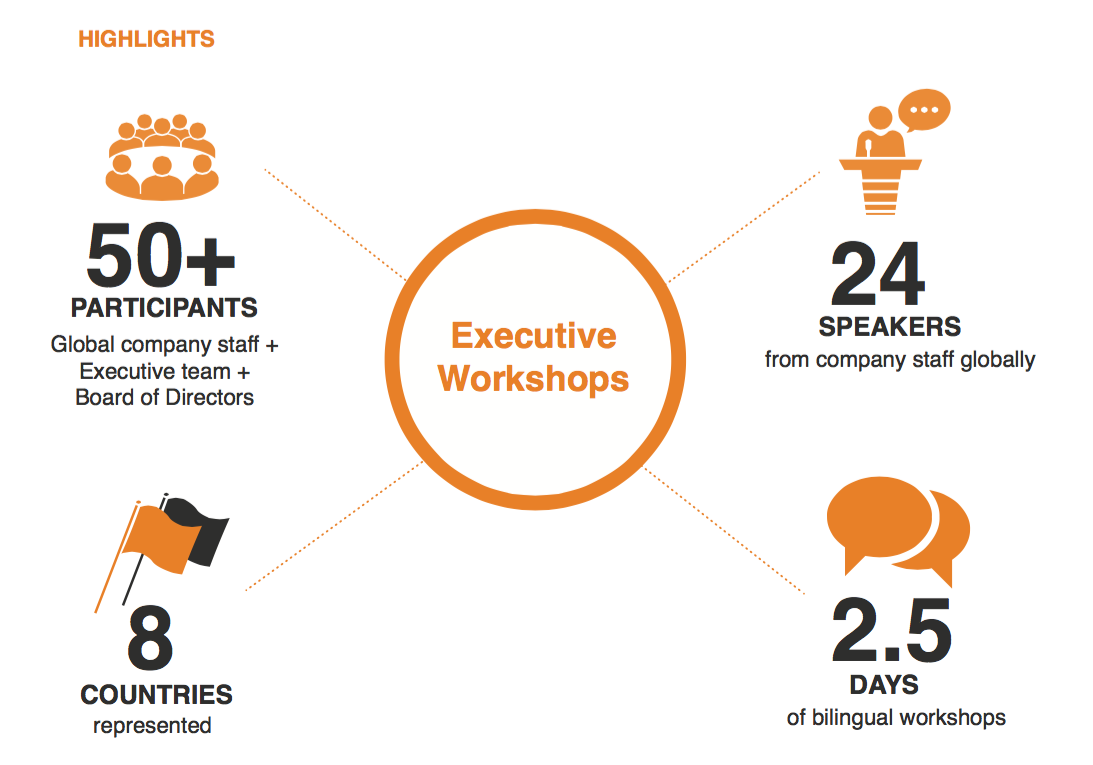
With one mining company, BSR facilitated a two-and-a-half-day workshop with more than 50 global participants, including corporate and local office managers, the executive team, and the board of directors. The workshop included presentations by 24 speakers from eight countries. During the workshop, participants prepared tools such as a set of best practices for stakeholder engagement, a “clinic” to solve problems related to the design and implementation of culturally appropriate grievance mechanisms, a shared vision describing what it means to close a mine in a responsible manner, and key performance indicators to measure the impact of the company’s various community investments.
After the workshop, BSR wrote a summary report that captured next steps for all participants, as well as recommendations for future workshops and ongoing internal collaboration.
Our Impact
While global sustainability workshops require a significant investment of time and money, they provide many returns. As a result of the workshops BSR has led, the companies were able to enhance their awareness of global sustainability practices, challenges, and opportunities; identify key performance indicators and additional tools to support local implementation of corporate standards; increase dialogue between in-country managers and the executive team and board; and contribute to a more collaborative corporate culture.
These workshops have the potential to benefit workers and communities as well, as companies are able to engage more deeply across the organization on sustainability issues and work to improve their global sustainability practices and decision-making.
Lessons Learned
- Global workshops give participants opportunities to learn best practices, build and expand relationships and networks of experts within the company, align on priorities, and work together to solve problems.
- We have found that when the workshops are more participatory—with more people and offices presenting information—they can boost the feeling of inclusion and collaboration. However, this shouldn’t come at the expense of a clear, streamlined workshop.
- Other aspects of inclusion to consider include language and translation needs, as well as the development of culturally appropriate content, which can be enhanced, for instance, if employees from indigenous groups review the materials in advance.
- Content is extremely important, but there is also value in devoting time for team-building and the development of new relationships that will support the ongoing sharing of information.
Search Again?