Searching for:
Search results: 1061 of 1263
Blog | Wednesday November 22, 2017
COP23: The ‘Inside-Out’ Approach to Delivering Climate Action
We take a look at the progress delivered at COP23 and consider an “inside-out” approach to increase ambition.
Blog | Wednesday November 22, 2017
COP23: The ‘Inside-Out’ Approach to Delivering Climate Action
Preview
What if there was a UN Climate Conference where actors reducing greenhouse gas emissions and building climate resilience took center stage, leaving government negotiators to the periphery?
At an “inside-out COP” like this—as described by renowned climate scientist Saleemul Huq at the Development and Climate Days event during the middle weekend of COP23—more attention would flow to those delivering results on the ground, not those skillfully weaving compromises with words.
COP23 showed that the inside-out COP is less and less a fantasy. It was physically divided between the Bonn zone, which featured on-the-ground action, and the Bula zone, where governments continued technical negotiations under the Paris Agreement. That the Bonn zone had brighter energy than the Bula zone may continue in COPs to come. And a focus on results is ever more important with global emissions set to increase for the first time this year, after plateauing for three years of economic expansion.
This is not because the UNFCCC negotiations derailed. To the contrary, countries agreed on the design of the Talanoa Dialogue, a high-level dialogue in 2018 which will take stock of our collective progress toward net-zero emissions, and set the scene for governments to enhance their commitments under the Paris Agreement in 2020. As the We Mean Business coalition and many others asked for, the dialogue creates opportunities for business to demonstrate our progress along the Paris Agreement emissions trajectory and the megatons of emissions we have removed from the atmosphere.
Countries also made progress on technical negotiations under the Paris Agreement by creating the raw material which will eventually become rules for how they account for emissions, communicate national commitments, report on progress, use carbon credits, and are held to comply. Since the Paris Agreement asks all countries to take action, all countries have skin in this game, slowing down the completion of these rules by COP24. There may be extra negotiating sessions in 2018 to finish them.
Just outside the government zone, the energy of action was more apparent. At the U.S. Climate Action Pavilion, California Governor Jerry Brown spoke to the Global Climate Action Summit, which will bring together non-state actors of all stripes in San Francisco next September. And former New York City mayor Mike Bloomberg launched the first report under America’s Pledge, an effort to aggregate the impact of non-state actors in the U.S.
Toward the end of the second week, China and 18 other countries announced an increase in the use of sustainable bioenergy. The U.K. and Canada led a group of 20 countries, as well as several U.S. states and Canadian provinces, to launch the Powering Past Coal Alliance to phase out coal use in power generation over the coming decades.
The Powering Past Coal Alliance may foreshadow two trends in the future. First, that policy commitments will become multistakeholder affairs, including governments, businesses, and other non-government partners. And second, that increases in government ambition will be incrementally marked outside the formal Nationally Determined Contributions (NDCs) deposited under the Paris Agreement, since updated NDCs will require a quid pro quo every five years at the multilateral negotiating table.
In this world of increasingly “inside-out” COPs, the We Mean Business coalition will continue to support increased ambition from all. We appreciate the invitation to convene events and provide inputs to the Talanoa Dialogue. Businesses are stepping up, hundreds are committing to reduce their own emissions in line with the 2°C Paris goal, and they are finding innovative ways of achieving those goals.
We look forward to sharing those experiences to help policymakers have the confidence they need to continue to set and implement stronger and more ambitious targets of their own. There were clear signs of momentum and continued commitment by both countries and non-state actors at this COP, which we must continue to build on in the year ahead.
Blog | Monday November 20, 2017
How Do We Measure the Impact of Our Membership?
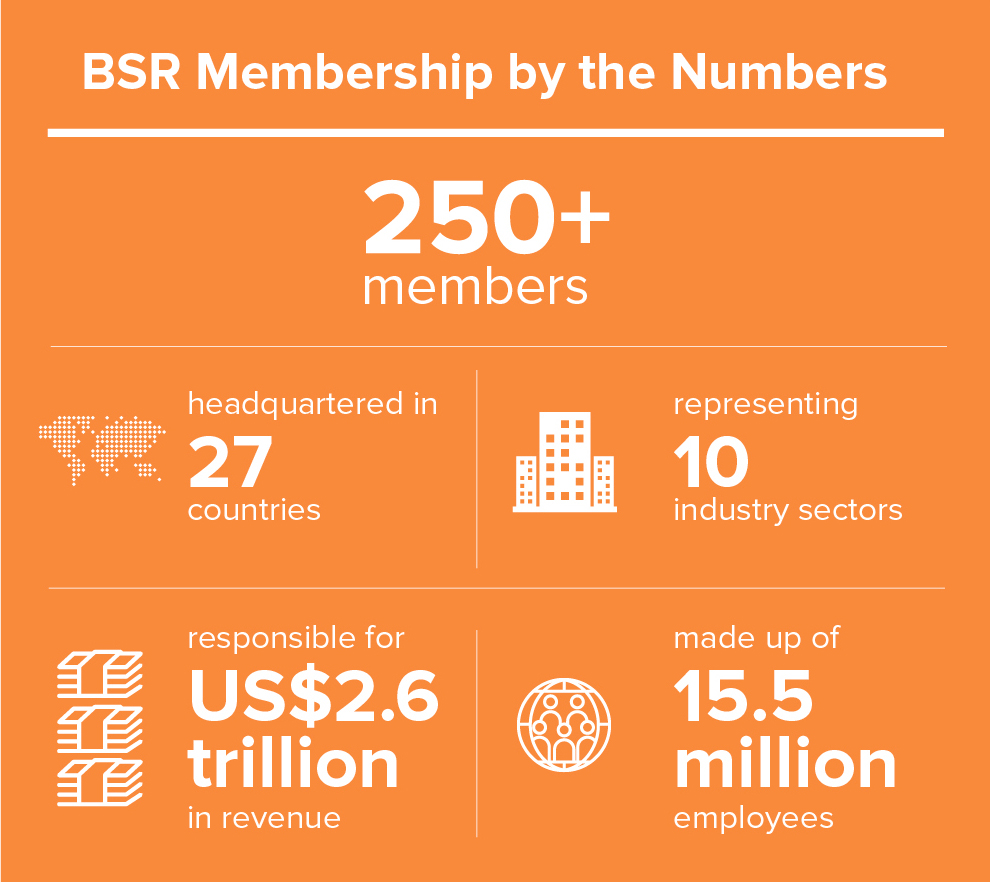
More than 250 companies in nearly 30 countries, spanning 10 industry sectors, representing more than US$2.6 trillion in revenue and more than 15 million employees: This is how we scale our impact at a global level.
Blog | Monday November 20, 2017
How Do We Measure the Impact of Our Membership?
Preview
In mission-driven work, it’s important but incredibly challenging to measure impact. Do you focus on the specific measures that can be quantified in the short term and directly attributed? Or do you identify longer-term, systemic impacts that are more difficult to quantify?
As there aren’t commonly agreed-upon answers to these questions, measurement tends to focus on specific project outcomes and intended impacts. BSR evaluates our project work, publishes case studies, and releases research. Yet, at our core, BSR is a membership organization, and it’s much harder to articulate the direct impacts of our membership. Even without numbers that explicitly “prove it,” I believe that our membership model enables BSR’s impact overall to be exponentially scaled at a global level. Why?
BSR has more than 250 member companies in nearly 30 countries spanning 10 industry sectors. These members represent more than US$2.6 trillion in revenue and more than 15 million employees worldwide. They are some of the world’s largest and most influential companies and constitute nearly 20 percent of the top 50 companies in the Forbes Global 2000. Because of this, some of the changes we help inspire reach people all over the world: For example, I love pointing out that helping a giant global food company change one policy on how they purchase one ingredient could have a larger impact on more peoples’ lives than working individually with more than 100 small organic food companies.
The reach and diversity of this membership means that BSR’s activities and insights are spread across these organizations and their broader value chains. By sharing knowledge, best practices, and new ideas, BSR’s impact is amplified well beyond one-to-one engagements, across sectors and regions. For example, when we worked with telecommunications firm Telia Company to integrate human rights into its business decision-making, we shared the process and broad learnings so that other companies can learn from it. Another recent example is the Playbook for Sustainable Business in the United States, which we published this fall. We engaged our members to shape the ideas in the playbook, and we then discussed these recommendations at our recent annual Conference. It is our hope that the dissemination of this Playbook will help sustainable business leaders succeed in the current U.S. economic and political context—both as individual businesses and in collaboration with each other and stakeholders.
With less than 130 staff around the globe, BSR cannot do individual projects with every member on every major sustainability issue. We must rely on the amplification of impacts through our membership if we’re going to achieve our ambitious mission. When we help a company devise a new climate strategy for its supply chain, the program that results is likely to impact not only that company, but also its suppliers and industry peers. When we work to help integrate human rights into business decision-making, we are hoping to shift industry practices toward a new normal.
Membership impacts are also multidirectional. Our impact is maximized because our relationships further help to inform our research and grant-funded activities to ensure that our insights and recommendations are relevant to and build on global businesses’ practices or challenges. This means that when we receive support from the Dutch Ministry of Foreign Affairs to develop Gender Equality in Codes of Conduct Guidance, for example, we base our work on our decades of experience working with companies, and we engage our members to further inform and refine our recommendations.
Our recent Marketer’s Guide to Behavior Change also illustrates this: It shares the perspectives of a small group of members—AT&T, eBay, Johnson & Johnson Consumer Inc., McDonald’s, and Walmart—to show how companies can trigger behavioral shifts that enable more sustainable lifestyles, grow demand for more sustainable products, and create business value. When we create something like this, it is our hope that our member companies can then share this tool with their marketing teams, who may use the techniques and inspire other companies to do the same. Thus, an engagement with five companies has the potential to change marketing practices at hundreds!
Finally, our membership provides built-in networks that enable BSR to address systemic challenges that require a collective business response. When we see an opportunity to convene companies on a topic like the use of renewable energy to power data centers or the future of sustainable fuel, we begin by reaching out to those of our member companies that have expressed an interest in the issue. Sometimes, this works in reverse, and our member companies bring ideas to us and ask us to convene others.
We may never know exactly what practices are changed as a result of a member reading a report, participating in a workshop, or talking to a BSR expert; let alone the exact impact that new practices we helped shape might have. But we can be proud that we do our best to magnify our impact across 250 of the world’s largest and most influential companies as we all work to create a more just and sustainable world.
Blog | Friday November 17, 2017
National Geographic Photographer Annie Griffiths Addresses the BSR Conference 2017
At the BSR Conference 2017, National Geographic Photographer Annie Griffiths shared her experience using photography as a tool for telling stories, creating empathy, and empowering women.
Blog | Friday November 17, 2017
National Geographic Photographer Annie Griffiths Addresses the BSR Conference 2017
Preview
In a plenary address at the BSR Conference 2017, National Geographic Photographer Annie Griffiths shared her experience using photography as a tool for telling stories, creating empathy, and empowering women.
“The big stories are not breaking news. They don’t break. They exist—they’re big; they’re complex. None more so than women,” Griffiths said.
Watch the full video below:
The BSR Conference 2017 took place October 24-26 in Huntington Beach, California, and gathered sustainability leaders from business, government, and civil society to explore the theme of “How Business Leads.” Follow the conversation on Twitter at #BSR17. See all video highlights on BSR’s YouTube channel.
Blog | Thursday November 16, 2017
Shared Resilience: Businesses Are Ready to Partner to Build Climate Resilience
Shared resilience—one of the themes of Development and Climate Days at COP23—embodies the concept that no one actor can tackle complex climate change issues alone.
Blog | Thursday November 16, 2017
Shared Resilience: Businesses Are Ready to Partner to Build Climate Resilience
Preview
This past weekend at COP23, the We Mean Business coalition cohosted the 15th annual Development and Climate Days—the signature climate development and resilience event during the UN climate negotiations. We Mean Business brought together resilience experts from around the globe, including business leaders, to discuss innovative ways to enhance community resilience in relation to climate change.
One of the themes during this event focused on “shared resilience,” which embodies the concept that no one actor can tackle this complex issue alone: We must work together. Climate risk is no longer thought of as something only impacting small island nations, but something that affects businesses, the global economy, and developed nations. We have seen this in particular this year, with natural disasters in the United States and extreme weather events around the world, such as the flooding in South Asia. All stakeholders must collectively work to create successful, lasting partnerships and initiatives that boost climate resilience.
For business, climate change is a material risk. Over the past three years, the World Economic Forum’s Global Risk Report ranked climate change as the highest risk facing business. Companies, therefore, have a crucial role to play in both building their own adaptive capacities to climate-related events and enhancing broader societal resilience.
Throughout the Development and Climate Days at COP23, we were lucky to hear from several multinational companies, along with other experts, that are already working to address climate resilience—some are doing so because resilience, development, and risk management are not fundamentally different. All three activities demand systems thinking, identifying root causes of vulnerability, long-term planning, and taking practical action.
Business already assesses many types of risk through enterprise risk management systems, and companies can consider applying an environmental and climate lens to these existing assessments. Holistic and comprehensive resilience strategies are the best bet to address climate risks within the operations, supply chains, and vulnerable communities in which business operates.
Companies can begin by assessing climate risk; they can then develop a resilience strategy that includes their physical, financial, social, natural, human, and political assets. One example of a company that is doing this is Woolworths Holdings Limited, which is tackling climate risk throughout its supply chain and within vulnerable communities through its people. With a program that seeks to enhance the livelihoods of local women throughout its supply chain, Woolworths works with smallholder farmers on water management and farming techniques.
The Kellogg Company also helps farmers in different places face challenges by addressing access to market issues, making supply chain pricing more transparent, and sharing growing and storing techniques.
Finance is also key to the bigger picture of how we’ll transition to a resilient society. How do we increase scale, broaden financial flows, and expand access to finance to those who need it to adapt to the impacts of climate change? Applying financial capital isn’t only about matching funds with project pipelines. It will require collaboration among companies, banks, and all levels of government. Capital can finance non-financial instruments, too, such as procurement, government engagement, guaranteed offtake, and disclosure. These tools can help move the trillions in the real economy necessary to combat climate change.
Companies are ready to partner on the issue of climate resilience. In this spirit, Michelle Patron, director of sustainability policy at Microsoft, told participants of Development and Climate Days, "We want to partner with you and understand where the challenges are—and get tools into the hands of the people who need them most.”
Blog | Wednesday November 15, 2017
Our Theory of Change: The Rationale Behind BSR’s Open Membership Policy
We believe in working with business to truly create a more just and sustainable world. We can’t do that if we only work with the small percentage of companies who are already 100 percent committed.
Blog | Wednesday November 15, 2017
Our Theory of Change: The Rationale Behind BSR’s Open Membership Policy
Preview
In an increasingly polarized world, we often look to sort organizations, ideas, or people into good or bad. When you communicate in soundbites or 140 characters (or even a whopping 280!), it can become challenging to provide context or nuance.
This trend toward categorizing good and bad actors has applied to the private sector for a long time. Big corporations are often portrayed as universally evil, while small businesses are assumed to be good. And while most people know it’s not that simple, it takes time to really investigate the nuance. The starting point for BSR’s theory of change is our open membership policy: Any company that expresses the desire to improve its sustainability performance is welcome to join BSR.
Even among large corporations, consumers and the media often paint one company, or an entire industry, in a negative light, rather than try to understand the balance of positive and negative impacts that most companies have on the world around them. As F. Scott Fitzgerald famously said, “The test of a first-rate intelligence is the ability to hold two opposed ideas in the mind at the same time, and still retain the ability to function.”
At BSR, our theory of change is based on this ability, and we believe the greatest impacts occur in the context of this nuance. As lead of BSR’s global membership, I am often asked, “How can BSR possibly work with ______ (insert your favorite company to hate)?” The answer is that we believe in working with business to truly create a more just and sustainable world. We can’t do that if we only work with the small percentage of companies who are already 100 percent committed; and we also know that nobody is perfect.
For example, Unilever has been named the global leader on sustainability in the GlobeScan/SustainAbility Leaders Survey for seven years in a row. Yet Unilever readily acknowledges that they have not yet achieved all of their sustainable living objectives: They understand the need for continuous improvement. And if we only worked with companies at the level of sustainability commitment of Unilever, we would not be doing a very good job in truly changing the way all mainstream business is done. We would also miss opportunities to multiply the number of leaders driving meaningful, sustainable change throughout the ecosystem.
From our perspective, all companies have areas of their performance that can be improved. As our founders stated, BSR works with “leaders and learners, and most companies are both.” The integrity of this model is safeguarded by our policy against allowing companies to cite BSR membership as a “seal of approval,” certifying in some way that they have achieved a certain level of performance. As such, we are clear in stating that BSR membership alone does not provide any qualitative assessment of a company’s performance on sustainability.
We also understand that some industries are inherently less sustainable than others—and for some organizations, it may make sense to avoid an entire sector when developing an engagement strategy. Our model is not perfect, and it works in part because other organizations have different theories of change that complement what we do.
However, at BSR, we have found that the same sectors that some find problematic are the ones where the greatest opportunities for transformation often exist. Our mission is predicated on engagement, and from this perspective, we don’t believe it makes sense to uniformly single out an industry. That’s why BSR works across many industries that some may find objectionable—from those producing GMOs, soft drinks, tobacco, or fast food to those in the business of defense, nuclear power, or oil and gas.
To summarize, our theory of change is based on inclusion and continuous progress within mainstream business. I believe our approach substantially increases our opportunity for impact; it also enhances our ability to engage deeply with businesses across the sustainability leadership spectrum on the tough challenges the world faces today.
Blog | Tuesday November 14, 2017
Communities First: Top Human Rights Priorities for Extractives Companies
These top three opportunities for the extractives industry to make a positive impact on human rights all relate to including and empowering people in the communities where they operate.
Blog | Tuesday November 14, 2017
Communities First: Top Human Rights Priorities for Extractives Companies
Preview
As former UN Commissioner for Human Rights Mary Robinson once said, “We must understand the role of human rights as empowering of individuals and communities. By protecting these rights, we can help prevent the many conflicts based on poverty, discrimination, and exclusion (social, economic, and political) that continue to plague humanity and destroy decades of development efforts.”
The extractives industry has had a long and complicated relationship with human rights, particularly in relation to transparency and local communities. With the recent announcement of the U.S. withdrawal from the Extractive Industries Transparency Initiative (EITI), a global standard that promotes the open and accountable management of oil, gas, and mineral resources, these issues are once again making headlines around the globe.
At BSR, we strongly believe that transparency is crucial for sustainable business and the protection of human rights, and given the pervasiveness of corruption in large-scale extractive projects, transparency is especially vital for extractives companies.
Bribery and corruption constitute one of the key issues BSR has identified in our new primer on the 10 most salient human rights challenges for the extractives industry. These practices can have a deep and profound impact on vulnerable communities—either by misdirecting funds that could be spent on healthcare, education, or other public goods, or by preventing participation in the democratic process. Because extractives companies have very high exposure to government, the risk of corruption is massive, especially for those projects taking place in autocratic countries, carried out in ventures with state-owned enterprises, or overseen by politically connected individuals.
The UN Guiding Principles on Business and Human Rights prescribe that companies must first and foremost ensure that they take all reasonable measures to avoid human rights harms. For the extractives industry, that means companies should ensure that any engagement in high-corruption contexts proceeds according to international norms of transparency and accountability.
While some companies have led on inclusive approaches that minimize harm to local communities or have pioneered participatory community engagement, the human rights impact from extractives projects can nonetheless be devastating, and the industry often receives heavy criticism for its human rights record.
By identifying and addressing known human rights risks, extractives companies can work to protect the rights of a community and its workers. And in addition to protecting human rights, companies also have the opportunity to champion and defend them. That’s why we outline three top opportunities for the industry to make a positive impact on human rights in our new primer—perhaps not surprisingly, they all relate to including and empowering people in the communities where they operate:
- Community Development: Extractives companies can ensure inclusive socioeconomic development by using participatory development models in their decisions about resettlement, compensation, and community investment. Community consultation and decision-making processes should be inclusive of all groups, and make special allowances for those populations marginalized from decision-making, such as women, minorities, and the rural poor.
- Local Economic Empowerment: While direct employment for local communities is often limited in extractives operations, the industry can be a significant economic multiplier through direct and indirect employment across the value chain. Local supplier policies should be sensitive to the local context, investing in local talent pipelines and taking into account the needs of vulnerable groups, such as female small-business owners.
- Natural Resource Governance: Historically, poor management of natural resources has kept billions of dollars in extractives revenues from supporting public goods, such as health, education, and housing. Extractives companies should support efforts for governments and citizens to exert greater control over natural resources.
We encourage all extractives companies to address the human rights risks that are inherent in their operations and take proactive steps to protect and promote human rights. In both preventing the negative and focusing on the positive, the sector would do well to put communities first in developing its approach.
Blog | Monday November 13, 2017
Audrey Choi Emphasizes Need for Business Action for an Inclusive Economy at the BSR Conference 2017
In a plenary address at the BSR Conference 2017, Morgan Stanley Chief Chief Marketing Officer and Chief Sustainability Officer Audrey Choi emphasized the role of business in promoting inclusive growth.
Blog | Monday November 13, 2017
Audrey Choi Emphasizes Need for Business Action for an Inclusive Economy at the BSR Conference 2017
Preview
In a plenary address at the BSR Conference 2017, Morgan Stanley Chief Marketing Officer and Chief Sustainability Officer Audrey Choi emphasized the importance of business action in promoting inclusive growth.
“At the end of the day, we are convinced that corporations, individually and collectively, are powerful forces for change,” Choi said.
Watch the full video below:
The BSR Conference 2017 took place October 24-26 in Huntington Beach, California, and gathered sustainability leaders from business, government, and civil society to explore the theme of “How Business Leads.” Follow the conversation on Twitter at #BSR17. See all video highlights on BSR’s YouTube channel.
Blog | Thursday November 9, 2017
The Sustainability Form 10-K: A Proposal
We’re proposing an equivalent of the Securities and Exchange Commission (SEC) Form 10-K for sustainability reporting. Here’s why.
Blog | Thursday November 9, 2017
The Sustainability Form 10-K: A Proposal
Preview
I believe we need an equivalent of the Securities and Exchange Commission (SEC) Form 10-K for sustainability reporting. Allow me to explain why.
The Form 10-K and sustainability reports serve very similar purposes. The Form 10-K is required to contain the information necessary for informed decision-making by investors, while the sustainability report is expected to contain the information necessary for informed decision-making by a wider range of stakeholders.
However, the Form 10-K and the sustainability report have evolved to achieve these outcomes in very different ways.
Every company’s Form 10-K has an identical structure, and this makes it easy for analysts to know where to find the information they need. As someone said to me recently, “We all know our way around a Form 10-K.”
By contrast, sustainability reports come in many different shapes and sizes, and this makes the work of sustainability analysts assessing company performance on these issues much more difficult. We don’t all know our way around a sustainability report.
For example, every company’s Form 10-K contains a description of the business strategy, an analysis of the organization’s financial conditions and results of operations, material risk factors, financial statements, and executive compensation information. The information is numbered consistently, located in the same place, and presented the same way, which makes it relatively straightforward to compare companies across these metrics.
I believe that the usefulness of the sustainability report would be greatly enhanced by a similarly consistent structure. For example, every report could contain a list of sustainability risks and opportunities, a description of sustainability governance and management approach, an analysis of the company’s sustainability condition and performance, and a sustainability results statement. Comparability would be much easier if this information were always presented in the same way, with the same order and numbering.
There are four potential objections to my proposal.
- It could be argued that sustainability reporting shouldn’t have its own version of the Form 10-K, and that instead sustainability information should be included in the “real” Form 10-K. I agree that sustainability information of material significance to investors should indeed be included in the “real” Form 10-K, ideally using the Sustainability Accounting Standards Board (SASB) standards. I also believe that business strategies should focus on long-term value creation with sustainability as a foundation. However, as SASB states, a lot of sustainability information sought by stakeholders is not of material interest to reasonable investors, and therefore it should not be included in the “real” Form 10-K.
- Along similar lines, it could be argued that this proposal works against the trend toward the integrated thinking and integrated reporting promoted by the International Integrated Reporting Council (IIRC). I believe that an integrated narrative about how the company creates value is essential—however, the focus of the IIRC is on the creation of a concise narrative, not on the creation of a new report with the high level of detail found in a Form 10-K. As the IIRC conciseness principle states, “an integrated report is a concise communication about how an organization’s strategy, governance, performance, and prospects ... lead to the creation of value.”
- It could be argued that the GRI content index already serves this purpose. To an extent this is true, as the GRI content index establishes a common numbering system and structure for sustainability information. The GRI standards also provide a highly credible list of content for inclusion in my proposed sustainability version of the Form 10-K. However, the reality is that most GRI content indexes are long lists of links, which do not provide the same level of usefulness or convenience as the Form 10-K. The GRI content index is a list, not a report.
- Finally, it could be argued that my proposed “consistently structured form” approach is outdated in the age of the internet and social media. However, I believe the reverse is true—just as companies communicate their business strategies and performance in many ways outside the Form 10-K, so a sustainability version of the Form 10-K would store year-on-year comparable information in one formal location, freeing up space to communicate sustainability strategy and performance in other, more innovative ways. No longer would the sustainability report need to be all things to all people, and no longer would report writers feel the need to create catchy new report themes every year.
We live in the so-called “post-fact world,” an era of misinformation where public trust in business, government, and the media is at an all-time low. I believe this raises the stakes when it comes to the quality, robustness, and comparability of sustainability disclosures, as well as the importance of rigorous reporting processes.
A sustainability version of the Form 10-K can be part of the business response to this new era—and if reaction to this blog is positive, I’d be happy to propose a template.
Blog | Wednesday November 8, 2017
Microsoft’s Brad Smith Highlights Business Leadership at the BSR Conference 2017
In a keynote address at the BSR Conference 2017, Microsoft President and Chief Legal Officer Brad Smith highlighted the need for the technology sector to think about embracing technology as a cause to protect people.
Blog | Wednesday November 8, 2017
Microsoft’s Brad Smith Highlights Business Leadership at the BSR Conference 2017
Preview
In a keynote address at the BSR Conference 2017, Microsoft President and Chief Legal Officer Brad Smith highlighted the company's experiences raising its voice on political issues and bridging the digital divide.
"As the first responders of this new era, those of us who are in the business of technology need to think about it as more than a business," Smith said. "We need to think about it as a cause to protect people."
Following his address, Smith joined a conversation with BSR President and CEO Aron Cramer and answered live questions from the audience and Twitter.
Watch the full video below:
The BSR Conference 2017 took place October 24-26 in Huntington Beach, California, and gathered sustainability leaders from business, government, and civil society to explore the theme of “How Business Leads.” Follow the conversation on Twitter at #BSR17. See all video highlights on BSR’s YouTube channel.
Blog | Tuesday November 7, 2017
In Defense of Transparency: Why Extractives Companies Should Remain Committed
In spite of the U.S. government’s decision to withdraw from the Extractives Industry Transparency Initiative, extractives companies should continue to pursue transparent practices to protect their reputations and licenses to operate.
Blog | Tuesday November 7, 2017
In Defense of Transparency: Why Extractives Companies Should Remain Committed
Preview
Last week, the U.S. government’s decision to withdraw from the Extractives Industry Transparency Initiative (EITI) landed with the thud of inevitability. The stated explanation for the decision—which affirms a commitment to EITI principles and focuses on unique aspects of the U.S. tax system—has little credibility, given the current state of play in the anti-corruption field.
While the U.S. policy environment may be shifting, extractives companies would nevertheless be well advised to continue to pursue holistic, innovative approaches to stakeholder engagement, strategy, and values in order to restore and maintain the public trust, which is increasingly essential to protecting their reputations and licenses to operate.
The EITI was created in 2002 as a joint effort by government, business, and civil society to help citizens of resource-rich countries hold their governments accountable. EITI aims to provide the public with knowledge of exactly how much money oil, gas, and mining companies pay to governments in taxes, royalties, and other fees.
Its essential goal, however, is the protection and support of fundamental human and civic rights. The premise? With access to this information, citizens can try to ensure that these vital financial resources are used for public health, education, and infrastructure, rather than to enrich powerful figures linked to national governance.
Corruption used to be viewed as a problem afflicting developing countries, but this is no longer the case. The release of the Paradise Papers by the International Consortium of Investigative Journalists has picked up and amplified Lux Leaks, the Panama Papers, and other whistleblowing efforts. Just as money launderers can easily buy property in New York and San Francisco, offshore tax havens are used by politicians, the children of dictators, and some of our most prestigious multinationals.
Transparency activists immediately slammed the U.S. decision on EITI, emphasizing that traditionally recalcitrant Russian and Chinese energy companies now adhere to higher disclosure standards than the U.S. demands of American enterprises. America has already stepped away from its goal of being a role model on human rights, climate justice, transparency, and international cooperation under the current administration. The turn away from EITI is more of the same.
Of greater interest than Washington’s isolationist agenda is what energy and extractives companies might gain from the U.S. decision to stall on transparency regulations. The short answer is: not much. But responses to the EITI debate provide fresh evidence of a widening split over how oil and gas majors regard the sector’s long-term future, as well as their relationship with investors and the public.
Those companies that have made corporate commitments to meet the EITI’s standards of payment transparency include BP, Repsol, Shell, and Statoil. It is no coincidence that these are the very companies that have also chosen openly to embrace the Paris climate agreement while touting their investments in gas and renewables. Exxon Mobil, too, publicly supported the Paris Agreement in the wake of Donald Trump’s election.
The big strategic distinction in the oil industry is no longer over whether to acknowledge and plan for the existential challenges facing the sector; it is about how transparent companies ought to be while the energy transition proceeds. To this end, two strategies have emerged.
The first has been to acknowledge the science of climate change and the problematic history of the sector’s relationship with the government, and then to model best practice on disclosure to regain trust. Some companies, mainly based in Europe, are making headway in this direction—with the understanding that, when it comes to transparency, the horse long ago bolted from the stable. Because companies today must act as if everything they say or do might become public, disclosure has become the optimal approach to issues like payments to governments and political candidates, plans for stranded assets, or strategies to meet a low-carbon future.
The second option has been to invest in the carbon transition and support transparency aspirations publicly while privately obstructing and stalling specific regulations and disclosure efforts for as long as possible. This approach may seem foolish to observers, but it buys some time for big investors and incumbents of the C-suite, who seem to think they might squeak through to retirement before the deluge strikes.
Oil and gas companies are perfectly aware of the deep deficit of trust. Some corporations seem to have concluded that efforts to move beyond a defensive public relations stance are destined to fail; indeed, the reputational benefits accruing from a more progressive approach have been mixed. So, with much of the debate polarized and entrenched and no clear path to public approval, some companies are retreating to the practices of habit as they wait to be dragged into the present after all other options have been exhausted.
With traditional approaches to managing corporate reputation no longer fit for purpose, companies need to devise strategies that extend far beyond reactive communication and public relations. Those corporations that hope to be considered innovative will need to embrace a holistic approach to stakeholder engagement, strategy, and values that prioritizes the importance of restoring trust, regardless of whether public policy requires them to do so.
Search Again?