Searching for:
Search results: 106 of 1188
Audio | Wednesday January 8, 2025
A Conversation with Darsh Myronidis, Group Director of Sustainability, Virgin
Darshana Myronidis, Group Director of Sustainability at Virgin Group, chats with BSR Managing Director, Transformation Christine Diamente, and host David Stearns about of the evolution of her role at Virgin, strategies for embedding sustainability within a company, how to maintain momentum in the face of externalities developments like the recent…
Audio | Wednesday January 8, 2025
A Conversation with Darsh Myronidis, Group Director of Sustainability, Virgin
Preview
Darshana Myronidis, Group Director of Sustainability at Virgin Group, chats with BSR Managing Director, Transformation Christine Diamente, and host David Stearns about of the evolution of her role at Virgin, strategies for embedding sustainability within a company, how to maintain momentum in the face of externalities developments like the recent outcome of the U.S. election, and where the greatest opportunities for significant progress lie.
People
Darshana Myronidis
Blog | Thursday December 19, 2024
A Launchpad for Action: Key Tech and Human Trafficking Priorities in 2025
Following the third annual Tech Against Trafficking Summit, BSR’s Technology and Human Rights teams share six key priorities for business action on leveraging technology to combat modern slavery.
Blog | Thursday December 19, 2024
A Launchpad for Action: Key Tech and Human Trafficking Priorities in 2025
Preview
The third Tech Against Trafficking Summit, hosted by Amazon in London, convened over 160 anti-trafficking and tech leaders to identify priority action for leveraging technology to combat modern slavery and addressing its misuse.
Over the three-day program of policy roundtables, plenary sessions, workshops, and a dedicated tech day for NGOs, the discussions focused on three top-of-mind tracks for the anti-trafficking field.
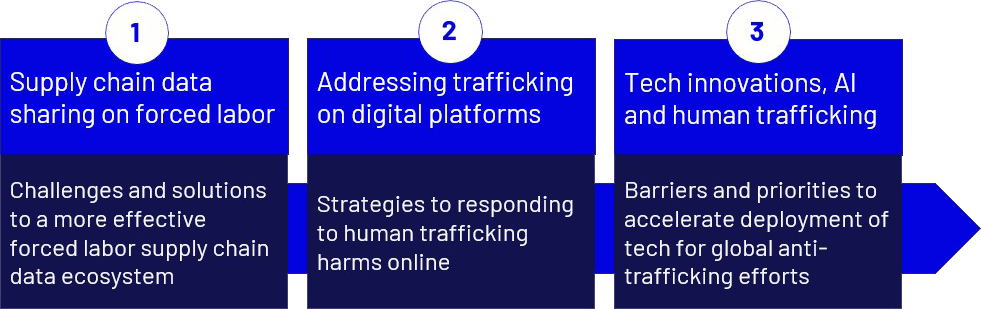
With insights gathered from human rights leads at global companies, suppliers, anti-trafficking NGOs, and experts with lived experience, here's what we learned about the key individual and collective priorities for business in 2025.
Key Priorities for 2025
Supply chain data sharing on forced labor
1) Streamlining forced labor data points collected by business: TAT consultations over the past year have highlighted that there is a lack of clarity about precise actual or proxy data points collected by business on forced labor. The ILO indicators offer a useful blueprint for business, but they remain imperfect with differences in how these are interpreted and integrated into businesses’ human rights due diligence tools. Too many data points by business are collected with limited understanding about their effectiveness and in a way that is extractive for information holders.
Through a multi-stakeholder convening in 2025, Tech Against Trafficking will look to streamline and consolidate list of forced labor data points in alignment with ILO indicators. A more focused set of data points aims to help business reduce the volume of information collected and requested from suppliers and enable a better tracking and measurement of improvement over time.
2) Bringing corporate suppliers into the conversation on the forced labor data ecosystem: Corporate suppliers are required by clients to provide data on forced labor via self-assessment questionnaires (SAQs), surveys and audits (desktop and on-site). Yet they are not always kept informed about how their data is used.
In 2025, businesses with global supply chains have the opportunity to engage with selected corporate suppliers, including small and medium-sized enterprises (SMEs), to understand the challenges they face in collecting and sharing data points on forced labor and find opportunities to make the current system less extractive.
Addressing trafficking on digital platforms
3) Building effective information sharing platforms for identifying and disrupting trafficking networks. Secure platforms, forums, or mechanisms for sharing information, such as trends, data, patterns, and indicators, are needed to enhance business awareness of online harms and investigative capabilities. Collaborating with peer companies, law enforcement agencies, and financial institutions can facilitate the exchange of critical information and lead to more effective investigations. Further information gathered from individuals with lived experience and experts can bring additional perspectives.
Through its dedicated workstream on online trafficking, Tech Against Trafficking will bring together leading tech companies to share practices and challenges, as well as information about emerging threats to address the misuse of technology platforms in a collaborative manner.
4) Leverage technology to maximize impact, including via collaboration: While there are limited resources for companies and organizations to address online trafficking issues on their own, scaling up the use of advanced technologies, like machine learning, can enhance detection capabilities and streamline investigative efforts. Tech solutions deployed should account for and be calibrated to the rapidly evolving tactics employed by traffickers. Tech companies can also look to collaborate across sectors, such as financial services and child safety, to share insights, tools, and technologies.
Tech innovations, AI, and human trafficking
5) Engaging end users and lived experience experts in the design of anti-trafficking technology solutions: This includes lived experienced experts who can inform the design and deployment of tech tools. This is particularly critical to scale the potential of technology, prevent harms for those in situations of human trafficking (in terms of accuracy and bias of data), and ensure trauma-informed or victim-centered approaches.
This effort can take a variety of forms, including the involvement of end-users in the design of technology solutions to ensure they are contextually relevant, as well as collaboration with survivor organizations.
6) Building a culture of trust with end-users: Developers of anti-trafficking technologies should ensure transparent communication with stakeholders (especially end users) about technologies being used, including what they are, why and how they are being used, and how information processed through them will be managed. This will likely build trust in utilizing tech solutions and make such technology innovation effective.
2025 will likely bring new opportunities in how tech is deployed to address human trafficking and forced labor globally, including how to inform corporate forced labor data collecting and sharing efforts. On the flipside, tech will also continue to present challenges in how online platforms are leveraged by traffickers. Addressing these six priorities is a good start for the broader anti-trafficking community to co-design context-specific anti-trafficking solutions and respond to changing tactics in a collaborative and effective manner.
“Technology is not the destination, but a powerful tool. It should always be designed and deployed with the needs, values, trust, and lived experiences of people at its core.”
— 2024 TAT Summit panelist
BSR is the secretariat of Tech Against Trafficking, a coalition of leading technology companies collaborating with global experts to help eradicate human trafficking and modern slavery using technology. Explore the TAT Summit's outcomes and for more details about how to join Tech Against Trafficking, contact the Tech Against Trafficking team.
Insights+ | Tuesday December 17, 2024
From Commitments to Action: A Business Guide to Address Forced Labor Across Value Chains
From Commitments to Action: A Business Guide to Address Forced Labor Across Value Chains
Insights+ | Tuesday December 17, 2024
From Commitments to Action: A Business Guide to Address Forced Labor Across Value Chains
Preview
Case Studies | Wednesday December 11, 2024
Conducting a Double Materiality Assessment with a Financial Institution
Beyond Bank approached BSR to conduct a materiality assessment to proactively identify, assess, and prioritize the bank’s material environment, social, and governance (ESG) risks, opportunities, and impacts.
Case Studies | Wednesday December 11, 2024
Conducting a Double Materiality Assessment with a Financial Institution
Preview
Introduction
Beyond Bank Australia (“Beyond Bank”) approached BSR to conduct a materiality assessment to proactively identify, assess, and prioritize the bank’s material environment, social, and governance (ESG) risks, opportunities, and impacts. As a customer-owned bank, Beyond Bank’s senior management was keen to undertake this exercise despite not being under mandatory regulatory pressure to do so. By opting for a double materiality assessment over a traditional perception-based materiality assessment, Beyond Bank demonstrated its long-term commitment to its customers by evaluating the impacts of material ESG issues on its enterprise value as well as its broader commitment to communities by holistically assessing the impacts of its operations and supply chain on society and the environment.
Background
Beyond Bank is one of the largest customer-owned banks in Australia. As a purpose-driven mutual bank, Beyond Bank aims to change the lives of its customers and communities through financial well-being. It also strives to reduce its environmental footprint by using resources efficiently, reducing consumption, and helping its customers and people to do the same.
The Challenge
The quick evolution of disclosure requirements, such as the European Union’s Corporate Sustainability Reporting Disclosure (CSRD)'s double materiality requirement, has accelerated the shift of stakeholder expectations for companies to adopt and disclose impact-based material issues. Despite not being within the jurisdictions in scope of these legislative disclosure requirements, Beyond Bank understood the importance of ensuring it is well-placed and ready to meet potential changes in the regulatory landscape.
Senior management at Beyond Bank recognized early on the benefits of completing a materiality assessment using a double materiality approach, which considers how sustainability topics influence a company's enterprise value (“financial materiality") and how the company's activities affect the environment and society (“impact materiality"). Even without the disclosure and reporting obligations a listed financial institution would be subject to, Beyond Bank was able to secure buy-in from the Board, management, and internal stakeholders involved based on the rationale and benefits that a double materiality assessment would confer to Beyond Bank.
Beyond Bank also sought to develop its internal/in-house capability to be equipped with the tools and know-how to independently conduct a double materiality assessment to ensure it remains agile and well-positioned to refresh the exercise after any significant business changes in future.
BSR’s Response
The entire exercise was a collaborative effort between BSR and the Beyond Bank sustainability team—from level-setting the Beyond Bank team with an ESG 101 training to walking through and partnering to complete the double materiality assessment process. The Beyond Bank team completed the internal stakeholder interviews, while BSR conducted interviews with external stakeholders and representatives from Beyond Bank’s Executive Team and Board.
As part of the assessment process, 35 internal stakeholders and 12 external stakeholders shared their perspectives across a broad range of material issues. Internal stakeholders included leaders and management teams across the country and the organization, ensuring both regional and functional representation. External stakeholders included customers, community group partners, suppliers, industry groups, rightsholders, and NGOs. In addition, a customer survey and internal employee survey gathered input from both key stakeholder groups on their ESG priorities, with over 2,000 customer responses and nearly 200 employee responses.
These conversations and consolidated input helped to inform and refine the definitions of risks and opportunities for each ESG topic within the Australian context, and ultimately the prioritization of material issues based on Beyond Bank’s unique operational model/activities and footprint.
Impact
This collaborative process helped to strengthen internal capability within the Beyond Bank team in relation to knowledge of ESG topics and its potential impacts, risks, and opportunities, as well as a greater sense of buy-in to the process and confidence in the outcome. Insights from meaningful conversations with both internal and external stakeholders also provided Beyond Bank with valuable information on strategic priorities going forward. Building on the outcome of this double materiality assessment, Beyond Bank is referencing the identified priority issues to inform the organization’s sustainability strategy, and it is also considering reporting on specific GRI and SASB indicators for priority material topics.
"We enjoyed partnering with [the] team at BSR Singapore, and the insights we gained with respect to our material ESG topics [were] extremely beneficial to our strategic planning processes. We also feel very well positioned for any future changes that may come to the sustainability reporting landscape in Australia.”
- Brooke Avory, Sustainability Manager, Beyond Bank Australia
Conclusion
Despite not being in scope of the CSRD, it is evident that the European Union is setting the bar and precedent when it comes to ESG reporting and disclosure requirements, and it can be reasonably expected that a wave of regulations is forthcoming across the different jurisdictions. The double materiality assessment will position Beyond Bank well to meet such potential changes in the regulatory landscape.
Companies will benefit from staying ahead of the curve and understanding where their ESG risks and opportunities lie. The outcome of the double materiality assessment provided Beyond Bank with data-driven insights on what ESG topics to prioritize, and it helped to inform its sustainability strategy in the longer term. Moreover, with the Beyond Bank team equipped with the know-how of conducting the double materiality assessment themselves, they are well-placed to refresh the exercise after any significant business changes in future.
Get in Touch
For more information on how BSR works with companies on sustainability management and strategy, please get in touch with BSR's Transformation Team.
Blog | Thursday December 5, 2024
Integrating Climate and Nature: A Dual Approach to Business Resilience
Learn how businesses can better understand the climate and nature nexus and how BSR is guiding our member companies in creating more integrated strategies that consider impacts on human livelihoods.
Blog | Thursday December 5, 2024
Integrating Climate and Nature: A Dual Approach to Business Resilience
Preview
In today's rapidly evolving business landscape, forward-thinking companies understand that addressing climate change and protecting nature are intrinsically linked. While the private sector has historically been focused on reducing greenhouse gas emissions, systems that work together in the natural world require similarly collaborative solutions.
This dual approach not only yields better environmental outcomes, but also creates more resilient business models. That means taking a clear-eyed view of the world, appreciating the interconnectedness of our systems, and grasping that climate change, biodiversity preservation, economic opportunity, community well-being, and human rights are deeply interconnected opportunities to address.
To date, the climate and nature agendas have been separated—to say nothing of societal considerations. Our institutions, global convenings (e.g., COPs), frameworks, guidelines, initiatives, and targets are siloed. And for the most part, so are the teams working on these critical initiatives within businesses.
Through careful planning, integrated strategies, and a commitment to combining goals, businesses can create lasting positive impacts while building more sustainable and resilient operations for the future. The need for a de-siloed approach is particularly evident after this year’s Biodiversity COP16 in Cali and Climate COP29 in Baku.
Understanding the Climate and Nature Nexus
Fragmented approaches to interconnected environmental challenges are counterproductive. Solving the climate crisis requires a holistic understanding of nature's critical role, and integrated strategies are the most productive way forward.
Healthy ecosystems act as natural carbon sinks, while climate change accelerates biodiversity loss. Climate impacts disproportionately affect vulnerable communities, and transitioning to more durable economic models can displace traditional workers and harm local communities without careful planning.
Over half the world’s total GDP is moderately or highly dependent on nature and its services, with an estimated US$58 trillion exposed to nature-related risk. To make these numbers tangible, consider that 75 percent of global food crops rely on pollinators, 70 percent of cancer drugs are inspired by or based on nature, as well as traditional knowledge of Indigenous Peoples, and 72 percent of companies are highly dependent on at least one ecosystem service.
More and more, science shows us that nature-based solutions are fundamental to addressing the climate crisis alongside local community health and wellbeing. These solutions include restoring forests, protecting wetlands, and regenerating grasslands, which not only sequester significant amounts of carbon dioxide—potentially offsetting up to 37 percent of global emissions cost-effectively—but are also critical in protecting communities from disaster risk, preserving vulnerable coastlines and maintaining clean water for consumption and disease prevention.
Considering any of these issues in isolation can make the risks and vulnerabilities worse through maladaptation. By addressing climate and nature together, businesses can create many positive impacts, optimize synergies, and avoid unintended consequences and inefficiencies that stem from focusing on one aspect alone.
Simply put, climate and nature resilience is business resilience.
Societal Considerations of Integrating Climate & Nature
Against this backdrop, there are fundamentally important principles for incorporating societal considerations. This means human rights considerations, including decent work, respect for Indigenous traditions, and ensuring environmental solutions don’t exacerbate societal inequalities.
Human rights approaches provide an essential roadmap for business action. Meaningful engagement with affected communities is a crucial pathway to maximizing these positive impacts and understanding the risks of damaging actions of climate and nature solutions.
Doing this well includes recognition of and commitment to upholding human rights, including Indigenous peoples' rights, assessing impacts on and including the voices of workers and local communities in decision-making, effective grievance mechanisms, and ongoing engagement for continuous dialogue.
To ensure economic opportunity is created, it’s crucial to invest in skills training for new economic opportunities, develop targeted training programs and inclusive supply chains, establish fair compensation mechanisms, and support local capacity-building initiatives.
How is BSR Helping Businesses Integrate Climate & Nature?
At BSR, we are guiding our member companies in creating integrated climate and nature strategies that consider impacts on human livelihoods through assessments, reporting and disclosure, strategy development, stakeholder engagements, and collaborations.
2025 Climate & Nature Engagement Opportunities for BSR Members
Assessments: Integrate climate and nature risks and scenarios analysis. Assess biodiversity links in operations and value chains. Map impacts and dependencies on biodiversity and natural resources. Identify areas where climate, nature, and societal goals intersect. Assist with Just Transition maturity assessment and benchmarking.
Reporting & Disclosure: Conduct Gap Assessments against regulatory requirements (i.e., ESRS and CSDDD) to understand major issues and opportunities, potential actions, as well as disclosure implications in collaboration with BSR’s Human Rights and Transformation teams.
Strategy Development: Undertake futures work on business model transformation. Integrate climate and nature transition plans that lead to business model transformation and embed Just Transition and human rights considerations. Help align business operations and supply chains with both sets of goals. Establish clear governance and oversight mechanisms.
Stakeholder Engagement: Co-create solutions with local organizations and affected stakeholders. Collaborate with suppliers on integrated solutions. Engage internal stakeholders across departments to embed climate and nature into business strategy. Partner with conservation organizations, the scientific community, and climate experts.
Collaborations: Obtain training and guidance via BSR’s Climate and Nature pilot working group, launching in 2025 to help members implement cohesive strategies integrating climate and nature. Offer outlets to anticipate and share individual approaches on disclosure requirements such as EUDR or TNFD through Future of Reporting and human rights implications through the Human Rights Work Group.
Looking Ahead
The integration of climate and nature strategies represents more than corporate sustainability—it defines business resilience for the future.
Companies that recognize and act on the interconnected nature of these challenges will be better positioned to thrive in an increasingly complex operating environment. By working with nature rather than against it, these approaches provide a holistic, multi-benefit approach to combating climate change while supporting ecological resilience and human well-being.
Success requires shifting from siloed thinking to integrated action. By embracing solutions that simultaneously address climate change, protect nature, and support communities, businesses can build truly resilient models that create lasting positive impacts.
The key to success lies not in viewing climate and nature as separate challenges but as interconnected aspects of a single journey.
People
Lara Birkes
Lara is responsible for leading BSR’s Climate and Nature team globally and driving the organization’s work with Member companies’ impact consulting, grants, and collaborative initiatives. Lara is a sustainability and policy professional with over fifteen years of experience managing partnerships, sustainability initiatives and policy engagement with companies, international organizations, governments,…
People
Lara Birkes
Preview
Lara is responsible for leading BSR's Climate and Nature team globally and driving the organization’s work with Member companies' impact consulting, grants, and collaborative initiatives.
Lara is a sustainability and policy professional with over fifteen years of experience managing partnerships, sustainability initiatives and policy engagement with companies, international organizations, governments, and NGOs.
Prior to BSR, Lara was Global Head of Sustainability at Sonder, joining in 2020 to establish the corporate responsibility function, implementing policies to engrain responsible business practices across the company pre to post IPO.
She also serves on the Advisory Board of EQX Biome, a start-up working to mobilize financial markets to protect the world’s remaining biodiversity hotspots. In 2024 Lara started hosting a web series & podcast called Nature IS to raise awareness of the critical need for protection, conservation, and regeneration of biodiversity.
Lara holds a B.S. degree in International Business & Management from the University of Montana, a M.A. degree in International Trade Policy from the Middlebury Institute of International Studies in Monterey, California and is a World Economic Forum Global Leadership Fellow.
Insights+ | Thursday November 21, 2024
Sustainable Business in Context: US Politics and Global Impacts
Sustainable Business in Context: US Politics and Global Impacts
Insights+ | Thursday November 21, 2024
Sustainable Business in Context: US Politics and Global Impacts
Preview
Case Studies | Thursday November 14, 2024
Building a Social Performance Framework Aligned with the EU Corporate Sustainability Reporting Directive (CSRD)
BSR worked with Inter IKEA, a global home furnishing brand, to design a social performance framework aligned with the EU Corporate Sustainability Reporting Directive (CSRD), international frameworks, and existing company best practices.
Case Studies | Thursday November 14, 2024
Building a Social Performance Framework Aligned with the EU Corporate Sustainability Reporting Directive (CSRD)
Preview
Introduction
BSR worked with Inter IKEA, a global home furnishing brand, to design a social performance framework aligned with the EU Corporate Sustainability Reporting Directive (CSRD), international frameworks, and existing company best practices. The performance framework needed to enable measuring the progress of Inter IKEA’s social sustainability strategy, called Fair & Equal, including key performance indicators (KPIs) and strategic goals.
This project allowed Inter IKEA to bring its key internal stakeholders together in developing a shared understanding of the company’s social sustainability strategy and agreeing on the focus areas and a roadmap for next steps, to confirm its strategic social sustainability priorities, and to prepare for the new regulatory reporting requirements like the CSRD.
Background
The Inter IKEA Group, a BSR member company, is the group of companies that connects IKEA franchisees with range developers and suppliers and aligns the overall IKEA strategic direction. The group employs 219,000 people, operates in more than 60 countries, and works with 1,500 suppliers and partners.
IKEA’s sustainability strategy, People & Planet Positive, covers the entire IKEA value chain and franchise system, including sourcing and extracting raw materials, manufacturing, transporting products, retail activities in stores, customer travel to stores, product use in customers’ homes, and product end-of-life. The Fair & Equal agenda, one of the three focus areas of Inter IKEA’s sustainability strategy, reflects the Group’s commitment to ensuring human rights are always respected and understanding the impact its business has on people and communities where it operates.
The Challenge
Stakeholder expectations, company values, and new regulations like CSRD and CSDDD prompted Inter IKEA to disclose information on its social performance and the progress of Fair & Equal, its social sustainability strategy. To do this, Inter IKEA sought to develop a social performance framework with strategic goals and key performance indicators.
The complexity of the scope of Inter IKEA's business, which includes various entities operating under the IKEA brand, posed challenges in developing clear measurements and an implementation framework to guide functions in achieving their commitments. Additionally, Inter IKEA faced the challenge of linking the strategy’s overall goals with tangible and measurable daily tasks, leading to a lack of internal alignment on understanding the impact of the social strategy.
This situation presented an opportunity to strengthen stakeholder trust and preparedness for upcoming regulations by developing internal guidance and alignment on reporting metrics for Inter IKEA’s external sustainability reporting. Moreover, the project offered the chance to enhance Inter IKEA’s capacity to deliver on its vision, support a greater and deeper impact of Inter IKEA’s sustainability efforts within Fair & Equal, and make it easy for its value chain actors to undertake similar efforts.
After working with BSR on several other projects, Inter IKEA reached out to BSR for this challenge.
“IKEA’s work affects millions of people around the world. With this reach comes the responsibility to respect human rights and understand the impact our business has on both the people and communities where we operate. That’s why it is important to collaborate with like-minded partners with good skills and experience to support us on our journey to define performance and goal-setting. BSR has supported us and contributed both theoretical and pragmatic perspectives.”
-Lars-Erik Fridolfsson, Head of Fair & Equal, IKEA
BSR’s Response
In co-designing a social performance framework with Inter IKEA’s team, BSR:
- Conducted a benchmark assessment of approaches to social performance measurement
- Conducted interviews to understand current social performance at Inter IKEA and the INGKA Group (Inter IKEA’s biggest franchisee)
- Facilitated two alignment and co-creation workshops with internal stakeholders to achieve a shared understanding of the strategic areas and the envisioned structure
- Developed 200+ KPIs, in alignment with CSRD, international guidance, and best peer practice, for the six levels of Inter IKEA’s value chain under Fair & Equal’s nine strategic areas. These included staff, suppliers, franchisees, customers, communities, and society.
- Developed a high-level roadmap to guide the implementation of the framework, including recommendations on prioritization of strategic areas, based on current maturity and CSRD priorities
Impact
BSR helped Inter IKEA Group internal stakeholders arrive at a shared understanding of its social sustainability strategy for its value chain and agree on the focus areas, performance measurement framework, and a roadmap for the next steps.
"BSR gave an extensive and well-conducted overview of key external frameworks and standards that exist in the field of social impact. They also covered upcoming legislation and regulations that [we will need] to adapt to. [In] this work, they showed that they have a great knowledge… [of] sustainability topics related to human rights and social impact. We felt very secure [in using] this material for our organization's benchmark work and as a part of the foundation for the framework.
The design and outcome of the performance framework has fully met our expectations and will now be aligned [across] our different IKEA organizations and implemented throughout.
As always in large projects, focus changes and new possibilities occur. We found BSR very adaptive and responsive to the changing needs during the project.
BSR was also very performance focused and delivered according to the agreed timeframe for the different phases of the project."
-Lars-Erik Fridolfsson, Head of Fair & Equal, Inter IKEA Group
Conclusion
After agreeing on the baseline framework, IKEA continued the project by adapting the framework further within the organization and mapping where in the value chain it had indicators and metrics that could be used as a first-generation performance framework. It found five KPI areas to start working with, decided on performance indicators, and conducted an impact pathway analysis. This initial framework will now be implemented across the organization in a step-by-step approach.
Reporting does not need to be disconnected from operations and impacts. In fact, good reporting should aim for the opposite: focusing on activities that make a difference, testing the assumptions it builds on, adjusting over time based on successes and mistakes, and helping with effective decision-making. By identifying Social KPIs for policy, process, target, and impact, companies can better align their vision of impact with the impacts of their value chains, products, and services as experienced by the affected parties.
Get in Touch
For more information on setting social KPIs under the CSRD, contact BSR’s Sustainability Management team.
This case study was written by Renata Greenberg.
Blog | Tuesday November 12, 2024
The Silent G: Six Questions Every Leadership Team Should Ask About Sustainability Governance
Explore six questions every leadership team must answer on sustainability governance to drive the ESG agenda forward.
Blog | Tuesday November 12, 2024
The Silent G: Six Questions Every Leadership Team Should Ask About Sustainability Governance
Preview
The term ESG (Environment, Social, and Governance) is easy to say but hard to deliver. In fact, recent election results may make it even harder—by exacerbating the fundamental drivers of environmental degradation and societal discord.
Pursuing the vision of just and sustainable business has never been for the faint of heart. Yet business adoption of E, S, and G has progressed, albeit at different paces. Corporate investment in E has the longest history and has proven over decades to improve the state of land, water, air, and climate. Corporate prioritization of S has yielded strides in diversity and inclusion within the enterprise, and improved human rights and workers’ rights along the value chain. And while work in all of these areas is far from complete, new issues are popping up on the ESG agenda, from nature and biodiversity to living wage, a just transition, and responsible AI.
What about G? Governance flashed into the spotlight in 2020-21 with CEO-level commitments spurred by a few select yet seismic events, including Covid-19, the Me Too movement, and the cost-of-living crisis. But this chorus of commitments has quieted—due to the politicization of ESG topics, the challenge of executing against ambitious goals, and the consideration required to align governance with new, turbulent market and societal dynamics.
Don’t Be Fooled by the Silent G.
In BSR’s recent report The CSO at a Crossroads: Three Paths Forward for Sustainability Leaders, 83 percent of the CSOs interviewed felt that increased involvement by other C-suite executives helped advance ambitious sustainability objectives that protect and promote the business. This indicates that despite concerns about market dynamics, corporate leaders see the silent G as a positive force. That support is manifesting in increased professionalization of the CSO role, and the integration of sustainability across corporate functions and from the back office to the boardroom.
In fact, in closed-door convenings and private conversations around the globe, we’re seeing companies refocusing on G. They are assessing material ESG impacts; building data streams to measure and monitor progress; and hiring ESG controllers to collect, consolidate, and report.
At the same time, they are evaluating and upgrading organizational capacity to manage material ESG issues, both within the company and across the value chain. This first piece of homework—baseline analysis—is apt preparation for previously voluntary disclosure regimes such as the Task Force on Climate-related Financial Disclosures (TCFD), which is being embedded in regulations around the world, and for new newly minted requirements such as the Corporate Sustainability Reporting Directive (CSRD) and the International Financial Reporting Standards (IFRS). It also provides a solid foundation for corporate leaders navigating an extremely dynamic, high-risk operating environment, as described in BSR’s report, Between Two Worlds: Sustainable Business in the Turbulent Transition. The number and complexity of the issues at stake and the number and divergence of critical stakeholders underscores the essential role of strategy, oversight, and control to build business resilience.
Principles of Good Sustainability Governance: Key Questions
The confluence of all these developments is a real and abiding tension between pragmatism and ambition, which was on full display at Climate Week New York in September and continues to dominate the atmosphere in which sustainability plans are being developed. As corporate leaders contemplate how to assess and improve sustainability governance in this environment, we suggest asking six sets of questions, three each at the Business and Board levels:
Business
- Organizational structure, roles and responsibilities: What organizational models will ensure that material issues pertinent to specific business functions get the support, attention, resources, and controls they merit? How should you assign accountability for sustainability across functions? How should you align competency, resources, accountability in practice, and ensure that upskilling happens at all needed levels?
- Stakeholder engagement: How do you identify, target, and constructively engage stakeholders? What tools and levers can you use to anticipate and prepare for disruptive events?
- Resilience: How do you harness internal expertise and external perspectives to drive resilience throughout the business and along the value chain? How can company resources be leveraged to anticipate and prepare for cross cutting issues, like climate and health, nature and human rights, and the just transition?
Board
- Competencies: Does the Board have the depth of expertise required to evaluate key ESG topics, both within the business and in the larger policy environment? How is this expertise integrated into Board structures, roles, and responsibilities?
- Strategy and risk: What mechanisms does the Board have in place to understand the full range of material sustainability risks and opportunities for the business? How does it maintain a current, coherent view of evolving market dynamics and potential impacts on both business resilience and external stakeholders?
- Oversight, controls, and accountability: As Boards work to formalize ESG oversight in light of new mandatory disclosure regulations, how are material sustainability issues integrated into enterprise risk management? What mechanisms are in place to support timely oversight and informed decision-making on business strategy, market entry, M&A, and other areas under Board purview? How are decision-making structures and director incentives aligned with ESG goals?
In BSR’s experience, companies whose leaders ask these questions regularly—and sense-check them with materiality assessments, stakeholder discussions, and learning and foresight sessions—are more resilient to external forces, from extreme weather to economic headwinds.
If you are interested in learning more, stay tuned: we will address each set of questions in upcoming blogs. In the meantime, if you are seeking advisory support to build, enhance, or stress-test your corporate or Board sustainability governance structure, get in touch! Learn more about BSR’s corporate governance activities or contact the Sustainability Management team.