Searching for: leadership
Search results: 121 of 283
Blog | Tuesday July 18, 2023
ESG Scenarios: Leading Sustainability in a New Context
25 US-based Chief Sustainability Officers from leading companies across multiple sectors to participate in workshops focused on examining the short- and medium-term future of corporate sustainability.
Blog | Tuesday July 18, 2023
ESG Scenarios: Leading Sustainability in a New Context
Preview
The past few years have seen sustainable business on a rollercoaster ride—ascending one moment, plunging the next, twisting and turning, and yet racing along all the while. The role of the Chief Sustainability Officer (CSO) has required a steady hand and a cast-iron stomach.
As part of ongoing engagement with members, BSR convened 25 US-based Chief Sustainability Officers or their equivalents from leading companies in financial services, technology, retail, healthcare, energy, food, travel, manufacturing, and industrial sectors.
The workshops centered around four potential scenarios and examined the short- and medium-term future of corporate sustainability in the context of increased regulatory activity, the polarization of ESG, the macroeconomic context, state/national/ global shifts on ESG, and stakeholder expectations. Key issues included “greenhushing” with continued corporate action on sustainability but a pullback in communications; a scenario with a resurgent “sustainable growth” economy putting Chief Sustainability Officers in business leadership positions; and an “ESG winter” where a weak economy is blamed on ESG and companies withdraw entirely. Each scenario included an imagined “CSO Inbox” to bring the day-to-day concerns to life. The convening aimed to identify actions each individual and company could take to help them steer through different possible futures.
Despite differences in sector, geography, and even changes in current events across the two-month duration, three distinct themes emerged consistently across all the workshops:
The role of the CSO is more fraught and fragile than ever.
From increased mandatory ESG reporting requirements to scrutiny over "greenwashing," partisanship over "ESG", and economic uncertainty, it’s a challenging time to lead sustainability at a company. Participants were open about the obstacles they face, the pressure of mounting expectations, and the urgency of the problems they are aiming to solve. Some of the common challenges cited include:
-
Maintaining ambition: In light of increased scrutiny and new regulations, setting ambitious targets that will be considered credible, not merely compliant.
-
Navigating Upcoming Regulations: Tracking and responding to a myriad of fragmented, and sometimes conflicting new regulations and requirements.
-
Data and Verification: Gathering audit-ready ESG data.
-
Finding Signal in the Noise: Tuning out hype to focus on priorities and action, and helping internal stakeholders do the same.
-
Scrutiny over language: With partisan concerns over ESG on the one hand, and heightened sensitivity to greenwashing on the other, corporate communications and language is subject to intense review and debate.
Every scenario requires robust action on sustainability.
It was helpful for participants to recognize that—regardless of economic volatility and the anti-ESG landscape in the U.S. —the underlying factors that have been driving increased sustainability action remain strong and undeterred.
Sustainability leaders said that they would need to continue to focus on progress on their most material ESG issues for several reasons:
-
They have been focused on long-term business value, so their strategies will continue to be relevant regardless of the political or economic context.
-
Direct business risks related to ESG (e.g. health and safety, climate impacts) are climbing the corporate risk register. While “ESG” terminology can be controversial, the fiduciary responsibility to address those risks is widely recognized.
-
Nearly all of the companies will be subject to European regulation and mandatory reporting requirements.
-
Stakeholder expectations for corporate action and disclosure remain high—especially among investors, employees and customers.
-
The business-to-business relationship remains critical and drives much of the strategic imperative. This was true for traditional B2B companies, as well as consumer-facing that still have value chain expectations from retailers or business partners.
Participants expressed ambivalence around so-called “greenhushing” (the phenomenon of companies quieting their sustainability communications, even as they continue to take action). Some emphasized the importance of companies speaking up for sustainability and pushing back on politicization; others were content for the role of CSO to focus less on communications and more on substance; most agreed the work itself would continue even if the communications strategy may change.
Sustainability leads can adapt tactics and increase resiliency.
Participants were united in the need to maintain ambition: it’s a moment for leaders to be rigorous in their approach, vocal about what matters, focused on how their work affects people and business, and creative in solutions. Some tactics included:
-
Focus on material risks and opportunities, not jargon.
-
Participants recognized they need to better understand and articulate how salient and material issues impact long-term business value, and how short-term actions link to the long-term.
-
The term “ESG” may feel controversial in some US political corners, but the substance is not. Rather than arguing for the importance of “ESG”, most companies plan to focus on using direct language to emphasize the importance of the underlying issues.
-
Build integrity of ESG efforts, and anticipate global requirements.
-
There’s value in integrating ESG into core systems and policies such as enterprise risk management, various compliance and data systems and controls, and financial filings.
-
Drive purposeful leadership in policy and business.
-
Companies may need to consider ESG regulations and attitudes as part of market and geopolitical risk analysis, including at the state level in the U.S. Many non-US based companies are beginning to carry out risk assessments for the United States.
-
Participants also highlighted the increased need to align policy and sustainability priorities (e.g., in political spending, donations, policy agendas) and disclose activities.
-
Build internal alignment and support from the Board.
-
Most participants had noticed an increase in Board engagement on ESG, and a clear understanding of its direct relevance to strategic advantage and increased resilience.
-
Participants were also trying to build bridges with other parts of the organization, notably legal, data science, and investor relations teams, along with P&L owners.
-
Get comfortable with uncertainty.
-
Finally, participants enjoyed using the scenarios exercise to identify potential risks/opportunities and potential steps for resilience and see value in customizing it to their particular industry.
Throughout all three events not a single company expected to backtrack or reduce their commitments. Instead, CSOs came together with a palpable desire for comradery, a mutual aspiration to maintain and grow their commitments, and an eagerness to share and explore best practices.
BSR member companies can contact their relationship leads for more information about upcoming events for sustainability leaders.
Blog | Wednesday August 16, 2017
Now Is the Time to Examine (and Re-Examine) Your Commitment to Diversity and Inclusion
The recent events in Charlottesville, Virginia, and a leaked internal memo at Google remind us of the importance of corporate action on diversity and inclusion.
Blog | Wednesday August 16, 2017
Now Is the Time to Examine (and Re-Examine) Your Commitment to Diversity and Inclusion
Preview
From weekend events in Charlottesville, Virginia, to a leaked internal memo at Google just a couple of weeks ago, the conversation around diversity, particularly in the United States, has dominated the news in America.
While the scenarios are entirely different—and take place in very different settings—they are both a reminder that harmful narratives, stereotypes, and, in the case of Charlottesville, violence and hate, continue to exist in our society and in our workplaces.
These recent events remind us of the importance of corporate action on diversity and inclusion, as well as the need to defend equality and fairness. These events raise important questions about the true meaning of these terms today.
In this context, all companies would do well to ensure they are clear on their commitment to diversity and walking their talk when it comes to their values.
This means that any workplace across the world, in any sector, of any size—a Fortune 500 technology company in Silicon Valley, a manufacturing company headquartered in the southern United States, or a factory operating in India—needs to examine, and reexamine (and then examine again), its approach to and voice on issues of diversity and inclusion.
This also means that reinforcing corporate values is critical. While this might not please everyone, doing so is the best way to make clear for your employees, your community, and your customers know where you stand on equal rights, diversity, and inclusion.
For some companies, this means holding town halls to provide a space for employees to share their thoughts and reactions to recent events; for others, this means looking at their products and services and how they are being used to promote discriminatory actions.
For others still, it means responding to actions by public officials. Just this week, we saw the CEOs of Intel, Merck, and Under Armour resign from the President’s American Manufacturing Council following his response to the violence in Charlottesville. The CEOs of Walmart and GE expressed their support for diversity in direct response to the White House’s reaction to the events in Virginia.
Earlier this year, CEOs from a range of companies voiced their concerns about recent immigration bans and transgender bans. Airbnb cancelled user accounts linked to the White Nationalist Rally, as these violated the Airbnb Community Commitment to “accept people regardless of their race, religion, national origin, ethnicity, disability, sex, gender identity, sexual orientation, or age.”
All companies will have to continue to ask themselves tough questions and find their voices on issues that are impacting their communities. Increasingly, your employees and your customers will demand it of you: a recent survey from Povaddo shows that more than half of employees working in America’s largest companies believe their employers should be more vocal on social issues.
As Martin Luther King, Jr. once said, "The ultimate measure of a man is not where he stands in moments of comfort and convenience, but where he stands at times of challenge and controversy."
If ever there were a time for companies to double down on their commitments to equality and diversity and show the world what values-based leadership can look like, that time is now.
Blog | Thursday June 4, 2020
An Open Letter from BSR on Racial Justice
The brutal killing of George Floyd by Minneapolis police officers last week—following on the previous killings of Ahmaud Arbery, Breonna Taylor, Eric Garner, Alton Sterling, Trayvon Martin, and countless others—is yet another example of the systemic and institutional racism that persists in the United States.
Blog | Thursday June 4, 2020
An Open Letter from BSR on Racial Justice
Preview
Dear BSR Members and Partners,
The brutal killing of George Floyd by Minneapolis police officers last week—following on the previous killings of Ahmaud Arbery, Breonna Taylor, Eric Garner, Alton Sterling, Trayvon Martin, and countless others—is yet another example of the systemic and institutional racism that persists in the United States.
We are heartbroken and outraged by these injustices. This is a deep stain on the promise and reality of the United States. It has been for more than 400 years.
Black Americans continue to face repression and unspeakable treatment by the police, with too many innocent lives ended prematurely, and violently.
And while this inhuman treatment reveals this awful truth in the starkest way, we know also that there are countless other ways that so many are deprived of their human rights. Black Americans face deeply entrenched barriers in the workplace, in education, and basic daily activities: profiled on public transportation, attacked and murdered for “running while black,” and even intimidated when doing something as innocuous as birdwatching. And for the last three months, we have watched as COVID-19 has killed disproportionate numbers of Black Americans.
This is unacceptable, and it is time for change.
There is much to be done, by all of us—to listen, to learn, and to speak out—and then to act.
- For BSR: We have a long way to go. We can and must do more to become a more diverse and inclusive organization. While we don’t have all of the answers, we know we must do better. For us, this is a time to listen, to learn, and to begin to do the hard work we know will be required. And we encourage our partners and others in our community to hold us accountable when we fall short.
- For the sustainability community: We can and must become more diverse. And we need to work together, both to effectively and meaningfully integrate racial justice into our vision for sustainable business and to set an agenda for how companies can protect and defend the human rights of their employees, customers, and users.
- For business: Your leadership is needed on this issue. This begins with changing employment practices and investments that are critical engines of economic opportunity that can influence outcomes for generations. It also extends to using your influence, partnerships, and voice to change the public policies that have enabled systemic and institutional racism to persist. The anger and frustration we feel right now is raw. As so many of my thoughtful colleagues have said over the last few days of dialogue, we need to commit to change today, and not only that. In addition to speaking out at important moments like this, we must maintain this effort over time, and not simply when the world’s attention is upon it.
History is full of moments of great pain and tragedy. It is also a story of turning points. Let us hope—and let us commit—to making this a turning point, one that we can be proud of, and one that honors the memory of George Floyd and the many victims who came before him.
Blog | Thursday January 19, 2023
2023: Delivering Just and Sustainable Business Amidst Polycrisis
BSR President and CEO Aron Cramer discusses major priorities shaping the year ahead, including business transformation, preserving nature, and advancing social justice.
Blog | Thursday January 19, 2023
2023: Delivering Just and Sustainable Business Amidst Polycrisis
Preview
As we enter 2023, it is easy to focus only on the polycrisis, the numerous and interconnected challenges business and the world are facing. It is more compelling, and certainly more useful, to focus on the immense array of opportunities to build on progress that is well within our grasp.
We should not learn the wrong lesson from the upheavals of the early 2020s. Instead, we should recognize that we clearly know what the challenges are, and embrace the fact that many business leaders have responded to health, social, political, and environmental challenges by raising ambition.
It is now time to deliver on that ambition.
Indeed, the unexpected developments of the past three years should serve as stark reminders of the essential value of our shared agenda: a rapid and inclusive transition to a clean energy economy; equitable societies and economies that work for all; business advocacy for policy solutions and good public policy; and corporate governance that eschews short-termism in favor of long-term leadership that benefits both business and society, all reinforced by global cooperation.
Some would dismiss these as luxuries during a time of change and disruption, others that they represent a hijacking of business by unwise social engineering. These arguments, many of them quite cynical, are fundamentally wrong. In fact, just and sustainable business is indispensable to building resilient, innovative companies; healthy and prosperous societies; and a stable natural environment that can sustain human life.
BSR is looking forward to advancing these objectives through our insights, advice, and opportunities for system-changing collaboration.
Our priorities for 2023 include:
- Business transformation
- Reporting and disclosure in support of value creation
- Net-zero transformation
- Climate justice and just transition
- Preserving nature
- Advancing social justice
- Creating a fair and inclusive economy
- Human rights amidst a changing geopolitical environment and new technologies
Our work entering 2023 is defined also by the need to ensure that just and sustainable business delivers on its promise. We will take head on the important questions about the delivery gap and how to define elements of ESG consistently and with integrity. Ensuring that sloppiness and misleading information is out of bounds is crucial. Put another way, there are legitimate questions about whether just and sustainable business commitments are being translated into real action that makes a difference: these questions must be addressed, with action.
At the same time, we will continue to counter the many cynical voices seeking to misrepresent ESG, or just and sustainable business, as somehow inconsistent with business objectives.
There is no doubt that the world will continue to deliver the unexpected. Whatever happens in 2023, we know that there are fundamentally sound business and social reasons to double down on delivering on sustainability commitments. This is precisely what we continue to hear from each and every one of our 300+ member companies. This is why investors continue to shift capital to just and sustainable business, and it’s why regulators are focusing increased attention on ESG. And it’s why we are excited to get underway in the new year.
Blog | Thursday January 23, 2025
Corporate Sustainability Governance Fitness Test: Three Actions for Leaders
Explore three key ways to upgrade your businesses sustainability governance system in 2025.
Blog | Thursday January 23, 2025
Corporate Sustainability Governance Fitness Test: Three Actions for Leaders
Preview
As we enter 2025, navigating business leadership on key sustainability issues has never been more challenging. Political polarization, the advent of mandatory sustainability reporting regulations, and an environmental, social, and governance (ESG) backlash have created a paradox: companies are expected to disclose their sustainability programs yet may be punished for doing so. Wars and a burgeoning energy crisis are disrupting supply chains and straining long-held assumptions about material availability and business models. At the same time, the emergence of AI-enabled misinformation campaigns is causing companies to question what they know and how they can credibly communicate with stakeholders.
Business leaders are currently grappling with how to govern in such a chaotic, disruptive environment. In the first blog in our three part series, The Silent G: Six Questions Every Leadership Team Should Ask about Sustainability Governance, BSR Managing Director Christine Diamente suggested the answer lay in getting the foundations in place: organizational structure, stakeholder engagement, and resilience. Here we take a deeper dive into these three topics.
Getting the Organizational Charts right: Governance structures, roles, and responsibilities
It’s tempting to mistake a governance flow chart for a map: follow the boxes and lines, and it will take you where you want to go. But flow charts defining authority and decision-making (usually flowing down), and accountability and information (usually flowing up), are just the beginning. Does the chart reflect reality? Does a current materiality assessment inform issue management? Do issue owners possess the requisite capacity, skill, time, and resources? Does an oversight body validate issue assessments, vet assignments, review targets, and KPIs, and ensure incentives aligned with corporate strategy? Is there a flexible mechanism to spot emerging issues and institutionalize or sunset old ones?
BSR supports its members to stress-test and upgrade their sustainability governance systems by:
- Adopting a sustainability issue management model across teams. A dedicated sustainability team led by a Chief Sustainability Officer (CSO) (or equivalent) works across business functions to translate material issues and corresponding data into operational goals, targets, and KPIs. They should ensure a balance between embedding material issues across the business while looking ahead to emerging issues. Issue ownership rests with the function best equipped to manage them in concert with other organizational goals—thus Procurement has KPIs for supply chain sustainability; Product Development is charged with incorporating more sustainable materials into product design; etc. An executive-led steering committee oversees this process and is accountable to the C-Suite, which in turn reports to the Board.
- Leveraging materiality assessments. Materiality, when well executed, validates known issues and illuminates previously obscured or emerging issues. New issues trigger issue-specific assessments, which yield the information and insights required to confirm impacts, identify affected stakeholders and design corresponding strategy, data collection and controls. These steps constitute an early warning system—a yellow flag to prevent a red or to transform to a green—allowing companies to refresh their policies, practices, and training before an issue becomes a crisis. We’ve seen this process successfully deployed with human rights, living wage, and climate resilience, amongst others. Materiality assessments can also be a useful catalyst to refresh strategy, reporting, and communications.
- For more insights, see So You've Completed a Materiality Assessment: Now What?
- Doubling down on integration: A materiality assessment can also reveal that sustainability governance systems and policies are essentially dormant, without the organizational focus, skillsets, or resourcing needed to animate them. The task then becomes operationalizing governance through integration.
- BSR’s recent report, The Impact of Mandatory Sustainability Reporting on Corporate Functions, is an overview of how diverse functions across the enterprise are evolving in response to new requirements. For example, mandatory sustainability disclosure laws have prompted the creation of an ESG Controller responsible for ESG data measurement and reporting. This position leverages financial acumen to connect ESG to financial and operational data; prepares risk assessments, forecasts, and reports; and ensures that control processes appropriately address and deliver on goals.
- Increasingly, companies are also creating dedicated Sustainability training functions or a sustainability academy to ensure that the entire organization has a program to upskill continuously on current and emerging sustainability trends relevant to the business. This can include all-employee training sessions to dedicated, bespoke programs for specific expert functions, C-suite, and the board of directors.
Cracking the Code on Stakeholder Engagement
In a climate of increased stakeholder expectations, companies must identify priority stakeholders and understand their perspectives and concerns. Of particular priority are rights-holders: those whose human rights are or could be affected by the company’s operations or value chain, and who often lack a direct, trusted line of communication with the company.
BSR employs a 5-step process to help companies build stakeholder engagement strategies for long-term business value.
There is a learning opportunity at each step in this process. Co-creating Climate Justice Interventions Between Business and Communities lays out 10 principles for co-creating stakeholder engagements for long-term value creation, including listening to learn, contending with systemic historic and contemporary injustices, and moving at the speed of trust. These principles can be applied with a wide range of stakeholders and rights-holder engagements to build the foundations of solid, long-lasting collaborations.
Building Resilience, from the Value Chain Forward
In many ways, business resilience is the holy grail: a well-designed sustainability strategy delivers a more robust, flexible, and resilient business. How does one start? It won’t surprise you to learn that any sustainability-led resilience strategy is grounded in a few material issues. BSR helps companies select priority issues; explore their evolution through futures exercises; map related impacts; and use the insights gained to build and test strategies. To broaden the aperture of their thinking, many companies are turning to External Advisory Councils to bring authoritative yet often less visible stakeholder interests to the fore, allowing executives to stress-test their strategies before they are adopted and deployed and strengthen their approach, especially at value chain level.
In our experience, leaders who ask the right sustainability governance questions—and have the vision and tenacity to find the right answers for their company and context—have the most resilient governance structures. Check out BSR’s corporate governance activities or contact the Sustainability Management team to put your system to the test.
Blog | Thursday March 2, 2023
Get Comfortable with Uncertainty in 2023
Tailwinds for action on sustainability are stronger than ever. Explore themes shaping sustainable business and key steps for companies.
Blog | Thursday March 2, 2023
Get Comfortable with Uncertainty in 2023
Preview
People have worried about the end of environmental, social, and corporate governance (ESG) since before it was called “ESG.” For decades now, reports of the death of ESG have been greatly exaggerated, and these concerns have continually accompanied global crises.
In 2007-2009, the Great Recession and banking crisis rattled the burgeoning field of environmental, social, and governance action. Then, in 2016, Donald Trump assumed the US presidency and withdrew the US from the Paris Agreement. In 2020, COVID-19 struck, bringing astonishing global disruption and damage. Two years later, Russia invaded Ukraine, plunging Europe into energy, human migration, and cost-of-living crises. In each case, pundits speculated: would investors and businesses drop this ESG stuff amid the terror and economic calamity of the moment?
In each case, the opposite happened: crisis led to greater awareness and more rapid action on the social and environmental challenges that affect business. To take a current example, analysis indicates that the war in Europe has "turbocharged the green transition.” Credible, strategic approaches to sustainability built on engagement with stakeholders, management of ESG risk, and contribution to the global sustainability agenda aren’t a distraction—they are a compass.
Seven Themes Shaping Sustainable Business
The tailwinds for action are stronger than ever, even if businesses face increasing uncertainty. We’ve identified seven themes to consider, beginning with issues that companies can anticipate with confidence and moving down to more volatile topics:
- Stakeholder advocacy is growing, with higher expectations of companies by consumers, employees, and civil society, all with a keen eye for greenwashing and passivity. Demographic and generational shifts are inspiring a wave of even more vigorous and effective advocacy.
- Global regulations are mandating action and disclosure. Those directives cover public and private companies alike as well as a range of sustainability issues, including climate, human rights, social impact, and board oversight.
- The financial industry is integrating and committing on ESG, driven by recognition of the value of ESG and strengthened by emerging regulatory requirements. The increase in action spans the industry, manifesting in everything from ESG asset management to mergers and acquisitions (M&A) diligence, insurance premiums, and lending terms.
- Economic drivers are strong, but may face tailwinds. For example, there is dramatic growth in government investment in green energy, and clean energy costs are coming down. While significant economic uncertainty and headwinds could stymie investment in sustainability. they could just as easily put more of a focus on “S” issues such as jobs, cost of living, social benefits, community impacts, and consumer trust.
- Regional and sub-regional action is fragmented and escalating. In the US, some state politicians seek political points by criticizing ESG, even as other states are pushing ambitious sustainability agendas. The EU’s far-reaching reporting requirements under the Corporate Sustainability Reporting Directive (CSRD) and Corporate Sustainability Due Diligence Directive (CSDDD) potentially set up misalignment with US requirements. While the trend is toward more global support for action on sustainability, there is considerable fragmentation and uncertainty by geography.
- US national politics and court decisions are highly unpredictable. Some political figures are pushing a highly politicized view of ESG and often demonizing business in the process. This rhetoric threatens to create a chilling effect on the ability of companies to exercise judgment in addressing material business risks and opportunities, even as the American people seem to agree on seeking corporate accountability and action. Similarly, US courts have recently issued dramatic rulings with implications for companies and their stakeholders.
- Geopolitics are pivoting on climate and sustainability: Whether it’s climate change, human rights in supply chain issues, or technology, privacy, and expression—sustainability topics are now a major force in geopolitics and business. There is high potential for volatility and disruption.
Companies Can Take Several Measures to Navigate the Current Crosswinds
- Focus on material risks and opportunities, not jargon
- Understand how salient and material issues impact long-term business value
- Be specific on risks and opportunities affecting enterprise value, people, and the environment.
- Strike out “jargon” in favor of using direct language and debunking myths
- Build relationships to deliver long-term impact and value
- Engage your stakeholders to understand how they are affected, understand their expectations, substantively address your impacts, and be prepared to show your positive effects (e.g., community impacts, economic growth, health equity)
- Work directly with investors to show effective ESG risk management and potential for increase in value
- Seek ESG-linked financing opportunities and the potential for increase in value
- Be transparent, build integrity, anticipate global requirements
- Anticipate global disclosure expectations, laws, and common global frameworks. Don’t “wait and see”—be bold and open about the challenges of implementation
- Align globally to avoid inconsistencies across regions
- Be transparent behind all claims, including addressing positive and negative impacts
- Drive purposeful leadership in policy and business
- Foster public leadership (e.g., communications, collaborations) and private diplomacy (e.g., engagement with policymakers) to support an operating context that enables sustainable business growth and builds trust for and in business
- Consider ESG regulations/attitudes as part of market and geopolitical risk analysis
- Align policy and sustainability priorities (e.g., in political spending/donations, policy agendas) and disclose activities
- Get comfortable with uncertainty
- Use futures analysis to identify potential risks/opportunities and potential steps for resilience, including trends assessment, scenario analysis, and visionary futures
- Identify and prepare to respond to emerging risk events (e.g., major court decisions)
- Build board and executive support
- Engage the board to increase understanding of ESG and its direct business relevance
- Encourage board strategic planning, emerging risks, and stakeholder insight on ESG
- Ensure board oversight of ESG and ESG disclosure that is consistent with global regulations
There is a storm for sustainability. But with a good compass and an eye on the long-term horizon, companies can navigate toward the just, sustainable, and thriving economy we all need.
For more on this topic, BSR members can review our recent webinar featuring additional investor insights from Morgan Stanley and stakeholder analysis from Polecat: Into the Sustainability Maelstrom: Navigating Uncertainty in 2023.
Blog | Wednesday June 19, 2019
Is Stakeholder Engagement the Key to Successful Community Standards?
Ongoing debates about leadership, governance, and regulation of social media are highly relevant to any stakeholder engagement discussion for platforms like Facebook, YouTube, and Twitter.
Blog | Wednesday June 19, 2019
Is Stakeholder Engagement the Key to Successful Community Standards?
Preview
Building stakeholder trust has become a core goal for corporate executives. With some of the biggest investors publicly challenging corporations to think beyond short-term financial goals, companies are working to map, anticipate, and respond to concerns across societal interest groups.
This task daunts most companies, not least global social media platforms such as Facebook, YouTube, and Twitter. These platforms seek to calibrate and reflect societal views, but in the process, they have become powerful actors that dramatically affect the trajectory and impact of popular expression. How they set and implement content policies on issues such as terrorism, hate speech, and political and religious extremism has directly impacted the lives of billions of people in hundreds of countries. Today, there is a consensus that technology platforms should no longer make high-stakes decisions without granting the public structured visibility and input.
Ongoing debates about leadership, governance, and regulation of social media are highly relevant to any stakeholder engagement discussion. The public will not differentiate an organization’s approach to content standards from its view of the organization’s overall behavior. But even a transformation of the regulatory and competitive environment for social media platforms will leave open the question of how best to set and implement content policies in the best interest of society—and what that interest is. There are no easy answers. How, for example, is freedom of expression to be protected without undermining privacy?
BSR has provided independent advice to Facebook on stakeholder engagement relating to its content policies (named “Community Standards”). Our work is based on our five-step methodology and our belief in the importance of proactive stakeholder engagement strategy. It suggests some principles for engagement by social media platforms that could help set direction for more long-term solutions, such as Social Media Councils.
Given the human rights impacts of social media platforms, it is important to prioritize the voices of such vulnerable groups as rights defenders, political dissidents, women, young people, minorities, and indigenous communities.
Why engage?
Engagement is needed to proactively identify areas in which content policies, newsfeed prioritization, and algorithms driving ads need to evolve to meet user expectations, social norms, and international standards—both to identify new issues that haven’t been explored and to revise policies on known issues as they evolve. Further engagement must then balance and resolve diverse perspectives on contentious topics which, given the near-universal reach of social media, could conceivably cover every issue of interest to any stakeholder anywhere in the world. To align with human rights and sustainability frameworks, engagement principles must be transparent, comprehensible, and consistent, even as issues play out in radically disparate ways across different geographic contexts.
Who is a stakeholder?
For most companies, stakeholder mapping involves categorizing stakeholder groups—typically investors, regulators, customers, suppliers, civil society organizations, and relevant communities. For social media platforms, however, the stakeholder landscape poses unprecedented challenges of scale, diversity, and complexity. Consider impact and representation: Beyond contemplating billions of users (itself a task of gigantic scale), social media platforms also need to consider “rightsholders”—employees, contractors, customers, and individuals whose images or words are shared even when they are not platform users. Given the sheer number and diversity of rightsholders, social media platforms need to locate organizations capable of speaking on their behalf. Depending on circumstances, rightsholders might be represented by civil society organizations, activist groups, or policymakers. How credibly any given stakeholder can represent a specific interest or opinion always requires deep analysis.
As a result of stakeholder mapping exercises, platforms will be able to evaluate gaps, seek expertise to fill them, and at least avoid uninformed attempts to balance a spectrum of views.
How should stakeholders be prioritized?
Unconscious biases, external pressures, and commercial incentives can easily foster approaches that fail to reflect the full range of effects on rightsholders. Given the human rights impacts of social media platforms, it is important to prioritize the voices of such vulnerable groups as rights defenders, political dissidents, women, young people, minorities, and indigenous communities.
Stakeholder mapping exercises need to begin with the landscape of contentious issues upon which to engage stakeholders. Terrorism, hate speech, sexual harassment, bullying, and disinformation are obvious examples, but new issues emerge constantly. For each issue, perspectives can be mapped across linguistic, geographical, and social identities, supplementing user data with academic expertise. This enables identification of representative organizations, should they exist. As a result of this mapping exercise, platforms will be able to evaluate gaps, seek expertise to fill them, and at least avoid uninformed attempts to balance a spectrum of views.
What is the best way to gather perspectives?
Social media platforms face strong incentives to transparently disclose their consultation processes—and the stakeholder perspectives they yield—but some vulnerable people and identity groups will prefer anonymity, for good reasons. While candid, one-on-one conversations with stakeholder can build trust, they are narrow in focus, extremely resource-intensive, and invite questions regarding overall balance and focus. Setting up groups according to geography or issue expertise is more efficient and can boost a platform’s analytical capacity, but groups are challenging to analyze and can develop blind spots. Given all this, a mix of approaches and formats is most appropriate.
Social media companies are beginning to experiment with advisory councils that typically comprise stakeholders that have a mature understanding of company policies and processes and can credibly represent interest groups or perspectives. This necessarily limits diversity and inclusivity, inviting allegations of elitism. The payment of honoraria to council members can be viewed as compromising their independence, but lack of compensation raises questions about exploitation of stakeholders and practical constraints on their ability to contribute. Setting standard industry practices and “arms-length” mechanisms would help to address this dilemma.
Facebook has proposed creating an independent oversight board to review the company’s most difficult decisions about content, and it is considering the board’s role with respect to content policy advice, too. This provides an additional channel for input, and Facebook will benefit from explaining how the board affects policy over time.
How should decisions be made and disclosed?
Intent on retaining accountability for their content decisions, social media platforms are unable and unwilling to outsource policy control. A key challenge they face will be to explain how—and why—collecting stakeholder views can and will inform their internal decision-making.
The platforms must also incorporate local political and social nuances without undermining their own global consistency; issues of origination and impact mean that setting national boundaries around content and opinion raises more questions than it solves. On highly contentious issues such as terrorism, hate speech, and incitement to violence, social media platforms need to credibly draw on existing academic expertise and then capture the range of values and opinion without defaulting to the median (or most commercially friendly) option. Human rights frameworks offer an appropriate reference point in that they take scale and severity of impact as a starting point and proceed to consider immediate, cumulative, and longer-term developments in navigating difficult trade-offs. For example, a decision to limit hate speech on a platform may protect vulnerable groups while having a detrimental long-term effect on democratic participation.
For now, the power to determine, promote, and limit content rests with a handful of companies that are both overwhelmingly powerful and keenly exposed to public anger. Rather than focusing on molding friendly legislation or reacting arbitrarily to the latest incident, social media platforms should continue to develop institutional approaches while steeling themselves to invite broader public participation.
Facebook is already posting minutes from its Content Standards Forum. As it works toward broader disclosure, the company should embrace full transparency of its positions and policy determinations and the relevant internal user data that informs them.
BSR’s work with Facebook raises questions, answers, and then more questions. What is clear is that in this rapidly evolving area, cross-industry and multi-stakeholder collaboration should become a priority. The prospect of effective external oversight from society remains nascent and contested. For now, the power to determine, promote, and limit content rests with a handful of companies that are both overwhelmingly powerful and keenly exposed to public anger. Rather than focusing on molding friendly legislation or reacting arbitrarily to the latest incident, social media platforms should continue to develop institutional approaches while steeling themselves to invite broader public participation.
Blog | Monday September 23, 2024
CSDDD: A De Facto Climate Due Diligence Law That Safeguards People
The CSDDD offers an opportunity to advance transformational climate action centered on just transition principles.
Blog | Monday September 23, 2024
CSDDD: A De Facto Climate Due Diligence Law That Safeguards People
Preview
The EU Corporate Sustainability Due Diligence Directive (CSDDD)’s Climate Transition Plan (CTP) requirement has three major implications for climate action:
- Delivering climate transition plans, including science-based targets covering Scope 1, 2, and 3 across the full value chain, are now a legal obligation.
- Climate transition plans are evolving from being seen merely as a reporting tool to a key strategic approach. The CSDDD requires companies to determine whether their business model and strategy are compatible with the 1.5°C goal of the Paris Agreement—taking corrective action if they are not.
- Climate transition plans should be grounded in respect for human rights to ensure climate actions are sustainable, just, and equitable. By requiring companies to conduct human rights due diligence on their negative impacts, CSDDD brings the just transition in scope—with potential litigation risks for non-compliance.
Climate Week NYC is upon us. Sustainability professionals are gathering in New York City for arguably the most important milestone in the climate agenda this year. With the climate crisis dangerously nearing tipping points, and this year marking halfway through the “decisive decade,” the CSDDD offers an opportunity to advance transformational climate action centered on just transition principles.
After years of negotiation, the EU’s CSDDD entered into force in July 2024. Arguably the EU’s most ambitious sustainability measure, companies in scope must adopt and implement Climate Transition Plans (CTPs) and conduct due diligence to assess and manage their negative human rights and environmental impacts.
Regulating Climate Action for Business
While governments have advanced a range of climate-related regulations, these measures have focused on disclosure, not action. CSDDD makes delivering the Paris Agreement a regulated affair for business—and that’s a big deal.
According to the CSDDD, companies must “adopt and put into effect a climate mitigation transition plan that aims to ensure, through best efforts, that their business model and strategy are compatible with the transition to a sustainable economy and with the limiting of global warming to 1.5 °C in line with the Paris Agreement.” This includes time-bound targets for 2030 and five-year steps up to 2050, including absolute targets for scopes 1, 2, and 3 (covering full value chain, unlike CSDDD’s other due diligence requirements).
CSDDD establishes CTPs as a strategy tool. It makes clear that reaching Paris Agreement goals requires companies to transform their business models, which includes addressing tensions between their growth and sustainability.
Advancing Climate Due Diligence
The CSDDD is grounded in global due diligence standards. The OECD Guidelines expect companies to conduct climate due diligence to assess and manage the adverse climate impacts they generate and to conduct human rights and environmental due diligence to address the negative impacts of their operations and value chains, including their climate activities, on people and nature.
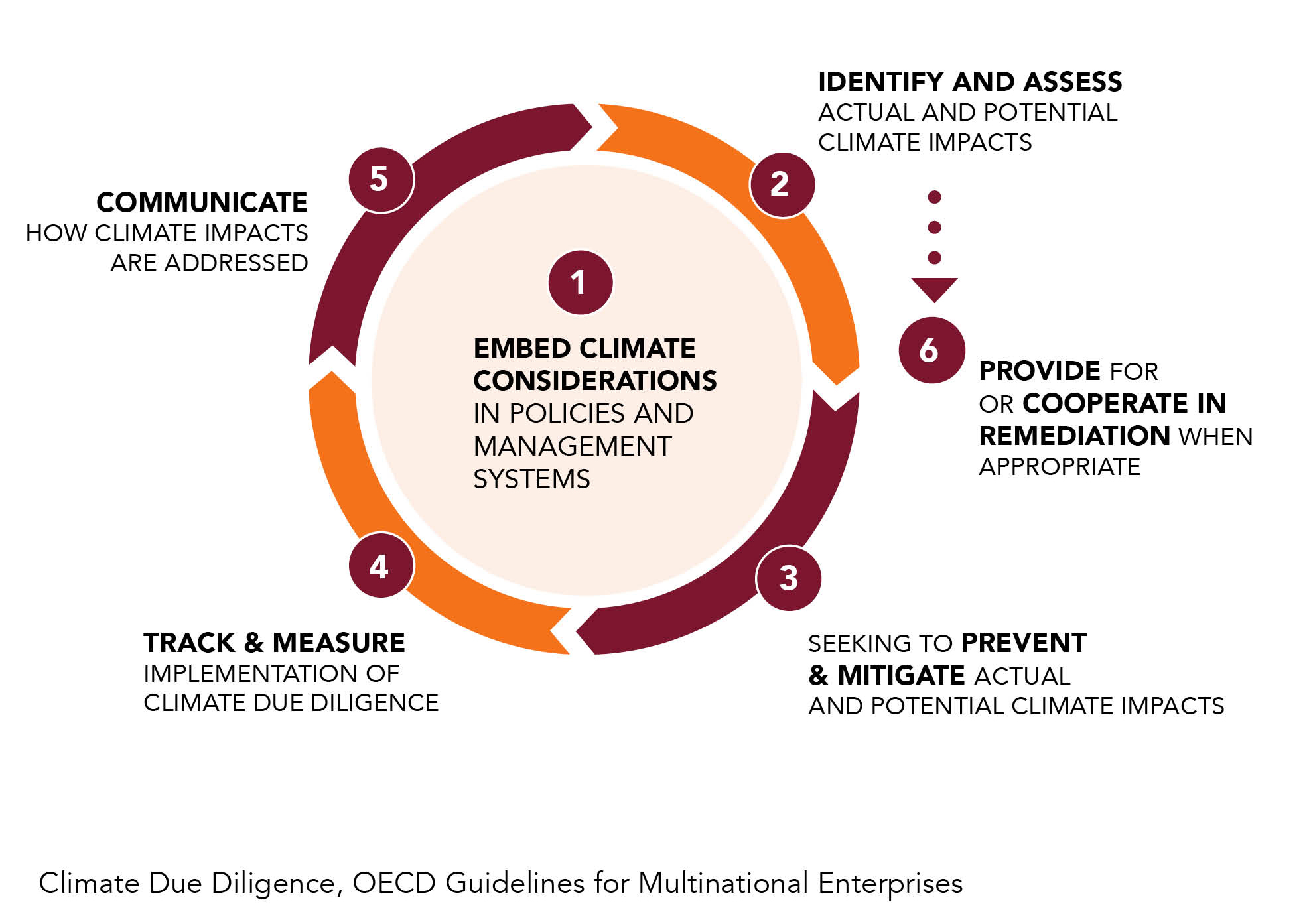
Click on the image to view a larger size
Voluntary frameworks on climate action have long directed companies to align with steps of climate due diligence, such as identifying, mitigating, and communicating climate impacts. For instance, companies following Greenhouse Gas (GHG) Protocol, Science Based Targets Initiative (SBTi), Task Force on Climate-Related Financial Disclosures (TCFD) governance-related guidance, Carbon Disclosure Project (CDP) disclosure expectations, or frameworks such as Transition Plan Taskforce, are ahead on their CSDDD CTP-related compliance journey.
While CSDDD doesn’t require companies to assess their impacts on climate, companies must know their emissions to adopt and implement credible, CSDDD-aligned CTPs.
CSDDD is Closing the Just Transition Gap
Climate action is urgent, but it must be just and inclusive. Few climate transition frameworks (e.g., Glasgow Financial Alliance for Net Zero, or GFANZ, UK’s Transition Plan Taskforce) ask companies to assess the impacts of climate action on people—and none ask companies to address them. This perpetuates siloes between climate and human rights teams within companies.
At first glance, the CSDDD’s CTP requirements reflect a siloed approach. There is no explicit requirement to consider the actual or potential negative impacts of climate mitigation on people. CSDDD also doesn’t explicitly require companies to focus on adaptation—which is a miss. Yet by requiring companies to conduct human rights due diligence on the negative impacts of their operations, supply chains, and limited downstream partners, the just transition is in scope.
Respecting human rights in climate action involves committing to respect human rights in the transition out of fossil fuels and into a green economy. Companies must expand human rights due diligence to cover CTP measures, such as decommissioning mining sites, switching to renewables, and protecting carbon sinks, and enable remedy when harms occur.
Engagement of affected stakeholders, such as workers, trade unions, communities, and Indigenous Peoples, is required. This may take the form of tripartite dialogue with trade unions and government or engaging in good faith processes of free, prior, and informed consent. At all times, companies must provide comprehensive information about climate mitigation plans and activities that may affect people’s lives and ensure ongoing consultation while reducing engagement barriers and ensuring people are free from retaliation.
Companies that fail to comply with CSDDD’s due diligence requirements may be held civilly liable for any resulting damages to people. This comes amidst the rise of just transition litigation—affecting companies that extract and produce materials critical for the transition, as well as wind energy, hydropower, and solar projects—a trend that is certain to continue.
CSDDD Preparation: Putting Just Transition at the Heart of Climate Action
Few companies have conducted human rights due diligence of CTPs despite growing attention to just transition in GFANZ, the Transition Plan Taskforce (TPT), and the Corporate Sustainability Reporting Directive (CSRD). The following recommendations support an ambitious approach to preparing for CSDDD:
- Assess gaps in CTP mitigation measures and associated climate and human rights due diligence approaches against CSDDD requirements. Review business models to ensure compatibility with Paris Agreement goals and respect for human rights.
- Assess alignment of overall climate strategy with the OECD Guidelines and the UN Guiding Principles to strengthen a holistic approach to human rights and climate change. Ensure the climate approach focuses not only on mitigation, but on adaptation and climate justice.
- Engage and strengthen board and senior leadership capacity. Strong leadership is needed to set the tone and ensure the company leans into the complexities associated with adapting business models, evaluating trade-offs, and ensuring net-zero efforts are grounded in human rights due diligence.
- Build internal expertise and foster cross-functional collaboration between human rights and climate teams, including when conducting due diligence and designing strategies and action plans.
- Develop an affected stakeholder engagement strategy, including stakeholder mapping to identify all groups relevant to each mitigation activity, such as climate-vulnerable stakeholders. Create an engagement timeline that starts earlier than traditional project cycles and design culturally appropriate engagement methods for each group.
- Identify and scrutinize collective action platforms that support climate mitigation efforts. Use leverage within initiatives to promote the inclusion of human rights and just transition approaches in the transition to a Paris-Agreement aligned economy.
BSR will discuss the connection between environmental and human rights due diligence this week at Climate Week NYC.
Interested in advancing your company's Climate and Human Rights Due Diligence Strategies? Contact BSR’s Human Rights and Climate experts to find out more.
Blog | Tuesday June 27, 2017
Supply Chain Sustainability in the Consumer Goods Industry and the Benefits of Collaboration
Here are five key findings from the 2016 AIM-PROGRESS Member Benchmarking report on the state of supply chain sustainability in the fast-moving consumer goods industry.
Blog | Tuesday June 27, 2017
Supply Chain Sustainability in the Consumer Goods Industry and the Benefits of Collaboration
Preview
When it comes to building sustainable supply chains, collaboration is critical. It helps companies share best practices and resources and jointly develop principles and standards that amplify impacts. In fact, when BSR set out our Supply Chain Leadership Ladder framework earlier this year, we established collaboration as one of the four dimensions of a robust sustainable supply chain program.
Collaboration is also a core theme of a new AIM-PROGRESS study that BSR led to examine how much progress the fast-moving consumer goods industry is making on supply chain sustainability. The annual study, which BSR has supported for the past two years, is based on information and data submitted by 40 companies representing more than US$800 billion in revenue.
In addition to providing a snapshot of the state of supply chain sustainability in the consumer goods industry, the study also shows how collaboration can drive efficiencies, encourage companies to innovate and act with ambition, and deliver greater impacts in the world. Here are five key findings from the 2016 AIM-PROGRESS Member Benchmarking report:
- Collaboration is generating cost savings: In 2016, AIM-PROGRESS members accepted nearly 2,000 supplier audits commissioned by another member rather than asking suppliers to submit to another audit. In addition to addressing audit fatigue and reducing administrative burdens, this saved members an estimated US$5 million in avoided audit costs.
- Collaboration helps companies implement the international sustainability agenda: When the UK Modern Slavery Act was passed in 2015, one-third of AIM-PROGRESS members had no formal approach to address the risks of modern slavery in the supply chain. AIM-PROGRESS set modern slavery as a priority area for the group, and today, 92 percent of members have an established approach to this issue.
- Supply chain sustainability goals are now mainstream: Today, 90 percent of AIM-PROGRESS members have set supply chain sustainability goals—an 18 percent increase since 2015.
- Supply chain sustainability actions are reaching a larger number of suppliers: In 2016, companies engaged about 50 percent of in-scope suppliers through a sustainability assessment, audit, or self-assessment—up from 33 percent of in-scope suppliers in 2015.
- Companies are investing in more robust governance and management: In 2016, companies reported a 60 percent increase in the number of people working on responsible sourcing, and a 14 percent increase in program oversight at the vice president level or above.
This survey reveals that company efforts on supply chain sustainability are maturing, as is the collaboration architecture that supports them. Members of AIM-PROGRESS said the collaboration has helped to strengthen their responsible sourcing programs. “We have benefitted substantially from learning from other companies and sharing resources as we have ramped up our program. We use the [survey] insights as a tool to engage our teams and drive further progress,” said Anheuser-Busch InBev Sustainability Manager Clare Flannery. WestRock Director of Supply Chain Compliance and Sustainability Christopher Campolongo added that this kind of work gives AIM-PROGRESS members “greater visibility into common topics that can be improved on a global scale.”
As we mark our 25th year, BSR will build on what we have learned to help our members get the most out of collaboration on supply chain sustainability. Whether through our own Collaborative Initiatives or via partnerships with other platforms, we will continue to champion collaboration as a way to build inclusive, resilient, and transparent supply chains.
Blog | Wednesday November 15, 2017
Our Theory of Change: The Rationale Behind BSR's Open Membership Policy
We believe in working with business to truly create a more just and sustainable world. We can’t do that if we only work with the small percentage of companies who are already 100 percent committed.
Blog | Wednesday November 15, 2017
Our Theory of Change: The Rationale Behind BSR's Open Membership Policy
Preview
In an increasingly polarized world, we often look to sort organizations, ideas, or people into good or bad. When you communicate in soundbites or 140 characters (or even a whopping 280!), it can become challenging to provide context or nuance.
This trend toward categorizing good and bad actors has applied to the private sector for a long time. Big corporations are often portrayed as universally evil, while small businesses are assumed to be good. And while most people know it’s not that simple, it takes time to really investigate the nuance. The starting point for BSR’s theory of change is our open membership policy: Any company that expresses the desire to improve its sustainability performance is welcome to join BSR.
Even among large corporations, consumers and the media often paint one company, or an entire industry, in a negative light, rather than try to understand the balance of positive and negative impacts that most companies have on the world around them. As F. Scott Fitzgerald famously said, “The test of a first-rate intelligence is the ability to hold two opposed ideas in the mind at the same time, and still retain the ability to function.”
At BSR, our theory of change is based on this ability, and we believe the greatest impacts occur in the context of this nuance. As lead of BSR’s global membership, I am often asked, “How can BSR possibly work with ______ (insert your favorite company to hate)?” The answer is that we believe in working with business to truly create a more just and sustainable world. We can’t do that if we only work with the small percentage of companies who are already 100 percent committed; and we also know that nobody is perfect.
For example, Unilever has been named the global leader on sustainability in the GlobeScan/SustainAbility Leaders Survey for seven years in a row. Yet Unilever readily acknowledges that they have not yet achieved all of their sustainable living objectives: They understand the need for continuous improvement. And if we only worked with companies at the level of sustainability commitment of Unilever, we would not be doing a very good job in truly changing the way all mainstream business is done. We would also miss opportunities to multiply the number of leaders driving meaningful, sustainable change throughout the ecosystem.
From our perspective, all companies have areas of their performance that can be improved. As our founders stated, BSR works with “leaders and learners, and most companies are both.” The integrity of this model is safeguarded by our policy against allowing companies to cite BSR membership as a “seal of approval,” certifying in some way that they have achieved a certain level of performance. As such, we are clear in stating that BSR membership alone does not provide any qualitative assessment of a company’s performance on sustainability.
We also understand that some industries are inherently less sustainable than others—and for some organizations, it may make sense to avoid an entire sector when developing an engagement strategy. Our model is not perfect, and it works in part because other organizations have different theories of change that complement what we do.
However, at BSR, we have found that the same sectors that some find problematic are the ones where the greatest opportunities for transformation often exist. Our mission is predicated on engagement, and from this perspective, we don’t believe it makes sense to uniformly single out an industry. That’s why BSR works across many industries that some may find objectionable—from those producing GMOs, soft drinks, tobacco, or fast food to those in the business of defense, nuclear power, or oil and gas.
To summarize, our theory of change is based on inclusion and continuous progress within mainstream business. I believe our approach substantially increases our opportunity for impact; it also enhances our ability to engage deeply with businesses across the sustainability leadership spectrum on the tough challenges the world faces today.