Searching for: leadership
Search results: 11 of 283
Reports | Tuesday July 17, 2018
Resilient Business, Resilient World: A Framework for Private-Sector Leadership on Climate Adaptation
This report assesses and consolidates the best available knowledge to present an accessible and actionable framework for private-sector leadership on climate change resilience.
Reports | Tuesday July 17, 2018
Resilient Business, Resilient World: A Framework for Private-Sector Leadership on Climate Adaptation
Preview
Climate change represents a material risk to the private sector with profound implications across companies’ operations, in their supply chains, and in the vulnerable communities in which they operate. For the past three years, the World Economic Forum’s annual Global Risk Report has ranked climate risk high-priority in terms of both likelihood and impact. From extreme weather events, like hurricanes, flooding, and drought, to longer-term events like sea-level rise, the private sector faces a host of physical climate-related events that create risk on various aspects of the value chain. And yet, companies have the capacity to be powerful agents of climate resilience across society—if properly equipped with a comprehensive diagnosis of climate risk and tailored strategies for enhancing adaptive capacity to the effects of climate change.
This report assesses and consolidates the best available knowledge from natural and social science in the field of climate risk and resilience to present an accessible and actionable framework for private-sector leadership on climate change resilience inside individual companies, across complex global supply chains, and within frontline communities vulnerable to climate impacts.
Blog | Thursday March 15, 2018
The Women's Empowerment Principles in Practice: Analyzing One Year of Data
The Women’s Empowerment Principles (WEPs) Gap Analysis Tool was developed to give companies guidance on how to implement the WEPs. Here’s how companies are using it one year after its launch.
Blog | Thursday March 15, 2018
The Women's Empowerment Principles in Practice: Analyzing One Year of Data
Preview
This year, the level of corporate engagement in International Women’s Day (IWD) was unprecedented. Companies marked the day seemingly everywhere: ANN announced it achieved its milestone of empowering 100,000 women across its supply chain; others, like Pottery Barn, launched special-edition products celebrating women whose proceeds benefit BSR’s HERproject. Still others, including Swarovski, launched collaborations and campaigns to bring visibility to those women across society who are often forgotten.
One week after IWD, we are releasing new insights on the extent to which companies are taking steps internally to integrate a gender lens into their policies, programs, metrics and reporting. To date, 1,800 companies have signed onto the Women’s Empowerment Principles (WEPs); the WEPs Global Trends Report, which we authored in close collaboration with the partners of the tool, reviews the aggregate practices of companies that have used the WEPs Gap Analysis Tool. Developed to give companies guidance on how to implement the WEPs, the tool is a joint project of the UN Global Compact, UN Women, the Multilateral Investment Fund of the IDB, and the Inter-American Investment Corporation, and is supported by the BSR, Governments of Japan and Germany, The Coca-Cola Company, Itaipu, and KPMG.
This first trends report provides a snapshot of corporate performance—across the WEPs categories of leadership, workplace, marketplace, and community—on gender equality and women’s empowerment.
Here are some of the key findings on how companies are managing these critical issues:
- Leadership: A majority of companies—69 percent—have a commitment from their leadership on gender equality and women’s empowerment, while only 32 percent have an organization-wide gender equality strategy.
- Workplace: 45 percent of companies have a policy addressing equal pay for work of equal value, and 15 percent are setting goals to build the pipeline of women in management positions.
- Marketplace: 12 percent of businesses include gender equality criteria in supplier management tools; only 5 percent of companies have set procurement targets for women-owned businesses.
- Community: 52 percent embed gender in philanthropic, advocacy, and partnership efforts, while only 10 percent assess differential impacts on men and women during human rights or social impact assessments.
The data show there is a lot of opportunity for companies to translate their commitments into policies and programs that support concrete action.
If you’re looking to better understand your company’s performance on these issues, taking the WEPs tool is a great first step.
Let’s make sure we continue to celebrate and focus on women’s advancement well beyond a single day or month.
Blog | Tuesday October 15, 2019
Answering the Call for Business Leadership on Climate Policy
Our recently released letter calling for business action on climate policy—which we were delighted to publish in partnership with 10 other leading environmental and sustainability organizations—is a sign of the times.
Blog | Tuesday October 15, 2019
Answering the Call for Business Leadership on Climate Policy
Preview
Our recently released letter calling for business action on climate policy—which we were delighted to publish in partnership with 10 other leading environmental and sustainability organizations—is a sign of the times.
The creation of the letter was driven by a few fundamental things, some good and some bad: First, the bad. My colleagues Aron Cramer and David Wei recently summarized the current situation and outcomes from the recent UN General Assembly and Climate Week in NYC. The bottom line? Despite mounting scientific evidence for urgent action, a growing list of leadership initiatives by companies and other “non-state actors” (cities, states, regions), and increasingly urgent demands for action by investors, employees, students, etc., national governments have demonstrated that they cannot and/or will not deliver without a significant push from key constituents.
Now the good news: That’s us and we can do this.
Working with our friends and partners in the We Mean Business coalition and the Renewable Energy Buyers Alliance, we have seen steadily increasing engagement from more and more diverse companies in climate advocacy. On an international level, business engagement has grown dramatically over the past several years and arguably played a key role in achieving the Paris Agreement. More recently, here in the US, we have seen the emergence of business stepping up to fill a leadership vacuum left by our national political leadership. Earlier this year, for example, we supported a lobby day in Washington DC, that saw more than 75 companies talk to Senate and House members on both sides of the aisle about the need for a price on carbon to underpin our efforts to build a prosperous, low-carbon economy.
What Comes Next for Business’ Climate Action
At a high level, the solution is clear and reflected in the three pillars of our call to CEOs of corporate America to adopt a science-based climate policy agenda:
- Advocate for policies at the national, subnational, and/or sectoral level that are consistent with achieving net-zero emissions by 2050;
- Align their trade associations’ climate policy advocacy to be consistent with the goal of net-zero emissions by 2050; and
- Allocate advocacy spending to advance climate policies, not obstruct them.
We understand that clear is not the same thing as easy. Putting these principles into action will require that business—in partnership with like-minded players in civil society and the public sector—play an active role in addressing a number of obstacles facing each of them. Specifically:
Business must define their advocate priorities. We can and must create a coherent policy action agenda that clarifies key ‘must-haves’ vs. ‘nice-to-haves’ or specific sectoral interest that we can refer to as a guide through the rough and tumble of electoral politics. What are must-haves that will set overall direction and who will join us?
Business must assess whether trade associations’ priorities align with their values. How can we navigate opportunities to influence the bodies that represent us and when are we better served to pull out?
Business must review how they allocate advocacy spending, again to ensure alignment with values. How can we develop a more comprehensive understanding of overall net benefit and interest in the midst of a daunting set of apparently conflicting priorities? Is it really true that we need to restrict our advocacy to the near-term and urgent (taxes, trade, etc.) at the expense of longer-term self-interest?
In order to put these principles to work, we know that we must also enable the right kind of transparency in our collective efforts. We furthermore need to this without creating new, additional platforms for disclosure and reporting at a time when there is a need to reduce duplication and fragmentation in reporting and disclosure. How and where can we best enhance the platforms we already have to provide more transparency on corporate climate lobbying?
Climate action by corporate leaders is important, and it continues to gain momentum. Soon there will be more than 700 large corporates with formal, public, science-based climate targets, including net-zero emissions by no later than 2050 and significant milestones along the way. We need effective advocacy to match that ambition, doing all we can to ensure that those 700 can actually achieve these targets and that many thousands more can join them.
We look forward to working with our members and partners to make it so.
Our shared future depends on it.
Blog | Friday December 15, 2017
In Case You Missed It: Noteworthy BSR Insights of 2017
We published a lot of blogs throughout 2017, and some of them may have slipped under your radar. So we’ve rounded up some of our favorites here ICYMI (in case you missed it).
Blog | Friday December 15, 2017
In Case You Missed It: Noteworthy BSR Insights of 2017
Preview
As the year draws to a close, we are taking a moment to reflect on the turbulent year that has been 2017. In addition to the top blogs and reports of the year, we wanted to share with you some of our favorite series and stories that you may have missed.
Our first series of 2017 was on shared solutions to global challenges. It explored outcomes and impacts of our work with partners and through our Collaborative Initiatives. As part of this series, we launched two new efforts—Building Responsibly and the Future of Reporting initiative.
We also ran a series on the business case for climate action, in partnership with We Mean Business, that dove deep into corporate energy management trends, business resilience in the face of extreme weather, and the influence of global value chains on climate action from business.
During Climate Week NYC, we brought these two themes together in a series on climate and collaboration, with our thoughts on new climate leadership to realize the Paris vision; the need for radical collaboration, inside and outside of companies; and company examples of collaborating to achieve climate leadership. In short, we are seeing collaboration on a massive scale across all sectors, including and especially from business, to achieve the objectives articulated in the Paris Agreement.
We also sat down with the practice leads from each of our areas of expertise—climate, human rights, inclusive economy, supply chain sustainability, sustainability management, and women’s empowerment—to talk about the future of sustainable business in a Q&A series. Their thoughts also helped inform our report on The Future of Sustainable Business, which we released in October.
We published quite a few insights outside these series that are worth revisiting, too. Here are some of my favorites:
- To feel inspired by successful pilots to promote women’s health and empowerment, read Dorje Mundle’s Innovative Financing for Sustainability at Scale.
- To give your brain a workout by thinking through the human rights implications of artificial intelligence, and specifically what remedy should look like for decisions made by machines, see Remedy against the Machine from Dunstan Allison-Hope.
- To remind yourself why you bring your values to your day job, and why business leadership on diversity and inclusion is more important now than ever, read Now Is the Time to Examine (and Re-Examine) Your Commitment to Diversity and Inclusion from Aditi Mohapatra.
- To learn about (and then explore!) a tool to help you empower women in your business, check out A New Tool to Help Close the Gender Gap by Lauren Shields.
- To get excited about the transportation innovations that will revolutionize the way we get from point A to point B, as well as their sustainability implications, enjoy Sustainability on the Move: Transportation Innovation by John Hodges.
What was your favorite BSR content from the past year? Connect with us on Twitter @BSRnews to share.
Blog | Thursday March 3, 2022
Unlocking Opportunities in Access to Healthcare
While progress has been made in the past two decades, half the world’s population still lacks access to essential healthcare services. As a step in their collective action for driving progress, BSR and the HCWG have developed the Access to Healthcare Leadership Ladder.
Blog | Thursday March 3, 2022
Unlocking Opportunities in Access to Healthcare
Preview
The right to health is a fundamental part of human rights and of our understanding of a life with dignity. While progress has been made in the past two decades, half the world’s population still lacks access to essential healthcare services. This continues to be one of the biggest global challenges and one that demands system-wide change.
For the past 12 years, BSR and the Healthcare Working Group have explored new methods to bring about change, via guiding principles, research papers, and multistakeholder dialogue. Today, the assessment is clear:
- The healthcare industry has unique competencies they can harness for continued progress. By working alongside peers, governments, NGOs, and other organizations, companies can continue to help overcome barriers that prevent underserved populations from receiving quality healthcare and contribute to expanding universal and equitable access to all.
- With regards to companies in the healthcare sector, access should be understood as a core business issue and opportunity. While long addressed through donations and one-off initiatives or programs, it is has become clear that real progress can only be achieved by integrating “access thinking” throughout a company: including from R&D to logistics, from the board room to the patient, from idea to impact.
- There are still some largely untapped avenues for progress, and even the most mature business and corporations have opportunities to move the sector forward.
“The BSR Access to Healthcare Leadership Ladder framework is an important step forward in establishing standards for industry-led access programs. We encourage all stakeholders, within and outside the industry, to get involved and agree on such standards, in order to establish a common understanding of the industry’s role and achievements in improving global access.”
—Profs. Veronika Wirtz and Peter Rockers, Boston University School of Public Health
As a step in their collective action for driving progress, BSR and the HCWG have developed the Access to Healthcare Leadership Ladder, a maturity diagnostic and ambition-setting tool to guide and drive progress on access to healthcare. Based on BSR research and dialogues with external experts (including academics, industry associations, investors, relevant foundations, and NGOs) and HCWG members, the Ladder aims to achieve HCWG members’ shared vision of access to healthcare.
The tool helps companies to drive impact by assessing the current level of maturity and opportunities for progress across different dimensions that constitute access to healthcare, helping companies look at their practices through a value chain lens, realizing the extent to which access is currently integrated across their organization, and identifying gaps and opportunities for further improvement.
The Ladder has been designed to cover a broad spectrum of access issues for healthcare companies, irrespective of the medicine they develop or the market in which they distribute their products. Furthermore, the tool is relevant to any company and should provide insights to even the most mature companies.
In the Ladder, access maturity is evaluated across the company value chain through nine dimensions: six dimensions covering the “four As” (Availability, Affordability, Accessibility, and Acceptability) plus three dimensions covering business practices and measurement.
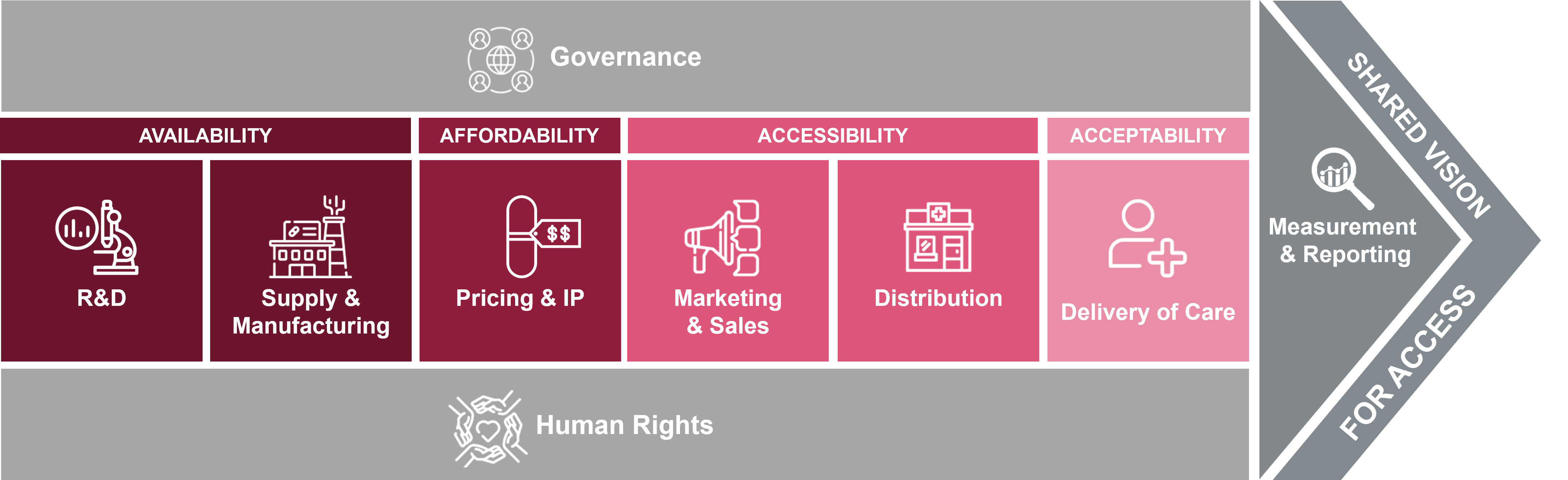
For each of the dimensions, the Ladder defines four maturity levels:
- Working at a base level, i.e., defining the minimum practice, beyond regulatory requirements
- Achieving good access practices, i.e., an overview of good practice
- Pioneering innovative solutions, i.e., examples of current, innovative practices
- Driving impact, i.e., next steps to achieving the HCWG vision of access
We trust the Ladder will be a useful tool to spark the higher ambitions and resources needed for underserved patients across the world to receive quality healthcare.
The Ladder now enters a pilot phase that companies are welcome to join. For any questions or comments, please contact the Healthcare Working Group.
Blog | Wednesday March 6, 2019
#ThisIsALeader: Raising the Profile of Women Making a Difference
Out of the spotlight and away from the media attention, women throughout global supply chains are quietly taking on leadership roles and driving change for their colleagues, families, and communities.
Blog | Wednesday March 6, 2019
#ThisIsALeader: Raising the Profile of Women Making a Difference
Preview
When you think of inspirational women leaders in business, who comes to mind? Is it Mary Barra, Chairman and CEO of General Motors—the first female CEO of a major global automaker? Or maybe Indra Nooyi, who served for 13 years as CEO of PepsiCo, one of the largest food and beverage businesses in the world?
With women at the helm of such large enterprises, it’s hard to believe that there had not been a woman CEO of a Fortune 500 company until 1972—when Nooyi was 17. No doubt she and Barra faced formidable obstacles in their journeys to leadership, including discrimination against women in education, in business, and across societal expectations. In spite of this, they rose to prominence and success, blazing a trail for others to follow, and we are right to celebrate what they have achieved.
However, the celebration of women leaders should not be limited to the C-suite. Out of the spotlight and away from the media attention, women throughout global supply chains are quietly taking on leadership roles and driving change for their colleagues, families, and communities. To highlight these lesser-known leaders on International Women’s Day, we have partnered with four committed partners of BSR’s HERproject—The Estée Lauder Companies, Inc., Nordstrom, UGG®, and Williams-Sonoma, Inc.—to raise the profile of and increase support for women leaders right across the supply chain, from corporate offices to the factory floor.
Out of the spotlight and away from the media attention, women throughout global supply chains are quietly taking on leadership roles and driving change for their colleagues, families, and communities.
Our #ThisIsALeader campaign celebrates workers from factories in China, India, Vietnam, and other countries where HERproject is active. Through HERproject, these women have become peer educators: sharing knowledge and skills on health, financial inclusion, and gender equality with their colleagues. And as leaders in their respective communities, these peer educators advocate on behalf of their colleagues, provide them with support, and show what is possible even in societies where women often face overwhelming challenges.
Take Sapna, a HERproject Peer Educator in Agra, India:
I was the sole breadwinner of my family for a long time and I was responsible for the overall well-being of everyone at home. For reasons we never discovered, one of my brothers fell ill and suffered a paralytic stroke. He was bedridden for months. My mother was also unwell and eventually passed away after a heart attack. That happened just after my engagement.
Because of this series of sad events, culminating in my mother’s death, the groom’s family decided that I was a bad omen and called off our engagement. These were really bitter and tough experiences for me. But they only strengthened my determination to succeed in life.

I didn’t know what the HERfinance program was, but when I heard about it, I was curious, and I thought that I wouldn’t lose anything by attending it. So, I took part in the trainings at the factory and they helped me to regain the confidence I had lost. I realized that, along with education, financial planning is critical for our generation. The trainings made me decide to spend wisely and save so that my future is secure.
My brother has now recovered from his illness. He recently started a new job and is looking forward to a bright future. For myself, I’m pursuing higher education again and I’m hoping to graduate.
That’s just one of the amazing stories we hear through HERproject. Like Sapna, women leaders within brands are driving commitment to women’s empowerment. They are connected across geographies by the belief that they can help others and improve the lives of people around them—especially fellow women.
In addition to our #ThisIsALeader social media campaign, we are hosting an evening event on Thursday, March 7, to celebrate women’s leadership. Senior leaders from The Estée Lauder Companies, Inc., UGG®, and Williams-Sonoma, Inc. will join nonprofit leaders, public officials, and members of the media for a discussion on what is needed to ensure that women around the world can fulfil their potential as leaders. If you would like to join us, please register your interest here.
We invite you to join the conversation on social media by sharing a photo of an unsung woman leader with the sentence “#ThisIsALeader because…”.
Beyond celebrating women across the global supply chain, we want to catalyze support so that they can go further as leaders: spreading knowledge, belief, and confidence, and unlocking the potential of women around them. Because we believe that when business and partners work to unlock this potential, the impact will be unprecedented.
Ahead of International Women’s Day, we call on businesses to commit to empowering women leaders right across your supply chain. And we invite you to join the conversation on social media by sharing a photo of an unsung woman leader with the sentence “#ThisIsALeader because…”. Together, we can raise the profile of the women who are making a difference and step up our support for them as they drive positive change.
Blog | Tuesday September 5, 2017
Business Leadership: Continuing to Build the Momentum
As many of us prepare to gather in New York this month for Climate Week and the UN General Assembly, we are also focused on how to translate this important talk into action.
Blog | Tuesday September 5, 2017
Business Leadership: Continuing to Build the Momentum
Preview
The world is increasingly looking to businesses—and business leaders—to chart a path forward on a range of topics, from diversity, to climate action, to the changing nature of work as automation reshapes our world and our economy. One of the more inspiring stories so far in 2017 has been the large number of CEOs who have stood up publicly to support progress on these topics, which are central both to the business agenda and the public’s priorities. Advocacy for a just and sustainable world is more important now than ever.
As many of us prepare to gather in New York this month for Climate Week and the UN General Assembly, we are also focused on how to translate this important talk into action. That’s why we are excited to continue the momentum of these efforts and work with you to define the future of sustainable business during our 25th annual BSR Conference in Huntington Beach, California.
This milestone arrives at a time when looking ahead in a rapidly changing world is essential. While we will be taking stock at the Conference of where we have come from—not just BSR, but the wider sustainability community—we will be focusing even more attention on redefining business in a world where it is said that the pace of change will never again be as slow as it is today. As we know, it is already mind-bendingly fast.
In our times of change, it is no longer enough to look to “integrate” sustainability into business strategy. Our changing demographics, disruptive technologies, economic dislocation, shifting culture, and natural resource scarcity are not just sustainability issues; they are business issues. The best companies we work with are the ones who know that women’s empowerment, climate resilience, the changing nature of work, and new production and consumption models aren’t topics only for the sustainability report: They are crucial conversations for the board room.
In our view, this means a new agenda for business, new tools for sustainability leaders, and, in a world of political volatility, a new approach to business leadership.
At the Conference next month, we will be highlighting changemakers who are embracing the need to redefine business for an era of change. We will be featuring a special track, “FastForward 25,” that will feature conversations on topics like “Harnessing New Technologies for Supply Chain Sustainability,” “The Ethics of Artificial Intelligence,” and “Redefining Sustainable Business.”
We will explore how leading businesses are embracing new technologies; helping to reshape the social contract, navigating the intersection of technology and human rights, and many other cutting-edge topics. We will also be introducing BSR’s Sustainable Futures Lab, which we are launching this year as a new way for us to integrate futures thinking and methodologies into our collaborative and one-on-one work with our members.
We will hear from prominent voices who are looking ahead with a keen understanding of where we have come from. Al Gore will kick us off on Tuesday. He has focused on the future throughout his career. He has the perspective of someone who was involved in the earliest U.S. Congressional hearings on climate and was a powerful representative for the U.S. at the first Earth Summit in 1992, the same year BSR was launched.
BSR’s earliest leaders, including my predecessor Bob Dunn and BSR’s longtime Chairman Mats Lederhausen, both of whom possess a clear vision of what it takes to make business truly sustainable, will join us. We are also delighted to showcase some great BSR alumni: Kara Hurst of Amazon, Michael Kobori of Levi Strauss & Co., and Wei Dong Zhou of The Sustainability Consortium, great leaders of whom we are immensely proud.
The 25th BSR Conference will be a fun and stimulating opportunity to encounter old friends and new ideas. We are excited to redefine sustainable business, recharge our wonderful community of leaders, and recommit to building a just and sustainable world.
I hope you will join us by the ocean in Huntington Beach as we meet our moment with passion, creativity, and commitment.
Audio | Tuesday November 28, 2023
Role of Boards and Governance with Christine Diamente
Christine Diamente, BSR Managing Director, Transformation chats with David Stearns on the Role of Boards and Governance, exploring: What new skills boards need to have in light of these new regulatory and reporting requirements. What platforms or opportunities exist for upskilling and what kind of requests is BSR receiving from…
Audio | Tuesday November 28, 2023
Role of Boards and Governance with Christine Diamente
Preview
Christine Diamente, BSR Managing Director, Transformation chats with David Stearns on the Role of Boards and Governance, exploring:
- What new skills boards need to have in light of these new regulatory and reporting requirements.
- What platforms or opportunities exist for upskilling and what kind of requests is BSR receiving from boards.
- What do we mean by business transformation and what hurdles and opportunities exist for corporate leaders in this new environment.
- Lessons learned from Christine’s experience engaging in scenario planning exercises with BSR members.
Blog | Tuesday February 7, 2017
Redefining Business Leadership in a New Environment
As we witness a systematic assault on the foundations for a just and sustainable world, a new question is arising: How do companies and CEOs respond when basic principles are under attack?
Blog | Tuesday February 7, 2017
Redefining Business Leadership in a New Environment
Preview
Donald Trump ran for president of the United States as an unconventional candidate, and in the third week of his presidency, it is undeniable that change has arrived.
And while he pledged to “shake up Washington,” in a very short time, he has changed the way we define business leadership, too. To meet this moment—in the United States and beyond—it is time to rethink how businesses lead not only through their actions but also their words. This presents important opportunities and also complexities for CEOs and their companies.
It is important to note that here in the United States, BSR has worked effectively with both Democratic and Republican administrations and other officeholders for 25 years. There are leaders in both parties committed to our core issues of human rights, climate action, women’s empowerment, and inclusive economic growth.
Unfortunately, we—and the business community overall—are not experiencing a policy debate on how to make progress on these issues. Instead, we are seeing early signs of a systematic assault on the foundations for a just and sustainable world: open societies, climate science, transparency, diversity, inclusion, and at its essence, the concept of collaborative global engagement to solve global challenges.
This presents a new situation for companies and CEOs: How do you respond when basic principles are under attack?
The travel ban put all these questions into sharp relief, and the responses from various companies show how complex the new environment is. We have seen companies (e.g., Ford, Google, Microsoft) lauded for standing up against the travel ban, companies (e.g., Uber) pilloried for being seen to enable the ban, and companies (e.g., Starbucks) both applauded and attacked for opposing the ban.
In navigating this environment, there are four core principles that CEOs should keep in mind:
- Values are non-negotiable: Now is the time for CEOs to act on the basis of core values. All the assertions that businesses should have a “purpose” are being tested. No company can survive if principles are either undermined or revealed to be nothing more than words on a website. To put it another way, values are meant to endure over decades; they cannot be abandoned when political winds change.
- Your employees and customers are watching what you do—and say: When 2,000 Google employees walked off the job last week to protest the travel ban, it was the most visible example of how company employees are viewing the current environment. No CEO has a politically unified workforce. But there is growing evidence that employees are indeed watching what their leaders do and acting accordingly—evidence suggests that Travis Kalanick’s resignation from the president’s CEO council was driven by unrest from Uber’s employees and customers.
- There is strength in numbers: CEOs face multiple pressures in deciding how to engage. There are several bread-and-butter economic matters being decided by the new government. No CEO can afford to abandon those interests. Collaboration is more important than ever, because it allows companies to express their values as one voice, while maintaining the opportunity for influence in other matters. The many companies that joined the state of Washington’s lawsuit challenging the travel ban is but one example of that principle.
- Opposition alone is insufficient—it’s time for a powerful, positive vision of progress: Business leaders need to reinforce their vision of the future. In the absence of leadership in Washington, and frankly, with a bleak picture coming from the White House, it is essential that business leaders illustrate what we have to gain through sustainability. Businesses know firsthand that a shift to low-carbon models brings innovations that deliver great value with fewer societal costs. Business leaders know that diverse teams are more creative. Business leaders know that open societies are, in fact, a crucial engine of American innovation and competitiveness (a point that is equally true in every country). The world needs to hear these messages from business leaders, lest we manage and govern from a position of fear and suspicion.
We all know that every company has a mix of interests at stake with the government. Acting in overt opposition to an administration prone to singling out individual companies for abuse is no small decision. But equally so, failing to act when core principles are being eroded presents a comparable problem. At some point, maintaining dialogue with the administration could become irrelevant and counterproductive, and while we are not there yet, possibly toxic.
The stakes are high, and business has a powerful voice. As former U.S. Treasury Secretary Lawrence Summers said in Harvard Business Review last week: “If CEOs who employ hundreds of thousands of people are not in a position to speak truth to power, who is going to be in a position to speak truth to power?”
With basic rights, respect for science, and rule of law being questioned, this is the question: Which companies will meet the moment?
Blog | Wednesday September 21, 2022
Beyond the Generation Equality Forum: One Year of Driving Action for Gender Equality
In June 2021, the private sector set a new gender equality agenda through the Generation Equality Forum. Learn about the progress made and where gaps remain.
Blog | Wednesday September 21, 2022
Beyond the Generation Equality Forum: One Year of Driving Action for Gender Equality
Preview
In June 2021, the private sector stepped up to set a new agenda on gender equality. The Generation Equality Forum called for all stakeholders to make clear financial commitments that address critical issues to the advancement of gender equality and the creation of a world free from gender biases and discrimination where all women thrive.
The forum resulted in a record US$40 billion in pledged commitments and new investments in gender equality across the following six Action Coalitions:
- Gender-based violence
- Economic justice and rights
- Bodily autonomy and sexual and reproductive health and rights
- Feminist action for climate justice
- Technology and innovation for gender equality
- Feminist movements and leadership
One year on from the launch of the Generation Equality Forum, we spoke to two commitment-makers—Tamara Dancheva from GSMA and Justin White from Mars—on how key commitments made at the forum have seen growing progress toward gender equality across their organizations.
GSMA on Equal Access to Digital and Financial Services
GSMA’s commitments include reducing the gender gap in mobile internet and mobile money services, as well as a pledge to provide one million women and girls with access to free training and e-mentoring by 2026 via the EQUALS Her Digital Skills Initiative.
Its Mobile Gender Gap Report, which is used by a wide range of stakeholders to better understand the size of the mobile gender gap to inform business choices, has shown that progress toward closing the mobile internet gender gap has stalled across low- and middle-income countries (LMICs) and, in some countries, even reversed, highlighting a clear call to action. Internally, GSMA has committed to achieving a 50/50 gender balance across its Executive Leadership and Leadership teams by 2025, in line with the UN Women Empowerment Principles.
It tracks progress on these different commitments in various ways, including reporting on progress against targets to increase the proportion of women in mobile internet and/or mobile money services customer base, evaluation of beneficiaries’ experience, and ongoing learning through direct feedback mechanisms and reporting on diversity and inclusion metrics.
“GSMA is proud to be driving action across access, skills and leadership when it comes to closing the digital gender divide and this is reflected in our commitments to Generation Equality. We will continue to drive awareness, prioritization and action around the mobile gender gap including through our extensive research and our Connected Women Commitment Initiative, which supports mobile network operators in proactively reducing the gender gap in their mobile Internet and/or mobile money customer base. We are also equally determined to continue with our efforts to leave no woman or girl behind in an increasingly digital world as we work hard to empower emerging female young talent through our internal and external diversity and inclusion work. As we look to expand the remit of our Generation Equality commitments, support from our senior leadership team has been key and we hope to see many more companies follow suit by engaging their senior leaders directly.”
- Tamara Dancheva, Senior International Relations Manager, GSMA
Mars’ Focus on Economic Justice and Rights, Feminist Movements, and Leadership
Mars’ Full Potential platform brings thought leaders together to advance policies, practices, and partnerships that unlock opportunities for women across their workplaces, in sourcing communities, and in the marketplace to reach their full potential.
In 2019, the platform had a comprehensive set of ambitions, including reaching 100 percent gender-balanced business leadership teams, improving family support benefits, investing in women’s social and economic empowerment in sourcing communities, and working to remove gender bias and negative stereotypes in advertising.
In 2021, Mars launched its #HereToBeHeard listening campaign to inform a new set of priorities and ambitions. During the campaign, Mars asked one question: “What needs to change for more women to reach their full potential?” In total, more than 10,000 women from 88 countries responded.
Applying results from the campaign, Mars has shaped refreshed ambitions around its three pillars: workplaces, sourcing communities, and the marketplace. Their commitments include:
- Spending USD$500 million with women-led suppliers
- Deepening their focus on women in sourcing communities by updating procurement guidance that is gender transformative
- Focusing on key issues such as maternal mental health through the Maltesers brand and leveraging the Dove/Galaxy brand to support women’s financial independence in cocoa sourcing communities
Mars has made progress toward their ambition of 100 percent gender-balanced business leadership teams and is reporting on gender representation in advertising. They are also currently working with leading monitoring, evaluation, and learning experts to design a set of metrics that allow them to better measure the impact of sustainable sourcing programs.
“In the world we want tomorrow, society is inclusive, and women are reaching their full potential. We believe we have an opportunity to unlock opportunities for women, to improve community and business outcomes, and address the key themes identified through our #HereToBeHeard campaign.”
- Justin White, Manager, Human Rights and Gender Equality, Global Sustainability, Mars
It is more important than ever to see commitments across various action coalitions and the engagement of different private sector players within the Generation Equality Forum. However, a year into the launch of multi-stakeholder action coalitions, we still observe limited investment and commitments from the private sector on crucial Action Coalitions—including Bodily Autonomy/Sexual and Reproductive Health and Rights (SRHR) and Feminist Action for Climate Justice, which together represent a mere 10 percent of the total financial commitments to date.
For further insight on the private sector commitments and investments made across the six action coalitions, download BSR’s updated report here.