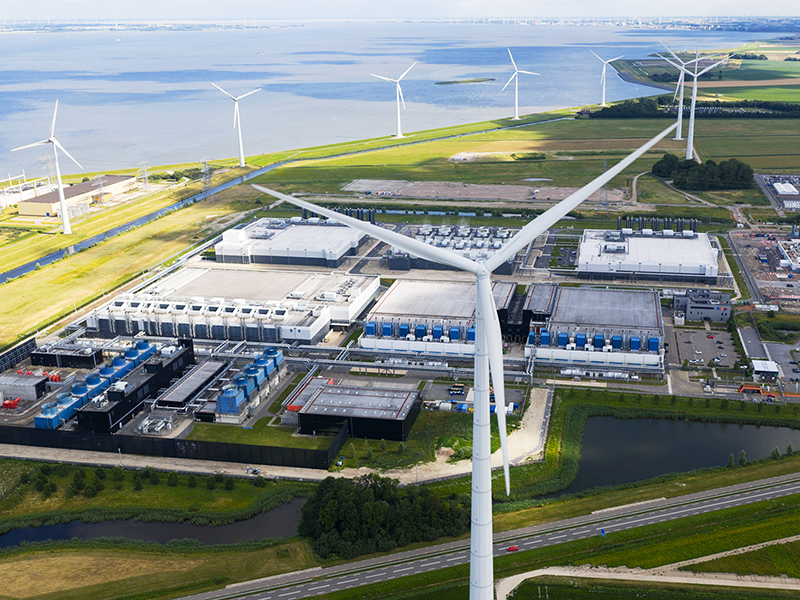
Photo by Hugo Kurk on iStock
Key Points
- To meet rising demand, data centers are expanding at an unprecedented pace.
- With this growth comes increasing pressure on energy systems, water resources, supply chains, workers, and local communities.
- BSR explores key social and environmental impacts, and how businesses can proactively work to mitigate these risks while strengthening long-term business performance.
Data centers provide the backbone for the AI revolution. Their construction and deployment have become a critical area of interest for both the public and private sectors and present opportunities for investment across the value chain. However, data centers also pose significant sustainability risks that must be carefully managed to mitigate harm to people and the environment.
As businesses across all sectors rely on cloud services and AI, they also become more dependent on the data center infrastructure that powers these technologies. This makes the sustainability impacts of data centers relevant not only for technology companies and data center providers, but for any business seeking to deploy AI responsibly.
Companies that invest in understanding and managing the environmental and social impacts of data centers across the value chain are better positioned to:
- Scale AI responsibly by identifying and addressing environmental and social impacts associated with the infrastructure that powers AI.
- Reduce operational and supply chain risk by anticipating constraints related to energy, water, critical infrastructure, and hardware supply.
- Strengthen resilience and stakeholder trust by supporting responsible sourcing, community engagement, and sustainable infrastructure development.
- Meet evolving regulatory and investor expectations around climate, human rights, responsible AI governance, and supply chain due diligence.
This briefing provides an overview of the data center industry and related social and environmental impacts. As demand for digital infrastructure continues to grow, the risk profile and levers to alleviate these impacts will evolve over time.
How Do Data Centers Power AI?
Data centers are the physical facilities that house the servers, storage systems, networking equipment, and cooling infrastructure that keep digital services running. They support everything from cloud computing and streaming to financial systems, e-commerce, and enterprise software.
As AI expands rapidly, data centers have become even more central to the global economy, powering the high-compute models and applications driving the AI boom. AI data centers are a specialized subset designed for the significantly higher computing demands of AI training and inference. They typically house advanced chips, denser server configurations, and sophisticated cooling systems to dissipate the large amounts of heat generated by high-performance computing.
The rapid growth of AI has accelerated investment in larger and more advanced data centers. At the same time, continued expansion is being driven by broader trends, including increasing cloud adoption, digitalization across industries, and the growing availability of renewable and distributed energy sources.
Environmental Risks
BSR’s latest sustainability insights and events straight to your inbox.
Topics
Data centers contribute to significant environmental impacts due to their high electricity demand, cooling needs, water use, land footprint, and reliance on energy- and materials-intensive hardware. As digital infrastructure expands to support growing demand for cloud computing and AI, data centers are contributing to increased greenhouse gas emissions, pressure on electricity and water systems, land conversion, loss of biodiversity, and growing volumes of electronic waste.
AI data centers further intensify many of these impacts because training and deploying advanced AI models requires substantially greater computing power than conventional digital workloads. This demand is supported by specialized chips, denser server configurations, and more intensive cooling systems, increasing resource consumption across the data center lifecycle.
-
Energy: Data centers require large and continuous amounts of electricity to power servers, networking equipment, storage systems, and cooling infrastructure, making energy use one of their most significant environmental impacts. AI data centers are particularly energy-intensive, and growing demand for AI is expected to drive a substantial increase in electricity consumption over the coming decade. Recent AI infrastructure expansion has also outpaced many earlier electricity demand projections, creating uncertainty around future energy needs and suggesting that existing emissions forecasts and climate scenarios may underestimate AI-related impacts. Depending on the local energy mix and grid capacity, this demand may increase greenhouse gas emissions, place pressure on electricity infrastructure, and require new generation and transmission investments. In some regions, backup diesel generators may also contribute to local air pollution and emissions, while increased electricity demand can affect grid reliability and energy costs for surrounding communities.
-
Water: Many data centers rely on water-based cooling systems to maintain safe operating temperatures. As data center capacity expands—particularly for AI workloads—water demand is expected to increase, placing additional pressure on freshwater resources. This is especially significant in water-stressed regions, where competition for limited water supplies may affect local communities, agriculture, and ecosystems. Climate change is expected to further increase these risks as droughts and other water-related stresses become more frequent and severe.
-
Land use and biodiversity: Modern data centers require large sites as well as supporting infrastructure such as substations, transmission lines, roads, and water systems. As development expands into previously undeveloped areas, data centers may contribute to habitat fragmentation, biodiversity loss, and changes in land use. Once established, supporting infrastructure can anchor long-term industrial development, limiting opportunities for ecosystem restoration and increasing cumulative environmental impacts, particularly in ecologically sensitive areas.
- Environmental impacts across the hardware value chain: The environmental footprint of data centers begins well before facilities become operational. Manufacturing servers, semiconductors, networking equipment, and cooling systems requires energy-intensive industrial processes and the extraction of critical minerals, which can contribute to greenhouse gas emissions, land disturbance, water pollution, and biodiversity loss. At the end of their useful life, rapid hardware replacement generates increasing volumes of electronic waste. Many components are difficult to recycle and improper disposal can release hazardous substances while increasing demand for additional virgin materials.
Social Risks
The development of data centers presents a range of social risks that must be carefully managed. These include risks associated with infrastructure development and operational activities; risks impacting local communities, labor markets, and individual rights; and broader societal risks linked to the use of technologies powered by data centers.
- Community impacts: The construction and operation of data centers can have wide-ranging impacts on surrounding communities:
- Land rights: Large-scale land acquisition and land use may displace residents, disrupt local economies, and threaten culturally significant sites. Indigenous Peoples face heightened risks where projects affect their traditional lands, territories, or resources5, particularly if they are carried out without meaningful engagement and without obtaining their Free, Prior, and Informed Consent.
- Environment and quality of life: Data center development may increase traffic, noise, and pressure on local infrastructure and resources, while construction and ongoing operations can alter land use, affect the local environment, and strain energy systems.
- Labor market: Construction can create temporary surges in demand for labor—particularly skilled trades, such as electricians—which may disrupt local labor markets.
- Governance and community engagement: Community concerns may be compounded by limited transparency around utility arrangements, tax incentives, and development agreements. Where communities are not meaningfully consulted, residents may feel that decisions about local land, infrastructure, and resources are being made without their participation, contributing to a loss of trust and a perceived loss of control over the future development of their community.
- Worker welfare: The construction and operation of data centers can expose workers to occupational health and safety risks, including hazardous materials, physically demanding conditions, and workplace accidents. These risks underscore the need for rigorous health and safety protections and strong oversight of working conditions. Additionally, data center construction can carry worker welfare risks common to large, fast-paced construction projects, including excessive working hours, inadequate wages, and poor living conditions. Risks may be heightened for migrant and subcontracted workers, who can face recruitment fees, document retention, and limited access to grievance mechanisms.
- Hardware value chain impacts: The hardware used in data centers, including servers, semiconductors, networking equipment, and cooling systems, relies on complex global value chains with significant human rights risks. Upstream, the extraction and processing of critical minerals and the manufacturing of hardware components may contribute to land displacement, adverse community impacts, unsafe working conditions, labor rights violations, and, in some contexts, child or forced labor. Downstream, the rapid replacement of hardware can generate growing volumes of electronic waste, where informal recycling and improper disposal may expose workers and surrounding communities to hazardous substances and environmental contamination.
- Downstream technology impacts: Data centers store and process vast amounts of information, including sensitive personal, biometric, behavioral, or proprietary data. The concentration of data in these facilities can increase the risk of unauthorized access, misuse, and security breaches, potentially resulting in privacy violations, surveillance, discrimination, restrictions on freedom of expression, and other human rights harms. As critical infrastructure providers, data center operators play an important role in implementing robust privacy and security measures to mitigate these risks and uphold the protection of individual rights. Data centers may also be linked to adverse human rights impacts associated with the deployment of AI systems by customers. Without adequate due diligence, data center services may support AI applications associated with discrimination, privacy violations, unlawful or arbitrary surveillance, or other human rights infringements.
Data Center Value Chain and Stakeholders
The data center value chain includes five key components:

01 // Upstream Supply Chain
Sustainability Impacts
- Environmental footprint of metals and mining
- Land rights
- Community environmental impacts
- Labor impacts and local economic opportunity
- Worker welfare
- Habitat fragmentation
- Biodiversity loss
Main Actors
- Utility suppliers
- Construction and engineering suppliers
- Equipment and hardware suppliers

02 // Construction
Sustainability Impacts
- Land rights
- Community environmental impacts
- Labor impacts and local economic opportunity
- Worker welfare
- Habitat fragmentation
- Biodiversity loss
- Air, noise, and light pollution
Main Actors
- Construction and engineering suppliers

03 // Operations
Sustainability Impacts
- Energy
- Water
- Land use and biodiversity
- Land rights
- Community environmental impacts
- Labor impacts and local economic opportunity
- Worker welfare
Main Actors
- Data center and digital infrastructure providers
- Utility suppliers
- Construction and engineering suppliers
- Equipment and hardware suppliers
- Cloud and software providers

04 // Data and Technology Use
Sustainability Impacts
- Downstream technology impacts
Main Actors
- Data center and digital infrastructure providers
- Cloud and software providers
- Customers using the services (e.g., companies, governments, end users)

05 // End of Life
Sustainability Impacts
- Soil, air, and water pollution
- Land rights
- Community environmental impacts
- Labor impacts and local economic opportunity
- Worker welfare
Main Actors
- Data center and digital infrastructure providers
- Construction and engineering suppliers
The main stakeholders that make up the data center ecosystem include:
- Data center and digital infrastructure providers
- Utility suppliers
- Construction and engineering suppliers
- Equipment and hardware suppliers
- Cloud and software providers
- Customers using the services (e.g., banks, public and private companies)
Each stakeholder plays a distinct role in shaping sustainability outcomes—whether through decisions related to energy sourcing and emissions, data privacy and security, labor practices in construction and operations, or procurement standards across the supply chain. These roles come with varying responsibilities for identifying and addressing sustainability-related risks.
What Businesses Can Do
While responsibility varies across the data center value chain, all companies can help advance more sustainable outcomes. Key actions to consider:
- Understand your role: Identify where your company sits in the data center value chain and where you have opportunities to influence sustainability outcomes.
- Expand existing due diligence processes: Assess data center-related environmental and social impacts as part of broader sustainability, human rights, procurement, and responsible AI processes.
- Engage suppliers and stakeholders: Work with suppliers, customers, workers, and affected communities to strengthen responsible sourcing, transparency, and risk management across the value chain.
- Collaborate to address systemic challenges: Participate in industry initiatives and cross-sector partnerships to help address shared challenges such as energy, water, responsible sourcing, worker welfare, and community engagement.
How BSR Can Help
Learn more about how BSR can help your company manage the environmental and social impacts of data center development through integrated strategies, community engagement, and collaboration.
- 5 Recent data center-related Indigenous rights concerns include the Yakama Nation's opposition to energy infrastructure linked to data center development and the Anacé Indigenous community's legal challenge to a planned TikTok data center over impacts on traditional lands and consultation.
Authors

Lucia Dardis
Associate, Climate and Nature
New York


Scarlet George
Manager
San Francisco

Kelly Metcalf
Manager, Human Rights and Inclusive Business
New York

Lale Tekişalp
Director, Responsible Tech
New York