Searching for:
Search results: 851 of 1263
Blog | Monday September 23, 2019
New Collaborations for Japanese Companies (Japanese only)
Blog | Friday September 20, 2019
Responsible Use of Technology
BSR has partnered with the World Economic Forum’s Centre for the Fourth Industrial Revolution to publish Responsible Use of Technology and offer a framework for the responsible use of disruptive technologies.
Blog | Friday September 20, 2019
Responsible Use of Technology
Preview
The increasingly pervasive use of technology in our everyday lives has triggered a spirited debate on how new and disruptive technologies—such as artificial intelligence (AI), robotics, internet of things (IoT), 5G, blockchain, quantum computing, autonomous vehicles, biotechnology, and nanotechnology—should be managed and governed.
To contribute to the evolving dialogue, BSR has partnered with the World Economic Forum (WEF) Centre for the Fourth Industrial Revolution to publish Responsible Use of Technology and offer a framework for the responsible use of disruptive technologies. This framework is intended to connect the practical steps companies can take to address responsible use issues systematically with the underlying concepts of ethical thinking and international human rights standards.
Over the past few years, a debate has arisen about the relative merits of ethics-based and human rights-based approaches when it comes to the responsible use of disruptive technologies. We believe this is a false choice. In the paper, we begin by making the case that responsible use of disruptive technologies will benefit from both approaches. Ethics and human rights approaches should not be thought of as oppositional but rather as two synergistic approaches for the responsible use of technology: A human rights-based approach provides a universal foundation upon which various ethical frameworks, choices, and judgments can be applied. Over the coming months, by drawing upon lessons learned working with BSR’s member companies, we plan to set out more detail about how this combination can be implemented in practice.
“Ethics and human rights approaches should not be thought of as oppositional but rather as two synergistic approaches for the responsible use of technology—a human rights-based approach provides a universal foundation upon which various ethical frameworks, choices, and judgments can be applied.”
Using these approaches, companies can take action to encourage the responsible use of disruptive technologies and mitigate the risk of irresponsible use. However, in the paper, we make the case that this will require the active participation of companies from across the whole technology value chain—not just technology companies, but all industries deploying disruptive technology—as well as governments, civil society, and other stakeholders. The paper lays out the three phases of the technology value chain (design and development, deployment and sale, and use and application) and presents the necessary actions and key questions to address at each phase.
Finally, our paper describes how companies can take action to prevent or mitigate adverse human rights impacts that we have most commonly identified during real-world human rights and ethics due diligence engagements with BSR member companies.
Companies that design, develop, deploy, or sell disruptive technology—the vendors—have at least three main courses of action available to prevent or mitigate adverse human rights impacts.
- They can set and implement limits on what customers can or cannot do with disruptive technologies by establishing “acceptable use policies” covering impacts relevant for that technology, such as privacy, surveillance, or discrimination.
- They can define who they will or won’t sell to by creating whitelists (approved customers) or blacklists (blocked customers).
- They can reduce the likelihood of product misuse by sharing guidance, training, and best practices with others.
Companies that buy, use, and apply disruptive technology—the customers—also have at least three main courses of action available to prevent or mitigate adverse human rights impacts.
- They can make proactive attempts to understand the real impacts arising from their use of disruptive technology by undertaking human rights impact assessments for their own use cases.
- They can make judgment calls and choices about how the disruptive technology will be used to avoid, prevent, or mitigate impacts by acting upon the findings of the assessments.
- They can be deliberate in communicating their lessons learned about product misuse and abuse back to the vendor.
There are also courses of action to prevent or mitigate adverse human rights impacts that exist across the entire value chain.
- Companies can engage in proactive transparency to increase collective awareness of how a technology works with the aim of informing better decisions by others, such as users, governments, and partners.
- Companies can advocate for standards, policies, laws, and regulations from governments at all levels that define how technology should or should not be used.
- Companies can engage with a diverse range of stakeholders and deploy strategic foresight and futures methodologies (such as scenario planning) to anticipate adverse impacts that might otherwise go unnoticed.
It is noteworthy that all these suggested measures have their shortcomings. A vendor may establish acceptable use policies—on data privacy, for example—but not have the insight necessary to enforce them effectively. There may be circumstances where society doesn’t want companies to be deeply engaged with deciding who they do and don’t sell products to, such as communications infrastructure that enables freedom of expression. And there may be situations when transparency heightens the risks faced by vulnerable groups. These shortcomings emphasize the importance of taking system-wide approaches to the responsible use of disruptive technology and not relying on the actions of a single company or government alone to affect change.
WEF plans to use this paper and the dialogue it creates to inform the creation of implementation tools for organizations to advance responsible technology practices. This might include a responsible use decision framework, resources to improve the integration of both ethical and human rights-based approaches across roles and business functions, and playbooks for each stage of the technology product lifecycle. BSR will be an active participant in this work, and we welcome expressions of interest from BSR member companies seeking to learn more.
Blog | Thursday September 19, 2019
Climate Week 2019: Going from Climate Risk to Resilience through Collective Action
While the list of impacts and resulting climate risk to business grows as the amount and intensity of climate-related events rises, the opportunity to address these risks through robust climate resilience solutions also increases.
Blog | Thursday September 19, 2019
Climate Week 2019: Going from Climate Risk to Resilience through Collective Action
Preview
The UN Secretary General’s Global Climate Action Summit is now just days away, and the world is anxiously awaiting new updated commitments from countries and other stakeholders that will help us meet the global goal of keeping global warming under 1.5°C. Against this context, the Global Commission on Adaptation launched its flagship report last week.
The report makes clear the stark reality of the global climate crisis and the irrefutable impacts on the planet, people, and the economy. Alternatively, enormous opportunity exists—but this hinges on how we choose to collectively develop solutions as a society. How governments plan and implement adaptation policies, how businesses choose to manage climate risk with robust resilience solutions across their entire value chains, and how we, as individuals, make choices in our lives will be the difference between success and failure to respond to the expected climate impacts already locked into the system.
Climate change is a material risk to business across operations, supply chains, and in communities vital to the fundamental existence and continuity of a business. And while the list of impacts and resulting climate risk to business grows as the amount and intensity of climate-related events rises, the opportunity to address these risks through robust climate resilience solutions also increases.
The Global Commission on Adaptation’s report highlights the tremendous opportunity that comes with adapting to climate change. They estimate that investing nearly US$1.8 trillion in adaptation could result in net benefits of four times that amount: US$8 trillion. This provides a clear opportunity for business to benefit financially, to protect business continuity, and to increase the resilience of vital communities around the world.
Investing nearly US$1.8 trillion in adaptation could result in net benefits of four times that amount: US$8 trillion.
Business can do this by first acting within their own value chain through the assessment and management of climate risks and also by enabling and influencing other partners through collective action to address the system-side problems society faces today. To make it easy, we’ve seen an influx of ways to categorize and report on corporate climate risk: the recommendations from the Task Force for Climate-related Financial Disclosures provide companies a simple and clear categorization of the acute and chronic physical and transition risks to climate change as well as a methodology to communicate and disclose those risks.
Recognizing the challenge climate risk poses to their collective value chains, companies like Mars Incorporated, The Coca-Cola Company, PepsiCo, Anheuser-Busch InBev, Target, and Santam Limited have collaborated with BSR to establish the Value Chain Risk to Resilience platform. Formally launched in July 2019, the platform aims to build climate resilience for communities, farmers, and workers along value chains and through the following outcomes:
- Risk Assessment: Scalable best practice methodology for climate risk assessment
- Resilience Metrics: Shared metrics to measure impact of climate resilience-related interventions, improved tools and collateral for communicating impact of resilience-building efforts
- Business Integration: Consolidated framework for assessing governance of climate risks; identification of existing and/or recommended tools, such as the TCFD, for integrating climate into risk registers and ERM processes
- Programmatic Work: Scale up of an innovative pilot intervention via shared resources of the group, at least one designed collaborative on-the-ground effort that uses the shared metrics of this platform to build resilience for a particular community or commodity
On the cusp of the UN Secretary General’s Climate Summit, BSR is partnering with the Global Resilience Partnership, a group of organizations, companies, and other stakeholders working to drive resilience programs and work across the globe, to convene an entire day dedicated to climate resilience on “Building a Resilient Future” on Sunday, September 22, in New York.
The event will feature high-level speakers across constituencies, including corporate perspectives on climate risk and resilience from companies such as Mars Incorporated. For more information and to register for the event, please see the complete program here.
While reducing emissions and keeping global warming to safe levels—under 1.5°C—remain the priority, we must also manage the unavoidable climate impacts affecting the world, including business. No one actor—government, business, and global citizen alike—can do this alone. We must align to protect valuable economies, ecosystems, and communities imperative to our society’s existence, and business as humanity’s natural solution provider can lead and benefit.
Blog | Wednesday September 18, 2019
Climate Week 2019: Time for Bold Commitments—and Action
As we approach Climate Week, which kicks off with the UN Secretary General’s Climate Action Summit, it is clear that more action is needed.
Blog | Wednesday September 18, 2019
Climate Week 2019: Time for Bold Commitments—and Action
Preview
Climate Week 2019 comes at a time of both great distress and great promise. This is our great challenge and our great opportunity.
As we approach Climate Week, which kicks off with the UN Secretary General’s Climate Action Summit, it is clear that more action is needed. Globally, emissions continue to rise, despite Paris Agreement pledges. The impacts of a changing climate are coming faster than median predictions would have us believe, evidenced by stronger storms, increased flooding, and year-round wildfire seasons. Political will in many of the leading—and heaviest-emitting—economies is flagging, with the United States interfering with joint action. And there is already debate over whether a recession—if it comes—will again dampen public interest in climate action. Unfortunately, next week’s Summit is unlikely to match the urgency that Secretary General António Guterres is rightly and diligently fighting for.
It is essential that we recognize that, despite the serious efforts made since 2015, we are not yet pointed in the right direction or making sufficient progress.
There are also, to be sure, many reasons to be optimistic. Public calls for action are intensifying. Bottom-up activism from company employees, students, and the general public is growing steadily. In the United States, the Democratic presidential contenders are in an unprecedented competition to generate the most ambitious climate plans. Around the world, nations, regions, and cities accounting for nearly one-sixth of global GDP have committed to net zero emissions targets.
Even more crucially, changes are reshaping the “real economy” as well. The end of the internal combustion engine in passenger vehicles is within sight—China and others are electrifying public transport—and investors are taking an increasingly aggressive approach to fostering a clean energy system.
Over the coming week, I will be looking for signs that the building blocks of decisive action are being put in place. A concerted effort that includes government action, business commitments, innovation, and financing is needed. New York will be awash in events, and the list of new commitments will be long. We must celebrate that, but we cannot stop there. It is essential that we recognize that, despite the serious efforts made since 2015, we are not yet pointed in the right direction or making sufficient progress.
That’s why it’s so important that more governments join the U.K., France, California, and others with net zero by 2050 targets, along with tangible plans to achieve them. Business needs to align emissions reductions plans with a 1.5°C objective rather than a 2°C goal, a shift that more and more companies are embracing. To make this goal a reality, it is crucial that businesses ensure that their trade associations are acting consistently with the objectives of the Paris Agreement. Shell and BHP, amongst others, have taken this step in 2019, and more should follow. Financial flows are also essential. Investments also should be aligned with the need to support both the economies that are most vulnerable to a changing climate and the valuable commercial opportunities that will help us to build the clean energy economy. And we need to see wider uptake of the recommendations of the Task Force on Climate-related Financial Disclosures (TCFD), which will ensure that business strategy and reporting are also in line with climate ambition.
And while the UN General Assembly is possibly the ultimate expression of top-down leadership, some of the great hope and energy will come from ordinary citizens.
We know that heightened urgency is badly needed. And while the UN General Assembly is possibly the ultimate expression of top-down leadership, some of the great hope and energy will come from ordinary citizens. The fact that 16-year-old Greta Thunberg has become the most talked-about name when heads of state gather from around the world is both astonishing and thrilling. She has inspired millions to call for action, and this may provide what Al Gore calls the ultimate renewable energy: the will to shift to a clean economy that works for all.
As for BSR, we will push forward on several fronts, including climate resilience commitments, heightened commitments to clean transport, including an emerging sustainable air freight initiative, and calls for companies to align their lobbying efforts with their climate commitments. We will also be joining our partners in the We Mean Business coalition to build momentum for companies to embrace a truly Paris-compliant objective of limiting warming to 1.5°C and achieving net zero no later than mid-century. And our teams across the world will be participating in the climate strike taking place on Friday.
Climate Week this year is designed to create momentum to build towards a successful outcome at COP26 in Scotland next year, the intended five-year interval to assess progress toward the Paris Agreement. Given the trajectory we are on, the very concept of Climate Week is a misnomer. We are – or should be – living through Climate Era. Let us hope that the gathering in New York next week takes that to heart, makes bold new commitments over the next few days, and then gets to work to make those commitments a reality.
Blog | Thursday September 5, 2019
Empowering Women in Toy Factories: Insights from Our Pilot in India
BSR and the Ethical Toy Program collaborated on a women’s empowerment program that was piloted in three toy factories in India with a total population of 824 workers—including 198 women. From the pilots, we gained several insights into what it takes to develop successful programs to advance women in the…
Blog | Thursday September 5, 2019
Empowering Women in Toy Factories: Insights from Our Pilot in India
Preview
If you are buying a toy for your child, niece, or nephew, it was most likely made by a woman in China or India. Indeed, women make up over 60 percent of the global toy manufacturing workforce and are critical to its success. However, low-income women working at toy factories can face gender discrimination, harassment, and poor health conditions.
BSR and the Ethical Toy Program (ETP) collaborated on a women’s empowerment program that was piloted in three toy factories in India with a total population of 824 workers—including 198 women. The program, funded by the Ministry of Foreign Affairs of the Netherlands, consisted of in-factory trainings on gender awareness, health, communications, and prevention of gender-based violence delivered to ‘Core Groups’ comprised of managers, HR staff, and frontline workers. Core Group members were also in charge of driving actions for gender equality and disseminating the learnings to the entire workforce.
From the pilots, we gained several insights into what it takes to develop successful programs to advance women in the workplace:
- Partner with an organization that has a deep understanding of the local context and can build trust with the factory. We worked with Kshitij, an Indian NGO with knowledge of the local gender norms, to deliver the program. At the beginning of the pilot, factories were skeptical of the relevance of a women’s empowerment program for their business. However, Kshitij’s extensive experience with workplace-based interventions and a clear communication of the business and social benefits of the program ensured the factories’ buy-in.
- Consult beneficiaries before program design to tailor it to their needs and encourage program ownership by having beneficiaries define their own priorities. Interviews with workers informed program design and, at the beginning of the pilot, members of the Core Groups completed a questionnaire to assess the factory’s strengths and gaps on gender equity and equality. To encourage honest answers, sharing the results was optional. Guided by their assessment score, Core Groups defined the issues to tackle through an action plan.
- Ensure meaningful engagement with men to achieve sustainable gender norm transformation. The Core Groups comprised of both women and men that engaged on critical reflections around gender norms that reinforce patriarchy and inequality. As they begun to understand what they could gain by shifting these harmful norms, they became eager to share their learnings with their peers and their families.
As India is an emerging sourcing destination, the largest toy factories in the country employ only a few hundred workers, compared to factories located in established toy manufacturing centers such as China which can employ many thousands of workers. The factories that participated in the pilot were family-owned and were new to women’s empowerment and social sustainability standards. Despite the experience being different for each of the factories, we saw common changes across the whole pilot. These outcomes are encouraging for factories and buyers who want to invest in women even at the beginning of their journey.
One outcome we saw across the three factories was an increased understanding of and commitment to gender equality and worker well-being among factory management, supervisors, and workers through the provision of in-factory training. This translated into all three factories creating or strengthening policies to prevent sexual harassment, in compliance with India’s POSH Act, reinforcing their grievance mechanisms, and increasing awareness of these amongst workers.
These outcomes are encouraging for factories and buyers who want to invest in women even at the beginning of their journey.
The pilot also resulted in greater awareness on menstrual hygiene and increased use of sanitary napkins. Prior the training, it was common for women workers to use cloth during menstrual cycles. By realizing that period poverty was exposing women to serious infections, the factories decided to provide subsidized sanitary napkins to the workers. That, coupled with the efforts to debunk the taboo of menstruation, increased the reported usage of sanitary napkins among women by a factor of eight and, more surprisingly, led to men advocating for their use to the women in their family.
Though the trainings were conducted in the workplace, the program helped improve workers’ communication and relationships both at work and at home. Before the trainings, women would hesitate to approach their male coworkers. The focus on assertive communications and tackling deep-rooted gender stereotypes led to better interactions between workers and supervisors of the opposite sex. It also led to greater confidence, as explained by one woman frontline worker that was part of the Core Group, “I spread awareness on health and hygiene among my peers at work and home. This process has given me immense confidence, I now plan to study again to realize my dream of becoming a teacher.”
In addition, before the intervention, participants rated their relationships at home with an average of three, on a scale from zero to 10, with 10 being the highest. After program completion, the average rating was nine. Some men attributed the improvement to their engagement in household work. “Before I never helped my wife with household chores,” one worker explained. “Now, instead of blaming her, I cook breakfast if she is busy. I have become more considerate towards her.”
The program made all participants aware of the existing services to prevent violence against women at work and in their community.
Lastly, the feedback we received showed that the program helped to decrease acceptance of violence against women and increase awareness on how to address violence. Prior to the program, participants rated their understanding of sexual harassment with an average of three out of 10, and they reported no awareness of available services to approach in case of violence. After program completion, the average rating had risen to eight. The program made all participants aware of the existing services to prevent violence against women at work and in their community. Even more, some participants also re-evaluated their abusive behavior. One male worker noted, “The trainings made me realize how insensitive I was. Now, instead of insisting, I wait for my wife’s consent when it comes to intimacy. Respect and communication are very important in a relationship.”
Factory owners, managers, and workers that were once skeptical about the intervention are now championing women’s empowerment in the workplace—and also within the wider toy industry in India and their own communities. Looking ahead, BSR and ETP will explore opportunities to scale the program in China to reach thousands more women, as well as using the learnings of this pilot to inform BSR’s initiatives on women’s empowerment, such as the HERproject.
Blog | Thursday August 29, 2019
Supply Chain Visibility: Traceability, Transparency, and Mapping Explained
BSR experts explain three concepts for gaining and demonstrating visibility in multi-tier supply chains: traceability, mapping, and transparency. What are these concepts, how do they differ, and what do they offer?
Blog | Thursday August 29, 2019
Supply Chain Visibility: Traceability, Transparency, and Mapping Explained
Preview
Companies across sectors are under pressure to gain visibility into their multi-tier supply chains and to share more information with their customers, partners, and stakeholders. Regulatory due diligence requirements, increased investor and consumer expectations, and technological advances have all raised the bar.
Below, we explain three concepts for gaining and demonstrating visibility in multi-tier supply chains: Traceability, mapping, and transparency. What are these concepts, how do they differ, and what do they offer?
Supply Chain Traceability
Supply chain traceability is the process of tracking the provenance and journey of products and their inputs, from the very start of the supply chain through to end-use.
There are many reasons to pursue traceability, and some sectors have been chasing it for many years—for example in food and pharmaceuticals, where safety is critical. Traceability provides opportunities to find supply chain efficiencies, meet regulatory requirements, to connect with and understand the actors in the upstream supply chain, and of course, to story-tell to consumers about the provenance and journey of products, often utilizing pictures or scannable QR codes on packaging.
In the sustainability context, traceability provides an opportunity for a company to credibly make and verify sustainability claims. The UN Global Compact and BSR’s definition of traceability explicitly incorporates sustainability. While traceability is the backbone of a sustainable product system to verify social and environmental claims (e.g. certified organic, carbon neutral, no forced labor), traceability alone does not provide this verification. It’s vital that companies deliberately specify sustainability objectives and ensure that they incorporate appropriate data capture and validation methods into their approach, as well as choose the right technology that can meet their needs.
Traceability Examples: The hot technology in this space continues to be blockchain. Provenance, a company providing blockchain technology, now claims 200 retail clients. BSR and Envisible are leveraging blockchain to trace ingredients from smallholder farmers to global brands. However, blockchain is not necessary: 98% of Subway products have traceable barcodes using GS1 technology. This field is exploding, with many cutting-edge technologies to explore including DNA tracking, microbiome, near field communication, and Internet of Things.
Supply Chain Mapping
Supply chain mapping is the process of creating a full picture of the companies and organizations within the supply chain at every tier. Mapping does not show the flow of goods among the individual actors to fulfill individual orders, but rather enables visibility of all the potential actors within each tier of the supply chain. When mapping complex supply chains far upstream, this can become complicated with smallholder farmers, artisanal miners, or homeworkers. In these cases, proxies such as geographic location may be used or the mapping may stop at a trusted collective point, such as a farming cooperative.
Mapping is a useful tool to support risk assessment and for prioritizing suppliers and actions within a sustainable sourcing strategy. It also provides the ability to produce some interactive visuals that still respect confidential trading relationships within a supply chain.
Supply Chain Mapping Examples: Guerlain launched a public-facing product supply chain map that enables consumers to see all of the suppliers at different levels in the supply chain associated with the product. There are multiple examples from Sourcemap, a leading enabler in the supply chain mapping space. L’Oréal has been mapping its supply chain for palm oil derivatives.
Supply Chain Transparency
Supply chain transparency refers to the strategy of how to disclose supply chain and sourcing information to stakeholders. Transparency is defined by what data you are going to be transparent about, to whom, and how often, or when. Any company pursuing visibility needs to consider transparency upfront.
- Who: Who needs to have visibility and access to supply chain information, and for what purposes? Examples can include internal stakeholders, suppliers at multiple tiers, clients, and consumers.
- What: What information is being shared, and in what format? Is it a supplier list or a map? Does it include multiple tiers? What information needs to be included?
- When: How often will the information be shared and updated? There is pressure on companies today for information to be closer to real-time, but achieving this is a challenge.
Increasing transparency is an effective way of demonstrating sustainability efforts and openness to stakeholders. Many companies have used transparency in response to criticism, where achieving full traceability is currently impossible—for example sharing supply chain mapping for a palm oil supply chain.
Transparency Examples: Nike is arguably the pioneer of supply chain transparency, as the first company to publish its supplier list. Today, the Nike manufacturing map provides more insight on its supplier base. Companies choose to publish periodic reports, such as the Apple Supplier Responsibility Progress Report, which shares real progress, admirably including when performance slides. This revelation of poor performance serves to catalyze action. As a starting point for companies considering their approach to supply chain transparency, the BSR Supply Chain Leadership Ladder reporting dimension provides guidance for what good transparency looks like.
Traceability, supply chain mapping, and a supply chain transparency strategy can help companies to better understand, and thus respond to, the most important risks and opportunities in their multi-tier supply chains. We are always open to discussing this, so don’t hesitate to reach out, and please join us at this year’s BSR Conference, where we’ll be exploring this in more detail at our session, The Secret to Transparent, Traceable Supply Chains.
Blog | Thursday August 22, 2019
Business Roundtable Aims High, But Misses
In a very welcome—and long overdue—step, the Business Roundtable, America’s foremost CEO network, has recognized that a singular focus on shareholder value is the wrong “north star” for business leaders. However, its update falls short of what society and business truly need to thrive in the 21st century.
Blog | Thursday August 22, 2019
Business Roundtable Aims High, But Misses
Preview
In a very welcome—and long overdue—step, the Business Roundtable, America’s foremost CEO network, has recognized that a singular focus on shareholder value is the wrong “north star” for business leaders. While the Roundtable has usefully removed shareholder primacy from its statement of purpose, what replaces it falls short of what society and business truly need to thrive in the 21st century.
About shareholder primacy, the less said, the better. The concept has been distorted beyond all reality and has been often used to justify actions that hurt people, communities, and the environment and to enable lobbying that prioritizes short-term benefits over lasting investments needed for businesses to succeed and for a competitive economy.
As a result, while the pivot to the new statement of purpose is very welcome, it also falls far short of what the best businesses aspire to and are capable of.
Crafting this statement no doubt required a lot of horse-trading and the inherent caution that trade associations too often adopt. This approach is no longer fit for purpose. Our times demand vision, ambition, innovation, and risk-taking, and the new statement is sorely lacking on all fronts.
At a time when the very essence and value of capitalism are facing serious blowback, the role of the corporation, and corporate leaders, in America gets no attention.
To start, some key issues are missing. First and foremost, it is incomprehensible that the statement has no mention of climate change. It is increasingly clear that accelerating climate change presents a stark and growing challenge to economic and social stability. No responsible CEO or Board of Directors can steer his or her company without a climate strategy, yet it is invisible here. In addition, at a time when daily work lives and employment are changing rapidly and creating increased anxiety, there is reference only to helping workers “develop new skills for a rapidly changing world.” This is all good, but it does not signal the sense of urgency and disquiet in today’s world, let alone tomorrow’s. Climate and decreased economic security and mobility are not simply “today’s issues”—they reflect structural changes in our world and our economy that demand attention.
Second, the statement skirts the issue of the private sector’s role in our societies. At a time when the very essence and value of capitalism are facing serious blowback, the role of the corporation, and corporate leaders, in America gets no attention. Poll after poll shows that the public is deeply upset about the role lobbying plays in Washington. Employees are increasingly calling on companies to take a stand on issues from a woman’s right to choose, to the epidemic of gun violence, to respect for diversity in all its forms. The critiques of capitalism which are being heard across the political spectrum are a natural consequence of the sense by many that the system is deeply unfair and manipulated to benefit the few. This statement does little to address that, and to the degree it is intended to respond to the public challenge to capitalism, it is unlikely to succeed.
Finally, our times are calling for aspirational language—something that can excite people. This statement reveals a notable lack of ambition. Businesses commit to being good partners with their suppliers, but not to ensure alignment of values and commitments. There is no mention of innovation to meet the fast-changing world of the 21st century. Furthermore, the statement fails to make reference to the Sustainable Development Goals, which have been adopted by every country in the world—including the US— as the template for social and economic progress over the coming decade.
If business is to thrive, contribute to social and economic advancement, and secure the trust of the public, more is needed.
At BSR, we have been working with the world’s largest companies since 1992 to make serious commitments to promote human rights, take decisive action on climate change, generate access to economic opportunity for people who need it most, and create workforces in which all people can thrive. I know firsthand from the many CEOs that we work with that there is a genuine level of commitment to business as a powerful engine for social progress. This statement falls short of that ambition and is therefore a disservice to business and the public.
Credit is due to the Roundtable for updating a statement more suited to 2019 than 1969. Much more, however, is needed. If business is to thrive, contribute to social and economic advancement, and secure the trust of the public, more is needed. We celebrate business leaders who can deliver on big ideas that deliver big value and meet big needs. The Roundtable should go back to the drawing board and create a vision that reflects the best of this tradition.
Blog | Monday August 19, 2019
How Aligning Sustainability and Risk Can Overcome Organizational Blind Spots
A new collaborative approach between sustainability functions and enterprise risk management can help to drive stronger, more sustainable strategies to make business more resilient for the changes to come.
Blog | Monday August 19, 2019
How Aligning Sustainability and Risk Can Overcome Organizational Blind Spots
Preview
One of the most striking trends in sustainability over the last few years has been the demand from companies to help them align sustainability and enterprise risk management (ERM) frameworks. This work has proved to be highly effective in helping our BSR member companies integrate sustainability, address blind spots, and develop more robust strategies. As one of our member companies commented in a recent interview: “Companies that have a well-developed ERM process are far better at managing sustainability issues.”
While practitioners of risk and sustainability have reason to be skeptical of each other, the current approach fosters institutional blindness and narrow thinking. On reading a corporation’s annual report and then perusing its sustainability report, they might as well be different companies. Risk disclosures are biased toward the selection of only the issues on which the company can take direct action to mitigate; its sustainability disclosures risk coming off as marketing exercises that feature happy children and questionable data. The current divide is in no one’s interest, and changes in the world are forcing both parties and organizational management to rethink.
The Current Approach
Until recently, sustainability practitioners tended to dismiss risk-led approaches as regressive. Early corporate social responsibility efforts focused on philanthropism divorced from the core business; this evolved into compliance-driven risk-reduction work focused on the supply chain. Both approaches were eclipsed by concepts of “shared value,” which hold that companies should pursue sustainability initiatives that simultaneously create business value and address societal concerns. Growth and innovation, not risk reduction, is the goal of this approach to sustainability. Inspired by the chance to build a more just, equitable world, corporate sustainability leaders want to alert senior leaders to sustainability’s transformational opportunities, not focus exclusively on narrow risk-reduction efforts in energy use, recycling, and health and safety.
For their part, risk management professionals tend to regard sustainability as vague and grandiose. ERM categorizes business risks and then measures their impact and likelihood before and after mitigation efforts. The focus in sustainability on “material priorities” does not slot easily into these frameworks. Materiality assessments consider the overall relevance of issues to a business and to society according to a variety of qualitative and quantitative approaches. While they do seek to determine an issue’s impact on the business—distinct from the issue’s impact on stakeholders—they do not translate these issues into plausible events or evaluate their likelihood. These limitations can make it difficult to differentiate between strategic sustainability opportunities and “table stakes” compliance issues. Indeed, assigning internal ownership of such issues as climate change or economic inequality lies somewhere between challenging and impossible. The effects of these risks are broad and unpredictable, with mitigation responsibilities crossing several departments. No company can address these risks solely through its own actions. It is far easier to leave them off the list.
If priority sustainability issues can be evaluated using risk management tools, goals, actions, and programs will become much more rigorous and robust.
A Path Forward
In the 2019 World Economic Forum list of global risks, the primary items are not economic or geopolitical. Mounting investor interest in climate change is driving broader consideration of the financial consequences attending systemic environmental and social risks, which have eclipsed governance issues as focal issues for activist investors in the past several years. The new chief executive officer of the Sustainability Accounting Standards Board recently declared that “sustainability isn’t new; it is the new face of risk.”
The World Business Council for Sustainable Development (WBCSD) and the Committee of Sponsoring Organizations of the Treadway Commission (COSO) have published a wealth of innovative thinking on how best to practically align sustainability and risk concepts. These approaches will help integrate sustainability into core business decisions, driving a more robust, differentiated understanding of risk. This will help focus proper consideration of a company’s impact on its environment and on potential consequences for the company’s reputation—itself an ever-tighter feedback loop.
If priority sustainability issues can be evaluated using risk management tools, goals, actions, and programs will become much more rigorous and robust. BSR has conducted gap analysis between the materiality “long list” and the risk taxonomy to ensure that there is a clear understanding of where there is overlap. We have also evaluated priority risk material issues using ERM criteria, notably analysis of likelihood and reputational risk. By using these tools, we have sparked hugely productive discussions between the risk and sustainability function that have driven clearer approaches to strategic priorities and supported traction with senior leadership. We have also brought risk, sustainability, and other functional teams together in scenario planning workshops to drive creative thinking about the longer term future.
As businesses prepare for the 2020s, they must prepare for the consequences of climate change, the onset of disruptive technologies and new business models, and huge demands for transparency from stakeholders—from investors to employees.
These approaches do not mean reverting to a narrow concept of sustainability as risk reduction. It means that sustainability practitioners must become much clearer as to what constitutes a true business risk, as opposed to a reputational concern or strategic sustainability opportunity. Clarity will help ensure more robust implementation plans, goals, and issue accountability. As a BSR member puts it: “Sustainability needs to be part of the ERM process, and we need to clearly distinguish between what is a business risk and what is not. We need to act decisively on material sustainability risks, but people will get tired if we claim all sustainability issues are also business risks.”
For their part, risk teams will maintain a core focus on short-term, quantifiable risks. However, better alignment can provide language and concepts to evaluate emerging concerns and better anticipate large societal shifts that have too often been dismissed as unpredictable “black swans.”
As businesses prepare for the 2020s, they must prepare for the consequences of climate change, the onset of disruptive technologies and new business models, and huge demands for transparency from stakeholders—from investors to employees. A new collaborative approach between sustainability functions and ERM can help to drive stronger, more sustainable strategies to make business more resilient for the changes to come.
Blog | Wednesday August 7, 2019
Can We Create a ‘Future of Work’ that Works for Women?
How can businesses navigate the broader changes taking place in the world of work in a way that accelerates women’s workplace participation? BSR sets out to answer this question in its latest report, How Business Can Build a ‘Future of Work’ that Works for Women, published today in partnership with…
Blog | Wednesday August 7, 2019
Can We Create a ‘Future of Work’ that Works for Women?
Preview
It wasn’t your typical business conference: youth from around the world danced in silent discos, Native women shared sacred words, and the Prime Minister of Canada made a 10-year commitment to women’s health.
For a week this past June, Vancouver’s population increased by nearly 8,000 as attendees of Women Deliver 2019, the world’s largest conference on gender equality, came together to celebrate the progress of women—and collaborate on solving current and future challenges. Amid this environment of women’s empowerment, BSR and Women Deliver convened a unique day-long event, bringing corporate leaders into the mix for a discussion on the role of business in building a ‘future of work’ that works for women.
Automation, artificial intelligence, the gig economy, and demographic and social shifts are defining a 'future of work' that is already affecting companies, supply chains, and workers around the world. This changing nature of work has unique implications for women: disruptive technologies are affecting both the quantity and quality of women’s jobs while systemic constraints impact the ability of women to transition into new sectors; workplaces are increasingly requiring new skills and calling for experience in science, technology, engineering, and mathematics (STEM), but the lack of women in STEM fields and gaps in technical skills could hold women back; contingent work and new gig economy opportunities are disrupting traditional work models, which present new challenges for women due to violence and harassment, unpredictable hours, and unequal wages and benefits.
The question businesses must face then becomes: How can we navigate the broader changes taking place in the world of work in a way that accelerates women’s workplace participation?
This is the very question that BSR set out to answer in its latest report, How Business Can Build a ‘Future of Work’ that Works for Women, published today in partnership with Women Deliver. The report provides a framework for companies on how they can act, enable, and influence in order to ensure that women can not just participate, but lead in the workplaces of the future.
.jpg)
Companies need to design inclusive future of work strategies that address both systemic challenges faced by women at work as well as the new challenges presented by new work structures and gaps in social protections.
Business can ACT by updating their own policies and practices
Companies must take action to prepare for the ‘future of work’ with an eye towards addressing potential inequities that could result from the changing nature of work. By using a gender lens to prepare for job losses due to automation and AI, investing in employee reskilling and upskilling efforts with an emphasis on digital skills training for women, and assessing AI products and solutions for gender bias, companies can adopt new workplace models and technologies associated with the ‘future of work’ without contributing to further gender inequality.
Unfortunately, at the same time, issues such as stereotypes and biases, care burdens, unequal pay, and workplace harassment continue to plague working women around the world and prevent them from joining high-growth industries and high-powered roles.
Business can ENABLE progress for women
Beyond their own operations and supply chains, companies can contribute to addressing shifts that may further hinder women’s economic participation. By partnering with corporate peers, civil society organizations, and academic and government institutions, business can make an impact on areas critical for women’s future economic success.
In particular, the ‘future of work’ will require all workers to be fluent in technology. Women, who are currently underrepresented in STEM fields, will need to advance not just to achieve equity but to survive in the new era of work. Business can help to close these gaps by addressing the various ways in which women and girls are behind on the digital curve through STEM programs, accelerating women’s access to digital tools and mobile connectivity, and ensuring women are safe online.
Business can INFLUENCE gender equality
Companies, particularly multinational corporations with budgets dedicated to public relations and government relations, can affect the overall conversation on gender equality on a wider scale. Be it producing an ad on toxic masculinity or signing on to a public letter on issues like abortion, companies’ public relations and marketing efforts can jumpstart cultural conversations on women’s issues—and in the process, challenge gender norms related to what constitutes “women’s work.”
Business can also leverage its existing government relations efforts to influence policymakers to address discrimination against women through laws and policies. In many countries, existing laws prevent women from working or severely limit their freedom to reach their full economic potential. On the other hand, new legislation can be introduced to equalize care burdens and close gaps in benefits presented by new work models.

Photo credit: Women Deliver
The report includes input gathered from over 125 representatives of corporations, civil society, and government at BSR’s private sector side event at Women Deliver 2019. Together, we concluded that companies need to design inclusive future of work strategies that address both systemic challenges faced by women at work as well as the new challenges presented by new work structures and gaps in social protections.
Taking action would benefit companies by ensuring they attract and retain the best talent and build a highly skilled and innovative workforce positioned for future success. Furthermore, gains women make in employment benefit societies and economies overall.
Businesses cannot wait for the future to arrive; rather, companies need to begin their efforts today. Decisions made now will bring significant consequences for women’s advancement long into the future. Without action, companies risk prolonging gender disparities in the workplace, but with intention and focus, companies can shape a radically different future for working women.
Reports | Wednesday August 7, 2019
How Business Can Build a ‘Future of Work’ That Works for Women
Businesses have a responsibility not only to help workers prepare and transition for the ‘future of work,’ but also enact strategies that create positive change and economic advances for women. This report outlines how to do so.
Reports | Wednesday August 7, 2019
How Business Can Build a ‘Future of Work’ That Works for Women
Preview
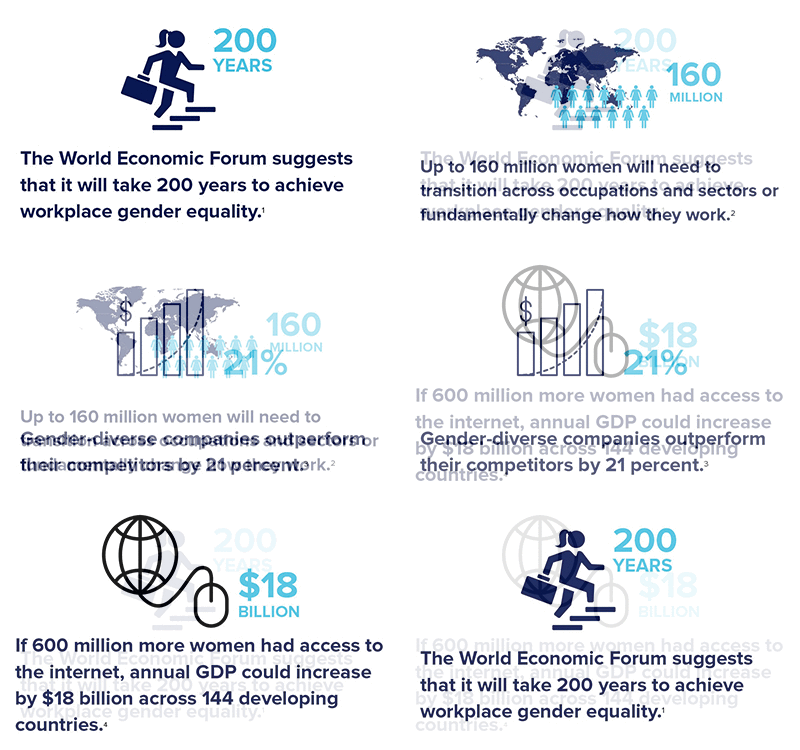
Automation, artificial intelligence, the gig economy, and demographic and social shifts are changing the very nature of work. Women, who are still striving to achieve workplace gender equality, are particularly vulnerable in this time of rapid change.
As companies prepare for and respond to the changes brought about by the ‘future of work,’ we need business action to ensure that women can not only participate, but lead in the workplaces of the future. In turn, this will benefit companies by ensuring they attract and retain the best talent and build a highly skilled and innovative workforce positioned for future success.
Search Again?