Searching for:
Search results: 911 of 1245
Blog | Tuesday November 13, 2018
Three Steps for Business to Connect Climate and Human Rights
This is how companies can address the interactions of climate change and human rights in vulnerable communities.
Blog | Tuesday November 13, 2018
Three Steps for Business to Connect Climate and Human Rights
Preview
Historically, climate and human rights have been managed and addressed separately—governed by different policy frameworks, addressed by different communities of practice, managed by different tools, and treated in isolation.
But, as we’re starting to understand, climate change and human rights are intimately connected. The known impacts of climate change undermine a range of internationally recognized human rights, including the right to life, health, food, adequate standard of living, housing, property, and water. The absence of adequate protection for human rights exacerbates vulnerability to climate impacts, magnifying the risk faced by marginalized communities, who are disproportionately impacted by climate change.
Such marginalized communities are often at the heart of global supply chains. If their vulnerability increases, the strength and resilience of supply chains drops, leaving businesses exposed to operational risk. Forward-thinking businesses are considering ways to align climate and human rights policies to increase their resilience and that of affected communities.
Today, BSR is pleased to launch a new report that helps business to understand and accelerate this alignment. Our key message is that businesses should begin merging their understanding and management of the two issues, and view the risks and mitigation tactics as interrelated.
The actions taken by business to ensure access to human rights will mean that workers are able to protect their assets, recover quickly, and remain engaged in the workforce should a climate event take place. That’s good for workers, good for suppliers, and good for global brands.
The actions taken by business to ensure access to human rights will mean that workers are able to protect their assets, recover quickly, and remain engaged in the workforce should a climate event take place.
The critical first step is to conduct due diligence to understand human rights and climate-related impacts as well as the scope of corporate responsibility to prevent harm. We propose a three-step approach to address the interactions of climate change and human rights in vulnerable communities, leveraging the due diligence framework established in the UN Guiding Principles on Business and Human Rights (UNGPs):
- Map where in a company’s operations, or in the operations of significant suppliers, the company is working within a climate-vulnerable community with weak realization of human rights, exacerbating the community’s vulnerability.
- Determine the scope of responsibility through the lens of the UNGPs’ “cause, contribute, and directly linked” framework. Where a company’s operations, or the operations of a significant business partner, increase the vulnerability of communities facing climate-related risks, the company has an obligation to prevent the negative impact from occurring, or to engage with key business partners to do so.
- Determine an appropriate remedy. We propose investment in capital assets, which have been shown to significantly improve a community’s resilience to climate change. Human rights provides an entry point into several types of capital assets, and companies can direct investments in these assets to strengthen human rights and thus strengthen climate resilience. In some cases, companies should consider going beyond “respect” and into the areas of strategic rights promotion and ecosystem change to leverage business resources to support people who are most susceptible to the negative impacts of climate change.
In conjunction with these actions, leading companies will adopt a policy clearly stating their corporate commitment to climate resilience and respect for human rights. They will also provide transparency and accountability: Improved disclosure and better-quality reporting of the financial risks and opportunities at the nexus of climate change and human rights will benefit companies’ relations with investors, stakeholders, and the public.
The nexus of climate change and human rights can seem intimidating, but there is opportunity in this space, too. Companies that go beyond their duty to respect human rights will likely realize returns on investment in the form of stronger and more resilient supply chains, in addition to the positive outcome of advancing human rights in vulnerable communities.
Businesses that act now to address the human rights implications of climate change can gain a long-term competitive advantage. To learn more about how to do so, read our new report, Climate and Human Rights: The Business Case for Action.
BSR’s climate and human rights nexus report is the fifth in our series, which also includes reports on the intersection between climate and supply chains, health, inclusive economy, and women’s empowerment. Stay tuned for more on the connections between climate resilience and a just transition to the low-carbon economy in the months to come.
Reports | Tuesday November 13, 2018
Climate and Human Rights
This report explores the intimate connection between climate resilience and human rights and outlines how companies can address this nexus.
Reports | Tuesday November 13, 2018
Climate and Human Rights
Preview
Climate change and human rights are intimately connected. The impacts of climate change undermine the realization of a range of internationally recognized human rights, including those dealing with life, health, food, adequate standard of living, housing, property, and water. The absence of adequate protection for human rights—particularly those that provide access to information, right to public participation in decision-making, and access to remedy—exacerbates vulnerability to climate impacts, magnifying the risk faced by the marginalized communities who are disproportionately impacted by climate change.
This paper demonstrates why and how business can act, including how to establish a deeper understanding of the nexus of climate change and human rights throughout the company as well as how businesses across sectors can articulate their risk and opportunities. It proposes operational principles to help companies identify, assess, prevent, mitigate, and remedy adverse climate change and human rights impacts.
This report is part of a series of six climate nexus reports that cover human rights, inclusive economy, women’s empowerment, supply chain, just transition, and health.
Climate and Human Rights
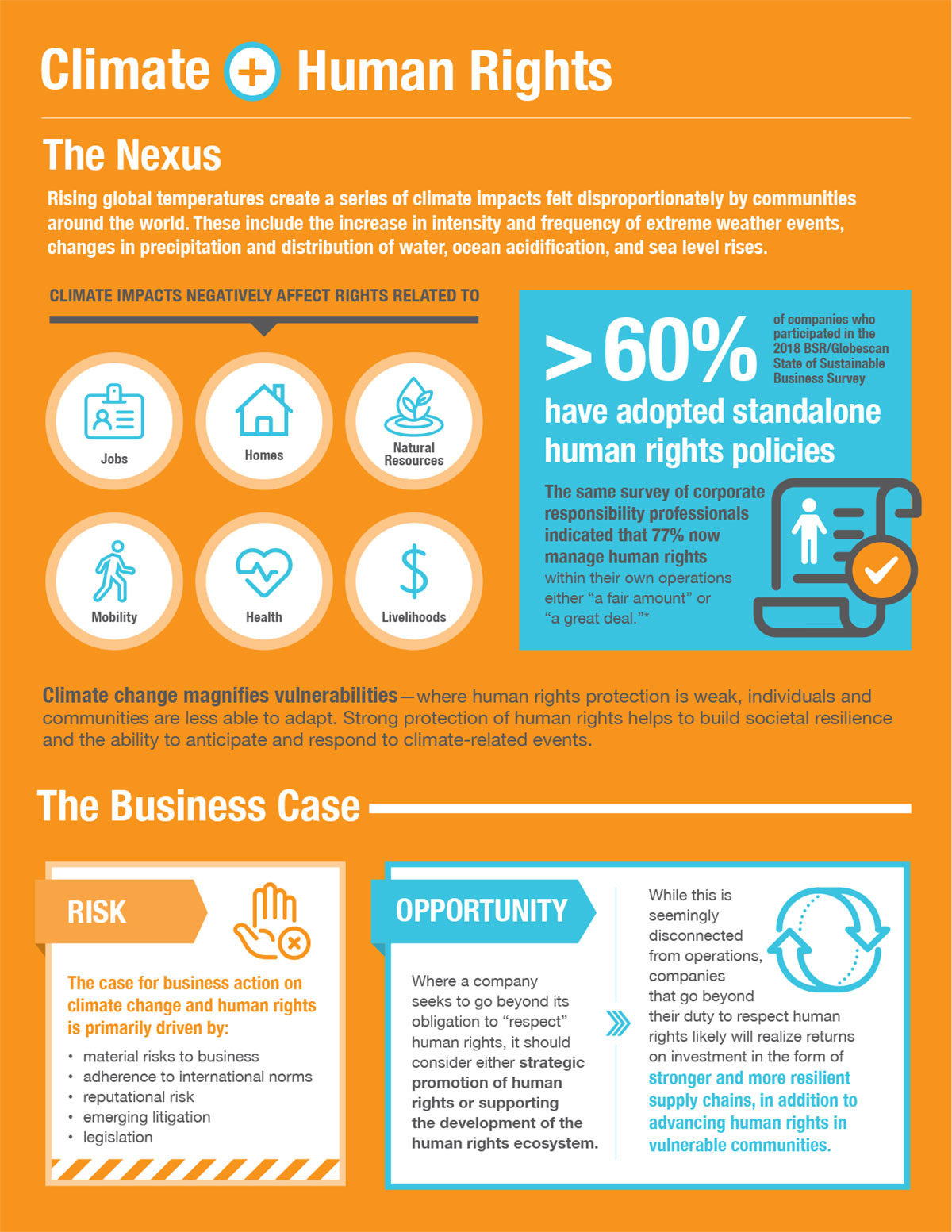
The Nexus
Rising global temperatures create a series of climate impacts felt disproportionately by communities around the world. These include the increase in intensity and frequency of extreme weather events, changes in precipitation and distribution of water, ocean acidification, and sea level rises.
Climate impacts negatively affect rights related to:
- Jobs
- Homes
- Natural Resources
- Mobility
- Health
- Livelihoods
More than 60 percent of companies who participated in the 2018 BSR/Globescan State of Sustainable Business survey have adopted standalone human rights policies.
The same survey of corporate responsibility professionals indicated that 77 percent now manage human rights within their own operations either “a fair amount” or “a great deal.”
Climate change magnifies vulnerabilities—where human rights protection is weak, individuals and communities are less able to adapt. Strong protection of human rights helps to build societal resilience and the ability to anticipate and respond to climate-related events.
The Business Case
Risk
The case for business action on climate change and human rights is primarily driven by:
- material risks to business
- adherence to international norms
- reputational risk
- emerging litigation
- legislation
Opportunity
Where a company seeks to go beyond its obligation to “respect” human rights, it should consider either strategic promotion of human rights or supporting the development of the human rights ecosystem.
While this is seemingly disconnected from operations, companies that go beyond their duty to respect human rights likely will realize returns on investment in the form of stronger and more resilient supply chains, in addition to advancing human rights in vulnerable communities.
Climate and Human Rights (continued)
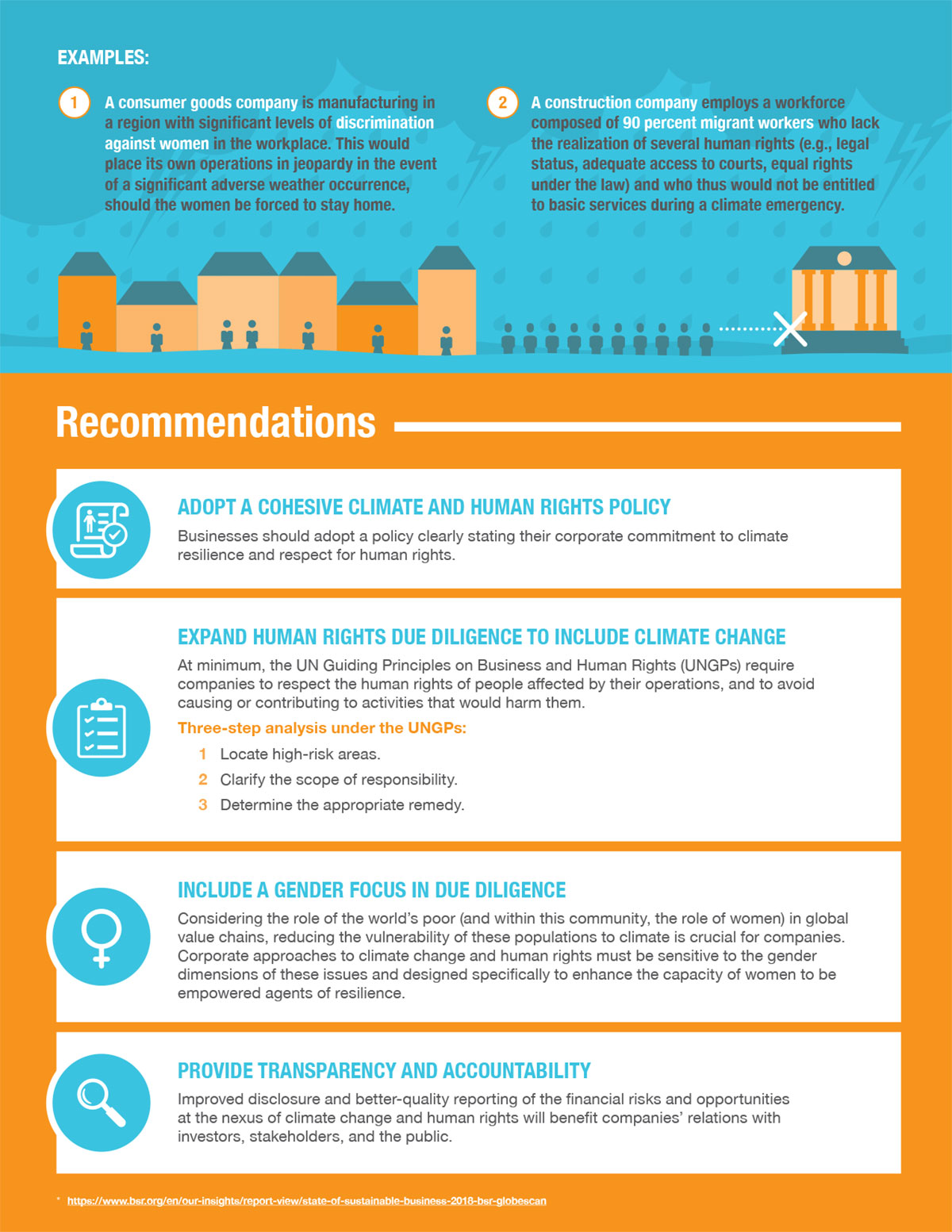
Examples
- A consumer goods company is manufacturing in a region with significant levels of discrimination against women in the workplace. This would place its own operations in jeopardy in the event of a significant adverse weather occurrence, should the women be forced to stay home.
- A construction company employs a workforce composed of 90 percent migrant workers who lack the realization of several human rights (e.g., legal status, adequate access to courts, equal rights under the law) and who thus would not be entitled to basic services during a climate emergency.
Recommendations
Adopt a Cohesive Climate and Human Rights Policy
Businesses should adopt a policy clearly stating their corporate commitment to climate resilience and respect for human rights.
Expand Human Rights and Due Diligence to Include Climate Change
At minimum, the UN Guiding Principles on Business and Human Rights (UNGPs) require companies to respect the human rights of people affected by their operations, and to avoid causing or contributing to activities that would harm them.
Three-step analysis under the UNGPs:
- Locate high-risk areas.
- Clarify the scope of responsibility.
- Determine the appropriate remedy.
Include a Gender Focus in Due Diligence
Considering the role of the world’s poor (and within this community, the role of women) in global value chains, reducing the vulnerability of these populations to climate is crucial for companies. Corporate approaches to climate change and human rights must be sensitive to the gender dimensions of these issues and designed specifically to enhance the capacity of women to be empowered agents of resilience.
Provide Transparency and Accountability
Improved disclosure and better-quality reporting of the financial risks and opportunities at the nexus of climate change and human rights will benefit companies’ relations with investors, stakeholders, and the public.
Climate Nexus Report Series






Blog | Monday November 12, 2018
Reflections from the BSR Conference 2018
These are our thoughts on BSR18 plus five ways to review highlights from the week.
Blog | Monday November 12, 2018
Reflections from the BSR Conference 2018
Preview
Last week, our community of more than 800 sustainability leaders from the private, public, and nonprofit sectors came together in New York City at the BSR Conference 2018 to create a new blueprint for business.
To borrow a question that The Coca-Cola Company’s Beatriz Perez posed to the audience last week, “How do you run a business for the next quarter-century, as opposed to the next quarter?” This was a theme throughout the Conference, as we collectively grappled with how rapidly our operating environment is shifting and how radically different our future will look.
How do you run a business for the next quarter-century, as opposed to the next quarter?
We tackled some of today’s most difficult but urgent subjects, including racial justice, power imbalances, and sexual harassment in the workplace. Our closing plenary speakers were New York Times investigative reporters Jodi Kantor and Megan Twohey, who, among countless other accomplishments, broke last year’s Harvey Weinstein story, helping ignite the #MeToo movement. They shared their thoughts with us on what comes next, both for the movement and the fight to advance gender equality in the workplace.
Plenaries and breakouts alike addressed the idea that business should engage with governments and increasingly needs to speak out on social and environmental issues: Author Anand Giridharadas urged participants to think about the policies their companies are lobbying for and against in Washington and how these efforts align—or don’t—with their sustainability efforts.
Technology was also top of mind, from John Ruggie’s remarks, where he referenced his work to translate the UNGPs into algorithms, to conversations about the human rights implications of artificial intelligence, blockchain, and the lessons of “techlash.” Participants rolled up their sleeves in futures thinking sessions to imagine the implications of technological advances like these for business.
Not least, results of the U.S. midterm elections made their way into several conversations; most notably the fact that more than 100 women were elected to Congress.
Here are five ways that you can re-live the highlights of the event—or catch the things you missed:
- Watch plenary session videos: Almost every plenary session is now live on our YouTube channel, from David Schwimmer’s call for men to be a bigger part of the conversation around sexual harassment and power dynamics, to Novartis CEO Vasant Narasimhan’s talk about “bending the curve of life” through improving access to medicine through innovation.
- Read about our latest initiatives: We launched a lot of new content last week. Check out our new report to help you increase the resilience of your business strategy, Doing Business in 2030: Four Possible Futures, and CoLab, our new incubator and accelerator of private-sector collaboration.
- See the social media highlights: Follow @BSRnews, @bsrherproject, and BSR staff on Twitter, and see what you missed on the #BSR18 hashtag. You will also find photo highlights on our Instagram accounts, @bsrorg and @herprojectbsr.
- Find yourself in photos: We’ve uploaded photos from the week onto our Flickr account—head on over to see whether we captured you, or your favorite moment, in our BSR18 album.
- Share your thoughts: If you were with us in New York, please take a moment to complete the Conference survey (available in the mobile app under “Surveys”). If you weren’t there, you can always tweet at us or email us your perspective.
We are grateful to have had the opportunity to connect with all of you—our global community of change agents and thought leaders who are truly creating a more just and sustainable world through the work you do every day. It is so energizing for us to come together to discuss big issues, explore global challenges, and share stories from the front lines of our work to advance sustainability, and we’re already looking forward to seeing you next year at BSR19 in San Jose, California, November 12-14, 2019.
Blog | Wednesday November 7, 2018
Introducing CoLab
We are pleased to launch CoLab: BSR’s incubator and accelerator of private-sector collaboration, mobilizing the collective power of business to solve some of the world’s biggest sustainability challenges.
Blog | Wednesday November 7, 2018
Introducing CoLab
Preview
While the world is changing for the better, in alignment with the ambitions of the Sustainable Development Goals (SDGs), it’s not changing anywhere near fast enough.
The IPCC recently released a report highlighting how the world has an increasingly small window to take the drastic action required to limit the devastating impacts of climate change. Analysis by the Ellen MacArthur Foundation in 2017 suggested that there could be more plastic than fish in the ocean by 2050. A report from Sisters for Change published in 2016 found that one in seven women garment workers has been raped or forced to commit a sexual act.
We need to do better. And we can. The world needs new partnerships of unprecedented scale and ambition between the private sector, governments, and civil society to create a future in which both societies and companies thrive.
The world needs new partnerships of unprecedented scale and ambition between the private sector, governments, and civil society to create a future in which both societies and companies thrive.
Today we are pleased to launch CoLab: BSR's incubator and accelerator of private-sector collaboration, mobilizing the collective power of business to solve some of the world’s biggest sustainability challenges. Driven by the collective ingenuity of business and stakeholders, CoLab ideates, designs, and scales collaborations that have transformational impacts.
With their reach, resources, capacity for innovation, and voice, companies can be a major driver of positive change. A unified and collective effort from business can create a step change in progress toward the SDGs.
Increased collaboration is good for societies, who benefit from the collective reach, resources, and voice of businesses working in common cause. And it is good for businesses, who can build more resilient supply chains, reduce costs and improve productivity, overcome systemic barriers, and enhance brand value.
BSR has been designing, implementing, and scaling business-led collaborations to achieve win-win solutions for over 25 years. For instance, the Maritime Anti-Corruption Network (MACN) contributed to regulatory reform in Argentinian ports, which reduces corruption risks and creates a more efficient trading environment; shipping companies in Clean Cargo have cut their carbon dioxide emissions by 35 percent per TEU-km since 2009; and HERproject has empowered more than 800,000 women in 14 countries with knowledge and skills related to health, financial inclusion, and gender equality.
CoLab will work by crowdsourcing a wide range of proposals for game-changing collaborations like these and developing the most promising. We are therefore calling on you—as businesses, NGOs, governments, foundations, or individuals—to take this opportunity to participate in a major, global incubation exercise. Through CoLab, you can engage with BSR’s global network of peer companies and thought leaders to ideate, design, and scale game-changing initiatives with transformational impacts. CoLab can help you take a vision for collaboration and turn it into reality.
CoLab will operate according to four principles:
- Value to Business and Society: Prioritize issues that deliver business value as well as significant societal impact.
- Solutions that Motivate: Advance solutions that engage participants’ core business strategies and tap into their full range of assets—capabilities, ingenuity, knowledge, reputation, networks, and financial resources.
- Stakeholder Inclusion: Ensure collaborative solutions take into account stakeholder and rights-holder perspectives, as well as optimize impacts and mitigate risks for beneficiaries.
- Action Orientation: Select efforts that are actionable to deliver change and impact. Move fast, be prepared to adapt.
By following these four principles, we aim to create collaborations that can grow quickly by mobilizing a wide range of actors around critical topics.
We are inviting all of BSR’s stakeholders and any other interested parties to submit ideas now through the CoLab page. We look forward to collaborating with you through this and other ways.
Blog | Tuesday November 6, 2018
Is Your Business Ready for a Radically Different Future?
During times of rapid change, the greatest danger lies in being unable to imagine radically different futures.
Blog | Tuesday November 6, 2018
Is Your Business Ready for a Radically Different Future?
Preview
With rapid automation putting millions out of work, a new “Humans First” movement emerges—determined to fight back. Saudi Arabia decides that emissions mitigation efforts are too slow to prevent severe climate disruption and announces plans to launch a risky geoengineering program, prompting threats of retaliation from other nations. The rate of Type 2 diabetes has dropped for the second year in a row, thanks to a powerful new health AI that guides consumers toward healthier behavior—and punishes those who make unhealthy choices.
None of these things have happened—yet. But what would it mean for your business if they did?
During times of rapid change, the greatest danger lies in being unable to imagine radically different futures.
BSR’s new report, Doing Business in 2030: Four Possible Futures, combines research with imagination to help you consider disruptive possibilities such as these. The report presents four scenarios describing alternate future contexts for business. These scenarios explore key factors that could reshape the world over the coming decade and describe how they might develop, interact, and transform.
From climate disruption to automation to artificial intelligence, these changes are rapid, complex, interconnected, uncertain, and nonlinear. They are creating an entirely new operating environment for business.
While the scenarios explore numerous factors reshaping the future, on a high level they are organized around two critical uncertainties: 1) whether the forces of centralization or decentralization prevail, and 2) whether we will stick with the current economic paradigm of endless growth and profit maximization or shift toward a new paradigm that views the purpose of the economy as providing for equitable prosperity on a healthy planet.
Each scenario, summarized briefly below, imagines different answers to those questions.
Scenario 1: A Tale of Two Systems
Automation and environmental disruption cause global turmoil. China promotes a vision of “prosperity, order, and sustainability” and draws emerging economies into its orbit. Western government and business leaders realize they need to radically reform the social contract if free market capitalism is to survive.
Scenario 2: Move Slow and Fix Things
Health concerns, misinformation scandals, and a global recession undermine trust. People become disillusioned with consumerism, big business, and social media. As more localized economies emerge, people rediscover the benefits of community, and a culture of healing starts to take root.
Scenario 3: Tribalism, Inc.
The notion that “all business is political” drives social, economic, and cultural fragmentation. New “tribes” emerge with profoundly different experiences of reality. As collective action becomes increasingly difficult, some of these tribes experiment with radical approaches to global challenges like climate change.
Scenario 4: Total Information Awareness
Highly personalized AI companions become an essential part of everyday life. Concentrated networks of huge businesses leverage extreme data to provide affordable, effective, and seamless services. Privacy is gone and much work is automated away, but most people embrace the new reality.
Scenarios are neither predictions nor forecasts, and none of these will “come true” exactly as written (although elements of each are likely to happen). Instead, they are a tool to help us think differently—and to consider truly radical changes that escape the bounds of our current models. Rather than providing us with a single answer about the future—which would almost certainly be wrong—they enable us to embrace uncertainty and develop more robust and resilient strategies.
So, how should you use them?
First, suspend disbelief and immerse yourself in each of these worlds. Imagine it is 2030, and the scenario you’re reading accurately describes the world you inhabit. What would your life be like? Where do you live, what do you care about, and how do you spend your time? Use questions like these to develop an intuitive understanding of what these worlds would be like to live in.
Second, explore what new challenges and opportunities each of these worlds would present for your business and for sustainability, and consider how your company would need to operate differently in 2030 to address these. How has your supply chain changed? What new competitors have entered the market? Who are your employees, and how is their work different from today? What do your customers need, and how are you meeting those needs sustainably?
Finally, consider how you could make your company’s strategy more resilient to the entire set of scenarios. Are there any elements of your current strategy that would fail in one of these scenarios, but which could be reconsidered? Are there any no-regrets actions you could take that would work well across all the scenarios? What sorts of hedging strategies could you use to avoid risking everything on one big bet? Once you’ve identified the most promising strategic initiatives, consider what you’d have to start doing today to bring them to life.
Much of what characterizes our current reality—from highly accurate facial recognition technology to Brexit—was not so long ago considered unlikely or even crazy. Scenarios offer us a unique opportunity to step outside of the box for a moment and consider truly different possibilities. While nobody can predict the future, thinking about the ways things might evolve can help us make wiser choices today. During times of rapid change, the greatest danger lies in being unable to imagine radically different futures.
Business—and the well-being of people and the planet—depend on new strategies for the future that account for the profound changes underway and imagine transformative new opportunities to create a more just and sustainable world.
Reports | Tuesday November 6, 2018
Doing Business in 2030
Reports | Tuesday November 6, 2018
Doing Business in 2030
Preview
The operating environment for sustainable business is being radically transformed by a diverse set of powerful and complex interacting forces. From climate disruption to automation to artificial intelligence, these changes are rapidly creating an entirely new operating environment for business. Business—and the well-being of people and the planet—will depend on new strategies for the future that account for the profound changes underway and imagine transformative new opportunities to create a more just and sustainable world.
In conditions of rapid change, scenarios offer a powerful way to explore multiple distinct possibilities. Rather than predicting what the world will be, they provide stories of alternate futures that combine research into drivers of change, with informed speculation about how key uncertainties could play out.
Scenarios are not predictions or forecasts. The scenarios in this report are organized around two critical uncertainties: Will the forces of centralization or decentralization prevail? Will we stick with the current economic paradigm of endless growth and profit maximization, or will we shift toward a new paradigm that views the purpose of the economy as providing for equitable prosperity on a healthy planet?
Each scenario imagines how different answers to these questions might shape the future.
Blog | Monday November 5, 2018
Our Human Rights Impact Assessment of Facebook in Myanmar
The question of how social media platforms can respect freedom of expression while also protecting users from harm is one of the most pressing challenges of our time.
Blog | Monday November 5, 2018
Our Human Rights Impact Assessment of Facebook in Myanmar
Preview
Today, Facebook has published the human rights impact assessment (HRIA) of the company’s presence in Myanmar that it engaged BSR to undertake earlier this year.
The question of how social media platforms can respect the freedom of expression rights of users while also protecting rightsholders from harm is one of the most pressing challenges of our time.
This challenge is even more testing in Myanmar, where the majority of the population is still developing the digital literacy required to navigate the complex world of information sharing online, and where a minority of users are seeking to use Facebook as a platform to undermine democracy and incite offline violence. The lack of rule of law and recent political, economic, and social history in Myanmar add to the challenging environment.
We didn’t want the HRIA to reproduce what was already known—so we asked ourselves, what can we do to help increase human rights protections in the future?
Last month, the UN Human Rights Council’s Independent International Fact-Finding Mission on Myanmar concluded that serious crimes under international law have been committed by military and security forces that warrant criminal investigation and prosecution. The use of Facebook to spread anti-Muslim, anti-Rohingya sentiment featured prominently in the Mission’s report.
In this context, the commissioning of this comprehensive HRIA is an important new milestone in business efforts to undertake due diligence and respect human rights. Facebook’s decision to publish the report in unredacted form also demonstrates an impressive commitment to transparency and sets an example for other companies to follow.
The challenging human rights context for Facebook and questions about the company’s response have been well-documented by international bodies, civil society organizations, and the media. Given this context, we didn’t want the HRIA to reproduce what was already known—so we asked ourselves, what can we do to help increase human rights protections in the future?
At the basic level, addressing this question meant thoroughly applying the UN Guiding Principles on Business and Human Rights to the letter—identifying and prioritizing Facebook’s actual and potential human rights impacts and making recommendations for how to address them.
However, we concluded that answering this question would require us to be disciplined in two very important ways.
First, it was essential to take an inclusive approach. We consulted directly with over 60 potentially affected rightsholders and stakeholders during two visits to Myanmar by BSR staff, and we made sure that we spoke to as diverse a range of voices as we were able to in the time available. This approach generated very important insights. While many stakeholders—and Facebook itself—emphasized that Facebook’s efforts have fallen short in the past, we witnessed a strong determination from everyone we spoke with, inside and outside Facebook, to address human rights in Myanmar as a matter of utmost importance and urgency. We are hopeful about collaborative efforts, both now and over the long-term.
Second, it was essential to take a distinctly forward-looking approach. Understanding the mistakes and shortcomings of the past established crucial context, but it was important that we focused on forward-looking analysis and recommendations.
This approach led to us make recommendations in five main areas. These recommendations are shaped by the observation that Facebook’s human rights impacts in Myanmar cannot be addressed by Facebook alone, but also require system-wide change:
- Governance and accountability at Facebook, including human rights policies, formalized governance structures, and public communications.
- Community standards enforcement by Facebook, such as continuing to build a cross-functional team that understands the local Myanmar context, as well as a stricter implementation of Facebook’s credible violence policy and further development of artificial intelligence solutions that support human decision-making.
- Engagement, trust, and transparency, such as publishing a local, Myanmar-specific version of Facebook’s Community Standards Enforcement Report and supporting international mechanisms created to investigate violations of international human rights.
- System-wide change, including advocacy efforts aimed at policy, legal, and regulatory reform and continued investment in efforts to increase digital literacy and counter hate speech.
- Risk mitigation and opportunity enhancement, such as preparations for the 2020 elections in Myanmar and for the possibility that WhatsApp becomes more commonly used, as well as the development of new products and services that accelerate growth of the digital economy in Myanmar.
Facebook’s blog to accompany the publication of the HRIA described in some detail the company’s stance and current status for each of these five areas.
We believe that the implementation of these recommendations is far more important than the HRIA itself. For this reason, we hope that the publication of the HRIA in full provides three main benefits: first, to provide a clear action plan for Facebook; second, to increase awareness of the human rights approaches available to Facebook and other technology companies engaged in Myanmar; and third, to stimulate further dialogue, collaboration, and solutions.
The report was made possible thanks to the many stakeholders and rightsholders in Myanmar who participated in the assessment process. We encourage everyone interested in the human rights situation in Myanmar to read the report in full, and we look forward to updates from Facebook in the future on its progress implementing the recommendations.
Blog | Friday November 2, 2018
All the Ways to Follow Us at #BSR18
Whether you’re joining us in New York or online, you can be part of the BSR Conference 2018 action.
Blog | Friday November 2, 2018
All the Ways to Follow Us at #BSR18
Preview
On Tuesday, we’re kicking off the BSR Conference 2018 in New York City. Over the course of three days, we’ll hear from thought-provoking speakers on how we can create a new blueprint for business. This year’s Conference comes not only at the time of the U.S. midterm elections—the results of which will be woven into conversations throughout the week—but also at a time when cultural shifts, disruptive technology, political divisiveness, and the impacts of climate change are making it even more pressing for us to create a global economy that delivers on the promise of prosperity for all.
It all starts Tuesday evening with opening remarks from BSR President and CEO Aron Cramer and the launch of new scenarios for doing business in 2030, followed by a special presentation and #ThatsHarassment short film screening from actor, director, and producer David Schwimmer and a plenary spotlight with Asher Jay, creative conservationist and National Geographic explorer.
On Wednesday morning, we’ll hear from C-Suite executives—Emanuel Chirico of PVH Corp., Marie-Claire Daveu of Kering, and Beatriz Perez of The Coca-Cola Company—as well as best-selling author Anand Giridharadas. In the afternoon, Novartis Chief Executive Officer Vasant Narasimhan will discuss access to medicine, and a panel of human rights experts—including John G. Ruggie—will highlight the 70th anniversary of the Universal Declaration of Human Rights.
On the final day, New York Times reporter David Gelles will speak to business, politics, and the culture wars, and Etsy CEO Josh Silverman will update us on the company’s impact strategy. We’ll close the Conference with a keynote address from Jodi Kantor and Megan Twohey, the New York Times investigative reporters who broke last year’s Harvey Weinstein story, igniting the #MeToo movement.
Whether you’re joining us in person or online, here are the best ways to follow along:
1. Catch the livestream.
We’ll broadcast most plenary sessions in a live video feed. Visit the livestream registration page to sign up and join in.
2. Get social.
No matter your favorite social media platform, we’ll be there:
- Twitter: We’ll live tweet the entire event from @BSRnews using the hashtag #BSR18.


- Instagram: Follow our Instagram account, @bsrorg, for exclusive, behind-the-scenes looks at the Conference. Post your photos using #BSR18—and don’t forget to tag us!

- And more: Explore the biggest launches and best photos from the week on Facebook, LinkedIn, and Flickr.
3. Ask questions.
We’re opening up some of our plenary sessions for questions from Twitter—while you’re watching the livestream, ask our keynote speakers about their experiences using #BSR18.
4. Follow up.
We’ll have videos, wrap-ups, and other content available after the event, so be sure to visit the BSR blog, our YouTube channel, and the BSR Conference website.
Single-day passes are still available, so if you’re in the area, join us! Whether you’re with us in the plenary hall or participating virtually this week, we look forward to hearing your thoughts on #BSR18.
Blog | Monday October 29, 2018
Five Tips for Improving ESG Disclosure in Asia
Here are some things to keep in mind as you begin to enhance your ESG profile in Asia.
Blog | Monday October 29, 2018
Five Tips for Improving ESG Disclosure in Asia
Preview
The business context for environmental, social, and governance (ESG) impacts is complex and evolving rapidly, challenging companies to manage an increasingly diverse set of risks while adapting to global megatrends such as climate change, automation, and population growth. Through ESG transparency, companies have an opportunity to increase accountability and corporate responsibility and translate this into long-term growth.
A New Blueprint for Business
Join us at BSR18 for a conversation about what your audience really thinks about your sustainability reporting.
In Asia, ESG disclosure has increased, especially in Japan, in part due to the proliferation of reporting policies set by governments. Stock exchanges and regulators are also mandating increased transparency to build investor trust and confidence, particularly in emerging markets. Corporate responsibility reporting has become a valuable tool for increasing ESG disclosure, and Asian companies have made significant progress, posting some of the highest annual reporting rates globally over the past decade, closely behind those in North America and surpassing those in Europe. However, due to a lack of comparable data, depth, and verification, the value of this information to stakeholders has been limited.
Corporate responsibility reporting has become a valuable tool for increasing ESG disclosure, and Asian companies have made significant progress, posting some of the highest annual reporting rates globally over the past decade.
Positively, we are beginning to see change in critical markets. In China, under the revised (2018) Code of Corporate Governance for Listed Companies, entities are required to disclose information on their board and management composition. Those who fail to comply or issue false information will be penalized to protect investor interests.
As these markets continue to mature and grow, so will the role of ESG in securing the sustainability of the region’s transformation. Therefore, now is the time to reflect on the importance of ESG disclosure and consider how data can be collected, shared, and acted on to take advantage of emerging opportunities.
Here are some things to keep in mind as you begin to enhance your ESG profile in Asia:
- Know your audience: To begin, make sure that you have identified all relevant stakeholders. To do this, map stakeholder groups, engage them early, understand their expectations, and build trust through frequent and informed engagement. For experienced companies looking to enhance their ESG data and communication, focus on the most critical, relevant, and material issues as they relate to your business and your stakeholders.
- Assess the ‘critical’: Understanding your environmental and social impacts is essential to building an effective governance structure. After an organization has determined its material sustainability impacts and mapped those to business value drivers, it can look to the various sustainability standards and frameworks to guide credible, reliable disclosure.
- Work smarter, not harder: The foundation of any market is a common language for communication. As the attention around the role and necessity of business in driving solutions to pressing global social and environmental challenges increases, so does the need for greater consistency in company communications on ESG performance. Think about what you want to achieve, know your audience, and determine the smartest approach.
- Share and compare: Establish a long-term plan, so that investors and stakeholders can understand your vision, goals, and achievements. Demonstrate how sustainability priorities are embedded in business priorities. Provide comparable data to allow readers to benchmark and assess performance, while disclosing procedures and management systems that support.
- Emphasize value: Reports can be used to develop a purpose and rationale for actions that can be rewarded through internal engagement and brand equity. Increasing the quality and decision-usefulness of the data disclosed allows for greater ESG analysis. Explore opportunities to translate value into clear financial terms.
As companies gain more experience with ESG reporting and sustainability management, the business case for high-quality ESG measurement and reporting systems to enhance stakeholder confidence will become even clearer. While we have seen significant developments in ESG integration and disclosure in Asia over the past several years, opportunity remains to improve quality and enable communication that empowers stakeholders, reduces disruption, and supports sustainable growth.
Blog | Thursday October 25, 2018
Four Reflections on the Human Rights Implications of Artificial Intelligence
Human rights teams and decision-makers in companies across sectors will need to engage with the social, ethical, and human rights issues relating to the use of artificial intelligence in their respective industries.
Blog | Thursday October 25, 2018
Four Reflections on the Human Rights Implications of Artificial Intelligence
Preview
This is part of a series of blog posts BSR has published in 2018 exploring the intersection of disruptive technologies and sustainability.
A New Blueprint for Business
Join us at BSR18 for a conversation about the human rights approach to artificial intelligence.
Over the past few years, the technology industry has been under the spotlight for social, ethical, and human rights issues arising from the rapid development of artificial intelligence (AI). Yet AI will be deployed in almost every sector of the economy—companies in mining, agriculture, healthcare, retail, financial services, or transportation are all exploring how AI can be turned into innovative customer solutions, new business models, and massive operational efficiencies.
This means that human rights teams and decision-makers in non-technology companies will need to engage with the social, ethical, and human rights issues relating to the use of AI in their respective industries.
Given the uncertainty around the deployment of AI, futures methodology can be applied to consider different scenarios and assist companies in identifying their potential human rights impacts of the future.
On October 3, we ran a workshop to assist companies in the exploration of these issues. The workshop did two things: First, it identified the barriers and challenges of applying human rights due diligence practices to new and disruptive technology through industry-specific roundtables. Second, it trained companies to anticipate AI-related human rights issues and take tangible steps toward addressing them through an innovative futures methodology exercise. We specifically engaged non-technology companies, in addition to the ICT sector, to broaden the discussion about the diverse opportunities and risks associated with AI.
Reflecting on this workshop, we reached four main conclusions:
- AI is becoming increasingly relevant to non-technology companies and should be considered in human rights due diligence processes. Examples like the use of algorithms to assess credit-worthiness in the financial sector, automated purchasing in the retail industry, and the use of AI in connected health demonstrate that the widespread application of AI is slowly transforming almost every company into a technology company. This creates an urgent need to consider whether AI is reshaping existing human rights risks and opportunities or creating entirely new ones. A human rights due diligence process that ignores AI and other disruptive technologies runs a high risk of being incomplete.
- The questions outnumber the answers. The impact of AI on human rights is uncertain, with a wide variety of potential scenarios. In this context, a practical next step for companies is to broaden the range of questions they ask about potential impacts in the future—even if the answers to these questions are unknown. Some early stage questions may include: Can my company describe whether specific choices or decisions arrived at by AI have impacted the human rights of customers, users, or employees? How could a lack of understanding around the algorithmic decision-making process affect my ability of my customers to understand their rights? Are algorithms discriminating against certain populations—either intentionally or unintentionally? If my company expands operations to new countries and cultures, are the same algorithms and data going to be used to make decisions, and if they are, what are the potential ramifications?
- A human rights due diligence and futures methodology “mash up” has potential. Futures thinking, strategic foresight, and scenario planning methodologies have been in existence for many years, as have human rights due diligence methodologies. However, to our knowledge, the two methodologies have not been combined since the publication of the UNGPs. Given the uncertainty around the deployment of AI, futures methodology can be applied to consider different scenarios and assist companies in identifying their potential human rights impacts of the future.
- Industry-wide human rights impact assessments could be a way to increase the capacity of entire industries to address AI and human rights. While the tech sector is actively engaged in the task of incorporating human rights into the design, development, and deployment of AI, other industries also have work to do. Working with industry peers to identify human rights impacts, risks, and opportunities will allow for shared learning and support efforts at individual companies to address the human rights impacts of AI.
As we move into 2019, BSR will continue to prioritize the connection between disruptive technology and human rights, and we will endeavor to put these industry explorations at the forefront of our agenda.
Search Again?