Searching for:
Search results: 716 of 1188
Blog | Wednesday March 18, 2020
An Update from BSR on COVID-19
Our movement for resilient, sustainable business has never been more relevant, or important. BSR President and CEO Aron Cramer addresses the COVID-19 coronavirus.
Blog | Wednesday March 18, 2020
An Update from BSR on COVID-19
Preview
Dear BSR Members and Valued Partners,
The COVID-19 coronavirus pandemic is presenting the world with a fast-changing and unprecedented global health situation.
We hope that you and your families and communities are staying safe and healthy, and applying the values that underlie our collective work on sustainability to see us through this challenging time.
In addition, as a global business network dedicated to advancing sustainable business, we remain focused on our work while also adapting to address the ever-shifting environment in our offices around the world.
We remain very much open for business, with our teams working remotely (though in Hong Kong, some have been able to return to the office safely), at as close to regular capacity as the situation permits, and in accordance with the guidelines provided by relevant national, regional, and local health authorities. You can find us online, with all meetings conducted remotely via video teleconferencing platforms.
Our work with you, our member companies and many partners, matters now more than ever. At moments like this, we welcome and encourage more dialogue with you, and more collaboration amongst our network.
This week we will be rolling out new platforms and opportunities for engagement with BSR issue and industry experts, and for networking with other BSR member companies, partners, and thought leaders.
We’ll also be offering a series of perspectives from our industry and issue experts, with the latest thinking on how business can continue to advance the sustainability agenda while navigating the challenge of the coronavirus. Our new COVID-19 content hub already features insights from BSR staff, including business lessons from the first phase of the pandemic, how to protect human rights while protecting public health, and the pandemic’s impact on workers and supply chains in China. We will be adding content in the days and weeks to come.
Finally, we will be encouraging additional engagement from you, our members, as we navigate this crisis together. This includes:
- Information sharing and problem solving: We want to hear from you if you have perspectives to share on how this pandemic is affecting your business and your sustainability efforts; or support in solving particular challenges you face throughout your business, whether arising from the impacts of the pandemic or the long-term objectives that remain crucially important. In addition, as part of your BSR membership, you have access to high-level insights on how the coronavirus is impacting your digital (online and social media) profile through BSR’s reputation intelligence partner, Polecat. Please reach out to your relationship manager to learn more.
- Project support: We will continue to support and work with members on one-on-one projects, using all of the remote tools at our disposal.
- Networking: We will be looking at additional ways to enable you to share your experiences with other BSR member company contacts through online webinars or examples of responses to the pandemic via contributions to the new content hub. Reach out to your BSR relationship manager if you have ideas for a webinar, or an idea for a blog that you think may be of interest to the broader BSR network.
- Collaboration: Our collaborative initiatives continue to operate with an immediate shift to virtual gatherings. If the systemic failures made apparent during this pandemic have inspired you to think more long term about how you can collaborate to build a more resilient business and a more resilient system, our collaborations offer a powerful platform. BSR’s CoLab, our incubator and accelerator of private-sector collaboration, works with companies and other partners on a range of sustainability issues, including global health. And BSR’s Healthy Business Coalition is a great resource for collaboration with private-sector peers on public health issues that affect companies and workers. Please reach out to your BSR contact if you’re interested in more information about this.
- BSR Conference 2020: The Decisive Decade: The BSR Conference 2020 is still set for October 27-29 in New York, and the program will be launched formally later this spring. We will of course be monitoring the situation and re-evaluating the feasibility of hosting an in-person event as the pandemic situation evolves. We will provide updates as we learn more.
We are all facing a monumental challenge, which will undoubtedly have both short- and long-term impacts on the economy, and on the health and well-being of businesses, workers, and communities around the world. Our movement for resilient, sustainable business has never been more relevant, or important.
Our collective ability to achieve a world in which everyone can live a prosperous and dignified life within the planet’s natural boundaries remains fundamentally important. It is up to all of us to redouble our commitments, with urgency and kindness, to unlock the capabilities, ingenuity, knowledge, and resources of the private sector to achieve that vision.
Please stay tuned for further updates and visit this website and our social media channels for the latest information.
All of us at BSR wish you, your colleagues, and your families good health and safety during this challenging moment.
With thanks,
Aron Cramer
President and CEO, BSR
Blog | Monday March 16, 2020
Business Lessons from Phase One of the COVID-19 Pandemic
As we take time to think first of the health of our families, friends, and communities in the COVID-19 coronavirus pandemic, here are five lessons to guide us through these turbulent times and the uncertainties which lie ahead.
Blog | Monday March 16, 2020
Business Lessons from Phase One of the COVID-19 Pandemic
Preview
How quickly life can change.
We are only in phase one of a pandemic that has changed the rhythm of daily life like no other recent event. As we take time to think first of the health of our families, friends, and communities, we are already learning lessons that will help us to navigate the urgent trials we face today as well as the fundamentally important challenges awaiting us once the worst of the pandemic passes.
Here are five lessons to guide us through these turbulent times and the uncertainties which lie ahead.
1. The virus makes clearer than ever that the social contract in many places is not fit for purpose and needs to be reformed.
The social contract, meaning the roles and responsibilities of government and business and the needs of citizens and employees, is being tested in an extreme way right now, but it was already clear that it was not fit for purpose before the pandemic struck. In the wake of the pandemic, the lack of access to health care in the United States has come into even sharper relief, this time in a potentially devastating way. We have also seen examples of the social contract being adapted, as with Denmark’s move—through tripartite discussion between government, business, and trade unions—to extend benefits to help Danes get through this difficult time. It is also interesting to see how different societies accept data sharing and transparency, which trade some privacy for increased protection. Businesses should certainly step up to help their staff sustain themselves in the context of much economic activity apparently being stopped. And while we are seeing in real time how well the social safety net functions, there are also long-term questions that business would do well to address more forcefully after this crisis is behind us. BSR has launched an effort calling for a modernized social contract for the 21st century, with more attention to the changing nature of work, access to education and skill development, and the financial stability of our pension systems, amongst other issues. The COVID-19 pandemic reveals this to be deeply relevant for business and society and can serve to catalyze more business action to ensure our social contracts are fit for purpose. The business responses to the crisis have in many cases been excellent: this leadership can also be applied in non-crisis situations.
2. Resilience is not just a catchphrase; it’s a necessity, and it’s having its moment.
Every single Board of Directors should learn from this global challenge and invest more time and thought in exploring where its business faces other risks. There is little doubt, of course, that climate change could deliver a blow to many companies that is as profound as COVID-19, but with far more lasting impacts. We have also seen unexpected political shifts over the past few years, and businesses that have assumed broad support for a globalized economy have seen their plans upended. Resilience in the face of fast-changing attitudes and actions on the part of a company’s workforce also present questions of fundamental importance. And we also know that political change can come overnight and test our models. In many ways, the rise of ESG investing is asking one simple question: is your business resilient in the face of massive change? We are experiencing in real time how hard it can be when the answer is no.
In an era when powerful political leaders call for walls and barriers and play to publics who can be swayed in that direction, this difficult episode teaches us the importance of collaborative solutions.
3. We must not turn our backs on our interdependent globalized world.
It should go without saying that we are all connected and interdependent; the virus proves just how true that is. But in an era when powerful political leaders call for walls and barriers and play to publics who can be swayed in that direction, this difficult episode teaches us the importance of collaborative solutions. Credit should be given to French President Emmanuel Macron for convening a virtual G7 Summit and to the tireless workers at the World Health Organization for providing valid and valuable information, enabling testing, and supporting health systems that need it most. In short, we need each other, and crises often remind us of that. This one certainly should be doing exactly that. It is folly to suffer the negative consequences of our connectedness without maximizing the benefits. Business has a strong interest in advocating for open societies, effective public governance, and the rules-based international system that has come under attack in recent years.
4. Futures thinking may be the most essential tool we have, so let’s use it.
One of the best ways to build a resilient strategy is to employ futures thinking. BSR launched its Sustainable Futures Lab in 2017, and we have worked with many companies and other partners to build scenarios to help them to map and understand possible pathways to create more desirable future outcomes. This is no academic exercise, as we now see. Indeed, one in a set of climate scenarios we began developing late last year began with an animal-borne virus emerging from China to undermine economic and human health globally. The steps called for in the Task Force for Climate-Related Financial Disclosures (TCFD) embrace scenarios as a core of TCFD disclosures. The concept underlying the TCFD should be extended well beyond climate, to ensure that companies can prepare for the diverse array of futures that may well emerge.
The need for progress on climate and other environmental challenges don’t vanish during a recession. The need to invest in communities and people whose economic circumstances are diminished only grows more important.
5. Action on climate and the SDGs cannot be put off.
The world’s attention is quite rightly focused on the urgent need to save lives and avert immediate economic distress. But we are here for the long term also. We need both to address this shock in the first year of the decisive decade and remain 100 percent committed to building the world we are committed to building in 2030. Even as every company, large and small, is understandably focused on the here and now, this is a time when business leaders and companies should speak out to reinforce the need to make significant, tangible progress towards the SDGs. And even if the virus leaves a recession in its wake, it is essential that business remain focused on achieving the SDGs. The need for progress on climate and other environmental challenges don’t vanish during a recession. The need to invest in communities and people whose economic circumstances are diminished only grows more important. And the march of technology needs to be aligned with human rights and ethics regardless of which direction global stock markets head.
We have spoken about the “new climate for business” over the past year as we entered this “decisive decade.” As we work through this rocky start to the new decade, it is essential that we remember the central importance of staying committed to our long-term goals, while adjusting to an altered reality that has much to teach us when we inevitably emerge from this crisis.
Blog | Friday March 13, 2020
Respecting Human Rights While Protecting Public Health
As the COVID-19 coronavirus outbreak disrupts global supply chains and shutters factories and stores around the world, companies are grappling in real time with the human rights implications of the coronavirus response. How can we best protect public health while respecting individual human rights?
Blog | Friday March 13, 2020
Respecting Human Rights While Protecting Public Health
Preview
As the COVID-19 coronavirus outbreak disrupts global supply chains and shutters factories and stores around the world, companies are grappling in real time with the human rights implications of the coronavirus response. This raises a question that we have had little opportunity to ask ourselves before: How can we best protect public health while respecting individual human rights?
Coronavirus is raising a range of human rights dilemmas for business, including:
- Discrimination, notably against ethnically Chinese and Asian persons (including persons of Asian descent and appearance). The outbreak of coronavirus, which originated in Wuhan, Hubei Province, China, has seen a global rise in anti-Chinese and anti-Asian sentiment spurred by fear and anxiety, leading to stigmatization. For example, there have been reports that some businesses worldwide, including restaurants, have barred entry to Chinese and Asian customers. Such discriminatory actions have been further fueled by media sensationalism as some news outlets have been criticized on how they have been reporting the crisis.
- Privacy, as health and other personal data are collected in the workplace and in public, often via integration with facial recognition and other biometric technologies (including temperature testing). This in turn raises concerns about security of data storage, future use and misuse of data, and the risks of empowering authoritarian governments. Companies are now beginning to develop more sophisticated technologies with the ability to identify persons wearing face masks. Critics of such facial recognition technologies are concerned that coronavirus is giving authorities and companies the opportunity to ramp up surveillance.
- Labor rights and worker welfare, with heightened risks for vulnerable workers and those in forced labor. On the one hand, workers risk unhealthy and stressful living and working conditions if employers do not set policies to allow people to work from home, self-quarantine, or take paid sick leave. On the other hand, workers risk lost wages or job loss if employers terminate contracts or withhold pay due to absences for illness, quarantine, or caring for a sick family member. Companies may also increase working hours to compensate for a reduced workforce, risking exploitation of their workers and undermining their health and well-being.
- Freedom of expression, as employees face consequences for speaking publicly about working conditions, and companies address increased risks of disinformation. Employees who are critical of working conditions as well as business approaches to health and safety risk backlash, censorship, and in extreme cases termination of employment. It was recently alleged that an employee in Hong Kong was dismissed after he posted comments on Facebook criticizing his company’s response to coronavirus, specifically for not implementing a work-from-home policy and providing sub-standard face masks.
Coronavirus has put us all on notice that we must be ready with measures to ensure respect for human rights while protecting public health. The question for today is, “What’s the best way to do that?”
Companies can consider the following recommended actions to minimize adverse impacts on human rights stemming from their response to coronavirus or other public health crises in the future:
- Limit employee exposure to coronavirus in the workplace through a suite of actions: personal protective measures (e.g., hand and respiratory hygiene supported by proactive training and distribution of hand sanitizers), environmental measures (e.g., cleaning of frequently used surfaces and common spaces, appropriate ventilations), workplace policies (e.g., screening at the entrance in the facilities, social distancing, and others), and work arrangements (e.g., rotational schedules that reduce person-to-person contact, and work-from-home arrangements for non-essential staff).
- Provide paid leave in case of illness, quarantine, or to care for a sick family member. Employees who are required to work from home due to the outbreak should continue to receive their normal pay and benefits.
- Develop a plan with suppliers to ensure worker welfare while supporting business continuity, such as flexible quotas and delivery schedules.
- Ensure that any measures to increase working hours to compensate for workforce reductions are time-bound.
- Establish non-discrimination policies and proactive measures to protect staff and customers from discrimination.
- Ensure that personal data collection follows applicable regulations (e.g., GDPR), is limited to what is medically necessary (e.g., temperature), is provided under informed consent, and is not stored or used for purposes beyond public health measures to prevent the spread of coronavirus.
Pandemics are increasingly likely in today’s hyperconnected world, and our collective well-being is shaped by the well-being of the most vulnerable among us. Coronavirus has put us all on notice that we must be ready with measures to ensure respect for human rights while protecting public health. The question for today is, “What’s the best way to do that?”
And the question for tomorrow is, “How can we see the next one coming?”
Blog | Thursday March 12, 2020
Women’s Empowerment Principles: Turning a Decade of Lessons into Ambitious Business Action
A new report from BSR and the United Nations Global Compact presents aggregate findings of the WEPs Gender Gap Analysis Tool, an online platform that has been used by more than 2,000 companies around the world since its launch in 2017 to anonymously assess their gender equality performance.
Blog | Thursday March 12, 2020
Women’s Empowerment Principles: Turning a Decade of Lessons into Ambitious Business Action
Preview
This year marks the 10th anniversary of the launch of the Women’s Empowerment Principles (WEPs), a set of values based on international standards to guide business action to create more gender-equal workplaces.
Over the past decade, the business case for gender equality has expanded and deepened. For example, a 2019 study from S&P Global found that companies with female CEOs and CFOs produced superior stock performance, compared to the market average. In the 24 months post appointment, female CEOs helped drive a 20 percent increase in stock returns.
Gender-diverse workforces also help to attract talent, reduce turnover, and can contribute to building trust with clients and consumers. On a macro level, achieving gender equality could add upwards of US$12 trillion to the world’s economy. At the same time, we have seen increasing evidence highlighting the deeply entrenched and systemic barriers that women face in workplaces around the world, from violence and harassment to the unequal share of unpaid care and domestic work.
A new report from BSR and the United Nations Global Compact presents aggregate findings of the WEPs Gender Gap Analysis Tool, an online platform that has been used by more than 2,000 companies around the world since its launch in 2017 to anonymously assess their gender equality performance. Like the WEPs, the tool is holistic and considers the range of ways that companies can support women’s empowerment, from the representation of women in senior leadership, to ensuring equal pay for work of equal value, to respecting and supporting the rights of women workers in global supply chains. Here’s what we found:
1. Business is committed to advancing gender equality
When the WEPs launched in 2010, there was a lot of discussion about the business case for policies and programs aimed at creating workplaces that women and men can equally contribute to and benefit from. Companies were eager to be equipped with data that would prove return on investment and convince business leaders to make a top-level commitment to gender equality. Today, it is encouraging to see that over two-thirds of companies have a leadership commitment or demonstrate public support for gender equality and women’s empowerment. And the list of business leaders that have signed the CEO Statement of Support for the WEPs has grown from 39 in 2010 to over 2,700 today.
2. Translating business commitment to action remains a key challenge
While corporate support for gender equality is strong, businesses have yet to introduce specific policies, measurable targets, and robust accountability mechanisms to ensure progress. In fact, only 28 percentof companies include time-bound, measurable goals and targets on gender equality in their strategy, and even fewer companies report publicly on progress made and outcomes.
We can see the disconnect between commitment and implementation when we take a closer look at specific corporate practices. For example, while almost two-thirds of companies have a policy or a commitment for zero tolerance of all forms of violence at work, only 28 percent of companies provide annual training to promote this norm. Similarly, 67 percent of companies provide paid maternity and paternity leave, but only 21 percent track uptake of parental or care benefits, and only 9 percent report this data publicly. Only one-quarter of companies undertake a gender pay gap audit or evaluation, and only 15 percent disclose their gender pay gap.
3. Business can strengthen performance and contribution to gender equality by considering impacts across the value chain
Data from the WEPs Gender Gap Analysis Tool highlights key areas that have yet to receive adequate attention. For example, business has significant influence and reach to challenge negative gender stereotypes that are holding back progress. Yet, only 26 percent of companies have introduced a specific marketing policy or commitment to address the portrayal of gender stereotypes. Similarly, while engaging women entrepreneurs through inclusive procurement practices has a significant impact on economic growth, as well as business performance, only 3 percent of companies report on public spending on women-owned businesses.
BSR and the UN Global Compact are working with companies to address some of the most pressing issues related to gender equality and accelerate the pace of change. This includes:
- Signaling your commitment to women’s empowerment: Signing the WEPs CEO Statement of Support demonstrates top-level commitment to advance gender equality and women’s empowerment in the workplace, market, and community.
- Setting ambitious corporate goals for women’s empowerment: The UN Global Compact Target Gender Equality initiative supports companies in setting and reaching ambitious corporate targets for women’s representation and leadership, starting with the Board and Executive Management levels.
- Empowering women throughout your supply chain: BSR’s Gender Data and Impact Framework supports both brands and suppliers seeking to conduct better and more effective gender-responsive due diligence. The Framework includes a set of KPIs to measure outcomes for female and male workers and the Gender Data and Impact (GDI) tool, which suppliers can use to detect gender gaps in outcomes for workers. The GDI also helps companies to design an effective action plan, and track improvements against worker outcomes that are truly transformative.
- Working collectively to advance women’s rights: Business Action for Women is a leading coalition of companies committed to supporting women’s empowerment in the workplace. This initiative will inspire ambition, increase impact, and catalyze scalable corporate solutions to support women's global progress. By joining Business Action for Women, companies can discuss, learn, and explore dimensions of women’s advancement and gender equality with a focus on the full value chain—from policy engagement opportunities to investments in women workers in global supply chains.
With 2020 underway, we have entered a decisive decade to achieve the ambitious 2030 Agenda for Sustainable Development. However, the World Economic Forum currently estimates that it will take 257 years to achieve women’s economic empowerment and close gender gaps in the economy. Business can continue to play a critical role in achieving gender equality and empowerment for all women and girls by implementing the WEPs, supporting new international frameworks and guidance like the ILO Convention on Violence and Harassment in the World of Work and the Gender Dimensions of the UN Guiding Principles on Responsible Business, and participating in the Generation Equality Forum, which aims to build on this momentum to turn commitments into concrete actions.
However, stakeholders’ expectations of business are shifting, including investors and customers. As such, businesses will need to accelerate progress by identifying untapped areas for change, for example, only 31 percent of companies are taking proactive steps to recruit women in traditionally underrepresented roles. Imagine the outcomes for women if this number double or tripled? This decade is a moment for companies to prove they can turn their commitments into action, through targeted, meaningful programs and policies that enable women, and men, to thrive throughout their value chains.
Reports | Thursday March 12, 2020
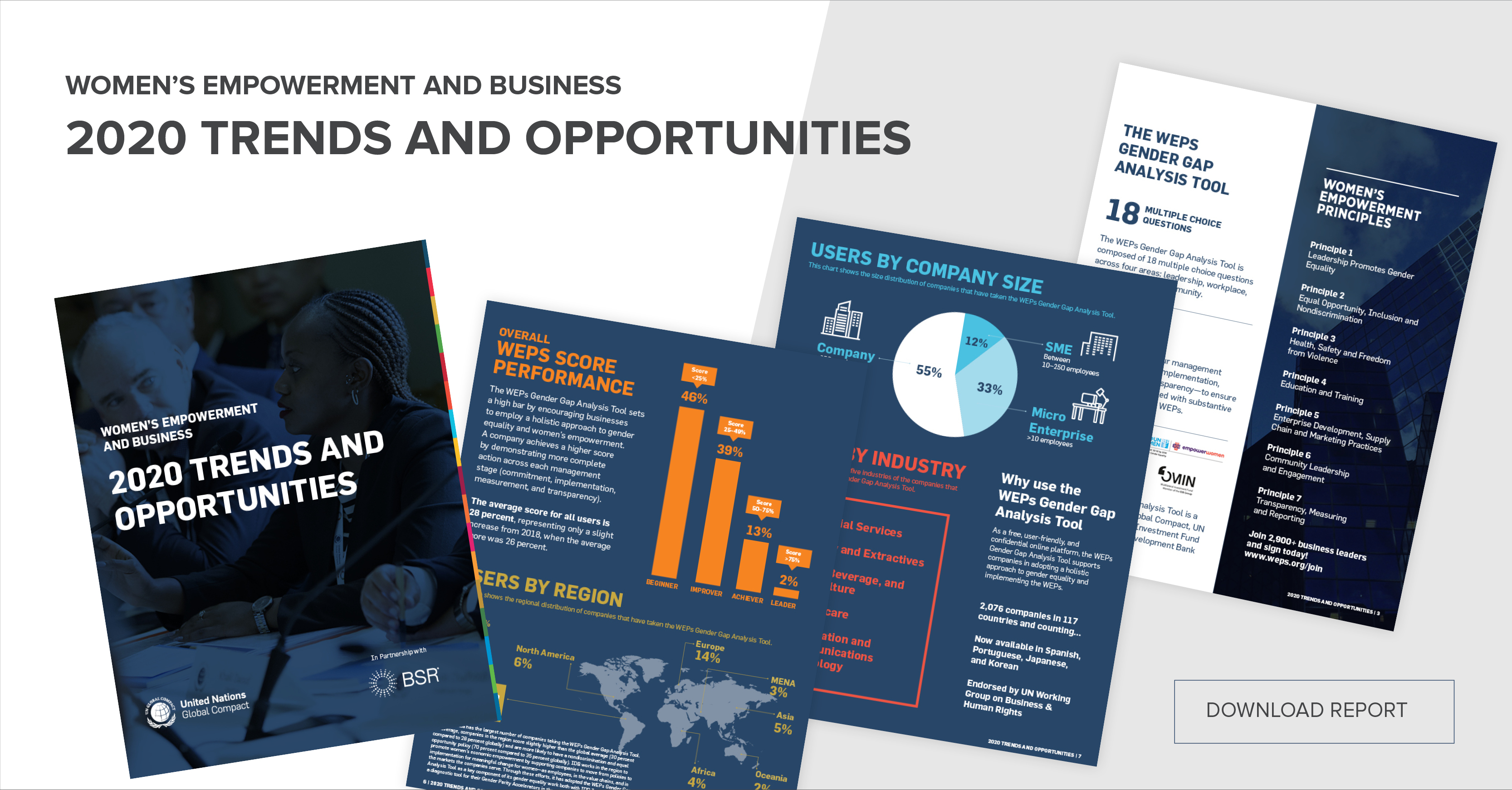
Women’s Empowerment and Business: 2020 Trends and Opportunities
This report presents the aggregate findings from the Women’s Empowerment Principles Gender Gap Analysis Tool, in particular how companies are doing in terms of commitment, implementation, measurement, and transparency on gender equality issues.
Reports | Thursday March 12, 2020
Women’s Empowerment and Business: 2020 Trends and Opportunities
Preview
2020 marks the 10th anniversary of the Women’s Empowerment Principles (WEPs), an ambitious set of principles to guide business action for more gender-equal workplaces. Since the launch of the WEPs, the business case for gender equality has continued to grow, and companies are scaling up their commitments to ensure women and men can equally contribute to and benefit from workplace policies and programs. However, as this report from BSR and the UN Global Compact shows, few companies are making the leap from commitment to action for meaningful change for women.
This report presents the aggregate findings from the WEPs Gender Gap Analysis Tool, an online resource for companies to anonymously measure their progress toward promoting a gender-equal workplace. As of January 2020, more than 2,000 companies from around the world have already used the tool to assess their gender equality performance across the workplace, marketplace, and community.
The report provides a snapshot of how companies are doing in terms of commitment, implementation, measurement, and transparency covering a wide range of issues. The results reveal important gaps in all areas, but in particular between the number of corporate commitments versus actions to promote gender equality, with even fewer companies tracking and reporting on progress. In order to support companies to move from commitment to action, the report highlights a range of initiatives to strengthen corporate efforts to create more gender-equal workplaces
Blog | Wednesday March 11, 2020
The Shift to Digital Wages: Making Sure It Works for Women and Business
In the HERfinance Digital Wages program in Bangladesh, designed to support garment factories making the transition from cash to digital payrolls, we found a tangible connection between tailoring programs to women’s needs and an increase in women’s financial inclusion and empowerment.
Blog | Wednesday March 11, 2020
The Shift to Digital Wages: Making Sure It Works for Women and Business
Preview
This year’s International Women’s Day focused on recognizing gender bias and taking action for equality, principles that are always present in our work at HERproject.
In our HERfinance Digital Wages program in Bangladesh, developed in partnership with the Bill & Melinda Gates Foundation and designed to support garment factories making the transition from cash to digital payrolls, we found a tangible connection between tailoring programs to women’s needs and an increase in women’s financial inclusion and empowerment. When factory managers recognized and addressed women’s specific requirements, it led to a more successful transition, which in turn led to positive impact for both women and business.
We are pleased to share these results today in the report Digital Wages: Positive Impact for Women and Business. The program had a positive impact upon both factories and workers in the areas of increased efficiency, financial inclusion, and women’s empowerment.
1. Efficiency
- Administrative time spent on payroll was reduced by more than half.
- Worker production-time lost on payday was cut by more than three-quarters.
2. Financial Inclusion
- 1 in 2 women opened a mobile money account.
- 1 in 5 workers started saving regularly.
3. Empowering Women Workers
- Women feel more in control of their wages:
- 1 in 10 women stopped giving their salary to someone else to decide how to use it.
- 1 in 5 women (a 19-percentage point increase) started making joint decisions about the use of their salary.
- Women experienced increased confidence about their future financial health:
- 1 in 8 women expressed an increase in confidence in meeting expected expenses.
- 1 in 8 women expressed an increase in the confidence in meeting unexpected expenses.

We have seen that the transition from cash to digital wages has the potential to transform business and society. Based on the learning from the HERfinance Digital Wages program in Bangladesh, we have created two new tools, with support from the Mastercard Center for Inclusive Growth, to bolster the transition from cash to digital wages.
For managers: the HERfinance Digital Wages Toolkit helps employers and managers to digitize their payroll in a responsible way that considers the needs of all workers, particularly female workers.
For employees: the HERfinance Digital Wages Tech Learning Tool includes six training modules, each 15-20 minutes long, based on HERfinance Digital Wages training curriculum. It uses engaging films, quizzes and animations to support workers to increase their financial health and benefit from digital wages.
Moshrefa Banu is a quality inspector in the sewing section in a Dhaka factory. Her story is representative of the positive changes that some women have experienced by moving from cash to digital wages. “It is much safer to use [mobile money]. It’s convenient and it saves time. I used to be worried about walking with cash, especially on payday, and when sending money. I felt uncomfortable going to the agent and waiting in line because there were men there. I would get ‘Eve teased.’ Sometimes I received disturbing calls at night because people in the line would overhear my number when I told the agent. I had to pay an extra 20 taka to send the money; now, it is free.”
Since receiving her wages via her mobile money account, not only does Moshrefa feel safer, she is also able to save some of her wages, with interest, toward her goal of buying a house.
Of course, digital wages can present technological and social challenges, and these need to be recognized and addressed for successful digital adoption to take place. We need a combined, cross-sector effort to promote responsible wage digitization, with focused contributions from businesses, financial services providers, and development organizations.
- Global businesses can collaborate with their suppliers, make the business case for the transition to digital wages, help shoulder some of the costs, and ensure a successful transition by focusing on the needs of workers, especially those of women.
- Financial service providers can prioritize expansion into a new market of financially excluded low-income people, particularly women, tailoring products and services to meet their needs.
- Local organizations can provide direct support for workers to gain financial and digital literacy, ensuring that the needs of female workers are taken into consideration.
- Development organizations can invest in unlocking market barriers, supporting the growth of financial services for low-income workers and championing gender issues within the market system.
The success of the HERfinance Digital Wages Program in Bangladesh has boosted HERproject’s plans for the future. We will be working to scale up HERfinance Digital Wages work across several more countries to enable many more workers and companies to benefit from digital wages, and we look forward to more of our partners joining us in this important work.
When accompanied by adequate support measures, a transition from cash to digital wages can increase business efficiency and transparency while bringing more people into the formal economy, thereby giving low-income workers—especially women—the tools to improve their lives. We hope global companies will embrace the responsible transition to digital wages as an effective means to advance financial inclusion, empower women, and build a just world.
Blog | Monday March 9, 2020
Business Action to Achieve Gender Equality in the Decisive Decade
At BSR, we are committed to working with our members to chart out a path that gets us to gender equality quickly. Here is what we think needs to happen to achieve this during the decisive decade.
Blog | Monday March 9, 2020
Business Action to Achieve Gender Equality in the Decisive Decade
Preview
As we enter the 2020s, BSR is eager to set the stage for how we can deliver gender equality in this decisive decade. The goalposts have been set: the Sustainable Development Goals state that we shouldn’t aim for global gender equality by 2030—we need to achieve it.
The roadmap is also in place: the Women’s Empowerment Principles lay out a series of steps that companies can work toward to advance gender equality across their operations. At the same time, data from the World Economic Forum’s Global Gender Gap report demonstrate that women are actually falling further behind in terms of economic parity, making us all too aware of just how far we still have to go.
At BSR, we are committed to working with our members to chart out a path that gets us to equality quickly. Here is what we think needs to happen to achieve gender equality in this decisive decade:
1. Companies need to dial up their ambition.
Nearly every major company has committed to increasing the number of women in leadership or published a statement on the importance of diverse and inclusive workplaces. Until now, many companies needed to be convinced of the business case for equality or on business’ role and opportunity to influence change. For the next decade, we need greater ambition—a shift away from broad corporate commitments and toward specific goals and metrics that chart a clear and measured path to equality. Equality in leadership, in pay, in safe and respectful workplaces, in the supply chain, and beyond.
There are some outstanding examples of this ambition in practice: Salesforce has gone beyond tracking and reporting its annual gender pay gap and is now making the necessary pay adjustments to close the gap, committing USD$10.3 million over the past four years. Cisco and Uber have taken the bold step of sharing data on sexual harassment complaints and occurrences. While not an easy step to take, this move underscores the companies’ commitment and establishes additional accountability to ensure employee and client safety.
Still, we need even more companies across all sectors to advance women to the highest levels of the organization. The percentage of women in global management roles has unfortunately steadied around 25 percent globally, and new thinking, curiosity, and creative approaches will be necessary to accelerate towards equitable leadership. For example, women are severely underrepresented in “line functions” and STEM roles. Given that these positions are often the pipeline to management and leadership opportunities, there is a need to put a particular focus on increasing the representation of women in these high-quality, high-earning roles.
2. Companies need to partner and work collaboratively together to scale efforts.
Since the Beijing Platform for Action 25 years ago, we have not seen a global convening on its scale or magnitude focused on women’s rights. This year, however, the Generation Equality Forum—a gathering of governments, civil society organizations, and companies—will seek to set the stage for ambitious global action on women’s rights. It will provide an important entry point for companies to learn, share, and partner to achieve the scale and partnerships necessary to accelerate progress. Multi-stakeholder Action Coalitions will launch targeted actions for 2020-2025 to deliver tangible results for women and girls. In addition, all actors, including businesses, are invited to make their own commitments to advancing women’s empowerment.
Of course, many companies are not waiting for this moment to get started. Partnerships such as Business Action for Women, Paternity Leave Taskforces, Unstereotype Alliance, Target Gender Equality, Deliver for Good Business Ally Network, and others are highlighting what is possible when businesses work together to remove barriers for gender equality.
3. Companies need to be mindful of the new climate for business.
The conversation on gender equality needs to take place in the context of the changes already taking place in the workplace, in communities, and for issues like climate change globally. The changing nature of work, from automation to entirely new business models, will have a differentiated impact on women. Businesses have an opportunity to be intentional and deliberate about how their approach to achieving gender equality intersectswith disruptions to their workplace and workforce over the next decade as these changes accelerate. By designing inclusive future of work strategies, companies can address both the systemic challenges faced by women at work as well as the new challenges presented by new work structures and gaps in social protections.
A new policy landscape sets a high bar for companies to protect and promote women throughout their operations—for example, the ILO Convention on Violence and Harassment sets out an international standard and guidance on addressing this critical issue in the workplace. But again, moving from commitment to action is paramount, beginning with ratification of the Convention at the country level and then with individual companies revising policies, risk assessments, and grievance mechanisms to ensure they are aligning with international best practice. In some regions, critical protections for women related to sexual and reproductive health are being rolled back. As the business case for how these issues impact workplaces becomes clearer, more companies are being asked to address these changes, engage in reproductive health policy, and understand the implications for their employees.
Finally, all decisions over the next decade will need to be made in the context of our warming climate. While climate change impacts everyone, marginalized groups, including women, are particularly impacted due to socioeconomic barriers, which include having a limited voice in decision-making and limited access to critical resources. Women and the role they play in communities—both on the front lines of climate impacts, and also in designing solutions—should be front of mind for companies. Research shows that more women in decision-making and leadership roles has a positive impact on sustainable natural resource management and climate change solutions. These two areas, traditionally managed very separately, should see a greater convergence as the linkages between gender equality and climate change are further understood.
Most of the issues facing companies and women are not new, but the urgency and growing momentum for change is unparalleled. At BSR, we believe that every company has a role to play in achieving gender equality both individually and through collective action. To support this, BSR has developed a suite of tools to help companies address many of these issues, from updating policies aligned with the ILO Convention on Violence and Harassment to identifying synergies between their approaches to climate and women’s empowerment for greater impact. For the decisive decade ahead, companies can make progress on gender equality by moving from commitments to action to create an equitable workplace that works for everyone. Please reach out to BSR's women's empowerment team for more information on steps to take.
Blog | Friday March 6, 2020
The Impact of Coronavirus on Workers, Business Operations, and Supply Chains in China
The coronavirus (COVID-19) outbreak has had an obvious and immediate impact on China’s economy. Here’s how it has impacted workers’ travel, supply chains, and the economy on local and global levels.
Blog | Friday March 6, 2020
The Impact of Coronavirus on Workers, Business Operations, and Supply Chains in China
Preview
The coronavirus (COVID-19) outbreak has had an obvious and immediate impact on China’s economy. According to the World Health Organization (WHO), as of March 5, there were 80,565 confirmed cases and more than 3,015 deaths from the virus in China alone. Cities, offices, stores, and factories across the nation have remained closed since the Chinese New Year on January 25, and travel controls and quarantine measures are still being tightly applied throughout the country.
People in all industries, especially workers in the manufacturing and service sectors, continue to be stuck in their hometowns, even though the official date for return to work was February 10.
While the Chinese Enterprise Confederation (CED) reports that 97 percent of the top 500 Chinese manufacturers have resumed operations, the impact on mid- and small-size factories is much greater. A survey from recruiting platform BOSS Zhipin cited an average resumption of work rate of only around 58 percent in the manufacturing sector as of February 21. Manufacturing for foreign trade in provinces such as Zhejiang and Shandong has only reached 70 percent capacity.
The Challenge of Workers’ Travel
By comparison, the SARS outbreak in 2003 had a less severe impact on the ability of workers to return to work and of businesses to resume operations. As one factory manager noted, it was less of challenge to get staff back to work in 2003 because the outbreak took place in April, long after the Chinese New Year holiday.
The coronavirus outbreak, on the other hand, took place during the beginning of the Chinese New Year holidays, when workers across all professions had returned to their hometowns to spend quality time with families and children, often in cities and provinces far from their workplaces. This is a result of the growth of China’s middle class, the significant increase in workers’ incomes, and the country’s poverty alleviation program, which has improved overall wellbeing for the greater population.
| 2010 | 2015 | 2018 | Annual rate | Non-local population | |
| Shanghai | 19,980,000 | 23,741,000 | 25,888,000 | +/-3% | +/-980,000 |
| Beijing | 19,619,000 | 21,705,000 | 21,542,000 | -3% | +/-770,000 |
Furthermore, China’s megacities—which have boomed along the Yangtze River, Pearl River Delta, and Beijing areas, as well as many regions in central and western China—have attracted mass migration from the rural areas as people seek professional and educational opportunities. In Beijing and Shanghai, for example, nearly 40 percent of the population are from other parts of the country. The domestic migrant population size is even greater in smaller cities and more industrialized areas.
To fight the continued spread of the virus, most cities and counties have restricted travel, particularly in regions which have been hit hard by the disease. Even workers with permission to travel—those not showing symptoms for 14 days—face an additional quarantine when they arrive at their destination. This has resulted in a phenomenal logistical challenge for workers and factories alike. The tens of millions of people traveling across the country for work face the challenge of planning for how they will meet their financial responsibilities at home with uncertain work schedules. For factory managers, there are massive challenges on everything, from planning for production line schedules, to the procurement of raw materials, and providing additional living space, food, and personal protection equipment for their workers.
The tens of millions of people traveling across the country for work face the challenge of planning for how they will meet their financial responsibilities at home with uncertain work schedules.
Impact on Supply Chains
Labor shortages and suspended manufacturing operations have also impacted global supply chains. Cambodia, Thailand, Vietnam, and Indonesia have all reported production interruptions due to lack of raw materials from China or Chinese factory managers who have yet to return to work. For example, some factories that host BSR’s HERproject, the largest workplace-based women’s empowerment initiative operating in global supply chains, have suspended operations in light of the coronavirus.
Realizing the challenges that the coronavirus has wrought on supply chains, Chinese local authorities are responding quickly, and many cities have introduced supportive policies and actions to help business and manufactures back to operations. Some measures include:
- Efforts to help the workers return to factories safely: The Zhejiang and Guangdong provinces, two of China’s biggest manufacturing and export hubs, have organized charter buses and trains to help factories get workers stuck in their hometowns due to travel restrictions and lack of travel options back to the cities where they work.
- Providing financial support: This includes banks offering loans to help business improve their cash flow, policies allowing enterprises to delay and temporarily reduce the percentage of social security contributions (with the baseline not affecting workers' overall benefits), and major retail and property owners reducing rent.
- Offering business solutions: This includes local tax offices using their databases to help manufacturers find raw materials suppliers and logistic solutions, policies to speed up reopening business applications and approval, and expedited import and export tax services at ports.
Despite these positive actions, factories and business are still facing significant challenges regarding shortage of protection products such as masks and disinfectants, quarantine facilities, and costs related to the number of migrant workers that require additional accommodations in line with government health regulations.
Uncertainty for the Chinese—and Global—Economy
The rapid slowing of China’s economy in the wake of the COVID-19 outbreak has hurt business around the world, from multinational companies to local suppliers.
On March 2, the OECD predicted that the slowdown could more than halve global growth in 2020, and the World Bank and IMF announced that they have set aside emergency funding for countries seeking to fight the fast-spreading virus.
The pan-European Stoxx 600 lost approximately 12.7 percent from February 24-28, its worst since October 2008 at the height of the global financial crisis. In the U.S., the S&P 500 fell by 13 percent and Nasdaq by 12.3 percent in just one week. Seven major Asia-Pacific markets have also fallen into correction territory.
On March 2, the OECD predicted that the slowdown could more than halve global growth in 2020, and the World Bank and IMF announced that they have set aside emergency funding for countries seeking to fight the fast-spreading virus.
This leaves major questions for companies and their workforces to consider:
- For workers stuck in their hometown: how to resume their career path, family financial plan, and children’s educational arrangements?
- For businesses with vertically integrated and complex supply chains in China: where to source materials, how to get workers back to work, and how to ship products?
- For the growing Chinese consumer market: where to get products, how to attract consumers, and how to regain the growth and expansion that have suddenly been put on hold?
- For international trade and business: how to meet consumer demand for products made in China, which have been critical to global retail shelves, and how to source raw materials to needed for production in southeast Asian factories?
For companies with operations or supply chains in China, understanding the evolution of the impact of the coronavirus on your supply chain is important. This sequence of blogs, written by BSR’s China team, is intended to help illustrate this.
As the virus situation evolves, companies need to start by asking some key questions, and attempting to gain a firmer understanding of how the virus will impact the financial, employment and raw material situation of their suppliers. We will explore some of the key solutions to many of these questions in an upcoming blog in this series.
Blog | Thursday March 5, 2020
Beyond Women on Boards: How Gender Lens Investing Can Transform Your Impact Strategy
More impact investors are slowly aligning their strategies to the push for greater gender equality and women’s empowerment. However, understanding on how to unlock the power of capital to support these commitments remains limited. Gender lens investing is a powerful new approach with the potential to change that.
Blog | Thursday March 5, 2020
Beyond Women on Boards: How Gender Lens Investing Can Transform Your Impact Strategy
Preview
The business case for gender equality and women’s empowerment, particularly its critical role as a driver of growth and innovation, has strengthened over the past decade.
A growing body of research shows how greater gender diversity in companies leads to long-term value creation, stability, and even greater returns. At the same time, ignoring women as consumers, a group responsible for 70-80 percent of consumer decisions, means missing out on one-third of the world’s private wealth.
Gender equality is at the heart of the 2030 Agenda for Sustainable Development. While SDG 5 is specifically focused on gender equality and the empowerment of all women and girls, it’s even more important to recognize that we cannot achieve the other 16 Goals if we do not ensure women have equal access to education, health care, decent work, and representation in political and economic decision-making processes.
More impact investors are—slowly—aligning their strategies to the sustainable development agenda and the push for greater gender equality and women’s empowerment. However, understanding on how to unlock the power of capital to support these commitments remains limited and leaves many investors simply counting the number of women reached. This check-box exercise provides little to no information about the actual impact for women and risks missing opportunities for more meaningful investments and greater returns.
Gender lens investing is a powerful new approach with the potential to change that. It considers the impact of financial investments, both good and bad, on women and girls. It also recognizes investments’ potential to generate financial returns and advance gender equality simultaneously. Gender lens investing can also address other sustainability issues, such as climate change, and can help companies to avoid potential reputational or legal risks related to issues such as discrimination, sexual violence and harassment.
Busting Gender Lens Investing Myths
- Gender Lens Investing is a niche market: While relatively small compared to other types of impact investing, assets under management with a gender lens mandate are growing at an impressive rate, increasing by 85 percent over 12 months in 2017/2018 and reaching US$2.4 billion in 2018. The number of gender lens funds has quadrupled over four years, and the growth of these liquid, low-fee, and low minimum funds are helping to democratize gender lens investing.
- Gender Lens Investing means concessionary returns: Morningstar evaluated the performance of 10 gender-focused funds and found that seven of these outperformed in the top quartiles of their categories. Pax Ellevate Global Women’s Leadership Fund (PXWEX), which invests in companies advancing women through gender diversity on their boards and in executive management, outperformed the benchmark MSCI World (Net) Index in 2017 with a 22.78 percent total return compared to 22.40 percent.
- Gender Lens Investing requires counting the number of women on boards: Women’s representation in leadership is critical to ensure a diverse set of views and experiences when making decisions, but it is not enough to ensure a positive impact for women and girls. Given the existing male-dominated financial ecosystem, it is easy to see how gender lens investing might be watered down to a check-box exercise, but this has its own set or risks including missing out on more meaningful opportunities to invest in women.
Ensuring Meaningful Investments
While the opportunity for gender lens investing is clear, meaningful impact requires thinking about both how you invest and who and what you are investing in. At BSR, our experience shows that gender equality should not be siloed but integrated into every investment decision. This means investing with a gender-responsive approach by:
- Ensuring gender-equal investment teams, providing training and/or guidance and promoting and supporting women in leadership positions. The IFC found that gender-balanced senior investment teams generate 10 to 20 percent higher returns for private equity firms and venture capital funds. However, female advancement in the sector remains staggeringly slow: less than 10 percent of U.S. portfolio managers at mutual funds and exchange-traded funds are women, a figure that has remained stable for many years. While anecdotal evidence points to impact investing firms having higher shares of women, the gender gap remains.
- Considering gender-related issues throughout the investment process. Maintaining a focus on gender perspectives is important, from due diligence to post-deal monitoring and reporting as part of broader ESG criteria. Depending on the context and objective, this may require new tools or strategies focused on ensuring gender issues are proactively considered. This can be accomplished through gender mainstreaming by incorporating gender considerations into existing materials.
In terms of investment opportunities, investing with a gender lens includes:
- Women-owned or -founded business: Research has found that women entrepreneurs tend to do better than their male counterparts in terms of profitability, with one study finding that women-owned startups generate twice as much revenue per dollar as startups led by men. And yet, women-owned and -led businesses are chronically underinvested in, with female CEOs raising just over 2 percent of venture capital in 2018. Recent unicorns are great examples of successful women-founded business reaching new markets, such as Rent the Runway, Glossier, and Classpass, which was recently valued at over US$1 billion.
- Gender-diverse businesses that work to promote gender equality and women’s empowerment internally. Given the strong evidence that gender equality is good business, understanding how companies are performing on all gender issues is critical. Corporate commitments to promote more women leaders and to ensure pay equity and safe and inclusive workplaces are an important first step. But these should be coupled with strong accountability mechanisms, programs, and policies dedicated to supporting women’s workplace advancement. New initiatives are making it easier for companies to assess and track progress toward gender equality, including EDGE Certification, the Gender Equity Now Certification, and the Bloomberg Financial Services Gender Equality Index.
- Products and delivery of services that can substantially improve the lives of women and girls. One good example of this is the “femtech” sector, which aims to improve the health and wellbeing of women through new digital innovations. While investments in femtech have been growing substantially over the past five years, they still lag behind investments in health products and services for men. In addition to products and services, many issues critical to women’s empowerment, such as ending violence against women, are also greatly underinvested in. For example, the Tara Health Fund has committed 100 percent of its endowment to a gender lens portfolio with a focus on women’s reproductive health.
Gender equality and women’s empowerment is not just a missed opportunity for impact investors. When properly addressed, it can be a driver of meaningful impact and catalyze greater and more sustainable change. BSR brings together deep expertise in the financial services sector and women’s empowerment to develop tools and strategies to support companies interested in impactful and effective gender lens investing.
Reports | Thursday March 5, 2020
Gender Equality and Social Audits e-Learning
To support social auditors, companies and a broader spectrum of social compliance regulatory organizations, BSR has developed a Gender Equality and Social Audits e-Learning course. The interactive course, consisting of three parts, covers key gender concepts, the business case for addressing gender in social audits, and considerations for tips for…
Reports | Thursday March 5, 2020
Gender Equality and Social Audits e-Learning
Preview
Support
The e-learning course was made possible by funding from the Ministry of Foreign Affairs of the Netherlands, based on BSR’s Gender Equality in Social Auditing Guidance, funded by the Laudes Foundation.
The resilience of global supply chains is intrinsically linked to the status of women on farms and in factories. In many industries, including agriculture, healthcare, apparel, and toys, women make up a majority of the workers. When women’s health, well-being, and access to opportunities are compromised, their productivity and efficiency suffer, which in turn hurts companies. Ignoring gender gaps and inequalities can leave companies exposed to production and delivery disruptions, bottlenecks, and inefficiencies.
Today, most companies use social audits both to verify that suppliers are upholding the company’s minimum requirements and to help design corrective action plans to improve workplaces. However, women’s rights and workplace-specific challenges are often not reflected in supplier codes of conduct and are addressed in very limited ways, if at all, in the auditing methodologies used to verify compliance with such codes. Mainstreaming gender equality considerations within social audits can have beneficial effects on the ability of companies and suppliers to identify and adequately remediate material existing issues for the women in their supply chains.
To support social auditors, companies and a broader spectrum of social compliance regulatory organizations, BSR has developed a Gender Equality and Social Audits e-Learning course. The interactive course, consisting of three parts, covers key gender concepts, the business case for addressing gender in social audits, and considerations for tips for ensuring a gender-sensitive approach throughout an audit process. The three modules should take approximately one and a half hours to complete.
For more information on how to integrate gender issues into social audits, read the full guidance in English and Chinese.