Searching for:
Search results: 666 of 1188
Reports | Monday September 28, 2020
Action for Sustainable Derivatives | Annual Update on Progress 2020
It has been just over ten months since Action for Sustainable Derivatives (ASD), a sector-wide collaboration for users of palm and palm kernel oil derivatives in the beauty, personal and health care, and oleochemical industries, was launched, and we are proud to share our first Annual Update on Progress.
Reports | Monday September 28, 2020
Action for Sustainable Derivatives | Annual Update on Progress 2020
Preview
It has been just over ten months since Action for Sustainable Derivatives (ASD), a sector-wide collaboration for users of palm and palm kernel oil derivatives in the beauty, personal and health care, and oleochemical industries, was launched to galvanize a collective voice of influence for responsible palm production and to operationalize collective tools for change. Our vision is to achieve and promote palm derivatives sourcing that is free from deforestation, respects human rights, and supports local livelihoods.
ASD is proud to share its first Annual Update on Progress, demonstrating the rapid progress that has been made even in the context of global upheaval. Since its inception, ASD has facilitated the sharing of information, data, and solutions to accelerate transformation of the palm derivatives sector among its members. Moreover, ASD also acts as an operational platform for transparency, risk prioritization, and on-the-ground impact.
The resulting proof points speak to our founding collaborative and impact-oriented approach. In just ten months, ASD has:
- Conducted individual member company and collective group supply chain mapping for 18 member companies, covering 450,000 tons of palm-based materials and over 700 ingredient types
- Mapped derivatives supply chain to mills of origin for 81 percent of palm volumes and to refineries and crushers for 90 percent
- Leveraged existing environmental and social risk data to prioritize production hotspots and supply chain players in the collective supply chain, which allows for engagement to improve production practices and secure supply of responsible palm derivatives to uphold No Deforestation, No Peat, No Exploitation commitments of downstream users
- Developed an impact-oriented strategy to focus collective resources in support of responsible production practices and relevant conservation, restoration, and livelihood initiatives
Blog | Friday September 25, 2020
Missing Climate Week, Seeing Climate Refugees
BSR President and CEO Aron Cramer shares his recent experience in Oregon during the wildfires, underlining the necessity of taking climate action.
Blog | Friday September 25, 2020
Missing Climate Week, Seeing Climate Refugees
Preview
For the first time in many years, I am missing Climate Week and the UN General Assembly (UNGA) this year, and not only because COVID-19 prevents me and most of the Sustainable Development Goals (SDG) community from traveling to New York. This year, I also missed it for family reasons: our younger son began university, in person, even amidst the pandemic.
Universities in the United States have been seriously disrupted by COVID-19, and there are many fears about whether even limited opening makes sense from a public health perspective.
But for our family, there’s more, since our son entered university in the state of Oregon in the immediate aftermath of the devastating wildfires that destroyed homes and livelihoods for so many. My “climate week” this year was all too real.
Upon arriving at our hotel in Eugene, Oregon, we encountered not old friends and colleagues from countless climate conferences, but a Red Cross table checking in dozens of fire evacuees whose homes had been destroyed and who required temporary housing in hotels.
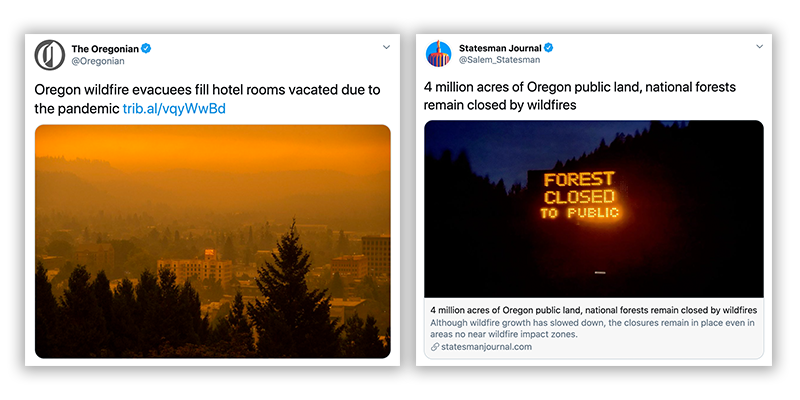
Transportation was disrupted not by the motorcades of heads of state shutting down midtown Manhattan, but the sight of entire neighborhoods burned to the ground alongside the interstate on the way from California and poor visibility from the smoke that plagues the West Coast of the U.S. weeks after the fires began.
Instead of earnest—and undeniably important—conversations about poverty reduction and achievement of the SDGs in conference rooms, our hotel hallways and common spaces were filled with evacuees—climate refugees—carrying their belongings. It was impossible to ignore the fact that many of the people in our hotel were economically disadvantaged before the fires and face extreme precarity thanks to these fires.
It was also striking that many of the displaced did not honor the statewide mandate to wear masks inside. This troubling experience seemed likely to be a real world manifestation of the “mask denialism” that plagues portions of the United States. This is yet another illustration of the all-too-familiar debates over red-state versus blue-state culture in the U.S. that have similarly undermined climate action in the world’s largest economy.
I suspect that my 2020 Climate Week, far from New York, far from an endless stream of dialogues, dinners, and impromptu meetings, will linger in my consciousness far longer than any other.
Climate Week remains an indispensable time of year. Indeed, amidst all the terrible news of 2020, the flurry of new announcements tied to Climate Week from leading businesses, investors, and coalitions is one of the best reasons I can think of to maintain a degree of optimism at a time of so much hate, suffering, and uncertainty.
And while I miss being with friends and colleagues working furiously for a net zero economy that truly sustains all people, I suspect that my 2020 Climate Week, far from New York, far from an endless stream of dialogues, dinners, and impromptu meetings, will linger in my consciousness far longer than any other.
I hope that next year, we will be able to gather safely in the ways we have grown accustomed to doing. And whether Climate Week 2021 is virtual or in person, I intend to hold dear the encounters I had with the climate refugees I witnessed in the lobbies and hallways of Eugene, Oregon this week. We do our work for them. Even more, we do our work to make sure that their tragic reality does not become our collective fate. And with no offense to everyone fighting hard to achieve decisive climate action, a single encounter with a family that has lost their home means more, and inspires more, than a thousand Zoom chats.
Blog | Thursday September 24, 2020
Scaling the Impact of Digital Financial Services: The Opportunity and Imperative during COVID-19
In a new report, HERproject and the Mastercard Center for Inclusive Growth share lessons and insights from Digital Wages programs that can help companies, governments, and financial service providers scale up digital payments for low-income workers after COVID-19.
Blog | Thursday September 24, 2020
Scaling the Impact of Digital Financial Services: The Opportunity and Imperative during COVID-19
Preview
DOWNLOAD REPORT REGISTER FOR WEBINAR
“Being paid into an account is much safer. During Corona, if I were paid in cash, I would have had to go to the factory in person and disinfect the money as my colleagues did when they received their salaries in the envelope.” Ibrahim, Garment Worker, Egypt
For Ibrahim, as for many low-income workers in global supply chains, the COVID-19 pandemic has brought the physicality of cash into sharp focus. Even where factories have remained open, for those who receive wages in cash, payday has become arduous and dangerous. Where operations are suspended, though, receiving cash wages becomes an impossibility, putting workers at increased risk of being plunged into economic crisis.
The pandemic has revealed and accentuated the limitations of cash payments: they are time-consuming, insecure, and disempowering for workers. As lockdowns have brought much of the world to a standstill, governments and the private sector alike have turned to digital financial services to make rapid payments at scale. For example, the government of Bangladesh’s COVID-19 support package for the garment sector was available only for employers paying digital wages; this led to over 800 garment factories rapidly digitizing their payroll, and in April 2020, 1.9 million garment workers received the government support package payments into their accounts—with more than half estimated to be paid digitally for the first time.
In global supply chains, this rapid shift to digital payments has, in the short term, enabled critical support to reach the most vulnerable populations: low-income workers who rely on regular wages or government payments to feed and support their families. More broadly, however, the shift has highlighted the longer-term potential of digital wages to drive financial inclusion and resilience, bringing low-income workers into the formal financial system and thereby increasing their ability to save, plan, and respond to crises. As Nupar, a Bangladeshi garment worker, revealed: “I keep track of all my expenses and have savings even from my small salary. Every month I save 1,000-1,500 taka in my mobile wallet and 5,100 in my savings group. Because of this, I didn’t need to borrow any money [during the COVID-19 lockdown].”
There is therefore a major opportunity, right now, to accelerate the transition to digital and generate positive impact at scale. Since 2018, BSR’s HERproject and the Mastercard Center for Inclusive Growth have partnered to leverage the HERfinance Digital Wages program to scale up wage digitization for ready-made garment factories and workers in Bangladesh, Egypt, and Cambodia. Together, we are calling on business globally and governments to unite in developing and implementing more cash digitization programs. Through their supply chains in countries like India and Bangladesh, global brands and buyers have unique access to millions of workers and can, in partnership with relevant governments and stakeholders, make digital wages a global reality. Governments can digitize their social protection payments and support individuals to access and use these much-needed disbursements.
However, while such a shift has enormous potential, it is critical that efforts are carefully designed and managed. The Mastercard Center for Inclusive Growth and HERproject are therefore pleased to share a new report, Digitizing for Inclusion: Insights from Wage Digitization in the Garment Sector. This report draws on the extensive experience of HERfinance Digital Wages programs across multiple countries, highlighting key lessons that can help global brands, governments, financial service providers, and other stakeholders ensure that the transition to digital payments is inclusive, effective, and beneficial to all.
The report shares insights that private sector, governmental, and development organizations should consider before beginning any payment digitization programs. These include the following:
- Without training, digital wages may offer little to no benefit. While digital wages programs may succeed in providing workers with accounts and transitioning factories away from cash payments, this may be a token gesture with little impact if workers are not trained and encouraged to use digital financial services. In 2017, for instance, when the garment industry in India digitized wages, there was limited training provided to workers. Three years later, research found that male and female workers are still withdrawing 100 percent of their wages on payday. By contrast, through the HERfinance Digital Wages programs in Bangladesh, workers have been trained on using their mobile money accounts to send remittances to families, save money in their accounts (which helps them to better weather future shocks), and make payments for products in areas around the factory. As a result, they became active mobile money users: women were conducting approximately eight transactions per month and men 13 transactions.
- If gender is considered from the start, digital payments can enable women’s economic empowerment. In Bangladesh, for example, women are often forced to hand over some or all of their wages to husbands or male family members. Paying women digitally does not necessarily alleviate this problem and may, in some cases, make it worse. The HERfinance Digital Wages programs have therefore devoted significant time to discussing the advantages of joint financial decision-making with both men and women, leading to female participants reporting increased control over their wages. If the specific barriers women face are accounted for and incorporated into training programs, there is an increased likelihood that gender norms can be shifted, paving the way for greater women’s empowerment.
As these lessons show, transitioning to digital payments is not just a matter of flicking a switch. It requires knowledge, expertise, and thoughtful planning and implementation. HERproject and the Mastercard Center for Inclusive Growth are therefore delighted to make the learnings from HERfinance Digital Wages programs publicly available; we encourage global brands and governments to read and share these learnings as the first step to activating their potential to scale digital payments and change lives for the better.
Originally appeared on HERproject.
Blog | Wednesday September 23, 2020
Freight Buyers Are the Zero-Emission Fuel We Need
BSR and the Smart Freight Centre are moving to accelerate the shift to zero-carbon freight across all modes of transport—air, sea, road, rail, waterways—by 2050 through a new buyer-focused collaborative platform: the Sustainable Freight Buyers Alliance.
Blog | Wednesday September 23, 2020
Freight Buyers Are the Zero-Emission Fuel We Need
Preview
As more and more businesses take action to address the climate crisis, few sectors can make as much of an impact as transportation. Representing approximately 15 percent of global energy demand, transport emissions accounted for over eight percent of global carbon emissions in 2015 according to the International Transport Forum, and is expected to continue to rise until the mid-century. Driving down emissions from freight transport is critical to achieve the Paris Agreement goals— and decarbonizing this sector will take both extraordinary ambition as well as global, coordinated action. Taking on a challenge of this scale will require working with multinational companies, as well as their suppliers; simultaneously changing air, sea, road, rail, and waterways transportation; and driving transformation across the entire global system.
In 2020, business ambition to address the climate crisis has never been higher, with nearly one thousand companies committed to Science Based Targets since the initiative was launched in 2015. As companies leverage climate science to drive emissions reductions in their operations and their value chains, they have realized that reaching these targets requires addressing the carbon emitted in their supply chains, including freight transport, if they wish to remain in line with the Paris goal to limit warming to 2oC or its stretch goal of 1.5oC.
As businesses look to move beyond commitments and take concrete steps to combat climate change, now is the time to take meaningful action to address freight emissions. With years of experience working collaboratively on initiatives aimed at decarbonizing freight, BSR and the Smart Freight Centre (SFC) are moving to address gaps in current efforts and accelerate the shift to zero-carbon freight across all modes of transport—air, sea, road, rail, waterways—by 2050 through a new buyer-focused collaborative platform: the Sustainable Freight Buyers Alliance (SFBA).
In order to drive system-wide change, we need a new type of collaborative platform purposefully designed to send a united market signal across the entire freight ecosystem. In a globally interconnected network, this unified market signal will enable more impact than disparate ones for individual modes, countries, or technologies – further driving the ability of other initiatives such as the Getting to Zero Coalition, the World Economic Forum, and others to progress meaningfully towards decarbonizing technologies for freight. We need to unite corporate buyers, suppliers, and other stakeholders in the freight value chain in order to meet the following three essential conditions for zero-emission transport by 2050:
- United market signal: Corporate buyers of freight share the same global freight system and have overlapping suppliers. We need to bring all these buyers together under a single purpose, define the common objectives, and agree to mutual accountability in order to translate this need into a powerful, specific, and united market demand signal for low-carbon freight.
- Opportunity for action: Once buyers have defined and signaled a common market demand, they can accelerate action. This can be done by joining initiatives that support the scale up or co-creation of promising technology, operational or financing solutions, and alignment of buyers and suppliers. Well-established collaborative buyer-supplier platforms for different regions and freight transport modes exist; such as BSR’s Clean Cargo for maritime freight, BSR’s Future of Fuels initiative and U.S. EPA’s SmartWay for road freight in North America, and BSR’s Sustainable Air Freight Alliance for air cargo. Other initiatives are focused specific technologies, such as Drive to Zero for electric trucks or Getting to Zero Coalition for zero-emission marine vessels, and a growing number of countries have national green freight programs. Solutions and knowledge must be shared across these platforms, to ensure the rapid identification and scaling of the most promising solutions.
- An industry standard: To ensure accountability, we will need standardized guidelines and an assessment tool that allows individual companies to monitor progress to achieving zero-emission freight. SFC’s Global Logistics Emissions Council has developed the GLEC Framework, which we believe to be the best example of standardized guidelines for emissions calculation and reporting, and an assessment tool to track progress can be coupled to this.
This Sustainable Freight Buyers Alliance will specifically focus on creating a united market signal by working with global buyers and tracking emission reduction progress across their entire freight value chain - not be limited by region or mode of transport. We can then accelerate action and industry standards by collaborating with existing initiatives. Together we can share knowledge and learnings—and identify the best technologies and opportunities to scale impact.
We look forward to connecting with more shippers to join us in creating a single voice to drive down freight emissions—and take coordinated action to meet science-based targets to counter the climate crisis. We encourage companies looking to scale impact and meet their SBTs to reach out to our team to learn more.
Blog | Tuesday September 22, 2020
Meeting the Moment for a New Social Contract: Q&A with Sharan Burrow of the ITUC
BSR is pleased to welcome Sharan Burrow, an outspoken champion for workers and climate, as a plenary speaker at our 2020 Conference. In this article, we discuss her point of view on what a 21st-century social contract should look like.
Blog | Tuesday September 22, 2020
Meeting the Moment for a New Social Contract: Q&A with Sharan Burrow of the ITUC
Preview
 BSR is pleased to welcome Sharan Burrow, an outspoken champion for workers and climate, as a plenary speaker at our 2020 Conference.
The events of 2020—in particular the COVID-19 pandemic and its economic impacts—have exposed many existing structural inequities and highlighted the fact that our existing social contract is no longer fit for purpose. Sharan is a driving force in the global movement to create a dialogue between business, civil society, and government in order to forge a new social contract that advances social progress for all, including the transition to a net-zero economy that sustains jobs, livelihoods, and economic fairness.
Sharan was elected as the General Secretary of the International Trade Union Confederation (ITUC) in 2010. As Vice Chair of The B Team, she has spearheaded cross-sector efforts in promotion of inclusive economies, climate justice, corporate transparency, and workplace equality. In 2016, she helped to establish the ITUC’s Just Transition Centre, which brings together workers and their unions, communities, businesses and governments in social dialogue to ensure that labor has a seat at the table when planning for a just transition to a low-carbon world.
As BSR continues to discuss what a 21st-century social contract should look like with our members, partners, and community, we welcome Sharan’s point of view—in the Q&A below and at BSR20 next month.
In 2020, we’ve dealt with the impacts of COVID-19, witnessed a growing demand for social and racial justice, and seen the growing impacts of climate change around the world. As we look to the future and try to rebuild the economy, how important is it to create a new social contract between business, government, and people that both protects the rights of workers while also safeguarding the planet? What do you think the key elements of a new social contract should be?
A New Social Contract must bring a recovery with a resilience against future shocks that is built on jobs, living wages, and universal social protection. A recovery which is inclusive of women and young people without discrimination and sustains a living planet. Climate action and employment cannot be separated if we are to stabilize the planet and end exploitation inherent in an economic model where profit and shareholder value take priority.
The current model of business has resulted in a global workforce where only 40 percent of workers have formal employment and more than a third of them face precarious work. The ILO Centenary Declaration laid out the floor for a new social contract.
- A labor protection floor for all workers irrespective of their employment arrangement with fundamental rights, health and safety, adequate minimum wages, and maximum hours of work
- Universal social protection
- A transformative agenda for women, and
- Just transitions for climate action and new technologies.
The SDGs reinforce these and other elements of a just and sustainable future for all. The urgency to act is now, and the only thing stopping us is political will.
The ILO estimates that we lost nearly 300 million jobs between April and June this year. From the perspective of a labor leader, what issues must business urgently address if we are to successfully build a more just and sustainable future?
Business must change. There are many companies that are committed to the rights of workers, fair wages, and safe conditions with due diligence and grievance mechanisms to remedy violations. Tragically, there are many that are not and whose global supply chains are dehumanizing and exploitative. Decent work requires respect for rights and a commitment to shared prosperity.
Likewise, many businesses are committed to climate action to realize a net zero future—but too many are not. This is not a level playing field for domestic or global business, and regulation is required at all levels to ensure a fair competition floor. Core ILO Labour Standards with mandated due diligence to ensure respect for UN Guiding Principles on Business and Human Rights are a key part of the level playing field for business as are environmental standards.
And business must abide by fair taxation rules supporting the elimination of tax avoidance and evasion with a commitment to eliminate corruption. If we expect investment in jobs with government support for enabling green infrastructure, health, education, childcare and aged care, sustainable cities with mass transit, and repair of ecosystems amongst other vital initiatives—fair taxation sits at the heart of making that possible and rebuilding hope.
In BSR’s report, The Business Role in Creating the 21st-Century Social Contract, we focus in part on the need to generate inclusive low-carbon employment opportunities and to manage the impact on workers who are transitioning away from high-carbon roles. What policies are needed to support a just transition? What actions should businesses be taking to prepare their workers and the communities in which they operate?
Just Transition is vital to build trust in climate action. All industry sectors must transition so it must start with social dialogue: workers and, where relevant, governments at the table with employers co-designing the pathway to net zero emissions. The principal measures for Just Transition are not difficult:
- Protecting jobs wherever possible
- Secure pensions for older workers
- Income support, reskilling arrangements, and redeployment for displaced younger workers; and
- Investment in community renewal.
There can be no recovery and no resilience if we don’t stabilize the planet. It will take all of us.
Blog | Monday September 21, 2020
Transform to Net Zero and the Shift from Climate Ambition to Climate Action
Unless companies transform into net zero businesses, targets alone will not persuade governments to make more ambitious national pledges. That is why we need—and we are beginning to see—a great shift from climate ambition to climate action.
Blog | Monday September 21, 2020
Transform to Net Zero and the Shift from Climate Ambition to Climate Action
Preview
When the Paris Agreement was being completed in 2015, the watchword of the day was climate ambition. Ambitious national pledges are essential to reaching the Agreement’s goal to hold warming well below 2°C and pursue 1.5°C. And if we do not close the gap between pledged ambition and the Paris targets in this Decisive Decade, we will forego those goals and suffer the consequences.
Over the past five years, Paris-aligned ambition has become a de facto standard in sustainability. Not only do stakeholders expect companies to take climate action—as 1,350 companies with a market capitalization of US$25 trillion have done with the We Mean Business coalition—they expect companies to set Paris-aligned emissions reduction targets. The Science Based Targets initiative has commitments from nearly a thousand companies, and Business Ambition for 1.5°C counts nearly three hundred aligned with the Paris 1.5°C stretch goal.
But if these ambitious climate targets do not feed a wider shift in the economy toward business success, better jobs, and shared prosperity, companies will not continue to implement them. And unless companies transform into net zero businesses, these targets alone will not persuade governments to make more ambitious national pledges. That is why we need—and we are beginning to see—a great shift from climate ambition to climate action.
Collaborating across industries will also be essential to reduce emissions across the entire economy. Transform to Net Zero is a cross-sector group of leaders delivering an inclusive net zero economy through accelerated business transformation, innovation, and systems change.
This shift is exemplified by the corporate announcements made during the 2019 UN Climate Action Summit, including the Net-Zero Asset Owner Alliance, a group of institutional investors aligning their portfolios to net zero emissions, and the Getting to Zero Coalition, dedicated to deploying commercially viable deep sea zero emission shipping vessels by 2030. These multistakeholder initiatives are implementing net zero goals in specific industries. And to reach net zero emissions, we will need many more of them to overhaul value chains across the economy.
Collaborating across industries will also be essential to reduce emissions across the entire economy. Transform to Net Zero is a cross-sector group of leaders delivering an inclusive net zero economy through accelerated business transformation, innovation, and systems change. By leading by example, they will demonstrate the transformation of corporate strategy and other company functions, innovate to remove barriers to net zero value chains, scale capital investment, and support ambitious public policies. BSR is proud, as the initiative’s Secretariat, to foster impactful collaboration with them.
Transform to Net Zero does not ask companies to announce yet another climate commitment; indeed, many of the companies involved already have extraordinary ambitions: take, for example, Microsoft’s commitments to be carbon negative across the value chain in just 10 years, to remove its historical operational carbon emissions by 2050, and to establish a US$1 billion climate innovation fund. Or Unilever’s recent announcement to achieve net zero emissions from all its products in less than 20 years and establish a EUR€1 billion Climate & Nature Fund. Instead of seeking new commitments, Transform to Net Zero enables all companies with net zero targets to implement them and all companies without such targets to act. To scale impact as widely as possible, all of Transform to Net Zero’s outputs are intended for the public domain.
In the Decisive Decade, this is the kind of collaboration that must flower—focused on transforming businesses and deploying all corporate functions to build net zero value chains.
This spike in company action is big enough now to dent the global emissions trajectory. Equally striking, it has taken place during a weakening regulatory environment. The G20 economies are conspicuously absent from governments intending to strengthen national targets at next year’s UN Climate Conference. This gap in national leadership makes business action, not just ambition, even more urgent as people around the globe suffer from increasingly devastating climate impacts.
In the Decisive Decade, this is the kind of collaboration that must flower—focused on transforming businesses and deploying all corporate functions to build net zero value chains. The day that net zero is not a press release but a business model is the day the Paris goals become achievable. Making this a business norm as soon as possible is critical because we have no time left.
Blog | Thursday September 17, 2020
Ensuring Circular Fashion is Good for People—as well as the Environment
Even before the COVID-19 outbreak, circular economic models had been sprouting up at increasing speed in the fashion industry. BSR’s new brief, Taking a People-Centered Approach to a Circular Fashion Economy, explores the potential social impacts that may emerge from a mainstream shift to circular fashion.
Blog | Thursday September 17, 2020
Ensuring Circular Fashion is Good for People—as well as the Environment
Preview
The COVID-19 pandemic has thrown the fashion industry into disarray, leaving supply chain workers without wages and causing major global brands to file for bankruptcy. In the U.S. alone, 2.1 million retail workers lost their jobs due to the crisis. In Bangladesh, the garment sector is expected to lose over a million jobs by December 2020, with over 70,000 workers already laid off. While many of the underlying issues are not new to the industry, the unprecedented situation has made us acutely aware of the fragilities of our current economic system and of just how vulnerable people —especially workers and their communities—are to significant business disruption.
As our society looks to build back better by emerging from the crisis with a more resilient and sustainable system, many industries are planning to integrate circularity into their recovery plans. Indeed, even before the COVID-19 outbreak, circular economic models had been sprouting up at increasing speed in the fashion industry, both to counter its enormous environmental impact and to respond to economic opportunities. The textile industry alone produces 1.2 billion tons of CO2 per year and accounts for around 20 percent of global industrial water pollution. Companies, brands, and designers are increasingly looking to circular fashion models, including resale, rental, and repair, to mitigate these impacts. A strong signal of the circular fashion opportunity: resale grew 25 times faster than the overall retail apparel market in 2019.
This current period of complex disruption presents a unique opportunity to leverage the shift to circularity to address some of the global fashion industry’s persistent and pervasive environmental and social issues.
While the potential positive environmental impact of a shift to circularity is enormous, few organizations are considering the social implications for the more than 60 million people in its value chain. Given the sheer size of the industry and the many ways people intersect throughout production and consumption, social implications, whether positive or negative, are unavoidable. Women, who comprise between 60 to 90 percent of total apparel workers, of whom an estimated 80 percent are women of color, will likely take the brunt of the impact due to their precarious working conditions and existing gender-based discrimination.
BSR’s new brief, Taking a People-Centered Approach to a Circular Fashion Economy, explores the potential social impacts that may emerge from a mainstream shift to circular fashion.
Informed by BSR’s research and stakeholder engagement supported by Laudes Foundation, an independent foundation tackling the dual crises of climate change and inequality, the brief proposes opportunities for businesses, policymakers, and advisors to design circular fashion business models to be inclusive and fair from the outset. In addition, we provide a set of guiding questions for companies and organizations to practically think through the social impacts of their shifts to circular fashion models, aiming to avoid and mitigate negative social impacts and more consciously target positive social impacts.
“The vision of ‘circular economy’ presents an economy that is compatible with nature, but we cannot take for granted that it will be inclusive,” says Megan McGill, Senior Programme Manager at Laudes Foundation. “BSR’s work is enabling us to ensure that in our pursuit for a regenerative and restorative economy, we are actively managing and promoting the rights and equity of people touched by the fashion sector.”
By taking a people-centered approach, we can build a more resilient industry and respond to the calls from stakeholders.
This current period of complex disruption presents a unique opportunity to leverage the shift to circularity to address some of the global fashion industry’s persistent and pervasive environmental and social issues. By taking a people-centered approach, we can build a more resilient industry and respond to the calls from stakeholders—through safer inputs that increase the health and safety of workers and production communities, enabling creative and dignified employment, and building inclusive models adapted to the needs of a diverse consumer base.
Supported by Laudes Foundation, BSR is continuing to explore the impacts of the shift to circular fashion on job opportunities and quality—a topic largely ignored in the circular transition to date and which we begin to delve into in this brief. Our current work aims to explore and develop responses to these impacts in collaboration with fashion companies and broader industry stakeholders. In addition, we will leverage strategic foresight in developing and testing practical recommendations with special focus on the U.S., Europe, and India.
This brief was developed by Cliodhnagh Conlon and Annelise Thim, with input from Laura Macias and Magali Barraja and with the support of Laudes Foundation. As we delve deeper into this topic, we are keen to hear feedback and learn from others who are working to ensure that the circular fashion transition delivers benefits for people. If you are currently working on circular fashion or would like to learn more about our work, please reach out to connect with the team.
Reports | Thursday September 17, 2020
Taking a People-Centered Approach to a Circular Fashion Economy
In partnership with Laudes Foundation, BSR has developed a brief on the potential social impacts of a shift to circular fashion based on BSR’s research and stakeholder engagement.
Reports | Thursday September 17, 2020
Taking a People-Centered Approach to a Circular Fashion Economy
Preview
The fashion industry has long been called out for its major negative environmental and social impacts. In 2020, the COVID-19 pandemic underscored the instability of global fashion supply chains and the vulnerability of its supply chains workers, adding urgency to the calls for a more sustainable and ethical fashion industry. Even before the pandemic, many fashion companies were looking to circular economy models to reduce risks of business disruption and mitigate negative environmental impacts. However, few circular economy models have considered the potential impacts—both positive and negative—on the 60+ million workers in fashion supply chains or the billions of consumers worldwide.
In partnership with Laudes Foundation, BSR has developed a brief on the potential social impacts of a shift to circular fashion based on BSR’s research and stakeholder engagement. We introduce issues that may arise during the shift to a circular fashion for consumers and workers as well as wider societal concerns. In the brief, we explore the likely differentiated impacts of a transition circular fashion models—first, in the dynamics between production and consumption communities and second, for women and marginalized groups.
The complex disruption by the COVID-19 pandemic presents a unique opportunity to leverage the shift to circularity and address many of the global fashion industry’s persistent and pervasive environmental and social issues. Seizing this opportunity requires us to first understand the impacts of innovation by identifying what those impacts are and who will be impacted. To that end, we propose a set of guiding questions for companies and organizations to think through the social impacts of their shifts to circular economy models on diverse groups and how projects might influence such impacts. We also provide several actions for companies and organizations to inform the design and implementation of circular business models, aiming to avoid and mitigate negative social impacts and more consciously target positive social impacts.
This brief represents an initial exploration of this topic. However, we are keen to receive feedback and learn from others who are working to ensure a shift to circular fashion that delivers benefits across production and consumption communities, aims to redress existing inequalities in the fashion industry, and contributes to a just transition for all to a low-carbon economy. For questions, comments, or to learn more, please reach out to our team at connect@bsr.org.
Reports | Thursday September 17, 2020
Digitizing for Inclusion: Insights from Wage Digitization in the Garment Sector
BSR’s HERproject and the Mastercard Center for Inclusive Growth share five insights on inclusive wage digitization in the garment sector.
Reports | Thursday September 17, 2020
Digitizing for Inclusion: Insights from Wage Digitization in the Garment Sector
Preview
The COVID-19 pandemic crisis has emphasized the need for global supply chains to move away from a predominantly cash-based system. It is clear that now is the time to scale up the use of digital financial services, not only because they are more efficient and effective than cash, but—perhaps even more importantly—because of the role that digitization plays in advancing greater financial inclusion and security, particularly for vulnerable populations.
As the transition from cash to digital financial services accelerates around the world, greater understanding is developing on how to manage this shift, what is needed to deliver impact, and the importance of increased collaboration across private and public sectors.
Since 2018, BSR’s HERproject has partnered with the Mastercard Center for Inclusive Growth to leverage the HERfinance Digital Wages program to scale up wage digitization for ready-made garment factories and workers in Bangladesh, Egypt, and Cambodia, with a focus on gender equality. This report shares five lessons and insights from this partnership and from across the Digital Wages program that can be valuable to everyone working collectively to scale digital financial services across multiple use cases, including wages and government payments.
Blog | Tuesday September 15, 2020
Building Resilient Supply Chains to Meet the Moment—and the Future
The COVID-19 crisis has exposed how efficiency in global supply chains came at the cost of resilience. It is time to build more robust and resilient supply chains—understanding, valuing, and incorporating resilience for the buyer, suppliers, and the workers across the value chain.
Blog | Tuesday September 15, 2020
Building Resilient Supply Chains to Meet the Moment—and the Future
Preview
The COVID-19 crisis has exposed how efficiency in global supply chains came at the cost of resilience. A persistent push for efficiency and cost competitiveness has spawned increasingly complex and opaque supply chains. Already facing disruptions such as natural disasters, trade wars, and human rights issues, the COVID-19 crisis demonstrates that for many companies, inadequate visibility and understanding of the situation within their supply chains—and by their procurement operations—hamper an effective, coordinated response to external shocks.
Companies rely on an ever-growing network of organizations to deliver their goods and services. Yet many businesses have an insufficient understanding of the players involved and the risks and opportunities these bring.
Based on its extended enterprise risk management survey, Deloitte suggests that ecosystems have been growing across organizations at a rate of ~15 percent a year. Recent research from Refinitiv found that 43 percent of third-party relationships are not subject to any form of due diligence. In short, more complexity and more opacity.
Clearly, it is time to build more robust and resilient supply chains—understanding, valuing, and incorporating resilience for the buyer, suppliers, and the workers across the value chain.
The Resilience Starting Point
Any resilience strategy starts with understanding the supply chain, the risks it faces, and the factors that affect the resilience of the nodes and connections throughout the value chain. Often, this starts with simple enterprise risk management. It is worth noting that companies with proactive management of extended enterprise risk record bottom line improvements of 2-3 percent. Such competitive advantage will then likely become the baseline, the norm, and the only way to proactively compete in the near future.
Facing up to Future Challenges
What issues will your supply chain face in the future? The list of potential issues is long, and it’s likely that your company will face one or more of the following: natural disasters, climate impacts, biodiversity loss, water scarcity, availability of input materials, health issues, trade tensions, a carbon tax, legislated due diligence requirements, seizure of product by customs due to forced labor-related conditions of production, lack of fossil resources, etc.
Each of these has the potential of significant impacts on your supply chain operations and thus on your general business. The impact could be on price (e.g. a carbon tax), legal risk (e.g. due diligence regulations), product availability (e.g. input scarcity), or just the continued growth and complexity of your supply chain as it morphs of its own accord to try to "get around" these issues instead of dealing with them appropriately.
Building a resilience strategy means understanding the full scope of risks to which you are exposed as well as those generated by current internal procurement practices. It will also require mapping company supply networks and improving visibility and traceability in order to identify and tackle the risks. Both sustainability and risk teams have long advocated for such practices because this knowledge better equips procurement teams for contingency planning. Each of these elements works together with the others to allow full understanding, risk integration, and the strategic sourcing choices facing a company: Should we move our sourcing to location X with supplier Y for costs Z?
As companies face major supply chain disruptions, it becomes necessary to look to build more flexible and dynamic supply chains. Investor, consumer, and external stakeholder expectations remain high, and growing resource constraints necessitate that sustainability remains a priority for company supply chains and is an imperative for long-term business prosperity.
BSR’s Supply Chain Resilience Assessment
Building on our experience and expertise working on supply chain sustainability, BSR’s newest offering, the Supply Chain Resilience Assessment, helps companies evaluate their current supply chain resilience status, incorporating current (and future) understanding, policies, risks, strategies, and imperatives.
Based on internal engagement, external benchmarking, and a dynamic assessment, BSR helps companies identify their current strengths and weaknesses on key aspects of the procurement organization, understand industry practices and opportunities, and build a resilience enhancement roadmap for their supply chain.
Preparation today will enhance the resilience of supply chains for the future, helping to anticipate the unexpected next crisis and throughout this decisive decade. We look forward to connecting with you to work to build a stronger, more resilient supply chain—please contact us to learn more.