Searching for:
Search results: 846 of 1188
Blog | Monday December 3, 2018
Why We Need a Just Transition to a Low-Carbon World
As the UN Climate Conference (COP24) kicks off, we emphasize why we need a just transition to a low-carbon world and how business can play a role in achieving it.
Blog | Monday December 3, 2018
Why We Need a Just Transition to a Low-Carbon World
Preview
The world is experiencing three massive, interconnected revolutions at once: the energy transition driven and necessitated by climate change; the Fourth Industrial Revolution, which is upending traditional models of employment and work; and demographic and economic changes that bring cycles of disruption more quickly than in the past. Amidst these changes, it is essential that we take seriously their impacts on people and communities.
The just transition is an economy-wide process that produces the plans, policies, and investments that build resilient economies and communities with green and decent jobs, in the midst of these shifts. This requires creating jobs by seizing new economic opportunities, while reducing the disruption people and communities face in moving away from high-carbon business models. A just transition that achieves these objectives will generate economic vitality and stability, and individual companies that contribute to a just transition will better manage the risks from a transition to the low-carbon economy and capitalize on related opportunities.
The just transition is an economy-wide process that produces the plans, policies, and investments that build resilient economies and communities with green and decent jobs, in the midst of these shifts.
Today, BSR launches our report Climate and the Just Transition: The Business Case for Action to highlight how businesses can engage in a just transition that will speed us toward the low-carbon economy.
The just transition is a key topic at the UN Climate Conference (COP24) this month, at which the Silesia Declaration on a Just Transition will be announced. Interestingly, COP24 is taking place in a region of Poland that has been highly dependent on coal, and where this traditional driver of employment has created opposition to climate action. Indeed, our hosts may be ambivalent about the shift to clean energy, based in no small part on concerns about domestic political support, given livelihoods are viewed as being at risk due to climate action. Poland is not alone: We have seen reversals by new governments in the United States, Brazil, and Australia, all in the name of protecting jobs.
Yet there is considerable evidence showing that decisive climate action in fact generates economic vitality. Most studies indicate that climate policies can result in net employment gains of 0.5-2 percent, or 15-60 million jobs globally, with the ILO estimating a net increase of 18 million jobs. A just transition will maximize the economic opportunities of the low-carbon economy, while minimizing the related disruption.
Business has a crucial role to play in shaping a just transition. For starters, emerging low-carbon business models offer quality employment opportunities. And companies that have made groundbreaking commitments to renewable energy procurement can take steps to ensure that such energy is generated and distributed through quality employment. There are significant investment opportunities to undertake in communities experiencing dislocation as business models based on fossil fuel production decline.
Social dialogue, through which business engages directly with workers and their representatives on working conditions, is crucial. Several companies, including Enel, Ørsted, and others, have engaged in dialogue with trade unions to develop modern, clean energy jobs on the basis of core labor standards.
Finally, businesses can engage in the development of public policy solutions. Climate is global, and action on the just transition is often local. It is therefore essential that both national and sub-national efforts ensure that workers can shift to jobs that drive carbon-neutral prosperity. At the Global Climate Action Summit in San Francisco in September, the mayors of Vancouver and Oslo expressed their support for just transition. The C40’s new “Inclusive Cities” initiative highlights efforts to deliver inclusive climate action that improve quality of life for all. Business should be at the table as these kinds of solutions are developed.
Business also has much to gain from working toward the just transition. First, there is a high likelihood that the social license to operate would be damaged by the perception that companies are disposing of workers in the name of climate action. Second, through the Pledge for a Just Transition to Decent Jobs, an emerging group of companies is developing positive labor relations with trade unions through partnerships to build the energy transition on the foundation of high labor standards. Third, companies seeking public policy frameworks and incentives needed to achieve mitigation targets are far likelier to obtain that result in an environment in which economic dislocation is also mitigated. And fourth, a just transition reduces the costs of managing the transition risks articulated by the Task Force on Climate-related Financial Disclosures (TCFD).
This year, the urgency of climate action has been driven home by the Intergovernmental Panel on Climate Change (IPCC) Special Report on Global Warming of 1.5°C, which demonstrates that the time to act is short, and the devastating wildfires in California, which show the profound impacts people and communities face right now. These wake-up calls provide a stark reminder of the need to act.
The just transition is a crucial roadmap to action that shifts climate from a threat to an opportunity. Business would be wise to pick up this challenge and run with it.
Reports | Monday December 3, 2018
Climate and the Just Transition
The just transition is an economy-wide process that produces the plans, policies, and investments that build resilient economies and communities with green and decent jobs, and this report explores the role business can play in making it a reality.
Reports | Monday December 3, 2018
Climate and the Just Transition
Preview
Climate change affects every human around the globe, with profound implications for economic opportunity, social justice, and human rights. Health-related stresses; competition for natural resources; and the impacts on livelihoods, hunger, and migration warrant immediate global action. Indeed, rising attention to climate change coincides with fundamental changes in technology, the nature of employment, and the social contract. Only by considering these issues together can we develop effective solutions.
This report examines the concept of the “just transition” to the low-carbon, climate-resilient economy. It provides recommendations for business on how to reduce greenhouse gas (GHG) emissions, while enabling economic vitality and ensuring adherence to global labor standards; how to enhance climate resilience for communities; and how to cultivate effective participation in the social dialogue, which will accelerate such a transition.
This report is part of a series of six climate nexus reports that cover just transition, human rights, inclusive economy, women’s empowerment, supply chain, and health.
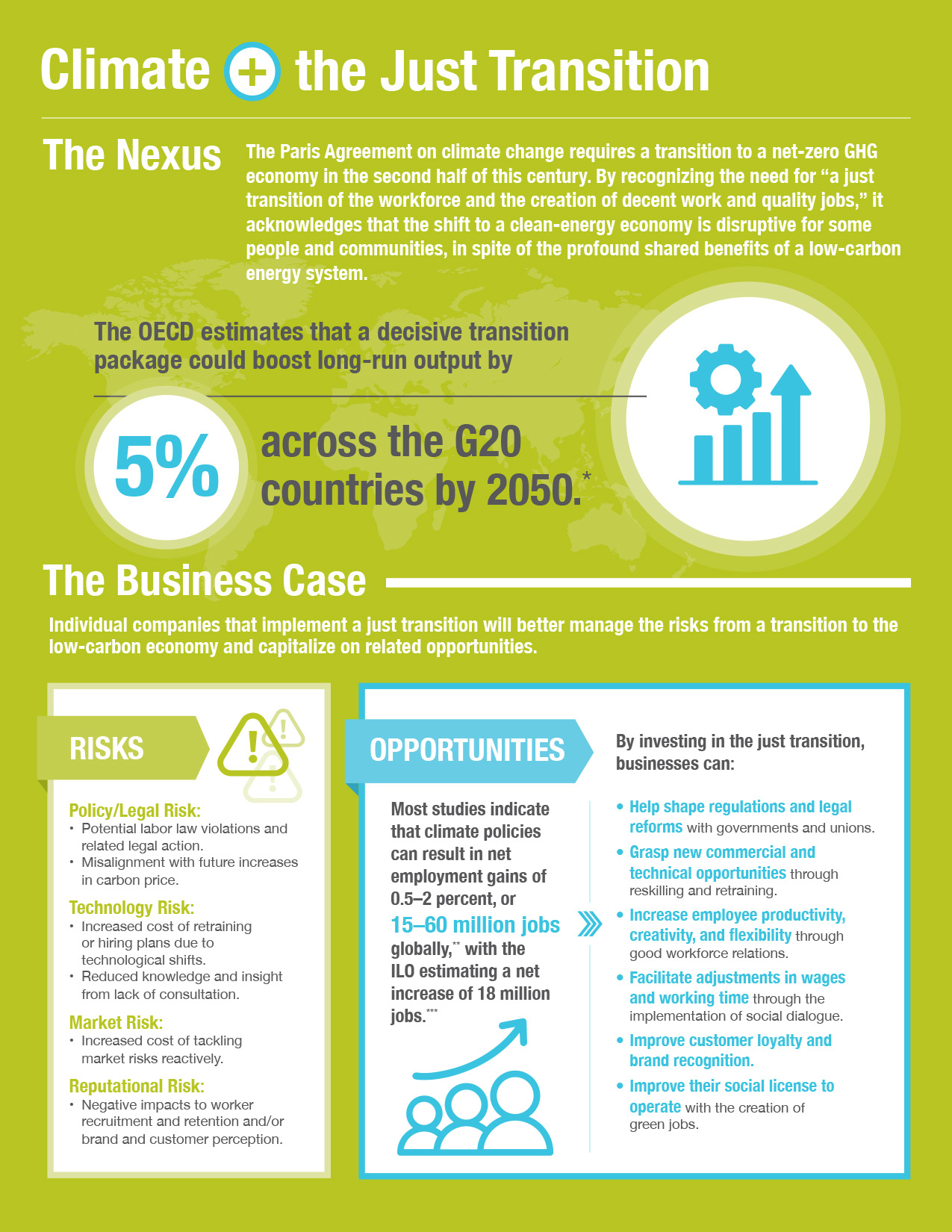
Climate and the Just Transition
The Nexus
The Paris Agreement on climate change requires a transition to a net-zero GHG economy in the second half of this century. By recognizing the need for “a just transition of the workforce and the creation of decent work and quality jobs,” it acknowledges that the shift to a clean-energy economy is disruptive for some people and communities, in spite of the profound shared benefits of a low-carbon energy system.
The OECD estimates that a decisive transition package could boost long-run output by 5% across the G20 countries by 2050.
The Business Case
Individual companies that implement a just transition will better manage the risks from a transition to the low-carbon economy and capitalize on related opportunities.
Risks
Policy/Legal Risk:
- Potential labor law violations and related legal action.
- Misalignment with future increases in carbon price.
Technology Risk:
- Increased cost of retraining or hiring plans due to technological shifts.
- Reduced knowledge and insight from lack of consultation.
Market Risk:
- Increased cost of tackling market risks reactively.
Reputational Risk:
- Negative impacts to worker recruitment and retention and/or brand and customer perception.
Opportunity
Most studies indicate that climate policies can result in net employment gains of 0.5–2 percent, or 15–60 million jobs globally, with the ILO estimating a net increase of 18 million jobs.
By investing in the just transition, businesses can:
- Help shape regulations and legal reforms with governments and unions.
- Grasp new commercial and technical opportunities through reskilling and retraining.
- Increase employee productivity, creativity, and flexibility through good workforce relations.
- Facilitate adjustments in wages and working time through the implementation of social dialogue.
- Improve customer loyalty and brand recognition.
- Improve their social license to operate with the creation of green jobs.
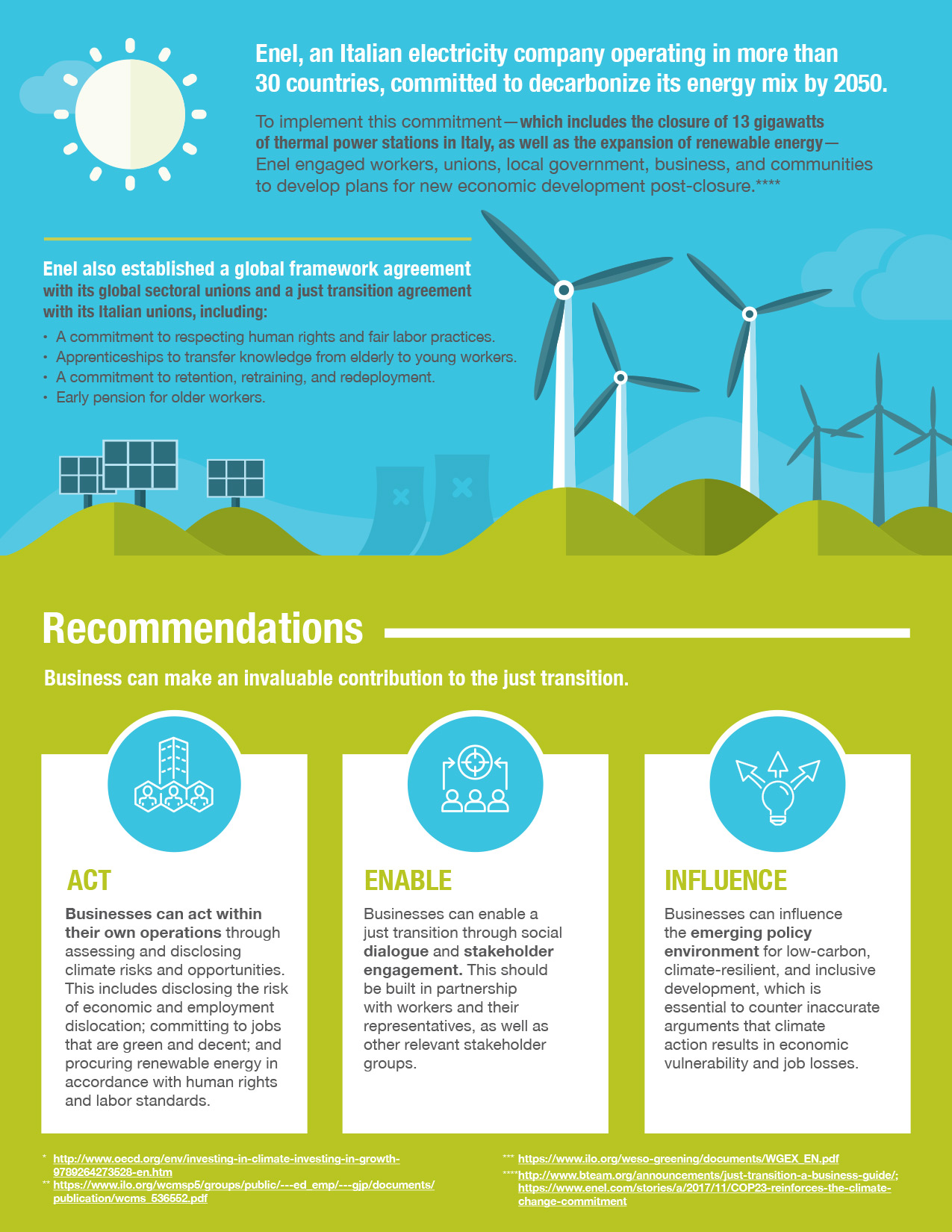
Climate and the Just Transition (continued)
Enel, an Italian electricity company operating in more than 30 countries, committed to decarbonize its energy mix by 2050.
To implement this commitment—which includes the closure of 13 gigawatts of thermal power stations in Italy, as well as the expansion of renewable energyEnel engaged workers, unions, local government, business, and communities to develop plans for new economic development post-closure.
Enel also established a global framework agreement with its global sectoral unions and a just transition agreement with its Italian unions, including:
- A commitment to respecting human rights and fair labor practices.
- Apprenticeships to transfer knowledge from elderly to young workers.
- A commitment to retention, retraining, and redeployment.
- Early pension for older workers.
Recommendations
Business can make an invaluable contribution to the just transition.
Act
Businesses can act within their own operations through assessing and disclosing climate risks and opportunities. This includes disclosing the risk of economic and employment dislocation; committing to jobs that are green and decent; and procuring renewable energy in accordance with human rights and labor standards.
Enable
Businesses can enable a just transition through social dialogue and stakeholder engagement. This should be built in partnership with workers and their representatives, as well as other relevant stakeholder groups.
Influence
Businesses can influence the emerging policy environment for low-carbon, climate-resilient, and inclusive development, which is essential to counter inaccurate arguments that climate action results in economic vulnerability and job losses.
Climate Nexus Report Series






Blog | Thursday November 29, 2018
How to Implement the TCFD Recommendations
Everything you need to know about implementing the recommendations of the Task Force on Climate-related Financial Disclosures (TCFD).
Blog | Thursday November 29, 2018
How to Implement the TCFD Recommendations
Preview
For sustainability practitioners, the recommendations of the Task Force on Climate-related Financial Disclosures (TCFD) remove a pain point by establishing a single vocabulary of climate risks and opportunities and harmonizing the landscape of climate reporting.
The recommendations are gaining steam: The September 2018 TCFD status report showed they now have support from 513 organizations (including 457 companies). However, it is time to move our discussion from whether to implement the recommendations to how companies should do so.
It is time to move our discussion from whether to implement the TCFD recommendations, to how companies should do so.
For the status report, the TCFD carried out artificial intelligence (AI) analysis of reporting from 1,700 companies, in addition to human analysis of 200 leading companies whose reporting includes the word “climate.” This analysis revealed that:
- Most companies disclose some climate-related information, but financial implications are often not disclosed.
- Disclosures are made in various company reports, including financial filings, annual reports, and sustainability reports.
- Larger companies and European companies disclose more related to the recommendations, but few companies overall implement climate resilience strategies, use different climate-related scenarios, or disclose processes for identifying, assessing, and managing climate risk or integrating it into overall risk management.
- Disclosures vary by industry, with each industry providing stronger or weaker disclosures on specific recommendations.
While the status report analysis is helpful in assessing the status of implementation on yes/no basis, it does not answer the practical question of best practice inclusions. It also reveals what is challenging about implementing the recommendations: Those recommendations that imply organizational change are, not surprisingly, the hardest to implement.
If the objective of the TCFD recommendations is to improve disclosures related to even the hardest recommendations, practical advice is also essential. For this reason, we examined the examples provided in the status report and companies’ disclosures to formulate the straw best practice inclusions below for each of the 11 recommendations.
For each TCFD recommendation, we suggest what should be disclosed, if applicable to the organization. By beginning with those recommendations for which they already have programs or policies in place, companies can take an iterative approach and resolve challenges over time.
Governance
Governance (a): Board oversight
- Clear description of who has ultimate accountability for management of climate risks
- Clear description of roles and responsibilities on climate change
- Experience of board members on climate change
- Specific board committees overseeing climate risks and membership and cadence of meetings
- Climate-specific structures/committees in place (if any) and related decision-making processes
- Methodology for and amount of incentives to promote management of climate-related risks at board level
Governance (b): Management’s role
- Management responsibilities on climate issues, beyond broader sustainability or ESG responsibilities
- Specific ESG functions or committees and climate-specific functions or committees, as well as their scope of concern
- Processes used by management to review climate-related issues and translate them into strategic decisions
- How risk management and sustainability functions collaborate on climate-related risks and opportunities
- Methodology and incentives to promote management of climate-related risks by management
Strategy
Strategy (a): Climate-related risks and opportunities over the short, medium, and long-term
- Risks categorized according to the TCFD typology (physical risks categorized as acute or chronic; transition risks categorized as regulatory, market, technology, or reputation)
- Relevant climate opportunities, in addition to risks
- Time horizons used (short, medium, and long term) and link to business strategy or sustainability strategy goals
- Distinction between risks to operations and those to the portfolio or supply chain
Strategy (b): Impact on business, strategy, and financial planning
- Processes used to determine which climate-related risks and opportunities are material
- Lines of business impacted by climate-related risks or opportunities
- Overarching goals and estimated costs and impacts, committed capital expenditure, and how investments have evolved
- Links between climate-related risks and opportunities and business and sustainability strategy
Strategy (c): Resilient strategy and scenario analysis
- Scenarios analysis conducted primarily as an opportunity to improve strategic resilience and explore climate vulnerabilities (and not a reporting exercise)
- A broad range of climate risks and opportunities, including both physical and transition risks
- Scenarios grounded in climate science that capture business specifics and focus on the key uncertainties for the company/sector
- Data from diverse sources to reduce the risk inherent in any single projection
- Relevant internal stakeholders consulted to shape scenarios
- Regular review of scenarios as part of business processes
- Methodology and key quantitative/qualitative assumptions for scenario analysis, as well as the impact of scenarios on the business
- How company strategy has been made more resilient through scenario analysis
Risk Management
Risk Management (a): Processes for identifying and assessing risks
- Risk assessment frameworks and criteria for assessment
- Major issues or categories of issues
- Use of internal carbon price, if relevant
- Monitoring of physical climate risks, if relevant, and preferably at local level
- Participation in relevant industry initiatives
Risk Management (b): Processes for managing risks
- Centralized climate risk management processes in a single location
- How the risk register is developed (e.g. from materiality) and how climate is reflected (e.g. combined with other risks, as its own specific risk, or broken down into different climate-related risks)
- How the most material risks are prioritized
Risk Management (c): Integration into overall risk management
- How climate indicators are integrated into projects and business decisions
- Processes of engagement with investee companies on climate-related risks and metrics
- How climate is considered adequately (and potentially separately) in enterprise risk management processes, alongside other ESG risk factors
Metrics and Targets
Metrics and Targets (a): Metrics
- Key information on metrics disclosed in mainstream financial reports
- Metrics and targets complemented with context of a specific project or target, as relevant
- Most decision-useful metrics as identified with investors
- Financial metrics used if available
Metrics and Targets (b): Scopes 1, 2, and 3 emissions and related risks
- Scope 3 calculations, including downstream emissions (e.g. use of sold products)
- Reference methodologies and standards used to measure emissions
- Consistent use of absolute and/or intensity metrics, to enable understanding of progress against targets
- Risks that relate to your largest sources of emissions
Metrics and Targets (c): Targets
- All basic features of a target (e.g. base year, target year, greenhouse gases, and geographies in scope)
- KPIs for climate targets and progress over time (e.g. data from last three years if available)
- Targets aligned to metrics (ex. scope 1, 2, 3) and including most important scope 3 categories
- Links between management remuneration and specific targets
BSR has convened events on the TCFD recommendations this year in San Francisco, Tokyo, Hong Kong, and at BSR Conference in New York. Please join us on December 4 in Paris for our conversation (in French) on this topic, Feedback on the TCFD Recommendations: How to Make Progress on Climate Resilience.
We welcome all opportunities to discuss implementation of the TCFD recommendations with you, so please don’t hesitate to get in touch.
Blog | Wednesday November 28, 2018
Four Steps to Align ESG and Enterprise Risk Management (ERM)
We have assessed the major needs and challenges to align sustainability priorities with ERM and we recommend the following four-step approach.
Blog | Wednesday November 28, 2018
Four Steps to Align ESG and Enterprise Risk Management (ERM)
Preview
As outlined in BSR’s recent report, Redefining Sustainable Business: Management for a Rapidly Changing World, resilient business strategies require an enterprise risk management (ERM) approach that effectively incorporates sustainability risks of material significance to the company, such as climate change, natural resource availability, and social volatility.
An executive we recently interviewed outlined it this way: “Risk awareness needs to become much greater now that we are living in a riskier world and facing issues such as the rise of authoritarianism, cybercrime, and migration. We will see companies having much greater oversight of risk, and investors will be much more demanding of this than in the past.”
Risk awareness needs to become much greater now that we are living in a riskier world and facing issues such as the rise of authoritarianism, cybercrime, and migration. We will see companies having much greater oversight of risk, and investors will be much more demanding of this than in the past.
There is a clear opportunity for companies to utilize the outputs of sustainability-oriented materiality assessments and align materiality and risk identification processes.
The World Economic Forum’s 2008-2018 annual Global Risk Reports show that environmental and societal risks have overtaken economic and geopolitical risks in terms of both likelihood and impact. However, companies are not addressing conventional risks and sustainability risks equally. According to WBCSD, fewer than one in three issues identified in sustainability materiality assessments are disclosed as risk factors in legal filings for investors.
Failing to manage ESG risks can lead to material business impacts, including missed profits, operational impacts, and loss of license to operate. Meanwhile, mainstream investors are increasingly emphasizing disclosure of ESG risks, monitoring ESG performance, and reporting on ESG issues: The recently released 2018 US SIF report found that investors today consider ESG factors across US$12 trillion of professionally managed assets, which represents a 38 percent increase since 2016. Although risk and sustainability teams are often siloed, there is a clear business case for corporate sustainability leaders to collaborate with risk teams on shared goals.
Incorporating sustainability into ERM can strengthen a company’s understanding of its full suite of risks, improve its sustainability management, and enhance overall business performance. Likewise, incorporating an ERM lens into materiality assessments can help to translate results into language relevant to the business. BSR has assessed the major needs and challenges to align sustainability priorities with ERM and recommends the following four-step approach:
- Identify the full spectrum of your company’s risks—including environmental, social, and governance risks. Use ESG risk identification methods, megatrend analysis, and media monitoring (for example, using tools like Polecat), to comprehensively identify both established and emerging risks.
- Align on priority ESG issues for inclusion in ERM and modify your ERM inventory accordingly. Conduct a gap assessment of your existing risk inventory, translate specific emerging and existing material issues across priority ESG issues and existing ERM issues, and make necessary adjustments to your materiality analysis and risk inventories.
- Evaluate relevant risks for likelihood, vulnerability, and impact. Use high-level risk assessments that consider less conventional criteria like impacts to reputation, speed of onset, persistence, and ability to mitigate to help enhance understanding of difficult-to-measure sustainability risks. You can also leverage forecasting and futures scenario analysis to assess the unique characteristics of longer-term and rapidly emerging sustainability risks.
- Maintain ongoing ERM and materiality alignment. Put effective governance structures in place that ensure emerging and evolving issues are captured by both sustainability and ERM teams to support ongoing ERM and materiality alignment.
This approach can help your company improve its processes to better manage emerging, cross-cutting, significant, and long-term risks. If you’d like to learn more about how we can help your company align your sustainability and risk management frameworks and priorities, please contact us.
Blog | Tuesday November 27, 2018
Business Calls for Strong Guidelines and Increased Climate Ambition at COP24
At COP24, business is calling on government to create a just transition to net zero, participation in the Talanoa Dialogue, and strong Paris rulebook guidelines.
Blog | Tuesday November 27, 2018
Business Calls for Strong Guidelines and Increased Climate Ambition at COP24
Preview
At COP24, the world’s governments will convene at the most important climate negotiations since the Paris Agreement was adopted in 2015. This meeting comes in the wake of the release of the IPCC Special Report Global Warming of 1.5ºC and amid increasing global political instability, as evidenced by Brazil’s presidential elections, the ousting of pro-climate action Prime Minister Malcolm Turnbull in Australia, and the Trump administration’s continued dismantling of U.S. climate policy. Moreover, it will unfold in the face of extreme climate impacts across the globe, including the recent deadly California forest fires.
While the IPCC report makes it clear that we must act now to curb potentially devastating climate-related events, it also shows that achieving net-zero greenhouse gas (GHG) emissions by 2050 is both possible and necessary to achieve the Paris Agreement’s goals. In this time of urgency, businesses, governments, and other stakeholders must do this together—reinforcing ambition loops that will drive system-wide progress to reach these goals and create a resilient, just, and zero-carbon future.
Business is contributing to the stability that will help governments feel confident that they can do this. Through We Mean Business, a coalition of nonprofit organizations working with the world’s most influential businesses to take action on climate change, business helps drive policy ambition and accelerate the transition to a low-carbon economy. Over 830 leading companies, representing US$16.9 trillion in market capitalization, equivalent to 20 percent of global GDP, have made more than 1,350 bold climate commitments, through the coalition's Take Action campaign.
Noting the urgency and that we must act faster and more inclusively, business is looking to policymakers to build on the progress to date and step up their ambition. Bold targets and clear timelines from governments give businesses the clarity and confidence they need to put forward even more ambitious commitments of their own, which in turn helps governments further strengthen and enhance national climate policies.
Bold targets and clear timelines from governments give businesses the clarity and confidence they need to put forward even more ambitious commitments of their own.
Business calls for a just transition
The transition from a fossil fuel economy to net-zero global GHG emissions in the second half of this century, as the Paris Agreement envisions, will require significant technological, social, and economic transformations. Companies must deliver a large share of these transformations but will only be able to do so if unions, workers, and communities are engaged and active participants.
For specific regions and sectors that will undergo a major transition, this requires initiating tripartite social dialogue with businesses and workers to secure trust and productive coordination between partners. For high-emitting sectors, this will mean integrating investment in training and skills provision into sectoral decarbonization pathways—as well as providing social security for workers moving from high-emitting jobs into low-emitting jobs—while ensuring investments and policies incentivize new, decent green jobs.
Business calls for government participation in the Talanoa Dialogue
At COP24, governments should participate fully in the Talanoa Dialogue and clearly signal their intention to increase ambition by updating nationally determined contribution (NDC) targets and creating long-term strategies. This includes communicating these targets and strategies before 2020 and aiming for net-zero emissions as early as possible, with leading economies aiming to achieve this by 2050 at the latest. Governments should implement collaborative, participatory engagement processes with key stakeholders; include mechanisms to initiate periodic (e.g. every five years) upwards revisions to targets; and account for employment, education, skills-building, and social planning to ensure a just transition.
Business calls for strong Paris rulebook guidelines
Finally, to ensure the implementation of the Paris Agreement, a strong rulebook with the following guidelines will give businesses the clarity and confidence they need to put forward even more ambitious commitments of their own.
- A global stocktake that drives ambition and considers input from stakeholders, including business;
- Common implementation periods and target years for NDCs to improve their comparability and enable businesses to more accurately calibrate decisions across a global set of NDCs;
- An enhanced transparency framework that credibly tracks progress, making it easier for business to plan their own climate strategies and goals; and
- Strong guidelines to protect the environmental integrity of carbon markets and enable the lowest-cost emissions reductions which enables business to seek out cost-effective emissions reductions.
As we look at the climate policy landscape in 2019, including to the UN Secretary General’s Climate Summit in September, and COP26 in 2020, where the next round of NDCs will be tabled, it is clear that COP24 is a key moment. We urge governments to step up their ambition and partner with business to ensure a successful COP24 that lays down the necessary foundation for a resilient, just, and zero-carbon future.
To read the business call for governments in more detail, please see the full publications here.
Blog | Monday November 19, 2018
Making Supply Chains Work for Women
This is why and how companies should drive gender equality in global supply chains.
Blog | Monday November 19, 2018
Making Supply Chains Work for Women
Preview
Today, BSR is pleased to launch a new video that sets out why and how companies should work to drive gender equality in global supply chains. We invite you to take a moment to watch it below.
There are many opportunities for companies to promote gender equality in supply chains—through their own actions, by enabling business partners, and by influencing industry peers and the broader policy landscape. Taking any of these steps will help drive progress for women in supply chains. However, we believe that those companies looking to create real and lasting change for women should adopt holistic approaches that tackle inequality at every level.
What does that look like, and how can you put it into practice?
Act
As a company, you can act by integrating a gender lens into your supply chain strategy, supplier codes of conduct, due diligence approach, and sourcing practices. Taking these actions is a solid first step to ensuring that women workers are visible, the specific challenges they face are better identified, and remediation measures are being designed with gender specificities in mind. BSR has—with support from the Dutch Ministry of Foreign Affairs—produced two guidance documents to help you get started: the Gender Equality in Codes of Conduct Guidance and the Gender Equality in Social Auditing Guidance.
Adding a gender lens to your due diligence processes has never been more important: In June 2019, the United Nations Guiding Principles (UNGPs) Working Group will present its report to the Human Rights Council on how to integrate gender more prominently into companies’ due diligence process, so that the business impacts of human rights abuses specifically related to women are better identified and addressed.
Enable
As a company, you can enable your business partners to develop stronger gender-sensitive management systems and inspire positive gender norms, either through collaborating with other companies to develop and pilot solutions or on a one-to-one basis with individual suppliers. As one example of what this can look like, BSR has worked with Lindex to develop its WE Women by Lindex program, and we are currently working with the Ethical Toy Program (ETP) to strengthen management systems with a range of toy manufacturers in India. Even when women have the knowledge and agency they need to make empowered choices, they may not be able to act on these choices because of workplace systems that provide inadequate support through pregnancy and maternity, hinder career advancement, or make it difficult to safely report any gender-sensitive grievances.
Influence
As a company, you can advocate for women’s empowerment and gender equality by joining a collaborative initiative with a strong influence agenda, such as Business Action for Women or HERproject. Through these efforts, you can work with your peers to raise your voice and advocate for change around systemic issues—the kind of issues that no individual company, or even a group of companies, can tackle in isolation. Changing unequal social norms, discriminatory legislation, or a lack of resources for women requires collaboration and a deeper engagement with governments, the development community, and grass-roots organizations.
As expectations grow for companies to drive gender equality around the world, it is vital for companies to consider the wide range of opportunities to do so, from creating gender-sensitive corporate strategy to directly empowering women workers through peer educator training in factories and on farms.
Are you ready to take your first step toward gender equality in supply chains or to engage more directly with the topic? Please contact our team of women’s empowerment experts.
Blog | Tuesday November 13, 2018
Three Steps for Business to Connect Climate and Human Rights
This is how companies can address the interactions of climate change and human rights in vulnerable communities.
Blog | Tuesday November 13, 2018
Three Steps for Business to Connect Climate and Human Rights
Preview
Historically, climate and human rights have been managed and addressed separately—governed by different policy frameworks, addressed by different communities of practice, managed by different tools, and treated in isolation.
But, as we’re starting to understand, climate change and human rights are intimately connected. The known impacts of climate change undermine a range of internationally recognized human rights, including the right to life, health, food, adequate standard of living, housing, property, and water. The absence of adequate protection for human rights exacerbates vulnerability to climate impacts, magnifying the risk faced by marginalized communities, who are disproportionately impacted by climate change.
Such marginalized communities are often at the heart of global supply chains. If their vulnerability increases, the strength and resilience of supply chains drops, leaving businesses exposed to operational risk. Forward-thinking businesses are considering ways to align climate and human rights policies to increase their resilience and that of affected communities.
Today, BSR is pleased to launch a new report that helps business to understand and accelerate this alignment. Our key message is that businesses should begin merging their understanding and management of the two issues, and view the risks and mitigation tactics as interrelated.
The actions taken by business to ensure access to human rights will mean that workers are able to protect their assets, recover quickly, and remain engaged in the workforce should a climate event take place. That’s good for workers, good for suppliers, and good for global brands.
The actions taken by business to ensure access to human rights will mean that workers are able to protect their assets, recover quickly, and remain engaged in the workforce should a climate event take place.
The critical first step is to conduct due diligence to understand human rights and climate-related impacts as well as the scope of corporate responsibility to prevent harm. We propose a three-step approach to address the interactions of climate change and human rights in vulnerable communities, leveraging the due diligence framework established in the UN Guiding Principles on Business and Human Rights (UNGPs):
- Map where in a company’s operations, or in the operations of significant suppliers, the company is working within a climate-vulnerable community with weak realization of human rights, exacerbating the community’s vulnerability.
- Determine the scope of responsibility through the lens of the UNGPs’ “cause, contribute, and directly linked” framework. Where a company’s operations, or the operations of a significant business partner, increase the vulnerability of communities facing climate-related risks, the company has an obligation to prevent the negative impact from occurring, or to engage with key business partners to do so.
- Determine an appropriate remedy. We propose investment in capital assets, which have been shown to significantly improve a community’s resilience to climate change. Human rights provides an entry point into several types of capital assets, and companies can direct investments in these assets to strengthen human rights and thus strengthen climate resilience. In some cases, companies should consider going beyond “respect” and into the areas of strategic rights promotion and ecosystem change to leverage business resources to support people who are most susceptible to the negative impacts of climate change.
In conjunction with these actions, leading companies will adopt a policy clearly stating their corporate commitment to climate resilience and respect for human rights. They will also provide transparency and accountability: Improved disclosure and better-quality reporting of the financial risks and opportunities at the nexus of climate change and human rights will benefit companies’ relations with investors, stakeholders, and the public.
The nexus of climate change and human rights can seem intimidating, but there is opportunity in this space, too. Companies that go beyond their duty to respect human rights will likely realize returns on investment in the form of stronger and more resilient supply chains, in addition to the positive outcome of advancing human rights in vulnerable communities.
Businesses that act now to address the human rights implications of climate change can gain a long-term competitive advantage. To learn more about how to do so, read our new report, Climate and Human Rights: The Business Case for Action.
BSR’s climate and human rights nexus report is the fifth in our series, which also includes reports on the intersection between climate and supply chains, health, inclusive economy, and women’s empowerment. Stay tuned for more on the connections between climate resilience and a just transition to the low-carbon economy in the months to come.
Reports | Tuesday November 13, 2018
Climate and Human Rights
This report explores the intimate connection between climate resilience and human rights and outlines how companies can address this nexus.
Reports | Tuesday November 13, 2018
Climate and Human Rights
Preview
Climate change and human rights are intimately connected. The impacts of climate change undermine the realization of a range of internationally recognized human rights, including those dealing with life, health, food, adequate standard of living, housing, property, and water. The absence of adequate protection for human rights—particularly those that provide access to information, right to public participation in decision-making, and access to remedy—exacerbates vulnerability to climate impacts, magnifying the risk faced by the marginalized communities who are disproportionately impacted by climate change.
This paper demonstrates why and how business can act, including how to establish a deeper understanding of the nexus of climate change and human rights throughout the company as well as how businesses across sectors can articulate their risk and opportunities. It proposes operational principles to help companies identify, assess, prevent, mitigate, and remedy adverse climate change and human rights impacts.
This report is part of a series of six climate nexus reports that cover human rights, inclusive economy, women’s empowerment, supply chain, just transition, and health.
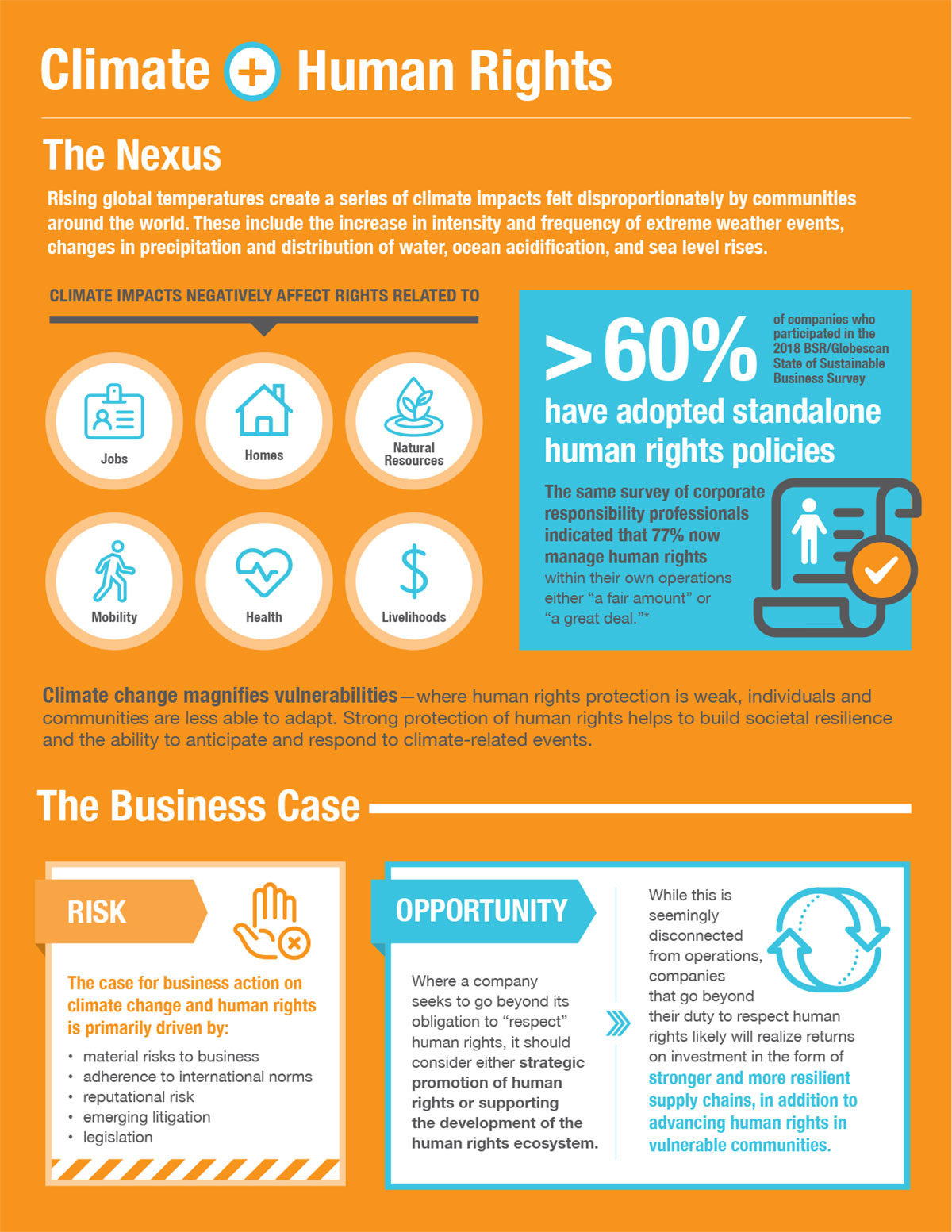
Climate and Human Rights
The Nexus
Rising global temperatures create a series of climate impacts felt disproportionately by communities around the world. These include the increase in intensity and frequency of extreme weather events, changes in precipitation and distribution of water, ocean acidification, and sea level rises.
Climate impacts negatively affect rights related to:
- Jobs
- Homes
- Natural Resources
- Mobility
- Health
- Livelihoods
More than 60 percent of companies who participated in the 2018 BSR/Globescan State of Sustainable Business survey have adopted standalone human rights policies.
The same survey of corporate responsibility professionals indicated that 77 percent now manage human rights within their own operations either “a fair amount” or “a great deal.”
Climate change magnifies vulnerabilities—where human rights protection is weak, individuals and communities are less able to adapt. Strong protection of human rights helps to build societal resilience and the ability to anticipate and respond to climate-related events.
The Business Case
Risk
The case for business action on climate change and human rights is primarily driven by:
- material risks to business
- adherence to international norms
- reputational risk
- emerging litigation
- legislation
Opportunity
Where a company seeks to go beyond its obligation to “respect” human rights, it should consider either strategic promotion of human rights or supporting the development of the human rights ecosystem.
While this is seemingly disconnected from operations, companies that go beyond their duty to respect human rights likely will realize returns on investment in the form of stronger and more resilient supply chains, in addition to advancing human rights in vulnerable communities.
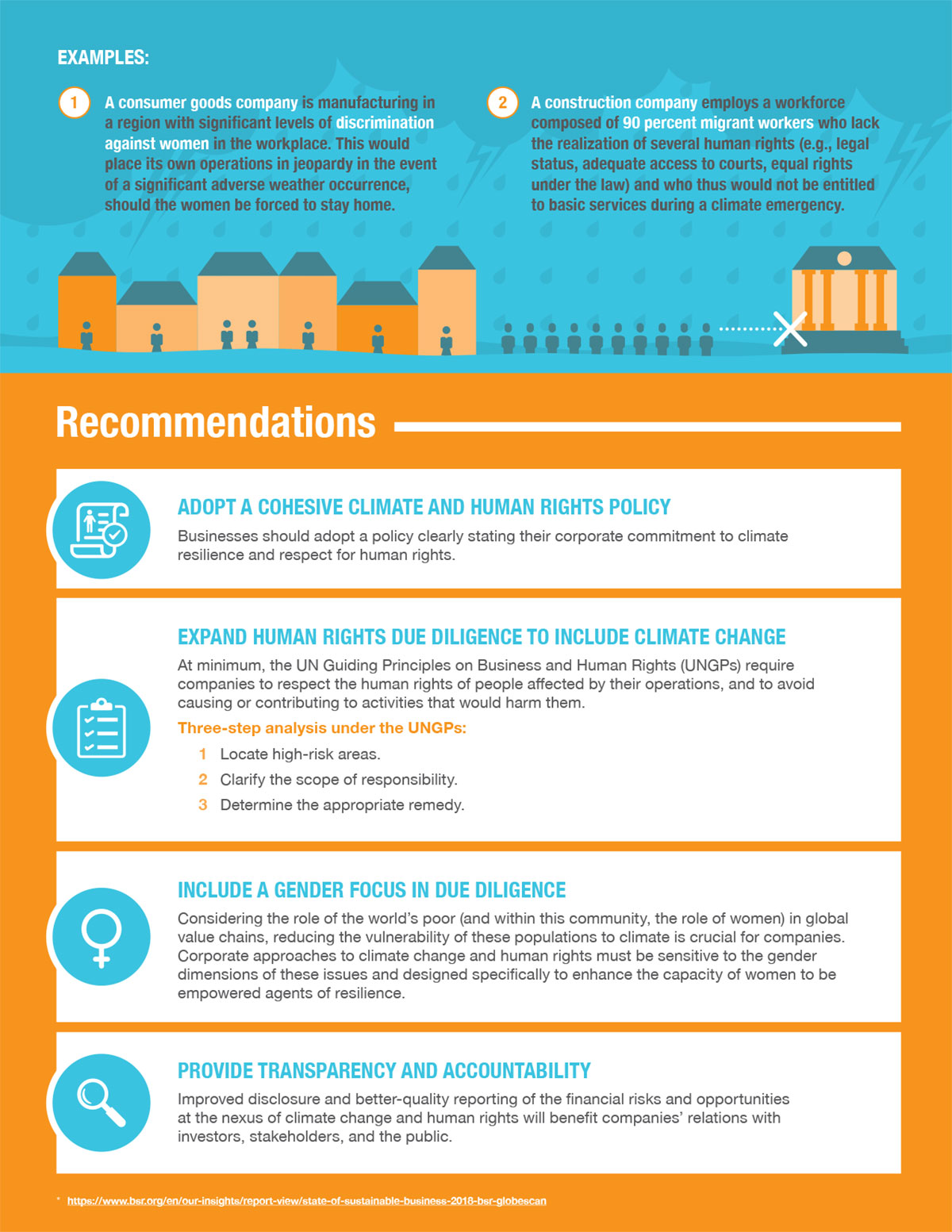
Climate and Human Rights (continued)
Examples
- A consumer goods company is manufacturing in a region with significant levels of discrimination against women in the workplace. This would place its own operations in jeopardy in the event of a significant adverse weather occurrence, should the women be forced to stay home.
- A construction company employs a workforce composed of 90 percent migrant workers who lack the realization of several human rights (e.g., legal status, adequate access to courts, equal rights under the law) and who thus would not be entitled to basic services during a climate emergency.
Recommendations
Adopt a Cohesive Climate and Human Rights Policy
Businesses should adopt a policy clearly stating their corporate commitment to climate resilience and respect for human rights.
Expand Human Rights and Due Diligence to Include Climate Change
At minimum, the UN Guiding Principles on Business and Human Rights (UNGPs) require companies to respect the human rights of people affected by their operations, and to avoid causing or contributing to activities that would harm them.
Three-step analysis under the UNGPs:
- Locate high-risk areas.
- Clarify the scope of responsibility.
- Determine the appropriate remedy.
Include a Gender Focus in Due Diligence
Considering the role of the world’s poor (and within this community, the role of women) in global value chains, reducing the vulnerability of these populations to climate is crucial for companies. Corporate approaches to climate change and human rights must be sensitive to the gender dimensions of these issues and designed specifically to enhance the capacity of women to be empowered agents of resilience.
Provide Transparency and Accountability
Improved disclosure and better-quality reporting of the financial risks and opportunities at the nexus of climate change and human rights will benefit companies’ relations with investors, stakeholders, and the public.
Climate Nexus Report Series
Blog | Monday November 12, 2018
Reflections from the BSR Conference 2018
These are our thoughts on BSR18 plus five ways to review highlights from the week.
Blog | Monday November 12, 2018
Reflections from the BSR Conference 2018
Preview
Last week, our community of more than 800 sustainability leaders from the private, public, and nonprofit sectors came together in New York City at the BSR Conference 2018 to create a new blueprint for business.
To borrow a question that The Coca-Cola Company’s Beatriz Perez posed to the audience last week, “How do you run a business for the next quarter-century, as opposed to the next quarter?” This was a theme throughout the Conference, as we collectively grappled with how rapidly our operating environment is shifting and how radically different our future will look.
How do you run a business for the next quarter-century, as opposed to the next quarter?
We tackled some of today’s most difficult but urgent subjects, including racial justice, power imbalances, and sexual harassment in the workplace. Our closing plenary speakers were New York Times investigative reporters Jodi Kantor and Megan Twohey, who, among countless other accomplishments, broke last year’s Harvey Weinstein story, helping ignite the #MeToo movement. They shared their thoughts with us on what comes next, both for the movement and the fight to advance gender equality in the workplace.
Plenaries and breakouts alike addressed the idea that business should engage with governments and increasingly needs to speak out on social and environmental issues: Author Anand Giridharadas urged participants to think about the policies their companies are lobbying for and against in Washington and how these efforts align—or don’t—with their sustainability efforts.
Technology was also top of mind, from John Ruggie’s remarks, where he referenced his work to translate the UNGPs into algorithms, to conversations about the human rights implications of artificial intelligence, blockchain, and the lessons of “techlash.” Participants rolled up their sleeves in futures thinking sessions to imagine the implications of technological advances like these for business.
Not least, results of the U.S. midterm elections made their way into several conversations; most notably the fact that more than 100 women were elected to Congress.
Here are five ways that you can re-live the highlights of the event—or catch the things you missed:
- Watch plenary session videos: Almost every plenary session is now live on our YouTube channel, from David Schwimmer’s call for men to be a bigger part of the conversation around sexual harassment and power dynamics, to Novartis CEO Vasant Narasimhan’s talk about “bending the curve of life” through improving access to medicine through innovation.
- Read about our latest initiatives: We launched a lot of new content last week. Check out our new report to help you increase the resilience of your business strategy, Doing Business in 2030: Four Possible Futures, and CoLab, our new incubator and accelerator of private-sector collaboration.
- See the social media highlights: Follow @BSRnews, @bsrherproject, and BSR staff on Twitter, and see what you missed on the #BSR18 hashtag. You will also find photo highlights on our Instagram accounts, @bsrorg and @herprojectbsr.
- Find yourself in photos: We’ve uploaded photos from the week onto our Flickr account—head on over to see whether we captured you, or your favorite moment, in our BSR18 album.
- Share your thoughts: If you were with us in New York, please take a moment to complete the Conference survey (available in the mobile app under “Surveys”). If you weren’t there, you can always tweet at us or email us your perspective.
We are grateful to have had the opportunity to connect with all of you—our global community of change agents and thought leaders who are truly creating a more just and sustainable world through the work you do every day. It is so energizing for us to come together to discuss big issues, explore global challenges, and share stories from the front lines of our work to advance sustainability, and we’re already looking forward to seeing you next year at BSR19 in San Jose, California, November 12-14, 2019.
Blog | Wednesday November 7, 2018
Introducing CoLab
We are pleased to launch CoLab: BSR’s incubator and accelerator of private-sector collaboration, mobilizing the collective power of business to solve some of the world’s biggest sustainability challenges.
Blog | Wednesday November 7, 2018
Introducing CoLab
Preview
While the world is changing for the better, in alignment with the ambitions of the Sustainable Development Goals (SDGs), it’s not changing anywhere near fast enough.
The IPCC recently released a report highlighting how the world has an increasingly small window to take the drastic action required to limit the devastating impacts of climate change. Analysis by the Ellen MacArthur Foundation in 2017 suggested that there could be more plastic than fish in the ocean by 2050. A report from Sisters for Change published in 2016 found that one in seven women garment workers has been raped or forced to commit a sexual act.
We need to do better. And we can. The world needs new partnerships of unprecedented scale and ambition between the private sector, governments, and civil society to create a future in which both societies and companies thrive.
The world needs new partnerships of unprecedented scale and ambition between the private sector, governments, and civil society to create a future in which both societies and companies thrive.
Today we are pleased to launch CoLab: BSR's incubator and accelerator of private-sector collaboration, mobilizing the collective power of business to solve some of the world’s biggest sustainability challenges. Driven by the collective ingenuity of business and stakeholders, CoLab ideates, designs, and scales collaborations that have transformational impacts.
With their reach, resources, capacity for innovation, and voice, companies can be a major driver of positive change. A unified and collective effort from business can create a step change in progress toward the SDGs.
Increased collaboration is good for societies, who benefit from the collective reach, resources, and voice of businesses working in common cause. And it is good for businesses, who can build more resilient supply chains, reduce costs and improve productivity, overcome systemic barriers, and enhance brand value.
BSR has been designing, implementing, and scaling business-led collaborations to achieve win-win solutions for over 25 years. For instance, the Maritime Anti-Corruption Network (MACN) contributed to regulatory reform in Argentinian ports, which reduces corruption risks and creates a more efficient trading environment; shipping companies in Clean Cargo have cut their carbon dioxide emissions by 35 percent per TEU-km since 2009; and HERproject has empowered more than 800,000 women in 14 countries with knowledge and skills related to health, financial inclusion, and gender equality.
CoLab will work by crowdsourcing a wide range of proposals for game-changing collaborations like these and developing the most promising. We are therefore calling on you—as businesses, NGOs, governments, foundations, or individuals—to take this opportunity to participate in a major, global incubation exercise. Through CoLab, you can engage with BSR’s global network of peer companies and thought leaders to ideate, design, and scale game-changing initiatives with transformational impacts. CoLab can help you take a vision for collaboration and turn it into reality.
CoLab will operate according to four principles:
- Value to Business and Society: Prioritize issues that deliver business value as well as significant societal impact.
- Solutions that Motivate: Advance solutions that engage participants’ core business strategies and tap into their full range of assets—capabilities, ingenuity, knowledge, reputation, networks, and financial resources.
- Stakeholder Inclusion: Ensure collaborative solutions take into account stakeholder and rights-holder perspectives, as well as optimize impacts and mitigate risks for beneficiaries.
- Action Orientation: Select efforts that are actionable to deliver change and impact. Move fast, be prepared to adapt.
By following these four principles, we aim to create collaborations that can grow quickly by mobilizing a wide range of actors around critical topics.
We are inviting all of BSR’s stakeholders and any other interested parties to submit ideas now through the CoLab page. We look forward to collaborating with you through this and other ways.