Searching for:
Search results: 806 of 1188
Blog | Wednesday May 15, 2019
Artificial Intelligence and Human Rights: We Need to Talk about the Use Phase
Undertaking due diligence of artificial intelligence (AI) across all industries now is a matter of urgency and not something that can be put off into a distant future.
Blog | Wednesday May 15, 2019
Artificial Intelligence and Human Rights: We Need to Talk about the Use Phase
Preview
As business, government, and civil society make progress in addressing the human rights impacts and ethical questions arising from the use of artificial intelligence (AI), we believe that one supremely important constituency needs to participate much more actively: the “non-technology” companies integrating AI into their business operations, strategies, and plans.
Without these participants, dialogue about AI and human rights risks being too focused on the development of AI, with insufficient attention given to the companies deploying AI. Our aim with this blog is to explain why.
In August last year, BSR published three reports setting out the importance of taking a human rights-based approach to the development, deployment, and use of AI. Since then, we’ve put this advice into practice in our work with BSR member companies in the U.S., Asia, and Europe to develop policies on AI and human rights, engage with civil society organizations, and undertake human rights due diligence of AI solutions. We’ve had the opportunity to consider a wide range of scenarios—including algorithmic decision making, facial recognition, and sentiment analysis—as well as a wide variety of application areas, including retail, national security, human resources, and transportation systems. As can be imagined for technologies that are evolving so rapidly, it’s been a time of extraordinary learning.
In many ways, this work has confirmed predominant assumptions that exist around how technology companies can fulfill the responsibility to respect the human rights impacts arising from the use of their products and services. Across many different settings, our recommendations have coalesced around some common themes: scrutinize the quality of training data, examine to whom you sell products and services and refuse sales to those most likely to misuse them, and establish acceptable use policies that place restrictions on how products and services may be used. We’ve also recommended system-wide approaches, such as advocating for rights-protecting laws and regulations, increasing disclosure and transparency, and providing best practice guidance for users.
These are all important responsibilities held by technology companies, and nothing that follows should suggest otherwise. However, we’ve found that the common thread running throughout these recommendations is the notion that technology companies should use their leverage to prevent the misuse of products, services, and technologies by influencing the actions of others—and that no matter how much effort is deployed, there is no guarantee of success.
Decisions made today about the deployment of AI will bring significant consequences for the realization of human rights long into the future.
This observation has led us to one simple question: In addition to trying to influence the actions of others, shouldn’t we also be working more directly with the companies, governments, and organizations that are directly deploying AI themselves? In the terms of the UN Guiding Principles on Business and Human Rights, why would we spend most of our time working with the companies that are contributing to or directly linked to human rights impacts, and much less of our time working with the companies that might be causing them?
- In the retail industry, stores are deploying AI for theft protection, creating new privacy, security, and discrimination risks, especially for vulnerable populations and marginal groups.
- In the transportation industry, airlines and airports are deploying facial recognition during the boarding and screening process, raising important issues of consent and non-discrimination.
- In the automotive industry, car companies are collecting more location data than ever before and sharing them with governments, provoking new questions about whether automotive companies should join with technology companies in publishing law enforcement relationship reports.
- In the hotel industry, facial recognition technologies are being used to ease the check-in process, impacting rights such as freedom of movement.
Companies in all these industries should be taking a human rights-based approach to their use of AI.
The second of the three reports we published last year on the importance of a human rights-based approach to AI anticipated these issues. In it, we listed the human rights risks and opportunities arising from the use of AI in the financial services, health care, retail, transportation, agriculture, and extractives industries, and proposed sector-wide impact assessments for each industry. One year on, we are doubling down on this point of view, such as during our recent participation in the Skoll World Forum, Sustainable Brands Paris, and our own BSR Connect events.
Decisions made today about the deployment of AI will bring significant consequences for the realization of human rights long into the future—and this means that undertaking due diligence of AI across all industries now is a matter of urgency and not something that can be put off into a distant future. Today, we are joining the Partnership on AI, and we look forward to making good on this perspective by working more closely with the Partnership on AI and BSR member companies across all industries to assess the human rights impacts arising from their use of AI.
Calling for more non-tech industries need to get involved with AI at the concept and development stage. @dunstanhope from @BSRNews was speaking at the #skollwf session on #ai #datascience and #humanrights. pic.twitter.com/jfRAZNyOQm
— Skoll Foundation (@SkollFoundation) April 10, 2019
Reports | Wednesday May 15, 2019
The Supply Chain Leadership Ladder 2.0
The Supply Chain Leadership Ladder 2.0 incorporates learnings from our work with companies where we use the framework to identify their level of maturity and ambition, benchmark their practices against their peers, and develop concrete action plans to improve.
Reports | Wednesday May 15, 2019
The Supply Chain Leadership Ladder 2.0
Preview
Across industries, managing companies’ supply chain sustainability has become increasingly important. Leading companies recognize that supply chain sustainability programs create value through mitigating risk, increasing resource efficiency to find cost savings, driving innovation through supplier collaboration, and more.
The Supply Chain Leadership Ladder is a maturity model that BSR has developed for companies to evaluate and evolve their approach to supply chain sustainability. A better understanding of their current standing with regards to supply chain knowledge, management, and supplier engagement helps these companies to identify how and where they need to invest in their supply chain in order to drive competitive advantage. Supply chain sustainability, also known as responsible sourcing, sustainable sourcing, responsible supply, sustainable procurement, and by other names, continues to evolve, and as such, our approach needed to evolve as well.
Two years following the launch of the Leadership Ladder, BSR is pleased to release this update. The Leadership Ladder 2.0 incorporates learnings from our work with companies where we use the framework to identify their level of maturity and ambition, benchmark their practices against their peers, and develop concrete action plans to improve.
For companies looking to build or advance their approaches to supply chain sustainability, the Supply Chain Leadership Ladder 2.0 is a useful tool to assess practices and the opportunity to progress. Please don’t hesitate to contact our team to discuss how we can work together.
Blog | Thursday May 9, 2019
Progress and Opportunities for Responsible Investing in Japan
At the RI Asia Japan conference in April 2019, three unique, Japan-focused dynamics stood out. These dynamics point to keys for adapting and applying global sustainable investment themes within Japan and ways the rest of the world can learn from Japan’s rapid uptake.
Blog | Thursday May 9, 2019
Progress and Opportunities for Responsible Investing in Japan
Preview
From 2014 to 2018, Japanese sustainable investing assets had an astonishing 308 percent compound annual growth rate, vastly outpacing the growth rates in other global regions. Amid this explosion of sustainable investing, the RI Asia Japan conference last month convened hundreds of engaged participants to discuss progress on sustainable finance around the world and specifically in Japan. Long-time participants expressed enthusiasm that the conference had expanded tremendously, necessitating a move to a much larger venue. Much of the discussion addressed global themes, such as the need for more investor-grade environmental, social, and governance (ESG) data and the imperative for climate action.
From my own experience in working on ESG topics in North America and Europe, and arriving as a newcomer to the Japanese responsible investment (RI) community, three unique, Japan-focused dynamics stood out. These dynamics point to keys for adapting and applying global sustainable investment themes within Japan and ways the rest of the world can learn from Japan’s rapid uptake.
The Japanese private equity market is poised for growth—and sustainable investment will be essential for success.
After many years as a niche market, private equity in Japan may be poised for growth. As Private Equity International (PEI) noted in their recent special edition on Japan, the past few years have seen a significant increase in private equity activity, with many predicting that this time, the uptick is likely to continue. As global and domestic firms expand their investments in Japan, it will be vital to adapt and apply global approaches to responsible investing in private equity in the context of two unique market characteristics in Japan.
First, there is significant skepticism about the industry that has led to some negative public perceptions. Private equity in Japan is also highly relationship-driven, with word-of-mouth and referrals an “important source of dealflow,” according to PEI. Many investments are also expected to target the large pool of Japanese family-owned businesses. Taken together, these considerations mean that it will be crucial for private equity firms to build trust and demonstrate a commitment to responsible investing—as firms and in how they steward companies. As Shunsuke Tanahashi, head of the Japan office for Partners Group and a long-time leader in the Principles for Responsible Investment (PRI) community in Japan, notes, “Japanese buyout general partners (GPs) are, in many cases, helping Japanese companies that are suffering from succession issues. Successful GPs are having sincere dialogues with the presidents of those companies and trying to contribute solutions. Sometimes, GPs get investment opportunities even if they do not bid the highest price because their proposal is very sincere and reflects the president's interests. RI/ESG enables those GPs to show their sincerity and create positive feelings toward private equity.”
Another factor affecting sustainable investing in Japanese private equity is that many deals are also likely to target carve-out businesses from large industrial conglomerates. As those businesses become new, independent companies, firms will have to help them establish their own ESG-related policies, governance structures, and practices (rather than continuing to rely on a corporate headquarters to drive those efforts).
Institutional support for the recommendations of the Taskforce on Climate-Related Financial Disclosure (TCFD) illustrates the potential for regulators and asset owners to spur action and the opportunity for Japanese firms to pioneer successful approaches.
Several influential figures have expressed ongoing, strong encouragement for the adoption of the TCFD recommendations. For example, at the RI Asia Japan 2019 conference, Satoshi Ikeda from the Financial Services Agency expressed support and encouragement for TCFD. Hiroshi Komori of the Japan Government Pension Investment Fund (GPIF) also expressed support for the TCFD recommendations, in alignment with GPIF’s stated views. GPIF has been a strong voice for the implementation of ESG more broadly as well; the fund’s principles include specific attention to “including the consideration of ESG factors.”
Inspired by such voices, Japanese investors and companies are stepping up. A total of 76 Japanese companies/organizations have committed publicly to the TCFD. Out of those 76 entities, 27, or more than one-third, represent the financial services sector.
To gain the full benefit of TCFD analysis, it will also be essential for investors and companies to look beyond a narrow focus on the quantitative analysis of physical and transition risk. To achieve this, they should use foresight and scenario analysis on a broad range of climate resilience factors, such as related changes in mass migration, human health, labor markets, technologies, etc. In addition, they should address the TCFD guidance regarding a company’s governance, strategy, risk management, and metrics and targets. Doing so may in turn improve the structure for broader ESG efforts as well.
Japanese banks have an opportunity to apply leading global practices on environmental and social risk management to address risks beyond climate.
As Japanese banks are eagerly pursuing growth domestically and overseas, they are pursuing investment and financing activities across industries. Sessions at RI Asia Japan 2019 addressed topics such as ESG in supply chains, natural capital, and life below water, yet it seemed that financial services companies had less-developed approaches in these areas compared to climate. While many banks have adopted sector policies on their activities regarding coal, it is imperative to manage a broader range of risks.
Many European and American banks have adopted robust environmental and social risk management (ESRM) approaches and sectors policies covering industries such as mining, forestry, and hydropower, and topics such as human rights and water. Japanese banks should develop similar approaches starting with overall ESRM policies and governance, adding specific guidance through sector policies and promoting implementation through practical tools.
Based on the presentations and conversations at the conference, it seems that there are some areas where Japanese financial institutions are pursuing leading approaches to ESG management and where there are opportunities to do more. BSR looks forward to continuing to serve our members based in Japan and doing business in the country and checking back in with RI Asia Japan 2020.
Blog | Tuesday May 7, 2019
Making Supply Chains Safe for Women Workers
When it comes to tackling harassment and abuse, compliance programs alone are inadequate. They need to be rethought with the worker at the center, and they should measure and bolster the programs put in place to address root causes and build real change.
Blog | Tuesday May 7, 2019
Making Supply Chains Safe for Women Workers
Preview
The Guardian reported on a recent study of Vietnamese clothing, footwear, and outdoor wear manufacturers, which found that “workers in Vietnamese factories have been harassed, groped, and even raped.” This was both sadly shocking and sadly predictable.
Though compliance programs are in place, they have not guaranteed harassment-free work environments. The prevalence of harassment is sadly shocking: nearly half of the women interviewed reported having faced abuse in the past year. The abuse “ranged from groping and slapping to rape and threats of contract termination.” What’s more, this took place in a Vietnamese factory that has been under the global corporate compliance microscope since the mid-1990s.
The story is also sadly predictable in several ways. First, it is well-known in the compliance industry that corporate compliance auditing has difficulty picking up on harassment issues. This article underlines that harassment and gender-based violence is a reality in the (garment) supply chain, no matter what your social compliance data tells you. This new study should drive us to revisit questions of auditing purpose and to ensure that the safeguarding of workers—and not just of buyers’ reputations—is at the heart of our efforts.
A second sadly predictable finding was “a high correlation between overtime and workplace abuse.” Stress, pressure, and exhaustion rarely lead to good outcomes, as this study makes clear: “Violence and harassment was 3.8 times more likely during the high season than the rest of the year, 2.4 times more likely when workers reported working overtime of 30 hours or more a month, and 1.6 times more likely when workers could not refuse to work overtime.”
Complying with Vietnamese legal requirements—that overtime cannot exceed 30 hours per month and 200 hours per year—could significantly reduce harassment and abuse. And yet overtime has been one of the most difficult and challenging issues for supply chain compliance programs to really impact. Solutions, as outlined in the article, must be built through supplier relationships.
The overriding message is that when it comes to tackling harassment and abuse, compliance programs alone are inadequate. They need to be rethought with the worker at the center, and they should measure and bolster the programs put in place to address root causes and build real change.
How can buyers and suppliers contribute to real, lasting change?
Buyer-supplier relationships matter in everyday situations as well as in exceptional circumstances. Corporate values stand as the baseline for decision-making. The starting point for buyers should be their own corporate values—which should be the values they expect their supply chain to mirror. These corporate values must be not just listed in a Code of Conduct, but integrated into business processes, trade terms and conditions, internal action, and corporate leadership.
One clear area for action that can directly benefit buyers and suppliers while contributing to tackling the harassment issues identified in this study is women’s empowerment. Ensuring that women workers have the tools, skills, support, and confidence they need will drive business benefits and address underlying norms and the all-too-prevalent acceptance of violence from both men and women.
Putting this value into action requires both buyer and supplier action. On the buyer side, “walking the talk” is fundamental, as well as providing incentives and recognition to suppliers which embrace and implement the value. Actions might include signing the Women’s Empowerment Principles (WEPs) and conducting a Gap Analysis to pinpoint areas for improvement. Buyers can also ensure that gender equality is adequately reflected in social auditing practices. When it comes to incentivizing suppliers, Lindex’s WE Women provides one instance of suppliers’ performance on gender equality being incorporated into overall sustainability performance scorecards.
Suppliers also need to “walk the talk.” This might mean evaluating and improving their own workplace attitudes, policies, and standards. Suppliers can also proliferate and promote knowledge and skills to their workforces and communities through workplace-based interventions while ensuring that management leads with appropriate policies, attitudes, and behavior, and that support is offered to workers to both understand what is right and wrong, how they can set boundaries for themselves, and/or report issues they encounter.
If we put the welfare of workers, particularly women, at the center of purpose, business benefits follow.
BSR’s HERrespect brings together buyers and suppliers to implement such programs and has seen significant impacts in changing attitudes to harassment and gender-based violence. It also supports suppliers in building or improving grievance systems. As the article notes: “Encouragingly, the study found that women working in factories with clear complaints procedures recorded far lower levels of abuse than those without such procedures.”
The least shocking finding from The Guardian's article is that if we put the welfare of workers, particularly women, at the center of purpose, business benefits follow.
By acknowledging the challenges and aligning values with supply chain partners, buyers and suppliers can make change. Harassment and violence is a reality for many women workers. You can do something—now—to improve it.
Blog | Tuesday April 30, 2019
How Companies Should Respond to the Vedanta Ruling
Following the UK Supreme Court’s recent decision in Vedanta v. Lungowe, we believe it is in the best interest of companies to double down on working with subsidiaries to ensure they properly understand and adequately manage environmental and social risk.
Blog | Tuesday April 30, 2019
How Companies Should Respond to the Vedanta Ruling
Preview
The UK Supreme Court’s recent decision in Vedanta v. Lungowe is an important read for corporate responsibility practitioners. Although it’s a jurisdictional ruling, for the first time, the UK Court held that a parent company sitting in London could be legally liable for harms allegedly caused to community members living near its subsidiary’s mining operation in Zambia.
The decision has implications for how companies influence the operations of their subsidiaries through corporate responsibility policies, training, and management support. After Vedanta, many practitioners and legal counsel may, understandably, think about the benefits of retreating from creating or enforcing these types of policies on subsidiaries in fear that they too may be legally liable for harm.
However, this is almost always going to be the wrong approach. Rather, we believe it is in the best interest of companies to double down on working with subsidiaries to ensure they properly understand and adequately manage environmental and social risk. Failure to do so will result in greater risk of harm occurring to communities and will expose the parent and subsidiary companies to increased legal risk.
The Vedanta Decision
Vedanta Resources PLC is an Indian mining company listed on the London stock exchange. They have since de-listed and now maintain a small office in London. Konkola Copper Mines (KCM) is a subsidiary of Vedanta that operates a mine in Zambia. The plaintiffs in the lawsuit, Zambian community members living near the mine, allege that KCM caused significant environmental damage to their farming communities and severely impacted their livelihood and ability to earn a living.
The plaintiffs sued KCM and Vedanta in Zambia and the UK. They argued that Vedanta owed a “duty of care” to the communities, i.e. that the parent was also liable for the harm caused by the subsidiary, KCM, because it exercised enough influence over the way the corporate responsibility policies were implemented to be held legally responsible. The evidence is still being collected, but the allegations point to Vedanta’s corporate responsibility report showing that Vedanta adopted and enforced corporate policies governing environmental and human rights issues over its subsidiaries and that it provided training and monitoring over the implementation of those policies. This is similar to the way many companies implement corporate responsibility programs.
Before the ruling, the law in the UK, and most other jurisdictions, treated parents and subsidiaries as separate companies when it came to holding them accountable for harm. This is one reason many companies establish a subsidiary relationship; each legal entity is accountable for their own profits, losses, operations, and legal liability. The plaintiffs sought to challenge this commonly held legal structure by arguing that Vedanta should also be accountable for the harm.
In the procedural ruling, the Court agreed with the community members and found that they could pursue their claim against Vedanta as long as they could demonstrate that it exercised a sufficient level of “involvement and control” over the operations at KCM at trial. The court did not hold that Vedanta and KCM were at fault or liable for the harm but rather that legally they could be liable and the case may proceed.
However, the court declined to establish a bright-line test for what a sufficient level of control over a subsidiary means. They simply stated that it all depends on the extent to which the parent “intervenes in, controls, supervises, or advises the management… of the subsidiary.”
In fact, they refuted what had previously been thought of as the test, which was articulated in an earlier case, Chandler v. Cape. In order to free plaintiffs from the “straitjacket” of needing to gather evidence to meet the bright-line test, they simply found that as long as Vedanta, through its policies, training, and monitoring, exercised enough influence over KCM, Vedanta could be liable for KCM’s alleged harm.
What does this mean for corporate responsibility practitioners?
The immediate and understandable reaction to Vedanta may be to simply retreat from providing corporate-level policies, training, and management support to subsidiaries, and being a purely passive investor. This seems like the wrong response, and companies should instead continue to supporting their subsidiaries for several reasons.
First, failing to understand and effectively manage environmental and human rights risks by subsidiaries leaves companies exposed to legal liability for negligent oversight. Several lawsuits currently pending in Canada are based, in part, on the theory that a parent owes a separate duty of care to local community members when it makes general company-wide statements that can apply to the subsidiary, such as a “commitment to respecting human rights.” The parent then can be liable, under the theory of those cases, when it fails to take adequate steps to protect against foreseeable harms. That can occur, for instance, when the parent understood that the local operating environment presented risks of security-related human rights violations, and it was foreseeable that a failure to properly select, train, supervise, and monitor security personnel employed by its subsidiary would cause harms.
Second, taking a hands-off approach may not protect the company under Vedanta. When a company makes general statements or issues general policies applicable to its operating units, under the theory of Vedanta and other such cases, it undertakes a degree of responsibility. However, a failure to make such general statements, or issue general policies, also creates risks. While a company might choose to totally stand to the side and allow local operating units to manage its own affairs purely to avoid potential legal risks, the subsidiary may not operate as effectively, or suffer economic and local legal harms that vastly outweigh the potential legal exposures. Indeed, even in the absence of any general proclamations or policies, certain legal responsibilities still can accrue, such as potential risks that arise when the company consolidates earnings from a passive subsidiary. In other words, doing nothing to try to circumvent the Vedanta holding creates risks of its own.
Third, the UK Supreme Court signaled that these cases are likely to be examined on a case-by-case basis. The circumstances surrounding each allegation of harm will be unique and the court will look at the content of corporate policies as well as how they were enforced. When the company’s policies, procedures, and implementation efforts are examined under the microscope of a lawsuit, the company will be in a much stronger position if it can demonstrate meaningful effort to develop and implement effective polices and procedures, rather than burying its head in the sand.
It is in the best interest of companies to double down on working with subsidiaries to ensure they properly understand and adequately manage environmental and social risk.
At its core, the Vedanta court advises companies to actually do what they claim to do in their corporate responsibility reports or potentially face legal liability. If the parent adopts and enforces an environmental or human rights policy “shown to contain systemic errors” which later causes harm to third parties, it cannot hide behind a parent-subsidiary legal relationship to escape liability.
Ultimately, the best legal defense – and the best outcome for communities – is to avoid a lawsuit in the first place. The best way to do this is by developing and implementing smart policies and programs in the right way so that harm does not occur.
Blog | Monday April 29, 2019
Why 2019 Is the Year of Stakeholder Trust
In 2019, the question of how to build and retain stakeholder trust—among investors, regulators, customers, suppliers, civil society organizations, and the general public—is the most pressing challenge facing business.
Blog | Monday April 29, 2019
Why 2019 Is the Year of Stakeholder Trust
Preview
In 2019, the question of how to build and retain trust—among investors, regulators, customers, suppliers, civil society organizations, and the general public—is the most pressing challenge facing business.
The stakes have never been higher. The average tenure of a business on the S&P 500 shrank from 33 years in 1964 to 24 years in 2016 and is forecast to last a mere 12 years by 2027. Competition, innovation, and technological disruption, while important drivers, tell only part of the story. If a business is not trusted by its stakeholders, it will not be able to maintain revenue, let alone grow, and may soon find its very existence imperiled.
To make matters even more challenging, societies worldwide are experiencing a crisis of leadership and trust in institutions across government, business, and the media. Hyper-transparency, geopolitics, social inequalities, and the increasing fragility of global governance mechanisms are all contributing factors. Businesses must now navigate an increasingly fraught external environment via a combination of firm core principles and imaginative new approaches.
In 2011, BSR published a five-step guide to stakeholder engagement in response to requests from companies for practical guidance on how to navigate the tricky topic of identifying, interacting with, and responding to external voices. The appetite for this topic has been insatiable: the 2011 report has consistently ranked among BSR’s top five most-viewed reports since its publication. And as effective engagement with society continues to be a topic of enormous, ongoing interest, we have just released an updated version of our report to account for major developments over the last eight years that have made the stakes higher than ever.

Why is stakeholder trust so important today?
First, an exponential increase in transparency means that companies must behave as if everything they say or do might become public.
Information becomes available at an ever-accelerating pace. While it is still disseminated primarily on dominant technology platforms, our understanding of facts and truth is far more contested and diffuse. Public concern over social and environmental issues can escalate rapidly on social media (ocean plastics are a recent example) and hyper-local conflicts between business and communities can generate global reputational crises.
Employees are also emerging as one of a company’s most vocal, empowered stakeholder groups; they increasingly invite wider, deeper scrutiny of their employers via media interviews, data leaks, petitions, and even walkouts.
Contractual confidentiality clauses are no longer an effective way to manage this new dynamic: The boundary between the corporation and society has grown permeable. Companies need to embrace strategies that make transparency, timeliness, and accountability core operating principles while bearing in mind that workers may view their social responsibilities as more urgent and compelling than their employers’ short-term profit targets.
Evidence signals that consideration of environmental, social, and governance issues is highly correlated with corporate performance over the long term.
Second, even big investors are declaring that an exclusive focus on company interests has become counter-productive.
BlackRock CEO Larry Fink made a pressing case for strategic stakeholder engagement in his 2019 annual letter, noting: “Companies that fulfill their purpose and responsibilities to stakeholders reap rewards over the long-term. Companies that ignore them stumble and fail. This dynamic is becoming increasingly apparent as the public holds companies to more exacting standards. And it will continue to accelerate as millennials—who today represent 35 percent of the workforce—express new expectations of the companies they work for, buy from, and invest in.”
This quote reflects a broader shift in investor sentiment. Evidence signals that consideration of environmental, social, and governance issues is highly correlated with corporate performance over the long term. Companies that rely on one-way, PR-led approaches to manage these issues will not thrive. Fink’s challenge necessitates a robust engagement strategy in which companies determine how to weigh and balance a broadening array of overlapping and conflicting interests in a transparent and defensible way.
Finally, companies in 2011 primarily understood stakeholder engagement as a way to understand and manage reputational risk.
A key question in any mapping exercise was “Can we trust the stakeholder?” Today, it is usually more important to ask: “Can the stakeholder trust us?” The development of international frameworks that shape sustainability efforts, most notably the UN Guiding Principles on Human Rights, has driven a shift in emphasis toward corporate impacts on society and away from self-interested risk considerations.
We have substantively updated our framework to reflect these developments, emphasizing such new stakeholder mapping criteria as vulnerability, developing a new set of core engagement principles, and shifting the focus away from one-way information-gathering and toward building mutual trust and understanding. We have also considered stakeholder engagement in the context of new business models such as digital platforms, wherein companies face billions of stakeholders and can have an unprecedented impact on their lives.
Stakeholder engagement may seem more difficult and overwhelming than ever, but it needn’t be. Our updated report takes full account of how the world has changed while maintaining our original focus on practicality and clarity. BSR’s goal is to help companies build a deeper understanding of the social systems in which they operate—and to help them develop purposeful direction in pursuing their own goal of building sustainable trust.
Reports | Monday April 29, 2019
Five-Step Approach to Stakeholder Engagement
This report provides a comprehensive stakeholder engagement approach and toolkit that will help your company build and retain stakeholder trust in the long term.
Reports | Monday April 29, 2019
Five-Step Approach to Stakeholder Engagement
Preview
Stakeholder engagement is—and will remain—a core element of the sustainability toolkit.
It is a fundamental component of materiality assessments, which are then used to inform sustainability strategy, reporting, and disclosure. Without input from key stakeholder groups, any approach to sustainability will be limited by an organization’s self-interest and inward focus.
In 2019, the landscape of digital communication, international agreements and investor expectations makes stakeholder engagement more important than ever: Digital and social media amplify voices of the public, including civil society organizations; international agreements such as the UN Guiding Principles and Sustainable Development Goals have been established and globally accepted; and investors are significantly more focused on company approaches to environmental, social, and governance (ESG) issues, which in turn necessitate consideration of all stakeholders, not just shareholders.
We first published this five-step guide to stakeholder engagement in 2011. We have updated the guide as a response to developments over the last seven years, all of which necessitate a far clearer focus on stakeholder trust by corporations. This report aims to provide a comprehensive toolkit that incorporates the latest thinking while maintaining the clarity and practicality of our five-step approach:
BSR’s Five-Step Approach
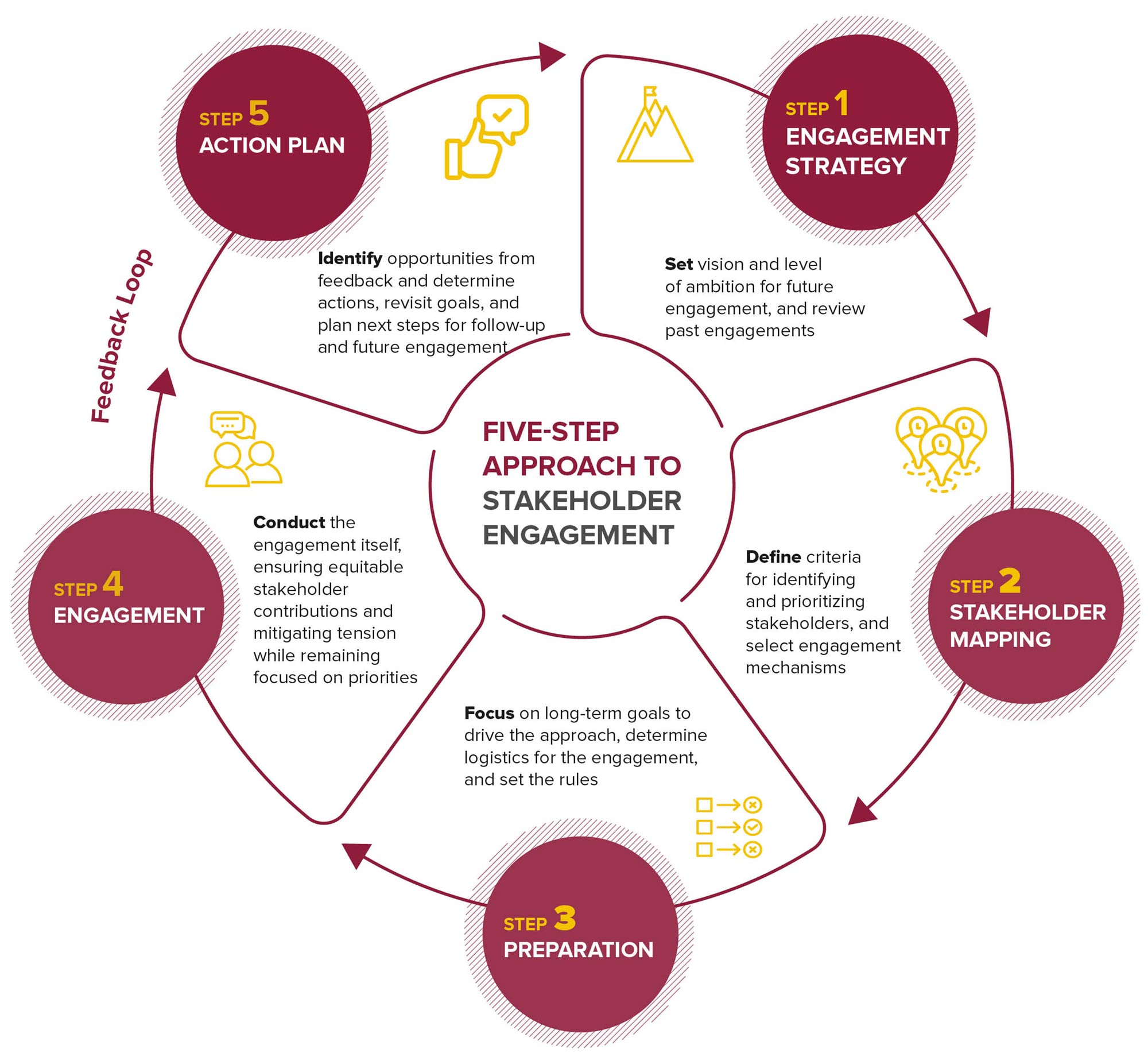
- Engagement Strategy: Set vision and level of ambition for future engagement, and review past engagements.
- Stakeholder Mapping: Define criteria for identitfying and prioritizing stakeholders, and select engagement mechanisms.
- Preparation: Focus on long-term goals to drive the approach, determine logistics for the engagement, and set the rules.
- Engagement: Conduct the engagement itself, ensuring equitable stakeholder contribution and mitigating tension while remaining focused on priorities.
- Action Plan: Identify opportunities from feedback and determine actions, revisit goals, and plan next steps for follow-up and future engagement.
Blog | Thursday April 25, 2019
Three Questions to Think About for Your 2030 Strategy
With many sustainability strategies and goals expiring in 2020, it is now time for companies to think about their sustainability priorities for the next ten years.
Blog | Thursday April 25, 2019
Three Questions to Think About for Your 2030 Strategy
Preview
For years, 2020 was a distant concept, the end-point for business goals and timelines. With many sustainability strategies and goals expiring in 2020, it is now time for companies to think about their sustainability priorities for the next 10 years.
At Sustainable Brands Paris, we discussed the dynamics shaping post-2020 strategies with representatives from Avery Dennison, evian, Fortitude Partners, and Mastercard.
The landscape for sustainable business is rapidly changing, as evidenced by the accelerating energy transition, highly disruptive technologies such as artificial intelligence, new business models, increasing geopolitical volatility, nascent climate disruption, and new expectations from stakeholders.
At BSR, our view is that the next phase of work requires building resilient business strategies with sustainability at their core. Gone are the days of piecemeal, siloed approaches and ticking off the quick wins. Now is the time to reset the trajectory recognizing the interwoven reality of business, society, and the consumer.
"Most big businesses have been working on sustainability with reasonable success for the last 10 to 15 years, but we have been picking the low-hanging fruit,” a BSR member once told us. “The next phase will be much more difficult. It is about what you buy and what you sell; it goes into the heart of your commercial operations and investment decisions."
This brings a huge opportunity to reflect on lessons learned from the past decade of sustainability management: what has worked well, what we have achieved, and what we need to do to drive ambition for changing the way we meet consumer needs while creating long-term value for business and society. In this context, we need to reflect on the following three questions as we work with member companies to develop strategies for 2030.
What could our world look like in 10 years, and how do we ensure the relevance of our priorities in 2030?
Companies cannot plan for 2030 without considering how different the world will be 10 years from now. While we cannot anticipate all the disruptions and innovations that will unfold in the next decade, we can leverage futures thinking and scenario planning to prepare long-term sustainable business strategies.
Futures thinking and scenario planning offer structured methodologies to identify signals of change on the horizon, explore possible future scenarios, and ensure your 2030 strategy is fit for the changing world. Scenario planning is not a prediction of the future, but a way to expand our field of vision, challenge assumptions about the present and future, and improve our capacity to adapt to and steer change. Importantly, it helps to understand how your business would look in a plausible new environment.
Explore BSR’s research into the key drivers of change affecting sustainable business in the Doing Business in 2030 report and theorize the impact of four plausible scenarios on your business and consumers.
Sustainability teams will need to develop new competencies to be fully empowered to drive the design of meaningful 2030 sustainability strategies and goals.
How are consumer needs and wants evolving, and how do brands partner with consumers and others to enable more sustainable lifestyles?
One BSR member company told us the most important thing for sustainability is to ensure pathways to growth for businesses and finding business benefits: “Consumers will use words other than sustainability, such as wellbeing and technology obsolescence. You should not put out new sustainable products just to win nice awards, but because consumers need and want these products.”
Truly sustainable and resilient businesses are those that integrate their commitment to achieving the Sustainable Development Goals (SDGs) into core business strategy. BSR member companies understand the “need to focus primarily on how solving major sustainability challenges create new revenue opportunities for the company. This means integrating the SDGs and sustainability into business planning.” More and more, companies see the value sustainable efforts deliver to their consumers and, conversely, the demand from consumers for goods and services that reflect a contribution to solving major societal challenges.
In the past, sustainability strategies have focused on doing business as usual, with fewer negative impacts. But, as another BSR member company explains, “products, services, and technologies are more important than processes and procedures, but we in the sustainable business field are too focused on process. This misses the key strategic link with market-based needs.”
Which business approaches can work to drive deeper internal integration and business value to get the entire company on board with a 2030 strategy?
According to the State of Sustainable Business 2018, consumer and customer demand is the second most powerful driver for sustainability efforts after reputation. However, only 34 percent of companies state that their sustainability team works effectively with marketing, 29 percent with research and development (R&D), and 28 percent with product development.
Integrating sustainability into brand strategies and innovation requires new approaches for teams that may not have worked closely before. Sustainability teams can give marketing and product development the right tools to enable sustainability to drive brand purpose and innovation.
Our partner Fortitude Partners outlines some tangible ways to work with your marketing department, such as developing a toolkit to enable brand managers to turn what is often an abstract sustainability strategy into consumer-led brand strategies. One BSR member explains how they have “baked sustainability attributes into the product development stage-gate process. Innovation teams are part of our sustainability governance. We’ve also partnered with an accelerator to incubate entrepreneurs that will generate ideas that will benefit us.”
Concrete tools and methodologies exist that can help companies build sustainability strategies that create business and stakeholder value over the next decade. Sustainability teams will need to develop new competencies to be fully empowered to drive the design of meaningful 2030 sustainability strategies and goals, such as the ability to identify value creation opportunities, drive internal change, and identify future factors.
Blog | Tuesday April 23, 2019
Accelerating the Adoption of Clean Fuels: Building a Sustainable Fuel Assessment Framework
As companies seek to reduce their environmental impact, meet climate goals, and reduce fuel costs, there is increasing demand for sustainable fuel technologies such as renewable natural gas, renewable diesel, electricity, and biodiesel.
Blog | Tuesday April 23, 2019
Accelerating the Adoption of Clean Fuels: Building a Sustainable Fuel Assessment Framework
Preview
Business, in addition to countries and multinational bodies, has a role to play in combating global climate change. The freight transportation sector represents a significant and growing share of global greenhouse gas (GHG) emissions. And as companies seek to reduce their environmental impact, meet climate goals, and reduce fuel costs, there is increasing demand for sustainable fuel technologies such as renewable natural gas, renewable diesel, electricity, and biodiesel.
Already, leading global companies are piloting and deploying many of these fuels and technologies, including members of BSR’s Future of Fuels initiative and signatories to the Sustainable Fuel Buyers’ Principles. Companies such as UPS and DHL are building their fleets of electric delivery vans in an attempt to meet their corporate sustainability goals, to reduce fuel costs, and to continue service in areas that have banned fossil-fuel-powered vehicles — such as some cities in Europe. Major retailers and consumer goods manufacturers are also making ambitious commitments to reduce the GHG emissions impact of their road freight fleets. For example, Amazon aims to have all of its shipments to customers become net zero carbon, with 50 percent of all shipments net zero by 2030.
In continued partnership with ACT Expo, Future of Fuels will host a Buyer-Supplier Roundtable on April 23 in Long Beach to discuss how companies are evaluating the sustainable fuel market for their commercial freight fleets.
While some progress has been made, many companies encounter significant challenges when assessing sustainable fuels options for their fleets, specifically trying to integrate economic, operational, and sustainability criteria. Fleet and goods owners today are faced with a proliferating set of new sustainable fuel choices, however, they do not have a streamlined, comprehensive framework to evaluate these fuels for their economic, performance, and sustainability attributes. As a result, uptake is lagging the availability of new options.
To help alleviate this need, BSR’s Future of Fuels initiative is currently developing an assessment framework that will outline key financial and performance criteria for at-market and near-market sustainable fuels. Co-developed with Future of Fuels members, this tool will help companies evaluate fuel suitability, financial viability (ROI), and potential barriers to uptake/adoption.
In continued partnership with ACT Expo, Future of Fuels will host a Buyer-Supplier Roundtable on April 23 in Long Beach, California, to discuss how companies are evaluating the sustainable fuel market for their commercial freight fleets. Insights collected during this session will serve as inputs for the development of an assessment framework that the group aims to complete later in 2019.
The Sustainable Fuel Roadmap will complement a series of tools co-developed by Future of Fuels over the past years: a case study library allowing fleet owners to compare clean fuel technologies independently tested and rated by peer companies, the Fuel Sustainability Tool (available for free), the world’s first apples-to-apples way to compare emissions reductions investments in efficiency and advanced fuel technologies, and the Sustainable Fuel Buyers’ Principles, through which companies demonstrate demand for sustainable fuels and catalyze the partnerships needed to drive a sustainable transition in the freight fuel system.
As described in the IPCC Special Report released last fall, we must limit global warming to 1.5°C by 2030 to avoid catastrophic impacts of climate change. Reducing GHG emissions from freight transportation is one effective tactic companies can deploy to mitigate their climate impact. Business looking to address the emissions of their freight transportation are welcome to connect with us, either at our event at ACT Expo or online.
----
We invite fuel purchasers and shippers to sign on to the Sustainable Fuel Buyers' Principles. There is no cost to join; we simply ask that companies offer a sincere commitment to use these principles to proactively engage with their value chains around sustainable, low-emission fuels. View the full list of signatories and the Principles themselves here.
Blog | Monday April 22, 2019
Five Trends Defining the Future of Retail
Retail is changing in complex ways, and the future will look quite different from today. We need to prepare now for new challenges, but also for new opportunities to drive more sustainable consumption patterns, promote diversity and inclusion, and meet emerging consumer needs.
Blog | Monday April 22, 2019
Five Trends Defining the Future of Retail
Preview
Chinese online retailer JD.com recently launched the first fully automated warehouse, where only four employees are needed to do work that previously required 400. Forty German supermarkets tested using facial recognition technology to serve personalized advertisements to customers waiting in checkout lines. Two hundred ninety companies have committed to ensure 100 percent of their plastic packaging can be reused, recycled, or composted by 2025.
As the signals of change above show, retail is changing in complex ways, and the future will look quite different from today. We need to prepare now for new challenges—such as job loss due to automation and ethical concerns related to artificial intelligence (AI)—but also for new opportunities to drive more sustainable consumption patterns, promote diversity and inclusion, and meet emerging consumer needs.
The future is not pre-determined. As we seek to shape a better future, it is important to both understand current trends and be attuned to signals of change that suggest new and emerging possibilities. Here are five constellations of trends and signals we’re monitoring that any retailer should consider as it thinks about the future.
The Workforce of Tomorrow
Automation, demographics, and wages are driving change in the retail worker landscape. While income inequality in Europe is generally lower than in non-European countries, focus remains on wage initiatives such as the U.K.’s Living Wage Foundation and IKEA’s living wage commitment. In contrast, in the United States, worker pay is stagnant and income inequality is at record high levels. National legal systems are also increasingly adopting gender pay laws, including the U.K., Iceland, and the Netherlands, to document and reduce the gender pay gap. In addition, automation is poised to significantly disrupt retail. McKinsey and PwC estimate that 62 million jobs in Europe’s five biggest economies can be automated, with retail being approximately 20-30 percent by 2030. Due to aging populations and declining birth rates, AI might, however, make up for productivity shortfalls mitigating technical unemployment.
Smart Everywhere
Virtual reality (VR) and augmented reality (AR) are enabling retail companies to immerse customers in highly personalized interactions and bring the retail experience closer to home or anywhere their consumers are connected. The majority of retailers are already implementing or planning to further invest in mixed reality. By 2021, nearly 79 percent of retailers will be able to customize the store visit for customers as a majority of them will know when a specific customer is in the store. AI is enabling companies to better anticipate consumer preferences and is already capable of improving demand forecasting up to 50 percent.
The Social Life of Business
Corporate activism is on the rise, with issues such as refugees and immigration, LGBTIQ+ rights, and the climate crisis drawing public commentary from thousands of executives, companies, and their employees. Brands from Primark to Starbucks are supporting various causes through their products, marketing, or commitments such as IKEA’s Refugee Employment Program. In Deloitte’s Millennial Survey 2018, three-quarters of the young workers interviewed see businesses around the world focusing on their own agendas rather than considering the wider society, and climate tops the list of issues where they expect business to take action. According to FleishmanHillard, two-thirds of consumers said they’ve already stopped using a company’s products or services because that company’s response to an issue didn’t comport with their own views.
Successful business—and the well-being of people and the planet—will depend on developing new strategies for the future that not only account for the profound changes underway but can also imagine transformative new opportunities to create a more just and sustainable world.
Over There Is Now Here
Western democracies are being challenged by the rise of populism, cultural nativism, and economic nationalism, and in response, international cooperation on global challenges is being undermined. On the other side, global grassroots movements for the climate and just capitalism are growing particularly among youth. In March, climate strikes around the world gathered hundreds of thousands of students. Disruption requires that companies constantly evaluate their short- and long-term sourcing options, both locally and globally. Climate change has the potential to critically disrupt the supply chains for important commodities like coffee and vanilla. Over 500 companies have committed to set science-based targets (SBTs), which require inclusion of Scope 2 and 3 emissions—increasing focus on supply chain climate impacts. Automation can provide significant costs savings on labor compared with offshoring to low-cost economies, and it is poised to lead to the reshoring of production and significant job losses in the supply chain.
Race to Stay Within Planetary Boundaries
The urgency to act on climate change has significantly increased this year, following recent reports from the Intergovernmental Panel on Climate Change (IPCC) and the Stockholm Resilience Institute that warn that 1.5 degrees, not 2 degrees, is the upper limit for warming if we are to avoid catastrophic impacts. The European Union (EU) aims to achieve carbon neutrality by 2050. In 2018, it aligned its ambitious Circular Economy Plan in a Memorandum of Understanding with China. California, the world’s fifth largest economy, declared its ambition in late 2018 to achieve carbon neutrality by 2045. In the meantime, plastics has become a hot button issue, both single use plastics such as straws as well as microplastics, which have been found in everything from fish to bottled water to table salt.
The European Parliament has voted for a complete ban on a range of single-use plastics across the union in a bid to stop pollution of the oceans. Other waste bans, e.g. on microplastics, are likely imminent. At the same time, the EU is considering a law for the ‘right to repair,’ forcing manufacturers to make repair accessible for all their products, either at repair shops or in their own stores.
From automation to climate impacts to social values, a diverse set of powerful and complex interacting forces are changing the retail and consumption landscape. However, it’s not enough just to read about these changes. Successful business—and the well-being of people and the planet—will depend on developing new strategies for the future that not only account for the profound changes underway but can also imagine transformative new opportunities to create a more just and sustainable world.
The most effective way to do this is using strategic foresight—a structured approach to exploring multiple future possibilities, clarifying the better future we’d like to shape together, and creating a roadmap to get there. For more information about BSR’s new strategic foresight offerings, please contact the BSR Sustainable Futures Lab.