Searching for: Our network
Search results: 81 of 136
Case Studies | Thursday July 13, 2023
Conducting a Climate Risk Assessment through Scenario Analysis
BSR worked with Mercer International Inc., a global producer of market pulp and solid wood products, to conduct a climate scenario analysis.
Case Studies | Thursday July 13, 2023
Conducting a Climate Risk Assessment through Scenario Analysis
Preview
Introduction
BSR worked with Mercer International Inc., a Nasdaq-listed global producer of market pulp and solid wood products, to conduct a climate scenario analysis. With a tailored set of three climate scenarios, BSR helped Mercer explore key climate-related risks and opportunities facing the company and identify strategic interventions to improve the overall resilience of the company’s strategy. With strong engagement from senior leaders throughout the process, this effort was not a “check-the-box” disclosure exercise—instead, it was a strong analysis of climate impacts to Mercer’s business strategy.
Background
Mercer is a global producer of market pulp and solid wood products. With mills and manufacturing facilities in North America and Germany, Mercer is strategically located next to strong softwood and hardwood suppliers. Softwood and hardwood pulp are utilized for tissue, specialty paper, packaging, and more. In addition to pulp, Mercer also produces dimensional lumber for construction as well as cross-laminated timber (CLT). CLT is an alternative building product used to replace steel and concrete, driving greenhouse gas (GHG) emissions reductions in building construction.
The Challenge
Given Mercer’s dependence on sustainable forests for pulp and timber production, the company must have a clear understanding of climate impacts. At the current level of warming, forests from which Mercer sources have already experienced climate-related events like disease, insect infestation, and increased wildfires. These, in turn, impacted the company’s operations, supply, and logistics. In 2021, an atmospheric river event in Canada affected Mercer’s transport and logistics of supply and delivery of its products to key markets. With these existing impacts on supply and logistics, as well as forecasted rise in demand for pulp and timber products, focusing on resilience and strategic interventions to key climate impacts is critical for Mercer's business.
Our climate scenario analysis approach helped facilitate that strategic thinking. After conducting Mercer’s first climate scenario analysis in 2020, Mercer was familiar with BSR's deep expertise in futures thinking and engaged BSR to help refresh and assess climate-related impacts on various business units across the globe. Mercer also understands the need to periodically reevaluate ever-changing climate risks, and it considers climate scenario analysis based on the latest science to be a crucial solution for companies and sectors highly exposed to climate change.
BSR’s Response
Our first step for this work was to understand Mercer's business strategy and market positioning in order to augment and tailor our off-the-shelf climate scenario narratives, originally developed in partnership with Bloomberg Philanthropies. The scenario set was built using the Network for Greening the Financial System (NGFS) base scenarios and projections.
BSR built out three in-depth scenario narratives: Current Policies, Net Zero 2050, and Delayed Transitions. This involved researching emerging trends and signals of change as well as integrating data projections from the NGFS climate scenario dataset. To tailor the scenarios, in collaboration with the Mercer team, BSR identified four critical themes of uncertainty for the company and conducted desktop research and analysis to learn how these themes could plausibly play out in each scenario. We also identified six critical transition data projections from the NGFS database and three key physical climate impact projections from the Climate Analytics portal that were relevant for Mercer’s main regions of supply and operation in Canada and Germany. With the full set of tailored scenarios, we began the internal stakeholder engagement process.
Our initial engagement consisted of small workshop sessions across critical business functions to identify a long list of climate-related risks and opportunities that Mercer might face in each future scenario. Through these working sessions, we engaged with 16 senior leaders across six functional areas, including operations, finance, forest management, sales, and logistics.
BSR collated the key risks and opportunities by scenario and identified thematic hotspots and overarching future trends that may present significant risks or opportunities to Mercer's business across the entire set of scenarios.
Our final workshop, the last step in our approach, brought back the senior leaders from the initial interviews. During the workshop, we started by validating the identified key risks and opportunities and then shifted quickly into exploring the hotspots in more detail. For each hotspot, BSR facilitated small group discussions to explore clear actions and strategic interventions that Mercer can perform across the organization to mitigate risks and seize the opportunities related to each hotspot. This final session encompassed actions to increase and enhance strategic resilience to these climate impacts.
Impact
BSR conducted a robust scenarios-based climate risk assessment to prepare Mercer for a TCFD-aligned climate risk disclosure. More importantly, BSR helped facilitate critical strategic conversations on the resilience of the overall business and growth strategy to key climate risks, and we equipped Mercer with a near-term roadmap that outlined key next steps and governance-related responsibilities to ensure successful management and mitigation of these risks.
"This in-depth assessment of Mercer's future resilience under all three climate change scenarios has enabled our senior leadership, across all key functional areas, to better understand the risk and opportunities of climate change and develop a more robust strategy that will incorporate these key learnings."
Bill Adams, VP, Sustainability and Innovation
After our work with Mercer, the company was able to produce a robust TCFD report and integrate resilience into its business strategy and planning processes.
Conclusion
As part of a wider set of activities in the business toolkit, climate scenario analysis is a powerful method for uncovering and assessing a company’s strategy against uncertain climate risks and emerging opportunities. By testing how to best respond to these uncertainties using actions that build resilience, companies can explore pathways for delivering successful business outcomes in the face of climate change.
"Undertaking a climate scenarios analysis was a strategic necessity for Mercer to ensure resilient operations and achieve sustainable growth. Proactively assessing and preparing for the potential effects of climate change helps businesses navigate the uncertain future. Specifically, it enables informed decision-making, fosters innovation, and helps build operations that can adapt, thrive, and contribute to a more sustainable world.”
Shahed Tootoonian, Director, Finance and Sustainability
Get in Touch
Interested in enhancing your company’s strategic resilience to climate impacts through climate scenario analysis? Please contact BSR’s Climate Team.
This case study was written by Nina Hatch and Ameer Azim.
Blog | Tuesday January 9, 2018
Pandemics: They're Everyone's Business
Global health security is everyone’s business, and examples from these companies demonstrate that collaborating and partnering is the only way forward for pandemic preparedness.
Blog | Tuesday January 9, 2018
Pandemics: They're Everyone's Business
Preview
The cover of the May 16, 2017, issue of TIME magazine featured a picture of one the scariest threats to the world. It was neither a picture of a mushroom cloud of an atomic bomb, nor the face of an infamously ruthless dictator. Rather, it was a picture of something rather invisible to the unaided human eye—the Ebola virus. The article, “The World Is Not Ready for the Next Pandemic,” (re)sounded the alarm for the scientific and international communities to take the increasing threat of pandemics more seriously and to incite action and collaboration among global health experts.
While the article points to the actions of government and civic society players, it fails to highlight the efforts of the private sector in preparing for and combatting emerging biothreats. Recently, the BSR Healthcare Working Group engaged several of its members, which represent many of the world’s leading biopharmaceutical companies, to elucidate their evolving and expanding role in pandemic preparedness. Global health security is everyone’s business, and examples from these companies demonstrate that collaborating and partnering is the only way forward.
Pandemics have the potential to bring national economies and international trade to a standstill. The World Bank estimates that the economies of Guinea, Liberia, and Sierra Leone lost US$2.2 billion in forgone economic growth in 2015 due to the Ebola crisis. According to the TIME article, the 2003 SARS epidemic, which killed fewer than 800 people, cost the global economy US$54 billion, much of it in lost trade, transportation disruption, and healthcare costs. The World Bank estimates that the toll from a severe flu pandemic could hit US$4 trillion.
When pandemics occur, local communities and national governments are not the only ones that are thrown into chaos and prompted to act quickly—vaccine producers shoulder the burden, too. For biopharmaceutical companies, vaccines have been traditionally developed and distributed under commercial frameworks that ensure profitability and economic sustainability. For diseases such as Ebola, Zika, and SARS, no real commercial market exists, yet it is expected that pharmaceutical companies will develop and produce solutions in record time, which comes with technical and regulatory challenges, vaccine development expenses, and opportunity cost from pausing other core vaccine programs.
Dr. Jean Lang, associate vice president of global R&D for Sanofi Pasteur, summarizes the challenge well: The system is not fit for purpose and needs to be rethought. As he explains, “It starts with changing the current mindset where the private sector is expected to develop vaccines at risk, without any visibility on a possible return on investment, which is utopian; we need to reach a point where private companies, governments, and health authorities become public health partners upstream to share the risks and benefits.” It’s about inventing a diversity of responses, he says, and “collectively deciding to step away from risk avoidance and move faster.”
GSK is tackling these challenges head on. When GSK got internal approval to move forward with Ebola vaccine development, they put hundreds of people on the project to condense a process that usually takes several years into a matter of months. In late 2016, GSK also opened a global R&D vaccines facility that has the capability to do full, end-to-end development and manufacturing, which is rare in the industry. Moreover, it is partnering with the U.S. government, PATH, and others to prepare for the next pandemic. According to Dr. Rip Ballou, vice president and head of GSK’s global vaccines R&D center in Rockville, Maryland, “GSK is working on a number of technology platforms that may speed up the process of vaccine discovery and manufacture, which could prove valuable during a health emergency. We are also in agreement that this requires collaboration between the public and private sectors, and we’re ready to play our part.”
Johnson & Johnson (J&J) understands this well. Dr. Alan Tennenberg, chief medical officer of global public health at J&J, works with government stakeholders and private-sector players to coordinate efforts around biopreparedness. Alongside the GE Foundation, J&J founded the Private Sector Roundtable for Global Health Security Agenda, which convenes 17 business players to work with governments and security networks to prepare for pandemics, epidemics, bioterrorism, and biosecurity. Furthermore, J&J co-leads the Global Pandemic Supply Chain Network, a public-private partnership that seeks to create a ready supply and network for response, prevention, and control. Private-sector players leverage their expertise in supply chain and logistics to enhance emergency response and avoid critical delays, waste of resources, and losses of lives. As Tennenberg elaborates, “Partnerships are essential. Success is not only private-private, but also private-public. It’s about openness, trust, and transparency.”
Another prime example of this type of collaboration is the Coalition for Epidemic Preparedness Innovations (CEPI), which raises funds and coordinates activities for vaccine development. The four companies we interviewed are all involved with CEPI, helping the coalition and its partners address the commercial challenge that biopreparedness presents and the increased legal liability of speedily testing vaccines on the market each time a biothreat emerges. Dr. Paula Annuziato, vice president and therapeutic area head of vaccines clinical research at Merck & Co., wants to change the perception that biopharmaceutical companies are investing in this area from profit-making motivation. According to Annuziato, “Misperceptions of industry’s intent and motivation can impede collaboration. It is more productive and effective to identify each coalition partner’s core capabilities and expertise and leverage them for the benefit of patients and health systems.”
The world may not yet be prepared for the next pandemic, but there is a growing coalition of private, public, and civil society partners working to change that and ensure that our increasingly interconnected global economy is safe and resilient. And while pharmaceutical companies have unique technical expertise to contribute to pandemic preparedness, every industry, from tech to energy, has a stake in contributing to strong and resilient health systems. Opportunities for partnership abound. We are all in it together.
Blog | Thursday October 20, 2022
Building Competent Boards: ESG Not about “Skills-Washing”
Boards need to understand emerging ESG issues and make informed decisions. Helle Bank Jorgensen, CEO and Founder of Competent Boards, discusses board training and evolution.
Blog | Thursday October 20, 2022
Building Competent Boards: ESG Not about “Skills-Washing”
Preview
In July 2022, I had the pleasure of interviewing Helle Bank Jorgensen, CEO and Founder of Competent Boards at BSR’s Future of Reporting Workshop. Helle and I previously spent a few years as advisory board members to Ethical Corp (now Reuters Sustainability) when she invited me to join her Competent Boards program during a Responsible Business awards ceremony in London in 2019.
Some years later, as part of our BSR Future of Reporting workshop on Boards and Regulation this past July, Helle shared with our 70+ members her experience since the founding of Competent Boards in 2019, with insights on who is seeking board training, what type of training, and what’s next for the evolution of boards.
Here are the key takeaways from our discussion:
- ESG training is not about “skills-washing”—boards now have a duty of care in the new regulatory environment.
- Where previously curious board directors sought training upon recognizing a skills gap, we’re now seeing entire company board cohorts looking to upskill on all issues across ESG.
- “Luck favors those who come prepared.” There is a changed mindset from "why boards should care" to "how do we care about this." This means going beyond compliance to building long-term value creation
- Boards need to have the right insights and foresight for resilience in governance.
- Directors live their values—they must be stewarded and acted upon.
Helle, could you tell us more about Competent Boards?
Competent Boards provides designation and certification programs on ESG and climate for board members and senior business professionals. Boards need to be equipped with knowledge and frameworks that allow them to understand emerging ESG issues and make informed decisions that contribute to the well-being of companies and society. Competent Boards leverages the expertise of over 180 faculty members to equip boards with the knowledge and network needed to succeed.
You launched Competent Boards in 2019 at Davos with astounding success. How have profiles of those who are getting certified evolved over the years?
Before, it was just believers at a personal level who were curious or lifelong learners who joined the program. Now, it is much broader. Professionals today are recognizing their duty and acknowledging the skills gap. ESG training is not about “skills-washing." Directors joining the program want to feel confident that they have the necessary information to anticipate risks and opportunities to the business and how the company can create more value for shareholders and society at large. More and more companies today are therefore asking to work with their entire board instead of just a few individual members. This is a huge mindset shift.
What are boards finding most difficult today in terms of ESG? Is there any one aspect they are struggling with more?
Many board members and professionals today are aware of the climate challenge and need to act in this decisive decade. However, less known and explored–and yet still important in terms of duty of care and duty to act—is human rights. Boards have discovered that this is business too, strategic, often overlooked in terms of major risks, and invisible to hidden risks in supply chains and operations. In Europe, there is now the Corporate Sustainability Due Diligence Directive that changes the game and stipulates a board’s duty to act. Many boards today are not ready for this.
How are questions from board members changing?
The biggest change I’m seeing in terms of board mentality is “why boards should care” to “how can we care about this.” I recently said at a World Economic Forum meeting, “luck favors those who come prepared,” and I firmly stand by this. There is a changed mindset from compliance, to accountability, to long-term governance and value creation, versus passive oversight or delegation to other experts in the company. Boards can ensure that they have the right insights and foresight for resilience in governance, including an important baseline knowledge and understanding across E, S, HR, and G.
With today’s shifting regulatory framework and the new role of boards, what’s next?
More scrutiny from stakeholders as well as shareholders. Shareholders are getting sophisticated in their knowledge of ESG and the value drivers for the company. They’re sharp, and they ask far more targeted questions.
I also want to conclude by saying that there is a profound cultural change happening from the inside. Companies must internalize their core values, and this starts at the board level. Boards must live their values—and these values must be stewarded and acted upon. Otherwise, we’re back at where we started—“skills-washing” through ESG.
Helle, thank you for joining us and for a very provocative dialogue. Learn more about Competent Boards certification programs and BSR’s board offering.
Blog | Monday October 19, 2020
Meeting the Moment with a Sustainability Strategy Refresh
For nearly every company, existing business and sustainability strategies need to be refreshed for the new COVID-19-affected world. Here are five steps for accomplishing this change.
Blog | Monday October 19, 2020
Meeting the Moment with a Sustainability Strategy Refresh
Preview
This week, BSR convenes the global sustainability community at BSR Conference 2020. Throughout the week, sustainability leaders will join us to share, learn, collaborate, and connect around the theme Meet the Moment. Build the Future. And there is no more important time than now to assess our changed world and how business sustainability strategies can meet the challenges ahead.
As a result of the global pandemic, every company is dealing with changes in the global markets, be it upswings, downswings, or other shifts. And whether you are a global leader with sustainability already integrated through your operations or still working to figure out sustainability and its meaning for your company, all businesses are experiencing changes to their operating environments. This means that—for nearly every company—your existing business strategy and sustainability strategy need to be refreshed for the new COVID-19-affected world. Indeed, governments, consumers, investors, and employees are all grappling with how to continue in this changing environment—and as a consequence businesses’ strategy, insights, and answers matter all the more.
Business sustainability investments now will matter most as the world emerges from the COVID-19 crisis and the after-effects become clear—from increasing stressed income inequality and consumer behavior and expectations changes to direct corporate impact, including reputation and talent retention. At the same time, the challenges on the horizon, temporarily obscured by COVID-19—climate change, environmental degradation, pollution, and social inclusion—will loom all the more large.
Investments in sustainability need to translate across your entire business as it emerges from the post-COVID-19 world. How will finance, banking, and investor engagement be affected as the pools of available capital, and their expectations, change? How should you approach responsibility, product, and traceability as new consumer expectations or legal requirements emerge? How does your strategy factor emissions and climate resilience as your industry, your competitors, and your value chain increasingly focus on climate impacts and 1.5°C targets? How will your brand and marketing convey your vision, values, and roadmap to your industry, consumers, and current and future employees?
The world post-COVID-19 won’t merely be a return to the world pre-COVID-19: expectations of work are changing; job creation and income inequality are of ever-growing concern; and workers at the base of globally supply chains, particularly women and those most at risk, are being hurt.
Here are five steps to make this refresh happen.
- Update your materiality. In short, understand not only which issues are changing in importance, but why they are changing. Be sure to understand the views of your investors, your regulators, your leadership, your stakeholders. Understanding what is changing, and particularly why, helps set the stage for step two.
- Refresh your strategy and purpose. If your company has already gone through a robust strategy process, this refresh is ensuring your corporate focuses continue to align with the external environment. If your company has not yet done this, well, it is really time to get to work.
- Plan for alternate futures. COVID-19 has certainly illustrated the need to anticipate and plan for a variety of future scenarios. What will be the impact of climate change on your business operations? What if we see another COVID-19-like incident? How are social expectations changing for business in your key markets? What trade tensions may impact business and supply chains in the future? Understanding scenarios allows you to build them into your business planning processes.
- Build resilience in your value chains. Understanding current changes and potential alternate futures allows you to understand resilience and build into your value chain. Whether it is in terms of strategic sourcing options, globalization of plant, equipment, and talent, or identification of future market needs—all can be understood, planned for, and invested in.
- Engage your employees. Invest in the knowledge, understanding, and engagement of your employees as they help your company navigate the increasingly complex and diverse impacts of COVID-19 and its consequences.
The economic impacts of the COVID-19 crisis will remain for years to come. If there is one thing we can be sure of now that the pandemic has been rampaging around the world for nearly a year, it is that the world post-COVID-19 won’t merely be a return to the world pre-COVID-19: expectations of work are changing; job creation and income inequality are of ever-growing concern; and workers at the base of globally supply chains, particularly women and those most at risk, are being hurt. As a consequence, markets, politics, and expectations of consumers, employees, and businesses—all continue to change.
At BSR, we continue to work through these issues with our members. From stakeholder engagement materiality processes, strategy integration, and futures scenarios to value chain resilience and employee engagement, we look forward to connecting with you, our members, partners, and network to build a more resilient, equitable, and sustainable future.
Blog | Tuesday September 29, 2020
Three Futures of Company Climate Action
This year’s Climate Week NYC has advanced a shift from climate commitments to climate action. What will company climate action look like in this Decisive Decade? Here are three plausible futures for companies considering their own climate and environmental strategy.
Blog | Tuesday September 29, 2020
Three Futures of Company Climate Action
Preview
When BSR carries out climate scenario analysis, we construct three or four plausible futures that capture the disruption relevant to a company’s business. We then work with the company to make its strategy more resilient, e.g. by hedging against risks in more than one scenario, by guarding against disastrous tail risks, or by investing in unexpected business opportunities. Climate scenario analysis then reveals how climate action by the company can build resilience to potential disruption.
This year’s Climate Week NYC has advanced a shift from climate commitments to climate action, which we must accelerate to keep the Paris Agreement goals within reach. What will company climate action look like in this Decisive Decade? Here are three plausible futures for companies considering their own climate and environmental strategy.
1. To Net Zero and Below
Two years ago, the IPCC’s Special Report on 1.5°C made it clear that to reach the Paris Agreement’s stretch target, we will need to reach global net zero emissions by 2050. The north star of net zero is followed by countries—witness the EU’s move towards climate neutrality by 2050, and China’s surprise pledge last week to reach carbon neutrality by 2060. If achieved, China’s pledge alone could reduce warming by 0.2-0.3°C.
Companies too have followed this north star. Last week, Walmart targeted zero emissions across global operations by 2040. In June, Unilever targeted net zero emissions from all of its products by 2039. In January, Microsoft targeted becoming carbon negative by 2030 and removing all of its historical emissions by 2050.
These targets and others like them reveal the main questions companies must answer about their future climate action. Will the company act on its own operations or also across its value chain? (Value chain action is usually more impactful.) What hierarchy of emissions reduction interventions will the company undertake to progress towards its target? (One which maximizes the company’s credibility and environmental integrity.) What will be the role of offsets—whether of avoided emissions or which sequester carbon from the atmosphere? (Hopefully secondary to action in the company’s own value chain.) The Science-Based Targets initiative (SBTi) last week published a paper on the conceptual foundations for net zero targets, attempting to bring some standardization to the debate.
2. Science-Based Everything
Indeed, the success of the SBTi over the past five years, with nearly a thousand companies committed to emissions reduction targets, points to a second plausible future. If science can ground a company’s climate target, can it ground all of a company’s environmental targets? Can we have a science-based corporate environmental strategy?
This is the premise of the initial guidance published by the Science-Based Targets Network last week. The SBTN proposes a framework which can apply to all environmental targets, even if the science underlying them is very different. Companies will need to work through the challenges related to their particular environmental targets, much as Mars did using Science-Based Problem Solving.
The implications for climate action in this future are clear—that it will increasingly align to objective science rather than subjective demands from stakeholders or peer behavior and that companies will attempt to lever an environmental system, rather than satisfy a group of people.
3. Business Transformation By All
Transform to Net Zero, which BSR helped to launch over the summer, points to a third plausible future of climate action. To build net zero value chains, companies will need to integrate climate goals into their corporate strategy and deploy corporate functions well beyond sustainability and operations. All businesses will need to transform.
Net zero value chain targets imply that procurement teams will prefer that resilient, low carbon suppliers support them to decarbonize. Enterprise risk management and business continuity processes will integrate climate risks. Finance departments will ring-fence capital and establish new criteria for its deployment. Public affairs staff will add climate-favorable policies to its list of priority asks. Research and innovation departments will need to develop lower carbon or more resilient designs. Marketing campaigns will foster public support. Human resources will improve recruitment and retention through connection to climate purpose. And company leadership will set out a strategy and management structure befitting this effort.
In this third future, businesses will transform into organizations directed against climate change and find climate action to be one of their main sources of business advantage.
Which of these three plausible futures will become reality? When we carry out climate scenario analysis, we know that none of our scenarios depicts the actual future and that the future will be a combination of all of them. So it is with company climate action. Our task ahead is to build net zero value chains by transforming our businesses and deliver what science demands. What can your company do to take the next step?
Blog | Thursday January 19, 2017
How Good Is Your Sustainable Supply Chain Program?
Sustainable supply chain management means operating in uncertainty, without clear guidance on universal standards on what constitutes best practice. A BSR tool can help companies benchmark their responsible sourcing programs and assess how to improve.
Blog | Thursday January 19, 2017
How Good Is Your Sustainable Supply Chain Program?
Preview
Many blogs in 2017 are going to start with some play on this obvious theme: We are living in uncertain times. For supply chains, you could argue that this is nothing new, as the complexities of global supply chains have always incorporated a high degree of uncertainty. BSR member companies know they need to manage this uncertainty, and having a supply chain sustainability program is, in essence, a program to do just that. Whether a company calls its program “supply chain sustainability,” “responsible sourcing,” “responsible supply,” “sustainable procurement,” or another name, our members know that these programs help them reduce uncertainty, identify and manage risk, and generate business value. According to the 2016 BSR/GlobeScan State of Sustainable Business Survey, 84 percent of respondents reported having a supplier code of conduct, and 61 percent reported considering sustainability in sourcing strategies.
While the principle of having a sustainable supply chain program is clear and widely accepted, there is still a lack of consensus on the practice. Notwithstanding the forthcoming launch of the ISO 20400 standard on sustainable procurement, there exists no globally accepted framework for what constitutes good practice, although there are frameworks for labor rights through the ILO fundamental principles and core conventions, human rights through the UN Guiding Principles on Business and Human Rights, and, now, climate change through the Paris Agreement.
BSR has nearly 25 years of experience working with companies to drive sustainability through supply chains, and our membership network offers a breadth of good practice. BSR has seen, and continues to see, the evolution of sustainable supply chain management toward greater and deeper impact. In our experience, even if it’s not codified in international frameworks or national laws, a universally accepted framework for sustainable supply chain management has emerged. This framework is applicable across industries, geographies, and cultures—and even across differences in size and levels of ambition among companies.
The Supply Chain Leadership Ladder
BSR’s Supply Chain Leadership Ladder sets out this framework. The ladder allows companies to benchmark their supply chain sustainability program and assess where they are in their maturity, based on the internal and external dimensions of their program.
- Internal dimensions are the scope and structure of the supply chain sustainability program and how the program is governed and managed.
- External dimensions are the company’s approach to supplier engagement and how it is collaborating and reporting.
Each rung of the impact ladder has a defining statement and a set of common elements that helps identify how far up the ladder a company’s supply chain sustainability program sits—is it at level 1, building awareness, or is it all the way up to level 4, driving impact?
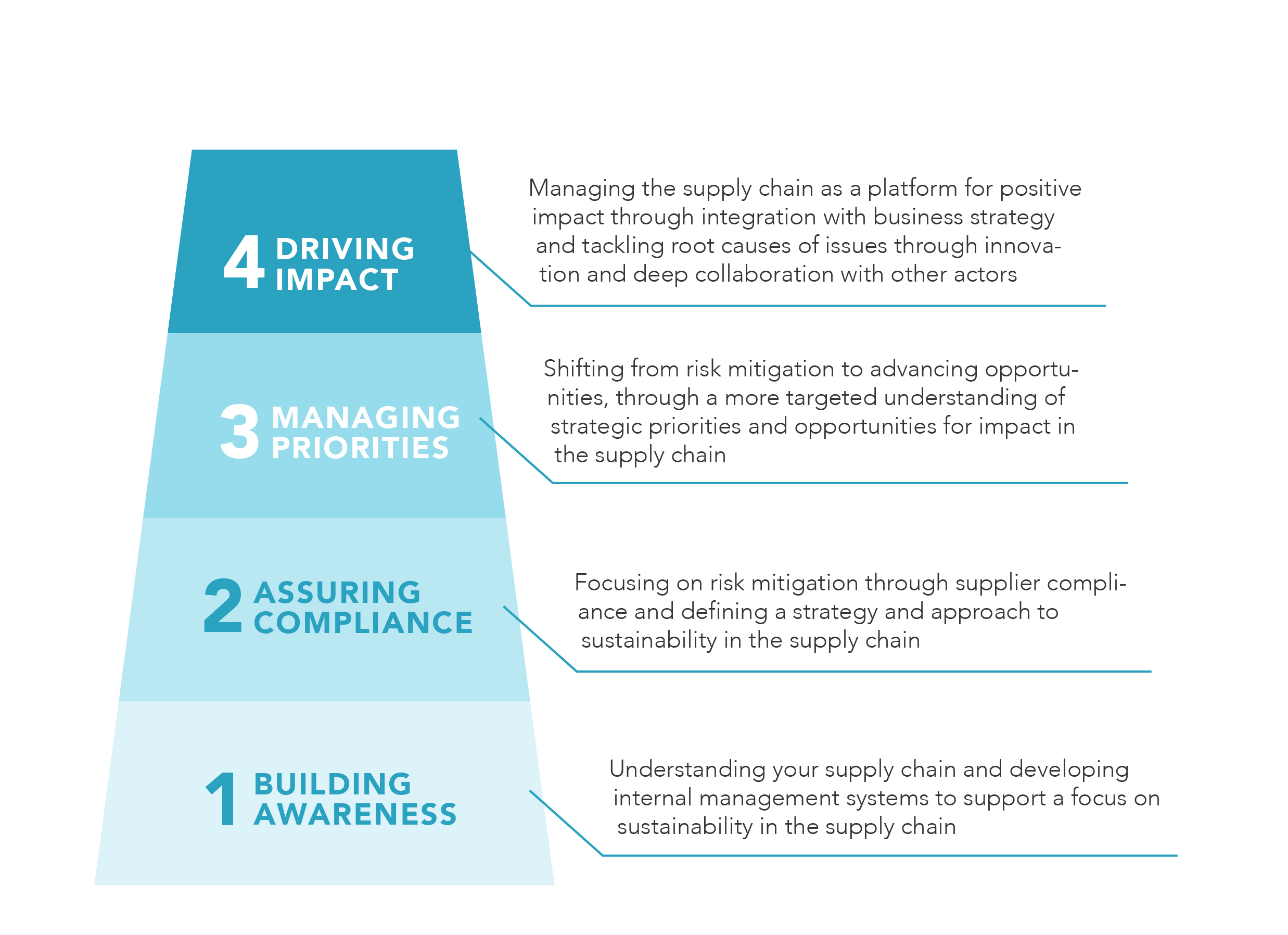
Moving Up the Ladder
In the last year, we’ve seen a continued shift upward among leading companies, moving up the ladder from assuring compliance to managing priorities, across both internal and external dimensions.
For a few years now, we’ve seen companies shift their program scope to incorporate specific priority issues or supply chain categories and now really pushing toward driving impact. For example, companies are identifying the biggest impact categories in their supply chains—see Kering’s focus on sustainable raw materials and H&M’s sustainable cotton efforts. Companies are also addressing the issues that are most material for their business and aligned with action on global priorities such as the Paris Agreement and the Sustainable Development Goals. For instance, Walmart’s efforts at defining science-based climate targets for its supply chain, ANN INC.’s women’s empowerment program, and the Global Impact Sourcing Coalition, facilitated by BSR.
This trend is also playing out in the way companies are engaging their suppliers and reporting. The concerted effort by some companies to publicly disclose their supply chains, such as Marks & Spencer’s Interactive Supplier Map, in some ways draws a line under the compliance movement to allow a new way forward—through transparency. If everyone can see a company’s supply chain, there is arguably less incentive to continue the auditing processes of the past.
Even collaborative industry efforts are part of this trend. For example, the Electronic Industry Citizenship Coalition’s (EICC) initiatives on key supply chain risks show a move up the ladder from general compliance to identifying the areas where the 110-plus EICC members can collectively have the most impact. Even newer initiatives such as Railsponsible, a sustainable procurement initiative for the rail industry that BSR facilitates, is collectively identifying the key priorities in the industry’s supply chain for 2017.
BSR would argue that all companies, across all industries, in all geographies, and of all sizes should at least be on the ladder. How high you climb is up to your appetite for leadership, your ability to actualize value from your supply chain sustainability program, and the kind of legacy and impact you want to leave in the world.
We’re going to be hearing a lot about uncertainty in 2017. For supply chains, this is nothing new, and we offer the ladder as a framework for responsive, resilient supply chain management.
Blog | Friday June 22, 2018
Sustainability Standards Driving Impact for Women in Global Supply Chains
Here’s how multistakeholder initiatives and sustainability standards organizations can further invest in progress on gender issues.
Blog | Friday June 22, 2018
Sustainability Standards Driving Impact for Women in Global Supply Chains
Preview
Sustainability standards and multistakeholder initiatives (MSIs) like Fairtrade International, Better Cotton Initiative, Rainforest Alliance, and the Fair Labor Association provide a set of tools and approaches to improve social, environmental, and economic conditions in global supply chains. These organizations and standards have played a powerful role in promoting good practice in certain industries, such as apparel and agriculture, where women make up 60-90 percent of the workforce in labor-intensive stages of production.
Gender is one key area where these groups have the opportunity to do more to drive systemic improvement for women working in factories and farms. In particular, there is potential to scale up the impact that sustainability standards and MSIs bring to women in global supply chains.
At an international level, the Sustainable Development Goals (SDGs), and SDG 5 in particular, have galvanized interest on gender equality and empowerment. The standards community is innovating around core technical issues like assurance, standard-setting, and monitoring and evaluation. Moreover, using data to drive change, working collaboratively, and breaking down silos between technical functions will further scale up the impact of these innovations on important issues, including gender.
During a recent session in São Paulo with ISEAL, an alliance of credible and innovative sustainability standards, we discussed several entry points for standards groups and MSIs to further invest in progress on gender.
- Standards: Standards cannot be gender blind, and ISEAL members are assessing the gender component of their standards in their periodic revisions. It is important to ensure a strong gender perspective in the language—for example, including guidance on how principles such as discrimination, harassment, wages, and working hours could impact women specifically.
- Gender-sensitive assurance: Sustainability standards can strengthen assurance processes—for instance, auditing teams should be equipped with training and facilitation skills to identify and address gender specific issues. SAN (Sustainable Agriculture Network) and Rainforest Alliance recently published an updated additional social auditing methods for sexual and psychological violence against women, which is one example of what this can look like.
- Systematic, robust, and transparent monitoring and evaluation: Data matters, and there is interest from sustainability standards groups to include more robust and meaningful indicators to track progress on gender equality in performance monitoring efforts, as well as to conduct in-depth evaluations. The Global Coffee Platform released a common measurement framework to guide collection of data relevant to promoting gender equality in coffee value chains.
- Capacity-building and awareness-raising: Sustainability standards can support capacity-building with suppliers to improve practices in factories and on farms, either directly or via local implementing partners that are part of existing systems. The Fair Labor Association is using its influence to raise the issue of pregnancy discrimination through its recent report.
- Gender mainstreaming: Some organizations are showing leadership by mainstreaming gender into their own organizations, creating gender task forces to help integrate gender components across projects and departments, and investing in gender experts.
These initiatives are a great start, but there is a need to go deeper and ensure that a substantial number of sustainability standards and MSIs take a comprehensive approach to gender. That’s why ISEAL and BSR have teamed up to organize a pioneering Gender Working Group for Sustainability Standards.
The Gender Working Group, which launched in May with support from the C&A Foundation, will convene standards organizations and MSIs to share their experiences addressing gender, learn best practices, and address frontier issues like women workers’ voice and gender data.
Our ambition through this collaboration is to drive systemic change to improve conditions for women workers in global supply chains—but we need a broad base of organizations to optimise our impact.
We will give special attention to the apparel and textile sector and facilitate cross-sectoral learning, but other perspectives are welcome. If your organization is a sustainability standard or an MSI interested in working on the topic of gender, we’d love for you to join the conversation.
For more information, please get in touch.
Blog | Wednesday February 22, 2023
Tech-Driven Insight to Address Labor Exploitation: TAT Launches Third Accelerator
Tech Against Trafficking is proud to launch its third Accelerator, focused on combating forced labor through the use of technology, in partnership with the Issara Institute and Polaris Project’s Nonechka.
Blog | Wednesday February 22, 2023
Tech-Driven Insight to Address Labor Exploitation: TAT Launches Third Accelerator
Preview
This month, Tech Against Trafficking (TAT) launched the third iteration of its flagship Accelerator program, partnering with Issara Institute and Polaris Project’s Nonechka program. TAT aims to exponentially accelerate the impact of the promising technology platforms that these organizations have built to address labor exploitation and trafficking.
Launched in 2019, the Tech Against Trafficking Accelerator Program identifies promising uses of technology in the anti-trafficking field and harnesses the expertise and resources of TAT members and advisors to advance and scale these technology solutions that assist victims, law enforcement, business, and civil society.
With rates of forced labor rising around the world, and with a multitude of regulations aimed at addressing these issues, companies are increasingly exploring the use of technology to identify and address forced labor in their supply chains. Along those lines, the thematic focus for this year’s Accelerator will be forced labor, as both Issara Institute and Polaris Project’s Nonechka program aim to eliminate labor exploitation and end labor trafficking through their work.
For the next nine months, the two organizations will work with member companies—Amazon, Google, Meta, Microsoft, and Salesforce—to solve existing challenges and identify new ways to scale their technology platforms.
Building on the Success of TAT’s Previous Work
The 2023 Accelerator builds on the momentum and outcomes of the first two cycles.
- The inaugural Accelerator in 2019 supported the Counter Trafficking Data Collaborative (CTDC) to develop privacy-preserving mechanisms and best practices related to data standardization.
- TAT’s second Accelerator supported the Lantern Project (previously Seattle Against Slavery) and Unseen UK in generating stronger insights from the human trafficking data that they collect, in turn helping the organizations improve operational efficiency and provide more effective services.
Introducing the 2023 Accelerator Cohort
The TAT selection process for the 2023 cohort sought to build on TAT’s prior investment in privacy-preserving mechanisms and pattern recognition methods by identifying anti-trafficking organizations that can leverage these advancements in pursuit of their unique objectives.
Issara Institute and Polaris were chosen in part for their ability to meet this criterion, in addition to bringing new opportunities related to the use of technology to combat trafficking. The rigorous selection process evaluated the impact, scalability, sustainability, interoperability, and effectiveness of the participants’ platforms.
Over the course of the Accelerator, TAT members and advisors will work with Issara Institute and Polaris on several different challenges, ranging from improving long-term technology architecture to improving worker engagement, and leveraging data insights to better understand the experience of those in situations of labor exploitation.
Issara Institute was founded in 2014 with a mission to eliminate labor abuses and exploitation in global supply chains through worker voice, partnership, and innovation. Issara's technology platforms are developed and managed in-house: the Inclusive Labour Monitoring (ILM) system, an online dashboard for business to have ongoing visibility of worker-reported feedback, risk and labor issues, worker validated remediation, and impact, and the Golden Dreams smartphone app, a Yelp-like platform developed in collaboration with jobseekers and foreign migrant workers to empower, reduce vulnerability, and support responsible recruitment. During the Accelerator, Issara Institute will focus on improving its technology architecture and scaling these two solutions to be able to serve more workers, NGOs, and businesses across a wider geography.
"The Issara team is thrilled to have been selected as a 2023 Tech Against Trafficking Accelerator awardee and to be able to collaborate with leading technology companies. Our organization is entering a pivotal stage of growth and expansion, and being able to have access to the resources, experiences, expertise of this group is truly unparalleled. Together we are going to connect more businesses, governments, conscientious consumers, advocates, academics, and others directly to worker insights, experiences, and needs—at scale and in real-time. And we will be helping so many amazing grassroots NGOs and trade unions in using this tech, being heard, and achieving their own goals as well."
- Lisa Rende Taylor, Executive Director at Issara Institute
Polaris, who runs the US National Human Trafficking hotline, was established in 2002 with a mission to end sex and labor trafficking and to help survivors reclaim their freedom. In partnership with Ulula, Polaris has created a mobile technology platform called Nonechka, a two-way communication tool that connects isolated migrant workers with crucial support networks, and collects information about dynamics of exploitation. Nonechka is primarily used by agricultural workers in the US and Mexico. Over the course of the Accelerator, Polaris will focus on analyzing the data gathered through Nonechka. This analysis will inform prevention efforts and increase accountability.
“We are grateful for the selection of Nonechka for the Accelerator Program. The collaboration with the Tech Against Trafficking team will allow us to unlock the full potential of this tool. This worker-centered technology provides isolated workers with information, and connects them with networks of support. The Accelerator program team will help us to scale our data analysis capacity and break isolation for workers who are at high risk of exploitation.”
- Andrea Rojas, Director of Strategic Initiatives at Polaris
TAT looks forward to sharing the outcomes of this Accelerator with the broader anti-trafficking community in Fall 2023. If you are interested in supporting the program as a volunteer, please fill out the contributor interest form. To discuss other future opportunities with TAT, contact us.
Blog | Monday March 9, 2020
Business Action to Achieve Gender Equality in the Decisive Decade
At BSR, we are committed to working with our members to chart out a path that gets us to gender equality quickly. Here is what we think needs to happen to achieve this during the decisive decade.
Blog | Monday March 9, 2020
Business Action to Achieve Gender Equality in the Decisive Decade
Preview
As we enter the 2020s, BSR is eager to set the stage for how we can deliver gender equality in this decisive decade. The goalposts have been set: the Sustainable Development Goals state that we shouldn’t aim for global gender equality by 2030—we need to achieve it.
The roadmap is also in place: the Women’s Empowerment Principles lay out a series of steps that companies can work toward to advance gender equality across their operations. At the same time, data from the World Economic Forum’s Global Gender Gap report demonstrate that women are actually falling further behind in terms of economic parity, making us all too aware of just how far we still have to go.
At BSR, we are committed to working with our members to chart out a path that gets us to equality quickly. Here is what we think needs to happen to achieve gender equality in this decisive decade:
1. Companies need to dial up their ambition.
Nearly every major company has committed to increasing the number of women in leadership or published a statement on the importance of diverse and inclusive workplaces. Until now, many companies needed to be convinced of the business case for equality or on business’ role and opportunity to influence change. For the next decade, we need greater ambition—a shift away from broad corporate commitments and toward specific goals and metrics that chart a clear and measured path to equality. Equality in leadership, in pay, in safe and respectful workplaces, in the supply chain, and beyond.
There are some outstanding examples of this ambition in practice: Salesforce has gone beyond tracking and reporting its annual gender pay gap and is now making the necessary pay adjustments to close the gap, committing USD$10.3 million over the past four years. Cisco and Uber have taken the bold step of sharing data on sexual harassment complaints and occurrences. While not an easy step to take, this move underscores the companies’ commitment and establishes additional accountability to ensure employee and client safety.
Still, we need even more companies across all sectors to advance women to the highest levels of the organization. The percentage of women in global management roles has unfortunately steadied around 25 percent globally, and new thinking, curiosity, and creative approaches will be necessary to accelerate towards equitable leadership. For example, women are severely underrepresented in “line functions” and STEM roles. Given that these positions are often the pipeline to management and leadership opportunities, there is a need to put a particular focus on increasing the representation of women in these high-quality, high-earning roles.
2. Companies need to partner and work collaboratively together to scale efforts.
Since the Beijing Platform for Action 25 years ago, we have not seen a global convening on its scale or magnitude focused on women’s rights. This year, however, the Generation Equality Forum—a gathering of governments, civil society organizations, and companies—will seek to set the stage for ambitious global action on women’s rights. It will provide an important entry point for companies to learn, share, and partner to achieve the scale and partnerships necessary to accelerate progress. Multi-stakeholder Action Coalitions will launch targeted actions for 2020-2025 to deliver tangible results for women and girls. In addition, all actors, including businesses, are invited to make their own commitments to advancing women’s empowerment.
Of course, many companies are not waiting for this moment to get started. Partnerships such as Business Action for Women, Paternity Leave Taskforces, Unstereotype Alliance, Target Gender Equality, Deliver for Good Business Ally Network, and others are highlighting what is possible when businesses work together to remove barriers for gender equality.
3. Companies need to be mindful of the new climate for business.
The conversation on gender equality needs to take place in the context of the changes already taking place in the workplace, in communities, and for issues like climate change globally. The changing nature of work, from automation to entirely new business models, will have a differentiated impact on women. Businesses have an opportunity to be intentional and deliberate about how their approach to achieving gender equality intersectswith disruptions to their workplace and workforce over the next decade as these changes accelerate. By designing inclusive future of work strategies, companies can address both the systemic challenges faced by women at work as well as the new challenges presented by new work structures and gaps in social protections.
A new policy landscape sets a high bar for companies to protect and promote women throughout their operations—for example, the ILO Convention on Violence and Harassment sets out an international standard and guidance on addressing this critical issue in the workplace. But again, moving from commitment to action is paramount, beginning with ratification of the Convention at the country level and then with individual companies revising policies, risk assessments, and grievance mechanisms to ensure they are aligning with international best practice. In some regions, critical protections for women related to sexual and reproductive health are being rolled back. As the business case for how these issues impact workplaces becomes clearer, more companies are being asked to address these changes, engage in reproductive health policy, and understand the implications for their employees.
Finally, all decisions over the next decade will need to be made in the context of our warming climate. While climate change impacts everyone, marginalized groups, including women, are particularly impacted due to socioeconomic barriers, which include having a limited voice in decision-making and limited access to critical resources. Women and the role they play in communities—both on the front lines of climate impacts, and also in designing solutions—should be front of mind for companies. Research shows that more women in decision-making and leadership roles has a positive impact on sustainable natural resource management and climate change solutions. These two areas, traditionally managed very separately, should see a greater convergence as the linkages between gender equality and climate change are further understood.
Most of the issues facing companies and women are not new, but the urgency and growing momentum for change is unparalleled. At BSR, we believe that every company has a role to play in achieving gender equality both individually and through collective action. To support this, BSR has developed a suite of tools to help companies address many of these issues, from updating policies aligned with the ILO Convention on Violence and Harassment to identifying synergies between their approaches to climate and women’s empowerment for greater impact. For the decisive decade ahead, companies can make progress on gender equality by moving from commitments to action to create an equitable workplace that works for everyone. Please reach out to BSR's women's empowerment team for more information on steps to take.
Blog | Wednesday October 25, 2017
How Business Can Act Now for Women’s Health and Empowerment: Q&A with Robyn Russell
The UN Foundation, the Evidence Project led by the Population Council, and BSR’s HERproject are pleased to release a new report on private sector action for women’s health and empowerment.
Blog | Wednesday October 25, 2017
How Business Can Act Now for Women’s Health and Empowerment: Q&A with Robyn Russell
Preview
Today sees the release of the new business guide, How Businesses Can Invest in Women and Realize Returns, co-authored by the UN Foundation, the Evidence Project led by the Population Council, and BSR’s HERproject. The guide encourages corporate leadership and showcases how companies can take action in the field of women workers’ health and empowerment. We sat down with Robyn Russell, Deputy Director of the Universal Access Project at the UN Foundation, to discuss private sector action for women’s health and well-being.
Dominic Kotas: What is the link between health and empowerment in developing countries?
Robyn Russell: If you think about your own life, it becomes very clear: if you have access to the health services you need—including family planning, prenatal care, maternity leave, and so on—you’re going to be more empowered and more in control of your life.
Women in developing countries, who might be entering the formal workforce for the first time, need all the same things that we do in order to be healthy and empowered and advance their careers. In particular, they need family planning, because if you can’t choose when you become a parent, you can’t have very much control over your career.
Kotas: What are the biggest challenges around women’s health globally?
Russell: Our guide focuses on women in supply chains, many of whom move from rural areas to urban areas for their first employment. They have often lacked basic healthcare services: everything from menstrual hygiene management, to family planning, to prenatal care, to information about protecting themselves from sexually-transmitted infections. So, this is a real opportunity to meet women where they are and provide them with those services, whether that’s through factory clinics or referrals to local clinics. Of course, the stakes in developing countries are much higher, because we know that lack of access to family planning and good maternal care are leading causes of death and disability for many women and girls in developing countries.
Kotas: How far have we come and how far do we still have to go?
Russell: Historically, these areas have been underfunded and deprioritized. Under the Millennium Development Goals (MDGs), we saw minimal progress on reductions in maternal mortality and access to family planning. Fortunately, the new Sustainable Development Goals (SDGs) have a focus on health (Goal 3) and gender equality (Goal 5), and we’re hopeful we can make progress.
The global health community is working very hard on women’s health through several initiatives, such as Family Planning 2020. However, there is a real role and opportunity for the private sector, especially as women move out of the informal workforce and into the formal workforce. One billion women will enter the global workforce over the next two decades, and 94 percent of them will be in emerging and developing economies. Sectors like textiles, clothing, and footwear employ an estimated 60-75 million people, of which three quarters are women. Action in global supply chains to advance women’s health can have a major impact.
Kotas: We’ve seen more action from business on this issue over the past decade. What has been the driver for this?
Russell: We’re increasingly seeing consumers making purchasing choices based on the social and ethical credentials of brands. Businesses are also realizing that by investing in the health and empowerment of women, particularly in their supply chains, they can see a return on investment—they can reduce turnover, absenteeism, and so on. It’s a win-win for business: you have healthier, happier workers, and you’re reducing costs to production while creating an ethically-made product that’s in greater demand from your customers. Our new business guide highlights current investments from 26 companies working with 11 NGOs in 19 countries, giving readers a number of models for action. From the global public health side, health organizations are realizing they can reach more people by using these networks to make interventions through companies and workplaces.
Kotas: Who and what can help business go further?
Russell: To date, most investments have been as smaller pilots—but we are now seeing companies ready to scale throughout their supply chains and networks. If it’s a matter of support and coordination, we at the UN Foundation are prepared to help companies bridge that gap. NGOs, civil society groups, labor groups, and governments also have a role to play. In the business guide, we outline a list of organizations around the world that are already working with companies and are ready to jump in and do more.
Another avenue is to make sure that women’s health and empowerment are incorporated into standards and certifications, so that these practices are sustainable in the long-term.
We also need buy-in from the folks on the ground: the workers, the local vendors, and the governments in countries where this is happening. We want to listen to workers and understand what they need, so that we can make the most impactful interventions possible.
Kotas: What would be your message to business leaders?
Russell: I would have two. First: If you want to get ahead of the curve on this, now is the time to make these investments. This will be the new norm moving forward. And secondly, we—the global health community, NGOs, and others—stand ready to help you make this transition.
Search Again?