Searching for: leadership
Search results: 41 of 283
Blog | Monday March 9, 2020
Business Action to Achieve Gender Equality in the Decisive Decade
At BSR, we are committed to working with our members to chart out a path that gets us to gender equality quickly. Here is what we think needs to happen to achieve this during the decisive decade.
Blog | Monday March 9, 2020
Business Action to Achieve Gender Equality in the Decisive Decade
Preview
As we enter the 2020s, BSR is eager to set the stage for how we can deliver gender equality in this decisive decade. The goalposts have been set: the Sustainable Development Goals state that we shouldn’t aim for global gender equality by 2030—we need to achieve it.
The roadmap is also in place: the Women’s Empowerment Principles lay out a series of steps that companies can work toward to advance gender equality across their operations. At the same time, data from the World Economic Forum’s Global Gender Gap report demonstrate that women are actually falling further behind in terms of economic parity, making us all too aware of just how far we still have to go.
At BSR, we are committed to working with our members to chart out a path that gets us to equality quickly. Here is what we think needs to happen to achieve gender equality in this decisive decade:
1. Companies need to dial up their ambition.
Nearly every major company has committed to increasing the number of women in leadership or published a statement on the importance of diverse and inclusive workplaces. Until now, many companies needed to be convinced of the business case for equality or on business’ role and opportunity to influence change. For the next decade, we need greater ambition—a shift away from broad corporate commitments and toward specific goals and metrics that chart a clear and measured path to equality. Equality in leadership, in pay, in safe and respectful workplaces, in the supply chain, and beyond.
There are some outstanding examples of this ambition in practice: Salesforce has gone beyond tracking and reporting its annual gender pay gap and is now making the necessary pay adjustments to close the gap, committing USD$10.3 million over the past four years. Cisco and Uber have taken the bold step of sharing data on sexual harassment complaints and occurrences. While not an easy step to take, this move underscores the companies’ commitment and establishes additional accountability to ensure employee and client safety.
Still, we need even more companies across all sectors to advance women to the highest levels of the organization. The percentage of women in global management roles has unfortunately steadied around 25 percent globally, and new thinking, curiosity, and creative approaches will be necessary to accelerate towards equitable leadership. For example, women are severely underrepresented in “line functions” and STEM roles. Given that these positions are often the pipeline to management and leadership opportunities, there is a need to put a particular focus on increasing the representation of women in these high-quality, high-earning roles.
2. Companies need to partner and work collaboratively together to scale efforts.
Since the Beijing Platform for Action 25 years ago, we have not seen a global convening on its scale or magnitude focused on women’s rights. This year, however, the Generation Equality Forum—a gathering of governments, civil society organizations, and companies—will seek to set the stage for ambitious global action on women’s rights. It will provide an important entry point for companies to learn, share, and partner to achieve the scale and partnerships necessary to accelerate progress. Multi-stakeholder Action Coalitions will launch targeted actions for 2020-2025 to deliver tangible results for women and girls. In addition, all actors, including businesses, are invited to make their own commitments to advancing women’s empowerment.
Of course, many companies are not waiting for this moment to get started. Partnerships such as Business Action for Women, Paternity Leave Taskforces, Unstereotype Alliance, Target Gender Equality, Deliver for Good Business Ally Network, and others are highlighting what is possible when businesses work together to remove barriers for gender equality.
3. Companies need to be mindful of the new climate for business.
The conversation on gender equality needs to take place in the context of the changes already taking place in the workplace, in communities, and for issues like climate change globally. The changing nature of work, from automation to entirely new business models, will have a differentiated impact on women. Businesses have an opportunity to be intentional and deliberate about how their approach to achieving gender equality intersectswith disruptions to their workplace and workforce over the next decade as these changes accelerate. By designing inclusive future of work strategies, companies can address both the systemic challenges faced by women at work as well as the new challenges presented by new work structures and gaps in social protections.
A new policy landscape sets a high bar for companies to protect and promote women throughout their operations—for example, the ILO Convention on Violence and Harassment sets out an international standard and guidance on addressing this critical issue in the workplace. But again, moving from commitment to action is paramount, beginning with ratification of the Convention at the country level and then with individual companies revising policies, risk assessments, and grievance mechanisms to ensure they are aligning with international best practice. In some regions, critical protections for women related to sexual and reproductive health are being rolled back. As the business case for how these issues impact workplaces becomes clearer, more companies are being asked to address these changes, engage in reproductive health policy, and understand the implications for their employees.
Finally, all decisions over the next decade will need to be made in the context of our warming climate. While climate change impacts everyone, marginalized groups, including women, are particularly impacted due to socioeconomic barriers, which include having a limited voice in decision-making and limited access to critical resources. Women and the role they play in communities—both on the front lines of climate impacts, and also in designing solutions—should be front of mind for companies. Research shows that more women in decision-making and leadership roles has a positive impact on sustainable natural resource management and climate change solutions. These two areas, traditionally managed very separately, should see a greater convergence as the linkages between gender equality and climate change are further understood.
Most of the issues facing companies and women are not new, but the urgency and growing momentum for change is unparalleled. At BSR, we believe that every company has a role to play in achieving gender equality both individually and through collective action. To support this, BSR has developed a suite of tools to help companies address many of these issues, from updating policies aligned with the ILO Convention on Violence and Harassment to identifying synergies between their approaches to climate and women’s empowerment for greater impact. For the decisive decade ahead, companies can make progress on gender equality by moving from commitments to action to create an equitable workplace that works for everyone. Please reach out to BSR's women's empowerment team for more information on steps to take.
Blog | Thursday January 19, 2017
How Good Is Your Sustainable Supply Chain Program?
Sustainable supply chain management means operating in uncertainty, without clear guidance on universal standards on what constitutes best practice. A BSR tool can help companies benchmark their responsible sourcing programs and assess how to improve.
Blog | Thursday January 19, 2017
How Good Is Your Sustainable Supply Chain Program?
Preview
Many blogs in 2017 are going to start with some play on this obvious theme: We are living in uncertain times. For supply chains, you could argue that this is nothing new, as the complexities of global supply chains have always incorporated a high degree of uncertainty. BSR member companies know they need to manage this uncertainty, and having a supply chain sustainability program is, in essence, a program to do just that. Whether a company calls its program “supply chain sustainability,” “responsible sourcing,” “responsible supply,” “sustainable procurement,” or another name, our members know that these programs help them reduce uncertainty, identify and manage risk, and generate business value. According to the 2016 BSR/GlobeScan State of Sustainable Business Survey, 84 percent of respondents reported having a supplier code of conduct, and 61 percent reported considering sustainability in sourcing strategies.
While the principle of having a sustainable supply chain program is clear and widely accepted, there is still a lack of consensus on the practice. Notwithstanding the forthcoming launch of the ISO 20400 standard on sustainable procurement, there exists no globally accepted framework for what constitutes good practice, although there are frameworks for labor rights through the ILO fundamental principles and core conventions, human rights through the UN Guiding Principles on Business and Human Rights, and, now, climate change through the Paris Agreement.
BSR has nearly 25 years of experience working with companies to drive sustainability through supply chains, and our membership network offers a breadth of good practice. BSR has seen, and continues to see, the evolution of sustainable supply chain management toward greater and deeper impact. In our experience, even if it’s not codified in international frameworks or national laws, a universally accepted framework for sustainable supply chain management has emerged. This framework is applicable across industries, geographies, and cultures—and even across differences in size and levels of ambition among companies.
The Supply Chain Leadership Ladder
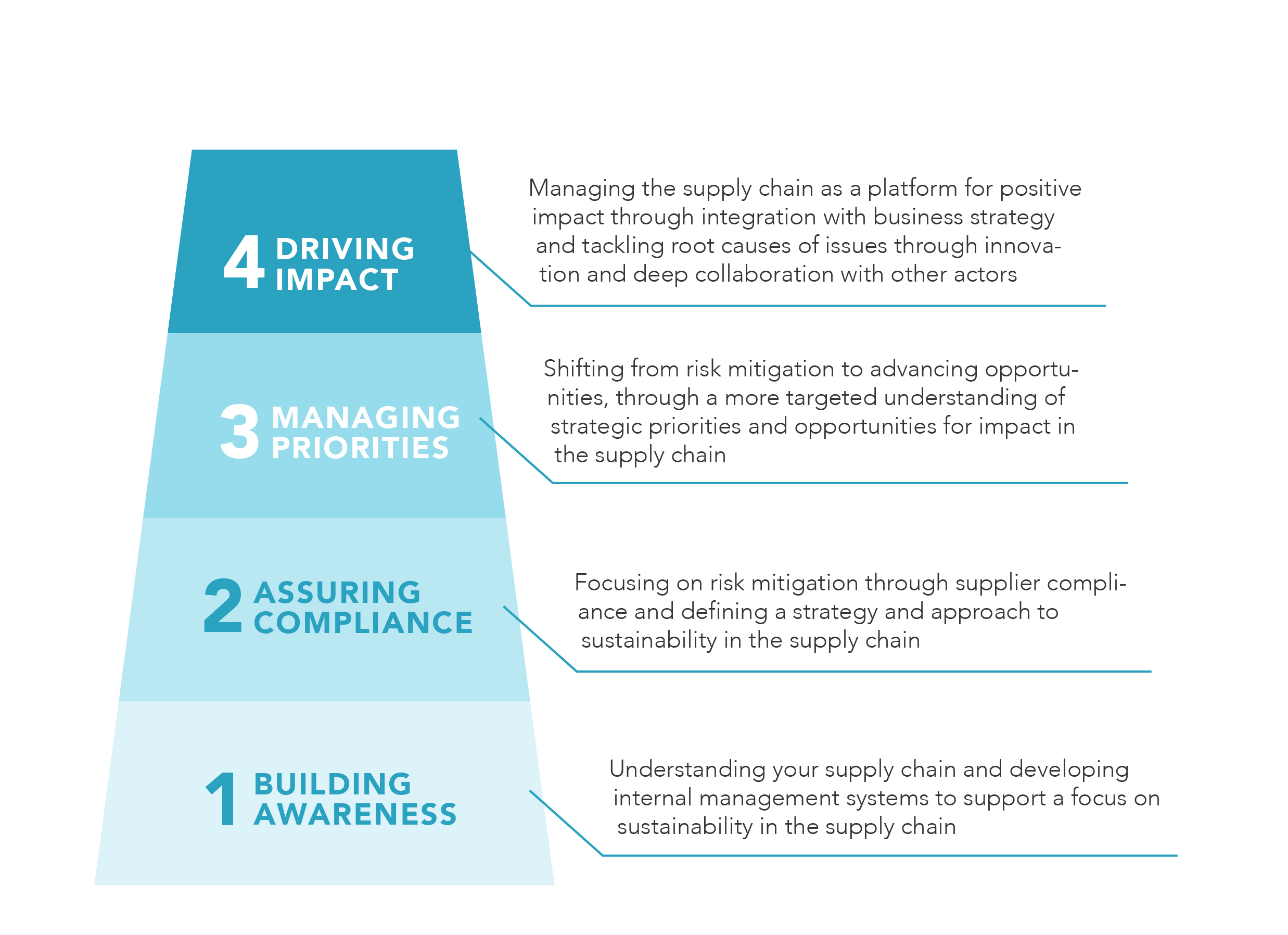
BSR’s Supply Chain Leadership Ladder sets out this framework. The ladder allows companies to benchmark their supply chain sustainability program and assess where they are in their maturity, based on the internal and external dimensions of their program.
- Internal dimensions are the scope and structure of the supply chain sustainability program and how the program is governed and managed.
- External dimensions are the company’s approach to supplier engagement and how it is collaborating and reporting.
Each rung of the impact ladder has a defining statement and a set of common elements that helps identify how far up the ladder a company’s supply chain sustainability program sits—is it at level 1, building awareness, or is it all the way up to level 4, driving impact?
Moving Up the Ladder
In the last year, we’ve seen a continued shift upward among leading companies, moving up the ladder from assuring compliance to managing priorities, across both internal and external dimensions.
For a few years now, we’ve seen companies shift their program scope to incorporate specific priority issues or supply chain categories and now really pushing toward driving impact. For example, companies are identifying the biggest impact categories in their supply chains—see Kering’s focus on sustainable raw materials and H&M’s sustainable cotton efforts. Companies are also addressing the issues that are most material for their business and aligned with action on global priorities such as the Paris Agreement and the Sustainable Development Goals. For instance, Walmart’s efforts at defining science-based climate targets for its supply chain, ANN INC.’s women’s empowerment program, and the Global Impact Sourcing Coalition, facilitated by BSR.
This trend is also playing out in the way companies are engaging their suppliers and reporting. The concerted effort by some companies to publicly disclose their supply chains, such as Marks & Spencer’s Interactive Supplier Map, in some ways draws a line under the compliance movement to allow a new way forward—through transparency. If everyone can see a company’s supply chain, there is arguably less incentive to continue the auditing processes of the past.
Even collaborative industry efforts are part of this trend. For example, the Electronic Industry Citizenship Coalition’s (EICC) initiatives on key supply chain risks show a move up the ladder from general compliance to identifying the areas where the 110-plus EICC members can collectively have the most impact. Even newer initiatives such as Railsponsible, a sustainable procurement initiative for the rail industry that BSR facilitates, is collectively identifying the key priorities in the industry’s supply chain for 2017.
BSR would argue that all companies, across all industries, in all geographies, and of all sizes should at least be on the ladder. How high you climb is up to your appetite for leadership, your ability to actualize value from your supply chain sustainability program, and the kind of legacy and impact you want to leave in the world.
We’re going to be hearing a lot about uncertainty in 2017. For supply chains, this is nothing new, and we offer the ladder as a framework for responsive, resilient supply chain management.
Blog | Wednesday June 7, 2017
Business Steps Up Leadership on Climate Action as U.S. Administration Withdraws
While consensus on climate action has long been elusive, companies from diverse sectors of the economy have stepped up and pledged to protect the standards of the Paris Agreement.
Blog | Wednesday June 7, 2017
Business Steps Up Leadership on Climate Action as U.S. Administration Withdraws
Preview
In the midst of political opposition from the Trump administration, which announced its withdrawal from the Paris Agreement on climate change on June 1, a cohesive and powerful voice has emerged: Business favors climate ambition for a shift to a low-carbon economy.
While consensus on climate action has long been elusive, companies from diverse sectors of the economy have stepped up to protect the standards of the Paris Agreement, which they see as a vital pillar for future growth, employment, competitiveness, and innovation.
An Ongoing Trend Grows Bigger
In the months leading up to COP21, where the Paris Agreement was written, the private sector mobilized to demonstrate its leadership on climate. Through initiatives such as We Mean Business, the Science-Based Targets initiative, or the UN’s Nazca platform, companies have showcased their ambition and commitment to contributing to the decarbonizaton of the economy, and they have voiced their demand for strong and stable regulation on emissions reductions.
Since then, the momentum has grown, even as real threats to American leadership have risen from the executive branch. Indeed, the past few months have seen support from the highest levels of business:
- Full-page ads in the Wall Street Journal, New York Times, and New York Post organized by C2ES supporting the agreement, with signatures from Adobe, Apple, Blue Cross Blue Shield of Massachusetts, Danfoss, Dignity Health, Facebook, Gap, Google, Hewlett Packard Enterprise, Ingersoll Rand, Intel, Johnson Controls, Levi Strauss & Co., Mars, Microsoft, Morgan Stanley, National Grid, PG&E, Royal DSM, Salesforce, Schneider Electric, Tiffany & Co., Unilever, and VF Corporation.
- An ad in the Wall Street Journal urging the president to stay in the Paris Agreement, signed by the 30 CEOs: 3M, Allianz SE, Bank of America, BROAD Group, Campbell Soup Company, Cargill, Citigroup, Coca-Cola Company, Corning, Cummins, Dana Incorporated, Dow, DuPont, GE, Goldman Sachs, Harris Corporation, Johnson and Johnson, JP Morgan Chase, Kering, Morgan Stanley, Newell Brands, PG&E, Proctor and Gamble, Royal DSM, Salesforce, Solvay, Tesla, Unilever, Virgin Group, and Walt Disney Company.
- More than 1,000 companies signed the “Business Backs a Low-Carbon USA” letter, which supports U.S. participation in the Paris Agreement, including DuPont, Hewlett Packard Enterprise, Hilton, HP, Intel, Johnson & Johnson, NRG Energy, PG&E, Schneider Electric, The Hartford, and Unilever.
- CEOs and spokespersons from companies such as ConocoPhillips, BP, Cheniere Energy, Cloud Peak Energy, Exxon, GE, Peabody and Arch Coal, and Shell have all expressed strong support for remaining in the Paris Agreement.
These public announcements have presented the business case for climate action and have demonstrated the need for strong and stable policies in order to meet investor, consumer, employee, and business demands. Privately, many more executives and senior leaders have contacted the Trump administration, emphasizing that a low-carbon economy is the backbone of American prosperity.
Business Is Drawing the Line
Within minutes of the White House Paris statement, business leaders expressed their opposition using the president’s favorite medium. Goldman Sachs CEO Lloyd Blankfein dedicated his very first tweet to the issue: “Today's decision is a setback for the environment and for the U.S. leadership position in the world.” Tesla CEO Elon Musk and Walt Disney Company CEO Robert Iger used the social media platform to announce they would step down from the President’s Business Council.
GE CEO Jeff Immelt tweeted that climate was now in the hands of business and ruled out the current government as a partner. Google CEO Sundhar Pichar renewed the company’s commitment to working toward a more prosperous and cleaner future, as did Salesforce CEO Mark Benioff. Microsoft President and Chief Legal Officer Brad Smith and Apple CEO Tim Cook also strengthened their resolve to contribute to the fight against climate change. Twitter CEO Jack Dorsey announced his discontent on the platform. On his company’s platform, Facebook CEO Mark Zuckerberg made a public statement in favor of continuing to act in favor of climate in a way that makes business sense.
Amazon, Dell, and Intel weighed in via Buzzfeed, insisting that not only is there is no contradiction between a low-carbon economy and a prosperous America, the opposite is true. HP issued a press release, saying the longevity of its business was at stake. IBM did the same.
The business voice is not only shaped by global tech companies: Ford and General Motors were also quick to respond to the president’s decision, stating that their commitments to emissions reductions would not change.
And just days after the withdrawal announcement from the White House, more than 900 businesses and investors have joined hundreds of cities, states, and universities in signing the We Are Still In statement to declare their continued support for climate action to meet the Paris Agreement, using the hashtag #WeAreStillIn.
How Business Leads
Leaders of some of the world’s most successful companies clearly see that remaining in the Paris Agreement and maintaining policies that favor emissions reductions is good for their bottom line as well as for the country. Companies have already seen significant cost savings, better supply chain management, and they have spurred innovation and employment by tackling climate change while responding to investor and consumer demands.
Business is leading opposing the federal government and marching on with its own climate commitments, which are consistent with business imperatives. And business can count on the support of local and global politics. Even though the United States withdrew from the Paris Agreement at the national level, 30 mayors, three governors, and 80 university presidents in U.S. cities and states have shored up climate action in line with the requirements of the international accord. And globally the 195 parties to the Paris Agreement remain staunch in their determination to make good on their goals. While the White House’s withdrawal from Paris is a major mistake, it has also served to underscore the broad and deep support for climate action in the United States. In our judgment, this will prove to be longer-lasting than the foolish, regressive approach taken by the president.
In this context, business can be assured that its ambition will be met and enabled at both the local and global levels—and we can be assured that the world’s business leaders will work to keep the global temperature rise under 2°C.
Audio | Thursday February 6, 2025
A Conversation with Mario Abreu, Group VP, Sustainability, Ferrero
Mario Abreu, Group VP, Sustainability at Ferrero chats with BSR Managing Director, Transformation Christine Diamente, and host David Stearns about the cross-functional role of sustainability at Ferrero, how he maintains a focus on ambition, and why the nexus between climate change, people, food, and planetary limits should be humankind’s top…
Audio | Thursday February 6, 2025
A Conversation with Mario Abreu, Group VP, Sustainability, Ferrero
Preview
Mario Abreu, Group VP, Sustainability at Ferrero chats with BSR Managing Director, Transformation Christine Diamente, and host David Stearns about the cross-functional role of sustainability at Ferrero, how he maintains a focus on ambition, and why the nexus between climate change, people, food, and planetary limits should be humankind’s top priority.
Audio | Tuesday October 1, 2024
Reflections from Climate Week NYC: The Tension Between Pragmatism and Ambition
…BSR’s events, including a debate over whether American political leadership is needed for advancing global climate action and shaping climate policies. Aron also highlights two new BSR publications featuring guidance for sustainability leaders on navigating these turbulent times, and new insights from over 30 Chief Sustainability Officers of BSR member…
Audio | Tuesday October 1, 2024
Reflections from Climate Week NYC: The Tension Between Pragmatism and Ambition
Preview
Immediately following Climate Week NYC, BSR President and CEO Aron Cramer chats with David Stearns about some of the inconvenient truths facing sustainability leaders going into this annual gathering, observations that gave him cause for optimism, and a look inside some of BSR’s events, including a debate over whether American political leadership is needed for advancing global climate action and shaping climate policies. Aron also highlights two new BSR publications featuring guidance for sustainability leaders on navigating these turbulent times, and new insights from over 30 Chief Sustainability Officers of BSR member companies.
Blog | Thursday June 2, 2022
Human Rights in the Healthcare Sector: Current State of Play
Over the past 18 months, BSR has worked with leading healthcare companies to assess the state of play in human rights practices. We share our maturity curve to chart healthcare companies’ approach to human rights.
Blog | Thursday June 2, 2022
Human Rights in the Healthcare Sector: Current State of Play
Preview
The COVID-19 pandemic has placed a spotlight on the pharmaceutical (pharma) industry and its ability to deliver global solutions at speed and in an equitable manner. Regulatory and stakeholder expectations on the corporate duty to respect and manage human rights impacts are rising—and scrutiny on the performance of the healthcare sector is likely to continue.
Healthcare companies have a huge opportunity to improve the health and well-being of individuals and entire societies. However, their activities can also cause harm to the human rights of patients, employees, supply chain workers, and local communities.
Under the UN Guiding Principles on Business and Human Rights (UNGPs), companies have a responsibility to prevent, mitigate, and remedy adverse impacts on people due to their business activities. As explored in previous BSR publications, salient human rights issues in the healthcare sector include ethical standards in research and development (R&D) and clinical trials, affordability, and accessibility of medicines and pharmaceuticals in the environment.
In the past 18 months, BSR has worked with leading healthcare companies to assess the state of play in human rights practices. Based on our analysis, we have developed a maturity curve to chart healthcare companies’ approach to human rights. We have identified four levels of maturity, from reactive compliance to public leadership on the business and human rights agenda.

From our research on the state of play of human rights due diligence in the pharma sector, we have concluded the following:
Healthcare Companies Are Making Progress
Leading pharma companies have made strides in recent years to meet human rights due diligence expectations in line with the UNGPs. Most companies assessed have a defined approach to human rights, with a basic due diligence process in place and dedicated functions working on human rights. Furthermore, it has become common practice for pharma companies to have made commitments to human rights, identify salient human rights issues, and report on their human rights due diligence.
Leading Pharma Companies Have Embedded Human Rights into Business Operations
Leaders in the field are demonstrating a strong level of integration of human rights into their business operations. Industry best practice includes conducting human rights assessments not just at a corporate level, but also a country level (either internally or with support from external consultants), by training internal auditors on human rights requirements to ensure they can support diligence processes and increased transparency on key challenges.
Insufficient Focus on Vulnerable Groups
A common challenge for healthcare companies is the integration of a vulnerable groups lens in their human rights due diligence. Most companies in the healthcare sector fail to identify vulnerable groups—including women, children, and people with disabilities—along with issues that may impact them more significantly. They also fail to identify or provide grievance mechanisms that are adapted to diverse groups.
Healthcare companies can go further to push the boundaries toward the business and human rights agenda. While a handful of companies are strongly aligned with the expectations of the UNGPs, there is scope for pharma companies to set the bar even higher on business and human rights. This includes through public leadership and proactive engagement on salient issues and increased transparency on human rights due diligence. Current and emerging issues for the pharma industry—including access to health, the nexus between climate and health, and bioethics challenges—demand robust human rights practices and industry collaboration.
Blog | Thursday March 10, 2022
Empowering Women Fruit Farmers with Digital Training
Responsible business is deepening its commitment to empowering women across the value chain. One such example is Fyffes and HERproject expanding the new digital program HERessentials across several Latin American countries.
Blog | Thursday March 10, 2022
Empowering Women Fruit Farmers with Digital Training
Preview
As responsible business deepens its commitment to empowering women across the value chain, new opportunities have arisen, which can improve operations and benefit both business and workers. One such opportunity is via an educational online tool that HERproject and Fyffes kickstarted last year in Latin America and the Caribbean. The tablet-based program works directly in fruit fields in the region, using videos, games, and quizzes that illustrate a selection of everyday situations that workers face both in the workplace and at home. It aims to challenge traditional gender stereotypes and provides essential information on health, financial resilience, and stress management while improving overall digital literacy.
The Gender Equality Observatory for Latin America and the Caribbean points to limited progress for gender equality in the region. One in three women do not earn a regular income, making them economically dependent on others. This, combined with a disproportionate burden of domestic activities and low representation in senior leadership positions, unions, and cooperatives, drastically reduces women’s opportunities in the workplace.
Considering the impact of the COVID-19 pandemic, as well as limited access to information in rural settings, Fyffes and HERproject expanded the new digital program HERessentials across Fyffes-owned banana, melon, and pineapple farms in Costa Rica, Ecuador, Honduras, and Belize.
To date, 1,100 Fyffes workers have been trained using the App. Drawing upon experience working in Latin America and the Caribbean, key insights are summarized below:
How to Gain Buy-in from Farms and Build Ownership of the Training Program
Fyffes identified that the ambition of addressing gender issues at the farm level came from gender equality being one of its core sustainability targets. Championed by the senior leadership team, this focus enabled the farm teams to prioritize gender amidst demanding schedules and other priorities. HERessentials has been a key tool in helping them achieve this goal.
Another crucial part in successfully creating ownership has been the leadership of on-site management and human resources teams, who created gender management committees to aid the implementation of the program. Each team has embraced HERessentials and driven the program forward week by week.
How to Train and Engage Workers, Especially Women, in Farms
The use of technology could make it challenging or intimidating for workers to engage in the program. However, HERessentials is a self-driven program that gives workers full autonomy to navigate the modules at their own pace. Creating a comfortable space and building trust with the facilitator guarantee high engagement levels. HERessentials works offline and can be delivered in a setting that is less intimidating than the classroom, such as the field, a lunchroom, or community area.
Fyffes has introduced a liaison element to speak informally to workers about the challenges they face, both at home and in the workplace, around the topics covered in the training. The workers relish this opportunity to open up and discuss issues.
“The issues covered in the training are very relevant within the reality of the communities where we operate. It is this simple approach of providing relevant information, that makes employees decide if they will continue to receive more training in other issues such as reproductive health, occupational health, financial management and stress, for example. HERessentials has been very well received, and it is certainly of benefit to our employees and their families.”
—Alejandro Cordero, human resources manager at Fyffes, Costa Rica
How to Make Training Content Relevant to the Agricultural Sector and to the Region
HERessentials is now ready to be implemented in any Latin American country, and it is suitable for multiple agricultural sectors. This makes it an appealing tool to work with stakeholders to achieve sustainability goals, which Fyffes has demonstrated by engaging both IDH—The Sustainable Trade Initiative and Lidl GB as partners in HERessentials implementation.
In the upcoming years, Fyffes will continue to use HERessentials to reach its sustainability target: 100 percent of Fyffes-owned sites in Latin America will benefit from gender equality programs by 2025 and 50 percent of its suppliers by 2030. The next step is to expand the program to banana suppliers in Nicaragua, Colombia, and Costa Rica, aiming to incorporate small producers, where women workers face additional challenges than in conventional farming systems.
HERessentials is flexible and works in any rural setting, from fruit to coffee, cacao, and flowers. If you're interested in learning more, please contact the HERproject team.
Audio | Wednesday January 8, 2025
A Conversation with Darsh Myronidis, Group Director of Sustainability, Virgin
Darshana Myronidis, Group Director of Sustainability at Virgin Group, chats with BSR Managing Director, Transformation Christine Diamente, and host David Stearns about of the evolution of her role at Virgin, strategies for embedding sustainability within a company, how to maintain momentum in the face of externalities developments like the recent…
Audio | Wednesday January 8, 2025
A Conversation with Darsh Myronidis, Group Director of Sustainability, Virgin
Preview
Darshana Myronidis, Group Director of Sustainability at Virgin Group, chats with BSR Managing Director, Transformation Christine Diamente, and host David Stearns about of the evolution of her role at Virgin, strategies for embedding sustainability within a company, how to maintain momentum in the face of externalities developments like the recent outcome of the U.S. election, and where the greatest opportunities for significant progress lie.
Blog | Tuesday May 30, 2017
Despite U.S. Uncertainty on Paris, Business Momentum for Climate Action Remains Strong
BSR urges the United States to remain in the Paris Agreement on climate change, and we are confident that the business community will continue to lead on climate action.
Blog | Tuesday May 30, 2017
Despite U.S. Uncertainty on Paris, Business Momentum for Climate Action Remains Strong
Preview
At the G7 Summit concluded this past weekend, the United States was unable to join consensus on the Paris Agreement on climate change, with a decision postponed to this week. BSR urges the United States to remain in the Paris Agreement on climate change. In this we are joined by the CEOs of major American companies, by some of the largest companies operating in the United States, and by more than 1,000 companies that employ 1.85 million Americans who have reaffirmed their commitment to American participation in the Paris Agreement.
We are confident that the business community will continue to lead on climate action, following the vision of the Paris Agreement, informed by climate science, and driven by the business imperative for innovation, jobs, and growth. U.S. participation in and implementation of the Paris Agreement would speed our transition to a resilient, low-carbon economy, enable American and global businesses to face the future with confidence, and spark innovation that will create shared prosperity.
Although the U.S. administration is pulling back from its leadership at home and abroad, incredible momentum on climate action remains. The business community is increasingly reducing greenhouse gas emissions and building climate resilience in line with the Paris Agreement. We anticipate that this leadership will accelerate, as companies set and implement targets for their own operations and throughout the vast global footprint of their value chains, and protect workers in these value chains from inevitable climate impacts.
For example, Walmart’s Project Gigaton aims to remove one billion tons of emissions from its supply chain by 2030—equal to the annual emissions of Germany. And last week HPE launched a supply chain program based on climate science to remove 100 million tons of emissions—equal to the annual emissions of Greece. 266 companies have now committed to setting science-based targets which represent their share of keeping warming well below 2°C. General Mills has committed to a 28 percent reduction by 2025 across its value chain, from farm to fork to landfill.
The low-carbon economy will take the lion’s share of finance in coming years. Annual renewable energy investment has grown from US$45 billion to more than US$270 billion over the last decade—by a factor of six. Through 2040, US$7.8 trillion out of the US$11.4 trillion invested in power generation will go toward renewable energy.
The low-carbon economy will also generate innovation and jobs. For instance, Goldman Sachs predicts that electric vehicles will experience a compound annual growth rate of 32 percent in the next 10 years, and Tesla aims to produce battery cells by 2020 that are 30-35 percent cheaper than they are today. The solar and wind industries are both creating jobs 12 times faster than the rest of the U.S. economy. Smart policy incentives will accelerate this low-carbon innovation, bringing wide economic benefits.
Together, we’re building a resilient, low-carbon economy that enables growth, good jobs, security, strong communities, and a healthy planet. We believe the business community understands the inevitability of the low-carbon transition and recognizes the opportunity it represents. U.S. withdrawal from the Paris Agreement, and the withdrawal of domestic policies which implement the agreement, are major errors which would weaken our economy, our health, and our environment.
Blog | Thursday July 17, 2025
Strengthening Supply Chain Sustainability: Eight Dimensions for Responsible Business
As recent global events disrupt supply chains, it is vital to remain focused on the fundamentals of value chain management to enable resilience and efficiency. BSR’s freshly updated Value Chain Leadership Ladder aims to help companies assess their maturity in supply chain management across eight key dimensions.
Blog | Thursday July 17, 2025
Strengthening Supply Chain Sustainability: Eight Dimensions for Responsible Business
Preview
Impacting billions of livelihoods and ecosystems around the world, value chains are a critical lever for business action and progress on climate and sustainable development. The pandemic, geopolitical tensions and wars, extreme weather events, and increasing and then diverging corporate sustainability regulations are just some of the disruptive events that have impacted the daily realities of supply chain management professionals and communities along the value chain. We have reached a point where the need for action is ever more urgent, yet the context for decisions and investments is growing increasingly more complex and seems to be in a constant state of flux.
In these chaotic times, it’s imperative to take care of the fundamentals (e.g., supplier relationships) that enable supply chain resilience and efficiency. It's impossible to accurately predict how current trade tensions will play out or what crises will come next; however, strong foundations and enduring value chain relationships will best equip companies to navigate these challenging times.
Informed by 30+ years of working with companies on downstream and upstream impacts across industries, our freshly updated Value Chain Leadership Ladder outlines how to advance business leadership in value chain sustainability. It is designed to help companies assess the maturity of their value chain sustainability processes and programs across eight fundamental dimensions, which enable solid supply and/or value chain management and sustainability progress. Performing the assessment helps evaluate the extent to which companies have a robust program in place and informs key actions in each of these areas.
The Ladder’s internal dimensions focus on actions that companies can take within their own organizations:
- Value chain knowledge and understanding: Knowledge is power. Having a better understanding of your value chain and the people, organizations, relationships, ecosystems and dynamics within not only supports effective and context-specific sustainability action, but also enables companies to anticipate the implications of shocks (e.g., tariffs, climate events) and allows for effective contingency planning.
- Strategies and processes: Increasing integration between companies’ sustainability and supply chain strategies ensures they are actively addressing material business risks (e.g., supply security) and capturing opportunities for sustainability-related competitive advantage and innovation.
- Commercial terms and buying practices: Approaching these with principles of fairness and shared value positions companies for collaborative relationships that (i) can support navigating value chain volatility and (ii) don't undermine business partners’ ability to make investments that support their buyers (e.g., investments in innovation, in excellence, and in addressing sustainability risks to which buying companies are also exposed).
- Governance and management: Appropriate oversight and institutional capacity and incentives are essential to achieve a company’s supply chain and sustainability objectives.
The external dimensions highlight how companies can pursue progress on sustainability goals beyond their own operations:
- Business partner engagement: Considerate and collaborative supplier and business partner engagement is a critical path for developing innovative sustainability solutions, mitigating sustainability and human rights-related risk, and conducting due diligence.
- Value chain worker and community engagement: Meaningful engagement with workers and communities along the value chain can help companies anticipate emerging issues, address long-term business risks (e.g. low farming incomes deterring young farmers), and identify and address serious human rights violations.
- Collaboration: Working collectively can help deepen and amplify progress on mutual sustainability goals. By sharing resources and knowledge with each other, companies can solve business-critical risks together that they might not be able to address alone.
- Reporting: Disclosure on various topics, whether specific (e.g., forced labor) or broad (e.g., sustainability and due diligence measures), remains and is becoming more important for regulatory compliance in many countries. Furthermore, decision-useful reporting helps investors and other business-critical stakeholders understand and gain confidence about the company’s value chain context and management of related issues.
Recommendations for Companies
Sustainability and supply chain leaders are operating in a turbulent context. With new regulations, growing interest in responsible value chains, and continued instability, companies need to take a more collaborative approach to supply chain sustainability and supplier engagement, stepping away from expensive, data-intensive practices. With these challenges in mind, the Ladder encourages companies to work in these ways:
- Expand from “supply chain” to “value chain.” Companies can consider impacts on society and the environment all along the value chain, reflecting a growing recognition of the salience of downstream impacts and their inclusion in due diligence regulation. The Ladder enables a more dynamic assessment as companies/industries vary in where impact is greatest (upstream/downstream).
- Elevate the importance of solutions that are co-created with and led by suppliers and workers. While it’s been long acknowledged that partnership between suppliers and workers enables greater and more sustained impact, sustainability solutions have too often been centered on buying companies’ priorities, rather than leveraging the skills and ideas and catering to the needs of the groups who are most impacted. Companies can provide the most impacted people with a priority role in solutions development and take a collaborative and enabling role in co-creation and solutions led by relevant groups.
- Reinforce balance between data, measurement, and context. With the proliferation of digital tools, standards, and regulation, it is even more urgent to avoid overburdening suppliers with data collection. Companies need to be mindful of the context for suppliers, business partners, and workers; to focus on data that is meaningful and useful; and to recognize its limitations.
- Maintain responsibility when increasing agility. Agility is the watchword as 2025 continues, but it comes with implications for human rights and sustainability as supply chain and sourcing regions shift (e.g., loss of livelihoods). The Ladder encourages companies to integrate sustainability principles in making and implementing decisions, with due diligence and responsible onboarding and exit as key frameworks to follow.
When companies are understandably forced by recent events into reactive decision-making, they may fail to consider the long- or medium-term implications for their relationships with suppliers and impacts on communities. Focusing on the fundamentals of value chain management, supported by tools like the Value Chain Leadership Ladder, can help companies move away from reactivity and into proactive, less transactional efforts.
Interested in learning more about addressing today’s global challenges in your company’s value chains? Contact BSR’s Supply Chain team to understand the strengths and gaps in your current supply chain approach.