Searching for: social media
Search results: 41 of 81
Blog | Wednesday November 28, 2018
Four Steps to Align ESG and Enterprise Risk Management (ERM)
We have assessed the major needs and challenges to align sustainability priorities with ERM and we recommend the following four-step approach.
Blog | Wednesday November 28, 2018
Four Steps to Align ESG and Enterprise Risk Management (ERM)
Preview
As outlined in BSR’s recent report, Redefining Sustainable Business: Management for a Rapidly Changing World, resilient business strategies require an enterprise risk management (ERM) approach that effectively incorporates sustainability risks of material significance to the company, such as climate change, natural resource availability, and social volatility.
An executive we recently interviewed outlined it this way: “Risk awareness needs to become much greater now that we are living in a riskier world and facing issues such as the rise of authoritarianism, cybercrime, and migration. We will see companies having much greater oversight of risk, and investors will be much more demanding of this than in the past.”
Risk awareness needs to become much greater now that we are living in a riskier world and facing issues such as the rise of authoritarianism, cybercrime, and migration. We will see companies having much greater oversight of risk, and investors will be much more demanding of this than in the past.
There is a clear opportunity for companies to utilize the outputs of sustainability-oriented materiality assessments and align materiality and risk identification processes.
The World Economic Forum’s 2008-2018 annual Global Risk Reports show that environmental and societal risks have overtaken economic and geopolitical risks in terms of both likelihood and impact. However, companies are not addressing conventional risks and sustainability risks equally. According to WBCSD, fewer than one in three issues identified in sustainability materiality assessments are disclosed as risk factors in legal filings for investors.
Failing to manage ESG risks can lead to material business impacts, including missed profits, operational impacts, and loss of license to operate. Meanwhile, mainstream investors are increasingly emphasizing disclosure of ESG risks, monitoring ESG performance, and reporting on ESG issues: The recently released 2018 US SIF report found that investors today consider ESG factors across US$12 trillion of professionally managed assets, which represents a 38 percent increase since 2016. Although risk and sustainability teams are often siloed, there is a clear business case for corporate sustainability leaders to collaborate with risk teams on shared goals.
Incorporating sustainability into ERM can strengthen a company’s understanding of its full suite of risks, improve its sustainability management, and enhance overall business performance. Likewise, incorporating an ERM lens into materiality assessments can help to translate results into language relevant to the business. BSR has assessed the major needs and challenges to align sustainability priorities with ERM and recommends the following four-step approach:
- Identify the full spectrum of your company’s risks—including environmental, social, and governance risks. Use ESG risk identification methods, megatrend analysis, and media monitoring (for example, using tools like Polecat), to comprehensively identify both established and emerging risks.
- Align on priority ESG issues for inclusion in ERM and modify your ERM inventory accordingly. Conduct a gap assessment of your existing risk inventory, translate specific emerging and existing material issues across priority ESG issues and existing ERM issues, and make necessary adjustments to your materiality analysis and risk inventories.
- Evaluate relevant risks for likelihood, vulnerability, and impact. Use high-level risk assessments that consider less conventional criteria like impacts to reputation, speed of onset, persistence, and ability to mitigate to help enhance understanding of difficult-to-measure sustainability risks. You can also leverage forecasting and futures scenario analysis to assess the unique characteristics of longer-term and rapidly emerging sustainability risks.
- Maintain ongoing ERM and materiality alignment. Put effective governance structures in place that ensure emerging and evolving issues are captured by both sustainability and ERM teams to support ongoing ERM and materiality alignment.
This approach can help your company improve its processes to better manage emerging, cross-cutting, significant, and long-term risks. If you’d like to learn more about how we can help your company align your sustainability and risk management frameworks and priorities, please contact us.
Blog | Wednesday October 24, 2018
Millennials, Gen Z, and the Future of Sustainability
As millennials and Generation Z become a more and more influential consumer group and employee demographic, the demand for sustainability and purpose is likely to increase.
Blog | Wednesday October 24, 2018
Millennials, Gen Z, and the Future of Sustainability
Preview
In the 2018 BSR/GlobeScan State of Sustainable Business survey, we learned that corporate reputation remains the number one driver of sustainability efforts at BSR member companies. Consumer/customer demand came in second; yet many sustainability leaders believe there is room for improvement in their communications about their sustainability efforts to these groups.
A New Blueprint for Business
Join us at BSR18 for a conversation with millennials in sustainability: Our Future Leaders: Engaging Millennials and Gen Z.
Investments in more sustainable products and a more coherent sustainability narrative are likely to pay increasing dividends: As millennials (born between 1981 and 1996) and Generation Z (born between 1996 and 2011) become a more and more influential consumer group and employee demographic, the demand for sustainability is likely to increase.
An entire blog post—and then some—could be written about the differences between these two generations. Yet many of the business implications of their increasing influence are the same.
Specifically, these two groups, more than older generations, highly value two things:
- Meaningful work
- Products that align with their values
As millennials and Generation Z become a more and more influential consumer group and employee demographic, the demand for sustainability and purpose is likely to increase.
This presents major opportunities for sustainable business. Here are two ways that you can realize them.
1. Invest in and communicate about your sustainability programs to support employees’ desire for meaningful work.
Study after study has shown that purpose is what both attracts and keeps younger workers. This is a huge opportunity for companies that are hoping to hire and retain the next generation of talent: Millennials became the largest generation in the labor force in 2016, and they will make up 75 percent of the global workforce in 2025.
Unfortunately, only a minority of millennials believe that businesses behave ethically and business leaders are committed to helping improve society, the 2018 Deloitte Millennials study found. Gen Z and Millennials both cited “being a good employer” as the number one CSR issue they care about, consistent with the general population, but more than older generations, they seek out employment at companies that demonstrate a commitment to responsibility.
In one survey, three quarters of millennials indicated they consider a company’s social and environmental commitments in deciding where to work, and two thirds said they would not accept a job somewhere without a strong sustainability program.
We learned in the BSR/Globescan survey that although many companies speak about employee engagement and recruitment as a primary benefit of sustainability efforts, less than 20 percent of company respondents saw it as a top-three driver of their programs.
However, some companies, like Workday, are investing in becoming desirable places to work for younger employees. Millennials make up 53 percent of Workday's almost 9,000 employees today. The company has “anchored its culture in research on generational differences,” which has included creating career development opportunities for employees, collecting data on employee engagement, building green teams, and placing a high priority on a giving its people a sense of purpose.
This appears to be paying dividends. The organization, ranked fourth on the 2018 “100 Best Workplaces for Millennials” list, has reported 35 percent revenue growth over the past three fiscal years and an 80 percent retention rate for its new-hire program for recent college grads.
2. Take a position on social and environmental issues—and make sure it’s consistent with your actions.
In a recent LIM College study, almost 90 percent of respondents agreed, “Millennials and Gen Z will help create more sustainably-produced products by convincing businesses and governments to alter existing practices.” In other words, these consumers are creating demand for sustainable products, from clothing to home goods to cars.
Moreover, Cone Communications found that Gen Z, which will account for 40 percent of all consumers globally by 2020, is the generation most likely to believe that companies should address urgent social and environmental issues: 94 percent of those surveyed said so (compared to 87 percent of millennials).
This isn’t limited to products, either. It also applies to a brand’s approach to social justice issues. As synthesized in a recent issue of Above the Bottom Line, FleischmanHillard’s latest research reveals that two thirds of U.S. consumers and 80 percent of U.K. consumers say they have stopped using products or services because the company’s response to a certain issue doesn’t align with their views.
The same research suggests that approximately 60 percent of consumers expect companies to speak up on important issues, even if those same consumers don’t agree with the companies’ positions—and this is true for 75 percent of millennials.
As millennials and Gen Z make up a larger and larger proportion of consumers around the globe, companies will increasingly need to be prepared to take a position on social debates and back it up with action.
It’s worth noting, however, that our recent Polecat research suggests that consistency in public policy efforts and overall positioning isn’t only important for people born after 1981: This issue ranked second as a priority for the public overall in our scan of social media conversations.
Millennials and Gen Z are already changing what is expected of business, and resilient companies are addressing this reality now through investments in sustainability, integrity, and advocacy.
If you’re interested in hearing about the future of sustainable business directly from a few of the millennial leaders who will bring it to life, join us at the BSR Conference 2018 in New York City November 6-8.
Blog | Wednesday October 4, 2023
Nine Ways to Mitigate Risk of Child Labor Across the Supply Chain
Instances of child labor are increasing across the world. Learn more about how businesses can mitigate these risks.
Blog | Wednesday October 4, 2023
Nine Ways to Mitigate Risk of Child Labor Across the Supply Chain
Preview
Child labor is on the rise across the world, with increasing incidence in wealthier nations, challenging the common assumption that it is primarily an emerging economy concern. Workforce shortages, migration patterns (including the increasing presence of undocumented workers and their children) conflict, and weakening regulations around child labor—particularly in the US—are all contributing to the rising exploitation of underage workers in high-income countries. This is especially true for industries that rely on low-skilled and flexible labor, including manufacturing, agriculture, and automotives, among others.
In the US, the Department of Labor (US DOL) reported that child labor violations have increased by 70% since 2018. Instances of child labor violations have been uncovered both in the supply chains of agriculture and meat processing facilities in the US, as well as in front-of-house positions within fast food restaurants. Meanwhile, at least 10 states have passed laws to weaken child labor standards in the last two years—including extending working hours and eliminating work permits for teenagers. Migrant and undocumented children are among the most vulnerable: the U.S recently opened investigations into Tyson Foods and Perdue Farms for child labor violations alleging that contractors working for the companies hired migrant children.
Children are increasingly used to fill labor gaps, with migrant and undocumented children particularly vulnerable to exploitation. Outside the US, Australian food companies are also facing allegations of breaking child labor laws, while a café reportedly hired 11-year-old children to address labor shortages. In Russia, there are movements to ease child labor laws and regulations to help the country fill workforce gaps left by the war with Ukraine, which has also exacerbated risks.
Adverse Impacts of Child Labor
Child labor refers to work that is dangerous, excessive, or harmful to children, including mental and physical well-being. According to UNICEF, many child laborers are subjected to long working hours, hazardous working environments, physical injuries, and mental, emotional and developmental health impacts making even them more vulnerable to trafficking and abuse.
In addition to jeopardizing children’s health, safety and development, child labor can have long-term impacts on families and communities. According to the ILO, more than 25% of children aged 5 to 11 and over 33% of children aged 12 to 14 who are in child labor do not go to school. By disrupting or ending schooling, child labor limits future work and economic opportunities, increasing income inequality over generations.
Implications for Business
Child labor is a violation of international human rights and labor rights laws and standards. Businesses that employ children or have child labor in their supply chains—including those in high-income countries—face reputational damage, compliance and legal risks. According to the US Labor Department, there has been an 87% increase in fines on employers in recent months, and companies across the country have been hit with $6.6 million in penalties for child labor violations.
Companies must navigate a complex regulatory landscape, with differing approaches to regulations across regions—and within countries – as well as increased scrutiny to counter weakened protections. In the US, companies may be caught between conflicting State and Federal laws. Amidst weakening regulations at the State level, the US federal government has taken steps to intensify labor investigations. The USDA has responded by increasing efforts to combat child labor in the meatpacking industry, while the Fair Labor Standards Act (FLSA) plays a crucial role in regulating and protecting workers' rights in these circumstances. Similarly, in Australia, the federal government has engaged in a new pledge to ‘stamp it out’ with similar calls in New Zealand.
While there are movements within some countries to reduce protection for children in the workforce, other countries and regions are taking a strong stance against child labor and requiring companies to eliminate the practice from their operations and supply chains.
In the United Kingdom, there have been calls from the All-Party Parliamentary Group on Street Children in June 2023 to outlaw child labor entirely. In Canada, the House of Commons has passed a bill aimed at tackling forced and child labor; however, critics argue that corporations still find ways to evade meaningful accountability. At the regional level, the EU has adopted a zero-tolerance policy on child labor in its new trade agreements and has implemented an EU Strategy on the Rights of the Child to further protect children's rights. At the global level, the ILO has set minimum age requirements for work and states that 15 years is the minimum age for work (13 for light work), while hazardous work is only permitted for individuals aged 18 or 16 under certain strict conditions.
Child labor also has long-term impacts that could make the operating environment for business more challenging in the future. In underregulated areas, procurement teams may find it difficult to determine whether possible new suppliers or business partners have child labor in their operations or their own supply chains, which could trigger new and emerging human rights and modern slavery reporting requirements. Additionally, by exacerbating existing social inequalities, child labor can reduce the earning potential of already disadvantaged groups, which can prompt the decline of a diverse and skilled workforce.
Online activities, not yet covered by child labor laws, further complicate the regulatory landscape for business. A new law in Illinois introduces the first protections in the US for Child Influencers, or children with large social media followings, entitling under-16s to a proportion of earnings from social media posts.
What can businesses do?
-
Adopt and implement clear corporate policies that prohibit the use of child labor and set out expectations for ethical business for suppliers and business partners.
-
Conduct human rights due diligence to determine how certain factors may increase risks of child labor in their own operations or supply chains, including increased migration, economic downturns, and conflict. Companies in high-risk sectors can also conduct enhanced human rights due diligence and specific child rights risk assessments.
-
Engage suppliers by awareness-raising, training, and capacity building to prevent, identify and address child labor, including understanding the root causes. Companies should also train and monitor supplier subcontractors and recruitment agencies.
-
Provide decent work opportunities, including traineeships and apprenticeships, to young workers and adolescents while equipping them with relevant skills needed to prepare for the future workforce.
-
Collaborate with peers, industry, business across different sectors, and suppliers to jointly address systemic risks of child labor and other forms of modern slavery. The Global Business Coalition Against Human Trafficking (GBCAT), for example, aims to scale business action to prevent modern slavery, including child labor, through supplier capacity building, survivor empowerment and employment, leveraging technology solutions to fight human trafficking, and addressing the misuse of technology to facilitate crime.
-
Where possible, work with relevant stakeholders to advocate for strengthening legislation to protect against child labor violations.
-
While companies should, at a minimum, comply with national laws and regulations, they should always adhere to the highest standard (as enshrined in international laws, standards, and regulations).
-
Publish and report risk assessment findings (including in operations and supply chains) to help increase industry transparency around risks and root causes and demonstrate actions that are being taken to prevent, identify and address child labor.
-
Collaborate with relevant stakeholders to provide appropriate remediation where child labor is identified on a case-by-case basis. This also includes requiring suppliers to have a robust remediation plan.
Debate and leadership are required to ensure child protections are fit for a changing world, and not to jeopardize tomorrow’s workforce for short-term gain. Contact us to understand how your company can lead within an increasingly complex and fragmented global human rights landscape.
Blog | Monday August 30, 2021
Sustainable from the Start: Embedding ESG into High-Growth Business Strategy
Younger, high-growth companies face unique challenges and opportunities as they expand business while also considering environmental, social, and governance (ESG) factors. What are the main considerations for a high-growth company at the start of its ESG journey?
Blog | Monday August 30, 2021
Sustainable from the Start: Embedding ESG into High-Growth Business Strategy
Preview
We are experiencing a profound shift in stakeholder expectations and business growth strategy: sustainability is more important than ever before. Younger, high-growth companies—those that either are privately held or recently went public—face unique challenges and opportunities as they expand business while also considering environmental, social, and governance (ESG) factors, be it climate change, privacy, diversity, or a range of other material issues.
Over the past two years, we have hosted quarterly convenings for high-growth companies to share challenges and approaches on a variety of ESG topics. In these meetings, BSR spoke with company sustainability leaders, who shared how their experiences might apply to younger businesses. Based on the outcomes of these discussions, what are the main considerations for a high-growth company at the start of its ESG journey?
First Up: Identify Material ESG Issues
Conducting a materiality assessment is an essential “do this first” step to jump-starting an ESG strategy. A materiality assessment is a widely used approach to help companies develop ESG priorities by understanding the most important topics. It identifies key areas of overlap between enterprise value creation (“impact inwards”) and impact on society and the environment (“impact outwards”).
Materiality can help a young company: 1) align on relative priorities and clarify the rationale; 2) enable better allocation of resources to address priority issues; and 3) communicate more effectively, internally and externally, on the most material issues.
We explore other key steps in a recent report published in collaboration with Morgan Stanley, which addresses why, when, and how high-growth companies can develop ESG strategies that support value generation and meet growing stakeholder (i.e. investor) expectations.
So, you’ve taken the initial recommended steps. What do you need to consider first among the ESG dynamics at play?
Environmental Issues
Acting on the climate crisis is more urgent than ever, no matter where a high-growth company is in their sustainability journey. While younger companies may have a smaller environmental impact than more established ones, they must not ignore issues such as climate change and energy use because extreme, systemic climate risks can be disruptive to the global economy and all businesses.
To develop a climate strategy that fits a company’s business model, scale, and stakeholder expectations, start by measuring the company’s greenhouse gas emissions footprint, which will provide a baseline to make informed decisions, commitments, investments, and operational changes moving forward. Once the company understands its footprint, it can then create a strategy to meet an ambitious climate action commitment, as exemplified by Atlassian’s Science-Based Target and net-zero goal and Okta's 100-percent renewable energy commitment.
Social Issues
The COVID-19 pandemic, ongoing social justice movements, and recent social media deplatforming events have put a spotlight on how companies need to address the “S” in corporate ESG issues—and younger companies whose workforces are rapidly growing cannot wait to act.
While studies continue to show that diverse and inclusive teams provide many business benefits, companies big and small still struggle with creating a workforce where employees enjoy equitable opportunities in a welcoming environment. BSR recommends that high-growth companies adopt equitable and inclusive practices early on, such as ensuring job descriptions don’t include gender-biased language and working with a third party to conduct an annual study to ensure pay equity. We also encourage companies to promote social justice by leading with equity.
Additionally, collaborative efforts with partners like the Tech Equity Collaborative, Alliance for Global Inclusion, and Partnership for Global LGBTI Equality are great ways for younger companies with smaller teams to work with others to help improve DEI practices and realize benefits at the company and industry-wide level.
Governance Issues
High-growth companies develop with such speed and scale that they often lack strategic approaches and governance structures for managing various ESG issues and are often not resourced with dedicated ESG staff. In turn, the management and communication of ESG efforts can be often an overwhelming task, leaving employees looking around and asking, “who’s responsible for what, and how does any of this get done?”
In establishing an ESG governance structure, first look at team members. Senior leadership support for and awareness of the business case for addressing material ESG issues is critical to gaining resources and realizing the benefits of action over time. Regardless of whether a dedicated Head of ESG position is an option or not, a cross-functional approach—in which senior leadership engages with various business units, be it human resources, investor relations, legal, sales, or product engineering—helps to ensure shared ownership and management of ESG issues that are often interconnected.
When it comes to communications, start with a featured section of the company website that transparently shares where the company is in its ESG journey. Then consider more robust reporting frameworks, such as the Global Reporting Initiative and the Value Reporting Foundation, to identify indicators to use when reporting annual progress on the company’s material ESG issues.
It is never too early (or too late) to embed ESG into a high-growth business model. Embracing ESG practices early has shown to improve valuation and ultimately long-term success. BSR continues to run our high growth webinar series both in the US and EMEA—if you want to participate, don’t hesitate to reach out.
Blog | Tuesday December 11, 2018
Are You Prepared for the Future of Business and Human Rights?
Futures and strategic foresight methodologies offer a new way to promote respect for human rights and the freedoms they protect.
Blog | Tuesday December 11, 2018
Are You Prepared for the Future of Business and Human Rights?
Preview
The Universal Declaration of Human Rights (UDHR) was adopted by the United Nations General Assembly 70 years ago on December 10, 1948. While written for states, the UDHR asserts that “every organ of society” shall strive to secure the universal and effective recognition and observance of human rights. We have witnessed huge progress in the role of business as an “organ of society” since the publication of the UN Guiding Principles on Business and Human Rights (UNGPs) in 2011.
As a historian (Dunstan) and a futurist (Jacob), we are naturally fascinated by the relationship between time and human rights. Embedded in the UDHR is the notion that every organ of society should strive toward the realization of human rights, while the UNGPs encompass “actual or potential adverse human rights impacts” (our emphasis). In addition to dealing with current and past harms, both documents are also forward-looking.
The emerging practice of human rights due diligence by business has led to the burgeoning completion of human rights impact assessments and accompanying human rights management and mitigation plans. This is highly encouraging; it reflects the increasingly prominent role played by business in society today when compared to 1948, as well as the desire to proactively mitigate adverse impacts that might arise in the future.
However, the world around us is changing at an increasingly rapid pace, with disruptive technologies, shifting social norms, and turbulent politics (among other forces) transforming the circumstances in which business is expected to meet its responsibility to respect human rights. Indeed, the very definition of “human” will be increasingly problematized by emerging developments in biology and technology.
In this context, one big question looms large: Is the business and human rights field equipped to identify the potentially adverse impacts of the future and put in place effective plans to mitigate them?
One big question looms large: Is the business and human rights field equipped to identify the potentially adverse impacts of the future and put in place effective plans to mitigate them?
We believe that there is huge potential for the business and human rights field to deploy futures and strategic foresight methodologies in ways that significantly enhance the effectiveness of human rights due diligence. One way to do this is through the use of future scenarios.
During the BSR Conference last month, we published a new report, Doing Business in 2030: Four Possible Futures, which presents four such scenarios describing alternate future contexts for business. From climate disruption to automation and artificial intelligence, the changes depicted in the report will create an entirely new operating environment for business, and for human rights.
The scenarios combined rigorous research with creativity to imagine four plausible yet very different versions of what the world might be like in 2030. In the first, challenges to the Western model of capitalism draw emerging economies into China's orbit and eventually drive a shift toward sustainability. In the second, the notion that “all business is political” has taken hold—and the polarization of today has intensified into profound social, economic, and cultural fragmentation. A third envisions a future in which people opt out of consumerism, big business, and social media and rediscover the benefits of local community. The fourth scenario explores a world dependent on incredibly powerful AI, where privacy has largely disappeared, but benefits in health and other areas are profound.
Scenarios are neither predictions nor forecasts, and none of BSR scenarios will “come true” exactly as written. Instead, they are a tool to help us think differently and consider truly radical changes that escape the bounds of our current models. Rather than providing us with a single answer about the future—which would almost certainly be wrong—they enable us to embrace uncertainty, eliminate blind spots, and develop more resilient strategies.
So, how can you use scenarios to enhance human rights due diligence?
First, suspend disbelief and immerse yourself in each new world. Imagine it is 2030, and the scenario you’re reading accurately describes the world your business inhabits. What would your operations look like? How might your products and services be used? What lifestyles would your customers, employees, and communities be experiencing?
Second, explore what new human rights risks and opportunities may arise for your business in each of these scenarios. What new human rights impacts might your business be causing or contributing to through its activities in 2030? How might your products and services be used to violate human rights in each scenario? Which of your rightsholders, especially vulnerable groups and those at risk of marginalization, would be at greatest risk, and why?
Third, consider how you could make your company’s human rights mitigation plan more resilient to the entire set of scenarios. Are there any elements of your current approach that would fail in one of these scenarios, but which could be reconsidered? Are there any actions you could take that would work well across all the scenarios? What system-wide challenges would need to be addressed through collaboration, rather than each company acting alone? Once you’ve identified the most promising activities, consider what you’d have to start doing today to bring them to life.
We are not proposing the deployment of futures and strategic foresight methodologies as an alternative to today’s human rights due diligence—far from it. Rather, our premise is that futures and strategic foresight methodologies offer a promising pathway for improving today’s human rights due diligence methodologies so that they are better equipped to address an uncertain future.
On the 70th anniversary of the UDHR, we believe this is an important new way to promote respect for the rights and freedoms it protects.
Blog | Wednesday March 21, 2018
Culture, Behavior, and Corporate Integrity 2.0
Today’s social and political dynamics have further sharpened the need for companies to rethink corporate purpose, values, and ethics beyond compliance.
Blog | Wednesday March 21, 2018
Culture, Behavior, and Corporate Integrity 2.0
Preview
At the Organisation for Economic Co-operation and Development (OECD) Integrity Forum in March of last year, the OECD concluded that a narrow focus on anti-corruption and fraud prevention has proven insufficient, and companies must broaden their approach to building “cultures of integrity.” Since then, social and political dynamics have further sharpened the need for companies to rethink corporate purpose, values, and ethics beyond compliance. In other words, it is time to launch Corporate Integrity 2.0.
Corporate Integrity 2.0 means considering ethics and integrity across the organization, not simply delegating ownership to the compliance team or responsible business functions, and managing this as much more than a response to regulatory risk. It involves using the latest behavioral research to shape decisions on governance, incentives, and oversight and working collaboratively with other organizations in the public and private sectors to tackle systemic social challenges. It entails considering the meaning of corporate values and understanding that these are determined in practice by strategic decisions, reward structures, and political and commercial relationships.
As BlackRock’s 2018 letter illustrates, the mainstream investment community is becoming increasingly vocal in its demands for companies to demonstrate social value. Businesses are also being called to step up and take action on a range of societal concerns, such as tax transparency, lobbying, inequality, immigration, women’s rights, and climate change—all areas that traditionally sit more squarely in the realm of public policy.
In response to these dynamics, there has been a notable growth in willingness of companies to take public positions on key issues, and several commentators have noted the rise of “CEO activism” as part of a new effort to engage with society in a more impactful way. Questions of corporate values and purpose are front and center in the minds of senior leadership teams, and this trend is only set to accelerate.
One question that has received far less media attention is what this means for how companies structure, manage, and organize themselves internally. Shifts are occurring here, too, but progress is far more incremental, and many companies tell us that they lack concrete direction on their next steps. As we have argued elsewhere, how to build and sustain an organization whose employees are happy, motivated, and ethical is one of the most complex, elusive questions confronting business leaders today.
As the OECD’s upcoming paper on behavioral insights for public integrity argues, creating cultures of integrity is a complex and multilayered effort. Employees need support and guidance on the ethical aspects of their daily decisions, but the cues an organization gives via its structures and management decisions are equally important.
Most compliance programs assume that individuals are rational actors making cost-benefit calculations, deciding to avoid misconduct if they perceive that the likelihood of detection or punishment outweighs the benefit of the wrongdoing. However, a compelling body of academic research suggests that this is not the best way to understand unethical behavior. Humans have a propensity to rationalize and justify their own decisions, and the organizational and group context is of overwhelming importance in this regard. Risk is increased via a range of factors, including role stress, poorly designed incentives, time pressure, diffuse accountability, and overly draconian preventative regimes. Companies have a huge opportunity to incorporate these findings into their programs today, and in the process can reduce the enormous cost and compliance burdens of approaches whose effectiveness is questionable at best.
We think there is a bigger opportunity to more cohesively align the ethics and compliance and sustainability agendas within organizations. Given what we know about how humans are motivated, how they respond to situational cues, and how fear of punishment may have negative unintended consequences, the compliance team needs more tools in its arsenal to inspire, drive pride in the organization, and demonstrate a commitment to values that are about more than competitive advantage and growth. The work of sustainability teams to use business’s energy and innovation to drive positive change is invaluable in this context.
Many—if not most—of the pressing strategic questions facing corporate leaders today do not fit squarely into the remit of a single department. To drive coherence and alignment around values and integrity, we are working with companies to create advisory groups, board committees, or cross-functional management teams with representatives from various functions. This process challenges companies to pay more attention to the relationships, resources, and power available to different groups and teams. If rhetoric and resources are out of sync, that will be highly visible across the organization, and employees will draw their own conclusions about what is truly important. But when these governance approaches are designed using behavioral best practice, they provide the possibility of an entirely new approach to managing integrity.
Companies are re-examining their core values, stakeholder concerns, and the way they make decisions across diverse areas, such as policy engagement, lobbying, marketing, and risk. This has created the possibility of transformational change in tomorrow’s organizations, which is why I believe it’s time to launch the era of Corporate Integrity 2.0.
Join me at the 2018 OECD Global Anti-Corruption and Integrity Forum in Paris next week to discuss what this might look like for you.
Blog | Thursday December 27, 2018
ICYMI: Our Top Sustainability Insights from 2018
In case you missed it, these were some of BSR’s most-read CSR blogs and reports of this year.
Blog | Thursday December 27, 2018
ICYMI: Our Top Sustainability Insights from 2018
Preview
2018 was a big year for many of the issues that BSR works on: We saw climate, human rights, and women’s empowerment make headlines around the world, from the release of the new IPCC reports and protests in France, to the removal of military officials from social media in Myanmar, to the #MeToo and #TimesUp movements in the United States.
We also spent this year thinking about the major forces that we see shaping our world for decades to come, from artificial intelligence (AI), automation, and blockchain to the increasing impacts of our changing climate on people and supply chains globally.
We know it can be easy to miss a blog post or a report launch in today’s news cycle, so we’ve rounded up some of your favorite pieces of content from this year.
Without further ado, here they are, for your end-of-year reading pleasure.
Blogs and Case Studies
- Seven Things Every Company Should Know about Artificial Intelligence and Sustainable Business explores—you guessed it—how your organization can start thinking about AI and sustainability.
- Announcing a New Collaboration Using Tech to Combat Human Trafficking introduces our Tech against Trafficking collaborative initiative.
- We Need to Talk about Blockchain—Together considers why collaboration will be essential to realizing the sustainability promise of blockchain.
- Our Human Rights Impact Assessment of Facebook in Myanmar summarizes our work with the company on its programs and policies in this space.
- How Luxury Can Lead the Future of Sustainable Business describes the opportunities the Responsible Luxury Initiative identified for the industry to increase its sustainability leadership.
- The Coca-Cola Company: Building a Climate-Resilient Value Chain is a case study of our work with the company to examine climate risk and resilience beyond its direct operations.
- Three Hot Debates in Sustainability Reporting Today addresses questions like whether companies should move to more real-time sustainability reporting or stop using “materiality” outside of investor relations.
- An Exciting New Era for ESG and Socially Responsible Investing in Japan shares an update on key developments in this space and the global implications.
- How Do We Solve the Plastic Waste Puzzle? provides an overview of our work on this topic with companies in the Asia-Pacific region.
- How Businesses are Collaborating for the SDGs gives five examples of private-sector collaboration toward the accomplishment of the Global Goals.
Reports
- Redefining Sustainable Business: Management for a Rapidly Changing World is a guide for sustainability practitioners in today’s dynamic environment.
- State of Sustainable Business 2018 details the results of our 10th annual BSR/GlobeScan survey of BSR member companies.
- Private-Sector Collaboration for Sustainable Development shares insights on how companies can contribute to the realization of the UN SDGs.
- Doing Business in 2030: Four Possible Futures leverages futures thinking to share four possible scenarios for 2030, which you can use to help your company develop a more resilient business strategy.
- Win-Win-Win: The Sustainable Supply Chain Finance Opportunity describes the massive opportunity for business to leverage supply chain finance to realize sustainability objectives.
We published a lot of great content on other cross-cutting issues, too, including a series of reports about the nexus between climate and other key sustainability topics, a set of papers on the human rights implications of artificial intelligence, a new video and guidance for more gender-sensitive supply chains, and the Sustainability Short Takes video campaign on hot topics in our space, which we will continue next year.
This is my last post as the editor-in-chief of the blog—while I’m staying here at BSR, I’ll be moving over to do more work directly with companies on sustainability management and strategy. Of course, you’ll be in great hands with my successor, Aimee Louise Bataclan, and we’ve got lots of exciting content lined up for you in 2019.
From me and my colleagues here at BSR, we wish you a safe and happy new year, and we look forward to working with you next year to create a more just and sustainable world.
Reports | Monday April 29, 2019
Five-Step Approach to Stakeholder Engagement
This report provides a comprehensive stakeholder engagement approach and toolkit that will help your company build and retain stakeholder trust in the long term.
Reports | Monday April 29, 2019
Five-Step Approach to Stakeholder Engagement
Preview
Stakeholder engagement is—and will remain—a core element of the sustainability toolkit.
It is a fundamental component of materiality assessments, which are then used to inform sustainability strategy, reporting, and disclosure. Without input from key stakeholder groups, any approach to sustainability will be limited by an organization’s self-interest and inward focus.
In 2019, the landscape of digital communication, international agreements and investor expectations makes stakeholder engagement more important than ever: Digital and social media amplify voices of the public, including civil society organizations; international agreements such as the UN Guiding Principles and Sustainable Development Goals have been established and globally accepted; and investors are significantly more focused on company approaches to environmental, social, and governance (ESG) issues, which in turn necessitate consideration of all stakeholders, not just shareholders.
We first published this five-step guide to stakeholder engagement in 2011. We have updated the guide as a response to developments over the last seven years, all of which necessitate a far clearer focus on stakeholder trust by corporations. This report aims to provide a comprehensive toolkit that incorporates the latest thinking while maintaining the clarity and practicality of our five-step approach:
BSR’s Five-Step Approach
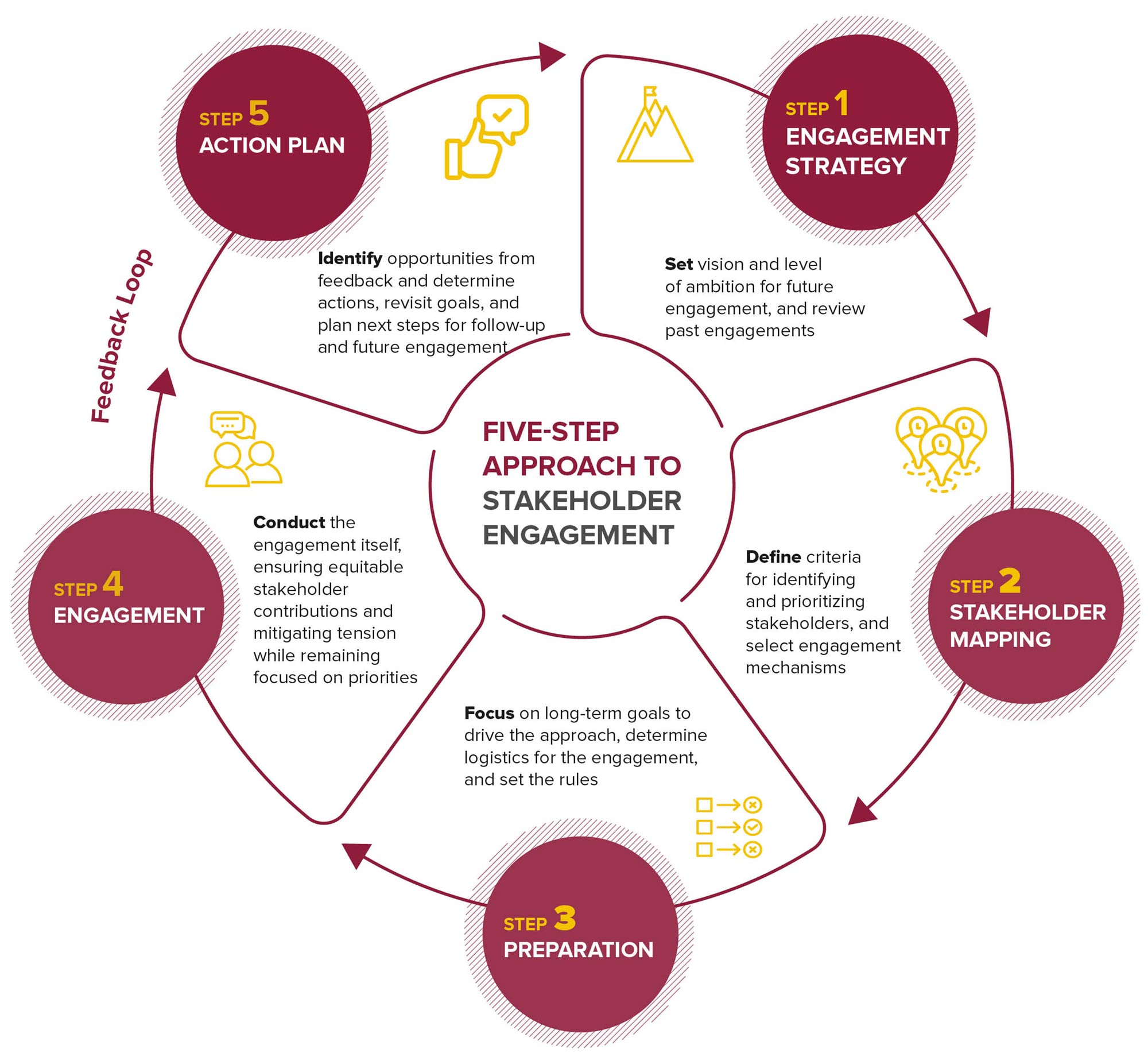
- Engagement Strategy: Set vision and level of ambition for future engagement, and review past engagements.
- Stakeholder Mapping: Define criteria for identitfying and prioritizing stakeholders, and select engagement mechanisms.
- Preparation: Focus on long-term goals to drive the approach, determine logistics for the engagement, and set the rules.
- Engagement: Conduct the engagement itself, ensuring equitable stakeholder contribution and mitigating tension while remaining focused on priorities.
- Action Plan: Identify opportunities from feedback and determine actions, revisit goals, and plan next steps for follow-up and future engagement.
Blog | Wednesday May 31, 2017
Can Marketers Change the World?
We have reached a tipping point for sustainability marketing.
Blog | Wednesday May 31, 2017
Can Marketers Change the World?
Preview
We have reached a tipping point for sustainability marketing.
For years, consumers said they were interested in buying more sustainable products and services, but sales of green products remained a niche market. This indicated a “value-action gap,” with consumers saying they would make values-driven purchases in surveys but failing to follow through in reality.
Today’s headlines tell a different story.
Tesla is now more valuable then Ford and GM, brands under Unilever’s Sustainable Living Plan are growing 50 percent faster than the rest of the portfolio, and Nike is making more than a billion from shoes that are radically more resource-efficient. These brands and others have put sustainability at the forefront of their marketing—and are reaping the rewards. That’s good news for their bottom lines and good news for the planet.
How have some companies cracked the code to convert consumer aspirations for a better world into sales?
A group of brands from BSR’s Sustainable Lifestyles Frontier Group—AT&T, eBay, Johnson & Johnson Consumer Inc. (JJCI), McDonald’s, and Walmart, with guidance from BSR, Futerra, and Stanford University—set out to explore this question. Following initial research, the group tested insights in the marketplace, moving beyond theory and into action. Each brand identified a sustainable behavior they could influence and a method to explore the effectiveness of their marketing efforts.
The Value of Sustainability
The results, along with lessons and advice, are captured in our latest study “Big Brands Big Impact: A Marketer’s Guide to Behavior Change,” including these highlights:
Sustainability is a value add, not the only value. When testing messages to promote a digital home security and energy automation system, AT&T found that the most effective messaging focused on benefits like security and control over one’s home, rather than carbon footprint reduction. However, in surveys, consumers said they were interested in energy conservation. This suggests that even if using a product delivers environmental benefits, those benefits should not necessarily be the primary focus of marketing efforts. When it comes to purchasing, these AT&T customers were influenced more by the perceived value of the product and its functionality.
“Consumers are looking for companies to be more and more environmentally and socially conscious,” said AT&T Director of Sustainability Integration Roman Smith. “It’s important for companies to understand how to best tap into that trend as we market and communicate our offerings. Being a part of the Sustainable Lifestyles Frontier Group has helped us do that.”
Making sustainability fun can drive engagement. When testing out different recycling signage at a San Francisco restaurant, McDonald’s found that playful imagery with vibrant colors captured customers’ attention and provided an unexpected moment of joy. By getting their attention in a whimsical, engaging way, it was easier to get the customers to focus on the “task” of recycling. These signs were much more effective than the “control scenario” sign, which lacked color and provided basic instructions.
“Being part of the Sustainable Lifestyles Frontier Group gave us the opportunity to extend our promise to bring delicious feel good moments to everyone, even at the recycling bin. The partnership of sustainability and marketing influenced sustainable behavior change and 'scaled for good' both the customer experience and landfill diversion,” said Victoria Zimmerman, Global Supply Chain and Sustainability Manager, McDonald's.
Helping people become more sustainable can improve brand reputation. Both eBay and JJCI found that when their communications helped consumers be more sustainable, these messages also improved consumers’ perception of the brands as environmentally responsible. JJCI tested social media posts that encouraged consumers to recycle by explaining how recycling can reduce landfill waste and by giving them do-it-yourself ideas such as using empty containers as planters. These posts improved participants’ perception of the brand as environmentally responsible, which could give the brand a competitive advantage when other factors such as price and performance are equal.
The bottom line?
It’s not about green marketing; it’s about great marketing.
Just as selling a drink isn’t all about selling the taste, selling sustainability isn’t all about saving the planet. For some brands, marketing sustainability might mean capturing attention by creating moments of joy; for others, it might mean using sustainability as an additional benefit to strengthen the value proposition; and for still others, sustainability can provide valuable storytelling opportunities.
As more and more mainstream consumers continue to shift toward buying sustainable products and experimenting with sustainable behaviors, marketers must believe that they can change the world—but they need to bring the same thorough, subtle approach to marketing sustainability as they would to marketing any product.
To learn more about marketing for sustainability, read the insights and case studies in “Big Brands, Big Impact,” and consider hosting a meeting with your marketing and sustainability colleagues to explore how your brand can use marketing to influence social or environmental behaviors.
Blog | Thursday January 26, 2017
Four Stakeholder Engagement Trends to Watch in 2017
There are clear drivers in today’s operating environment for multinationals to rethink their approaches to risk, resilience, and corporate responsibility. Here are four stakeholder trends to pay attention to this year.
Blog | Thursday January 26, 2017
Four Stakeholder Engagement Trends to Watch in 2017
Preview
It is already axiomatic to say that 2017 has ushered in a new era of uncertainty, though core assumptions driving multinational business have been under threat for some time. The ascendancy of competitive nationalism and populist politics in the United States and Europe has simply made these trends impossible to ignore. Developed markets and large emerging markets can no longer be considered benign and predictable from a political risk perspective, and business can no longer assume that we are on a steady journey toward ever greater economic liberalization and regulatory convergence.
These shifts in the operating environment have been accompanied by a dramatic collapse in public trust in institutions, including business, according to the 2017 Edelman Trust Barometer. Though only 37 percent of respondents now find CEOs to be trustworthy, perceptions of the media, NGOs, and governments are even lower. But despite a far more difficult operating environment, business still has an opportunity to provide leadership, innovation, and inclusivity.
There are clear drivers for multinationals to rethink their approaches to risk, resilience, and corporate responsibility. A far wider range of plausible scenarios is in play, and traditional risk management and strategy tools are not well placed to address current challenges. And open, interactive communication with those that are affected by, or have power to influence, a company’s strategy and agenda just shot to the top of the priority list.
Therefore, companies should pay attention to four stakeholder trends in 2017:
- The corollary of weaker regulation is greater stakeholder activism. The new U.S. government has already signaled that it would like to weaken or dismantle regulation in key sectors, such as finance and energy. But this is unlikely to ease operating conditions for business, as any weakening of regulation at the country level will be accompanied by an increase in stakeholder activism, amplified by the contentious political climate. Companies must learn to proactively address collapsing public trust via consideration of ethics that go beyond mere legal compliance. Many companies are setting up ethics functions that interact with, but are separate from, compliance. Others are exploring synergies among the audit, compliance, and sustainability functions to best promote their values.
- Local conflicts can now gain global platforms. Hyper-transparency means that community disputes can be amplified to win worldwide prominence. For example, indigenous rights groups in Latin America are partnering with global advocacy organizations to draw attention to their grievances. In agriculture, extractives, and infrastructure, companies that have long differentiated between project-level community engagement and corporate reputation management are finding this distinction increasingly difficult to maintain. Other companies that have traditionally thought of stakeholder engagement as an annual exercise conducted by headquarters are trying to define and understand their stakeholders more deeply, which is a complex exercise when it is not defined by the geographic focus of a project. Shifting migration patterns and cumulative impacts only complicate the exercise.
- Political and social risk are converging. Demographic shifts and automation are transforming the labor market and putting social services under extreme pressure—just as demands for sustainable, broad-based economic growth gain momentum. In the Global South, the growth of the middle class has increased individual and collective empowerment, while transforming the dynamics of political and social risk. Public opposition to government and business is coalescing around a common language of environmental justice, anti-corruption, and human rights. When protestors voice disillusionment with self-interested and inefficient regimes, local elites move with varying degrees of success to shore up their power. Companies can no longer separate social and political risk considerations, which means understanding the interaction among stakeholders—not just how stakeholders engage with companies.
- Understanding your impacts is no longer optional. The field of business and human rights has come of age, highlighting the need to extend risk analysis to understanding impacts. The launch of the Sustainable Development Goals in September 2015, too, is encouraging businesses to develop robust frameworks to measure the consequences of their activities. Human rights practitioners have rightly identified oversight of global supply chains as a key corporate vulnerability, with scrutiny of trafficking and slavery by regulators and the public giving rise to fresh norms and expectations. It has become clear to all that corruption everywhere is facilitated by global financial flows and can no longer be characterized as a developing-market problem. And while shareholder value remains any business’s dominant consideration, activists are scrutinizing the effects of tax avoidance upon human rights and broadly questioning the effectiveness of current corporate governance standards.
Neither legal compliance nor standard risk management tools are sufficient for companies who wish to survive and thrive in the new era. Rather, resilient companies will focus on core values, leadership, and a more inclusive approach to business.