Searching for: leadership
Search results: 251 of 283
People
Theresa Loar
…than 30 years with leadership positions across corporations, NGOs, and the U.S. government. Most recently, she was senior vice president for global corporate affairs at CH2M, a Fortune 500 engineering consulting firm. In this capacity, she initiated and led a global response to modern slavery issues raised in CH2M infrastructure…
People
Theresa Loar
Preview
Theresa Loar has been working at the nexus of business, human rights, and diplomacy for more than 30 years with leadership positions across corporations, NGOs, and the U.S. government.
Most recently, she was senior vice president for global corporate affairs at CH2M, a Fortune 500 engineering consulting firm. In this capacity, she initiated and led a global response to modern slavery issues raised in CH2M infrastructure programs in the Middle East. She built a team to embed preventive measures in management systems and engaged with governments, clients, NGOs, and industry peers to forge effective alliances to prevent slavery in supply chains.
During the Clinton Administration, Loar worked in the White House and the U.S. Department of State to promote and protect women’s human rights under the leadership of First Lady Hillary Clinton and Secretary of State Madeleine Albright. She co-led a presidential task force to develop policy to combat human trafficking and introduced the Prevention, Protection, and Prosecution framework into testimony before the U.S. Congress. She was also the founding president of the Vital Voices Global Partnership, founded by Hillary Clinton to invest in women to improve the world. As a foreign service officer, Loar served in diplomatic assignments overseas and in Washington, D.C. She is a member of the board of directors of the Women’s Foreign Policy Group and RAD-AID International, a trustee of the Social Mobility Foundation in London, and a member of the Vital Voices D.C. Council.
Insights+ | Monday September 18, 2023
The Evolving Reporting Landscape
Insights+ provides insights and foresight that empower the CSO to be a strategic C-Suite advisor by crystallizing emerging and cross-cutting sustainability issues, enabling companies to elevate their strategic ambition and achieve tangible progress toward a more just and sustainable world. In this fourth edition of the Insights+, the Future of…
Insights+ | Tuesday March 28, 2023
Back to Nature: A Call to Action
BSR’s Nature team dives into the Science-Based Targets for Nature and discusses how business can take immediate action if it is to keep pace with the market and mitigate nature-related risks before they become acute.
Blog | Tuesday December 10, 2019
Human Rights Day 2019: BSR Reflections on the UN Forum on Business and Human Rights
As we look ahead to 2020, what are the pivotal human rights issues that businesses should be paying attention to? Here’s what BSR heard at the UN Forum on Business and Human Rights.
Blog | Tuesday December 10, 2019
Human Rights Day 2019: BSR Reflections on the UN Forum on Business and Human Rights
Preview
Under the theme "Time to Act: Governments as Catalysts for Business Respect for Human Rights," the eighth annual UN Forum on Business and Human Rights brought together over 2,000 representatives of companies, civil society, and states in Geneva in the final week of November to discuss best practices and emerging issues in business and human rights. BSR attended the event both to share our learnings from working with leading companies on business and human rights over the course of the year and to keep our finger on the pulse of the latest trends.
As we look ahead to 2020—and to the dawn of this decisive decade when the decisions we make as a society on how to address economic inequality, climate change, technological innovation, and political polarization will shape our shared future for generations to come—what are the pivotal human rights issues that businesses should be paying attention to? Here’s what we heard at the Forum:
States and regulators are responding to the call to action to protect human rights through mandatory due diligence and increased regulation.
A crucial discussion throughout the Forum highlighted the role of states and regional regulators to take on their duty to protect human rights and close the gap in implementing the UN Guiding Principles on Business and Human Rights (UNGPs), as Pillar One, the state duty to protect human rights, remains the true catalyst to realize corporate respect beyond voluntary measures.
Mandatory due diligence in national legislation is gaining ground, with the latest laws being enacted in France, the Netherlands, and Australia and with more legislation proposed. What’s more, mandatory frameworks are only expected to increase. Comments by the European Union, the Council of Europe, and the OECD all stressed the importance of policy coherence at the state and regional levels. Regional bodies such as the EU and the African Union—which will soon be publishing its first human rights and business policy—are playing a growing role in creating a level playing field and strong systems for human rights protection and business accountability. Similarly, trade investments, public procurement practices, and state involvement in investments such as mega-sporting events must integrate human rights due diligence in project screening as well as regulatory measures to ensure law and trade agreements include respect for human rights. With interventions by states from all over the globe, notable leadership was taken by northern European countries Norway, Sweden, the Netherlands, and Finland, reflecting the region’s long-standing commitment to sustainable development and human rights.
Translating businesses’ numerous commitments to gender equality will require practical action.
Equality and inclusion must be prominent enablers in realizing the UNGPs.
The world is facing a profound inequality crisis as the divide between low- and high-income groups continues to deepen and discrimination remains a burden to the realization of human rights, especially for vulnerable groups. Creating and fostering equal and inclusive societies was the theme of many sessions, with emphasis on equal workplaces and supply chains.
BSR was represented on two panels, the first on the role of the private sector in protecting LGBTI rights and the second on applying a gender lens to the UNGPs in practice. According to the panel facilitated by Dan Bross, Executive Director of the Partnership for Global LGBTI Equality (PGLE), commitment to implementing the UN Standards of Business Conduct must be a priority of business, and joint action to decriminalize sexual orientation will be central to creating inclusive workplaces and enabling regulatory environments.
Similarly, we are at a point where translating businesses’ numerous commitments to gender equality will require practical action. BSR Manager Francesca Manta’s contribution to the panel on gender and the UNGPs stressed the importance of ensuring gender-specific impacts and issues are made visible and taken into account by using a new framework for context analysis and data collection in global supply chains. Diversity and Inclusion policies and commitments to the Women’s Empowerment Principles (WEPs) as well as to the UNGPs may remain a paper exercise if differentiated impacts are not identified, monitored, and acted upon, using operational tools such as the Gender Impact and Data tool (GDI), which BSR developed for supply chain due diligence. It is time for due diligence to stop being gender-blind and make women visible and counted.
In an increasingly fragile world characterized by rising violence, closing civic space, and more authoritarian governance, business has a critical role to play in preventing corrupt practices and human rights violations.
Addressing corruption and conflict must become a priority of business and states if we are to realize a future of peace and stability.
In line with this year’s theme, the Forum had numerous sessions on the linkages between corruption, conflict, and human rights and the role both states and companies must play to eradicate unethical practices and resolve regional and global conflicts.
Whispered already as the theme of next year’s Forum, corruption took center stage with discussions ranging from the integration of compliance and human rights due diligence processes to holistic approaches to context analysis such as the one at the session facilitated by the UN Global Compact networks. Corruption is often seen as a ‘victimless crime,’ and the panels urged participants to recognize corruption as a strong contributor to human rights abuses. In an increasingly fragile world characterized by rising violence, closing civic space, and more authoritarian governance, business has a critical role to play in preventing corrupt practices and human rights violations. The UN Working Group on Business and Human Rights is currently working on the connection between anti-corruption efforts and implementation of the UNGPs to inform its 2020 report to the UN Human Rights Council. In conflict-affected and high-risk areas, part of business’s responsibility to respect human rights involves actively combating corruption by integrating their anti-corruption and human rights efforts. Companies cannot successfully respect human rights without also addressing issues of corruption in the environment where they operate and that impact their supply chain.
The digital sphere is now indivisible from human rights impacts.
In a world where nearly every company can be considered a technology company, another important theme at the Forum was how human rights are affected by digital activities and what due diligence will mean in this sphere regardless of industry. Discussions spanned from the use of AI and biometrics in high-risk sectors such as defense and surveillance, to what accountability, attribution, and remedy look like in case of adverse impacts from digital activities, to how even digital marketing has far-reaching impacts on organized crime and online and offline hate crimes, and also explored how due diligence is key to ensuring ethical advertising by any brand. Every company should seek to understand the nature of its digital activities—data collection and processing, content management, advertising—and prioritize due diligence to understand human rights impacts from both intended and unintended misuse of their technology or digital activity. States, particularly those in Europe thanks to GDPR, are more and more involved in corporate dialogue and regulations in this sphere, including interesting initiatives such as the Tech Ambassador, which was instituted by Denmark to promote diplomatic activities with technology companies.
Climate is the biggest business and human rights issue of our time, and aggressive emission reductions by both states and businesses should be a core human rights demand.
Climate is our biggest challenge and will have profound human rights implications.
Another theme throughout the three days, the Forum stressed how the climate crisis is now inextricably linked to the current and upcoming human rights impacts—on human life, inequality, health, access to livelihoods, migration. The Forum concluded with a powerful final session on the theme where a unanimous panel agreed that climate is the biggest business and human rights issue of our time and aggressive emission reductions by both states and businesses should be a core human rights demand. There are indeed positive developments and companies that are truly transitioning to fossil-free business models, such as the panelist Scania, but the pace is still too slow to keep emissions under control, particularly in light of the newly published UNEP Emission Gap Report 2019 which predicts increase in temperatures by 3 degrees Celsius. Again, policy coherence was called upon to urge states and businesses to be true to their commitment to the Paris Agreement and act immediately to address climate change in how they operate and our growth models.
We believe these key themes will take even more prominence as we enter the decisive decade next year, and we look forward to working with our members and partners to accelerate change and contribute to a just and sustainable future. To learn more about our work on human rights, please don’t hesitate to reach out and connect with our team.
People
Christine Diamente
…effective board governance and leadership ambition on sustainability. She brings over 20 years of experience in leading brand, sustainability, public affairs, communications, and reputation management with multinational corporations at the executive leadership level. This also includes overseeing corporate relations with external stakeholders, such as the World Economic Forum, the UN,…
People
Christine Diamente
Preview
Christine leads BSR’s Business Transformation team, helping companies to manage sustainability throughout their business and across their supply chains and to develop resilient business strategies that leverage insights from BSR’s Sustainable Futures Lab.
She works with companies across sectors and geographies to structure a sustainability management approach that mitigates risk and captures emerging opportunities, creating strategic advantage for their businesses, while contributing to a more just, sustainable world. Christine also co-leads engagement with boards of directors to promote effective board governance and leadership ambition on sustainability.
She brings over 20 years of experience in leading brand, sustainability, public affairs, communications, and reputation management with multinational corporations at the executive leadership level. This also includes overseeing corporate relations with external stakeholders, such as the World Economic Forum, the UN, European institutions, and investors.
Previously, Christine was Head of Brand Strategy at Nokia. She has also held major roles at Alcatel-Lucent and Alcatel, leading Brand and Corporate Sustainability and European Affairs. Christine has also served on various boards, including as a chair of the Telecoms Industry Dialogue on human rights, as an advisory board member of Reuters Events Sustainability, as a member of the Alcatel-Lucent Foundation, and on the European Internet Foundation.
Christine holds a MA in History and a BA in History and International Politics from the University of Ottawa. She completed the Management Acceleration Program (MAP) at INSEAD, and she achieved the ESG Competent Boards Certificate and Global Competent Boards Designation (2021). She speaks English, French, Spanish, and Italian.
Reports | Monday September 17, 2018
Climate and Inclusive Economy
Climate change and the economy are inextricably linked. This report highlights how companies across sectors can better understand how they can contribute to more climate-resilient and inclusive economies.
Reports | Monday September 17, 2018
Climate and Inclusive Economy
Preview
Climate change affects each and every human around the globe, with profound and potentially lasting implications for an inclusive economy. This paper uses data and case studies to highlight the impacts of climate change on an inclusive economy and help companies across sectors understand the resulting consequences for business.
It demonstrates why and how business can act, including how companies can establish a deeper understanding of the nexus of an inclusive economy and climate resilience throughout their businesses; how to articulate the risks and opportunities for companies across various sectors; how to secure buy-in from senior leadership; and how to identify, assess, prevent, mitigate, and remedy the adverse effects of climate change.
This report is part of a series of six climate nexus reports that cover human rights, inclusive economy, women’s empowerment, supply chain, just transition, and health.
Climate and Inclusive Economy
The Nexus
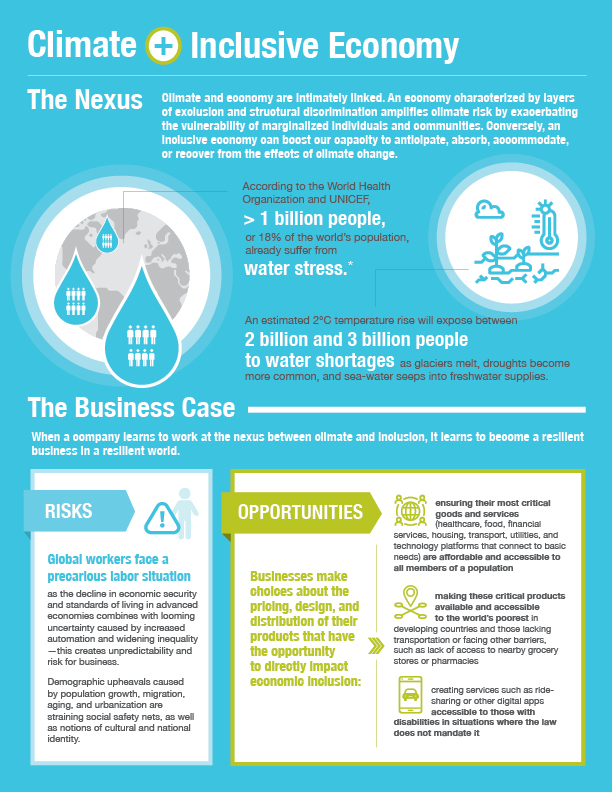
Climate and economy are intimately linked. An economy characterized by layers of exclusion and structural discrimination amplifies climate risk by exacerbating the vulnerability of marginalized individuals and communities. Conversely, an inclusive economy can boost our capacity to anticipate, absorb, accommodate, or recover from the effects of climate change.
According to the World Health Organization and UNICEF, more than 1 billion people, or 18% of the world’s population, already suffer from water stress.
An estimated 2°C temperature rise will expose between 2 billion and 3 billion people to water shortages as glaciers melt, droughts become more common, and sea-water seeps into freshwater supplies.
The Business Case
Risks
Global workers face a precarious labor situation as the decline in economic security and standards of living in advanced economies combines with looming uncertainty caused by increased automation and widening inequality —this creates unpredictability and risk for business.
Demographic upheavals caused by population growth, migration, aging, and urbanization are straining social safety nets, as well as notions of cultural and national identity.
Opportunities
Businesses make choices about the pricing, design, and distribution of their products that have the opportunity to directly impact economic inclusion:
- ensuring their most critical goods and services (healthcare, food, financial services, housing, transport, utilities, and technology platforms that connect to basic needs) are affordable and accessible to all members of a population
- making these critical products available and accessible to the world’s poorest in developing countries and those lacking transportation or facing other barriers, such as lack of access to nearby grocery stores or pharmacies
- creating services such as ride-sharing or other digital apps accessible to those with disabilities in situations where the law does not mandate it.
Climate and Inclusive Economy (continued)
Woolworths Farming for the Future Initiative
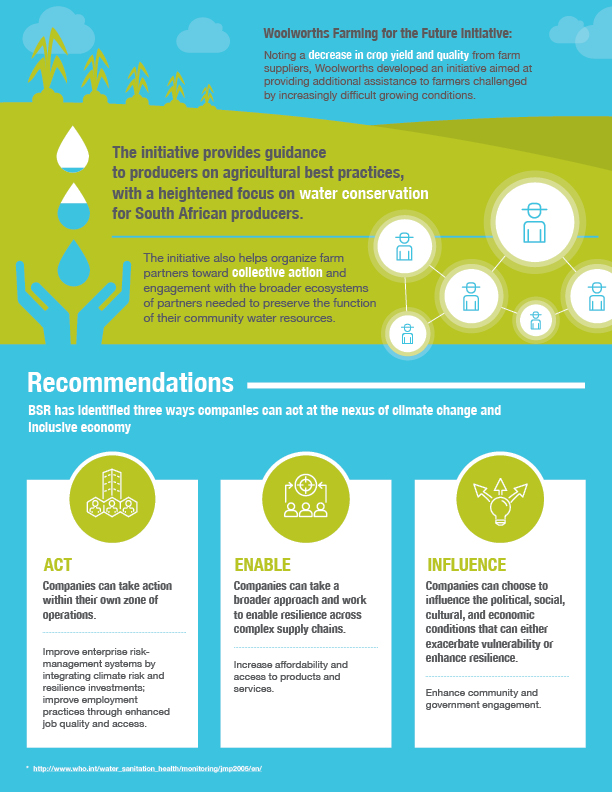
Noting a decrease in crop yield and quality from farm suppliers, Woolworths developed an initiative aimed at providing additional assistance to farmers challenged by increasingly difficult growing conditions.
The initiative provides guidance to producers on agricultural best practices, with a heightened focus on water conservation for South African producers.
The initiative also helps organize farm partners toward collective action and engagement with the broader ecosystems of partners needed to preserve the function of their community water resources.
Recommendations
BSR has identified three ways companies can act at the nexus of climate change and inclusive economy:
-
Act
Companies can take action within their own zone of operations.
Improve enterprise risk- management systems by integrating climate risk and resilience investments; improve employment practices through enhanced job quality and access.
-
Enable
Companies can take a broader approach and work to enable resilience across complex supply chains.
Increase affordability and access to products and services.
-
Influence
Companies can choose to influence the political, social, cultural, and economic conditions that can either exacerbate vulnerability or enhance resilience.
Enhance community and government engagement.
Climate Nexus Report Series





Blog | Wednesday January 10, 2024
CEO Outlook: Seven Pivotal Questions Shaping Sustainable Business in 2024
BSR President and CEO Aron Cramer poses seven questions for business that will define the scale of progress in the year ahead.
Blog | Wednesday January 10, 2024
CEO Outlook: Seven Pivotal Questions Shaping Sustainable Business in 2024
Preview
The multiple shocks and surprises affecting our world in the 2020s can easily lead us to think that we don’t know what’s coming next. It would be folly—and senseless—to diminish the impacts of a global pandemic, geopolitical conflict, and social upheaval.
And yet, as world-shaking as these disruptions are, the underlying questions at the heart of the role of business in society remain very clear. Our collective challenge is focused on three fundamental goals: accelerating the shift to an inclusive clean energy economy, ensuring that revolutionary new technologies are designed and deployed in service of society, and creating more equitable societies and economies.
These were all core questions in 2023 and they will continue to be for the foreseeable future. And they will be BSR’s focus in 2024. As we work with our 300+ member companies globally to support their ability to transform in service of these goals, we will be focusing our insights, advice, and collaborations on these areas.
While 2024 is in many ways a continuation of underlying changes that continue to reshape our world, the new year does present some unique questions. How we respond to them will shape not only how this year plays out, but also our lives for many years to come.
Here are the seven questions that will define how much progress is made in the year ahead.
1. What impact could the 2024 global elections have on just and sustainable business, and what can companies do about it?
Nearly two-thirds of the world’s population is living in countries with elections in 2024: more than any other year in human history. These elections are, in one way, a triumph for democracies that emerged and proved resilient in the 20th century. But many people are fearful of change, facing dislocation, and are on the receiving end of misinformation. This fertile ground for populist backlash risks undermining progress on climate action, diverse and equitable societies, and the international cooperation needed for truly shared prosperity. So, while this year will understandably have a significant focus on politics, the spate of elections is very much a business issue. The outcomes of these elections will help determine not only traditional policy questions, but also the degree to which the rule of law is respected, whether international cooperation on climate and other shared challenges is possible, and the degree of support for global trade. Companies therefore should stand up for free and fair elections, and the protection of democratic processes. This role is not natural or comfortable for many business leaders. The stakes, however, are too great for businesses to stand aside.
2. Will the COP28 agreement mark a real transition?
The fierce debate over whether the COP 28 agreement was sufficient is, to some degree, beside the point. The more salient question today is: will nations, businesses, and investors breathe life into the agreement, or render it a dead letter? Investments, innovation, and collaboration are continuing, but not at the pace that’s needed to achieve the rapid transformation required to limit global warming. The just transition is now firmly on the agenda, but too few companies have comprehensive approaches needed to ensure the transition is equitable and fair for all people. The legal considerations that come along with new reporting and disclosure requirements threaten to focus attention on delivering the data rather than delivering clean energy at scale. As we enter 2024, it is not so much a course correction we need, but rather redoubling efforts, without which the emissions reductions needed by 2030 won’t materialize.
3. Are DEI commitments flagging?
There is substantial evidence that the post-2020 efforts to strengthen diversity, particularly in the US, are fading. Data suggest that companies have pulled back on DEI staffing, and the backlash against such efforts, including legal challenges in the US, is accelerating a pullback. But the need for continued progress in the effort to achieve more inclusive companies, workplaces, and communities, remains as compelling as ever. Representation on Boards and in senior management continues to lag behind the overall workforce. Income inequality continues and is partly to blame for the populist movements that have limited public commitments to progress on other key issues like climate and nature. In fact, the business case for DEI remains as strong as ever, not least given the changing nature of the workforce and consumer base. History also teaches us that there will be more moments of reckoning when companies will face pressure to explain their follow-through on prior commitments. Boards and senior management need to send clear signals that they embrace and are ready to develop the diverse workforces of the future, and this remains crucial despite legal challenges.
4. Can we ensure that emerging technology is developed responsibly and sustainably?
The arrival of generative AI was bookended by the emergence of ChatGPT at the beginning of the year and the OpenAI drama at its close. As Winston Churchill said in a very different context, this is only “the end of the beginning” of complicated debates over new technologies and their social impacts. My advice is to believe neither the techno-utopians nor the doomsayers: AI will deliver both great opportunities while presenting us with profound questions and dilemmas, and they will both deepen as the technology advances. And more questions, on other technological innovations, are coming fast: the first approved treatment based on CRISPR gene editing technology also arrived, albeit with less fanfare, in 2023, and biotech will present new and complicated dilemmas. The existing mishmash of efforts to set guidelines will only confuse matters. Setting the rules of the road for the key actors involved will require both smart and flexible regulation, ideally synchronized between jurisdictions, as well as self-restraint on the part of business. Here again, business is going to need to get engaged—appropriately—in promoting regulatory frameworks with sufficient flexibility to enable innovation to flourish.
5. Will new regulations turn sustainability into a compliance exercise?
As we have written over the past year, the rise of regulatory requirements is a game changer for every business. This is undeniably a beneficial development. There are many reasons to believe that performance and transparency will increase on a wide range of topics: climate and nature, reporting and disclosure, human rights, and corporate governance primary among them. We also see a number of unintended consequences that deserve ongoing attention. We hear from many companies that resources are being dedicated to compliance rather than performance. Businesses are busy preparing for the EU’s Corporate Sustainability Reporting Directive (CSRD); that makes sense currently but should not crowd out ongoing ambition and innovation. The valuable caution in avoiding greenwashing claims is also being applied to tamp down ambition, both in communication and goal setting. There is also a growing focus on what can be quantified and verified, which applies well in some cases (measuring emissions) and misses the point on others (positive social impact). Compliance is of course non-negotiable, but no company ever complied to innovation, ambition, and excellence, and sustainability has to find a way to achieve all of the above.
6. How is the role of the Chief Sustainability Officer (CSO) changing?
In our discussions with Chief Sustainability Officers, it is also clear that the role of CSOs and their teams is at a crossroads. There is no doubt that the increased boardroom presence of the CSO is a major step forward. This advance should not come at the expense of the change agent role that CSOs can uniquely play. They should look to the future, and not focus too much on quantifying past performance. CSOs must also learn to see across interconnected issues, not serve merely as technical engineers in specific domains. And, finally, they must understand and deliver qualitative benefits, and not focus only on things that can be measured and verified with precision: the best and highest role the CSO can play is not as a compliance officer. Maintaining the essence—and even the soul—of the role is crucial in 2024.
7. How will business juggle so much interlocking change?
The final question could be dismissed as a process question, but it is crucial. The reality is that business leaders are juggling an immense number of profound questions. Business models, the very nature of work, technologies, environmental challenges, and societal expectations continue to intensify and change. That will only accelerate this year and in the years ahead. This is why principled leadership, strong governance, and clear vision have never been more important. The to-do list for business is replete with items that present both transformative opportunities and so-called “wicked questions.” The impulse to say “not my problem” won’t work. Today’s leaders will be judged by how well they embrace change, make sense of it for their colleagues and stakeholders, and stay true to principle, while continuing to focus on long-term value creation that brings shared societal benefits and respects natural resource boundaries.
These questions are interesting to debate. But more than that, they represent a priority list for every business. In the year ahead, we will be advocating and acting to achieve real progress on each of these questions, and tracking how well business, business leaders, investors, and the entire enabling community meets these challenges. So, while 2024 will undoubtedly deliver unexpected questions and challenges, we know in advance what the ultimate test of our actions will be at year end.
For more from Aron and Sustainable Business in 2024, check out the episode in our BSR Insights Audio Series:
Case Studies | Monday July 9, 2018
The Coca-Cola Company: Building a Climate-Resilient Value Chain
The Coca-Cola Company partnered with BSR to examine what climate risk and resilience might mean for its value chain.
Case Studies | Monday July 9, 2018
The Coca-Cola Company: Building a Climate-Resilient Value Chain
Preview
The Coca-Cola Company has been working to reduce emissions in its supply chain for years—including not only those associated with bottling, but also those associated with growing ingredients, producing packaging, and distributing and refrigerating products. As climate change impacts have begun to manifest around the globe, the 132-year-old company partnered with BSR to take this work a step further to examine what climate risk and resilience might mean for The Coca-Cola Company value chain.
The Challenge
From agricultural ingredients, like citrus and tea, to hyper-local distribution systems, The Coca-Cola Company supply chain is one of the largest and most complex in the world. Coca-Cola products are sold in more than 200 countries and territories, and each of those markets faces unique exposure and vulnerability to the impacts of climate change.
Mitigation efforts—those focused on reducing greenhouse gas emissions—are vital to any company’s climate strategy and critical to global efforts to avoid unmanageable climate impacts. As the impacts of climate change are increasingly felt around the world, however, it has become clear that simultaneous efforts are necessary to increase adaptive capacity and build resilience.
“Resilience” is defined as “the capacity to recover quickly from difficulties.” In the context of climate change, resilience is the ability of a system (such as a bottling plant, distribution network, or supply chain) or community to rebound following a shock such as a natural disaster. Building resilience requires not only recognizing potential hazards like extreme weather events, but also understanding the underlying vulnerabilities that may affect recovery from these potential disasters. For example, insufficient infrastructure can reduce a community’s capacity to rebound following a disruption like an extreme weather event, as can poverty or gender inequality.
After years focused on climate mitigation and water stewardship, understanding climate risk and resilience was a natural next step for Coca-Cola.
Our Strategy
BSR partnered with Coca-Cola to begin building the foundation for a more resilient company that is better able to anticipate, avoid, accommodate, and recover from climate risks in the future. At the outset, we identified seven markets—Argentina, Brazil, China, India, Kenya, Mexico, and the United States—and two commodities—coffee and tea—to serve as proxies for the full Coca-Cola value chain. For each of these markets and commodities, we explored exposure to major climate hazards in the context of underlying vulnerabilities, such as rapid urbanization, at-risk populations, food and economic insecurity, and insufficient infrastructure.
Using this analysis, a benchmark of climate resilience activities in the food and beverage sector, Coca-Cola’s existing risk mitigation strategy, and insights from internal company interviews, we developed a framework for identifying and prioritizing climate-related risks. We then mapped Coca-Cola’s existing programs and initiatives to high-priority risks and outlined an approach for expanding this work further across the company’s major business units.
Our Outcomes and Impact
The climate resilience framework we developed aims to integrate resilience into Coca-Cola’s existing strategy, risk management, and sustainability systems. The framework is designed to connect and amplify The Coca-Cola Company’s efforts in empowering women, protecting the climate, and sustainably sourcing ingredients, as well as in water leadership and community development. Over time, we hope to see the framework used to help Coca-Cola create a more resilient value chain, enabling the company to confidently source responsibly cultivated ingredients, withstand or promptly recover from climate-related impacts, identify and reduce climate risks, and contribute to building value chain and community resilience where Coca-Cola is produced and sold.
We hope that these leading-edge efforts will inspire other companies, as well as their partners in the public sector and civil society, to take a more holistic look at climate risk in their value chains and communities and identify opportunities to build adaptive capacity and resilience.
Lessons Learned
Undertaking this work with Coca-Cola allowed us to translate what we know about climate risk and resilience into the context of a global supply chain. Here are a few suggestions for companies interested in exploring climate risk and resilience in their value chains:
- Start small: Begin with a selection of facilities, locations, or products that represent important aspects of your business. This will allow you to identify the most useful and important data points before scaling your approach across the organization.
- Integrate into existing systems: Rather than approaching climate risk and resilience as a new, standalone exercise, consider integrating climate considerations into existing risk management and/or sustainability systems.
- Appreciate both the global and the local: Much like water stewardship, managing climate risk and building resilience is both a global and intensely local challenge. While some tenets and approaches can be broadly applied, individual interventions must be customized and reflect on-the-ground realities.
Learn more about our work on climate-resilient supply chains.
Reports | Tuesday September 25, 2018
Climate and Women
This paper explores the connection between women’s empowerment and resilience to climate change and aims to drive corporate action to put women at the center of climate solutions.
Reports | Tuesday September 25, 2018
Climate and Women
Preview
Climate change affects every human around the globe, with profound implications for social justice and human rights. Health-related stresses, competition for natural resources, and the impacts on livelihoods, hunger, and migration warrant immediate global action.
This paper explores a relatively new and developing topic for business: the intersection between climate change and women’s empowerment. It uses compelling data, a clear business case, and company case studies to strengthen corporate understanding of the connection between women’s empowerment and resilience to climate change impacts and to drive corporate action to put women at the center of climate-resilience solutions. Ultimately, this paper aims to help companies prepare for the consequences of climate change and address material business risks, while simultaneously embracing opportunities that benefit business, women, and communities.
This report is part of a series of six climate nexus reports that cover human rights, inclusive economy, women’s empowerment, supply chain, just transition, and health.
Climate and Women
The Nexus
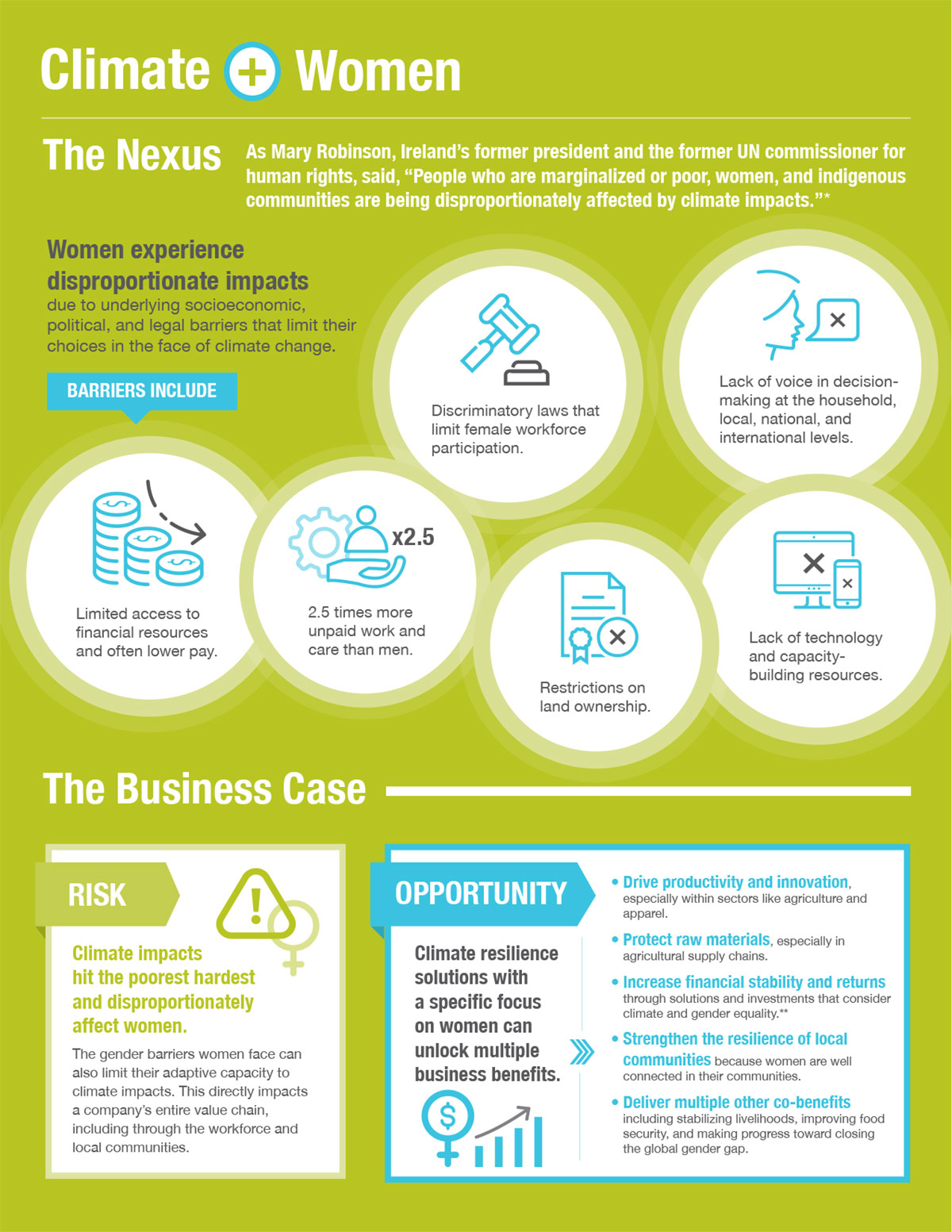
As Mary Robinson, Ireland’s former president and the former UN commissioner for human rights, said, “People who are marginalized or poor, women, and indigenous communities are being disproportionately affected by climate impacts.”
Women experience disproportionate impacts due to underlying socioeconomic, political, and legal barriers that limit their choices in the face of climate change.
Barriers Include
- Limited access to financial resources and often lower pay.
- 2.5 times more unpaid work and care than men.
- Discriminatory laws that limit female workforce participation.
- Restrictions on land ownership.
- Lack of voice in decision- making at the household, local, national, and international levels.
- Lack of technology and capacity-building resources.
The Business Case: Risk
Climate impacts hit the poorest hardest and disproportionately affect women.
The gender barriers women face can also limit their adaptive capacity to climate impacts. This directly impacts a company’s entire value chain, including through the workforce and local communities.
The Business Case: Opportunity
Climate resilience solutions with a specific focus on women can unlock multiple business benefits.
- Drive productivity and innovation, especially within sectors like agriculture and apparel.
- Protect raw materials, especially in agricultural supply chains.
- Increase financial stability and returns through solutions and investments that consider climate and gender equality.
- Strengthen the resilience of local communities because women are well connected in their communities.
- Deliver multiple other co-benefits including stabilizing livelihoods, improving food security, and making progress toward closing the global gender gap.
Climate and Supply Chain (continued)
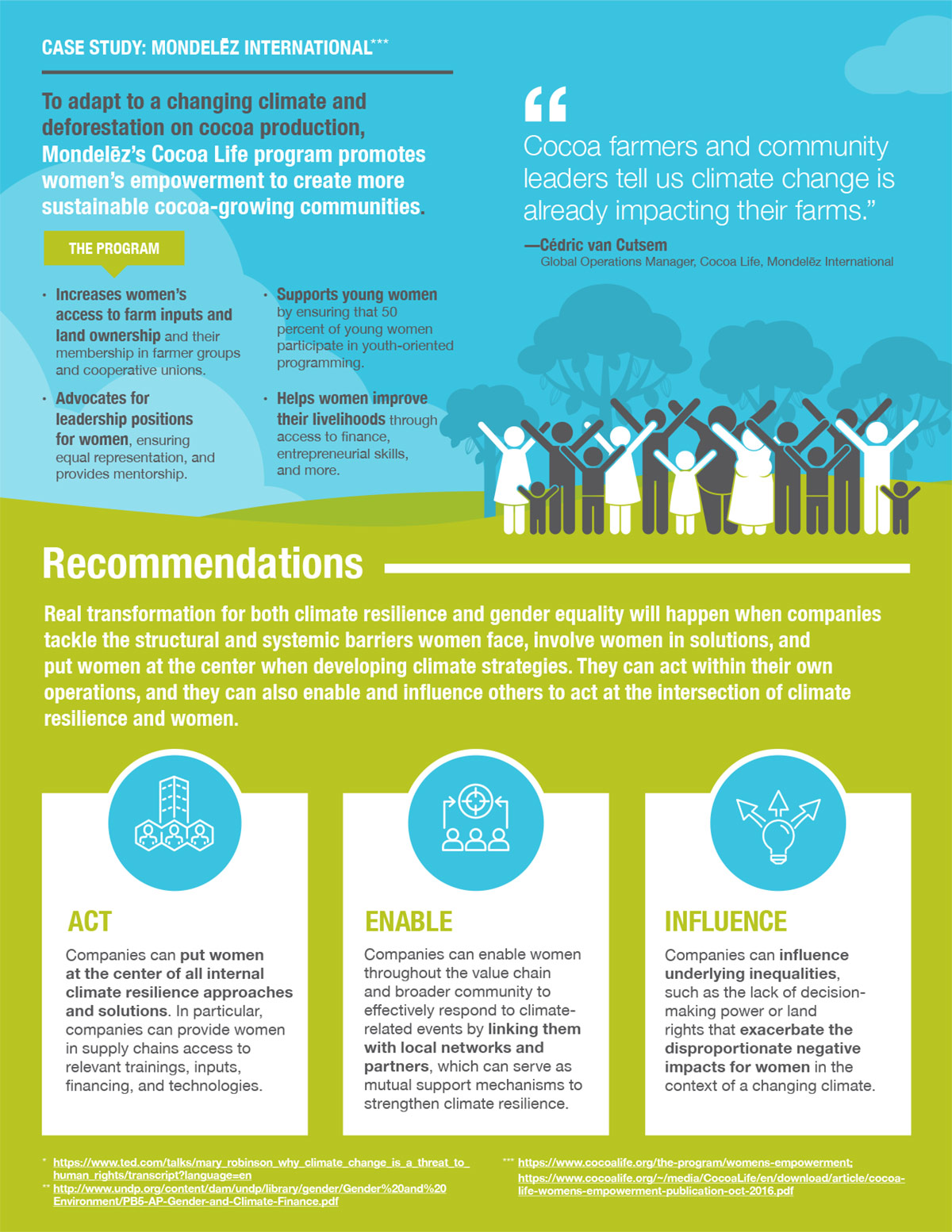
Cast Study: Mondelēz International
To adapt to a changing climate and deforestation on cocoa production, Mondelēz’s Cocoa Life program promotes women’s empowerment to create more sustainable cocoa-growing communities.
Cocoa farmers and community leaders tell us climate change is already impacting their farms. —Cédric van Cutsem, Global Operations Manager, Cocoa Life, Mondelēz International
The Program
- Increases women’s access to farm inputs and land ownership and their membership in farmer groups and cooperative unions.
- Advocates for leadership positions for women, ensuring equal representation, and provides mentorship.
- Supports young women by ensuring that 50 percent of young women participate in youth-oriented programming.
- Helps women improve their livelihoods through access to finance, entrepreneurial skills, and more.
Recomendations
Real transformation for both climate resilience and gender equality will happen when companies tackle the structural and systemic barriers women face, involve women in solutions, and put women at the center when developing climate strategies. They can act within their own operations, and they can also enable and influence others to act at the intersection of climate resilience and women.
-
Act
Companies can put women at the center of all internal climate resilience approaches and solutions. In particular, companies can provide women in supply chains access to relevant trainings, inputs, financing, and technologies.
-
Enable
Companies can enable women throughout the value chain and broader community to effectively respond to climate-related events by linking them with local networks and partners, which can serve as mutual support mechanisms to strengthen climate resilience.
-
Influence
Companies can influence underlying inequalities, such as the lack of decision-making power or land rights that exacerbate the disproportionate negative impacts for women in the context of a changing climate.
Climate Nexus Report Series
Blog | Thursday December 14, 2023
How Businesses Can Address the Water Scarcity Crisis
BSR’s Anna Iles talks to Tim Smedley, author of The Last Drop: Solving the World’s Water Crisis, about policies and practices to address water scarcity and the risks impacting current water management systems.
Blog | Thursday December 14, 2023
How Businesses Can Address the Water Scarcity Crisis
Preview
New guidance from the Taskforce for Nature-related Financial Disclosure and the Science Based Targets Network (SBTN) is bringing an increased focus on the materiality of freshwater. Interventions to make water use sustainable bring difficult trade-offs for businesses and communities. Will economies need to reach a crisis point to galvanize support for interventions? Or can ambitious solutions and collaborations redress the balance in time?
BSR’s Anna Iles talks to Tim Smedley, who traveled the world researching water scarcity, for his new book The Last Drop: Solving the World’s Water Crisis. Additionally, the Nature team provides key actions businesses can take to identify and address their impacts and dependencies on water and to understand their water-related risks.
Currently, 17 companies are piloting a methodology by the SBTN to set science-based freshwater targets. Why should businesses pay attention?
Water scarcity is knocking on the door of a lot of countries that aren’t expecting it. The World Resources Institute published a list of 25 countries facing extremely high water stress, and Belgium came higher than Syria. It’s not that Belgium doesn’t get enough rain: it doesn’t capture it when it falls. Like The Netherlands, it was designed on the drainage principle of sending all the water out to sea as fast as possible to avoid flooding, and that worked very well for a time. But now, as rainfall patterns change, they need to hold on to some of it.
Then there’s groundwater depletion. Unsustainable water use means aquifers dry out. In the US, aquifers supplying 90% of the nation’s water are being depleted. Meanwhile, one of its largest reservoirs, Lake Powell, is losing a cubic kilometer of water a year to evaporation, while its inflow is decreasing, due to less reliable snow caps. Mega dams and reservoirs will soon be stranded assets.
Are you saying the main driver of water risk is mismanagement—particularly in light of our changing weather patterns?
That’s right. A warmer climate causes more water to evaporate, from water bodies (including major reservoirs) and the soil. The air holds more moisture, and so the rain falls more heavily—and causes floods because it hits dry earth. Droughts have increased, which makes water management harder everywhere.
But much of the problem was man-made already. Many mega dams have past their 50 year intended timeframes. While pollution makes all these things harder, from soil run-off and microplastics to forever chemicals and human sewage. Polluted water is just as bad as no water.
The US Federal Government has stepped in to restrict water usage. Is more stringent legislation needed?
Legislation works for sustainability, but it doesn't necessarily work for people.
In Australia, the Government has been buying water back from farmers for the past decade to keep the River Murray flowing. In 2010 it no longer reached the sea due to over-abstraction: now it does. It’s a very successful policy but also hugely unpopular because it’s taking water from farmers. So we need to start having more honest conversations politically about the true value of water.
This raises the question of trade-offs between the private sector’s water demand and that of natural systems and communities. Analysts say tech giants’ water use is growing by 20-35% due to AI research and development. What is the way forward?
Water use for technology is set to increase and should certainly factor into business plans. You need water to cool servers and energy plants alike: French energy supplier EDF is forced to shut or scale down nuclear plants almost every summer due to water shortage. We need to invest in alternatives, like air cooling.
More sustainably, we need to harvest rainwater, and recycle greywater, from toilet to tap. There are off-grid solutions too: a company in Arizona is making ‘hydropanels’ that use solar thermal to draw water from moisture in the air. If it works in the desert air of Arizona, it can work anywhere.
Another way forward is public-private partnerships around watersheds, such as the Nature Conservancy’s Water Funds. It’s not currently the private sector's legal responsibility to maintain water, even if they depend upon it. Partnerships like these bring in private sector funding to update common infrastructure, and then public authorities maintain it afterward.
I also see impacts from sustainability standards like the Better Cotton Initiative and the Alliance for Water Stewardship, plus the leadership of big buyers. For instance, a major clothing brand recently announced it’s targeting a 40% reduction in water use among its suppliers. If you can’t deliver on that, you’re out. Buyers have huge influence.
Such policies have big implications for suppliers and their livelihoods.
Yes, there are clear Just Transition implications here. But current practices affect livelihoods too. The global crop system is currently based on moving from one region to the next. As one dries out, you start growing in another. There are huge Saudi-owned or invested farms in Arizona now, but Arizona also has dwindling groundwater reserves. The water will run out, and the investors will move on. The question is, how do you plan for a future without agribusiness dollars?
Are there solutions that work both for people and for natural systems?
Yes, there are—including indigenous practices. Peru—which currently grows the majority of the world’s out-of-season asparagus in the arid Ica region—is reviving a traditional irrigation method, part of a water-centric worldview called “Poza”. They flood fields such that it trickles into the aquifer below in a kind of closed-loop model.
In mainstream agriculture, no-till (effectively not ploughing) works on a similar principle. This mimics a natural system by enabling water to seep down into the ground and work its way back into streams and rivers. No-till approaches are much less costly and more effective than building reservoirs—and benefit farmers by decreasing fuel and labor costs.
A similar approach is Managed Aquifer Recharge, where you pump water back down into aquifers.
What’s the most important solution in your view?
Without a doubt, nature-based restoration and, where appropriate, rewilding. We are 100% reliant on our natural water cycle. One clear example is our approach to flood control. By moving away from grey infrastructure and restoring floodplains and wetlands, we get co-benefits from flood mitigation to carbon in the soil, groundwater recharge and water purification. Where I live, in the UK, they’re reintroducing beavers after 400 years: it turns out they’ll restore water courses for us.
We need to remember where water comes from. We thought we could decouple ourselves from natural systems. That was always hubris. We are fully reliant on natural systems.
Actions for Business
BSR supports businesses to develop positive relationships with land, freshwater, and marine systems in both their operations and value chains. We help companies to identify and address their impacts and dependencies on water and to understand their water-related risks, and how these intersect with climate change. Here are some key recommendations:
1) Understand your impacts and dependencies
-
Using a double materiality approach, assess your nature impacts and dependencies, including freshwater, and understand your reliance and impacts on freshwater quality and quantity. This should be done in alignment with the Taskforce for Nature-related Financial Disclosure and the Science-Based Targets for Nature, and consider all significant pollutants, from microplastics to chemicals.
-
Conduct a water risk analysis for the company and its supply chain, collecting quantitative primary and secondary data and appropriately including impacts for communities and ecosystems in the analysis.
-
Prioritize locations in your supply chain based on gathered data, incorporating stakeholder perspectives to ensure an equitable lens is applied to location identification.
-
Ensure you consider freshwater ecosystems as an important landscape in nature-related work.
-
Apply foresight techniques to understand how a changing water cycle might impact supply chains.
-
Monitor emerging policy and recommendations, such as the EU’s proposed Blue Deal.
2) Invest in shared nature-based solutions
-
Map identified risks to science-based interventions to employ the correct solutions in the right landscapes (e.g., do not try a ‘one size fits all’ approach).
-
Explore and invest in nature-based solutions (NbS) for long-term supply chain resilience, taking advantage of win-wins towards net-zero goals.
-
Explore the ramifications of proposed solutions for all stakeholders.
-
Develop and engage in watershed and watercourse-based collaborations to find shared solutions for restoration and conservation.
-
Adopt a human rights, environmental justice and community co-creation approach to water management.
3) Reduce water use across your value chain.
-
Build awareness of embedded water, through water consumption labels and price restructuring.
-
Consider water sources, differentiating between groundwater reserves and recycled greywater.
-
Invest in waterless technologies and reduce water use within your value chain. This includes developing products and manufacturing systems with minimal to no water dependency.
-
Develop and utilize circular water systems within production and manufacturing facilities throughout the value chain.
-
Consider divesting from business lines or activities that are overly reliant or disproportionately utilizing freshwater and freshwater ecosystems.
For more information on how to develop ambitious nature-based strategies and solutions toward your sustainability objectives, contact BSR’s Nature team.