Searching for:
Search results: 56 of 1188
Blog | Thursday June 26, 2025
Material, but Not Always Strategic: Why the Difference Matters
Learn how companies can use materiality as a lens for strategic clarity in shaping sustainability strategies that enhance impact, resilience, and long-term value.
Blog | Thursday June 26, 2025
Material, but Not Always Strategic: Why the Difference Matters
Preview
The context for sustainability strategies has become increasingly complex as businesses face changing geopolitical and trade dynamics, growing scrutiny of sustainability initiatives, and a shifting regulatory environment. Amidst these developments, sustainability strategies require vision, clear focus, strategic foresight, and strong alignment with business value drivers and the company's overall strategy, while delivering societal value and impact. If these factors are in place, a clear and simple narrative, sharing how the company is addressing societal impact alongside business value, can easily follow and is essential to give meaning to employees as well as external actors, including customers, investors, suppliers, communities, and affected stakeholders.
Make Materiality More Strategically Useful
A materiality assessment has historically been the most common entry point for sustainability strategies. Materiality’s origin lies primarily in its role as an exercise to inform disclosure. However, these assessments remain strategically valuable as they help define the sustainability topics, risks, and opportunities impacting the company, and the company's most significant impacts on society and environment.
Since conducting a double materiality assessment (DMA) is resource intensive, it is essential that companies leverage the investment in the exercise to inform strategic decision-making. This includes asking your internal and external stakeholders additional questions on various topics, including what they feel is strategic for the business priorities; how business value drivers, such as revenue growth and operational efficiency, link to or rely on impacts on people and the environment; and how they feel issues may evolve over time. A good DMA aligns with a company’s existing enterprise risk management (ERM) process, considers other assessments that have already been conducted, and reflects the company’s business strategy and governance processes. Opportunities and positive impacts identified through the DMA should be connected to the core business value drivers. They should also feed into strategy setting or refinement, including goals, targets, programs related to strategic focus areas (such as initiatives on climate or inclusive business), and accountability on those topics by leadership.
If conducted comprehensively, a DMA can serve as a strong foundation for shaping a focused and credible sustainability strategy aligned with stakeholder expectations and long-term business goals. A materiality assessment should not be perceived as a "compliance-only" exercise; rather, its results should be complemented with additional insights, such as key strategic business differentiators compared to other companies, to move from "compliance requirement" to "core strategy informant."
Distinguish Strategic Issues from Material Issues
When setting sustainability strategies, companies often fall into the trap of aggregating all material issues into the broad bucket of “ESG” and calling it a strategy. More tactical insight is needed to refine the list of material issues to a list of strategic issues. This refinement process should draw from the overall sustainability vision, the business strategy, and strategic foresight of the macro context (which includes global trends, economic shifts, regulatory developments, climate change, geopolitical dynamics, social movements, and technological innovation).
For example, while any robust financial materiality assessment will ground itself in core business drivers, a topic’s current or future performance does not determine whether the topic is material. Gaining a greater understanding of the direct links between business strategy and performance with material topics is crucial to creating a sustainability strategy that is embedded in and supportive of business strategy. Here, insights such as plans on future product or market growth, or innovation priorities, may be helpful. Furthermore, customer insights and employee surveys show us that some material issues, like product safety and workplace safety, may resonate more with customers and employees since they align with business values like integrity, quality, safety, ethics, longevity, and accessibility.
Another key consideration is the impact of macro conditions, like geopolitical volatility, market shifts, and plausible future developments. These may suddenly shift business strategy or sustainability impacts, risks, and opportunities. Strategic foresight can be used to better understand current volatility and identify potentially unforeseen risks or opportunities, helping to root strategy in longer-term transformations, while navigating and adapting to short-term shocks.
As companies have different approaches of setting a threshold for materiality (aligned with a company’s enterprise risk framework or not), this should also be considered when reviewing the sustainability topics in the context of strategy. Together, with a clear understanding of impacts, all these components should steer a company toward its unique position and clear narrative on business and societal value.
This process of designing or refining the sustainability strategy could also uncover topics that are material but not necessarily strategic. For example, water pollution may be a material topic for a company with water use and discharge in its operations or value chain due to its clear environmental impact and potential financial and reputational risk, requiring reporting under the CSRD. However, this does not mean that it is a strategic topic or driver of long-term value and differentiation for this company, and it could be addressed through robust environmental management systems rather than as a strategic priority.
On the other hand, sustainable product innovation (such as co-branded eco-friendly packaging) may be strategic for market positioning and future consumer appeal, but if these initiatives do not present significant risks, impacts, or financial implications, they may not be classified as material in a DMA—meaning they are managed internally, but are not subject to mandatory reporting.
Ensure That Material Issues Are Still Addressed and Managed
Leaving a material topic outside of your business or sustainability strategy does not necessarily mean it will be neglected. There are several ways that issues can continue to be addressed and managed without declaring them as the most strategic issues. For example, the issue of pollution can be addressed through management agendas, policies, and procedures. Joining or initiating a collaboration among peers is another way to show commitment and enable progress, especially for more nascent or systemic issues such as plastic pollution. It is helpful to distinguish between issues that are strategic, which require management, and issues that require reporting, and then determine the required actors and audiences for each of these issues.
At a time when sustainability and business strategy are becoming increasingly intertwined, companies must go beyond compliance and use materiality as a lens for strategic clarity. By distinguishing between what is material and what is truly strategic, businesses can focus their efforts where they matter most, increasing impact, resilience, and long-term value.
Interested in translating your company’s materiality insights into clear, credible strategies that meet stakeholder expectations? Reach out to BSR's Business Transformation team for more information on building business resilience and collaborating with peers to create systemic change.
Reports | Tuesday June 24, 2025
Reproductive and LGBTIQ+ Health Access
Access to reproductive and LGBTIQ+ healthcare is becoming increasingly fragmented across the United States. This report offers practical guidance to companies in various sectors on protecting their workforce, preparing for future impacts, and advancing meaningful solutions.
Reports | Tuesday June 24, 2025
Reproductive and LGBTIQ+ Health Access
Preview
As access to reproductive and LGBTIQ+ healthcare becomes increasingly fragmented across the United States, companies are navigating a growing set of challenges, with implications for workforce well-being, data governance, service delivery, and operations. An area once considered peripheral to business needs to be an influential factor in business strategy.
Businesses are providers and stewards of access through benefits, technology platforms, consumer touchpoints, and policy engagement. As legal uncertainty deepens and enforcement expands, companies are being called to take a more deliberate approach across their value chains.
The report, Reproductive and LGBTIQ+ Health Access: Emerging Risks and Responsibilities, offers practical guidance for companies responding to this shifting landscape. It supports efforts to reduce harm, align internal systems, meet evolving stakeholder expectations, and promote equitable access.
The guidance includes targeted insights for industries with heightened exposure and influence, including financial services; technology, travel and hospitality; pharmaceutical, biotech, and pharmacy sectors; retail; and energy, extractives, transport, and industrials.
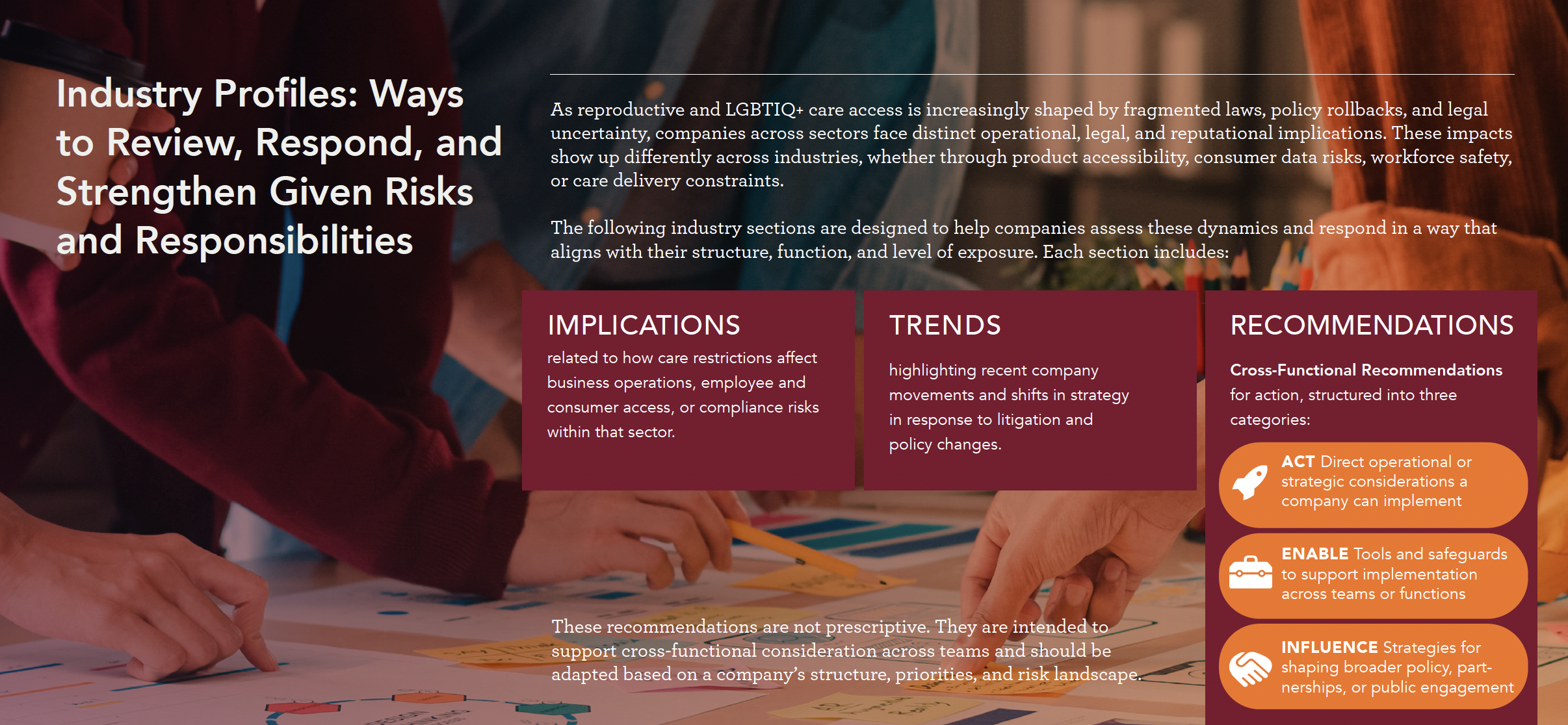
Click on the image to view a larger size.
The following action areas offer a starting point for business engagement:
- Understand how care access is shaped by operational and strategic decisions
- Build internal systems that can anticipate change and respond consistently
- Reevaluate physical footprint and service infrastructure through an access-informed lens
- Collaborate across sectors to promote coordinated and inclusive approaches
Reports | Wednesday June 18, 2025
Advancing Forced Labor Supply Chain Data Standardization
Two new Tech Against Trafficking reports provide comprehensive insights into how businesses and public sector actors collect data on forced labor risks and opportunities for greater standardization.
Reports | Wednesday June 18, 2025
Advancing Forced Labor Supply Chain Data Standardization
Preview
As businesses and public sector actors work to prevent, detect, and address forced labor, collecting data on risks and indicators can be complicated due to a lack of clear guidance and standardization. What key challenges do companies face, and how can data collection approaches be simplified to inform meaningful action?
Two new reports from BSR Collaborative Initiative Tech Against Trafficking (TAT) shed light on how public and private sectors collect forced labor data and highlight opportunities to drive greater standardization, based on a year of research and collaboration. The first report, Standardizing Data Collection on Forced Labor: Benchmark of Practices and Gap Analysis, examines practical examples in collecting forced labor data points across private sector value chains. The second publication, Governments as Intermediaries of Forced Labor Data, summarizes insights from a policy dialogue series with government and intergovernmental stakeholders, which TAT conducted in 2024.
Access TAT's press release to learn more about these reports and the initiative's next steps on forced labor data standardization.
Blog | Wednesday June 11, 2025
Extreme Heat, Floods, and Supply Chain Shocks: How to Future-Proof Your Manufacturing Operations
Manufacturers face constant crisis management, with billion-dollar disasters forcing them to rethink risk. BSR shares 5 key steps to assess climate risks.
Blog | Wednesday June 11, 2025
Extreme Heat, Floods, and Supply Chain Shocks: How to Future-Proof Your Manufacturing Operations
Preview
Blog | Thursday June 5, 2025
Four Tips for Authentic Business Leadership During Pride 2025
Pride celebrations come amid ongoing challenges to LGBTIQ+ equality, with some companies pulling back and others still prioritizing inclusion. BSR shares four practical tips for company engagement on LGBTIQ+ equality efforts.
Blog | Thursday June 5, 2025
Four Tips for Authentic Business Leadership During Pride 2025
Preview
This June’s Pride celebrations will occur as LGBTIQ+ equality advocates and inclusive business practitioners confront ongoing challenges to hard-earned progress that have raised the stakes of private-sector engagement.
This is especially true in the U.S., where federal research programs benefitting LGBTIQ+ people have already been cut by nearly a billion dollars. The future of preventative health care programs supporting LGBTIQ+ people is at risk, given longstanding efforts to dismantle the Affordable Care Act, and legal rights and protections related to dignity, safety, and healthcare of transgender people are being litigated in U.S. courts.
Some companies have limited their public communications or otherwise ended voluntary LGBTQI+ programs, including philanthropic grants, event sponsorships, and promotion of voluntary performance standards, efforts that were increasingly commonplace prior to the recent resurgent wave of anti-LGBTIQ+ political advocacy. Furthermore, social media campaigns driven by conservative “influencers” have undercut some business relationships with their core consumers, attacking brands for their inclusive advertising and/or retail choices. Special interest groups have instigated legal challenges to business’ DEI programs, creating unfavorable media attention and leading to uncertainty on company commitment to building organizations, products, and services that can meet the needs of their diverse consumers and stakeholders.
Still, there’s evidence that LGBTIQ+ equality and inclusive business practices remain a business priority even as some companies scale back. Participation in the Human Rights Campaign’s Corporate Equality Index increased over the last year in spite of some high-profile withdrawals from the effort in the fall. More and more, business shareholders have voted to uphold diversity programs and underscore the importance of inclusion despite recent legal flashpoints and an effort by federal officials to cripple these programs through executive orders and allegations of illegality. Though company sponsorship of Pride festivals is expected to lag overall, a majority of corporations have recently reported little to no change in their expected participation.
In this landscape, business actions on LGBTIQ+ equality efforts appear to be fueled less by sector-wide alignment and more by each company’s unique operational posture and the media/risk tolerance of its leaders. It is understandable, then, that many business practitioners, including communication, inclusion, human resources, and government affairs leads alike, may be questioning what current expectations or best practices they might advance within their company. Considering the risk-averse environment in which many business practitioners may find themselves, we share four practical tips for LGBTIQ+ engagement for the 2025 Pride season and beyond.
- Celebrate LGBTIQ+ Pride, even if it means doing so less publicly or with fewer resources. Like other cultural, civic, and social commemorations, LGBTIQ+ Pride is an opportunity for businesses to underscore its inclusive values and appreciate broader business success in the context of the contributions of its diverse leadership and workforce. It also offers businesses a chance to showcase positive impacts in communities where they are headquartered and operate more broadly. This remains true despite current sociopolitical headwinds. Indeed, even some companies that have made headlines for reported cuts to these engagements have privately indicated their intent to support Pride observances through more local sponsorships, events, and gatherings, yet with less budget, public fanfare, or formality. Ultimately, your company might choose to observe this Pride season with fewer resources and with greater awareness of potential scrutiny and/or worker safety risks. Still, these concerns should not preclude your company and your workers from engaging in lawful activities that help promote a culture of inclusion and positive impact, even if such activities are tailored to your specific circumstances and operational footprint.
- Share updated communications and policy materials, acknowledging your company’s responsibility for ensuring a workplace free from LGBTIQ+ discrimination and harassment. Include relevant global and local policies that guide your company’s efforts to uphold that responsibility. Your current employees and teams likely include LGBTIQ+ individuals or individuals who have loved ones who are directly impacted by social, legal, and cultural debates and/or shifting policies focused on LGBTIQ+ equality. Via diversity, legal, or communications officers, ensure clarity about your company’s nondiscrimination and harassment expectations and policies, as well as the processes/infrastructure that are in place to manage potential issues. The UN Standards of Conduct for Business Tackling Discrimination Against LGBTIQ+ People offers guidance for global businesses navigating wide-ranging expectations, and sometimes conflicting jurisdictional laws, for LGBTIQ+ workplace, marketplace, and community standards.
- Invite leaders of regional/local business headquarters and workforce volunteer coordinators to uplift local direct service/volunteer organizations providing general support to LGBTIQ+ workers and their families in communities touched by your business’ operations. Data from past few years, including the Association of Corporate Citizenship Professional’s Annual CSR Insights Report, has repeatedly indicated that employee volunteerism and issue-focused pro-bono engagement is both a norm and increasing throughout the private sector. Just as donation drives like Giving Tuesday raises billions in annual donations to nonprofits around the globe, Pride is a great opportunity for businesses to highlight employer benefits, including paid time-off for volunteerism, matched donations, and other community-sponsored activities that may benefit LGBTIQ+ community members, including your company’s workers and their families. Indeed, some of your workers may be especially keen to find volunteer activities or donation drives given the current climate. Driving awareness for such opportunities through regional/local leaders who may be able to share vetted information may be a great way to ensure your company enables its teams to align their efforts with local dynamics in place of overcompensating for broad-based concerns that may be best navigated at the corporate level.
- Create informational resources that can help address how your company may respond to various LGBTIQ+-related cases expected from the U.S. Supreme Court in the coming weeks. In the coming weeks, several Supreme Court decisions are anticipated on litigation that will directly/indirectly affect LGBTIQ+ individuals and families. From national coverage of preventative care treatments, including HIV and breast cancer medications, to the scope of certain healthcare programs available to transgender youth, some cases may lead to questions about the consistency or coverage provided in employee benefits and healthcare plans. Here, your company’s human resources team might host or commission an informational webinar, develop FAQ documents, and/or establish a small team/individual as the main point of contact for inquiries on any legal changes affecting LGBTIQ+ workers.
There is a lot of room for ambitious leadership for business engagement on LGBTIQ+ equality efforts, not only in the U.S. but globally as well. For more information on how your company can support LGBTIQ+ workers and communities, please reach out to BSR’s Inclusive Business team and explore the team’s latest insights on the BSR Member Portal.
Blog | Wednesday June 4, 2025
Advancing a People-Centered Approach to Sovereign Debt
A sovereign debt crisis is not only a financial crisis—it is also a human rights crisis. BSR shares recommendations for sovereign investors on aligning investment practices with relevant human rights standards.
Blog | Wednesday June 4, 2025
Advancing a People-Centered Approach to Sovereign Debt
Preview
Due to several factors, including the rapid increase of global interest rates, depreciation of local currencies, higher risk premiums, among others, many developing countries, particularly developing economies with the weakest credit ratings, are unable to fulfill their financial obligations to external creditors, sparking a “silent debt crisis” and leading to default, restructuring, and the requirement to refinance about US$60 billion in external debt annually. This means allocating twice as many resources to servicing public debts while diverting scarce resources away from socioeconomic development. In the recent World Bank Group Spring Meetings, the IMF called for the urgency in dealing with complex trade-offs between increasing sovereign debt, slower growth, and new spending pressures. Following a decade-long sovereign debt market boom, global public debt is expected to rise by an additional 2.8 percent of GDP by 2025 and to reach 100 percent of GDP by 2030.
This financial crisis is also a human rights crisis. While sovereign debt can help fund sustainable development, excessive public debt and high interest rates burden developing countries. By 2023, 3.3 billion people lived in countries spending more on interest payments than on critical public expenditures including 54 developing countries that allocated over 10 percent of government revenues to interest payments, outpacing growth in critical public expenditures, such as education, health, and other human rights-related expenditures. At the Spring Meetings, participants emphasized that growth must translate into better livelihoods through effective fiscal and monetary policies, transparency, and good governance.
This is key for private creditors, who own 61 percent of developing countries’ debt, and whose lending terms are more volatile and expensive than concessional financing. Private creditors have also financed repressive regimes responsible for severe human rights violations. This represents a twofold problem for responsible finance because sovereign bond investors may:
- Restrict governments’ ability to deliver human rights by demanding lending conditions mostly favorable to creditors, such as higher interest rates and a lack of concessions in times of financial difficulty, or irresponsible debt restructuring, and/or;
- Finance governments that systemically violate human rights and perpetrate crimes against humanity.
While countries have the ultimate duty to protect human rights, investors can impact human rights and have a responsibility to respect them in their operations and value chains. Yet the UN Working Group on Business and Human Rights finds that many investors fail to connect human rights standards and due diligence with responsible investment practices. The PRI (Principles for Responsible Investment) adds that few sovereign debt investors recognize how their investments impact human rights or the resulting material risks to their portfolios.
While some sovereign bondholders set human rights expectations for debtors and engage governments on issues like deforestation impacts on Indigenous Peoples, the majority fail to do so. This is due to several challenges, including perceived encroachment on sovereignty, limited leverage compared to corporate stocks and bonds, and potential reputational backlash from cutting government funding.
When governments can no longer afford interest payments, debt restructuring agreements may lead to further cuts in spending on essential services for the population, exacerbating socio-economic inequalities and undermining human rights. A study of 19 sovereign debt restructurings in 13 countries (Barbados, Belize, Chad, Côte d’Ivoire, Ecuador, Grenada, Greece, Jamaica, Mongolia, Mozambique, St Kitts and Nevis, Seychelles, and Ukraine) found that investors often ignore the human rights situation in debtor countries during negotiations, requiring countries to make financial decisions that may limit their ability to meet human rights obligations.
Despite these findings, the UN Guiding Principles on Business and Human Rights (UNGPs), Organisation for Economic Co-operation and Development‘s guidance on responsible business conduct for institutional investors, and EU-wide regulations outline processes for investors to respect human rights. In turn, the 2011 UN Guiding Principles on Foreign Debt and Human Rights focus on debt repayment and countries’ fiscal capacity to uphold human rights, urging lenders to conduct due diligence to ensure that the loans do not impair the borrower’s ability to fulfill human rights. These provide the foundation for investors to embed human rights considerations into their strategies and more effectively account for the implications of their sovereign investments.
Recommendations for investors
BSR recognizes the challenges sovereign investors face in addressing human rights in their sovereign bond portfolios. BSR encourages investors to take the following steps to align investment practices with the UNGPs and other relevant human rights standards:
1. Embed human rights in investment practices. This involves integrating human rights considerations into investment policies and processes, publishing a human rights policy, and communicating expectations to bond issuers and affected stakeholders.
2. Assess the country’s context and human rights profile before investing and continuously thereafter, including during debt restructuring negotiations.
- Understand the debtor’s human rights performance, the strength of the rule of law, and the socio-economic context. Use credible human rights indicators and data from reputable sources like the UN’s Universal Human Rights Index and the Human Rights Measurement Initiative while seeking input from affected stakeholders.
- During debt restructuring, assess how negotiating positions may impact the debtor’s capacity to meet human rights obligations and avoid exceeding the human rights debt tolerance threshold.
3. Use leverage to influence behavior changes among debtors. While sovereign bondholders have less influence than equity investors, multiple opportunities exist:
- Raise human rights considerations with governments,emphasizing the importance of tax and social spending, and strong democratic institutions attracting foreign investment. Creating lending conditions tied to sovereign human rights performance may be possible. During the Spring Meetings, participants highlighted the need for transparent, accountable sovereign debt decisions and empowering parliaments, civil society, and citizens to align borrowing with public interest.
- Participate in debt relief programs and restructuring negotiations in good faith, including through a formal social dialogue. Avoid predatory or obstructive behaviors that limit governments' efforts to fulfill human rights obligations and seek debt agreements that are financially sustainable and respect human rights cognizant of the country’s context (e.g., see proposal under the Debts of Vulnerable Economies Fund Principles).
- Influence and collaborate with peers to increase leverage over debtor countries. Communication between asset owners and managers regarding their expectations of debtor countries will raise awareness of this important topic in the industry.
- Consider taking a human rights-based approach to divestment if the leverage methods discussed above are not effective. Sovereign investors would need to consider the potential negative impact of divestment on human rights within the country.
Given the complexities of sovereign debt investment, it is important to anticipate regulatory and stakeholder expectations, including national and regional legislative developments in the EU and elsewhere that seek to ensure responsible business and investment strategies uphold human rights. Please contact us to learn more about BSR’s approach to helping your company navigate human rights and sustainability opportunities and challenges associated with sovereign debt.
People
Merry Samuel
Merry works with BSR member companies and internal teams to ensure quality membership communications and delivery of relevant content, events, advisory services and opportunities to collaborate. She also supports membership strategy, recruitment, engagement, and delivery to ensure communications and campaigns align with current and prospective member needs. Prior to joining…
People
Merry Samuel
Preview
Merry works with BSR member companies and internal teams to ensure quality membership communications and delivery of relevant content, events, advisory services and opportunities to collaborate. She also supports membership strategy, recruitment, engagement, and delivery to ensure communications and campaigns align with current and prospective member needs.
Prior to joining BSR, Merry was a Market Development Associate at the International Foundation for Valuing Impacts. She developed marketing and educational content, communicating the value proposition of impact valuation methodologies to sustainable business leaders. Merry also worked as a Senior Analyst at a global development and implementation firm, Resonance Global, where she supported public-private partnerships and activities between global development agencies and Fortune 500 companies to advance the SDGs. Through her prior experience at various global development firms and nonprofits, Merry brings over five years of experience in relationship management, business development, and project management.
Merry holds a B.A. in International Affairs from George Washington University, where she concentrated on international development.
Reports | Thursday May 15, 2025
BSR Climate Scenarios 2025
2024 was the warmest year on record, with a global average surface temperature of more than 1.5°C above pre-industrial records. As climate risks intensify, the need for credible, science-based scenario planning has never been greater.
Reports | Thursday May 15, 2025
BSR Climate Scenarios 2025
Preview
2024 was the warmest year on record, with a global average surface temperature of more than 1.5°C above pre-industrial records. As climate risks intensify, the need for credible, science-based scenario planning has never been greater.
BSR’s climate scenario narratives draw on a range of temperature pathways and integrated climate-economic models to evaluate both physical and transition risks. Our decade-by-decade assessments help organizations translate complex climate data into actionable insights, supporting more transparent climate risk disclosures and more resilient, forward-looking business strategies. By aligning with the global transition to a low-carbon economy, companies can not only mitigate risk but also unlock emerging strategic opportunities.
Blog | Wednesday May 7, 2025
Omnibus: The Costs of Looking Away from Sustainability Impacts in Uncertain Times
While the EU has made significant progress in building a sustainability framework, the latest Omnibus proposals increase policy incoherence and diverge from international due diligence standards. Businesses evaluating the Omnibus can consider five key changes that could affect their ability to understand and manage their most severe sustainability impacts.
Blog | Wednesday May 7, 2025
Omnibus: The Costs of Looking Away from Sustainability Impacts in Uncertain Times
Preview
People
Nicci Hong
Nicci supports BSR member companies across industries in respecting human rights across their organizations. Her primary areas of expertise include human rights in Southeast Asia and forced labor issues in global value chains. Prior to joining BSR, Nicci worked as an associate and independent contractor, providing advisory services on addressing…
People
Nicci Hong
Preview
Nicci supports BSR member companies across industries in respecting human rights across their organizations. Her primary areas of expertise include human rights in Southeast Asia and forced labor issues in global value chains.
Prior to joining BSR, Nicci worked as an associate and independent contractor, providing advisory services on addressing labor rights violations and the implementation of business and human rights standards.
Nicci graduated magna cum laude with a Master's in Management and a concentration in Corporate Social Responsibility from Louvain School of Management in Belgium. Nicci also holds a B.A. in Global Political Economy from Waseda University in Japan, and her degree focused on poverty and socioeconomics.