Searching for:
Search results: 976 of 1188
Blog | Sunday December 10, 2017
Surveying the Human Rights Landscape: Collaboration on the Rise
In honor of International Human Rights Day, we are kicking off a three-part series featuring our human rights experts’ reflections on the evolving business and human rights landscape in 2017, as well as their perspectives on emerging issues we anticipate in 2018.
Blog | Sunday December 10, 2017
Surveying the Human Rights Landscape: Collaboration on the Rise
Preview
In honor of International Human Rights Day, we are kicking off a three-part series featuring our human rights experts’ reflections on the evolving business and human rights landscape in 2017, as well as their perspectives on emerging issues we anticipate in 2018.
In 2017, BSR’s team of human rights experts tackled close to 50 projects and collaborated with more than 80 companies around the world. We worked on everything from empowering women in factories to conducting human rights impact assessments and establishing grievance mechanisms.
As this exciting and busy year draws to a close, I asked my colleagues to reflect on what we've learned in 2017 and what it means for the year ahead. 2018 will be the 70th anniversary of the Universal Declaration of Human Rights (UDHR).
At this time 70 years ago, the UDHR drafters were hard at work, formulating fundamental concepts like whether women should have equal rights at a universal level, or whether it should be left to national level cultures and preferences. It can be easy to fail to appreciate the inspiration (and guts) it took to produce a document like this at a global level, but over the next year, we plan to reflect on the progress the human rights field has made and explore those topics that are likely to define the next 70 years of work in this space.
—Margaret Jungk, Managing Director, Human Rights, BSR
Dunstan Allison-Hope, Managing Director (San Francisco)
For me, a big development in 2017 has been the growing interest in the social, ethical, and human rights implications of disruptive technologies, such as artificial intelligence (AI). For example, we have seen the creation of the Partnership on AI and the publication of new AI principles by the Software and Information Industries Association and the Information Technology Industry Council. The annual UN Forum on Business and Human Rights hosted a track on technology and human rights for the first time this year, where we ran a discussion on realizing access to remedy when decisions are made by machines rather than people. We hope that this interest in human rights and technology extends beyond the technology industry to other sectors that use technology.
Ouida Chichester, Manager (San Francisco)
In my work in 2017 on women’s empowerment and human rights, from sub-Saharan Africa to Latin America, I increasingly saw the language of human rights being used by communities when engaging with companies. Communities, even very remote ones, are becoming ever more adept at using the discourse of human rights to present their interests to companies.
This is likely in part the result of increasing international NGO efforts to train communities in the use of human rights language and the UN Guiding Principles approach. These trainings include things like using mobile phones to document and report abuses. You no longer hear women saying things like, "The security guards around your company are making me feel unsafe and unable to move about in my own community without harassment." Instead, you hear them invoke the stronger human rights language: "This is about my rights—and these security guards are infringing upon my freedom of movement." The companies that are learning that language alongside the societies where they operate are much better equipped to deal with community concerns and challenges, and are better able to address human rights risks and take proactive steps to protect and promote human rights.
Salah Husseini, Manager (New York)
Companies are ambitious entities, and if the last 15 years demonstrate anything, it is that when a company sets its mind to something—self-driving cars, instant deliveries, a phone that can scan your face—it can make it happen. This is why I'm excited to hear so many companies expressing an ambition to work with their industry peers to effect systemic change on human rights rather than take an individual approach. Human rights violations don't take place in a vacuum, and a unified company approach to issues like privacy, complicity with authoritarian regimes, or decent working conditions could change the world overnight. I know that sounds idealistic and impossible. But hey, 15 years ago, so did having your entire music collection in your pocket.
Jean-Baptiste Andrieu, Associate Director (Paris)
I observed in 2017 that a global coalition of actors are working intensely on the issue of recruitment and migrant workers. The link between unethical recruitment practices—the payment of fees in particular—and forced labor has been clearly established. NGOs, academics, unions, and companies now share a common understanding of the importance of tackling this issue. With so much interest, a lot of initiatives have emerged, many reports have been written, and tools have been developed. This is a good thing! In 2018, it will be important to ensure that solutions to this issue are not duplicative and are mutually reinforcing. One solution could be to build a coalition of collaborations promoting responsible recruitment practices. BSR’s Building Responsibly will be willing to contribute.
Michaela Lee, Associate (San Francisco)
There is an African proverb that says, “If you want to go fast, go alone. If you want to go far, go together.” For years, companies have dealt with human rights issues on an individual basis, often due to having nascent or under-resourced programs that get caught up in putting out fires. Today, a greater number of companies have stable programs that have allowed them to refocus efforts on untangling the more complex human rights issues underlying their value chains. This increasing capacity and ambition is fueling the continued development of collaborative initiatives to tackle intractable issues.
Over the past 15 years, we've seen an exponential increase in the number of collaborative initiatives and successful case studies that demonstrate the efficacy of collective action. Collaborations that came out at the turn of the century—the Voluntary Principles on Security and Human Rights and the Fair Labor Association—have filled governance gaps and advanced the human rights field. These established initiatives will continue to amplify business efforts even as new collaborations—like this year’s Building Responsibly and the Responsible Labor Initiative—pop up to tackle other issues. I look forward to the strengthening of collaborative efforts in 2018 that will help us "go far" and "go together."
Blog | Wednesday December 6, 2017
Remedy against the Machine
How can we ensure access to remedy when decisions are made by machines rather than humans?
Blog | Wednesday December 6, 2017
Remedy against the Machine
Preview
How can we ensure access to remedy when decisions are made by machines rather than humans? This was the complex question that BSR and the International Corporate Accountability Roundtable (ICAR) considered in our joint session at the UN Annual Forum on Business and Human Rights last week.
By vastly improving our analytical capability, artificial intelligence (AI) has the potential to address some of humanity’s most pressing challenges, including those relating to healthcare, education, transportation, counter-terrorism, and criminal justice. However, as we have noted in our new primer on top human rights priorities for the ICT industry, AI brings with it new and previously unforeseen human rights risks on topics as diverse as non-discrimination, privacy, child rights, freedom of expression, and access to public services.
For example, using AI when making sentencing decisions in courts, providing access to credit, or identifying potential terrorists can result in discriminatory decisions. Using voice recognition-based AI devices can bring implications for privacy rights and child rights, while some have articulated concern that machines making decisions about whether social media posts comply with terms of service could negatively impact freedom of expression.
The third pillar of the UN Guiding Principles on Business and Human Rights (UNGPs) establishes that access to remedy should be provided for victims of such violations. Our session considered three new challenges for securing access to remedy in the context of AI:
- Guaranteeing remedy when violations result from decisions made by machines and algorithms, rather than humans
- Providing operational grievance mechanisms when there are hundreds of millions of rightsholders and billions of decisions
- Safeguarding access to remedy when dozens of companies, rather than a single corporate actor, are linked to a human rights violation via the interaction of different AI-based products and services
While these discussions can seem hypothetical, technologies are moving fast, and companies from all industries are rapidly integrating AI into their products, services, and operations.
Microsoft Vice President and Deputy General Counsel Steve Crown raised the challenges of knowing when a harm has taken place, identifying who might be at fault, and defining a remedy that can return the victim to their previous state. Crown provided the example of a young woman who was targeted with advertisements based on retail data analytics suggesting she was pregnant—and her father discovering this fact from direct mail, rather than from his daughter. In this case, had a privacy violation taken place, what remedy might be appropriate if it had, and how could the company stop it from happening again?
Sandra Wachter, a researcher in data ethics at the University of Oxford and research fellow at The Alan Turing Institute, surfaced the notion of a “right to explanation” that might come into force under the new European General Data Protection Regulation (GDPR) in scenarios when decisions are made by machines, such as access to credit or employment opportunities.
However, Wachter highlighted that this right in the GDPR disappears once a human is involved in the process—even if the human is involved as a rubber stamp—and that many companies will oppose revealing detail about decision-making algorithms as being commercially confidential. Sandra proposed an alternative “right to explanation” model based on counterfactuals that describe facts that lead to that decision (such as income or educational achievement, for example) that may offer meaningful information to rightsholders, without the need to convey the internal logic of an algorithm. Sandra also spoke in favor of an independent watchdog to scrutinize companies and ensure accountability.
Google Free Expression and Human Rights Counsel Alex Walden spoke about how machines are being deployed to assist with judgments about controversial content uploaded by internet users, such as hate speech and terrorist content. These machines can be especially helpful given the sheer volume of content uploaded—but while machines can sift through huge volumes of content to identify cases, only humans have the necessary understanding of context and language to make final decisions.
A theme running throughout was the notion that AI is going to play an increasingly important role in our lives, and that it is going to be used by many industries, not only technology companies. Overall, I reached three conclusions about the application of the UNGPs in the age of AI.
First, it is important that the human rights implications of AI are understood by all sectors of the economy—such as retail, financial services, energy, healthcare, transportation, infrastructure, and the public sector.
Second, we should consider access to remedy through the lens of the rightsholder. AI is extremely complex, and only a very small number of people in the world know how it works. If AI is to fulfil its potential while mitigating accompanying risks, it is essential that civil society, rightsholders, and vulnerable populations benefit from channels to participate meaningfully in discussions about its application and have access to remedy. The professional communities engaged in the development of AI would benefit from a deep understanding of ethics issues and rightsholder perspectives, as is beginning to happen through initiatives such as Partnership in AI and AI Now.
Finally, there is a need to assess whether the access to remedy being developed in the context of AI meets the remedy effectiveness criteria set out in the UNGPs, such as being legitimate, accessible, predictable, equitable, transparent, rights-compatible, and based on engagement and dialogue.
Answers to these questions will only arise over time (unfortunately, we can’t just ask Alexa, Siri, or Cortana!) and with the identification of use cases demonstrating how effective remedy can be obtained. We look forward to the opportunity of working with our member companies from all industries to explore these important conversations further.
Blog | Tuesday December 5, 2017
The One Planet Summit Will Kick Off a Year of Focus on Climate Results
We will attend the One Planet Summit in Paris next week to kick off a year when collective focus on climate change will turn from targets to impacts, from promises to results. And we invite companies and other partners to join us.
Blog | Tuesday December 5, 2017
The One Planet Summit Will Kick Off a Year of Focus on Climate Results
Preview
On December 12, the two-year anniversary of the adoption of the Paris Agreement on climate change, French President Emmanuel Macron, UN Secretary-General António Guterres, and World Bank President Jim Yong Kim will jointly convene the One Planet Summit. Its focus—public- and private-sector finance in support of climate action—is a reminder that to reduce emissions and to build climate resilience, we will need to channel international funding toward low-emissions and climate-resilient development. One of the three stated objectives of the Paris Agreement is to do precisely that.
Over the past two years, momentum in the business community for climate action has grown. The BSR/Globescan 2017 State of Sustainability survey shows that climate change is now the top sustainability priority for business, along with human rights. Through the We Mean Business coalition’s Take Action campaign, more than 620 companies, with a total market capitalization of more than US$15.5 trillion and 2.31 gigatons of annual greenhouse gas emissions reported in their direct operations, have committed to bold climate action to date. However, in order to limit global temperature increases and build resilience to address the inevitable impacts of climate change, all of us—companies, investors, government actors, and other stakeholders—need to work together to go further, faster.
The financial system has a key role to play in accelerating the transition to a low-carbon economy, and it is beginning to integrate climate risks into the cost of capital. The recommendations of the Task Force on Climate-Related Financial Disclosures have galvanized increasing harmonization of climate reporting, as well as the creation of a new Climate Disclosure Standards Board and We Mean Business commitment to implement the recommendations. Sixteen banks are now piloting the recommendations with the UNEP Finance Initiative. S&P recently published that over the last two years, climate and environment were relevant to more than 700 ratings, and in more than 100 cases resulted in a ratings action. Norway’s sovereign wealth fund, the world’s largest, is considering divesting from oil. And BNP Paribas recently announced that it would stop financing shale and oil sands projects.
Our own Aron Cramer and Farid Baddache will participate in the One Planet Summit on behalf of BSR and the We Mean Business coalition next week. The event will feature four panels with corresponding announcements and calls to action.
- The “Scaling up Finance for Climate Action” panel will illustrate the new mandate for public and private finance and showcase investments to build climate resilience.
- In “Greening Finance for Sustainable Business,” panelists will discuss how to increase transparency about climate risks, promote impact investment, and mobilize investors for a low-carbon future.
- The “Accelerating Local and Regional Climate Action” session will feature innovative public-private collaborations and pathways for finance at the sub-national level.
- In “Strengthening Policies for Ecological and Inclusive Transition,” leaders will explore creative ways to deliver a transition to the low-carbon economy through policy that does not leave any country or group behind.
The Summit will kick off a year when our collective focus will turn from targets to impacts, from promises to results. The business community will be called upon to demonstrate progress in implementing the Paris Agreement in the high-level UNFCCC Talanoa Dialogue, named after a Fijian form of gathering aimed at the collective good, throughout the year; at the Global Climate Action Summit in San Francisco next September; and at the UN climate negotiations in Poland next December.
BSR is proud to serve on the Global Climate Action Summit’s Advisory Committee as the representative of the business community and to act as the international policy lead for the We Mean Business coalition. Through these roles and others, we will channel the energy and enthusiasm of business to deliver on the low-carbon, climate-resilient world we all need.
We’d love for you to join us in Paris next week to continue the conversation and the momentum.
Blog | Thursday November 30, 2017
The Sustainability Reporting Landscape: Q&A with GRI and SASB
We sat down with GRI’s Tim Mohin and SASB’s Jean Rogers to discuss the relationship between the organizations’ standards and how they can be used in combination.
Blog | Thursday November 30, 2017
The Sustainability Reporting Landscape: Q&A with GRI and SASB
Preview
We recently interviewed Tim Mohin, chief executive of GRI, and Jean Rogers, chair of the Sustainability Accounting Standards Board (SASB), about the relationship between the organizations’ standards and how they can be used in combination.
Dunstan Allison-Hope: You both recently stated that “rather than being in competition, GRI and SASB are designed to fulfill different purposes for different audiences. For companies, it’s about choosing the right tool for the job.” Can you share what you mean by this?
Tim Mohin: The GRI Sustainability Reporting Standards (GRI Standards) and the SASB Sustainability Accounting Standards are designed for different, but complementary, purposes. Stated simply, GRI looks at the company’s impacts on the world and the SASB looks at the world’s impacts on the company.
We believe both frameworks can work together to give companies and their stakeholders a comprehensive view of how businesses can create shareholder value, but, importantly, also help create the conditions for sustainable development. The GRI framework focuses on a company’s impacts on the broader economy, environment, and society to determine its material issues.
Jean Rogers: The key difference between the approach we take at the SASB and what GRI does stems from the specific audiences we’re trying to serve. At the SASB, that audience is financially motivated mainstream investors who are seeking access to standardized performance information on the small handful of sustainability factors that are reasonably likely to materially affect the financial condition or operating performance of their portfolio companies. The SASB serves the unique needs of the investment community, but this is not mutually exclusive with the type of reporting that GRI facilitates for a broader set of stakeholders. Rather, we like to say they are complementary and “mutually supportive.”
Companies now realize that they have a broad set of stakeholders and they ignore them at their own risk. This is, in large part, thanks to GRI’s important work of bringing a wide array of stakeholders and their interests to the attention of corporate actors over the past two decades.
Allison-Hope: The metrics in the GRI Standards are different than the metrics in the SASB Standards. Do you envision more alignment and harmonization over time on specific metrics? How can that be achieved?
Rogers: Wherever possible, the SASB Standards include quantitative, industry-specific performance metrics that are commonly used to describe performance on key sustainability issues, and we leverage the longstanding work of many organizations—including GRI—to achieve this. The SASB takes this approach, in part, to deliver the most cost-effective solution possible for companies. Companies are already likely measuring many metrics in the SASB Standards because we reference indicators from more than 200 entities, including GRI, CDP, the EPA, OSHA, and the EEOC and IPIECA. The SASB and GRI have also committed to mapping our metrics to one another, which is a project we aim to complete in 2018, so increasing alignment is certainly on the horizon.
Mohin: In many cases, our standards are identical. In others, the SASB has defined disclosures that represent issues that are narrowly defined for certain industries. There is alignment work to be done in the third category where the two frameworks have similar disclosures with different characteristics. For this group, we are working together on a technical level with an aim to create better alignment.
Allison-Hope: Reporting on sustainability issues is still a fairly young discipline, and we are learning all the time about how to do it better. What is your message for companies trying to use both the GRI Standards and the SASB Standards at the same time today?
Mohin: There is already very broad uptake of the GRI reporting framework. Given this level of adoption, it’s likely that many of the companies that are reviewing the SASB disclosures already use GRI. Working together, GRI and SASB have identified a few companies that are utilizing both approaches. We aim to highlight these case studies to show other reporters how the standards can co-exist.
Rogers: Neither GRI nor SASB are tick boxes—but they are both helpful in mastering sustainability. GRI helps you understand your various stakeholders—their interests and how you affect them. This makes you strong. SASB helps you identify and manage financially material issues that affect your business and therefore your investors. This makes you powerful. It’s good to be strong and powerful.
Allison-Hope: What are the best ways for BSR member companies to provide input into the development of the GRI Standards and SASB Standards?
Rogers: Our doors are always open to BSR member companies, and we would love to hear from them. Getting involved requires only that you reach out and provide feedback. Our goal is to ensure that the standards reflect the needs and expertise of all users—specifically corporate issuers and investors—but we can only do so if they’re forthcoming with their insights and experiences.
We have a 90-day public comment period open through December 31, which is a great opportunity to provide input on proposed changes to the provisional standards prior to codification. Corporate professionals at BSR member companies can also consider joining the SASB Alliance to develop, share, and explore best practices in integrating material sustainability information into existing processes.
Mohin: As a multistakeholder organization, collaboration has always been at the heart of our work at GRI. We encourage BSR members and other interested parties to play an active role in our standard-setting process. Organizations of all types can join the GRI GOLD Community to become more deeply involved in all the work we do.
There are several ways for individuals to get involved in GRI’s Standards: Stakeholders can apply to become a part of GRI’s standard-setting process; they can submit comments during the consultation period; or at a minimum, anyone can listen live or to a recording of the Global Sustainability Standards Board (GSSB). GSSB is a fully independent body that promulgates the GRI Standards.
GRI released its full set of Standards in 2016. More recently, we have conducted a review of two standards on water and occupational safety. If all goes according to plan, we will release those updated standards in the second quarter of 2018. Over the next year, we plan to review a number of other standards.
Allison-Hope: Thank you, Jean and Tim. We are delighted by efforts toward increased standardization, alignment, and harmonization, and we look forward to working with BSR member companies using the GRI and the SASB standards in combination. We will be sure to share lessons learned along the way.
Blog | Wednesday November 29, 2017
Climate Lessons from the Vehicle Industry
Global automakers and other vehicle manufacturers are in one of the most carbon-intensive industries. And other companies can—and should—look to their holistic approaches to climate action.
Blog | Wednesday November 29, 2017
Climate Lessons from the Vehicle Industry
Preview
For the third year in a row, global carbon emissions leveled off in 2016. Unfortunately, however, to avoid unmanageable climate impacts, we don’t just need emissions to level off—we need to ski down what Al Gore refers to as the “double black diamond” emissions reduction slope necessary to keep the Earth inhabitable for humans and realize the vision articulated in the Paris Agreement.
Business is an essential component of this effort. That’s why at the BSR Conference this year, I led a breakout session exploring lessons from companies that have been working on emissions reductions and energy efficiency for decades: global automakers and other vehicle manufacturers.
Alex Keros represented General Motors, one of the world’s largest automakers, and Laurie Counsel spoke for Cummins, a leading supplier of heavy-duty engines. The two of them highlighted several ways that companies in any industry can address climate change:
- Envision a different future. Climate change regulations, together with technology and market shifts, are creating more uncertainty in the vehicle industry than at any point in the past 70 years—pressures that other industries are also feeling. In the face of this uncertainty, companies that help shape a low-carbon future will be well positioned to thrive in it. Cummins’ scenario planning, its technology portfolio that includes all-electric trucks, and its leadership’s willingness to envision an energy-diverse future illustrate this approach, as do GM’s electric vehicle launches and its engagement in shared-use platforms, such as ride-hailing and car-sharing.
- But build on your legacy. Keros told the story of his kids learning to ride bikes to demonstrate that even if the nature of transportation is changing, people’s desire for freedom and flexibility isn’t. Cummins and GM are applying their legacies of innovation and mobility to meet new climate and market realities while supporting their core customers, whether building an EV that becomes Motor Trend’s Car of the Year because it is “fast, fun, and genuinely entertaining to drive,” or helping customers improve efficiency of products already in use.
- Identify and address potential roadblocks. An audience member highlighted concerns about growing resource use for vehicle electrification, such as the human rights concerns associated with cobalt mining. Panelists acknowledged that because transitions inevitably create new challenges, business leaders need to better understand what these changes are going to look like so that they can address them—a running theme of BSR17, particularly in relation to futures thinking.
- Engage in policy. Policy and regulation have important roles to play in addressing climate change, and we have seen a lot of company engagement in the climate negotiations, most recently at COP23 in Bonn. The climate policy environment is particularly complex and uncertain for automakers, and while they cite challenges related to vehicle efficiency regulations, they are also promoting policies at local, state, and national levels that encourage innovation, electrification, and shared mobility. Company support for effective policy, as well as collaboration with public officials in new ways to quickly learn about emerging technologies, will be important for continued progress.
Overall, however, the panelists encouraged business practitioners to think holistically. Through their power purchases, renewable energy goals, and work to evolve their products and business models, Cummins and GM are tackling numerous aspects of climate change.
For business, addressing this challenge won’t only be about reducing greenhouse gas emissions. It’s also about an uncertain and highly dynamic future. We will need to involve business leaders from product design, internal operations, supply chain, government affairs, communications, and other departments, in addition to executive leadership, if we are to “ski down the double black diamond” emissions reduction slope.
Cummins and GM demonstrated that even some of the most carbon-intensive industries are developing their maps to navigate this journey. Other companies can (and should) do the same.
Blog | Tuesday November 28, 2017
BSR Conference 2017 Report
Blog | Monday November 27, 2017
Corporations and the Challenge of the Global Refugee Crisis
At the BSR Conference 2017, a panel of experts from Mastercard Center for Inclusive Growth, Mercy Corps, and TripAdvisor gathered on stage to discuss what business can do to help solve the global refugee crisis.
Blog | Monday November 27, 2017
Corporations and the Challenge of the Global Refugee Crisis
Preview
At the BSR Conference 2017, a panel of experts from the private sector gathered on stage to discuss what business can do to help solve the global refugee crisis. Panelists included President and CEO of TripAdvisor Stephen Kaufer, Chief Executive Officer of Mercy Corps Neal Keny-Guyer, and Executive Vice President of Sustainability and President of Mastercard Center for Inclusive Growth Shamina Singh. BSR Associate Director Peter Nestor moderated the panel.
"When you leverage your business expertise and the value of your business—that is how you make a difference," said Singh.
Watch the full video below:
The BSR Conference 2017 took place October 24-26 in Huntington Beach, California, and gathered sustainability leaders from business, government, and civil society to explore the theme of “How Business Leads.” Follow the conversation on Twitter at #BSR17. See all video highlights on BSR’s YouTube channel.
Blog | Saturday November 25, 2017
Why Intimate Partner Violence Is Your Business
Business has a key role to play in addressing the systemic issue of violence against women in and beyond the workplace. Here are some examples of how to lead.
Blog | Saturday November 25, 2017
Why Intimate Partner Violence Is Your Business
Preview
The recent surfacing of numerous sexual harassment allegations—including multiple allegations of sexual harassment in the workplace—have demonstrated how much work remains to be done to create genuinely inclusive workplace around the world. Business can no longer be in any doubt about its duty to stamp out violence and harassment at work.
However, if there is another learning from the #MeToo movement, it is that violence knows no borders. It occurs at work, on the way to and from work, and at home, and the impact spills over from one aspect of life to the other. Companies have a clear interest in ensuring a violence-free workplace, and for a range of reasons—including the importance of looking after your employees—business must consider how it can go beyond the workplace to tackle violence in the domestic sphere.
International and local instruments increasingly identify employers as important stakeholders to address Intimate Partner Violence (IPV). Coinciding with the Governing Body of the International Labour Organization (ILO) deciding to place a standard-setting item on “Violence against Women and Men in the World of Work” on the agenda of the 107th Session of the International Labour Conference, a tripartite meeting of experts concluded that “domestic violence and other forms of violence and harassment are relevant to the world of work when they impact the workplace.” In another recent development, China enacted its first Domestic Violence Act in March 2016, which includes provisions that require employers to act against domestic violence through measures such as providing assistance to victims.
Furthermore, working to tackle violence against women makes business sense: IPV can have negative impacts on workers’ productivity. Emerging research suggests that domestic violence can cause absenteeism because of stress, injuries, or ill-health; victims also have difficulty concentrating at work, which results in poor performance. An IFC study in Papua New Guinea calculated that staff lost 11 work days per year to gender-based violence, costing the companies 3-9 percent of payroll. Research from UN Women indicates that women workers in Vietnam who suffered IPV earned 35 percent less than those not experiencing such violence. There is a significant cost to business inaction.
Business can take a leading role on tackling IPV in several ways:
- Understand the root causes, raise awareness, and create the business case for intervention. Business can commission or conduct research to understand the root causes of gender inequality and violence. One example of this is the partnership between Diageo and CARE to promote women’s empowerment in the agricultural and hospitality value chain. Business can also clarify laws and regulations on the responsibilities of employers in relation to IPV. A costing study of the economic and social cost of IPV can help generate internal buy-in, which in turn supports investment decisions.
- Leverage the workplace as an engine of positive social change. The workplace can be a powerful space to shape attitudes and behaviors, as well as to create positive role models. Workers—men and women—will be less willing to accept violence at home and in their communities if they work in a respectful environment. Particularly, business should engage with men in company policy dialogue and program interventions, especially in the context of adverse social norms toward women. Implementing gender policies and programs without engaging men could create a perception of male disadvantage, leading to backlash against women. BSR works to engage men through HERrespect, supported by DFID’s What Works to Prevent Violence against Women and Girls, while programs such as MenCare and Program H are other good examples of male engagement in program development.
- Facilitate access to services and opportunities for victims and enhance the response mechanism. Business can facilitate access to essential services such as hotlines, counseling, legal aid, and housing—as Kering demonstrates—for IPV survivors. Business can also create economic opportunities for victims, as Sodexo is doing. Effective redressal mechanisms are traditionally a government’s responsibility, but initiatives such as Avon Foundation’s Justice Institute could support the strengthening of the justice system.
- Campaign against violence. Companies can promote positive concepts of masculinity through campaigns or design products to provide direct support to women who seek help. The 16 Days of Activism campaign and others such as NO MORE provide a good opportunity for business to speak up against IPV.
It’s time for companies to be bold. That means adopting a comprehensive strategy on violence in the workplace, which companies have the power to eliminate, as well as helping to change norms and tackle social acceptance of violence beyond the workplace. Whether through raising its voice or protecting and supporting survivors, business has a key role to play in addressing the systemic issue of violence against women in every sphere.
Blog | Wednesday November 22, 2017
COP23: The ‘Inside-Out’ Approach to Delivering Climate Action
We take a look at the progress delivered at COP23 and consider an “inside-out” approach to increase ambition.
Blog | Wednesday November 22, 2017
COP23: The ‘Inside-Out’ Approach to Delivering Climate Action
Preview
What if there was a UN Climate Conference where actors reducing greenhouse gas emissions and building climate resilience took center stage, leaving government negotiators to the periphery?
At an “inside-out COP” like this—as described by renowned climate scientist Saleemul Huq at the Development and Climate Days event during the middle weekend of COP23—more attention would flow to those delivering results on the ground, not those skillfully weaving compromises with words.
COP23 showed that the inside-out COP is less and less a fantasy. It was physically divided between the Bonn zone, which featured on-the-ground action, and the Bula zone, where governments continued technical negotiations under the Paris Agreement. That the Bonn zone had brighter energy than the Bula zone may continue in COPs to come. And a focus on results is ever more important with global emissions set to increase for the first time this year, after plateauing for three years of economic expansion.
This is not because the UNFCCC negotiations derailed. To the contrary, countries agreed on the design of the Talanoa Dialogue, a high-level dialogue in 2018 which will take stock of our collective progress toward net-zero emissions, and set the scene for governments to enhance their commitments under the Paris Agreement in 2020. As the We Mean Business coalition and many others asked for, the dialogue creates opportunities for business to demonstrate our progress along the Paris Agreement emissions trajectory and the megatons of emissions we have removed from the atmosphere.
Countries also made progress on technical negotiations under the Paris Agreement by creating the raw material which will eventually become rules for how they account for emissions, communicate national commitments, report on progress, use carbon credits, and are held to comply. Since the Paris Agreement asks all countries to take action, all countries have skin in this game, slowing down the completion of these rules by COP24. There may be extra negotiating sessions in 2018 to finish them.
Just outside the government zone, the energy of action was more apparent. At the U.S. Climate Action Pavilion, California Governor Jerry Brown spoke to the Global Climate Action Summit, which will bring together non-state actors of all stripes in San Francisco next September. And former New York City mayor Mike Bloomberg launched the first report under America’s Pledge, an effort to aggregate the impact of non-state actors in the U.S.
Toward the end of the second week, China and 18 other countries announced an increase in the use of sustainable bioenergy. The U.K. and Canada led a group of 20 countries, as well as several U.S. states and Canadian provinces, to launch the Powering Past Coal Alliance to phase out coal use in power generation over the coming decades.
The Powering Past Coal Alliance may foreshadow two trends in the future. First, that policy commitments will become multistakeholder affairs, including governments, businesses, and other non-government partners. And second, that increases in government ambition will be incrementally marked outside the formal Nationally Determined Contributions (NDCs) deposited under the Paris Agreement, since updated NDCs will require a quid pro quo every five years at the multilateral negotiating table.
In this world of increasingly “inside-out” COPs, the We Mean Business coalition will continue to support increased ambition from all. We appreciate the invitation to convene events and provide inputs to the Talanoa Dialogue. Businesses are stepping up, hundreds are committing to reduce their own emissions in line with the 2°C Paris goal, and they are finding innovative ways of achieving those goals.
We look forward to sharing those experiences to help policymakers have the confidence they need to continue to set and implement stronger and more ambitious targets of their own. There were clear signs of momentum and continued commitment by both countries and non-state actors at this COP, which we must continue to build on in the year ahead.
Blog | Monday November 20, 2017
How Do We Measure the Impact of Our Membership?
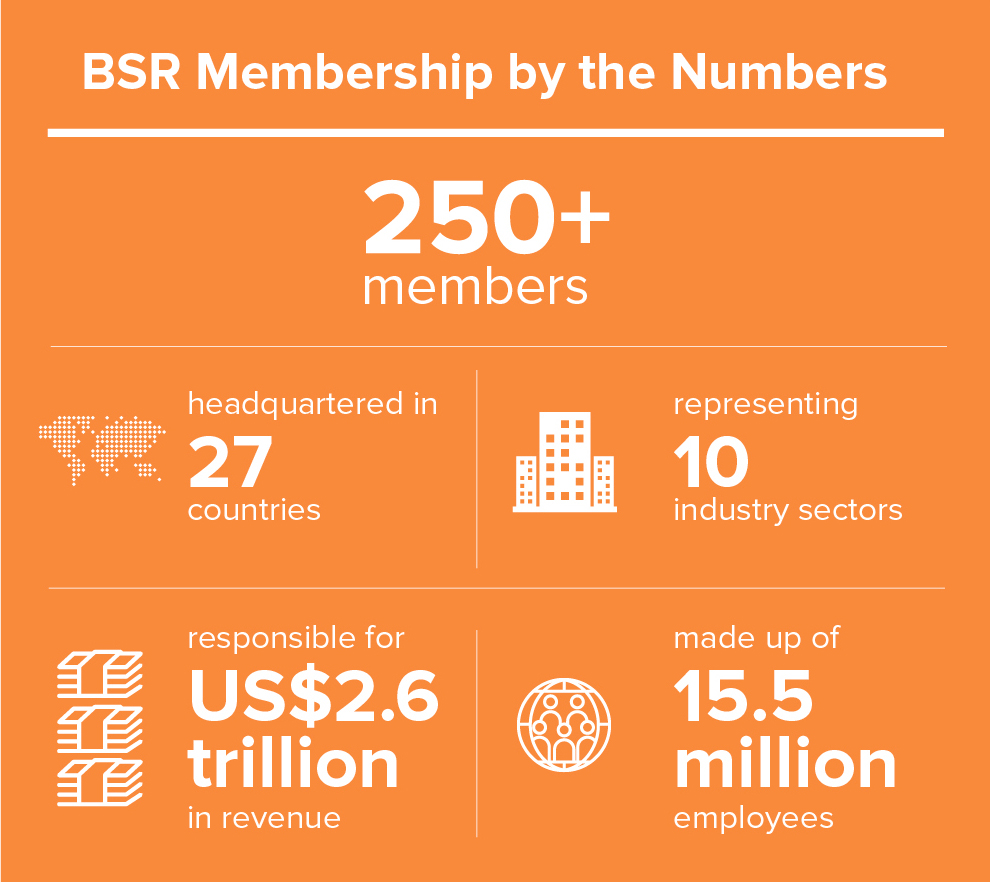
More than 250 companies in nearly 30 countries, spanning 10 industry sectors, representing more than US$2.6 trillion in revenue and more than 15 million employees: This is how we scale our impact at a global level.
Blog | Monday November 20, 2017
How Do We Measure the Impact of Our Membership?
Preview
In mission-driven work, it’s important but incredibly challenging to measure impact. Do you focus on the specific measures that can be quantified in the short term and directly attributed? Or do you identify longer-term, systemic impacts that are more difficult to quantify?
As there aren’t commonly agreed-upon answers to these questions, measurement tends to focus on specific project outcomes and intended impacts. BSR evaluates our project work, publishes case studies, and releases research. Yet, at our core, BSR is a membership organization, and it’s much harder to articulate the direct impacts of our membership. Even without numbers that explicitly “prove it,” I believe that our membership model enables BSR’s impact overall to be exponentially scaled at a global level. Why?
BSR has more than 250 member companies in nearly 30 countries spanning 10 industry sectors. These members represent more than US$2.6 trillion in revenue and more than 15 million employees worldwide. They are some of the world’s largest and most influential companies and constitute nearly 20 percent of the top 50 companies in the Forbes Global 2000. Because of this, some of the changes we help inspire reach people all over the world: For example, I love pointing out that helping a giant global food company change one policy on how they purchase one ingredient could have a larger impact on more peoples’ lives than working individually with more than 100 small organic food companies.
The reach and diversity of this membership means that BSR’s activities and insights are spread across these organizations and their broader value chains. By sharing knowledge, best practices, and new ideas, BSR’s impact is amplified well beyond one-to-one engagements, across sectors and regions. For example, when we worked with telecommunications firm Telia Company to integrate human rights into its business decision-making, we shared the process and broad learnings so that other companies can learn from it. Another recent example is the Playbook for Sustainable Business in the United States, which we published this fall. We engaged our members to shape the ideas in the playbook, and we then discussed these recommendations at our recent annual Conference. It is our hope that the dissemination of this Playbook will help sustainable business leaders succeed in the current U.S. economic and political context—both as individual businesses and in collaboration with each other and stakeholders.
With less than 130 staff around the globe, BSR cannot do individual projects with every member on every major sustainability issue. We must rely on the amplification of impacts through our membership if we’re going to achieve our ambitious mission. When we help a company devise a new climate strategy for its supply chain, the program that results is likely to impact not only that company, but also its suppliers and industry peers. When we work to help integrate human rights into business decision-making, we are hoping to shift industry practices toward a new normal.
Membership impacts are also multidirectional. Our impact is maximized because our relationships further help to inform our research and grant-funded activities to ensure that our insights and recommendations are relevant to and build on global businesses’ practices or challenges. This means that when we receive support from the Dutch Ministry of Foreign Affairs to develop Gender Equality in Codes of Conduct Guidance, for example, we base our work on our decades of experience working with companies, and we engage our members to further inform and refine our recommendations.
Our recent Marketer’s Guide to Behavior Change also illustrates this: It shares the perspectives of a small group of members—AT&T, eBay, Johnson & Johnson Consumer Inc., McDonald’s, and Walmart—to show how companies can trigger behavioral shifts that enable more sustainable lifestyles, grow demand for more sustainable products, and create business value. When we create something like this, it is our hope that our member companies can then share this tool with their marketing teams, who may use the techniques and inspire other companies to do the same. Thus, an engagement with five companies has the potential to change marketing practices at hundreds!
Finally, our membership provides built-in networks that enable BSR to address systemic challenges that require a collective business response. When we see an opportunity to convene companies on a topic like the use of renewable energy to power data centers or the future of sustainable fuel, we begin by reaching out to those of our member companies that have expressed an interest in the issue. Sometimes, this works in reverse, and our member companies bring ideas to us and ask us to convene others.
We may never know exactly what practices are changed as a result of a member reading a report, participating in a workshop, or talking to a BSR expert; let alone the exact impact that new practices we helped shape might have. But we can be proud that we do our best to magnify our impact across 250 of the world’s largest and most influential companies as we all work to create a more just and sustainable world.