Searching for:
Search results: 921 of 1245
Blog | Wednesday October 24, 2018
Millennials, Gen Z, and the Future of Sustainability
As millennials and Generation Z become a more and more influential consumer group and employee demographic, the demand for sustainability and purpose is likely to increase.
Blog | Wednesday October 24, 2018
Millennials, Gen Z, and the Future of Sustainability
Preview
In the 2018 BSR/GlobeScan State of Sustainable Business survey, we learned that corporate reputation remains the number one driver of sustainability efforts at BSR member companies. Consumer/customer demand came in second; yet many sustainability leaders believe there is room for improvement in their communications about their sustainability efforts to these groups.
A New Blueprint for Business
Join us at BSR18 for a conversation with millennials in sustainability: Our Future Leaders: Engaging Millennials and Gen Z.
Investments in more sustainable products and a more coherent sustainability narrative are likely to pay increasing dividends: As millennials (born between 1981 and 1996) and Generation Z (born between 1996 and 2011) become a more and more influential consumer group and employee demographic, the demand for sustainability is likely to increase.
An entire blog post—and then some—could be written about the differences between these two generations. Yet many of the business implications of their increasing influence are the same.
Specifically, these two groups, more than older generations, highly value two things:
- Meaningful work
- Products that align with their values
As millennials and Generation Z become a more and more influential consumer group and employee demographic, the demand for sustainability and purpose is likely to increase.
This presents major opportunities for sustainable business. Here are two ways that you can realize them.
1. Invest in and communicate about your sustainability programs to support employees’ desire for meaningful work.
Study after study has shown that purpose is what both attracts and keeps younger workers. This is a huge opportunity for companies that are hoping to hire and retain the next generation of talent: Millennials became the largest generation in the labor force in 2016, and they will make up 75 percent of the global workforce in 2025.
Unfortunately, only a minority of millennials believe that businesses behave ethically and business leaders are committed to helping improve society, the 2018 Deloitte Millennials study found. Gen Z and Millennials both cited “being a good employer” as the number one CSR issue they care about, consistent with the general population, but more than older generations, they seek out employment at companies that demonstrate a commitment to responsibility.
In one survey, three quarters of millennials indicated they consider a company’s social and environmental commitments in deciding where to work, and two thirds said they would not accept a job somewhere without a strong sustainability program.
We learned in the BSR/Globescan survey that although many companies speak about employee engagement and recruitment as a primary benefit of sustainability efforts, less than 20 percent of company respondents saw it as a top-three driver of their programs.
However, some companies, like Workday, are investing in becoming desirable places to work for younger employees. Millennials make up 53 percent of Workday's almost 9,000 employees today. The company has “anchored its culture in research on generational differences,” which has included creating career development opportunities for employees, collecting data on employee engagement, building green teams, and placing a high priority on a giving its people a sense of purpose.
This appears to be paying dividends. The organization, ranked fourth on the 2018 “100 Best Workplaces for Millennials” list, has reported 35 percent revenue growth over the past three fiscal years and an 80 percent retention rate for its new-hire program for recent college grads.
2. Take a position on social and environmental issues—and make sure it’s consistent with your actions.
In a recent LIM College study, almost 90 percent of respondents agreed, “Millennials and Gen Z will help create more sustainably-produced products by convincing businesses and governments to alter existing practices.” In other words, these consumers are creating demand for sustainable products, from clothing to home goods to cars.
Moreover, Cone Communications found that Gen Z, which will account for 40 percent of all consumers globally by 2020, is the generation most likely to believe that companies should address urgent social and environmental issues: 94 percent of those surveyed said so (compared to 87 percent of millennials).
This isn’t limited to products, either. It also applies to a brand’s approach to social justice issues. As synthesized in a recent issue of Above the Bottom Line, FleischmanHillard’s latest research reveals that two thirds of U.S. consumers and 80 percent of U.K. consumers say they have stopped using products or services because the company’s response to a certain issue doesn’t align with their views.
The same research suggests that approximately 60 percent of consumers expect companies to speak up on important issues, even if those same consumers don’t agree with the companies’ positions—and this is true for 75 percent of millennials.
As millennials and Gen Z make up a larger and larger proportion of consumers around the globe, companies will increasingly need to be prepared to take a position on social debates and back it up with action.
It’s worth noting, however, that our recent Polecat research suggests that consistency in public policy efforts and overall positioning isn’t only important for people born after 1981: This issue ranked second as a priority for the public overall in our scan of social media conversations.
Millennials and Gen Z are already changing what is expected of business, and resilient companies are addressing this reality now through investments in sustainability, integrity, and advocacy.
If you’re interested in hearing about the future of sustainable business directly from a few of the millennial leaders who will bring it to life, join us at the BSR Conference 2018 in New York City November 6-8.
Blog | Tuesday October 16, 2018
The Future Is on the Agenda at BSR18—Will You Join Us?
At the BSR Conference 2018, we will introduce four possible scenarios for 2030 that can help you and your company make sense of the evolving world over the coming years and decades.
Blog | Tuesday October 16, 2018
The Future Is on the Agenda at BSR18—Will You Join Us?
Preview
This year’s BSR Conference comes at a time of profound change. Market conditions are turbulent. Around the world, poverty rates continue to fall—at the same time, inequality continues to grow.
A New Blueprint for Business
Join us at BSR18 for a conversation about The Future of Retail.
Technology is sparking both utopian and dystopian views of the future. Culture is also changing fast, not least through the #MeToo movement. And just last week, the latest report from the Intergovernmental Panel on Climate Change reveals that despite many important initiatives, the world is not taking sufficient action to avoid seriously damaging climate change.
It is almost certainly the case that these changes, many of which are intertwined, will only grow in pace and intensity in the years ahead. What is a business to make of all these changes, and how can companies navigate our era of intense, inter-connected, non-linear change?
What is a business to make of all these changes, and how can companies navigate our era of intense, inter-connected, non-linear change?
At the BSR Conference 2018, we will be unveiling scenarios that can help you and your company make sense of the evolving world over the coming years and decades. These are not predictions of what the world will be like in 2019 or 2028. Rather, they aim to illuminate the underlying forces that are creating the market and social framework in which business will be operating.
Specifically, the scenarios revolve around two fundamental questions:
- What forces of centralization and decentralization will define our culture, economy, and political context?
- Will the world continue to rely on familiar, consumption-led economic models or shift to a new economic model that defines value in a more holistic way?
There is no single answer to these questions. Instead, we will present four scenarios that anticipate how these crucial questions could play out by 2030.
These scenarios tell stories of how our world might evolve, with important implications for business.
This is no academic exercise. Each of our four scenarios explores core elements of the sustainable business agenda: the shape of supply chains, availability of natural resources, and nature of employment, as well as product and service development, health, and energy and climate. In this way, the scenarios will enable planning and decision-making central to the achievement of the social, economic, and environmental outcomes crucial to business and embedded in the Sustainable Development Goals and the Paris Agreement.
These scenarios will be unveiled on the opening night of the Conference. But they are intended to live well beyond that: We hope that these scenarios will be widely used throughout the BSR network to consider how business can shape strategies that will thrive, regardless of which scenario, or hybrid of these scenarios, ultimately defines the coming decade.
As we continue in our effort (launched at last year’s BSR Conference) to redefine sustainable business, we aspire to drive the agenda forward with this year’s event. As ever, the Conference will facilitate new partnerships and collaborations through networking opportunities with participants from around the globe. It will present insights and inspiration from a diverse array of speakers from the private sector, civil society, government, academia, and elsewhere.
We will explore the ways that leadership is practiced in our fast-changing world. Our sessions will offer both provocative thinking to change how you think about sustainability in the long term and practical insights you can use the following week.
If a truly just and sustainable world is our desired endpoint—and it must be—then the scenarios we will introduce can help companies and business leaders across sectors understand the changing conditions on the journey toward that goal.
We look forward to welcoming you to New York and to joining with you to make the most positive possible future our new reality.
Blog | Monday October 8, 2018
Four Ways to Enhance Your Materiality Assessment
This is how to leverage data analytics, artificial intelligence, futures thinking, and other innovative approaches to inform your sustainability strategy.
Blog | Monday October 8, 2018
Four Ways to Enhance Your Materiality Assessment
Preview
The world is changing, with massive implications for business strategy and value creation. Whether it is new energy systems, disruptive technologies, new business models, changing demographics, hyper-transparency, or rising geopolitical uncertainty, the operating context for companies is evolving.
A New Blueprint for Business
Join us at BSR18 for a conversation about 21st-Century Business Strategy.
We believe the best response to address our changing world is not to continue integrating sustainability into company strategy, but to develop a completely new way of designing business strategy and creating value. As many sustainability practitioners will tell you, materiality is critical to establishing and refining your company’s approach to sustainability and environment, social, and governance (ESG) issues. Sustainability is a broad and evolving concept: A materiality assessment prioritizes the most important issues and topic areas for your company, helping you develop and refine your sustainability strategy and external reporting.1.
The relationship between materiality and financial reporting, risk, or issue management not always clear to the core business, which is likely related to the historic separation of sustainability and business strategy. To create a more resilient business strategy with sustainability at its core, here are four ways to enhance your materiality process:
1. Leverage Data Analytics and Artificial Intelligence
BSR partners with reputation intelligence firm Polecat to incorporate big data into materiality. This approach enhances the materiality process by providing data-driven insight on public perceptions of key ESG issues in your company and industry to inform prioritization. Polecat’s MeaningMine can identify stakeholder segments, like Tier 1 media, investors, and NGOs; consumer segments; and language-based regional segments to identify the most prominent issues for each. Used as a supplement to qualitative assessment inputs, such as interviews, big data strengthens the output of the materiality assessment by expanding your external reach, allowing for a more robust sense check of initial findings, illuminating risks and issues of most concern, and identifying emerging issues.
2. Conduct Regional Assessment
Sustainability/ESG priorities can vary significantly by region, which means globally focused assessments may not always capture the nuances of regional or market-specific expectations. This is particularly true for international companies with diversified business portfolios and regional business units. For example, a recent assessment with a member company revealed that terrorism and security was an extremely high priority for its operations in the Middle East, though this was not a priority at the global level. Similarly, topics like diversity and inclusion, genetically modified organisms (GMOs), and automation typically see varying prioritization by region due to regional legislation, public sentiment, and broader business action. A regional approach to materiality can help provide nuance and inform human and financial resource allocations to address priority issues. Moreover, engaging with your regional teams through the materiality assessment is an excellent way to gain buy-in and drive interest and internal support for both the assessment itself and sustainability/ESG more broadly.
3. Future-Proof
While materiality is undoubtedly useful, it is a static assessment, typically only capturing your company’s present priorities. Priorities can gradually change over time, or they can shift rapidly and unexpectedly—as we have seen with the recent increase in concern over corporate integrity and diversity—making your sustainability strategy unforeseeably obsolete. Resilient strategies must consider the disruptive trends, unintended consequences, and residual impacts that may affect them in the future. We have collaborated with various member companies in scenario-planning workshops to test current and emerging material priorities against various future scenarios. As one interviewee for our recent report, Redefining Sustainable Business: Management for a Rapidly Changing World, told us, “Scenario planning is not a prediction of the future, but a way to understand how our business would look in a new environment and to test the resilience of the business in the future.” Future-proofing helps to identify highly dynamic issues, critical uncertainties, and likely strategic implications for sustainability and the business.
4. Align with Enterprise Risk Management (ERM)
Incorporating sustainability into ERM is an increasing focus for companies, as it offers a tangible pathway to integrate sustainability priorities into the business. Materiality is often misunderstood and undervalued by the business and can be confused with enterprise risk. ERM can also be limited, as it tends to focus on short-term risks that are measurable and manageable. We can help you align your sustainability and risk management frameworks and incorporate risk-oriented sustainability priorities into ERM. This alignment can help your company improve its risk processes to better manage cross-cutting, significant long-term risks like climate change.
Scenario planning is not a prediction of the future, but a way to understand how our business would look in a new environment and to test the resilience of the business in the future.
These new approaches to materiality are not mutually exclusive: They can all be incorporated into your materiality assessment to help your company more effectively anticipate and manage priority issues and risks. If you’re interested in learning more about how to leverage them for your sustainability work, please contact us or join us in New York this November at the BSR Conference.
Blog | Monday October 1, 2018
Are Companies and Stakeholders Focusing on the Same Sustainability Priorities?
We looked at online news and social media conversations around the business practices of 4,000 global companies across sectors to determine alignment between company and stakeholder priorities.
Blog | Monday October 1, 2018
Are Companies and Stakeholders Focusing on the Same Sustainability Priorities?
Preview
This year, we conducted our 10th annual survey on the State of Sustainable Business in collaboration with GlobeScan. This year’s results show that the line between sustainability issues and mainstream business issues is increasingly blurred as businesses experience the consequences of social and political disruption in a rapidly changing world.
A New Blueprint for Business
Join us at BSR18 for a conversation on stakeholder engagement in today’s world: Everyone's an Activist.
This conclusion is most striking when we look at this year’s top priority issues, both included for the first time this year to capture changes in the business landscape. These are ethics/integrity (high priority for 76 percent of companies) and diversity/inclusion (high priority for 71 percent of companies). While ethics has traditionally been regarded as the domain of the compliance function and diversity/inclusion has primarily been seen a human resources issue, sustainability practitioners rank these issues at the top—suggesting, at minimum, that they are coming to be considered priorities from a holistic, organizational perspective.

Our member companies also told us that they view corporate reputation as the primary driver of their sustainability efforts, at a time when public trust in business continues to decline. In response to this, we worked with our big data partners at Polecat to understand whether companies are correctly prioritizing the issues that are most relevant to their reputations: Specifically, we looked at online news and social media conversations around the business practices of 4,000 global companies across sectors.
In online media reporting across the board, the top two priorities were (1) ethics and integrity and (2) diversity and inclusion, with climate change, water, and community health following closely behind. This seems to suggest that company priorities are highly aligned with issues in the news.
While human rights is not explicitly called out separately as a high priority in online media, each of the top five priority issues that emerged (listed above) has a strong human rights component. Journalists seem to be increasingly focused on the impact that business has on communities and other stakeholders.
We also used Polecat to track social media attention toward business—a more direct reflection of which issues the public is focused on than online media reporting affords. On Twitter and other social media sites, people are overwhelmingly focused on questions of corporate ethics and integrity, even more intently than in online media.
The second-highest concern for the public was corporate influence over public policy—arguably a corporate integrity issue. In recent years, scrutiny over lobbying and political financing has mounted dramatically. Indeed, the level of social media attention to this issue eclipses concerns about such topics as company approaches to diversity, climate change, and water.

This finding indicates that, for all the concern over reputational risk, companies may not be ready to address the public’s more challenging questions about interaction with policymakers, as well as what is perceived as the undue influence exercised by business. Given recent increases in transparency and business activism on social issues, it is likely that scrutiny of how corporate rhetoric aligns with corporate political spending will continue. BSR also considers it highly likely that questions about good jobs and tax avoidance will, over time, become more central to public understanding of what it means to be an ethical company.
Overall, despite some obvious gaps, companies generally seem to be paying attention to the issues of greatest potential reputational impact. The next question is how they should organize themselves to respond.

Approaches to diversity and integrity pose big questions for an entire organization, not just the sustainability function. While this year’s survey results show that three-quarters of practitioners are working to better integrate sustainability issues into strategic planning, it also indicates that they have had limited success so far. Corporate communications, procurement, and public affairs continue to be the internal areas in which sustainability has the most traction, though fewer than half of respondents deemed their organization’s communications on sustainability effective at present.
Overall, the 2018 State of Sustainable Business results give reason for both optimism and caution when considering how prepared business is to respond to disruptive trends. Companies are clearly hearing concerns. However, they are still focused on messaging, reputation management, and on the symptoms—rather than the root causes—of reputational risk.
Finally, companies are realizing that most of the profound challenges they face require alignment and collaboration across the organization. This has led directly to our focus at BSR on exactly how and when to collaborate with key functions across the organization, as well as our reframing of the sustainability practitioner’s role as that of change agent, futurist, and builder of coalitions.
Blog | Thursday September 27, 2018
From the Global Climate Action Summit to UNGA Week
Action to address the social impacts of climate change and other disruptions is essential to reach the SDGs—and that action must be inclusive of those left behind by the many changes remaking the economy.
Blog | Thursday September 27, 2018
From the Global Climate Action Summit to UNGA Week
Preview
Over the past couple of weeks, the New American Road Trip traversed the United States, with zero emissions vehicles making the trek from the Global Climate Action Summit to UNGA/Climate Week in New York City.
A New Blueprint for Business
Join us at BSR18 for a conversation about bold business commitments to a just transition.
These events come at a crucial time. The intersection of business and society is a busy place. Companies are navigating a complex set of profound changes: the related challenges of urgent climate action, erosion of human rights protections, and innovations reshaping the world of work, not to mention ongoing reminders of the need to ensure that women are able to thrive in society without fear of discrimination, or worse. All this comes when faith in business and the global economy remains low, and when the competitive pressures in a changing economy are intense.
The New American Road Trip reminds us of the opportunities that all this change is creating for companies that dive headlong into the future. Crossing North America in an EV that didn’t require hourly recharging was unimaginable a decade ago and has shown how even our most familiar cultural icons are being remade.
The Global Climate Action Summit two weeks ago served a very important purpose. As intended, the Summit catalyzed a number of significant new climate commitments. More businesses—now nearly 500 in all—have committed to science-based targets; nearly a 40 percent increase from the number a year ago. A coalition of foundations committed US$4 billion in new commitments to combat climate change. And the lead Summit host, California Governor Jerry Brown, committed his state—the fifth biggest economy in the world if it were a nation-state—to achieving 100 percent climate neutral power by 2045. No entity of such size has made such an audacious commitment to date.
Crucially, the human dimension of our changing climate was also at the core of the action in San Francisco. We welcome this: BSR has released four reports that explore the intersection of climate and other sustainability issues: supply chain management, health, inclusive economies, and women’s empowerment. We also launched, along with Mars and Coca-Cola, the Climate Resilient Supply Chain Leaders Platform, which will grow in the coming months as large global companies aim to engage their business partners in creating business solutions—and human protections—in light of a less predictable operating environment.
I also had the opportunity to explore the human dimension of climate change in dialogues organized by the B Team with leaders from business, labor, and civil society, as well as other changemakers, to ensure that the just transition is firmly on the climate agenda. Attention must be paid to those displaced by the clean energy transition.
Action to address the social impacts not only of climate, but of the other massive changes remaking our world, will be essential if we are to reach the Sustainable Development Goals.
Action to address the social impacts not only of climate, but of the other massive changes remaking our world, will be essential if we are to reach the Sustainable Development Goals (SDGs); however, I always approach UNGA Week with a bit of a divided soul. While it is inspiring to be in the company of a global community committed to the vision of the SDGs, it is equally concerning that we seem to be speaking primarily to ourselves at a time when there is massive discontent and such a lack of public trust. For the sustainability agenda to resonate outside the community of people who come to New York this week, it is essential that it deliver economic opportunity for those who are being left behind by the many changes remaking the economy.
For global companies, this means going beyond discussions of the future of work to the creation of solutions. There is both an imperative to address those living in poverty and a need for commitments to economic opportunity and security in the global north. The productivity gains coming from technology and innovative business models will not come to full fruition if they don’t also address the needs for skill development, basic social protections, and lifelong learning.
The New American Road Trip was a great way to remake a 20th century social ritual. But the question before us is bigger than that. In light of the many changes redefining the economy, from climate to technology to longer lifespans, we need to redefine the social contract, and business has a crucial role to play in this.
The innovators that answer these questions will define the 21st century, and the time has come for us to do so.
In New York, there is increased recognition of this need, which I find encouraging, but there is not yet enough of a commitment to next steps. The SDGs remain front and center for all of us who are here, and there is growing recognition of the link between economic security and climate action. But it is what we choose to do after we leave that will determine the extent to which we are able to make our ambitions a reality.
Blog | Wednesday September 26, 2018
Event Summary: TCFD Recommendation and Climate Change Risk
Blog | Wednesday September 26, 2018
Event Summary: TCFD Recommendation and Climate Change Risk
Preview
Blog | Tuesday September 25, 2018
Climate Solutions Need Women at the Center
Companies can address climate risk more effectively and efficiently if they put women at the heart of their climate resilience strategies.
Blog | Tuesday September 25, 2018
Climate Solutions Need Women at the Center
Preview
The intersection of climate change and women, although rarely prioritized in decision-making or solutions, is not a new concept. But, as Mary Robinson said, “If we took away the barriers to women’s leadership, we would solve the climate change problem a lot faster.”
As Mary Robinson said, “If we took away the barriers to women’s leadership, we would solve the climate change problem a lot faster.”
In 2015, the international arena formally gave this women-climate nexus a platform within the Paris Agreement and the Sustainable Development Goals (SDGs). In 2017, UNFCCC countries adopted the Gender Action Plan at the climate negotiations. These international frameworks now recognize the intersection between gender inequality and climate change, as well as the need for the integration of women’s voices, skills, and knowledge in solutions. It is time for businesses to act by empowering women leaders to take climate action throughout their value chains.
Today, we are excited to launch a new report that highlights tangible ways of doing this. Companies can address climate risk more effectively and efficiently if they put women at the heart of their climate resilience strategies.
Women are disproportionately affected by climate change—not because they experience more climate impacts than men, but because women face underlying socioeconomic, political, and legal barriers that limit their choices in the face of climate change. Climate impacts exacerbate these barriers and ultimately hinder climate resilience activities from reaching their full potential.
For example, only 47 percent of women have an account at a formal financial institution, compared to 55 percent of men. Without bank accounts and financial resources, women cannot easily diversify their livelihoods or access financial capital before and after climate disasters. Additional barriers include norms related to unpaid work, limited access to income, discriminatory laws, land ownership restrictions, a lack of capacity-building resources, and a lack of voice. These barriers not only limit the adaptive capacity of women to climate impacts, but they also influence the adaptive capacity of communities and company value chains—in particular, agriculture (nearly 50 percent of smallholder farmers in some countries are women) and apparel (nearly 80 percent of apparel factory workers are women).
Despite these deeply rooted barriers, women possess unique and key skills, knowledge, and experiences critical for climate resilience solutions, making them powerful change agents. For example, women make different choices than men that can help an agricultural community within a value chain thrive and adapt to climate change. For generations, women have been land stewards and have maintained local climate, plant, and seed-planting knowledge. This makes them natural targets for involvement in the creation and use of climate adaptation tools and trainings, in particular as men continue to move to more non-farm jobs and climate impacts continue to worsen.
Climate resilience solutions with a specific focus on women are a win-win: They tackle climate risk and gender inequality simultaneously, with clear benefits for business, women, and communities. For businesses, empowering women and also making them leaders in the development and implementation of these solutions can drive productivity and innovation, especially within sectors like agriculture and apparel that depend heavily on a female workforce. Companies can also protect raw materials, increase financial stability and returns, strengthen the resilience of local communities, and deliver other co-benefits, like stabilizing livelihoods, improving food security, and making progress toward closing the global gender gap, as part of this approach.
Businesses that recognize this can play an important role in developing these solutions within their own operations, and they can also collaborate with others to make progress. More specifically, they can:
- Act to put women at the center of all internal climate resilience approaches and solutions. In particular, companies can provide women in supply chains access to relevant trainings, inputs, financing, and technologies.
- Enable women throughout the value chain and broader community to effectively respond to climate-related events by linking them with local networks and partners, which can serve as mutual support mechanisms to strengthen climate resilience.
- Influence policymakers and other organizations to help address underlying inequalities, such as the lack of decision-making power of women, which are particularly challenging in the context of a changing climate.
Through the Business Action for Women collaboration, BSR works with leading companies on climate change, including Mars, L’Oreal, and Coca-Cola, to share best practices and collectively develop innovative solutions that empower women to lead on climate resilience in agricultural supply chains from the ground up.
Real transformation for both climate resilience and gender equality will happen when companies tackle the structural and systemic barriers women face and involve women in solutions—putting women at the center of their climate strategies.
BSR’s climate and women nexus report is the fourth in our series, which also includes reports on the intersection between climate and supply chains, health, and inclusive economy. Stay tuned for more on the connections between climate resilience and human rights and a just transition to the low-carbon economy in the months to come.
Reports | Tuesday September 25, 2018
Climate and Women
This paper explores the connection between women’s empowerment and resilience to climate change and aims to drive corporate action to put women at the center of climate solutions.
Reports | Tuesday September 25, 2018
Climate and Women
Preview
Climate change affects every human around the globe, with profound implications for social justice and human rights. Health-related stresses, competition for natural resources, and the impacts on livelihoods, hunger, and migration warrant immediate global action.
This paper explores a relatively new and developing topic for business: the intersection between climate change and women’s empowerment. It uses compelling data, a clear business case, and company case studies to strengthen corporate understanding of the connection between women’s empowerment and resilience to climate change impacts and to drive corporate action to put women at the center of climate-resilience solutions. Ultimately, this paper aims to help companies prepare for the consequences of climate change and address material business risks, while simultaneously embracing opportunities that benefit business, women, and communities.
This report is part of a series of six climate nexus reports that cover human rights, inclusive economy, women’s empowerment, supply chain, just transition, and health.
Climate and Women
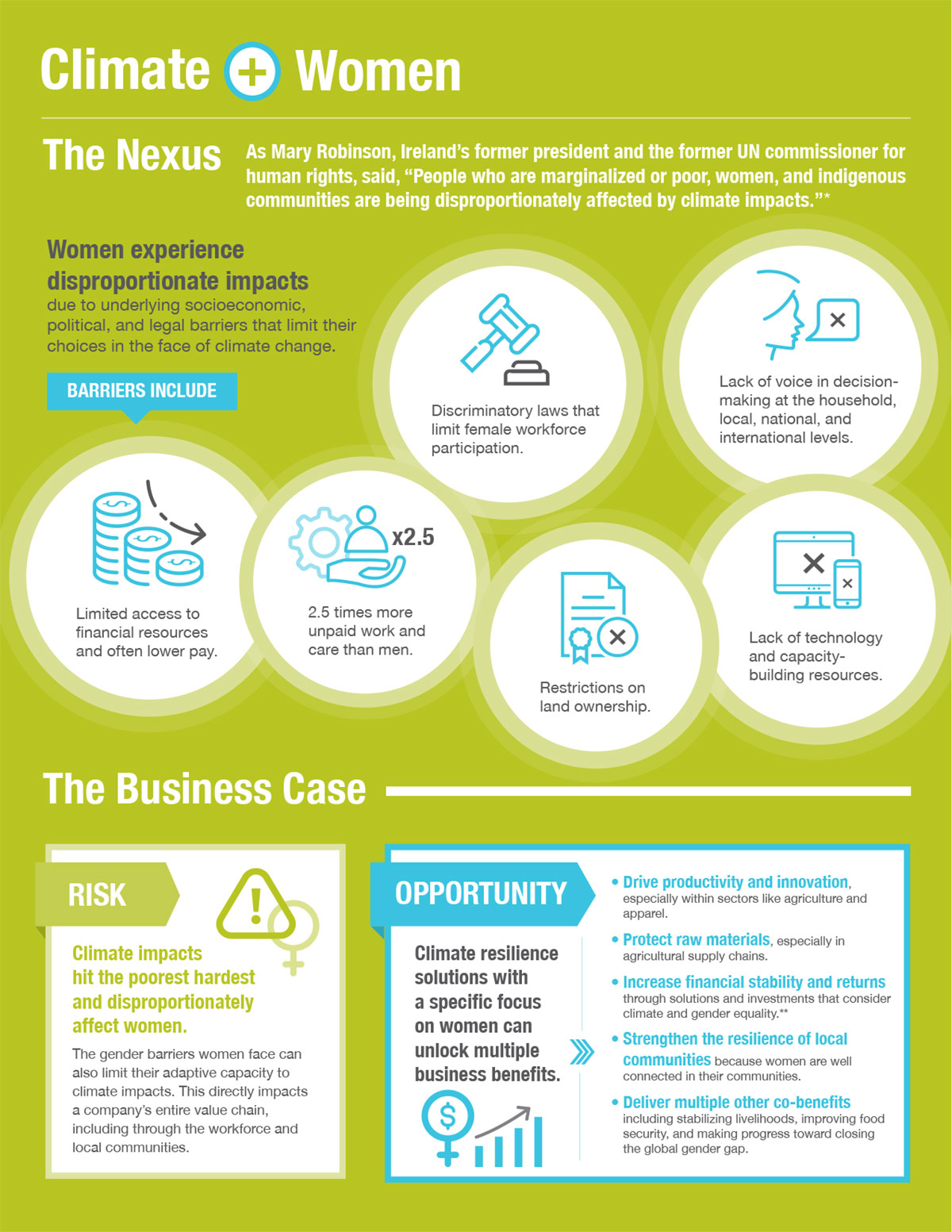
The Nexus
As Mary Robinson, Ireland’s former president and the former UN commissioner for human rights, said, “People who are marginalized or poor, women, and indigenous communities are being disproportionately affected by climate impacts.”
Women experience disproportionate impacts due to underlying socioeconomic, political, and legal barriers that limit their choices in the face of climate change.
Barriers Include
- Limited access to financial resources and often lower pay.
- 2.5 times more unpaid work and care than men.
- Discriminatory laws that limit female workforce participation.
- Restrictions on land ownership.
- Lack of voice in decision- making at the household, local, national, and international levels.
- Lack of technology and capacity-building resources.
The Business Case: Risk
Climate impacts hit the poorest hardest and disproportionately affect women.
The gender barriers women face can also limit their adaptive capacity to climate impacts. This directly impacts a company’s entire value chain, including through the workforce and local communities.
The Business Case: Opportunity
Climate resilience solutions with a specific focus on women can unlock multiple business benefits.
- Drive productivity and innovation, especially within sectors like agriculture and apparel.
- Protect raw materials, especially in agricultural supply chains.
- Increase financial stability and returns through solutions and investments that consider climate and gender equality.
- Strengthen the resilience of local communities because women are well connected in their communities.
- Deliver multiple other co-benefits including stabilizing livelihoods, improving food security, and making progress toward closing the global gender gap.
Climate and Supply Chain (continued)
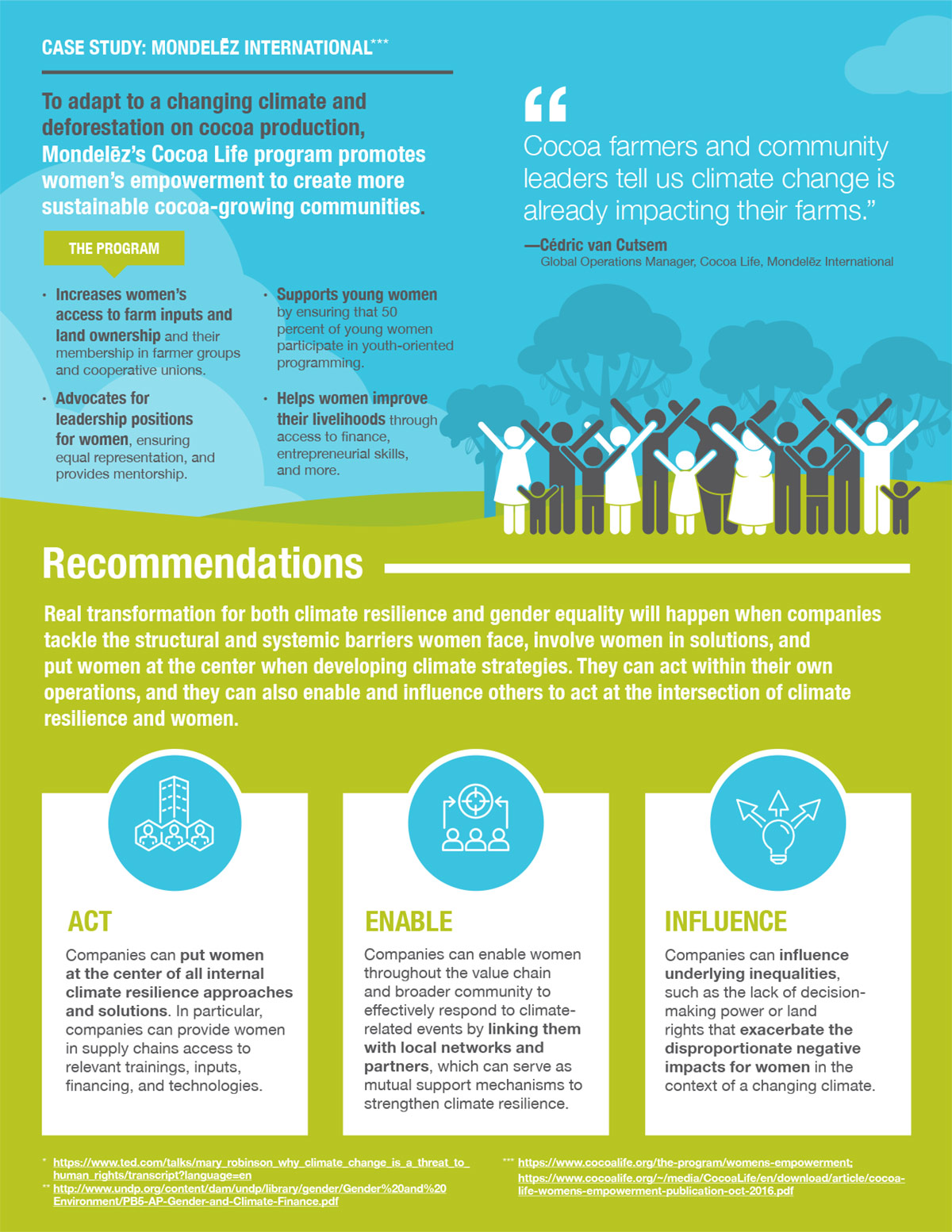
Cast Study: Mondelēz International
To adapt to a changing climate and deforestation on cocoa production, Mondelēz’s Cocoa Life program promotes women’s empowerment to create more sustainable cocoa-growing communities.
Cocoa farmers and community leaders tell us climate change is already impacting their farms. —Cédric van Cutsem, Global Operations Manager, Cocoa Life, Mondelēz International
The Program
- Increases women’s access to farm inputs and land ownership and their membership in farmer groups and cooperative unions.
- Advocates for leadership positions for women, ensuring equal representation, and provides mentorship.
- Supports young women by ensuring that 50 percent of young women participate in youth-oriented programming.
- Helps women improve their livelihoods through access to finance, entrepreneurial skills, and more.
Recomendations
Real transformation for both climate resilience and gender equality will happen when companies tackle the structural and systemic barriers women face, involve women in solutions, and put women at the center when developing climate strategies. They can act within their own operations, and they can also enable and influence others to act at the intersection of climate resilience and women.
-
Act
Companies can put women at the center of all internal climate resilience approaches and solutions. In particular, companies can provide women in supply chains access to relevant trainings, inputs, financing, and technologies.
-
Enable
Companies can enable women throughout the value chain and broader community to effectively respond to climate-related events by linking them with local networks and partners, which can serve as mutual support mechanisms to strengthen climate resilience.
-
Influence
Companies can influence underlying inequalities, such as the lack of decision-making power or land rights that exacerbate the disproportionate negative impacts for women in the context of a changing climate.
Climate Nexus Report Series






Blog | Monday September 24, 2018
Are You Ready to Incorporate Gender into Your Supply Chain Due Diligence?
New gender-sensitive auditing guidance provides recommendations, practical advice, and relevant examples on how to effectively integrate gender considerations into audits.
Blog | Monday September 24, 2018
Are You Ready to Incorporate Gender into Your Supply Chain Due Diligence?
Preview
In June 2019, the United Nations Guiding Principles (UNGPs) Working Group will present its report to the Human Rights Council on how to integrate gender more prominently into companies’ due diligence process so that the business impacts of human rights abuses specifically related to women are better identified and addressed.
A New Blueprint for Business
Join us at BSR18 this fall for a conversation about the future of supply chain transparency.
The systems currently used by brands and suppliers to verify that basic rights and working conditions are upheld in their supply chains rarely integrate a gender dimension. This is arguably evidence that companies have not paid sufficient attention to gender-specific human rights abuses and the broader spectrum of workplace practices harmful to women in their supply chains, where women constitute a majority of workers, especially for consumer products. In particular, women’s rights and workplace-specific challenges are often not reflected in supplier codes of conduct and are addressed in very limited ways, if at all, in the auditing methodologies used to verify compliance with such codes.
To help companies address this issue and prepare to meet the increased expectations associated with the UNGPs, BSR—with support from the Dutch Ministry of Foreign Affairs—is pleased to launch guidance that identifies the main improvements required for gender-sensitive social auditing and provides recommendations, practical advice, and relevant examples on how to effectively integrate gender considerations into audits. This new Gender Equality in Social Auditing Guidance is based on and complements the Gender Equality in Codes of Conduct Guidance published in 2017.
Social auditing is defined as the thorough formal examination of the labor practices of a workplace or company, based on corroborated evidence. It is appealing to companies as it provides a clear, easy-to-digest, quantitative picture that can be used as a basis for quick sourcing and business decision-making. However, it is still often considered a narrow “snapshot” exercise, predominantly using document checks to surface issues linked to workers’ employment relationships. The voices of workers do not figure prominently. As such, social auditing lacks the ability to uncover more complex, less visible social issues, such as freedom of association, discrimination, and sexual harassment.
Moreover, social audits focus on verifying elements within distinct categories, such as working hours or health and safety. This siloed approach makes it difficult for social auditors to analyze interlinkages between seemingly unrelated issues—a particularly important activity when considering gender-sensitive issues.
If social auditing is to remain relevant and to become better at capturing the underlying root causes of gendered issues and discrimination, providing meaningful corrective action plans to tackle them, and measuring progress toward better conditions for women workers, there is an urgent need to transform its objectives and methodology.
To understand the underlying root causes of gendered issues and discrimination, tackle them, and measure meaningful progress toward better conditions for women workers, there is an urgent need to transform social auditing systems.
BSR’s new guidance is designed to provide all actors involved in these audits with opportunities for individual and collective action to make social audits more gender-sensitive. The guidance will help companies and actors in the auditing ecosystem to:
- Understand and proactively address the structural constraints that prevent social audits from being more gender-sensitive, from the composition of auditing teams and their knowledge to the complexity of reporting gender-sensitive issues and capturing gender-disaggregated data.
- Integrate specific gender-sensitive verification measures across codes of conduct principles, verifying not just governance and policy structures, but also how these are embedded in operations and how they impact workers.
- Analyze the particularities of interviewing workers and apply a gender lens to (for example) sampling and interview techniques.
- Explore how to more effectively gather insights on women workers’ issues and needs through methodologies and techniques that are currently not part of traditional social auditing. The guidance shows how worker-driven feedback loops can capture risks and impacts in a way that traditional auditing mechanisms may not.
We hope that this guidance will serve as a significant first step in the transformation of social audits used in global supply chains. However, we recognize that this transformation is not straightforward: It will require proactive measures from key actors, including companies, standards bodies, certification schemes, supply chain initiatives, auditing companies, and auditors’ associations. BSR will convene a meeting on November 9 in New York to stimulate collaborative action amongst these various actors, and we would love for you to join us.
Further, we call on all actors to proactively review their systems and processes to enhance their ability to unearth gendered risks and positively impact women workers in global supply chains. Companies who integrate a gender lens into their auditing practices will be well equipped to respond to part of the UNGP Working Group’s increased gender expectations.
If you would like further assistance or guidance on improving your codes of conduct and auditing processes, please contact our team of women’s empowerment experts.
Reports | Monday September 24, 2018
Gender Equality in Social Auditing Guidance
Reports | Monday September 24, 2018
Gender Equality in Social Auditing Guidance
Preview
The resilience of supply chains is intrinsically linked to the status and wellbeing of women: When women’s health and access to opportunities are compromised, their productivity and efficiency suffers. Yet the systems currently used by brands and suppliers to verify that basic rights and working conditions are upheld in their supply chains do not integrate a gender dimension. In particular, women’s rights and workplace-specific challenges are often not reflected in supplier codes of conduct and are addressed in very limited ways, if at all, in the auditing methodologies used to verify compliance with such codes.
To help companies address this issue, BSR—with support from the Dutch Ministry of aForeign Affairs—is pleased to launch guidance that identifies the main improvements required for gender-sensitive social auditing and provides recommendations, practical advice, and relevant examples on how to effectively integrate gender considerations into audits. This new Gender Equality in Social Auditing Guidance is based on and complements the Gender Equality in Codes of Conduct Guidance published in 2017.
The Guidance:
- Considers the systemic barriers that prevent current social audits from being more gender-sensitive and provides recommendations for overcoming such barriers.
- Explores how best to integrate gender considerations within existing auditing verification measures and across the different principles in supplier codes of conduct.
- Highlights the vital process of worker interviews and considers how to maximize their effectiveness in picking up gender-sensitive issues.
- Evaluates methodologies, such as worker engagement approaches, that are not traditionally related to social auditing but that may enhance the ability of companies to identify gendered issues and effectively design remediation plans to improve workplace conditions for women.
- Assesses the broader range of strategies that companies should consider for monitoring their suppliers and whether such strategies may complement or partly replace social audits.
Search Again?