Searching for:
Search results: 86 of 1188
Blog | Wednesday February 26, 2025
Protecting Children in the Digital Environment: The Role of Impact Assessments
BSR Technology and Human Rights experts discuss the benefits of conducting a Child Rights Impact Assessment and key takeaways from their recent report.
Blog | Wednesday February 26, 2025
Protecting Children in the Digital Environment: The Role of Impact Assessments
Preview
There is more awareness of the impact of technology on children than ever before. Despite the many benefits that digital technology provides to children (e.g., access to education, free expression, and maintaining social connections), concerns are rising around the adverse impacts on mental health, attention, and protection from harm.
In 2023, Amazon entered a US$25 million settlement with the US Department of Justice and Federal Trade Commission over charges related to children’s privacy. In 2024, concerns about children and social media platforms regularly made headlines. State attorneys general in the US sued social media companies alleging harms to children’s safety and well-being. The US surgeon general called for warning labels on social media platforms, and several tech CEOs publicly apologized to parents whose children were harmed by social media.
In response, regulators have begun to take action to address these harms. The UK passed an Online Safety Act that requires online platforms to prevent children from accessing age-inappropriate or harmful content. In Australia, efforts to protect children from harm has resulted in a social media ban for children under 16. Companies developing and deploying tech tools are being required to take stock of their impacts on children’s rights and the effectiveness of their measures to address such impacts.
While companies, governments, and civil society actors are increasingly invested in addressing the adverse impacts of technology on children, approaches remain inconsistent and fragmented. Research shows that company approaches are often focused on protection issues (e.g., illegal content and freedom from exploitation or sexual abuse) and responding to legal mandates, which may cause issues related to children’s participation in the digital environment (e.g., freedom of expression or access to culture) to be overlooked. Furthermore, current approaches to assessing impacts on children are often seen by companies as a "one-and-done" exercise, rather than an ongoing process that integrates external perspectives and evolves as new technologies and use habits arise.
Several factors complicate our ability to fully understand and mitigate the adverse impacts of technology on children, including the rapid pace of technological advancement, regulatory discrepancies across different jurisdictions, and the limited availability of data about children across diverse ages, socioeconomic statuses, gender identities, geographies, and individual circumstances. As a result of these challenges and the gaps in their current approaches, companies fail to track and mitigate evolving risks to children.
Child Rights Impact Assessments
Companies have a responsibility to identify and address adverse human rights impacts associated with their operations, products, and services.
To assess impacts to children in particular, companies can conduct Child Rights Impact Assessments. CRIAs are an effective way for companies to systematically evaluate their impacts on child rights as defined in the Convention on the Rights of the Child, and other internationally accepted human rights and child rights instruments. Similar to a Human Rights Impact Assessment, the CRIA uses a methodology informed by the UN Guiding Principles on Business and Human Rights (UNGPs) and seeks input from rightsholders to identify a company’s impacts on children’s rights, prioritize these impacts based on their severity, and determine appropriate action to address them.
In 2023, UNICEF engaged BSR to explore how companies are leveraging CRIAs and help develop a CRIA tool that companies operating in the digital environment can use to systematically identify, assess, and address their impacts on child rights. The project involved extensive research into existing resources to assess companies’ impacts on children, a review of current CRIA tools and practices, an assessment of child rights considerations in new regulations, and engagement with 130 stakeholders.
BSR has published a paper that brings together key findings from this research, as well as our observations on how companies are currently approaching child rights impact assessments in relation to the digital environment. It is a precursor to the digital environment CRIA tool that UNICEF will publish in 2025.
Benefits of Conducting CRIAs
BSR’s review of the current landscape showed that while many companies seek to understand their actual and potential impacts on children in the digital environment, few use CRIAs to do so. For companies operating in the digital environment, CRIAs can be a helpful tool for several reasons:
- CRIAs allow companies to assess their impacts against the full list of child rights. Assessing against a comprehensive list of rights ensures that key issues or new impacts are not overlooked and constitutes a defensible methodology that is grounded in international human rights instruments.
- CRIAs can enable age-appropriate design through early consideration of risks and opportunities. Proactively engaging stakeholders and identifying the potential risks/opportunities allows companies to integrate these considerations into the design of a technology product and address harms before they become more severe, which can happen quickly in the digital environment.
- CRIAs can support companies’ regulatory compliance efforts. Regulations like the EU Digital Services Act, UK Online Safety Act, Australian Online Safety Act, and the Corporate Sustainability Reporting Directive require companies to assess risks to people, including children, and implement mitigation measures. CRIAs can help companies address these requirements by aligning with UNGPs due diligence approach and integrating findings into broader human rights and regulatory risk assessments.
As the digital environment continues to shape children’s lives and regulatory expectations continue to grow, respecting, protecting, and fulfilling child rights should be a priority for all businesses that engage with digital technologies—whether they are developers, deployers, or users. UNICEF’s development of a CRIA tool specific to the digital environment is a critical step in that process.
Explore BSR’s full report for detailed insights on why CRIAs are an essential practice and what to expect from UNICEF’s forthcoming tool.
Reports | Tuesday February 25, 2025
Human Rights Across the Generative AI Value Chain
This Human Rights Assessment shares how decisions made across the generative AI value chain can impact human rights. The report also includes practitioner guides on incorporating a human rights-based approach for people working on responsible AI.
Reports | Tuesday February 25, 2025
Human Rights Across the Generative AI Value Chain
Preview
As the capabilities of generative AI (genAI) increase daily, they also pose risks to people and society. While some companies have created AI governance systems to address these risks, many of these systems do not adequately integrate human rights principles and methodologies, or do not include them at all. Additionally, genAI's "value chain" involves an interconnected web of suppliers, vendors, individual users, foundation model developers, etc., where decisions made by one actor may have consequences on the others. As a result, to properly assess the human rights impacts of genAI, its entire value chain must be considered.
To assist responsible AI practitioners and encourage greater transparency in the field of human rights and genAI, BSR conducted a human rights assessment that identifies and assesses the actual and potential human rights impacts (i.e., risks and opportunities) associated with genAI through a value chain lens. It shows how different value chain actors, listed in the diagram below, are connected to potential impacts and recommends actions they can take to address risks and provide remedy for harms.
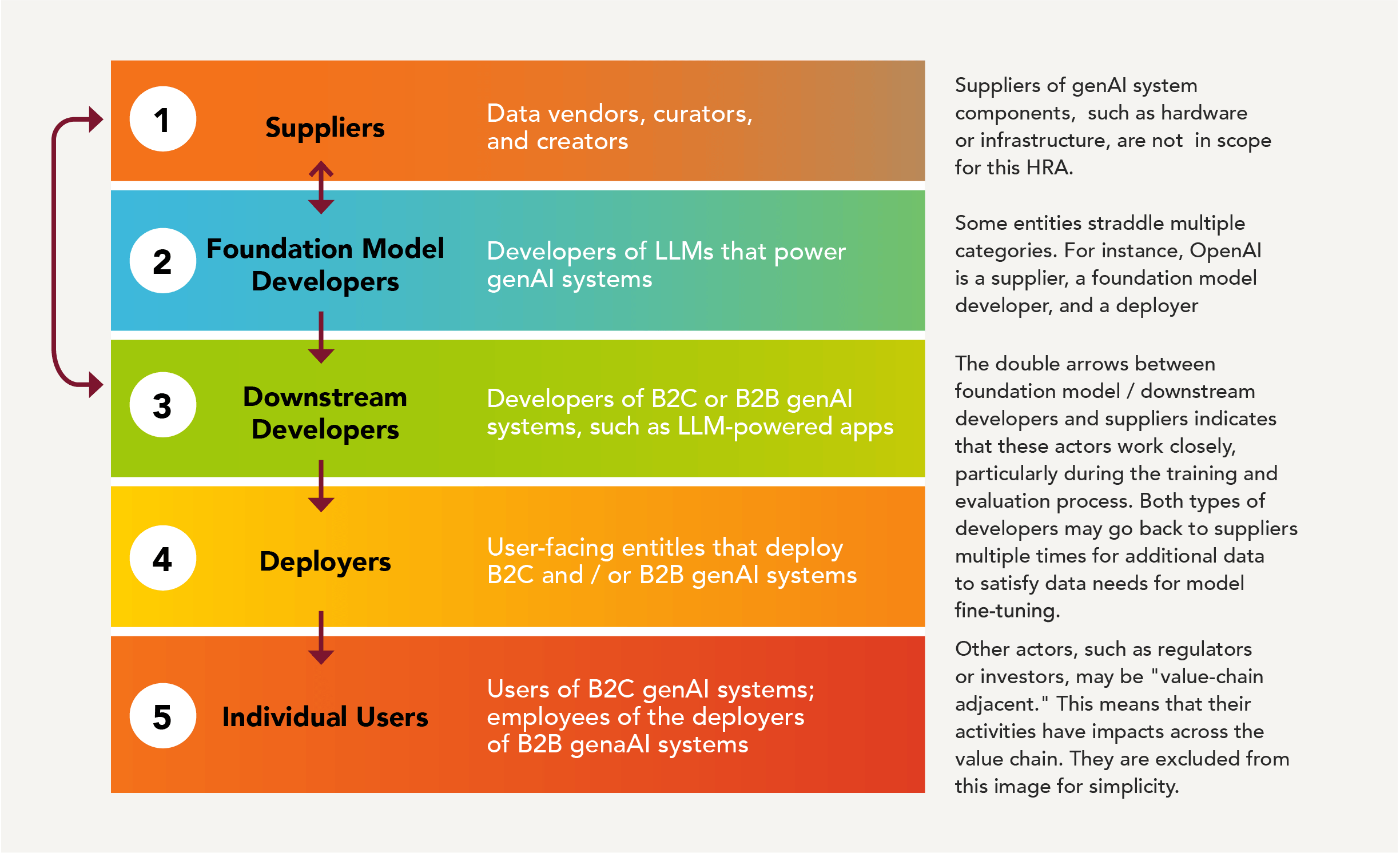
Click on the image to view a larger size
Accompanying this assessment is a series of practitioner guides that advise those working on responsible AI on how to incorporate a human rights-based approach to their work. These guides can be used across all AI product development and deployment.
- Overview of Responsible AI Practitioner Guides
- Guide 1: Fundamentals of a Human Rights-Based Approach to Generative AI
- Guide 2: Governance and Management
- Guide 3: Impact Assessment
- Guide 4: Risk Mitigation
- Guide 5: Conducting Stakeholder Engagement
- Guide 6: Policies and Enforcement
- Guide 7: Aligning Transparency and Disclosure Practices with Human Rights Responsibilities
- Guide 8: Remedy for Generative AI-Related Harms
Blog | Thursday February 20, 2025
Navigating Change: How Business Leaders Can Respond to a Changing Policy Environment
How can companies continue to deliver value and stability while navigating immense pressure from the new US administration to abandon their commitments to sustainable business?
Blog | Thursday February 20, 2025
Navigating Change: How Business Leaders Can Respond to a Changing Policy Environment
Preview
The new US administration has been in office for 30 days, and changes have come fast and furious, many of them relating directly and indirectly to sustainable business. The public response from business has been minimal thus far, despite the fact that many of these policy pronouncements and executive orders have created significant barriers to existing company commitments.
Some of the orders take direct aim at action on climate, diversity, international cooperation, and sustainable development. High profile moves including the withdrawal from the Paris Agreement, apparent shuttering of USAID, non-enforcement of the Foreign Corrupt Practices Act, and removal of all activities—and language—related to “DEI” have transformed the landscape.
Some of these measures seek to overturn well-established laws and regulations that have been in place for nearly a half century or more, noting that many have been challenged in the courts. This comes at the same time that the European Union’s “Omnibus” is about to appear, with the likely impact of reducing and/or delaying implementation of the world-leading regulatory architecture on ESG in the name of deregulation and competitiveness.
Put simply, there is now immense pressure on companies to diminish or abandon their commitments, de-emphasize climate, diversity, and human rights, and drop public advocacy on these subjects.
This presents a destabilizing moment for companies that remain convinced that sustainability is a way to deliver long-term value, ensure resilience, and innovate.
Through discussions with leaders at many of our member companies over the past month, we are hearing some common themes:
- Changes in direction from Washington present three interrelated challenges: policies are being reversed; funding and incentives are being withdrawn, and there is intense political pressure on companies to reverse their policies and practices.
- Corporate sustainability leaders are digesting the remarkable depth and breadth of recent executive actions. Many leaders expected a “rollback,” and instead have seen an attack. While withdrawal from the Paris Agreement was expected, the removal of well-established, long-standing laws and regulations such as the Foreign Corrupt Practices Act, and longstanding anti-discrimination requirements, are seen by many as departing from the kind of policy environment that enables a stable, predictable environment for business.
- With the European Union’s Omnibus expected to be produced in March, sustainability leaders are also looking at Europe with unease, with the potential for rollbacks or delays on the CSRD and CSDDD, for which companies have been preparing assiduously.
- Regardless of these abrupt changes to the policy and political context, fundamental drivers and stakeholder expectations for sustainable business remain powerful and relevant.
- Even as many companies have quietly–or quite publicly in some cases–reduced their commitments and sustainability communications, most maintain that they continue the lion’s share of the work. In doing so, they are refocusing on business relevance, overall strategy, and enterprise risk management.
Many sustainability leaders inside business also have expressed the concern that their companies are responding to recent developments with short-term thinking that bring negative long-term consequences. Some fear “anticipatory obedience” is diluting business autonomy and judgment, with lasting damage. They also fear that with the withdrawal of reliable policy and economic incentives, the private sector will be left to carry the burden on key issues on its own, resulting in increased costs and decreased predictability.
How should companies approach this moment? Here are some ways to navigate a period of uncertainty and challenge:
- Stay attentive to the underlying reasons sustainable business is important. Despite short-term political pressures and uncertainties, boards and business leaders can only effectively steward their companies if they stay resolutely focused on the strategic implications of changes that will impact them when the current political cycle passes. The mantra of “focusing on the fundamentals” remains important, and many companies are continuing to embrace this.
- Prioritize a sustainability agenda that addresses the needs of a skeptical public. There is little doubt that many aspects of the sustainability agenda have failed to resonate with much of the public. Sustainability should take greater account of the economic opportunities, livelihoods, and risk management that can deliver better outcomes for the public. The “new narrative” that so many have called for should do a better job of articulating how the average person can benefit from sustainable business.
- Decide what’s non-negotiable. Businesses and business leaders have faced pressure to abandon existing principles and commitments. In our view, this is not, well, sustainable. Every company, and every business leader will need to determine what “red lines” they are not willing to cross. Policy debate is a healthy and necessary part of a well-functioning society, and businesses will undoubtedly face moments when they will be expected to “find their voice” about their values and principles, as I noted in my recent chat with New York Times reporter David Gelles.
The abrupt policy changes coming from Washington in no way negate undeniable realities facing business. Challenging “DEI” (without defining the term in many instances) does not negate the fact that American and European societies are growing more diverse by the day, which means companies should be focused on inclusion. Reversing steps in the US and Europe to advance the energy transition should not mean that companies turn away from the real costs and risks of accelerating climate change, or the massive innovation opportunities for companies that meet this challenge. Withdrawing from international efforts to address shared challenges, as slow and imperfect as they may be, only creates more uncertainty and delay that will cost companies dearly; does nothing to stabilize the global economy, and detracts from important efforts to improve public health, address migration, and stabilize the international system.
Regardless of the currently unfavorable political climate, no business leader can disregard the ongoing reasons why sustainable business delivers value, future-proofed companies, and stability. Turning away from these realities presents risks for business and society. Leadership comes from people who are able to see past daily developments to stay focused on strategic needs. That brand of leadership is needed now, more than ever.
Reports | Thursday February 20, 2025
Charting the Course: Navigating the Climate Transition Plan Landscape
BSR’s new report provides an overview of the climate transition landscape, including awareness around existing regulations and frameworks as well as challenges business faces in complying with these regulations.
Reports | Thursday February 20, 2025
Charting the Course: Navigating the Climate Transition Plan Landscape
Preview
Companies are showing greater ambition in setting climate targets, yet a significant gap exists between targets and demonstrated progress. Climate Transition Plans (CTPs) are turning into the key medium for companies to demonstrate how they intend to reach their targets and to disclose progress
While there is mounting pressure on the private sector to publish CTPs, the ecosystem of frameworks, sectoral guidance, and regulatory requirements is complex. Consequently, businesses need more clarity so they can craft robust CTPs that meet stakeholder expectations.
BSR’s new report provides companies with a better understanding of the climate transition landscape, including awareness around existing regulations and frameworks as well as challenges business faces in complying with these regulations. With increased clarity, companies will be better equipped to navigate the complex and rapidly evolving landscape and develop credible CTPs.
Contents
- Three Questions about Climate Transition Plans
- From Soft Law Frameworks to Hard Law Requirements
- Focus on Key Climate Transition Plan Elements
- Connecting People, Nature, and Climate
- Conclusion
Blog | Wednesday February 19, 2025
Advancing Supply Chain Sustainability through Collaboration: Lessons from Action for Sustainable Derivatives
As collaboration becomes essential for businesses tackling complex supply chain issues, what lessons can be drawn from the work BSR’s Collaborative Initiative Action for Sustainable Derivatives (ASD) has done in the palm sector?
Blog | Wednesday February 19, 2025
Advancing Supply Chain Sustainability through Collaboration: Lessons from Action for Sustainable Derivatives
Preview
Case Studies | Tuesday February 18, 2025
Conducting an ESRS and IFRS Gap Assessment
Explore BSR’s newest case study with a global technology company to perform a gap assessment against the European Sustainability Reporting Standards (ESRS) and International Financial Reporting Standards (IFRS).
Case Studies | Tuesday February 18, 2025
Conducting an ESRS and IFRS Gap Assessment
Preview
Introduction
BSR worked with a global technology company to conduct a gap assessment against the European Sustainability Reporting Standards (ESRS) and International Sustainability Standard Board's (ISSB’s) International Financial Reporting Standards (IFRS). This project enabled the company to prepare to report in accordance with the requirements of the EU Corporate Sustainability Reporting Directive (CSRD) and ISSB and to plan for short-, medium-, and long-term actions to close existing disclosure gaps.
Background
The sustainability field is shifting from voluntary to mandatory reporting standards. The CSRD provides rules on corporate sustainability disclosure within the EU and mandates compliance against the European Sustainability Reporting Standards (ESRS). Under the CSRD, large companies operating in the EU and EU-listed companies, as well as large companies with securities on EU-regulated markets, are obliged to report on all identified material topics based on a double materiality assessment. ISSB's IFRS Sustainability Disclosure Standards aim to equip investors with globally comparable, decision-useful sustainability information. Various national jurisdictions have also decided to adopt ISSB standards within their respective regulations or are consulting on their introduction.
Given the evolving sustainability reporting landscape, a global technology company headquartered in the US identified the need to assess its preparedness for upcoming mandatory reporting requirements. Non-compliance with mandatory reporting regulations, such as those imposed by CSRD, could lead to fines and reputational damage, while failure to report in a manner that is comparable to international peers could impact reputation and limit a company's access to capital in the international markets.
BSR's 30+ years of experience with sustainability reporting and approach to assessing disclosure gaps resonated with the company's wish for a detail-oriented, thoughtful process. To ensure compliant and robust reporting practices, BSR helped the company understand which requirements are applicable to them based on their double materiality assessment, and the gaps between their current reporting practices and the desired future state.
BSR’s Response
BSR worked with the company to assess all applicable general and topical ESRS standards, as well as IFRS S1 and S2 (focusing on climate). This aligned with the results of the company’s Double Materiality Assessment, which was also led by BSR as a separate project. Using BSR’s ESRS and IFRS gap assessment tools, which provide a detailed comparison between reporting requirements and relevant disclosures, BSR reviewed all publicly available sustainability information and identified no, partial (where some revisions were necessary to comply), and full (where the disclosure was missing) gaps in relation to all applicable ESRS and climate-related IFRS standards. The team then provided a summary of gaps per standard and developed recommendations and next steps to start the planning process for compliance with CSRD and IFRS.
Impact
The project allowed the company to take a forward-looking approach to reporting. Aside from identifying and prioritizing disclosure gaps, the information also highlighted potential areas where process changes could be considered. As a next step to this work, the company is working to assign different topical areas to appropriate departments, to work on closing data gaps and implementing necessary process changes.
Conclusion
As the sustainability field solidifies mandatory reporting requirements, gap assessments will be critical to preparing for compliance. While CSRD is a regulatory requirement for all large companies operating in the EU and all EU-listed companies as well as large companies with securities on EU-regulated markets, compliance with IFRS sustainability disclosure standards may be requested by various investors in the future. To ensure consistency and the achievement of desired outcomes, all teams (finance, risk, procurement, sustainability, etc.) will need to collaborate closely and apply the same level of rigor to both financial and sustainability reporting. It is important for companies to invest in a long-term vision, prioritize, and focus on a mindset shift toward holistic approaches to compliance while not losing sight of broader sustainability strategies.
Get in Touch
Interested in learning more about BSR's approach to voluntary and mandatory reporting? Please contact BSR's Reporting team.
This case study was written by Verena Nüchter and Anna Zubets-Anderson.
Audio | Thursday February 13, 2025
A Year of Uncertainty: Maintaining Progress Amidst a Battle of Ideas
Following his recent blog about the “Ten Big Questions Facing Sustainable Business Leaders in 2025,” BSR President and CEO Aron Cramer chats with David Stearns about the EU Omnibus package and its potential impact on regulatory requirements, why sustainability goal setting remains a valuable exercise in an environment of political…
Audio | Thursday February 13, 2025
A Year of Uncertainty: Maintaining Progress Amidst a Battle of Ideas
Preview
Following his recent blog about the “Ten Big Questions Facing Sustainable Business Leaders in 2025,” BSR President and CEO Aron Cramer chats with David Stearns about the EU Omnibus package and its potential impact on regulatory requirements, why sustainability goal setting remains a valuable exercise in an environment of political pushback and uncertainty, the future of COP (with or without U.S. involvement), and why sustainable business must shift the language it uses to describe—in tangible ways—its connection to improving people’s lives and wellbeing.
Blog | Wednesday February 12, 2025
Healthy Planet, Healthy People, Thriving Businesses: Four Steps to Center Health Equity in Climate Action
Learn about the interconnection between business health, human health, and environmental health and explore four steps businesses can take to center health equity in their climate action efforts.
Blog | Wednesday February 12, 2025
Healthy Planet, Healthy People, Thriving Businesses: Four Steps to Center Health Equity in Climate Action
Preview
People
Mario Abreu
Audio | Thursday February 6, 2025
A Conversation with Mario Abreu, Group VP, Sustainability, Ferrero
Mario Abreu, Group VP, Sustainability at Ferrero chats with BSR Managing Director, Transformation Christine Diamente, and host David Stearns about the cross-functional role of sustainability at Ferrero, how he maintains a focus on ambition, and why the nexus between climate change, people, food, and planetary limits should be humankind’s top…
Audio | Thursday February 6, 2025
A Conversation with Mario Abreu, Group VP, Sustainability, Ferrero
Preview
Mario Abreu, Group VP, Sustainability at Ferrero chats with BSR Managing Director, Transformation Christine Diamente, and host David Stearns about the cross-functional role of sustainability at Ferrero, how he maintains a focus on ambition, and why the nexus between climate change, people, food, and planetary limits should be humankind’s top priority.