Searching for:
Search results: 556 of 1219
Blog | Thursday March 10, 2022
Empowering Women Fruit Farmers with Digital Training
Responsible business is deepening its commitment to empowering women across the value chain. One such example is Fyffes and HERproject expanding the new digital program HERessentials across several Latin American countries.
Blog | Thursday March 10, 2022
Empowering Women Fruit Farmers with Digital Training
Preview
As responsible business deepens its commitment to empowering women across the value chain, new opportunities have arisen, which can improve operations and benefit both business and workers. One such opportunity is via an educational online tool that HERproject and Fyffes kickstarted last year in Latin America and the Caribbean. The tablet-based program works directly in fruit fields in the region, using videos, games, and quizzes that illustrate a selection of everyday situations that workers face both in the workplace and at home. It aims to challenge traditional gender stereotypes and provides essential information on health, financial resilience, and stress management while improving overall digital literacy.
The Gender Equality Observatory for Latin America and the Caribbean points to limited progress for gender equality in the region. One in three women do not earn a regular income, making them economically dependent on others. This, combined with a disproportionate burden of domestic activities and low representation in senior leadership positions, unions, and cooperatives, drastically reduces women’s opportunities in the workplace.
Considering the impact of the COVID-19 pandemic, as well as limited access to information in rural settings, Fyffes and HERproject expanded the new digital program HERessentials across Fyffes-owned banana, melon, and pineapple farms in Costa Rica, Ecuador, Honduras, and Belize.
To date, 1,100 Fyffes workers have been trained using the App. Drawing upon experience working in Latin America and the Caribbean, key insights are summarized below:
How to Gain Buy-in from Farms and Build Ownership of the Training Program
Fyffes identified that the ambition of addressing gender issues at the farm level came from gender equality being one of its core sustainability targets. Championed by the senior leadership team, this focus enabled the farm teams to prioritize gender amidst demanding schedules and other priorities. HERessentials has been a key tool in helping them achieve this goal.
Another crucial part in successfully creating ownership has been the leadership of on-site management and human resources teams, who created gender management committees to aid the implementation of the program. Each team has embraced HERessentials and driven the program forward week by week.
How to Train and Engage Workers, Especially Women, in Farms
The use of technology could make it challenging or intimidating for workers to engage in the program. However, HERessentials is a self-driven program that gives workers full autonomy to navigate the modules at their own pace. Creating a comfortable space and building trust with the facilitator guarantee high engagement levels. HERessentials works offline and can be delivered in a setting that is less intimidating than the classroom, such as the field, a lunchroom, or community area.
Fyffes has introduced a liaison element to speak informally to workers about the challenges they face, both at home and in the workplace, around the topics covered in the training. The workers relish this opportunity to open up and discuss issues.
“The issues covered in the training are very relevant within the reality of the communities where we operate. It is this simple approach of providing relevant information, that makes employees decide if they will continue to receive more training in other issues such as reproductive health, occupational health, financial management and stress, for example. HERessentials has been very well received, and it is certainly of benefit to our employees and their families.”
—Alejandro Cordero, human resources manager at Fyffes, Costa Rica
How to Make Training Content Relevant to the Agricultural Sector and to the Region
HERessentials is now ready to be implemented in any Latin American country, and it is suitable for multiple agricultural sectors. This makes it an appealing tool to work with stakeholders to achieve sustainability goals, which Fyffes has demonstrated by engaging both IDH—The Sustainable Trade Initiative and Lidl GB as partners in HERessentials implementation.
In the upcoming years, Fyffes will continue to use HERessentials to reach its sustainability target: 100 percent of Fyffes-owned sites in Latin America will benefit from gender equality programs by 2025 and 50 percent of its suppliers by 2030. The next step is to expand the program to banana suppliers in Nicaragua, Colombia, and Costa Rica, aiming to incorporate small producers, where women workers face additional challenges than in conventional farming systems.
HERessentials is flexible and works in any rural setting, from fruit to coffee, cacao, and flowers. If you're interested in learning more, please contact the HERproject team.
Blog | Wednesday March 9, 2022
Inside BSR: Q&A with Smita Nimilita
Inside BSR is our monthly series featuring BSR team members from around the world. This International Women’s Day, we connected with Smita Nimilita, a HERproject Country Representative based in Bangladesh.
Blog | Wednesday March 9, 2022
Inside BSR: Q&A with Smita Nimilita
Preview
Inside BSR is our monthly series featuring BSR team members from around the world.
This International Women’s Day, we connected with Smita Nimilita, a HERproject Country Representative based in Bangladesh.

Tell us a bit about your background. Where are you from, and where are you based? What does a day in your life look like? What is your favorite hobby?
I was born, brought up, and am based in Dhaka—the capital city of Bangladesh. The city is densely populated, but I live in a nice neighborhood with parks and walkways. My typical day consists of three essential parts: morning tea, meeting my parents, and HERproject work.
I love traveling, although this has been disrupted by the COVID-19 pandemic. My last trip was in November, with extended family and friends around the coastal area of Cox’s Bazar, in Bangladesh. I am already planning my next trip!
How did you first get involved in gender equality issues? How long have you been working on HERproject? What is your current role, and what does that entail?
I have always been unpleasantly surprised by the stories of injustice and inequalities around me due to gender and social class. It was shocking to see that someone can be deprived of accessing basic human rights purely based on their gender. I believe that women, especially of a young age, are the ones who can act as an agent of change within the family and society at large.
I joined HERproject in 2017 and started my work with the HERfinance Digital Wages program in Bangladesh. After a year, I started working on other HERproject pillars as the Bangladeshi Country Representative. I lead the implementation and stakeholder management of all programs on the ground, which include managing HERproject staff, implementing partner NGOs, brands, suppliers, male and female workers, managers, other stakeholders such as program-specific market players, service providers, government and UN bodies. I also represent HERproject at events and seminars.
I am co-leading the Bangladesh workplace model design and the implementation of Empower@Work—a new collaborative effort by BSR HERproject, CARE International, Better Work, GAP Inc.’s P.A.C.E. program—with the goal of delivering a unified approach to women’s empowerment in global supply chains.
What are some interesting projects that you get to work on as part of your role at HERproject? What do you enjoy about them?
At HERproject, we keep women workers at the center of everything. Positive feedback and impact stories are what motivate me to improve. I am thrilled to share three notable programs that I enjoy working on:
Firstly, HERfinance Digital Wages has been an amazing journey. We started with a year-long struggle to onboard brands and suppliers, but within a couple of years, we have supported more than 150,000 workers in Bangladesh to digitize their wages along with financial capability training. After the program, 83 percent of female workers prefer digital wages, one in five workers started saving regularly, and women are making an average of eight transactions a month using their mobile money account. For more information, we have published a series of reports and training materials.
The second program that I am proud of is HERessentials. We launched the pilot in Bangladesh during the COVID-19 pandemic to support male and female workers by providing essential skills and knowledge through digital technology-based training. We have received many positive stories and feedback on the program from women workers.
Finally, we have re-launched the HERrespect program in Bangladesh, which aims to tackle violence against women in the supply chain. We are working on improving various aspects of the program based on our recent learning on the ground.
What issues are you passionate about and why? How does your work with HERproject reflect that?
I am passionate about being part of a society that has a place for people of all backgrounds. HERproject gives me the opportunity to do just that. I also enjoy collecting and sharing people’s stories because everyone has such unique journeys which inspire others. Through HERproject, I meet people from diverse profiles and backgrounds. Our team is truly global and we constantly learn and support each other.
As we celebrate International Women’s Day, how do you believe business can translate their gender equality commitments to meaningful action?
I urge business to take ambitious initiatives to support women in their supply chain. They have been unfortunately affected by COVID-19 and the future of work is risking their livelihood. Now is the time to translate strong commitments into action by coming together and taking impactful industry-wide action on the ground. Business need to consider gender equality and women’s empowerment as a cross-cutting issue, and become gender intentional in their policy and action.
Blog | Tuesday March 8, 2022
International Women’s Day: Business Trends and Opportunities
At the current pace, it will take another generation to achieve gender parity. As we mark International Women’s Day 2022, we share three key areas that require urgent action from companies: addressing unpaid work and care, combating gender-based violence, and preparing for future jobs.
Blog | Tuesday March 8, 2022
International Women’s Day: Business Trends and Opportunities
Preview
I asked Kalpona Akter, a workers’ rights advocate who started working in the Bangladeshi garment industry at the age of 12, about the state of business and gender equality. As we enter the third year of the pandemic, has business done its part in supporting women who make up the majority of workers in her industry?
Akter replied: “We are not on a positive track. This pandemic has shown the draconian side of business. Many companies make payments through charity instead of paying workers what they are due: a living wage.”
Akter is not the only one to identify a lack of progress on gender equality. In the context of the pandemic, the World Economic Forum’s Global Gender Gap Report announced that it will take another generation to achieve gender parity, as closing the gender gap has moved from 99.5 years to 135.6 years.
McKinsey’s Women in the Workplace report last fall pointed to an increase of women in American-based companies taking on leadership roles—although these gains do not extend to women of color, who continue to be underrepresented at every stage of the pipeline. Despite this progress, all women are facing much higher levels of burnout than men, and many consider stepping back or dropping out of the workforce. Part of this is due to women, and particularly women of color, taking on additional work, looking after colleagues’ well-being, and building more inclusive workplaces—efforts that often go unrecognized and unrewarded.
BSR’s Women’s Empowerment Trends Report, developed with the UNGC, likewise points to limited progress in companies making meaningful changes to improve gender equality—and those changes we saw were often limited to commitment making rather than action implemented.
The fundamentals of how business can promote gender equality remain relevant and require sustained attention: removing bias from hiring and advancement practices, ensuring living incomes, workers’ rights, representation—especially for vulnerable groups—and considering how business decisions affect groups differently. Beyond the usual debate, what are the trends in the gender space that business leaders need to pay attention to this year? Where are opportunities for business to do better?
Stepping up on Care
By now, there’s much more recognition that invisible work, including caring for family members, the sick, children, and domestic tasks—work that is primarily completed by women—is essential to keeping economies running. Yet the disproportionate share of domestic work that women take on forms a barrier to their full participation in the paid workforce and is a primary obstacle to gender equality, as a new 17-country study from our friends at Women Deliver shows.
Global companies have taken steps to support employees, increasing flexibility and ability to work from home, providing more paid leave, supporting parents and caregivers for both women and men. These initiatives will be even more critical to attract and retain talent in 2022 and beyond. While there is no “one-size-fits-all” approach to flexibility in the workplace, listening to what employees value and being willing to experiment and adapt are important. Companies must also keep tracking data on the pipeline and ensure that policies don’t have negative consequences on individuals.
Tackling Gender-Based Violence
A rise in gender-based violence has formed a shadow pandemic that is characteristic of lockdowns, increased insecurity and stress within households, and reduced access to support services. With regards to global supply chains, increased production pressure and uncertainty contribute to a high-stress environment with greater risk for abusive behavior from managers.
A commitment to ending gender-based violence is critical, and taking action to address this within internal operations is a start. Companies can also demonstrate support for the ILO’s Convention 190 on eliminating violence and harassment in the world of work. Partnering with local organizations or collaborations such as Empower@Work is one way for companies to translate commitments to actionable measures to prevent and respond to gender-based violence in the supply chain.
Preparing for the Jobs of Tomorrow
Across sectors, the nature of work is in flux, and women stand to be left behind with the rise of new technology and digitalization, the emergence of jobs tackling the climate crisis, and other disruptive change. For example, the green gender gap, referring to the gap in skills addressing environmental sustainability, has not improved since 2015.
Companies can make sure that women have equitable access to upskilling and reskilling opportunities and combat occupational segregation that keeps women out of jobs traditionally held by men. Improving technical competencies and upskilling workers in the face of new automated technologies, for example, will be important in sectors such as manufacturing and services. Research indicates a combination of decision-making and soft skills are necessary alongside technical competencies, and an intentional approach to include women and underrepresented groups is key.
This International Women’s Day, the basics remain true, and business must remain committed to ensuring equal opportunities for women as employees, business partners, and community members. Akter reminds us that real action addressing issues that matter most to women, such as wages, should remain the focus. As we begin the third year of the pandemic, three areas require urgent investment from companies: addressing unpaid work and care, combating gender-based violence, and preparing for future jobs. We invite companies to reach out and engage on these important topics when considering how business can push for progress on gender equality.
Blog | Monday March 7, 2022
Applying the UNGPs to Technology: Our Point of View
The UN Human Rights Council initiated an expert consultation on the practical application of the Guiding Principles on Business and Human Rights (UNGPs). BSR has published a submission drawing upon our experience of 100 human rights assessments with tech companies.
Blog | Monday March 7, 2022
Applying the UNGPs to Technology: Our Point of View
Preview
The UN Human Rights Council recently initiated an expert consultation on the practical application of the Guiding Principles on Business and Human Rights (UNGPs) to the activities of technology companies, and it sought formal input from stakeholders.
This consultation is very timely given the increasing relevance of technology to the realization of human rights in practice and the prominent role of the private sector in how technology is designed, developed, and deployed.
Over the past two decades, BSR has gained significant experience working with technology companies on human rights due diligence, including around 100 human rights assessments.
We have also led collaborative efforts (such as facilitating the creation of the Global Network Initiative, Responsible Business Alliance, and Technology Against Trafficking) and published research (such as Human Rights-Based Approaches to Content Governance in the Social Media Industry).
We’ve drawn upon this experience to make a submission to the consultation, which is available in full. We hope the submission provides a thoughtful contribution to the application of the UNGPs to the activities of technology companies. The key points are summarized below:
Human Rights Risks in Business Models
The need to understand the human rights impacts arising from company business models has rightly grown in focus over recent years. However, human rights due diligence practitioners can further define what human rights due diligence of business models means in practice, and the venture capital industry—an essential gatekeeper for technologies making it to market—requires more attention.
Human Rights Due Diligence and End-Use
BSR’s engagements with companies on human rights due diligence has taken a variety of forms, including geography (e.g., market-entry, exit, ongoing presence), products (e.g., entire platforms, new features, product research), customers (e.g., industry verticals, specific customers, use cases), and governance (e.g., product policies, mergers and acquisitions).
This diversity leads us to caution against a “one-size-fits-all” approach and instead to appreciate the value of tailoring approaches to secure maximum traction across a wide range of functions—such as engineering, product management, policy, and sales.
- Users play a significant role in shaping impact, and a considerable challenge when assessing human rights impacts is the interplay between the design of the product by the technology company and its real-life application. For more, see BSR’s report on downstream human rights due diligence.
- While today’s human rights assessments are typically undertaken for a single company, solutions are often more effective at the system or sector level. All industries deploying technology are relevant—not just technology companies—and business in other industries should be undertaking human rights due diligence around how they deploy technology.
- The quality of human rights due diligence improves significantly when it draws upon insights from a range of professional communities—including business and human rights teams, product managers, research and design teams, and sales and marketing teams—using a “human rights by design” approach.
- More engagement is required with non-users because technology can impact rightsholders who do not use the product in question. For example, hate speech on social media can be associated with real-world harm.
Accountability and Remedy
We believe that companies should be more transparent about the results of human rights due diligence and envision an ideal where companies publish insights as part of their overall “sustainability” disclosures. The recent integration of the UNGPs into the Global Reporting Initiative Universal Standards and the draft EU sustainability reporting standard are encouraging in this regard. Furthermore, we believe that access to remedy in a business-to-business (B2B) and business-to-government (B2G) context needs exploring. When undertaking human rights assessments in B2B and B2G settings (e.g., a cloud services company providing AI products to financial services companies), we’ve explored whether the AI vendor should “require” the buyer to set up reporting channels, if the AI vendor should have its own mechanism, and how responsibility to provide a remedy should be distributed across a complex web of vendors, systems integrators, and customers.
The State's Duty to Protect
Over recent years, governments have increasingly proposed and implemented regulations that are relevant for human rights in the technology industry.
We believe that government regulations of relevance to human rights due diligence—such as the General Data Protection Regulation, Digital Services Act, and AI Act—should be consistent with the UNGPs and are interoperable. For example, we recommend reinforcing the message that all human rights are potentially relevant for technology companies and that human rights due diligence is essential, rather than pre-determining certain technologies as inherently high or low risk.
We are also concerned about the growth of regulatory proposals from governments that would bring adverse human rights impacts; such as efforts seeking to establish liability for “lawful but awful” content (which will result in overbroad restrictions on freedom of expression), attacks on the use of end-to-end encryption (which is essential to protect rightsholders, especially human rights defenders, children, and other vulnerable users), and data localization laws (which can limit cross-border communication and present severe privacy risks).
Writing the BSR submission presented a timely opportunity for reflection, and we hope it provides a useful analysis of both the current state and future direction of human rights due diligence in the technology industry.
Blog | Friday March 4, 2022
Time’s Up: Urgent Climate Adaptation and Business Transformation Key to Secure a Livable Planet
IPCC’s recently released Sixth Assessment Report about climate impacts, adaptation, and vulnerability shines a light on the threat climate change poses to human well-being and planetary health.
Blog | Friday March 4, 2022
Time’s Up: Urgent Climate Adaptation and Business Transformation Key to Secure a Livable Planet
Preview
IPCC’s recently released Sixth Assessment Report about climate impacts, adaptation, and vulnerability shines a light on the threat climate change poses to human well-being and planetary health. It makes plain an indisputable fact: our efforts to reduce emissions have been unsuccessful, as has been our action to adapt to climate impacts.
According to the report:
“Increased heatwaves, droughts and floods are already exceeding plants’ and animals’ tolerance thresholds, driving mass mortalities in species such as trees and corals. These weather extremes are occurring simultaneously, causing cascading impacts that are increasingly difficult to manage. They have exposed millions of people to acute food and water insecurity on a global scale.”
Many of these impacts will be irreversible, but we can substantially reduce them if we succeed in limiting global warming to 1.5°C above pre-industrial levels. If we don’t, the risks posed to humans and natural ecosystems will be exponentially worse.
A key point in the report is that climate, ecosystems, and people are interconnected and interdependent, both with regards to impacts—which makes risks increasingly complex to understand and manage—but also to solutions. As stated by Inger Andersen, Executive Director at the UN Environment Programme:
“Nature can be our savior, but only if we save it first.”
Climate change is and will increasingly impact ecosystems, e.g., accelerating the current rates of extinction, something that is projected to be 10-fold more extreme in a 3°C world than a 1.5°C one. Yet, nature has an incredible ability to store carbon and clean pollution while also providing sustenance for life, making biodiversity and ecosystem health paramount to adapt to the impacts of climate change and deliver a 1.5°C future. To do this in practice, scientists have concluded that we must conserve 30-50 percent of Earth’s land, freshwater, and ocean areas.
The interconnection of climate, nature, and human beings reminds us that climate and nature solutions will not be effective if not designed to be fair and inclusive to people. Around 40 percent of the world’s population already lives in areas highly vulnerable to climate change, and it is often in these areas that socioeconomic issues interact and compound, deepening and perpetuating poverty and inequities, food and water insecurity, health issues and the overall ability to live a safe and self-determined life. Communities already experiencing the ills of global inequities—who tend to be the least responsible for global warming—will face disproportionate impacts from climate change.
It is imperative that we accelerate transformational rather than incremental climate adaptation to address more pressing risks. It’s equally important that we invest our resources to support effective, feasible adaptation solutions that consider potential effects on both nature and people. We should implement them in conformity to the principles of justice to ensure that burdens and benefits are distributed equitably, and that solutions are co-created with affected communities, so they reflect the perspectives of local cultures and needs. Multistakeholder collaboration for learning, capacity building, and scenario analysis can support this.
By embracing climate-resilient development to safeguard their own businesses, companies can help to catalyze sustainable and just development by scaling up greenhouse gas mitigation while simultaneously driving adaptation. The IPCC directly calls on the private sector to help address these grand challenges, leading to several key take-aways for business:
Embrace 1.5°C as the minimum threshold of ambition
Set a 1.5°C-aligned net-zero commitment and take quick and transformational action to achieve net-zero value chains.
Assess and adapt
Climate risks are unavoidable, and businesses need to take action to ensure long-term resilience. Business leaders should identify those interconnected risks, their effects on nature (and vice versa), and fully understand climate injustices and inequities across the value chain, seeking to listen to how employees, suppliers, customers, consumers, and the community at large are affected.
Conduct climate scenario analysis as an effective way to grapple with climate impacts on a company and its supply chain, and adjust strategy accordingly.
Implement climate and nature solutions that work for both people and planet
Incorporate and deploy capital to nature-based solutions into your strategy. Such solutions can have positive benefits on both the climate and communities.
Deploy capital to finance community resilience across supply chains, to ensure climate action does not perpetuate climate injustices.
Apply justice, equity, and inclusion as key principles of your climate strategy and ensure the principles are upheld in policies, programs, and investments.
Urgent action is needed. As António Guterres, UN Secretary General, starkly stated: “Delay means death.”
Business has both an obligation, and an opportunity, to play a key role in driving adaptation and delivering climate-resilient development. BSR is here to help you to navigate the complexity of interconnected climate, nature, and people issues, and take decisive action, now.
Blog | Thursday March 3, 2022
Unlocking Opportunities in Access to Healthcare
While progress has been made in the past two decades, half the world’s population still lacks access to essential healthcare services. As a step in their collective action for driving progress, BSR and the HCWG have developed the Access to Healthcare Leadership Ladder.
Blog | Thursday March 3, 2022
Unlocking Opportunities in Access to Healthcare
Preview
The right to health is a fundamental part of human rights and of our understanding of a life with dignity. While progress has been made in the past two decades, half the world’s population still lacks access to essential healthcare services. This continues to be one of the biggest global challenges and one that demands system-wide change.
For the past 12 years, BSR and the Healthcare Working Group have explored new methods to bring about change, via guiding principles, research papers, and multistakeholder dialogue. Today, the assessment is clear:
- The healthcare industry has unique competencies they can harness for continued progress. By working alongside peers, governments, NGOs, and other organizations, companies can continue to help overcome barriers that prevent underserved populations from receiving quality healthcare and contribute to expanding universal and equitable access to all.
- With regards to companies in the healthcare sector, access should be understood as a core business issue and opportunity. While long addressed through donations and one-off initiatives or programs, it is has become clear that real progress can only be achieved by integrating “access thinking” throughout a company: including from R&D to logistics, from the board room to the patient, from idea to impact.
- There are still some largely untapped avenues for progress, and even the most mature business and corporations have opportunities to move the sector forward.
“The BSR Access to Healthcare Leadership Ladder framework is an important step forward in establishing standards for industry-led access programs. We encourage all stakeholders, within and outside the industry, to get involved and agree on such standards, in order to establish a common understanding of the industry’s role and achievements in improving global access.”
—Profs. Veronika Wirtz and Peter Rockers, Boston University School of Public Health
As a step in their collective action for driving progress, BSR and the HCWG have developed the Access to Healthcare Leadership Ladder, a maturity diagnostic and ambition-setting tool to guide and drive progress on access to healthcare. Based on BSR research and dialogues with external experts (including academics, industry associations, investors, relevant foundations, and NGOs) and HCWG members, the Ladder aims to achieve HCWG members’ shared vision of access to healthcare.
The tool helps companies to drive impact by assessing the current level of maturity and opportunities for progress across different dimensions that constitute access to healthcare, helping companies look at their practices through a value chain lens, realizing the extent to which access is currently integrated across their organization, and identifying gaps and opportunities for further improvement.
The Ladder has been designed to cover a broad spectrum of access issues for healthcare companies, irrespective of the medicine they develop or the market in which they distribute their products. Furthermore, the tool is relevant to any company and should provide insights to even the most mature companies.
In the Ladder, access maturity is evaluated across the company value chain through nine dimensions: six dimensions covering the “four As” (Availability, Affordability, Accessibility, and Acceptability) plus three dimensions covering business practices and measurement.
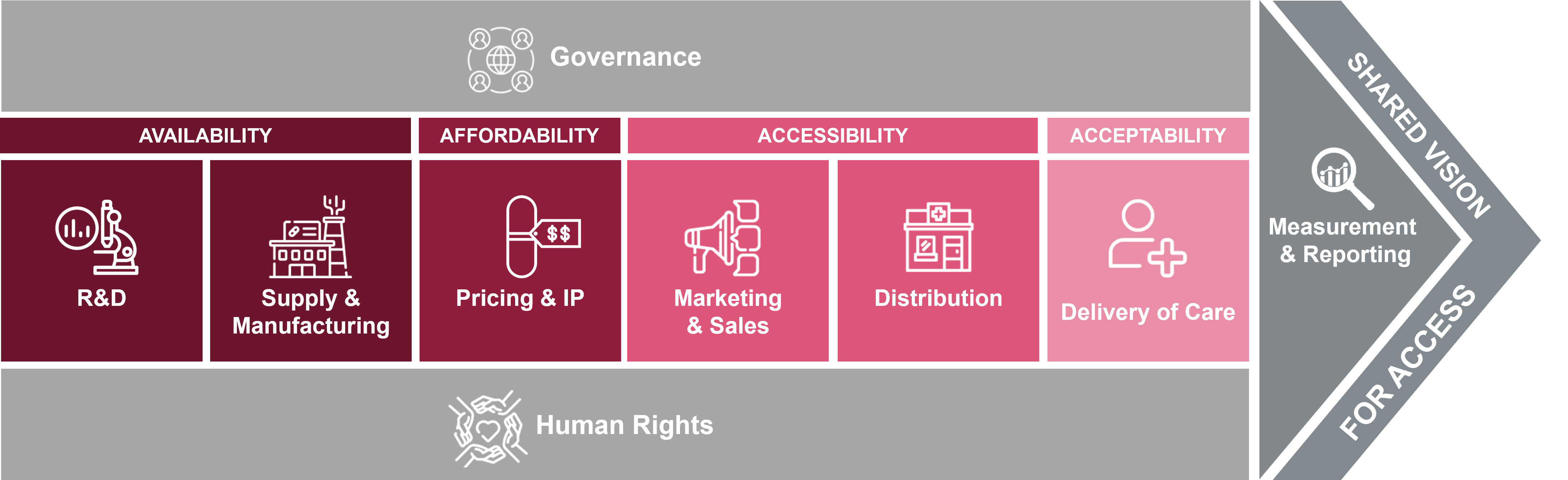
For each of the dimensions, the Ladder defines four maturity levels:
- Working at a base level, i.e., defining the minimum practice, beyond regulatory requirements
- Achieving good access practices, i.e., an overview of good practice
- Pioneering innovative solutions, i.e., examples of current, innovative practices
- Driving impact, i.e., next steps to achieving the HCWG vision of access
We trust the Ladder will be a useful tool to spark the higher ambitions and resources needed for underserved patients across the world to receive quality healthcare.
The Ladder now enters a pilot phase that companies are welcome to join. For any questions or comments, please contact the Healthcare Working Group.
Blog | Wednesday March 2, 2022
Mastering a Purposeful Approach to ESG Due Diligence in Mergers and Acquisitions
There’s no denying that 2021 was a year of significant growth in M&A, and global M&A activity is poised to climb even higher in the year ahead. M&A can be a tremendous tool for companies looking to adopt more resilient business strategies, but failing to account for the critical ESG…
Blog | Wednesday March 2, 2022
Mastering a Purposeful Approach to ESG Due Diligence in Mergers and Acquisitions
Preview
There’s no denying that 2021 was a year of significant growth in M&A, and global M&A activity is poised to climb even higher in the year ahead. M&A can be a tremendous tool for companies looking to adopt more resilient business strategies, but failing to account for the critical ESG elements can undermine success and lead to negative outcomes for business. Investors and regulators are placing more emphasis on corporate ESG performance and disclosure, including in M&A activity and financing terms. In addition, a lack of alignment around ESG topics (e.g., related to labor, governance, and corporate values) can substantially disrupt the post-merger integration process. As a result, interest among M&A teams in ESG is steadily growing, with requests to sustainability teams for guidance and frameworks on effectively integrating ESG considerations into standard due diligence.
To help our members meet this demand, BSR has built upon the guidance offered in our 2019 paper Key Considerations in Managing ESG Through a Merger and developed a set of simple steps that companies can follow to conduct effective ESG diligence in M&A. We hope that the guidance below will help our members to better evaluate the potential impact of ESG issues on business value while embracing purposeful sustainability leadership to better navigate these turbulent times.
Each company will need to develop its own approach to diligence that appropriately integrates ESG into each stage of the deal flow. The diligence process should help a company consider any potential impact of the merger or acquisition on their sustainability strategy and the long-term value of the combined entity. There are several basic elements to consider:
A red-flag check.
The objective of this step is to understand any major ESG-related opportunities or risks as part of the initial target identification process.
- Consider the “future fitness” of the core business and relevant assets. For example, do the target’s products and services appear to be compatible with the net-zero economy? Do they support or erode individual rights to privacy? Do they heavily rely on commodities with fragile supply chains (e.g., in conflict zones, reliant on current geopolitical conditions, or susceptible to extreme weather)? Does the business model present significant risks to human rights or a revised social contract (e.g., working hours, living wages and access to basic benefits, emerging legal requirements)?
- Conduct a media scan to understand any major ESG related risks. Searching for media coverage of human rights violations, serious privacy or data breaches, harassment, labor disputes, corruption, or environmental degradation can help to identify any major liabilities or cultural concerns that should be investigated upfront. Tools such as BSR’s partner Polecat perform big data analysis of online and social media, which are specifically focused on ESG.
A set of basic ESG governance questions.
The goal is to understand a target’s overall maturity related to ESG and ability to address current and emerging ESG issues:
- Does the company have a dedicated person or function responsible for management of ESG? What is their level of seniority? What type of oversight mechanisms govern ESG? Does the board play an active role? Is the CEO part of a regular ESG review cycle? What is the training program for the C-suite and board to understand ESG?
- Has the company conducted an assessment to determine its material ESG issues?
- Does the company have an ESG strategy or policy that addresses material sustainability topics and impacts from assessment results?
- Does the company have measurable timebound targets related to material ESG issues?
- Does the company publicly report performance on material ESG topics in line with relevant ESG reporting standards and regulatory requirements? Which regulatory frameworks for ESG disclosure is the company bound to according to jurisdiction?
- Does the company actively engage with external stakeholders, for example through an advisory group?
A shortlist of potentially material ESG topics based on industry, business model, and geography and evaluation of the inherent risk or opportunity level.
- As a starting point, review material issues identified for your own business. Complement this list of issues with information from tools like the SASB, MSCI, or GRI industry profiles in combination with a standard set of publicly available geographic indices (e.g., Transparency International’s Global Corruption Index), and industry- or topic-specific guidance from organizations like CDC.
- It may help to develop a standard list of topics reviewed in any deal (e.g., climate, human rights, and business ethics) alongside a list of possibly relevant additional topics (e.g., hazardous waste).
- Ask yourself how big the risk associated with each issue might be if it went unmanaged. Consider impacts across the full value chain, from raw material sourcing through product use and disposal across all relevant geographies.
- Be sure to take a double materiality approach that considers both possible impacts to business value and the environment, society, and economy associated with the target company.
- Consider dynamic issues that could be relevant in the next 5-10 years for the post-merger organization alongside issues for the individual business today. It may help to have a standard set of scenarios to evaluate performance across a range of possible future operating environments and to regularly monitor emerging issues.
Due diligence to understand risks and opportunities for each material topic.
Pull together an information request for the company based on material issues identified and tap experts as needed to help evaluate performance. Consider the following elements:
- Related policies and commitments: Do policies exist, and are they relevant to the new company?
- Governance: Is there clear ownership and accountability for performance?
- Performance management systems: Do management systems exist and are they certified to relevant external standards? Have goals been set, and are KPIs regularly tracked?
- Track record: Review performance data (e.g., GHG emissions), do a deeper dive on media coverage, consider litigation, and targeted stakeholder activism.
While it is ideal to have as much information as possible early in the process, in practice some of the components can come together after a deal is announced and before it is finalized. It’s worth noting that there are many reasons why M&A deals proceed even against significant ESG challenges. In fact, deficiencies in effective management can offer opportunities to create tremendous value and positive impact. Either way, it is essential to devote resources to defining sustainability strategy, governance, management, and disclosure protocols during and immediately following a merger. It is essential to have a clear and complete picture of the deal by both parties and a defined action plan to realize the potential of every business to maximize its long-term value and contribute to a more just and sustainable world.
Blog | Tuesday March 1, 2022
Ukraine: The Business Response
The news of Russia’s invasion of Ukraine has shaken the world and raises significant questions for business. While the situation is unfolding rapidly, there are seven key points for business to consider.
Blog | Tuesday March 1, 2022
Ukraine: The Business Response
Preview
The news of Russia’s invasion of Ukraine has shaken the world.
First and foremost, we stand with the brave people of Ukraine, who have been subjected to unnecessary and unfathomable suffering due to this illegitimate and brutal invasion of a sovereign nation. We are horrified by the death, destruction, and displacement Ukraine is experiencing. We urge the rapid end to this conflict with the restoration of full respect for democracy, rule of law, and human rights, and international cooperation to end the suffering of the Ukrainian people. This invasion should also remind us that millions of people in many parts of the world also continue to live under the threat of devastating political violence, often without the global attention the invasion of Ukraine has received.
The situation in Ukraine raises significant questions for business. Vast numbers of companies have ended or suspended their activities with Russia, combined with economic sanctions undertaken by numerous governments. We strongly support these efforts, in the name of the most rapid end possible to this conflict.
While the situation continues to unfold rapidly, there are seven key points for business to consider. Some point to immediate actions, and some relate to longer-term questions. BSR has been providing updates and advice to companies on how they can and should contribute to the most rapid resolution possible.
- Protect Staff: First and foremost, it is crucial that companies take all measures to ensure that their staff in affected locations are protected and that they can offer support to relatives in Ukraine, Russia, and other affected countries. This support extends to the impact these events may have on colleagues who are not directly affected, but who are concerned about new security risks presented by Russia’s actions.
- Express Support for Rule of Law: We have called in other contexts for businesses to express their support for democracy, human rights, and rule of law, and this is a time to restate these calls to action. At a time when human rights, democracy, and rule of law are under threat in all regions of the world, business should use its voice clearly and consistently to reinforce these fundamental underpinnings of both society and business.
- Withdrawal or Suspension of Commercial Relationships: Hundreds of companies have decided to withdraw from Russian activities. These decisions, taken by the lion’s share of international business, avoid potential complicity in the invasion. They also stand to reinforce the economic sanctions undertaken by most of the governments of the world’s largest economic actors and send a strong signal of solidarity with the Ukrainian people.
- Support Relief Efforts: Business can bring to bear the financial, logistical, and other support that can mitigate the human suffering of refugees and others displaced by this conflict. In addition to direct support, business can and should express its support for refugee and other displaced populations, not only in Europe but elsewhere.
- Stay Focused on Climate: Yesterday’s report from the Intergovernmental Panel on Climate Change (IPCC) makes plain the need for decisive, urgent action to combat the growing climate crisis. The situation in Ukraine is now occupying the minds of policymakers and business leaders. The spike in energy prices is already causing some to argue that we cannot “afford” to focus on clean energy. We cannot let the urgent crowd out our focus on matters of long-term importance. Business leaders should not only reconfirm their commitment to net zero, but also communicate to policymakers that we cannot lose precious time in the transition to an inclusive clean energy economy.
- Prepare for Future Threats to Resilient Business: The news from Ukraine reinforces the essential value of futures thinking in business strategy. As Nik Gowing has written, we are living in an era when the previously unthinkable becomes reality. This extends well beyond geopolitics to social, economic, and environmental shocks. Futures thinking through the lens of scenarios enables companies to anticipate profound change. Boards and leadership teams should use these tools to ensure that their businesses are truly resilient.
The world is facing another humanitarian crisis, and an attack on the rules-based international order. Business action can help to alleviate suffering, express global solidarity with displaced people and support for human rights, and, in doing so, reinforce practices that will help their companies achieve resilience in the face of a world that delivers wave after wave of change.
Reports | Tuesday March 1, 2022
Generation Equality Forum: Stepping Up for Women and Girls
The private sector has the responsibility to drive transformative progress for women and girls around the world, and through the Generation Equality Forum in 2021, companies stepped up to take concrete action. This report provides an overview of private-sector commitments, highlighting exciting new investments and remaining gaps in efforts needed…
Reports | Tuesday March 1, 2022
Generation Equality Forum: Stepping Up for Women and Girls
Preview
In June 2021, the private sector stepped up to set a new agenda on gender equality. The Generation Equality Forum called for all stakeholders to make clear financial commitments across six Action Coalitions that highlight critical issues to the advancement of gender equality and the creation of a world free from gender biases and discrimination. The forum resulted in a record US$40 billion in pledged commitments and new investments in gender equality over the next five years.
BSR’s Generation Equality Forum Report provides an overview of private-sector commitments, highlighting exciting new investments and remaining gaps in efforts needed to achieve gender equality.
Blog | Wednesday February 23, 2022
Luxury’s Move to E-Commerce and Its Implications for Sustainability
Post-pandemic estimates project that revenues in the e-commerce market will grow by 46 percent, from US$ 3.53 trillion in 2019 to US$6.54 trillion in 2022. This expansion brings with it an increase in greenhouse gas emissions, resources, and social risks. As e-commerce continues to grow, brands and retailers face a…
Blog | Wednesday February 23, 2022
Luxury’s Move to E-Commerce and Its Implications for Sustainability
Preview
Post-pandemic estimates project that revenues in the e-commerce market will grow by 46 percent, from US$3.53 trillion in 2019 to US$6.54 trillion in 2022. This expansion brings with it an increase in greenhouse gas (GHG) emissions, resources, and social risks. As e-commerce continues to grow, brands and retailers face a series of sustainability risks as well as opportunities to shape consumers’ purchasing habits in the years to come.
The luxury industry is no different. The global COVID-19 pandemic accelerated the adoption of e-commerce by luxury brands and consumers. In 2019, e-commerce made up between 10 and 15 percent of global luxury sales across Europe, the United States, and China. By 2020, this figure had increased by at least 50 percent. Bain & Company projects that as much as one-third of all personal luxury purchases will take place digitally by 2025, with revenues reaching an estimated US$136 billion.
The expansion of luxury brands’ e-commerce footprint—whether via their own channels or multi-brand marketplaces—carries with it social and environmental risks and opportunities. Luxury brands will have to address these potential issues as they implement their sustainable business commitments and make decisions regarding their online distribution and marketing strategies.
In 2021, BSR’s Responsible Luxury Initiative (ReLI) took a closer look at the environmental and social risks and opportunities related to e-commerce in the luxury industry. The group developed an Action Guide detailing actions that luxury brands can take in their e-commerce value chains (transport, fulfillment, e-store, distribution, and returns), both individually and with their partners, focusing specifically on climate, resources, and people topics.
While efforts to reduce the impact of e-commerce are emerging, such as the French responsible e-commerce charter, luxury brands can demonstrate leadership by driving exemplary practices within their eco-systems. They can both seek to mitigate specific risks (i.e., reliance on same-day or next-day delivery and GHG-intensive air freight) and leverage their power to drive cultural change, such as luxury consumer acceptance of reusable mailers and slower shipping speeds.
Below, we share the research’s key findings and ReLI’s perspective on opportunities specific to the luxury sector. In 2022, ReLI invites luxury brands to join the initiative and explore a key focus: how to decrease delivery speeds, which are a significant driver of GhG emissions, while maintaining high levels of consumer satisfaction and service.
Climate
E-commerce drives up the GHG emissions of a luxury brand, especially in the transport and delivery of goods (last mile and rushed deliveries), including returns. Certain data indicate that the average emissions per item from e-commerce operations can be lower with large and highly efficient US retailers compared to traditional brick and mortar (1700 grams of CO2 eq. versus 2050 grams of CO2 eq.,). However, accelerating delivery can lead to the opposite scenario—rushed online deliveries emit more carbon than in-store shopping (about 300 grams of CO2 eq. more in an urban area, with delivery and packaging contributing the most to the overall carbon footprint).
An expanding online footprint means that luxury brands must tackle increased complexity—in terms of data tracking and measurement and managing programs with business partners—to achieve significant reductions in GHG emissions required by many luxury brands’ commitments to a decarbonized future. Luxury brands should include their e-commerce footprint in their emissions tracking and reduction plans—encompassing those of transport and logistics partners—and collaborate to reduce emissions, including via relevant green freight initiatives and programs.
Luxury brands can demonstrate leadership by focusing attention on some of the root causes of growing emissions. They can reduce the movement of goods via strong demand management and inventory visibility systems. In this aspect, the luxury industry has an edge on traditional retail, given greater sophistication when it comes to inventory tracking, related to higher product value. Luxury brands can also dramatically reduce reliance on air freight while investing in sustainable aviation and greener modes of transport (air freight emits 20-30 times more carbon than ocean shipping).
As cultural influencers and standard-setters, luxury brands have a compelling opportunity to inspire new consumer preferences and behaviors related to shipping speed and over-ordering. Over half of consumers are unaware that express delivery services produce more emissions. However, 85 percent of consumers in a recent survey indicated that they would opt for slower delivery if they were made aware that it meant a reduction in emissions.
Emissions related to packaging represent a significant share of GHG emissions, which is further addressed in the “Resources” section.
Resources
E-commerce intensifies the use of natural and other resources via its reliance on transport and packaging materials. This can be especially acute in the luxury industry, where valuable products need to be protected (e.g., bubble wrap, foam, airbags) and consumers expect a rich “unboxing experience.” According to DHL, in some e-commerce categories, there is up to a 40-percent void in packaging.
Luxury brands have two significant opportunities related to resources in the e-commerce value chain. First, they can rethink both B2B and B2C packaging systems, pioneering the luxury experience with responsible and reusable packaging options that go beyond resource-intensive recycling. A compelling example comes from the champagne brand “Ruinart,” which launched a minimalist “second skin” packaging that is nine times lighter than existing boxes and is fully recyclable.
In a similar method to incentivizing slower shipping delivery, luxury brands can drive new behaviors by educating and potentially incentivizing consumers to return their mailers, rather than tossing their box. Brands are starting to experiment with these emerging reusable mailing systems, such as Hipli, Living Packets, or Olive. Hipli operates a returnable packaging service for brands and consumers, with packages that can be reused at least 100 times. LCA results show that Hipli has a lighter footprint than a cardboard box and is designed to be recycled at end of life.
Luxury brands can also influence sustainable resources via their products. They can increase communication to consumers on their e-stores related to environmental and social product offerings (using easily understandable and comparable data) and support increased desirability and purchase of better options, including preowned products. Several luxury marketplaces now feature sustainability edits, such as Net-a-Porter’s NET SUSTAIN, and re-sale options, such as Farfetch’s Second Life or Reflaunt via Yoox Net-a-Porter. In another example, Gucci clients can browse through a set of icons on its website to discover the sustainability features of around 400 products.
People
Luxury brands are faced with a multitude of social considerations to monitor across the e-commerce value chain, given the involvement of many transport, logistics, and service partners globally. The transport and logistics industry relies on low skilled labor, often from vulnerable groups (e.g., migrants, contractors, women, and youth) particularly during peak periods. Low wages and limited social security can prevail for dockers and truckers as well as gig workers at fulfillment centers. Given these risks, brands should pay particular attention to increasing visibility of the labor practices of their transportation partners and enabling change. Ikea, for example, carried out a study on wage practices and working conditions in its transportation supply chain specifically.
Luxury brands should also drive exemplary practices on persistent and emerging issues in the digital world. They can lead on strong digital privacy and trust approaches for their consumers. Secondly, they can lend their influence and pave the way for more inclusive digital marketing, including leveraging the power of their influencers on societal topics.
If you would like to learn more about these topics, or get involved in ReLI’s 2022 workstream, please consult our new case study and reach out to us for further information.