Searching for: leadership
Search results: 241 of 283
Blog | Wednesday November 4, 2020
Climate Justice: How Business Climate Action Can Reduce Environmental Racism
This year’s COVID-19 crisis and racial justice movement have highlighted the systemic inequities in the U.S. and revealed how crises disproportionately affect certain populations. Business has an important role to play in helping to bring climate justice and racial equity front and center while shifting the finance for the energy…
Blog | Wednesday November 4, 2020
Climate Justice: How Business Climate Action Can Reduce Environmental Racism
Preview
For decades, black, indigenous, and people of color (BIPOC) in the U.S. have sought environmental justice as a civil right, but now, the grave disparities in environmental harms are coming into national prominence. This year’s COVID-19 crisis and racial justice movement have highlighted the systemic inequities in the U.S. and revealed how crises disproportionately affect certain populations. The urgency of now is underscored by the climate crisis and the need for climate justice.
Businesses continue to lead on climate in the absence of U.S. political will. And while we have a long way to go, businesses are also stepping up in the fight for racial equity—some leading the pack, like Starbucks, and beginning to integrate equitable strategies across their business, particularly in their climate solutions. Whether we say climate justice, climate equity, the intersection of climate change and people, or the social impacts of climate change, one thing is clear: business has a role to play in addressing the structural inequity that causes low-income populations and communities of color to bear the brunt of the climate crisis.
Extreme heat and storms, sea level rise, intense wildfires—climate change may threaten everyone, but many BIPOC communities are more vulnerable to climate impacts. These communities also suffer disproportionately from the broader socioeconomic impacts of climate change, such as disrupted access to social services and increased energy costs—so much so that race is the most salient indicator in the U.S. of how the climate crisis affects people. This includes poor air quality due to proximity to polluting facilities such as fossil fuel power plants and refineries, which compounds the impacts of crises like COVID-19.
The Business Role in Climate Justice
Business has an important role to play in helping to bring climate justice and racial equity front and center while shifting the finance for the energy transition. Business action, supported by government regulations, investments, and incentives, is absolutely critical for transitioning to net-zero emissions by 2050. Achieving this not only addresses the climate crisis writ large, but it also improves local environments and economies to be more sustainable for everyone.
The move to a net-zero GHG emissions economy will require systemic transitions in business operations; however, the benefits of this shift are immense both for business and for broader society. Billions of dollars will be spent, saved, and made during this transition. A fair, just, and inclusive transition with justice at its core calls for climate investments to alleviate or eliminate existing disparities in environmental, social, and economic opportunities and outcomes. Traditionally, climate action has too narrowly focused on only the global benefits of reducing greenhouse gas emissions, ignoring the potential to generate immediate benefits for community well-being, such as “improving local air quality and economies through investments in infrastructure, restoring ecosystems, and increasing community vitality.”
Stakeholders, people, matter to business—whether through direct employment, raw material production in value chains, or markets. The barriers that prevent BIPOC communities from thriving also hinder business growth and sustainability. No longer can businesses ignore entrenched social inequality—greater inequality leads to greater environmental degradation. This phenomenon, also known as intersectional environmentalism, means that instead of one bottom line, there are three: environment, economy, and equity. Businesses can and should design all activities, especially those that address the climate crisis, with a racial equity/justice lens. As we transition, we must bring BIPOC communities along with us; otherwise, there’s a risk that they’ll continue to be left out, even in the new structure we create.
What Business Can Do about Climate Justice
While many businesses are stepping up by setting the necessary ambitious climate targets in line with the Paris Agreement, it simply isn't enough to protect those most affected by the climate crisis. The good news is, there are many things businesses can do to promote climate justice activities, including learning from what others have done already. For example, learning from the cities of Portland, Oregon and Oakland, California, businesses can take steps to place social justice at the center of their core activities, including those related to climate, within their own operations; enable others to do the same; and influence policies to reduce systemic inequities at their roots.
The City of Portland’s 2015 Climate Action Plan and the City of Oakland’s 2030 Equitable Climate Action Plan (ECAP) center climate solutions that address existing disparities, transitioning away from fossil fuel dependence while increasing community resilience. A companion document to Oakland’s ECAP, the Racial Equity Impact Assessment & Implementation Guide (REIA), describes how to identify the most impacted communities and reduce equity gaps in resource allocation and climate vulnerability.
Here are more ways in which businesses can lead:
- Center climate justice and racial equity in climate activities. Commit to a net-zero GHG reduction target by 2050, or sooner, across the entire value chain. Identify the business activities that disproportionately impact communities on the basis of race, and develop solutions centered in climate justice and racial equity. This can include reducing harmful on-site emissions as well as off-site fleet electrification in high pollution areas. Companies can also develop green jobs in a just manner that respects human rights and livelihoods. Resilience solutions should also ensure that those across the company operations and value chains are protected from climate-related events (i.e. employees, factory workers, smallholder farmers, vital communities).
- Engage those most affected by the climate crisis. Assess your business’ climate impact, and compile data showing the impacts on the communities and stakeholders most affected by the structural inequalities (climate risk and vulnerability assessments). Engage them in community-driven climate resilience planning. For example, businesses can diversify the value chain to support small disadvantaged business enterprises (DBEs) with sustainable practices and enter Community Benefits Agreements with residents living near business facilities to increase climate benefits such as urban tree cover, home weatherization, and electric vehicle (EV) access.
- Educate and build awareness about climate justice. Educate leadership and employees internally on how race intersects with the climate crisis. Build awareness externally and help educate others on the issue. Earlier this year, the B Corp Climate Collective launched their Climate Justice Learning Task Force, intended to help others access resources about climate justice.
- Collaborate to scale impact. Solving the climate crisis is too big to only act alone—companies should collaborate with others across industries and with expert stakeholders. For example, companies can commit to the Business Pledge for Just Transition and Decent Green Jobs. And Starbucks is collaborating with partners to identify areas across their business to incorporate climate justice, including how they procure renewable energy and build infrastructure.
- Leverage influence and advocate for public policy. Call on all levels of government to integrate a justice lens into their climate solutions. The climate action plans developed by the cities of Portland and Oakland are great examples of how to integrate racial equity into government plans.
We commend the efforts that businesses have already made, with over 1300 commitments that formally recognize the transition to a net-zero economy. But businesses are only starting to scratch the surface on climate justice solutions. When business solutions center those most affected by global crises—whether a pandemic or climate change—and improve these communities, everyone benefits. When they are left behind, everyone’s harmed. Now’s the moment to build a truly inclusive future.
Blog | Wednesday October 7, 2020
Investors Are Committing to Action on Diversity. Now What?
Amid a wave of societal commitments to action on diversity, equity, and inclusion (DEI) and racial justice, investors are stepping up commitments and vowing to intensify engagement with companies on DEI.
Blog | Wednesday October 7, 2020
Investors Are Committing to Action on Diversity. Now What?
Preview
Amid a wave of societal commitments to action on diversity, equity, and inclusion (DEI) and racial justice, investors are stepping up commitments and vowing to intensify engagement with companies on DEI. Despite some progress made to reflect a country’s demographics in the corporate office, in the U.S. and around the world, we are now amid a racial reckoning that calls on all of us to reflect on the real progress made and what needs to advance for real change.
So, what does that mean for companies, and how should they prepare to meet the moment?
The business case for diversity in the workplace is crystal clear. The most recent evidence includes a McKinsey report finding that companies with greater gender diversity are 25 percent more likely to experience above-average profitability compared to their counterparts. In the alternatives space, the average earnings growth of portfolio companies with two or more diverse board members has been nearly 12 percent per year greater than the average of companies that lack diversity, according to private equity firm The Carlyle Group.
Investors Want Transparency from Companies on the Diversity of Their Workforces
Investors, passive and active alike, are more than ever urging companies to go further and to do so transparently as DEI is integrated into investment decisions and corporate engagement activities. There is a clear and unambiguous ask from investors for U.S.-based companies to disclose annual data on the composition of their workforce disaggregated by race and ethnicity, gender, job category, and, as of recently, pay equity, using the U.S. Equal Employment Opportunity Commission’s (EEOC) EEO-1 form. These reports tell a story of the makeup of a company’s workforce over time.
Currently, only a fraction of companies, or 4 percent of companies of the Russell 1000, release the full data they are required to collect each year and disclose through an EEO-1 report. A more recent survey by Bloomberg revealed that in the S&P 100, as many as 25 companies have released their EEO-1 report, many for the first time, and others plan to do so in 2021. First-mover companies that publish their EEO-1 report are likely to be better off for it by holding themselves accountable to the progress they have committed to make and in doing so proactively rather than reactively.
There is a clear and unambiguous ask from investors for U.S.-based companies to disclose annual data on the composition of their workforce disaggregated by race and ethnicity, gender, job category, and pay equity.
Investors also request disclosure beyond the EEO-1 report, including turnover by region, and critically, what the company strategy on DEI is across the enterprise, including its governance. As pressure continues to build around diversity of board and executive leadership, proxy advisor Institutional Shareholder Services (ISS) has directed letters to U.S. companies asking for self-identified race and ethnicity data at the director and senior executive level. Likewise, the Workplace Equity Disclosure Statement—with investor backing of US$1.88 trillion in combined assets under management (AUM)—calls on companies to release meaningful data on policies, practices, and outcomes related to workforce composition, promotion, recruitment, and retention rates, as well as pay practices.
Investment managers are also increasingly requesting privately-held companies to provide data on race, ethnicity, and gender, particularly at the executive and board levels. In addition, some private equity firms are setting targets to improve DEI in their portfolio companies over a three- to five-year timeline.
Investors Want Companies to Take More Action on DEI
There is clear investor support for broader actions on diversity. Large institutional investors have articulated their expectations on diversity, from disclosure to strategy and implementation, through letters to the board chairs of the public companies in their portfolios, while active investors have filed several proposals on these topics. Investors and advocacy groups making a broader case for a diverse workplace will expect to see evidence of how companies are recruiting, retaining, and promoting diverse talent across corporate functions, including recruitment of board members.
Investor coalitions like the Racial Justice Investing Coalition seek to engage with, amplify, and include Black voices in investor spaces and company engagements, taking direction and guidance from their lived experience. The Thirty Percent Coalition, known as the Coalition for U.S. Board Diversity and representing over US$6 trillion in combined AUM nationally and internationally, has articulated the resolve of institutional investors to continue to press for more board diversity across gender, race, and ethnicity.
Investors and advocacy groups making a broader case for a diverse workplace will expect to see evidence of how companies are recruiting, retaining, and promoting diverse talent across corporate functions, including recruitment of board members.
As investor action on DEI escalates, we may see more investors and stakeholders taking litigious steps to demand action. For instance, earlier in 2020, shareholder derivative lawsuits were filed with the boards of three large technology companies for failing to deliver on diversity in their boards and executive ranks. Complaints have been filed with other companies for breaching their fiduciary duty by making false assertions about their diversity commitments.
Investors may also:
- Ask for disclosure on additional categories of diversity, including LGBTIQ+
- Scrutinize how companies’ products and services can impact DEI, whether they are conducting relevant human rights impact assessments, and how they make DEI part of product design and roll out
- As a result of the point above, diversity as an element of broader human rights company engagements could also take shape
Investors Will Take Action during Proxy Season
Investors want a clear strategy on the role that diversity plays at the management level and on the boards of companies. Outcomes from the past few proxy seasons have demonstrated that these are issues companies will likely hear about in the 2021 proxy season.
Investor requests for additional quantitative and qualitative information, such as the role that diversity plays in the firm’s broader human capital management practices and long-term strategy, will increase. Companies that delay or do not engage with their investors could expect to receive shareholder proposals asking for key metrics such as median gender and racial pay equity and diversity data. Blackrock, State Street, and Vanguard, among others, are going further in seeking to understand company performance across a variety of diversity-related issues. While institutional investors typically do not file shareholder proposals, they will exert their influence through proxy voting.
The impact of the use of mandatory arbitration on companies’ employees and workplace culture in employment policies is becoming a key indicator of policy actions to drive equity and inclusion. Investors and advocates see the use of arbitration as being a facilitator of the prevalence of harassment and discrimination in the workplace and on employees’ ability to seek redress for claims of discrimination.
It is imperative that companies respond to these investor interests by developing clear DEI strategies, integrating them into their core business, developing cross-functional communications between sustainability teams, human resources, investor relations, and the C-suite and board of directors, and, not least, engaging their investors.
How Companies Can Respond to Investors’ DEI Interests
Across the capital structure, we see companies making efforts to reduce the gender and race divide. BSR believes it is imperative that companies respond to these investor interests by developing clear DEI strategies, integrating them into their core business, developing cross-functional communications between sustainability teams, human resources, investor relations, and the C-suite and board of directors, and, not least, engaging their investors.
It is time for a deliberate, thoughtful, and humble reset of the role that the corporate world will play in creating diverse, equitable, and inclusive workplaces. The theme for BSR Conference 2020 is an active sentence: Meet the Moment, Build the Future. If you’re interested in learning more on this topic, please join our conference session, How Can Investors Better Address Diversity, Equity, and Inclusion? and contribute with your thoughts, questions, and ideas to advance DEI in your organization. To learn more about BSR’s work on DEI, please don’t hesitate to reach out to our team.
Blog | Thursday February 18, 2021
Larry Fink Adds His Voice to the Call for Business Transformation
Companies and their leaders need to articulate ambitious transformation plans to navigate and participate in the push from “shareholder capitalism,” past “ESG shareholder capitalism,” and toward a just, sustainable, and thriving world.
Blog | Thursday February 18, 2021
Larry Fink Adds His Voice to the Call for Business Transformation
Preview
Key Terms in This Article
ESG Investing
ESG Investing: “ESG stands for Environmental, Social, and Governance. Investors are increasingly applying these non-financial factors as part of their analysis process to identify material risks and growth opportunities.”
Source: CFA Institute
SASB
SASB: “The Sustainability Accounting Standards Board (SASB) is an independent nonprofit organization that sets standards to guide the disclosure of financially material sustainability information by companies to their investors.”
Source: Sustainability Accounting Standards Board (SASB)
TCFD
TCFD: “The Financial Stability Board established the TCFD [Task Force on Climate-Related Financial Disclosures] to develop recommendations for more effective climate-related disclosures that could promote more informed investment, credit, and insurance underwriting decisions and, in turn, enable stakeholders to understand better the concentrations of carbon-related assets in the financial sector and the financial system’s exposures to climate-related risks.”
Source: Task Force on Climate-related Financial Disclosures
Many investors and companies are reacting to the present enthusiasm for ESG investing with questions such as: “Which ESG KPIs should I report on? Which frameworks should I use? Does ESG investing create better returns?”
Larry Fink—Chair and CEO of BlackRock, the world’s largest asset manager—recently published his annual letters to CEOs and clients, providing valuable perspective on these questions. Many ESG and sustainability professionals are eagerly applying the guidance. But it is vital to recognize that the letters go far beyond these proximate questions to deliver a clear message to the market: ESG KPIs aren’t enough—it’s time for investors and companies to lead with ambition, transformation, and action for a sustainable world.
BlackRock Continues to Prioritize ESG…
The Fink letters spotlight many important developments and trends on ESG:
- Sustainable investing is good investing. Fink highlights that in 2020 “81 percent of a globally-representative selection of sustainable indexes outperformed their parent benchmarks.” He goes on to note that within industries, “companies with better ESG profiles are performing better than their peers, enjoying a ‘sustainability premium.’”
- ESG and climate are part of the firms’ fundamental approaches to investment management and risk management. BlackRock touts that in 2020 the firm integrated ESG considerations into 100 percent of its active and advisory strategies. BlackRock also launched Aladdin Climate to integrate assess environmental risks as part of its portfolio and risk management platform.
- Companies should report in alignment with global standards, especially TCFD and SASB. Fink notes that since his 2020 letter, the field has seen “a 363 percent increase in SASB disclosures and more than 1,700 organizations expressing support for the TCFD.” Fink also expresses strong support for a consolidated global standard, exhorting companies to report against SASB and TCFD until such a standard is determined.
- Climate, racial justice, and economic inequality are top priorities—along with the intersection of those issues. BlackRock emphasizes climate action, transparency, and the relevance of “net zero” targets. The firm additionally emphasized the relationship among these topics, with climate change “already having a disproportionate impact on low-income communities around the world.”
It’s also essential to note that BlackRock isn’t alone in calling for such advancements on ESG. For example, in January State Street Global Advisors CEO Cyrus Taraporevala published his annual missive to Boards with a similar emphasis on ESG. Together the two firms manage more than US$12 trillion in assets. A vast set of asset managers have also committed to support SASB, TCFD, and other initiatives.
…and Calls for Business Transformation
Beyond the ESG topics of the day, Fink’s letter pushes the conversation about sustainability and ESG investing to address the broad societal and environmental challenges facing the world.
On climate, his letter specifically emphasizes BlackRock’s requests for “companies to disclose a plan for how their business model will be compatible with a net zero economy” and “to disclose how this plan is incorporated into your long-term strategy and reviewed by your board of directors.”
And on stakeholder engagement, Fink warns:
Companies ignore stakeholders at their peril—companies that do not earn this trust will find it harder and harder to attract customers and talent, especially as young people increasingly expect companies to reflect their values. The more your company can show its purpose in delivering value to its customers, its employees, and its communities, the better able you will be to compete and deliver long-term, durable profits for shareholders.
These comments illustrate the imperative to respond to a changing world, to drive transformation, and to think big. Just adding a few ESG metrics and bumping your ESG scores will not be enough.
ESG Shareholder Capitalism is Not Stakeholder Capitalism
Humanity presently faces a staggering set of challenges. In response, we at BSR see many investors and corporations developing ESG strategies that focus on ESG policies, gathering and reporting ESG KPIs, and initiating targeted ESG programs. These efforts constitute important progress, and we are proud to work with many members and stakeholders on such initiatives.
At the same time, we must be clear about what lies ahead: taking the same old system and adding a few ESG KPIs is not a meaningful solution to global challenges, investor objectives, or corporate imperatives. Incrementalism won’t be enough.
Put another way, as we seek to make the transition from “shareholder capitalism” to “stakeholder capitalism,” we must ensure we don’t get stuck at “ESG shareholder capitalism”—a system that perpetuates the catastrophe of short-termism, social harms, and environmental degradation, but with better scores on ESG ratings.
Recognizing this imperative—and the insights from BlackRock and State Street—is why BSR continues to build on its nearly thirty-year history on the vanguard of sustainability with efforts centered on initiatives such as futures thinking and scenario analysis; business resilience; climate transformation; diversity, equity, and inclusion; stakeholder engagement; human rights impacts; and sustainability reporting and transparency. We’ve seen how important it is for companies to:
- Develop resilient business strategies that consider a broad range of stakeholders and impacts—not just the interests of short-term investors
- Make strong ESG ratings performance the outcome of a sustainability strategy—not the driver of it
- Set ambitious targets and marshal the organization to achieve them
- Use scenarios to imagine, prepare for, and influence the future of business
- Collaborate with peers, stakeholders, and policymakers to support shared solutions and aligned incentives
- Speak out and demonstrate leadership, knowing that those who are silent face scrutiny, and those who fail to back up their words face reproach
Transformation happens quickly. Around 15 years ago, the iPhone didn’t exist, financial markets were in a frenzy for mortgage-backed securities, oil prices were more than 30 percent higher than today, and the U.S. was on a 50-year streak of shopping mall construction. A lot has changed, and business has had to transform in response. We should not dismiss the astonishing swiftness and power of global transition.
The coming years will bring such transition as the world grapples with fundamental social and environmental disruption. Companies and their leaders need to articulate ambitious transformation plans to navigate and participate in the push from “shareholder capitalism,” past “ESG shareholder capitalism,” and toward a just, sustainable, and thriving world.
To all corporate leaders: your stakeholders are waiting to hear your plans and—as BlackRock just made clear—your investors are, too.
Blog | Thursday August 14, 2025
Developing Integrated Approaches to Human Rights, Climate, and Nature
Siloed operational frameworks, data issues, and limited guidance on how EU-wide sustainability regulations interact hinder effective human rights and environmental due diligence. BSR shares insights and emerging good practices for integrated approaches to human rights, climate, and nature.
Blog | Thursday August 14, 2025
Developing Integrated Approaches to Human Rights, Climate, and Nature
Preview
In July 2025, the International Court of Justice affirmed that all nations have a binding duty to protect the climate, recognizing a clean, healthy, and sustainable environment as a fundamental human right. It warned that inaction or harmful conduct—such as fossil fuel production and subsidies—may require reparations, including through ecosystem restoration and financial compensation. These obligations remedy both human welfare and biodiversity harms, underscoring the inseparable link between environmental protection and human rights.
This decision, alongside ambitious regulations like the Corporate Sustainability Due Diligence Directive (CSDDD) and Corporate Sustainability Reporting Directive (CSRD) and rising litigation on climate- and nature-related human rights impacts, reflects growing recognition of the need to address the triple planetary crisis of climate change, pollution, and biodiversity loss while upholding human rights.
For business, this is an opportunity to integrate environmental and social strategies, as impacts on climate, deforestation, land degradation, and pollution are often tied to human rights harms—and vice versa. And while business efforts to mitigate climate change are urgently needed, climate action that ignores people can lead to job dislocation and community displacement.
Many companies, however, struggle with effective human rights and environmental due diligence (HREDD) due to fragmented regulations, siloed internal systems, and limited guidance, slowing progress toward integrated, impactful action.
Key Challenges
Siloed Operational Frameworks
The OECD Guidelines for Multinational Enterprises’ risk-based due diligence approach sets consistent expectations for businesses seeking to address their impacts on climate, nature, and human rights. However, this approach is inconsistently reflected across operational frameworks in these fields. These operational frameworks are intended to guide impact identification, assessment, and action on internationally recognized human rights standards and global environmental goals and targets (e.g., UN Guiding Principles on Business and Human Rights, Science-Based Targets initiative, Science-Based Targets for Nature), hindering integrated HREDD. Differences in terminology, methodologies, and stakeholder expectations of each persist, making it harder for teams within companies to coordinate. Some frameworks prioritize outward impact management, others financial materiality, and a few integrate both, complicating alignment.
Different Data Sets, Varying Methodologies
One challenge for companies in delivering effective HREDD lies in the data. Environmental assessments typically rely on quantitative metrics, e.g., carbon emissions, energy use, or water consumption. Human rights assessments are largely qualitative, requiring stakeholder input, contextual nuance, and narrative disclosure. The ease of quantifying environmental data and performance can lead companies to prioritize environmental over social initiatives.
Integrating qualitative and quantitative data is essential for a complete risk picture. Scientific indicators provide critical metrics, but combining them with local knowledge and cultural context can uncover issues that numbers alone miss. This approach strengthens decision-making when data are incomplete and helps identify cumulative impacts where different risks intersect and amplify each other. For institutional investors (or universal owners, such as pension funds and sovereign wealth funds), this is critical, as systemic risks from the interaction between climate change, biodiversity loss, and inequality pose a far greater threat to portfolios than the performance of any single company.
Some sectors, like oil, gas, and mining, have incorporated social considerations into Environmental Impact Assessments (EIAs), producing Environmental and Social Impact Assessments (ESIAs). However, the primary purpose of such assessments is not to assess a company’s broader impacts against internationally agreed environmental conventions. Rather, ESIAs are project-specific tools designed to identify, predict, evaluate, and mitigate potential environmental and social impacts before a project proceeds and in compliance with domestic laws and permitting requirements, which may differ from international standards.
Limited Guidance on Interaction and Synergies between EU-Wide Sustainability Laws
The EU’s sustainability laws were developed by different Commission bodies on separate timelines, with limited guidance on how requirements are meant to work together. This raises practical questions, including:
- How should high-level due diligence under CSDDD support compliance with more prescriptive regulation, e.g., EU Deforestation Regulation (EUDR), EU Batteries Regulation?
- Can EUDR risk assessments be leveraged to support compliance with other requirements, e.g., EU Forced Labour Regulation?
- How can integrated HREDD, including in the context of climate transition plans under CSDDD, inform CSRD reporting on intersecting environmental and social impacts?
These and other factors can contribute to siloed compliance approaches, where legal teams may lead on CSDDD; environment, health, and safety departments on environmental impacts; and finance teams on non-financial reporting of HREDD under CSRD. While dedicated teams, systems, and resources can be valuable for managing business impacts on people and the environment, working in silos can create fragmented cultures, poor information sharing, and duplicative processes that fail to build on existing, well-established approaches. This can undermine a coherent strategic direction and weaken leadership buy-in.
The Path Forward: Building Bridges Across Fields and Business Functions
An integrated approach to climate, nature, and human rights is essential to long-term business value. While geopolitical tensions may slow regulatory momentum, expectations are rising for companies to holistically address their impact on people and the planet.
Some companies are already moving in this direction. For example, Unilever’s People and Nature Policy connects deforestation, regenerative agriculture, and human rights, including land rights and the protection of human rights defenders. A food and beverage company is tackling emissions, waste and pollution, and human rights by adopting a circular economy model developed with local governments to support and protect informal waste workers.
How BSR Can Help
To support companies, BSR is undertaking initiatives that provide clarity on coherently implementing standards:
- Multi-stakeholder engagement to bring key organizations together, including standard setters, to develop a shared understanding of what good looks like when integrating human rights and environmental impacts into one due diligence process
- Building a platform on people-centered climate action in private capital markets to support private equity and venture capital investors on advancing a just transition
- Supporting members on integrated human rights and environmental due diligence in line with OECD Guidelines
- Creating collaborative spaces for companies to advance in this area, including through the Human Rights Working Group, Climate and Nature Working Group, and Impactful Sustainability Due Diligence Roundtable Series
- Developing insights, including on how to take an integrated approach to climate and human rights under CSDDD and across regulatory compliance efforts
Interested in implementing effective HREDD in your company? Reach out to BSR’s Human Rights team.
Blog | Wednesday October 4, 2023
Nine Ways to Mitigate Risk of Child Labor Across the Supply Chain
Instances of child labor are increasing across the world. Learn more about how businesses can mitigate these risks.
Blog | Wednesday October 4, 2023
Nine Ways to Mitigate Risk of Child Labor Across the Supply Chain
Preview
Child labor is on the rise across the world, with increasing incidence in wealthier nations, challenging the common assumption that it is primarily an emerging economy concern. Workforce shortages, migration patterns (including the increasing presence of undocumented workers and their children) conflict, and weakening regulations around child labor—particularly in the US—are all contributing to the rising exploitation of underage workers in high-income countries. This is especially true for industries that rely on low-skilled and flexible labor, including manufacturing, agriculture, and automotives, among others.
In the US, the Department of Labor (US DOL) reported that child labor violations have increased by 70% since 2018. Instances of child labor violations have been uncovered both in the supply chains of agriculture and meat processing facilities in the US, as well as in front-of-house positions within fast food restaurants. Meanwhile, at least 10 states have passed laws to weaken child labor standards in the last two years—including extending working hours and eliminating work permits for teenagers. Migrant and undocumented children are among the most vulnerable: the U.S recently opened investigations into Tyson Foods and Perdue Farms for child labor violations alleging that contractors working for the companies hired migrant children.
Children are increasingly used to fill labor gaps, with migrant and undocumented children particularly vulnerable to exploitation. Outside the US, Australian food companies are also facing allegations of breaking child labor laws, while a café reportedly hired 11-year-old children to address labor shortages. In Russia, there are movements to ease child labor laws and regulations to help the country fill workforce gaps left by the war with Ukraine, which has also exacerbated risks.
Adverse Impacts of Child Labor
Child labor refers to work that is dangerous, excessive, or harmful to children, including mental and physical well-being. According to UNICEF, many child laborers are subjected to long working hours, hazardous working environments, physical injuries, and mental, emotional and developmental health impacts making even them more vulnerable to trafficking and abuse.
In addition to jeopardizing children’s health, safety and development, child labor can have long-term impacts on families and communities. According to the ILO, more than 25% of children aged 5 to 11 and over 33% of children aged 12 to 14 who are in child labor do not go to school. By disrupting or ending schooling, child labor limits future work and economic opportunities, increasing income inequality over generations.
Implications for Business
Child labor is a violation of international human rights and labor rights laws and standards. Businesses that employ children or have child labor in their supply chains—including those in high-income countries—face reputational damage, compliance and legal risks. According to the US Labor Department, there has been an 87% increase in fines on employers in recent months, and companies across the country have been hit with $6.6 million in penalties for child labor violations.
Companies must navigate a complex regulatory landscape, with differing approaches to regulations across regions—and within countries – as well as increased scrutiny to counter weakened protections. In the US, companies may be caught between conflicting State and Federal laws. Amidst weakening regulations at the State level, the US federal government has taken steps to intensify labor investigations. The USDA has responded by increasing efforts to combat child labor in the meatpacking industry, while the Fair Labor Standards Act (FLSA) plays a crucial role in regulating and protecting workers' rights in these circumstances. Similarly, in Australia, the federal government has engaged in a new pledge to ‘stamp it out’ with similar calls in New Zealand.
While there are movements within some countries to reduce protection for children in the workforce, other countries and regions are taking a strong stance against child labor and requiring companies to eliminate the practice from their operations and supply chains.
In the United Kingdom, there have been calls from the All-Party Parliamentary Group on Street Children in June 2023 to outlaw child labor entirely. In Canada, the House of Commons has passed a bill aimed at tackling forced and child labor; however, critics argue that corporations still find ways to evade meaningful accountability. At the regional level, the EU has adopted a zero-tolerance policy on child labor in its new trade agreements and has implemented an EU Strategy on the Rights of the Child to further protect children's rights. At the global level, the ILO has set minimum age requirements for work and states that 15 years is the minimum age for work (13 for light work), while hazardous work is only permitted for individuals aged 18 or 16 under certain strict conditions.
Child labor also has long-term impacts that could make the operating environment for business more challenging in the future. In underregulated areas, procurement teams may find it difficult to determine whether possible new suppliers or business partners have child labor in their operations or their own supply chains, which could trigger new and emerging human rights and modern slavery reporting requirements. Additionally, by exacerbating existing social inequalities, child labor can reduce the earning potential of already disadvantaged groups, which can prompt the decline of a diverse and skilled workforce.
Online activities, not yet covered by child labor laws, further complicate the regulatory landscape for business. A new law in Illinois introduces the first protections in the US for Child Influencers, or children with large social media followings, entitling under-16s to a proportion of earnings from social media posts.
What can businesses do?
-
Adopt and implement clear corporate policies that prohibit the use of child labor and set out expectations for ethical business for suppliers and business partners.
-
Conduct human rights due diligence to determine how certain factors may increase risks of child labor in their own operations or supply chains, including increased migration, economic downturns, and conflict. Companies in high-risk sectors can also conduct enhanced human rights due diligence and specific child rights risk assessments.
-
Engage suppliers by awareness-raising, training, and capacity building to prevent, identify and address child labor, including understanding the root causes. Companies should also train and monitor supplier subcontractors and recruitment agencies.
-
Provide decent work opportunities, including traineeships and apprenticeships, to young workers and adolescents while equipping them with relevant skills needed to prepare for the future workforce.
-
Collaborate with peers, industry, business across different sectors, and suppliers to jointly address systemic risks of child labor and other forms of modern slavery. The Global Business Coalition Against Human Trafficking (GBCAT), for example, aims to scale business action to prevent modern slavery, including child labor, through supplier capacity building, survivor empowerment and employment, leveraging technology solutions to fight human trafficking, and addressing the misuse of technology to facilitate crime.
-
Where possible, work with relevant stakeholders to advocate for strengthening legislation to protect against child labor violations.
-
While companies should, at a minimum, comply with national laws and regulations, they should always adhere to the highest standard (as enshrined in international laws, standards, and regulations).
-
Publish and report risk assessment findings (including in operations and supply chains) to help increase industry transparency around risks and root causes and demonstrate actions that are being taken to prevent, identify and address child labor.
-
Collaborate with relevant stakeholders to provide appropriate remediation where child labor is identified on a case-by-case basis. This also includes requiring suppliers to have a robust remediation plan.
Debate and leadership are required to ensure child protections are fit for a changing world, and not to jeopardize tomorrow’s workforce for short-term gain. Contact us to understand how your company can lead within an increasingly complex and fragmented global human rights landscape.
People
Dian Grobler
…He partners with senior leadership to foster an inclusive culture, ensuring employees thrive and advance BSR’s mission for a just and sustainable world. Dian also strategically manages workforce initiatives to ensure the organization consistently attracts, develops, and retains skilled professionals aligned with BSR’s long-term objectives. Dian is a seasoned HR…
People
Dian Grobler
Preview
As Director of People and Culture, Dian leads BSR’s global human resources (HR) strategy, including talent acquisition, learning and development, and diversity, equity, and inclusion. He partners with senior leadership to foster an inclusive culture, ensuring employees thrive and advance BSR’s mission for a just and sustainable world. Dian also strategically manages workforce initiatives to ensure the organization consistently attracts, develops, and retains skilled professionals aligned with BSR’s long-term objectives.
Dian is a seasoned HR leader with extensive experience in multinational consulting and technology organizations. Specializing in the fields of people management, HR, and leadership development, he has successfully led ambitious people and culture projects across Europe, the Middle East, and Africa; North America; and the Asia-Pacific region. Dian believes strongly that people management is integral to creating high-performing teams and providing service excellence to member companies.
Dian holds a B.A. degree in Human Resources, a B.A. Honors degree in Industrial Psychology, and a B.Psych degree in Psychometrics at the University of the Free State. Dian was awarded the HP Langenhoven and PPS prizes for outstanding academic merit for Industrial Psychology and Psychometrics respectively. Dian also holds a M.B.A. degree from the University of Cape Town Graduate School of Business.
Blog | Tuesday April 14, 2020
Wings of Change: A Scenario Realized
As we move through and beyond the COVID-19 pandemic, Merck’s Cathryn Gunther offers her thoughts on consequential gifts that might materialize from the crisis, and the role companies can play in making them a reality.
Blog | Tuesday April 14, 2020
Wings of Change: A Scenario Realized
Preview

Cathryn E. Gunther
AVP Global Population Health
Merck & Co., Inc.
“Wings of Change” was the title of a pandemic-based future scenario that I coauthored in 2008 when working for a strategic consultancy firm. Scenario planning is a disciplined method for imagining plausible future states in which companies envision what it will take to "future-proof" their business model, remain relevant, and ensure sustainability amidst a range of alternative environments. It is a tool for strategic thinking.
I recently reread the scenario narrative with some trepidation. Even though the imaginary killer virus was a bird flu of the H1N1 type (not a coronavirus), the scenario was eerily comparable to our current state of the SARS-CoV-2 pandemic. “Wings of Change” was an imaginative future state that came to life—and came into our lives.
As dramatic and honestly—scary—as that scenario was to research and write, the resulting national health care system that rose up from the fictional pandemic was forever changed for the better. The virus was a catalyst for reformation of a health care ecosystem that vigorously focused on health promotion, health prevention, and the reframing of community health. Local and public health care was reimagined. Health—not sickness—was prioritized, and accountability for a healthy society was shared widely. Health and health care were "socialized." Not through a single-payer model, but literally through the mobilization and collaborations of citizens, businesses, public and private health care providers and through a lightning-speed step change in health analytics, artificial intelligence, and technologies. In "Wings of Change," the fictional pandemic was a catalyst for sustained improvements in health and health outcomes.
As we move through and beyond this real-world, global—and human—experience, we will be left with heartbreaking stories of untimely and widespread deaths, massively disrupted lives and economies, and selfless heroic acts of humanity. Coming out of the fog of disruption and renewal will also come gifts. Yes, gifts.
As a health care strategist, business executive, and advocate for well-being, I’d like to share my views of three consequential gifts that will materialize from this pandemic and the role that companies can play in amplifying the value of those gifts to society.
Gift #1: A Vital Appreciation of Mental Health
People will have experienced physical and social isolation in ways that were unimaginable just weeks prior to the pandemic. Anxiety, depression, loneliness, and sustained worry over the virus and the personal and economic consequences to families and businesses may linger for some time. For those with underlying mental health conditions, fragile emotional health, or individuals who struggle to cope with change, the recovery period will be especially difficult. Since everyone will be impacted by this shared experience, the stigma of mental health will be muted.
This vulnerable period presents an opportunity for employers to establish greater parity between physical health and mental health for employees. Companies can implement policies and practices that support healthy bodies and minds. Organizations can create a culture that leverages our shared experience to reduce the stigma associated with mental health by providing and promoting resources, tools, and programs.
When studying which illnesses impact productivity and performance the most, mental illness is at or near the top for most employers. At Merck, mental and emotional health are strategic priorities in support of our workforce. By sharing personal stories of how people—especially leaders—were affected by the pandemic, others will be comforted to come forward for help. Companies can embrace a holistic "total worker" view and acknowledge that there is no health without mental health. Leaders and grassroots efforts can hasten the elevation of mental health as a key component of well-being. The aftermath of the pandemic will mandate heightened awareness of, attention to, and action on employee mental and emotional wellness. Mental health can come out of the corporate closet for good, and businesses can lead the way.
Mental health can come out of the corporate closet for good, and businesses can lead the way.
Gift #2: The Value of Vaccination
The SARS-CoV-2 pandemic is a harsh reminder that immunity through vaccination is one of the most effective measures we can take to protect our societies and economies from disease outbreaks. We are seeing a public outcry for new treatments and new vaccines effective against the novel coronavirus. Companies are coming together in unprecedented ways to research and test vaccines and treatments against COVID-19. Decades of evidence indisputably demonstrate that vaccines serve a critical public health need. We know that vaccines save countless lives. It can be argued that on a population health scale, vaccines are the greatest achievement of medical science. Belief in the power of immunization will be renewed.
Employers are uniquely positioned to encourage and promote appropriate vaccination of their workforce. Through health education and promotion, health fairs, vaccine clinics, benefits coverage and by leadership example, companies can boost understanding of, access to, and confidence in vaccination. With over 100 million workers in the U.S., employers have the capacity to increase immunization by supporting vaccination and protecting employees, dependents, and communities from preventable diseases.
Employers that have invested in building a culture of well-being through integrated policies, programs, and environmental cues reap the benefits of a healthier workforce.
Gift #3: The Benefits of Health and Well-Being
A person’s baseline health is an important determinant of their clinical outcome with COVID-19. For example, we know that smoking can impact pulmonary function. Smoking increases the risk of chronic diseases that place COVID-19 patients at higher risk. Individuals with high cholesterol, uncontrolled hypertension, poorly controlled diabetes, and certain immunocompromised conditions have increased risk of poor outcomes. Staying healthy is a good starting point for fighting the virus.
Employers that have invested in building a culture of well-being through integrated policies, programs, and environmental cues reap the benefits of a healthier workforce. Merck is committed to this by making the healthy choice the easy choice and by ensuring that health and safety is considered in every aspect of daily life at work. Evidence shows that employers with a benchmark culture of health can reduce health care spending, improve employee engagement, boost productivity, prevent injuries, and improve overall corporate performance. Employers are well-positioned to help stem the tide of chronic conditions that cripple our societies by advocating and creating health within their workforce. After all, good health is smart business.
It is hard to envision the silver lining of a pandemic. As we turn the corner and look to the future, employers can incorporate health into their return-to-work efforts. Companies have retooled manufacturing processes from cars to respirators, from evening gowns to masks, and from beer to hand sanitizer. They, too, can retool their employee health efforts. Businesses can carry forward the gifts that improve mental health support and services. Businesses can fuel the broader use of vaccines to protect workers, families, and society. Businesses can drive improvements in the health and well-being of their workforce. These are just a few of the gifts that will arise out of this public health crisis.
This real-world version of “Wings of Change” presents an opportunity for a step-change in how the private sector supports health promotion, health prevention, and health protection. Companies have the power to catalyze enduring change towards health and wellness, create a competitive advantage, and amplify their social responsibility.
This is part of a series of guest blogs by BSR member companies, offering their insights as they continue their work in sustainability while managing the immediate economic and social impacts of the COVID-19 pandemic.
Blog | Tuesday April 16, 2024
Beyond 2025: Setting Credible Sustainability Goals for Long-Term Impact
It’s time for business to reflect and plan ahead for sustainability commitments for 2025 and beyond.
Blog | Tuesday April 16, 2024
Beyond 2025: Setting Credible Sustainability Goals for Long-Term Impact
Preview
Sustainability goals are naturally rooted in long-term ambition. It is not uncommon for companies to set goals 5-10 years in advance or, in the case of climate goals, even longer. Given this long time horizon, they are often pegged to major global frameworks, such as the Sustainable Development Goals or net zero goals for 2030, 2040 and 2050.
BSR research on members indicated that roughly 35 percent of time-bound goals expire in 2025, and another 40 percent are pegged to 2030. As 2025 goals reach their expiration date and we evaluate progress toward those 2030 commitments, it’s time for many companies to reflect on what they’ve learned and start thinking about what’s next. It’s clear that much has changed since the last time companies undertook this exercise. As we lay out in more detail below, the 2020s have been disruptive, and goals set before 2020 need updating to reflect a new reality and fresh vision.
The key question is: How can companies seize this moment to develop a set of goals that are ambitious, credible, and flexible enough to be fit for the future?
What are the key trends and disruptions impacting goals?
Many of the goals set to expire were developed in or before 2020. A great deal has changed since then, as the world experienced the COVID-19 pandemic, wars in Ukraine and Gaza, all amidst a macroeconomic context of inflation and high interest rates. And we should prepare for still more turbulence and change to come. As we look ahead, we need to consider four key trends that will further reshape the operating context for business in the next few years.
Intensifying climate impacts bring new levels of disruption.
We have seen to operations and value chains, threatening people, infrastructure, and the availability of raw materials. In the World Economic Forum's 2024 Global Risks Report, extreme weather topped the list of risks that leaders believe could present a material crisis on a global scale. With progress on emissions reductions still insufficient to meet the challenge of keeping global warming within a 1.5°C limit, stakeholders—including regulators—are strengthening their calls to action. As companies revisit their climate goals, our guidance is to plan the energy transition in line with science, gear up adaptation and nature efforts, and to put justice and equity at the center of our efforts.
Explosive growth in AI capabilities is poised to change how we work.
It may significantly accelerate progress in scientific research and resource efficiency, and it may also pose risks to privacy, human rights, and livelihoods. As companies review and refresh goals, it will be important to closely monitor and understand these different possibilities, as well as the nascent efforts to regulate this technology.
Growing geopolitical tensions and regional conflicts are disrupting supply chains.
Trade policy and regulations, human rights, and the energy transition are increasingly refracted through a geopolitical lens. Meanwhile, concerns are rising about the potential for new conflicts. As we enter a season of global elections, leadership changes could result in additional geopolitical volatility. Strategic foresight techniques like scenario planning can help companies chart more resilient pathways towards achieving supply chain, sourcing-related goals, and energy transition goals.
The fast-changing regulatory environment is a critical consideration.
While new requirements like mandatory disclosure and due diligence may sometimes feel like an onerous compliance exercise, new laws and regulation like the EU’s Corporate Sustainability Reporting and Corporate Sustainability Due Diligence Directives are a game-changer for sustainable business. The transition from voluntary to mandatory action is raising the floor for corporate performance and disclosure on a range of sustainability topics, and as such can be a strong foundation for goal-setting efforts.
Of course, all these challenges are interconnected. As our understanding of these complex issues deepens and cross-cutting regulatory requirements proliferate, the connection between traditionally siloed sustainability topics is likely to become more prominent and pressing. These interdependencies and reinforcements will need to be reflected in goals that are cross-cutting and holistic. Responsibility for implementation will need to move beyond the historical E, S and G divide.
With all of this in play, how can companies best navigate?
At BSR, we continue to believe that there are several elements that, when taken together, result in ambitious but credible goals: clear priorities, strong understanding of context, and focus on long-term impact.
Focus carefully. Companies need to undertake sustainability due diligence to understand where impacts lie across the full value chain, how the business is connected to the impacts, how they’re governed and managed, and what more they can do to address harms. A double materiality assessment can further help to identify and rigorously prioritize potential business risks and opportunities over the short-, medium-, and long-term. While all impacts, risks, and opportunities should be monitored and managed, when it comes to goal setting, the aim of these efforts should be to surface a handful of focus areas where the company can truly have the most significant impact.
It is also important to consider how actions on selected focus areas will align with a company’s mission and values. Achieving ambitious, long-term goals requires the management of a complex array of thorny challenges. When companies face headwinds like the “ESG backlash” in the US and economic uncertainty, goals that feel misaligned with the core business will start to feel arbitrary and non-essential. Selecting focus areas with goals that clearly connect to mission and values will help ensure commitments remain relevant over time.
Build an inclusive process. Companies are most likely to achieve goals with strong buy-in from stakeholders, which can either be secured or severely undermined in the goal development process. A smart stakeholder engagement strategy enables diversity of thought, opportunities for co-creation, a clear-eyed view of potential operational challenges, and insights into stakeholder perceptions. It is important that companies consult both internal and external stakeholders, and where possible, engage directly with affected stakeholders.
There are a range of ways to do this in practice. As a starting point, companies can review documentation of prior engagements. They can conduct dedicated interviews, focus groups, and surveys to collect input or feedback on draft goals. They can also integrate discussions into ongoing stakeholder engagement efforts like established stakeholder advisory councils. The right solution will look different for each organization based on its existing relationships, governance structures, and logistical considerations, but the inclusion of diverse stakeholder viewpoints should always be an important priority.
Leverage futures thinking. Goals reflect our assumptions and aspirations about the future. If you have not explicitly considered how the world is changing, then you risk creating goals that are well-suited for today but will be seriously outdated a couple of years from now.
Although it's impossible to fully predict the future, strategic foresight offers us structured ways to think about the future and can help inform goals that are more robust, resilient, and ambitious.
Trends analysis can be used to anticipate how the world is likely to change and to identify the likely headwinds and tailwinds for a company's sustainability efforts. Integrating a perspective on relevant trends such as those mentioned above should be considered a fundamental ingredient for a robust sustainability strategy and goals.
In conditions of high uncertainty, such as those surrounding political shifts, scenario analysis offers a tool to increase resilience by stress-testing strategies and goals against multiple different versions of the future.
Finally, futures techniques like Three Horizons can serve to articulate ambitious visions and goals that support the deep transformation that is needed.
Whether you are refreshing your goals or overhauling your overall vision and strategy, creating credible and ambitious goals requires a robust process that is both future-orientated and grounded in operational realities. We look forward to supporting businesses to do this as we look beyond 2025. Please feel free to connect with our Futures Lab and Sustainability Management teams to learn more.
Reports | Wednesday September 12, 2018
Climate and Health
Climate change will impact the health of humans around the world. This paper explores the intersection of climate and public health issues and highlights the business case for action.
Reports | Wednesday September 12, 2018
Climate and Health
Preview
Climate change affects each and every human around the globe, with profound and potentially lasting implications for global health. This paper uses data and case studies to highlight the impacts of climate change on health and help companies across sectors understand the resulting consequences for business.
The report demonstrates why and how business can act, and it explores how to establish a deeper understanding of the nexus of health and climate throughout the company; articulate the risks and opportunities for companies across sectors; secure buy-in from senior leadership; and identify, assess, prevent, mitigate, and remedy the adverse impacts of climate change on health.
This report is part of a series of six climate nexus reports that cover human rights, inclusive economy, women’s empowerment, supply chain, just transition, and health. This series is aimed at business to drive resilience inside the company, across supply chains, and within vulnerable communities.
Climate and Health
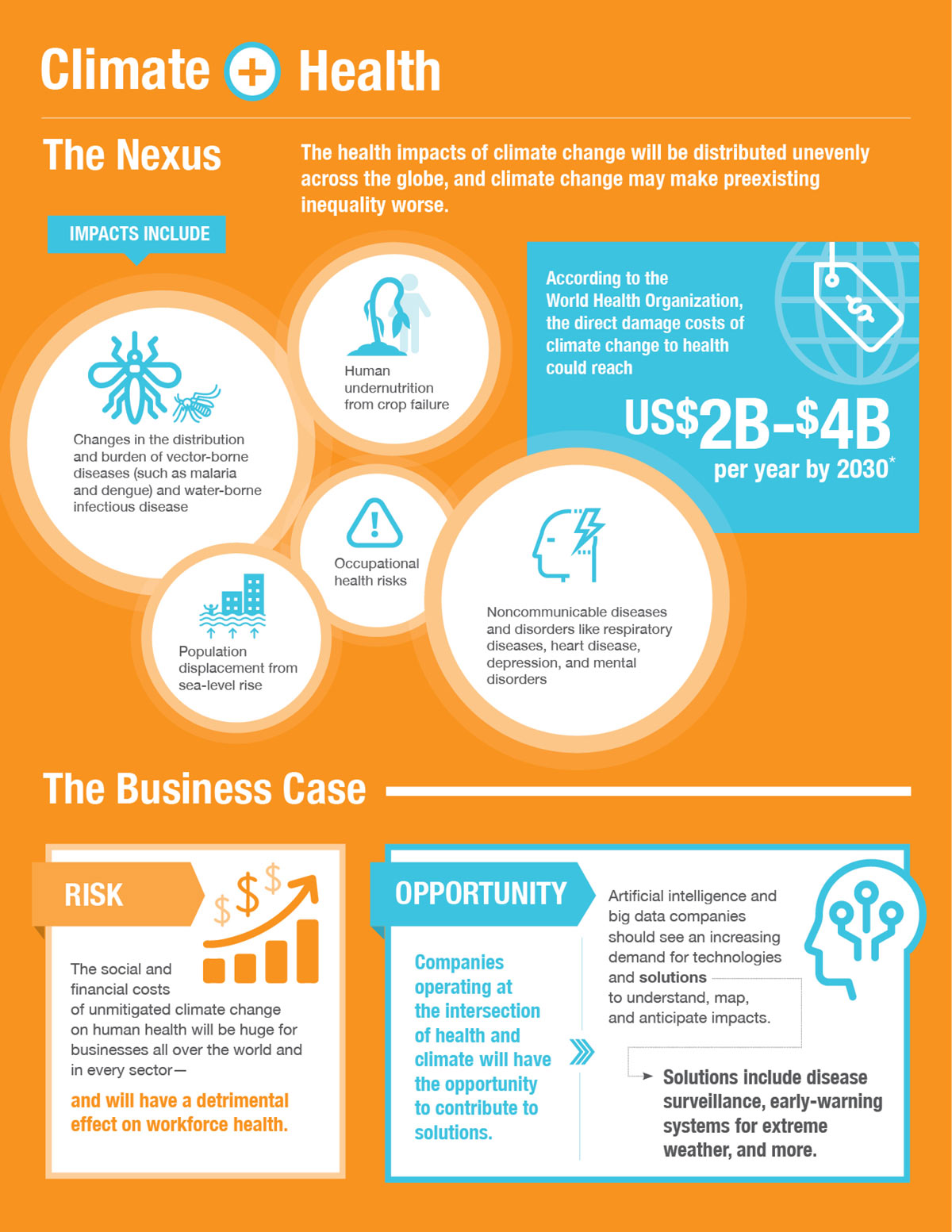
The Nexus
The health impacts of climate change will be distributed unevenly across the globe, and climate change may make preexisting inequality worse.
According to the World Health Organization, the direct damage costs of climate change to health could reach US$2B to US$4B a year by 2030.
Impacts include:
- Changes in the distribution and burden of vector-borne diseases (such as malaria and dengue) and water-borne infectious disease
- Human undernutrition from crop failure
- Population displacement from sea-level rise
- Occupational health risks
- Noncommunicable diseases and disorders like respiratory diseases, heart disease, depression, and mental disorders
The Business Case: Risk
The social and financial costs of unmitigated climate change on human health will be huge for businesses all over the world and in every sector— and will have a detrimental effect an workforce health.
The Business Case: Opportunity
Companies operating at the intersection of health and climate will have the opportunity to contribute to solutions.
Artificial intelligence and big data companies should see an increasing demand for technologies and solutions to understand, map, and anticipate impacts.
Solutions include disease surveillance, early-warning systems for extreme weather, and more.
Climate and Health (continued)
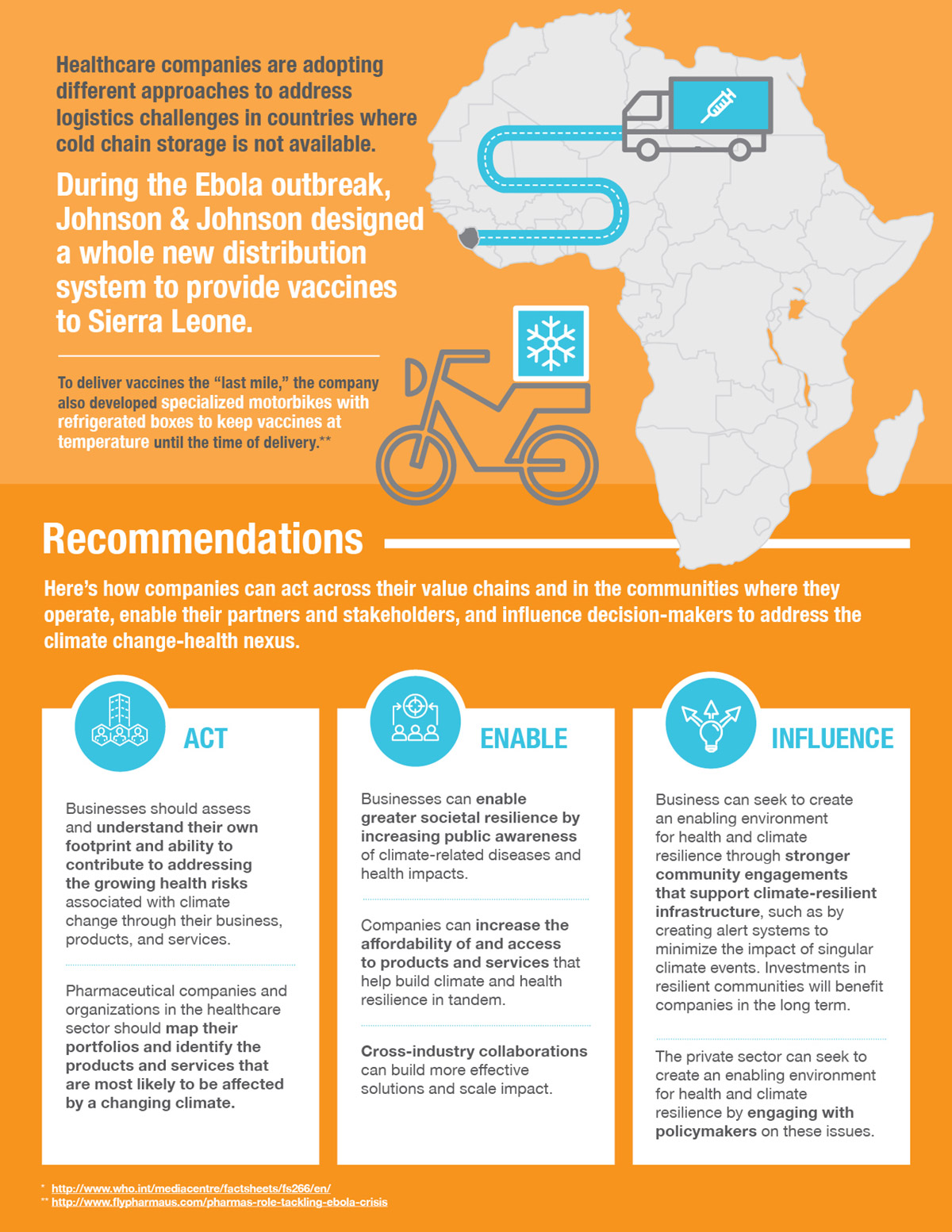
The Coca-Cola Company, among other partners, committed to investing US$21,000,000 (including cash and in-kind technical logistics expertise) to improve the distribution and storage of medical products in ten African countries.
Recommendations
Here’s how companies can act across their value chains and in the communities where they operate, enable their partners and stakeholders, and influence decision-makers to address the climate change-health nexus.
-
Act
Businesses should assess and understand their own footprint and ability to contribute to addressing the growing health risks associated with climate change through their business, products, and services.
Pharmaceutical companies and organizations in the healthcare sector should map their portfolios and identify the products and services that are most likely to be affected by a changing climate.
-
Enable
Businesses can enable greater societal resilience by increasing public awareness of climate-related diseases and health impacts.
Companies can increase the affordability of and access to products and services that help build climate and health resilience in tandem.
Cross-industry collaborations can build more effective solutions and scale impact.
-
Influence
Business can seek to create an enabling environment for health and climate resilience through stronger community engagements that support climate-resilient infrastructure, such as by creating alert systems to minimize the impact of singular climate events. Investments in resilient communities will benefit companies in the long term.
The private sector can seek to create an enabling environment for health and climate resilience by engaging with policymakers on these issues.
Climate Nexus Report Series






People
Len Savoleo
…offices worldwide with our previous accomplishments and current thought leadership. Before joining BSR, Len worked at KPMG’s Department of Professional Practice, maintaining collections to support the company’s national office. Len holds a BA in Psychology from Loyola University Maryland and a MLS from St. John’s University in New York.
People
Len Savoleo
Preview
Len curates BSR’s ever-developing body of institutional knowledge. He manages BSR’s document management and internal collaboration systems, connecting our offices worldwide with our previous accomplishments and current thought leadership.
Before joining BSR, Len worked at KPMG’s Department of Professional Practice, maintaining collections to support the company’s national office.
Len holds a BA in Psychology from Loyola University Maryland and a MLS from St. John’s University in New York.