Searching for: leadership
Search results: 161 of 283
Blog | Monday October 19, 2020
Meeting the Moment with a Sustainability Strategy Refresh
For nearly every company, existing business and sustainability strategies need to be refreshed for the new COVID-19-affected world. Here are five steps for accomplishing this change.
Blog | Monday October 19, 2020
Meeting the Moment with a Sustainability Strategy Refresh
Preview
This week, BSR convenes the global sustainability community at BSR Conference 2020. Throughout the week, sustainability leaders will join us to share, learn, collaborate, and connect around the theme Meet the Moment. Build the Future. And there is no more important time than now to assess our changed world and how business sustainability strategies can meet the challenges ahead.
As a result of the global pandemic, every company is dealing with changes in the global markets, be it upswings, downswings, or other shifts. And whether you are a global leader with sustainability already integrated through your operations or still working to figure out sustainability and its meaning for your company, all businesses are experiencing changes to their operating environments. This means that—for nearly every company—your existing business strategy and sustainability strategy need to be refreshed for the new COVID-19-affected world. Indeed, governments, consumers, investors, and employees are all grappling with how to continue in this changing environment—and as a consequence businesses’ strategy, insights, and answers matter all the more.
Business sustainability investments now will matter most as the world emerges from the COVID-19 crisis and the after-effects become clear—from increasing stressed income inequality and consumer behavior and expectations changes to direct corporate impact, including reputation and talent retention. At the same time, the challenges on the horizon, temporarily obscured by COVID-19—climate change, environmental degradation, pollution, and social inclusion—will loom all the more large.
Investments in sustainability need to translate across your entire business as it emerges from the post-COVID-19 world. How will finance, banking, and investor engagement be affected as the pools of available capital, and their expectations, change? How should you approach responsibility, product, and traceability as new consumer expectations or legal requirements emerge? How does your strategy factor emissions and climate resilience as your industry, your competitors, and your value chain increasingly focus on climate impacts and 1.5°C targets? How will your brand and marketing convey your vision, values, and roadmap to your industry, consumers, and current and future employees?
The world post-COVID-19 won’t merely be a return to the world pre-COVID-19: expectations of work are changing; job creation and income inequality are of ever-growing concern; and workers at the base of globally supply chains, particularly women and those most at risk, are being hurt.
Here are five steps to make this refresh happen.
- Update your materiality. In short, understand not only which issues are changing in importance, but why they are changing. Be sure to understand the views of your investors, your regulators, your leadership, your stakeholders. Understanding what is changing, and particularly why, helps set the stage for step two.
- Refresh your strategy and purpose. If your company has already gone through a robust strategy process, this refresh is ensuring your corporate focuses continue to align with the external environment. If your company has not yet done this, well, it is really time to get to work.
- Plan for alternate futures. COVID-19 has certainly illustrated the need to anticipate and plan for a variety of future scenarios. What will be the impact of climate change on your business operations? What if we see another COVID-19-like incident? How are social expectations changing for business in your key markets? What trade tensions may impact business and supply chains in the future? Understanding scenarios allows you to build them into your business planning processes.
- Build resilience in your value chains. Understanding current changes and potential alternate futures allows you to understand resilience and build into your value chain. Whether it is in terms of strategic sourcing options, globalization of plant, equipment, and talent, or identification of future market needs—all can be understood, planned for, and invested in.
- Engage your employees. Invest in the knowledge, understanding, and engagement of your employees as they help your company navigate the increasingly complex and diverse impacts of COVID-19 and its consequences.
The economic impacts of the COVID-19 crisis will remain for years to come. If there is one thing we can be sure of now that the pandemic has been rampaging around the world for nearly a year, it is that the world post-COVID-19 won’t merely be a return to the world pre-COVID-19: expectations of work are changing; job creation and income inequality are of ever-growing concern; and workers at the base of globally supply chains, particularly women and those most at risk, are being hurt. As a consequence, markets, politics, and expectations of consumers, employees, and businesses—all continue to change.
At BSR, we continue to work through these issues with our members. From stakeholder engagement materiality processes, strategy integration, and futures scenarios to value chain resilience and employee engagement, we look forward to connecting with you, our members, partners, and network to build a more resilient, equitable, and sustainable future.
Blog | Thursday July 27, 2023
Scaling Anti-Trafficking Efforts Across Sectors Through Collaboration
Tech Against Trafficking (TAT) and The Global Business Coalition Against Human Trafficking (GBCAT) have merged. Learn more about how the two organizations will be working together to enable a more comprehensive and inclusive business approach to end human trafficking.
Blog | Thursday July 27, 2023
Scaling Anti-Trafficking Efforts Across Sectors Through Collaboration
Preview
Human trafficking is on the rise around the world. Every year, conflicts, humanitarian crises, climate change, and socioeconomic challenges leave millions of people vulnerable to exploitation by traffickers.
On July 30, the United Nations marks World Day Against Trafficking by calling on the global community to reinforce commitments to eliminate human trafficking. We are proud to answer that call and to announce that the Tech Against Trafficking (TAT) coalition has merged with the Global Business Coalition Against Trafficking (GBCAT) in an effort to enable a more comprehensive business approach to scale anti-human trafficking efforts through collaboration between leading multinational business, civil society, survivors and academia.
Established in 2012, GBCAT aims to harness the power of business across all sectors to prevent and reduce human trafficking, and expand survivors’ access to resources. TAT launched in 2018 as a coalition of technology companies collaborating with global experts to help eradicate human trafficking using technology, including job skills training. With this merger, TAT is now one of three core workstreams of GBCAT, and the unique focus on the use of technology to prevent, disrupt, and reduce human trafficking will become part of GBCAT’s efforts. Together, we aim to create a one-stop hub for businesses to work together across sectors and from different angles to eliminate human trafficking.
GBCAT’s work is focused on three workstreams: 1) Corporate Supplier Capacity-building, 2) Survivor Empowerment and Employment, and 3) Tech Against Trafficking (TAT).
Corporate Supplier Capacity-building:
GBCAT supports capacity building among small and medium sized enterprises to prevent and eradicate human trafficking. Its Toolkit on Addressing Forced Labor and Modern Slavery Risks aims to help companies that work in corporate supply chains identify areas of their business that carry the highest risk of modern slavery and develop a simple plan to prevent and address those risks.
GBCAT has also published a compendium specifically for procurement functions to help ensure that business partners are conducting business free of modern slavery. Most recently, GBCAT published free, downloadable template policies to help corporate suppliers establish standalone, comprehensive corporate policies on modern slavery and child labor. GBCAT plans to build on these efforts by directly engaging corporate suppliers and updating GBCAT’s Supplier Portal with new resources.
Survivor Empowerment and Employment:
Safe and sustainable employment is one of the most effective ways to prevent the exploitation of vulnerable individuals and the re-exploitation of survivors of human trafficking and other forms of slavery. As a key focus area, GBCAT published a guide that describes actions business can take to empower and employ survivors. Additionally, GBCAT and Futures Without Violence developed a free virtual training for managers on how to implement a trauma-informed workplace that supports both employees and survivors of human trafficking. Looking ahead, the coalition plans to build on this work, including efforts to pilot a survivor employment program in the U.S.
Tech Against Trafficking (TAT):
Digital information and communication technologies can serve as a powerful tool to disrupt and reduce modern slavery. Tech Against Trafficking aims to advance the use of technology solutions to fight human trafficking, while addressing the misuse of technology to facilitate crime.
TAT works with civil society, academia, technologists, and survivors to identify promising uses of technology in the anti-trafficking field, and to advance and scale the use of these solutions through its Accelerator Program. As more businesses are using technology and data to address forced labor risks in their supply chains, TAT is exploring how to strengthen the labor data and technology ecosystem. TAT is also focused on facilitating cross-industry sharing and collaboration to prevent technology-facilitated trafficking.
Current GBCAT members include Amazon, Boost Engagement, Carlson, The Coca-Cola Company, Google, Marriott International, Meta, and Microsoft. BSR provides executive leadership and secretariat support for GBCAT. GBCAT welcomes inquires from any company that wishes to actively contribute to our mission to harness the power of business across sectors to prevent and reduce the incidence of human trafficking, and support survivors.
Blog | Wednesday August 2, 2023
Partnering with Procurement to Deliver on Net Zero
Key actions business leaders can take to engage and integrate the procurement team into their net zero strategy.
Blog | Wednesday August 2, 2023
Partnering with Procurement to Deliver on Net Zero
Preview
Companies are increasingly active and ambitious in their journeys to reduce detrimental impacts on the environment. Led in part by stakeholder demand, legislative pressure, and a clearer understanding of declining available natural resources, a paradigm shift has taken place. Many organizations now have in place not only large sustainability teams but supply chain teams that are well-versed in issues like deforestation and water scarcity and are finding that ESG has made its way consistently into boardroom discussions. However, if companies are truly going to achieve their net zero visions, one critical partner that needs to be engaged is the Procurement Team.
When it comes to engaging with suppliers, there is a real focus on managing existing suppliers who are currently contracted to provide key services and materials across a company’s value chain. Supply Chain teams are integrating with more traditional sustainability teams, assigned Key Performance Indicators (KPIs), exposing employees to new ways of thinking, and producing integrated reporting with the sustainability team.
The same has yet to occur with procurement teams. While managing the existing supplier base is of course integral in the path toward net zero–it is not the sole area of focus. And in fact, influencing change with a current supplier base, many of whom have long-term, multi-year contracts already in place, can be much more challenging than integrating stricter ESG requirements at the procurement phase.
Currently, most companies’ procurement sits separately from the sustainability initiatives—this is a missed opportunity. Not only does procurement control a large amount of budget, but they also sit at the critical juncture where an organization has the most leverage: the phase before a contract is awarded. Setting a high bar on environmental topics before suppliers are either brought on, or re-upping contracts for new engagement, allows companies to get more aggressive on their requirements.
Many procurement teams are energized by the prospect of helping to achieve a more stainable future for their organization but lack the critical resources to do so.
Businesses can engage procurement on net zero transformation via the following steps:
Set the Stage.
-
Get buy- in from Leadership that sustainability will be a key element embedded into business decisions. Executives can communicate that remit directly to procurement and explain how additional criteria are being added to the traditional Time, Cost, Quality trifecta.
-
Help them understand how sustainability will serve as a risk mitigation tool and be a value add to their department.
Train and Communicate.
-
Understanding that this has not been a traditional subject covered in their role, provide access to training via internal meetings, webinars and direct them to publicly available resources on ESG topics.
-
Recognize that embedding sustainability into the procurement function is a long process, and institute regular check-ins between procurement and sustainability teams.
Assign Proper Governance and KPIs.
-
Ensure that there is at least one sustainability expert on the procurement team to serve as the point person and liaison between the Procurement, Business, and Sustainability teams.
-
Give the procurement team clear targets and objectives to work toward, thus incentivizing them to push for further integration of sustainability into sourcing decisions.
Codify Policies & Procedures.
-
Create sustainable procurement policies (including deciding what certifications to use) and an accompanying rollout procedure. It may be best to pilot this policy in a smaller region/department to see how it works in practice and adjust accordingly.
-
Integrate sustainability into the onboarding process for new suppliers, ensuring that suppliers fully understand the requirements being asked of them.
Amend the Supplier Scorecard.
-
Embed sustainability topics into the supplier scorecard and increase weighting, thus incentivizing suppliers to integrate sustainability more quickly into their operations. With the new legislative push (mainly from Europe at this juncture) toward due diligence, Procurement teams have a clear mandate to request much more information during the RFP process as suppliers are trying to win business.
Source from zero-emissions suppliers.
-
In conjunction with reducing the impacts of current suppliers, there is a unique opportunity to select suppliers who have already achieved carbon neutrality in their own operations.
Integrate with Design Teams.
-
Suppliers are selected many times, based on design specifications. This means that it is essential for Procurement and Design to work together to understand what opportunities exist, barriers that are non-negotiable, and where the biggest opportunity for change exists.
Remember that this is not a one-off session with Procurement. This should be the beginning of a deep connection and integration of sustainability into sourcing decisions. Acknowledge that there is a reason that Procurement will need time to shift their traditional ways of selection and onboarding and provide the necessary support and guidance to help them on their journey.
For more information on engaging procurement on key sustainability topics contact BSR’s Supply Chain Sustainability team.
Blog | Tuesday February 9, 2021
Why Companies Should Assess Double Materiality
In the first part of our blog series on materiality, we discuss why companies should assess double materiality.
Blog | Tuesday February 9, 2021
Why Companies Should Assess Double Materiality
Preview
This is the first post in a four-part series on materiality.
After years of debate over the definition of materiality, 2020 has brought a consensus that materiality is double—meaning that businesses should report on financially material topics that influence enterprise value as well as topics material to the economy, environment, and people.
The new definitions of the Global Reporting Initiative (GRI), Sustainability Accounting Standards Board (SASB), and the two papers published by the five reporting standard organizations helpfully clarify reporting standards’ different perspectives on the question “material to whom,” enabling greater interoperability between them:
- On the one hand, a company identifies and assesses those sustainability issues that influence enterprise value. We can also call this "financial materiality" or "impacts inwards." This is covered by the SASB definition of materiality. The main audience for this information is investors, lenders, or other creditors.
- On the other hand, a company identifies and assesses impacts on the economy, environment, and people. This refers to "environmental and social materiality" or "impacts outwards." This is covered by the GRI definition of materiality. The main audience is a broad set of stakeholders, including governments, consumers, business partners, responsible investors, employees, civil society organizations, local communities, and vulnerable groups.
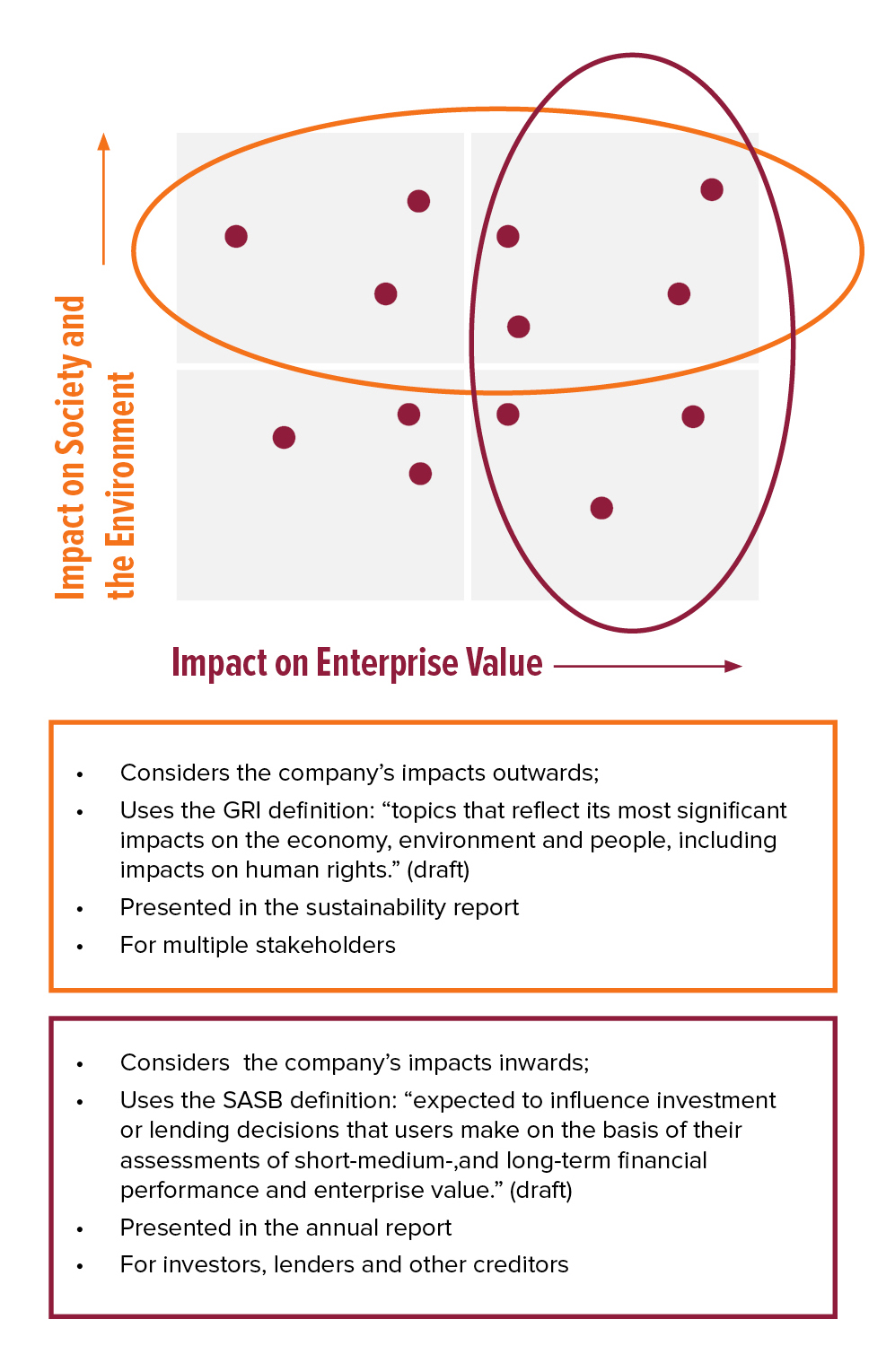
Take the topic of climate change. A business will want to understand how physical and transition risks may impact its enterprise value. Severe weather events may affect the company’s manufacturing sites or supply chain security, or climate regulation may mean that some of its products and services are no longer relevant. On the other hand, the company emits carbon emissions that impact the environment and people’s livelihoods.
Double materiality is also applicable to an issue like diversity, equity, and inclusion. In a talent-tight market, a company’s ability to attract a diverse workforce may improve its pool of talent and workforce productivity and influence its enterprise value. If a company has discriminatory practices, this may result in lawsuits or change of leadership, which could in turn negatively impact enterprise value. On the other hand, discriminatory practices constitute an infringement on civil and human rights.
However, some topics may constitute significant impacts outward without affecting enterprise value (top left quadrant of the matrix). Take the presence of conflict minerals in electronics companies’ supply chains. Minerals extracted in conflict zones are sold to perpetuate conflicts, affecting communities’ human rights and livelihoods. On the other hand, conflict minerals has not proven to negatively impact enterprise value.
Looking at the bottom-right quadrant, customer satisfaction will likely affect enterprise value. However, it might not constitute a significant impact on people, the environment, or human rights.
For the purposes of reporting, a business should engage its investors on topics that affect enterprise value (in the two right quadrants). The business will report to a wider range of stakeholders, such as consumers, business partners, and local communities, on significant impacts to the economy, the environment, and people (in the two top quadrants).
So, why should companies apply this concept of double materiality?
We hear from our members that despite having completed a materiality assessment, they still get questions from stakeholders about other issues that may not be material to their business. We hear that some topics like modern slavery get Board time and attention, even if this topic may not be material to the company. We hear that executives get tired of hearing that all sustainability issues are material topics, when actually they are not.
By applying the concept of double materiality, a company will be able to clearly distinguish between inward and outward impacts.
- A company should report on all its significant impacts outwards, regardless of whether they are material to the business. Applying the concept of double materiality will help answer stakeholder pressures for greater corporate transparency.
- The sustainability field has at times overestimated the impact of sustainability topics on the business. In our view, this can impede on the sustainability team’s ability to convey true priorities. By identifying those issues that are financially material, a sustainability team will be able to advance priorities that are truly a business concern.
- Understanding the link between inward and outward impacts of an issue will help the company build an adequate management plan, as well as report on these topics in a meaningful way to different stakeholders. When drawing a plan to manage an impact, e.g. labor rights in the supply chain, a business will be able to inform the plan with an understanding of whether this is a true risk for the business or whether this is part of the company’s responsibility to mitigate an impact on people.
As businesses are looking to refresh their materiality assessment, applying the lens of double materiality will help enhance the value of the assessment for reporting and strategy. We will continue to explore how to enhance the value of materiality assessments in this blog series. We are interested in hearing your thoughts and continuing the conversation about double materiality with our members. Contact us!
Blog | Friday March 9, 2018
How Do You Empower 100,000 Women?
In 2014, ANN made its 100,000 Women Commitment to empower 100,000 women working in its global supply chain. Here’s the story of how it achieved this milestone.
Blog | Friday March 9, 2018
How Do You Empower 100,000 Women?
Preview
In 2014, ANN made its 100,000 Women Commitment: a commitment to empower 100,000 women working in its global supply chain. Through a strategic partnership with BSR’s HERproject, ANN achieved this milestone in 2018.
Christine Svarer, Director of HERproject, sat down with Jeanette Ferran Astorga, Vice President, Corporate Responsibility at ascena retail group, parent company of brands Ann Taylor, LOFT, and Lou & Grey, to discuss the rationale behind the commitment, its impact, and next steps.
Christine Svarer: Can you tell us a bit about how your 100,000 Women Commitment came about?
Jeanette Ferran Astorga: Absolutely. Our commitment, and our partnership with HERproject, was driven by our core values as an organization. From our corporate leadership on down, we believe every woman deserves a chance to be her best self every day, and we’ve been clear about how important it is to us to help women have the confidence to shape their lives in the way they want.
We aim to give women confidence through fashion and inspiration, but that must be matched by standing with and supporting the women in our supply chain. When we discussed how to do this, we realized that empowering women with knowledge of and access to services around health was a critical step, so we decided to commit to HERproject, BSR’s flagship women’s empowerment initiative. We were drawn to the peer-to-peer training model that enables women employees to acquire and share knowledge and skills. We also liked that HERproject brings together companies, their suppliers, and local partners to deliver workplace-based trainings focused on increasing women’s knowledge and self-esteem, while also strengthening management systems to create inclusive workplaces.
Svarer: Shared values, like a shared goal, are so critical for a strong partnership—at least in our experience. And it was clear from the start that our values aligned. We know that when women working in supply chains have the confidence and ability to shape their lives through choices they value, they can be a huge positive force for change.
Ferran Astorga: Exactly. And it’s important to flag that none of this would have been possible without a similar shared belief in empowering women. Before we started, we consulted our strategic suppliers and confirmed that we would have their support to make this happen, as they needed to make the commitment to allow time for training and to support staff toward becoming peer educators, who would then bring the curriculum to their colleagues. Overwhelmingly, we found that our suppliers wanted to be part of HERproject.
As this commitment to supporting women in our supply chain has developed, it’s been amazing for us to see how our suppliers have found their own ways to spark employee engagement. HERproject gives suppliers the framework and the guidance for the trainings, but the suppliers have really stepped up in terms of customizing the programs to meet their employees’ needs, whether through health fairs, or having local doctors come in and run health clinics, or nutritional sessions for men and women. That’s a mark of success for us—that the suppliers have made it their own.
Svarer: I really like the connection from the corporate level to vendors, suppliers, and on to women workers. That really aligns with our belief at HERproject that for women’s empowerment to take hold—but also to create resilience in global supply chains—everyone must pull in the same direction.
Ferran Astorga: I agree. Another way we try to ensure that alignment is through embedding performance in this program into our vendor scorecards. Our vendors are assessed on how they are driving the initiative and how they are supporting the peer educators; we measure it as part of their commitment to management systems and improved workplace practices. That’s part of our effort to go beyond compliance and develop leading practices.
Svarer: Absolutely—and we’re seeing other companies tying their commitment to women into how they work with their suppliers. What has been central to our work with you is that you have made women’s empowerment part and parcel of good business.
Ferran Astorga: That’s certainly our vision—and it means looking at our policies, as well as our programs. Earlier this week, we published a revised Code of Conduct for merchandise suppliers for the ascena retail group, which includes ANN’s brands. On two occasions in the last few years, we worked with BSR to revise this code through a gender lens, ensuring that specific challenges and obstacles that women face are incorporated into our expectations of suppliers. We have just launched the latest version of the code this week in line with International Women’s Day with a pronounced reference to supporting women in the workplace, especially informed by the UN Sustainable Development Goals and a commitment to SDG 5.
Svarer: I think that revising your Code of Conduct twice over the course of this partnership highlights not just your commitment but also how ANN continues to improve its ability to empower women within its supply chain. ANN has continued to learn and improve throughout this partnership—as have we at BSR and at HERproject.
The longer-term nature of ANN’s commitment is critical in this respect. Empowerment is not achieved overnight, so it’s been such a privilege for us to work with a partner like ANN that is in it for the long haul.
Ferran Astorga: I agree. And our work is not done. We’re continuing to work with HERproject to explore new ways to reach and empower the inspiring women who work in our supply chain, and we will be sharing more later this year. Stay tuned!
Blog | Wednesday October 25, 2017
How Business Can Act Now for Women’s Health and Empowerment: Q&A with Robyn Russell
The UN Foundation, the Evidence Project led by the Population Council, and BSR’s HERproject are pleased to release a new report on private sector action for women’s health and empowerment.
Blog | Wednesday October 25, 2017
How Business Can Act Now for Women’s Health and Empowerment: Q&A with Robyn Russell
Preview
Today sees the release of the new business guide, How Businesses Can Invest in Women and Realize Returns, co-authored by the UN Foundation, the Evidence Project led by the Population Council, and BSR’s HERproject. The guide encourages corporate leadership and showcases how companies can take action in the field of women workers’ health and empowerment. We sat down with Robyn Russell, Deputy Director of the Universal Access Project at the UN Foundation, to discuss private sector action for women’s health and well-being.
Dominic Kotas: What is the link between health and empowerment in developing countries?
Robyn Russell: If you think about your own life, it becomes very clear: if you have access to the health services you need—including family planning, prenatal care, maternity leave, and so on—you’re going to be more empowered and more in control of your life.
Women in developing countries, who might be entering the formal workforce for the first time, need all the same things that we do in order to be healthy and empowered and advance their careers. In particular, they need family planning, because if you can’t choose when you become a parent, you can’t have very much control over your career.
Kotas: What are the biggest challenges around women’s health globally?
Russell: Our guide focuses on women in supply chains, many of whom move from rural areas to urban areas for their first employment. They have often lacked basic healthcare services: everything from menstrual hygiene management, to family planning, to prenatal care, to information about protecting themselves from sexually-transmitted infections. So, this is a real opportunity to meet women where they are and provide them with those services, whether that’s through factory clinics or referrals to local clinics. Of course, the stakes in developing countries are much higher, because we know that lack of access to family planning and good maternal care are leading causes of death and disability for many women and girls in developing countries.
Kotas: How far have we come and how far do we still have to go?
Russell: Historically, these areas have been underfunded and deprioritized. Under the Millennium Development Goals (MDGs), we saw minimal progress on reductions in maternal mortality and access to family planning. Fortunately, the new Sustainable Development Goals (SDGs) have a focus on health (Goal 3) and gender equality (Goal 5), and we’re hopeful we can make progress.
The global health community is working very hard on women’s health through several initiatives, such as Family Planning 2020. However, there is a real role and opportunity for the private sector, especially as women move out of the informal workforce and into the formal workforce. One billion women will enter the global workforce over the next two decades, and 94 percent of them will be in emerging and developing economies. Sectors like textiles, clothing, and footwear employ an estimated 60-75 million people, of which three quarters are women. Action in global supply chains to advance women’s health can have a major impact.
Kotas: We’ve seen more action from business on this issue over the past decade. What has been the driver for this?
Russell: We’re increasingly seeing consumers making purchasing choices based on the social and ethical credentials of brands. Businesses are also realizing that by investing in the health and empowerment of women, particularly in their supply chains, they can see a return on investment—they can reduce turnover, absenteeism, and so on. It’s a win-win for business: you have healthier, happier workers, and you’re reducing costs to production while creating an ethically-made product that’s in greater demand from your customers. Our new business guide highlights current investments from 26 companies working with 11 NGOs in 19 countries, giving readers a number of models for action. From the global public health side, health organizations are realizing they can reach more people by using these networks to make interventions through companies and workplaces.
Kotas: Who and what can help business go further?
Russell: To date, most investments have been as smaller pilots—but we are now seeing companies ready to scale throughout their supply chains and networks. If it’s a matter of support and coordination, we at the UN Foundation are prepared to help companies bridge that gap. NGOs, civil society groups, labor groups, and governments also have a role to play. In the business guide, we outline a list of organizations around the world that are already working with companies and are ready to jump in and do more.
Another avenue is to make sure that women’s health and empowerment are incorporated into standards and certifications, so that these practices are sustainable in the long-term.
We also need buy-in from the folks on the ground: the workers, the local vendors, and the governments in countries where this is happening. We want to listen to workers and understand what they need, so that we can make the most impactful interventions possible.
Kotas: What would be your message to business leaders?
Russell: I would have two. First: If you want to get ahead of the curve on this, now is the time to make these investments. This will be the new norm moving forward. And secondly, we—the global health community, NGOs, and others—stand ready to help you make this transition.
Blog | Tuesday December 13, 2022
FIFA World Cup: Combating Modern Slavery at Mega Sporting Events
Major sporting events, like the FIFA World Cup, have been linked with human rights abuses. Here’s how business can protect human rights throughout these events.
Blog | Tuesday December 13, 2022
FIFA World Cup: Combating Modern Slavery at Mega Sporting Events
Preview
On Sunday, November 20 at the Al Bayt Stadium in Qatar, Ecuador prevailed 2-0 over the host country team at the inaugural game of the FIFA Men’s World Cup—a tournament marred by controversy over human rights impacts on migrant foreign workers, who were employed at construction sites or provided essential services.
While mega sporting events can be catalytic to promoting human rights, there are indeed serious implications for business not just before, but during and after such events if companies fail to conduct effective due diligence or put in place prevention and mitigation measures. Grave violations of human rights, such as forced labor and human trafficking, entail far-reaching business consequences amidst heightened public scrutiny.
The UN Guiding Principles on Business and Human Rights (UNGPs) provide guidance on the steps businesses should take to avoid infringing on the human rights of others and to address adverse impacts. Businesses that are involved in major sporting events must be aware of their duties and responsibilities.
The Context
Migrant workers who traveled to Qatar with a promise of well-paid jobs, including from Nepal, Bangladesh, India, Pakistan, Sri Lanka, the Philippines, and Kenya, reported widespread labor abuses. Exploitative and forced labor practices amounted to significant recruitment fees, passport confiscation, debt bondage, poor living conditions, and the tragic death of at least 6,500 workers.
Reported abuses are not confined to the construction industry. Thousands of workers in multiple sectors central to the sporting event, such as cleaning services, private security, and waste disposal, have alleged serious human and labor rights violations. Hotel staff in the accommodation and hospitality sector were subjected to slavery-like practices, such as wage retention and high recruitment fees.
Over the years, the nexus between human trafficking and major sporting events such as the US Super Bowl have emerged not only in the lead up to, but also during and after, the event. Sex trafficking, involuntary servitude, and labor exploitation can all increase because of the demand for services and, sadly, due to the influx of visitors to a host city or state. Even beyond an event, infrastructure, such as sporting facilities and hotels, will continue to require workers to maintain and run properties.
Key Business Priorities
Beyond the FIFA World Cup in Qatar, and with other major sporting events planned such as the Summer Olympic Games in France and the 2026 FIFA World Cup across Canada, Mexico, and the United States, there are several key steps business and investors can take:
- Implement a strong company anti-trafficking policy. A viable prevention strategy to address the risks of modern slavery starts with taking a leadership position in developing and adopting a forward-facing policy that addresses fair recruitment of migrant workers. Suppliers and vendors should responsibly source their products and hire staff ethically—sub-contracting practices should be limited and duly monitored.
- Train staff on how to respond. Standard Operating Procedures (SoPs), especially for hotel personnel, should be adopted. Training staff on human trafficking indicators can help identify victims and address the misuse of accommodation premises, including for sex trafficking.
- Enhance grievance mechanisms. Companies can introduce an effective reporting mechanism for workers to safely report labor abuses, exploitation, and other human rights abuses. The application of technology-based innovation can help workers report anonymously.
- Ensure remedy to those affected. As a follow-up to established abuses, companies involved can take urgent action, ensure decent and safe work for migrant workers, and provide effective remediation.
- Involve local organizations and grassroots associations. Businesses can meaningfully engage with human rights and civil society organizations on the ground before, during, and after their involvement with a sporting event to assess risks and adopt necessary mitigation strategies.
Human rights abuses related to large sporting events are sadly not infrequent. With the release of the new Global Estimates on Modern Slavery pointing at 86 percent of forced labor cases happening within the private economy, companies have not only a responsibility under the UNGPs’ framework to counter modern slavery, but also a critical role in promoting and advancing human rights at mega sporting events worldwide.
Sustainability FAQs | Tuesday April 18, 2023
Stakeholder Engagement
This FAQ sets out the BSR perspective on stakeholder engagement. We believe that meaningful stakeholder engagement is an essential foundation for just and sustainable business and a core element of processes such as decision making, strategy development, materiality assessment, human rights due diligence, and reporting. Without meaningful stakeholder engagement, any…
Sustainability FAQs | Tuesday April 18, 2023
Stakeholder Engagement
Preview
This FAQ sets out the BSR perspective on stakeholder engagement. We believe that meaningful stakeholder engagement is an essential foundation for just and sustainable business and a core element of processes such as decision making, strategy development, materiality assessment, human rights due diligence, and reporting. Without meaningful stakeholder engagement, any approach to just and sustainable business would be constrained by a company’s self-interest and inward focus.
Defining Stakeholder Engagement
What is the definition of a stakeholder?
A stakeholder is someone who affects or is affected by a company’s operations, activities, products, or services, and can be either inside or outside the company. Common stakeholders include employees, customers, users, consumers, suppliers, business partners, investors, trade unions, civil society organizations, policy makers, regulators, and the communities impacted by operations.
The OECD defines stakeholders as “persons or groups who have interests that are or could be impacted by an enterprise’s activities.”1 The Global Reporting Initiative adopts this same definition and clarifies that stakeholders may not always have a direct relationship with the company—for example, workers in the supply chain or future generations can also be considered stakeholders.2
What is the distinction between a rightsholder and a stakeholder?
The term rightsholder is used for individuals or groups whose individual human rights or collective rights are or could be directly impacted by business activities, products, or services. This is distinct from other stakeholders (such as civil society organizations) who may have insights, expertise, and awareness relevant for rightsholder interests, but who may not themselves be rightsholders. All rightsholders are stakeholders. The term “affected stakeholder” is also used to refer to an individual whose human rights has been affected by a company’s operations, activities, products, or services.3
As a matter of principle companies should engage with potentially affected stakeholders (i.e., rightsholders) by consulting them directly; in situations where such consultation is not possible, companies should engage reasonable alternatives, such as independent experts, civil society organizations, and human rights defenders.4
In practice, this can often mean that companies should engage both large international / national organizations and grassroots / local organizations; the relevant stakeholders to engage with may not always be the “usual suspects” of prominent organizations.
What is meaningful stakeholder engagement?
Meaningful stakeholder engagement is characterized by two-way communication based on the good faith of participants on both sides. Meaningful stakeholder engagement is proactive, responsive, and ongoing, and is often conducted before decisions are made.5
Stakeholders that choose to engage with companies generally expect the interaction to generate change, so engagement should be treated as a dialogue, not a one-way information dissemination process. This means that the company engages with the genuine intention to understand how stakeholders are affected by its activities and is prepared to both pursue opportunities identified and address adverse impacts.
What is a multi-stakeholder initiative?
The term “multi-stakeholder” is often used to describe collaborative efforts where no single organization has the authority or resources to address a particular issue. However, the term “multi-stakeholder” is used to convey different meanings.
In BSR’s view, a “multi-stakeholder initiative” (sometimes referred to as an MSI) is characterized by a decision-making structure where no single constituency (e.g., companies, civil society organizations, investors, governments) has a majority of the votes. By contrast, a “multi- stakeholder approach” implies the formal involvement of different constituencies, and “multi-stakeholder engagement” implies informal engagement with different constituencies; however, in the latter two cases, a single constituency (typically companies) retains exclusive or majority decision-making power.
Which rightsholders may be at heightened risk of becoming vulnerable or marginalized?
The UN Guiding Principles on Business and Human Rights state that companies should pay particular attention to the rights and needs of, as well as the challenges faced by, individuals from groups or populations that may be at heightened risk of becoming vulnerable or marginalized.6 Vulnerability can have four dimensions:
- Formal Discrimination: Laws or policies that favor one group over another.
- Societal Discrimination: Cultural or social practices that marginalize some and favor others.
- Practical Discrimination: Marginalization due to life circumstances, such as poverty.
- Hidden Groups: People who might need to remain hidden and consequently may not speak up for their rights, such as undocumented migrants and sexual assault victims.
Vulnerability is not limited to discrimination and can manifest in heightened risk for several harms, such as bodily integrity, psychological safety, and economic exclusion. Vulnerability is context-specific, and someone may possess a privileged identity in one context that is marginalized in another; vulnerability is also intersectional, and possessing multiple vulnerable identities may compound impacts on a rightsholder.
These features of vulnerability mean that companies should consider which stakeholders are most vulnerable for the relevant context, such as project, product, or service. Engagement with individuals from groups or populations that may be at heightened risk of becoming vulnerable or marginalized may necessitate specific approaches that remove barriers for participation (e.g., language, location, cost).
Purpose of Stakeholder Engagement
Why should companies engage stakeholders?
There are several reasons for companies to undertake meaningful stakeholder engagement:
- Gaining insights: Engaging with stakeholders can help companies gain valuable insights about stakeholder needs, expectations, and concerns. These insights can help companies refine their operations, products, and services to better meet the needs and expectations of their stakeholders.
- Trust building: Engaging with stakeholders can help companies build trust and credibility with their stakeholders. When companies listen to stakeholder feedback and act upon it, stakeholders are more likely to view the company as trustworthy and reliable.
- Risk and impact management: Engaging with stakeholders can help companies identify risks and challenges before they escalate into major concerns.
- Enhancing reputation: Engaging with stakeholders in a meaningful and authentic way can help companies enhance their reputation and brand image, leading to increased customer loyalty, employee retention, and investor confidence.
- Meeting legal and regulatory requirements: Many companies are required by law to engage with certain stakeholders, such as employees, customers, and communities. Failure to do so can result in legal and financial consequences.
What projects are most relevant for stakeholder engagement?
The following projects are not mutually exclusive, and stakeholder engagement can serve multiple purposes at the same time:
- Environmental and human rights due diligence: When undertaking environmental or human rights assessments companies should seek to understand the concerns of potential affected stakeholders by consulting them directly in a manner that takes into account language and other potential barriers to effective engagement. Engagement with stakeholders should influence other due diligence steps too, such as determining appropriate action, tracking effectiveness, and defining external communications.7
- Materiality assessments: Companies should engage stakeholders when identifying actual and potential impacts, assessing the significance of impacts, and prioritizing the most significant impacts for reporting. Stakeholders can have insights into both financial materiality (i.e., what is material to investors from a financial perspective) and impact materiality (i.e., impacts on people and the environment).
- Creating strategy: Meaningful stakeholder engagement can inform the creation of strategies for just and sustainable business—both stand-alone strategy and the embedding of social justice, human rights, and sustainability factors into business strategy.
- Reporting and disclosure: Companies should communicate their approach to just and sustainable business externally and address concerns raised by or on behalf of affected stakeholders. This communication should be in form and frequency that reflects the companies impacts and accessible to intended audiences; for this reason, stakeholder engagement can usefully inform reporting strategies, channels, and forms.
When should companies undertake stakeholder engagement?
Companies should undertake stakeholder engagement prior to major decisions, such as a new activity or relationship, market entry, product launch, or policy change. However, investment in trusted stakeholder relationships over time can improve the quality of engagement quality at moments when timelines and decision-making processes are compressed (e.g., prior to product launch or response to a new crisis).
Meaningful stakeholder engagement is important throughout the due diligence process: identifying actual or potential adverse impacts; devising responses to risks of adverse impacts; tracking and communicating how impacts are being addressed; and identifying forms of remedy for adverse impacts. During due diligence it may be necessary to distinguish between stakeholders whose interests have been affected (i.e., “affected stakeholders”), and those whose interests have not yet been affected but could potentially be affected (i.e., “potentially affected stakeholders”).
Is stakeholder engagement solely taken for the purpose of risk management?
No. While stakeholder engagement can inform risk management (e.g., meaningful engagement of stakeholders during due diligence), stakeholder engagement can also be undertaken to identify value creation opportunities, such as designing new products and services, undertaking more inclusive research and development, and testing new strategic priorities.
Stakeholder Engagement Best Practice
What are the principles of meaningful stakeholder engagement?
Stakeholder engagement methods will vary by context. However, all engagement should satisfy the following principles:
- Focused: Engagement goals should be focused and relevant, and expectations for both the company and the stakeholder should be shared, clear, and realistic.
- Timely: Engagement should be conducted in a timely manner to ensure that the perspectives of stakeholders can inform the outcome of business decisions that might affect them (e.g., at relevant points in a product or project lifecycle).
- Representative: The engagement should be structured in a way that enables the perspectives of diverse stakeholders to be considered.
- Inclusive: Companies should ensure that engagement reaches individuals from groups or populations that may be at heightened risk of becoming vulnerable or marginalized, such as human rights defenders, political dissidents, women, young people, minorities, and indigenous people.
- Respectful: In the context of stakeholder engagement, respecting means listening as well as sharing, and using an engagement approach that is culturally sensitive and accessible to all participants. This means considering context, location, format, and language.
- Candid: The process of selecting participants should be transparent, and engagement notes, actions, and outcomes should be shared with participants. If full disclosure to the wider public is impossible—given potential risks to participants and to the confidentiality of business decisions—summary outcomes should be disclosed.
What are some of the stakeholder engagement best practices?
The specifics of stakeholder engagement practice will vary by context. Some best practices for stakeholder engagement include:
- Help stakeholders prepare: Making sure that participants are aware of goals, format, envisaged contribution, and any useful background information so the discussion will be as productive as possible.
- Share and address stakeholder expectations: Inviting stakeholders to share their expectations for the engagement, and be clear whether, when, and how these may be addressed after the engagement.
- Allow for equal contribution: Encouraging less-vocal stakeholders to participate in the conversation, creating a space in which this is possible and comfortable, and respecting each party’s right to observe quietly if they choose.
- Focus the discussion: Dialogues can veer off-topic if not properly focused. Sticking to an agenda, remaining within the issue’s scope, and assessing when / how any exciting out-of-scope issues should be addressed.
- Manage cultural dynamics: Participants should be wary of potential cultural misunderstandings and be prepared to manage any that arises. There are various approaches (e.g., local partners, translators) that can help.
- Mitigate tension: Some topics can prove controversial or provocative, and unexpected dynamics or rivalries may surface among participants. Thorough preparation will help, but anticipating a range of outcomes is essential.
- Effective communication: Communication should be tailored to the stakeholders' needs and preferences.
- Transparency: Being transparent with stakeholders about a company’s goals, performance, and challenges can contribute to trust building.
What are the skills needed to conduct meaningful stakeholder engagement?
Meaningful stakeholder engagement requires a good level of cultural competency, especially when conducting interviews or facilitating dialogue with rightsholders. Cultural competency means bringing empathy, awareness, and sensitivity to cultures other than one’s own, and requires actively avoiding inclinations to just see from one’s own experience and perspective. This can be especially important when dominant cultures exist or where there is power asymmetry between the company and stakeholders. It is crucial to not make assumptions, but rather to ask questions, learn, and listen to lived experiences.
The subtlest (and perhaps most important) skill for engagement is understanding that each stakeholder will always harbor certain perceptions of both the company and the other stakeholders involved, and that each is just one player in a dynamic system.
What are some of the main risks associated with stakeholder engagement?
There are contexts where stakeholders may face risks to their personal safety and security and those of their families, friends, and associates if their engagement with the company becomes known—for example, in the form backlash, retaliation, or harassment. Companies should be aware of these risks when recording the engagement (e.g., whether to attribute comments when taking notes), communicating about the engagement (e.g., in sustainability reports), or choosing the engagement location (e.g., selecting a safe / private location).
Should the company board be involved in stakeholder engagement?
While stakeholder engagement should normally be led by company management, it is important for Boards to (1) be informed of insights gained through stakeholder engagement and (2) be involved in discussions about the strategic and risk mitigation implications feedback provided by stakeholders. An external stakeholder advisory council is one method that can be used for Boards to gain regular insight into stakeholder perspectives, alongside executive leadership and relevant teams.
What are some of the biggest stakeholder engagement mistakes?
There are several common mistakes that companies make with stakeholder engagement.
First, there can be a mismatch of expectations for the engagement, such as the perception that it may lead to immediate action by the company for mitigation and remediation.
Second, companies can sometimes view engagement as the end goal, rather than the foundation for an ongoing dialogue or mutually beneficial relationship. Companies sometimes fail to report back on decisions made or actions taken following the engagement, don’t “close the loop” on engagement, and don’t view the engagement as the start of a longer-term relationship.
Third, companies can often view stakeholder engagement as an opportunity to convince the stakeholder of perspective or “tell a good story” about the company’s work, rather than as an opportunity for listening, learning, and dialogue.
Finally, stakeholder engagement can be undertaken in ways that are “extractive”, “transactional”, or “procedural”, with little benefit for participating stakeholders. The best stakeholder engagement builds and nurtures long-lasting and trusted relationships.
Are there power imbalances in stakeholder engagement?
Yes. Company relationships with stakeholders are often asymmetrical, and there can be power imbalances between companies and stakeholders that may be smaller, less influential, and less well-resourced. These power imbalances can be informational (e.g., the company has technical expertise or product knowledge that stakeholders don’t have), resource based (e.g., the company has resources for research that stakeholders don’t have), or time-based (e.g., companies having more time to prepare for the engagement than stakeholders).
Power imbalances can be addressed in various ways, such as timely provision of information needed by stakeholders to participate effectively, the provision of resources (e.g., travel expenses, honoraria), and use of subtitle or translation services.
What is “stakeholder fatigue”?
The risk of “stakeholder fatigue” arises when stakeholders are asked to participate in multiple duplicative and repetitive engagements by many companies operating independently. This can be addressed by companies in similar contexts (e.g., same industry, product, country, value chain) engaging stakeholders via multi-stakeholder initiatives / forums or other collaborative approaches to engagement.
Footnotes
- OECD (2018) OECD Due Diligence Guidance for Responsible Business Conduct
- Global Reporting Initiative (2021) GRI 1: Foundation.
- For example, in United Nations (2012) UN Guiding Principles for Business and Human Rights Interpretive Guide
- UN Guiding Principles for Business and Human Rights, Principle 18; Global Reporting Initiative (2021) GRI 3: Material Topics.
- For example, see OECD (2018) OECD Due Diligence Guidance for Responsible Business Conduct and Global Reporting Initiative (2021) GRI 2: General Disclosures.
- UN Guiding Principles for Business and Human Rights, General Principles
- UN Guiding Principles on Business and Human Rights, Principles 18 (Assessment), 19 (Appropriate Action), 20 (Tracking), and 21 (Communications)
Blog | Wednesday December 18, 2019
COP25: National Governments Fail to Seize the Day, but Business Climate Action Continues
As we enter the decisive decade of the 2020s—when significant steps towards decarbonization have to happen if we are to stave off the worst impacts of climate change—the 2019 UN climate conference in Madrid, COP25, was a poor jumping-off point.
Blog | Wednesday December 18, 2019
COP25: National Governments Fail to Seize the Day, but Business Climate Action Continues
Preview
As we enter the decisive decade of the 2020s—when significant steps towards decarbonization have to happen if we are to stave off the worst impacts of climate change—the 2019 UN climate conference in Madrid, COP25, was a poor jumping-off point.
This year’s COP was designed to pave the way for greater ambition on the part of national governments. Unfortunately, they failed to live up to the importance of the moment. In advance of the climate conference, the UN Environment Programme’s Emissions Gap report called for annual emissions reductions of 7.6 percent if the world is to keep global heating to 1.5°C. Measured against that benchmark, the last COP of the 2010s represents a serious setback.
There were multiple disappointments in Madrid. There was no agreement on alignment of carbon market rules, which would provide guidelines on how countries can trade emissions internationally. Also, countries did not prioritize the ground rules that would protect vulnerable nations after a climate disaster.
Even the aspirational language emerging from the negotiations took a step backwards from the more concrete commitments to heightened ambition in the run-up to next year’s pivotal COP26, when the “ratchet” of national contributions is intended to happen. And while 121 nations have committed to net-zero emissions, this is less significant in terms of impact: these countries represent only 15 percent of global emissions.
There is little doubt that this reflects, in part, the absence of American leadership under the current administration in Washington. While American business and investors were visible and there was political representation from a climate-friendly delegation of congressmembers, state governors, and mayors, they are not able to shift national government commitments. While the We Are Still In coalition remains vibrant and important, it cannot make up for the loss of climate diplomacy from the White House. And with the exception of the European Union, other major emitting nations did not step up either.
But while this was clearly a COP where national governments did not seize the day, there were still some glimmers of hope.
Because while national government action matters—a lot—it is far from the only pathway to progress. And in many other areas, COP showed important steps forward. Many businesses, reflecting what is known in the hallways of the climate talks as “the real economy,” continue to make new commitments. Nearly 800 companies are now committed to net-zero emissions by mid-century.
Many businesses, reflecting what is known in the hallways of the climate talks as “the real economy,” continue to make new commitments.
While many heavy-emitting industries remain on the sidelines, there are some interesting new commitments. For example, Spanish oil and gas producer Repsol made its COP host country proud by announcing the first net-zero commitment in that sector to include Scope 3 emissions. More broadly, the number of companies joining the UN Global Compact’s Climate Ambition Coalition, committing to a 1.5°C target has doubled since September, expanding to 177 companies representing US$2.8 trillion in market capitalization. Goldman Sachs and AXA have both announced new divestment strategies.
In addition to action by businesses and investors, public demand for climate action continues to be heard. Coinciding with COP, Time named Greta Thunberg the Person of the Year for 2019, and “climate emergency” was named the word of the year by Oxford Dictionaries. It is clear public expectations about climate action are stronger than ever and growing.
What does this mean for business? Looking ahead to 2020, business has both the interest and the opportunity to continue to raise its ambition. Companies can act by joining the growing parade of businesses committed to 100 percent renewable energy in service of augmented science-based targets and aligning their business strategies with the 1.5°C target.
Companies also can enable progress by working with their supply chains as the number of businesses seeking deep Scope 3 emissions cuts continues to grow. And finally, business should leverage its influence by calling on governments to drop the timidity that was—unfortunately—on display in Madrid. A loud business voice was vital in the run-up to the Paris Agreement in 2015, and it will be essential to delivering the strong result that will be badly needed at COP26 next November in Glasgow.
The need for heightened urgency is coming from the science, the streets, and the employees of global companies. 2020 must be a year when the promise of Paris is given new life in Glasgow. With business engagement in the year ahead, we can redefine Madrid as a footnote in history, rather than lasting damage to climate ambition.
Reports | Wednesday December 16, 2020
Empowerment and Employment of Survivors of Human Trafficking: A Business Guide
BSR and the Global Business Coalition Against Human Trafficking (GBCAT) have developed a new business guide, entitled Empowerment and Employment of Survivors of Human Trafficking.
Reports | Wednesday December 16, 2020
Empowerment and Employment of Survivors of Human Trafficking: A Business Guide
Preview
Safe and sustainable employment is one of the most effective ways to prevent the exploitation of vulnerable individuals and the re-exploitation of survivors of human trafficking and other forms of slavery. As employers, companies can offer quality training and stable incomes to survivors of human trafficking to enable them to better build the skills and resources they need to achieve financial security and long-term safety.
To inform companies on how to support survivors in their long-term recovery, BSR and the Global Business Coalition Against Human Trafficking (GBCAT) have developed a new business guide, Empowerment and Employment of Survivors of Human Trafficking. The guide describes the effects of human trafficking on survivors as well as survivors' needs and experiences; actions business can take to empower and employ survivors; and explains the types of organizations that companies can look to for partnership support, including real-world case examples. For businesses interested in engaging on the topic, the guide indicates criteria to look for when assessing survivor-support organizations for partnership, outlines the elements of a strong survivor employment approach, and key considerations for business when deciding whether and how to intentionally integrate survivors into their workforce.
The guide was developed through a literature review as well as interviews and consultations with over 20 organizations that support survivors of human trafficking. The guide also reflects inputs from experts, including survivor leaders from the Survivor Alliance and the National Survivor Network’s Resilient Voices leadership program. This Guide is intended for individuals working in global business departments such as human resources, diversity and inclusion, and community engagement. Personnel in departments that oversee the business’ approach to human trafficking issues (e.g. human rights, public policy, legal, or sustainability) or those who regularly engage with suppliers and contractors (e.g. supply chain or procurement) may also benefit.
Businesses seeking to learn more about supporting survivors of human trafficking can download the free guide here and reach out to the team to learn more.