Searching for:
Search results: 681 of 1245
Blog | Wednesday February 10, 2021
Women’s Empowerment in the Era of Social Distancing
A new digital tool from HERproject aims to reach women workers in global value chains and build resilience to COVID-19 impacts.
Blog | Wednesday February 10, 2021
Women’s Empowerment in the Era of Social Distancing
Preview
Approximately 190 million women are employed in global supply chains, yet many are in precarious positions. Low literacy and tech literacy levels, among other factors, relegate women to lower paying jobs with minimal rights protections, making them particularly vulnerable. Since 2007, BSR collaborative initiative HERproject has sought to change this and empower women workers through workplace-based interventions on health, financial inclusion, and gender equality.
Over the years, HERproject has worked in more than 620 workplaces across 14 countries. And yet in 2020—as COVID-19 and its economic impacts have exacerbated gender inequalities—health and safety precautions prevented HERproject programs from continuing in the farms and factories where they have traditionally taken place.
Against this backdrop, we developed HERessentials—a new HERproject program leveraging digital tools to reach workers, particularly women, to build their adaptive capacity and resilience in the face of crisis. HERessentials engages workers in a safe and socially distant way and provides workers and managers access to trainings and important resources on stress management, communication, health, and finance topics through a tablet. Furthermore, it is designed to increase workers’ digital and tech literacy while also heightening resilience in an increasingly technological world of work. The offering puts technology in the hands of low-income women with low tech skills all while empowering suppliers to take ownership of worker trainings on essential topics.
HERessentials is incorporated in workplaces via content downloaded onto tablets, ensuring access and collecting data offline, and workplace management is supported by local HERproject implementing partners to ensure sustainable ownership of the program.
Although HERessentials started as a response to the COVID-19 crisis and recovery in supply chains, it will have longevity. The content aims to provide workers with valuable trainings that, while important before, have become much more pressing given the COVID-19 crisis.
“I have financial issues because my salary can hardly sustain the family. My husband lost his job due to COVID-19, and this has affected the family both financially and emotionally. There have been increased arguments in the family.”
- Female Worker, Kenya
COVID-19’s Consequences for Women in Global Value Chains
The COVID-19-fueled economic crisis has made vulnerable women workers even more exposed to job insecurity and diminished protections of worker rights.
The consequences of this have been manifold: Workers have been facing increased reliance on credit, notable upticks in violence at home and at the workplace, and reduced health-seeking tendencies due to concerns around COVID-19. Such challenges are formidable and can seem especially difficult to tackle in times of social distancing and restrictions on movement that reduce access to local services and support.
At the onset of the crisis, factories halted production for long periods, and when they were finally able to reopen, they did so with limited capacity given budget cuts and adaptations for social distancing. HERproject recently published a report illustrating that these impacts are occurring in real time. For example, it was reported that in Bangladesh, women taking loans increased by 15 percent, while the percentage of men who borrowed nearly doubled in order to make ends meet. Furthermore, in Kenya, 54 percent of female and 49 percent of male respondents reported noticing an increase of violence against women around them.
Closing the Digital Gender Gap
In light of these issues, empowering women workers through information dissemination and capacity building is crucial. In a time where in-person engagement is limited, digital tools like HERessentials can be leveraged to strengthen workplace support for workers as well as develop women workers’ resilience.
A gender divide currently exists in digital literacy and access. However, closing the digital gender gap has the potential to reduce inequalities, empower women, and shore up their skills. By increasing workers’ skills and versatility in the workforce, in addition to providing access to key information, digital tools like those used in HERessentials have the potential to strengthen women’s awareness and capacity.
Digital tools are not the panacea to women workers’ vulnerabilities in global supply chains, but they can have an impact on empowering women with information and skills to strengthen their resilience especially in times where traditional in-person methods are restricted. COVID-19 was the catalyst for the creation of HERessentials, but its design has been centered around a long-term view of sustainability and capacity building.
Digital Learning for a More Just, Sustainable Future
We recently began implementing HERessentials in garment factories in Bangladesh, and in the coming months, we will adapt and roll out the program in India, Pakistan, Costa Rica, and Honduras, with a view to future expansion in Myanmar, Cambodia, Kenya, and Ethiopia. While there is much more learning to do on how to make digital learning as effective and impactful as possible, this is a positive step toward putting tools and resources in the hands of women workers.
HERproject looks forward to continuing to work with global brands, their suppliers, and local NGOs to bring vital empowerment programs to women across the globe. To learn more about our work, please reach out to connect with our team.
Blog | Tuesday February 9, 2021
Why Companies Should Assess Double Materiality
In the first part of our blog series on materiality, we discuss why companies should assess double materiality.
Blog | Tuesday February 9, 2021
Why Companies Should Assess Double Materiality
Preview
This is the first post in a four-part series on materiality.
After years of debate over the definition of materiality, 2020 has brought a consensus that materiality is double—meaning that businesses should report on financially material topics that influence enterprise value as well as topics material to the economy, environment, and people.
The new definitions of the Global Reporting Initiative (GRI), Sustainability Accounting Standards Board (SASB), and the two papers published by the five reporting standard organizations helpfully clarify reporting standards’ different perspectives on the question “material to whom,” enabling greater interoperability between them:
- On the one hand, a company identifies and assesses those sustainability issues that influence enterprise value. We can also call this "financial materiality" or "impacts inwards." This is covered by the SASB definition of materiality. The main audience for this information is investors, lenders, or other creditors.
- On the other hand, a company identifies and assesses impacts on the economy, environment, and people. This refers to "environmental and social materiality" or "impacts outwards." This is covered by the GRI definition of materiality. The main audience is a broad set of stakeholders, including governments, consumers, business partners, responsible investors, employees, civil society organizations, local communities, and vulnerable groups.
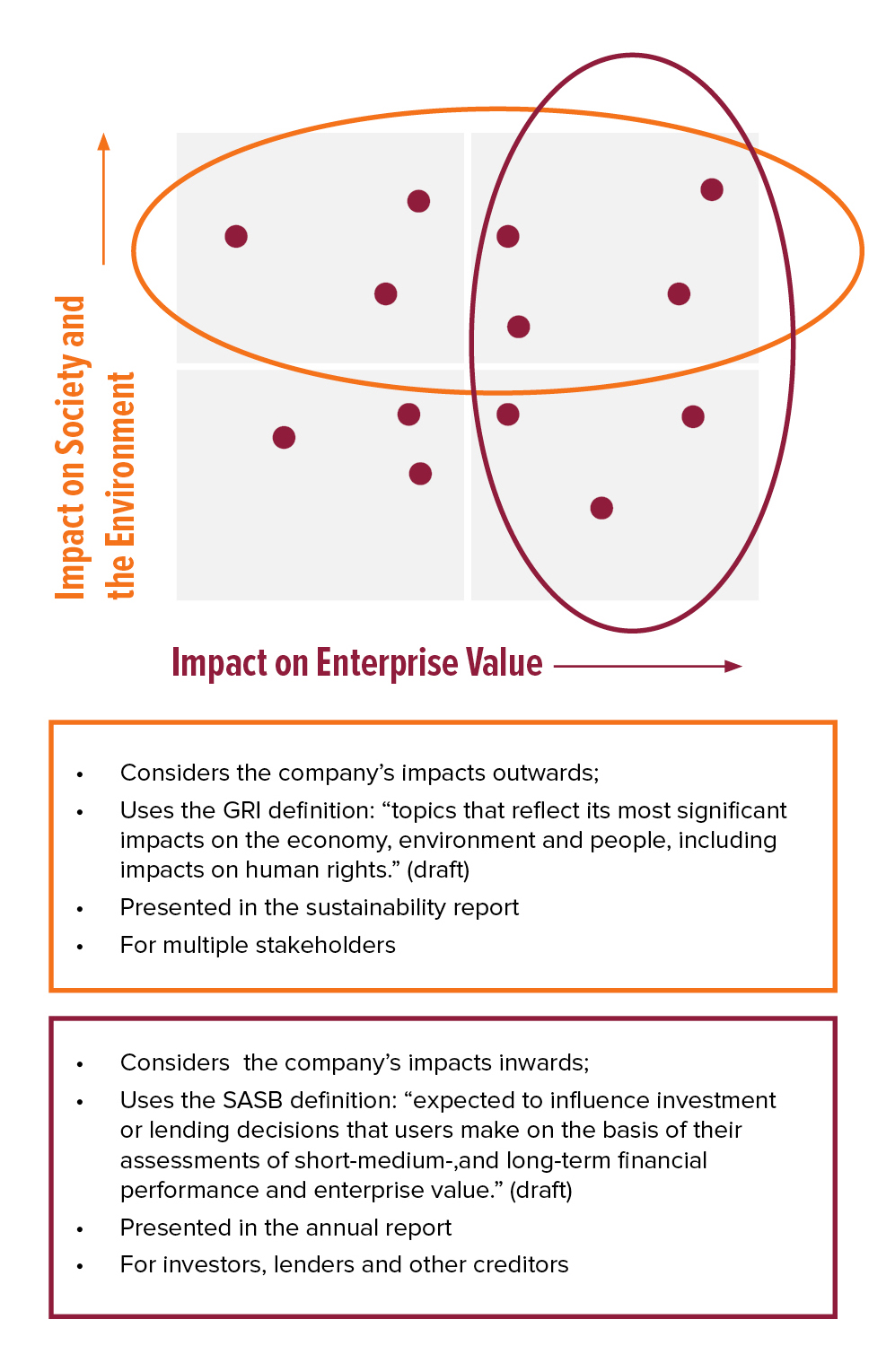
Take the topic of climate change. A business will want to understand how physical and transition risks may impact its enterprise value. Severe weather events may affect the company’s manufacturing sites or supply chain security, or climate regulation may mean that some of its products and services are no longer relevant. On the other hand, the company emits carbon emissions that impact the environment and people’s livelihoods.
Double materiality is also applicable to an issue like diversity, equity, and inclusion. In a talent-tight market, a company’s ability to attract a diverse workforce may improve its pool of talent and workforce productivity and influence its enterprise value. If a company has discriminatory practices, this may result in lawsuits or change of leadership, which could in turn negatively impact enterprise value. On the other hand, discriminatory practices constitute an infringement on civil and human rights.
However, some topics may constitute significant impacts outward without affecting enterprise value (top left quadrant of the matrix). Take the presence of conflict minerals in electronics companies’ supply chains. Minerals extracted in conflict zones are sold to perpetuate conflicts, affecting communities’ human rights and livelihoods. On the other hand, conflict minerals has not proven to negatively impact enterprise value.
Looking at the bottom-right quadrant, customer satisfaction will likely affect enterprise value. However, it might not constitute a significant impact on people, the environment, or human rights.
For the purposes of reporting, a business should engage its investors on topics that affect enterprise value (in the two right quadrants). The business will report to a wider range of stakeholders, such as consumers, business partners, and local communities, on significant impacts to the economy, the environment, and people (in the two top quadrants).
So, why should companies apply this concept of double materiality?
We hear from our members that despite having completed a materiality assessment, they still get questions from stakeholders about other issues that may not be material to their business. We hear that some topics like modern slavery get Board time and attention, even if this topic may not be material to the company. We hear that executives get tired of hearing that all sustainability issues are material topics, when actually they are not.
By applying the concept of double materiality, a company will be able to clearly distinguish between inward and outward impacts.
- A company should report on all its significant impacts outwards, regardless of whether they are material to the business. Applying the concept of double materiality will help answer stakeholder pressures for greater corporate transparency.
- The sustainability field has at times overestimated the impact of sustainability topics on the business. In our view, this can impede on the sustainability team’s ability to convey true priorities. By identifying those issues that are financially material, a sustainability team will be able to advance priorities that are truly a business concern.
- Understanding the link between inward and outward impacts of an issue will help the company build an adequate management plan, as well as report on these topics in a meaningful way to different stakeholders. When drawing a plan to manage an impact, e.g. labor rights in the supply chain, a business will be able to inform the plan with an understanding of whether this is a true risk for the business or whether this is part of the company’s responsibility to mitigate an impact on people.
As businesses are looking to refresh their materiality assessment, applying the lens of double materiality will help enhance the value of the assessment for reporting and strategy. We will continue to explore how to enhance the value of materiality assessments in this blog series. We are interested in hearing your thoughts and continuing the conversation about double materiality with our members. Contact us!
Blog | Tuesday February 9, 2021
Double and Dynamic: How to Enhance the Value of Your Materiality Assessment
After 20 years of discussions and evolving perspectives on what materiality means, who is it for, or whether the sustainability field should even be using the term “materiality,” a consensus is emerging.
Blog | Tuesday February 9, 2021
Double and Dynamic: How to Enhance the Value of Your Materiality Assessment
Preview
Progress on harmonizing sustainability reporting standards and definitions hit the accelerator in 2020. After 20 years of discussions and evolving perspectives on what materiality means, who is it for, or whether the sustainability field should even be using the term “materiality,” we see a consensus emerging.
At BSR, we welcome this consensus. Frankly, after years of debate in our field, this clarity is refreshing!
A materiality assessment is often considered the cornerstone of a company’s sustainability efforts. If done well, a materiality assessment helps a company focus its sustainability strategies on the areas and topics that will have the most impact. It allows a company to understand stakeholder priorities and deliver decision-useful sustainability reporting to its stakeholders. It enables sustainability teams to build a shared understanding by relevant functions and business leaders on sustainability priorities.
However, in our experience, materiality assessments can fall short of delivering these key benefits. The process is often not well understood by business leaders and is disconnected from other business processes, such as strategic planning or risk management. It is often viewed as a check-the-box and low-value exercise. The methodology is often seen as more art than science. The results are often dependent on which stakeholders you engage and what is high on their agenda at the time you ask them. A materiality assessment provides a static picture of what is important today, with little insight on what will be important tomorrow.
Today, we can agree that materiality is double and dynamic. Double materiality recognizes that a business should report on both impacts inwards (sustainability topics that are financially material influencing enterprise value) and impacts outward (sustainability topics that are material to the economy, the environment, and people). Dynamic materiality acknowledges that the financial materiality of an issue can be dynamic, changing based on foreseen or unforeseen events.
In this four-part blog series, we will explain how to enhance the value of materiality assessment and what these new materiality definitions mean for businesses, whether they use this assessment for the purposes of reporting, strategy building, or stakeholder assessment.
- Part one will focus on why companies should assess double materiality.
- Part two will look at how companies can monitor dynamic materiality.
- Part three will focus on identifying and assessing the company’s impacts outwards and how this assessment links to a human rights assessment.
- Part four we will discuss methods to evaluate how sustainability issues can impact enterprise value.
Summary of Changes to the Definition of Materiality
- In June 2019, the European Commission introduced the “double materiality perspective” in its Guidelines on non-financial reporting: supplement on reporting climate related information. According to the Non-Financial Reporting Directive, a company is required to disclose information on ESG “to the extent that such information is necessary for an understanding of the company’s development, performance, position and impact of its activities.” The European Commission states: “The reference to the ‘company’s development performance and position’ indicates financial materiality, in the broad sense of affecting the value of the company. This perspective is typically of most interest to investors. (…) The reference to ‘impact of the company’s activities’ indicates environmental and social materiality. This perspective is typically of most interest to citizens, consumers, employees, business partners, communities and civil society organizations.”
- In June 2020, the Global Reporting Initiative (GRI) published its exposure draft with a revised definition of materiality. The GRI states: “The organization prioritizes reporting on those topics that reflect its most significant impacts on the economy, environment and people, including impacts on human rights. In the GRI Standards, these are the organization’s material topics.”
- In August 2020, the Sustainability Accounting Standards Board (SASB) published proposed changes to the SASB Conceptual Framework. The proposed changes to the definition of materiality are intended to align to an international definition of financial materiality rather than a U.S.-centric one. The proposed definition reads: “For the purpose of SASB’s standard-setting process, information is financially material if omitting, misstating, or obscuring it could reasonably be expected to influence investment or lending decisions that users make on the basis of their assessments of short-, medium-, and long-term financial performance and enterprise value.”
- The five reporting standards organizations, CDP, CDSB, GRI, IIRC, and SASB, (also known as Group of Five) published two papers, Statement of Intent to Work Together Towards Comprehensive Corporate Reporting in September 2020 and Reporting on enterprise value in December 2020. In these two papers, they describe materiality as "nested and dynamic" and present a comprehensive corporate reporting system with three lenses. The largest lens of reporting reflects “reporting on all sustainability matters that reflect significant positive or negative impacts on people, the environment and the economy.” The second lens is a subset of topics reflecting “those sustainability matters that create or erode enterprise value.” The third lens is the smallest subset of topics “already represented as monetary amounts recognized in the financial statements.” Materiality is dynamic because topics can move from the larger lens to the smaller lens and become financially material over time.
- In September 2020, the IFRS Foundation, which sets global standards in financial accounting, launched a Consultation Paper on Sustainability Reporting. One of the key questions it asks is whether a global standard should focus on issues material to investors ("single materiality") or address topics “that are material to multiple stakeholders’ understanding of a company’s effect on its environment” ("double materiality").
Blog | Thursday February 4, 2021
Companies Can’t Ignore the ‘She-cession’ Created by the COVID-19 Pandemic
COVID-19 has fueled a recession for women. BSR recommends six actions for companies to incorporate a gender lens on recovery efforts.
Blog | Thursday February 4, 2021
Companies Can’t Ignore the ‘She-cession’ Created by the COVID-19 Pandemic
Preview
“Stronger engagement on gender equality is key to a sustainable global recovery from the COVID-19 crisis and building fairer, more inclusive, more prosperous societies. Women and girls are in the frontline of the pandemic and must be put in the driving seat of the recovery.”
In this statement, Jutta Urpilainen, EU Commissioner for International Partnerships, stresses the vital importance on the role of women in both responding to the COVID-19 pandemic and its economic recovery. Indeed, women will be key to the economic recovery from COVID-19, in part because they have been the hardest hit.
As early as April 2020, news investigations raised the alarm over the disproportionate impact of COVID-19 on women and their economic prospects. As the months went on, the pandemic continued to spread, governments imposed lockdowns, schools stayed closed, and more workers lost their jobs—the economic crisis caused by COVID-19 grew into a full blown “she-cession” that companies cannot afford to ignore.
Women Have Suffered Disproportionately due to COVID-19
Women make up the majority of workers in “frontline” sectors, including retail, health, K-12 education, and paid care. Many of these workers are in precarious situations with inadequate health and safety measures, putting themselves and their families at risk. In other sectors, women have experienced higher levels of job losses, either being let go or leaving to manage childcare.
In the U.S., women account for 53.6 percent of overall net job losses since the beginning of the pandemic, with Black and Latina women facing even higher unemployment rates. In Europe, the job loss rate for women is 1.8 times greater than that of men. Low-income women and women in rural settings in Latin America are more likely to be unable to work or go out during the pandemic. Similar trends can be seen around the world in countries such as Brazil, South Africa, and India.
COVID-19 is likely to have long-lasting impacts on women’s economic participation: the poverty rate among women in Europe is expected to go up by 1.9 percent. In the U.S., nearly 40 percent of unemployed women have been out of work for six months or longer. In addition, the jobs that are coming back are not going to women; this is true even in female-dominated sectors like retail, leisure, and hospitality.
Job losses are not the only negative impacts women face. In the U.S., France, and the U.K., incidents of domestic abuse increased by 25-36 percent following the first confinement. Globally, domestic violence is expected to soar by 20 percent globally during lockdowns.
What’s more, around 70 countries have reported issues delivering family planning services during the pandemic. Marie Stopes International, which provides family planning services in 37 countries, estimates that nearly two million fewer women received birth control services between January and June of 2020.
Building Back Better—with Women in Mind
As governments and businesses begin to develop and enact plans for rebuilding, they need to incorporate an intentional gender lens on recovery efforts. Without this lens, we run the risk of undoing the decades of progress that we have made towards women’s economic empowerment and gender equality.
So far, both the European Union and the U.S. state of Hawaii have already decided to put women at the center of their recovery. This holds enormous potential to help families and communities rebuild, as women invest more in their children’s education and health and put more of their income back into their local community. Thus, targeted programs and policies, including paid leave, equal pay, addressing gender bias in hiring, and others that support gender equality and women’s empowerment, are more important than ever.
BSR believes the six actions listed below are steps companies can take to ensure a gender-responsive approach to building back better.
- Make flexible work options the norm so that all employees of all genders can balance their professional and personal responsibilities. This includes teleworking, reduced working hours and part-time schedules, flexible working hours, compressed work weeks, and role sharing, among others. For example, Mars, as part of their new “Full Potential” platform, has committed to advancing their approach to flexible work beyond the pandemic. These options will not be feasible for all roles, many of which are the hardest hit by the pandemic (retail, health, and care), so companies will need to consider other options to support women as listed below.
- Consider re-entry programs, mentorship, and training for women who have been out of the workforce for an extended period. This should also include skills development to support employees to transition to more tech-based models of working. IBM is expanding its “returnship program” to hire and train women who have had to step back from employment during the pandemic, while Verizon retrained 8,000 workers to work remotely when stores were shut down and has allowed some of those employees to continue working remotely or part-time even when stores reopened.
- Encourage men to do their share of unpaid care work through awareness-raising campaigns, providing paid paternity and care leave, and supporting men who choose to take leave for care responsibilities. Initiatives such as the Parental Leave Taskforce, founded by Dove Men+Care and Promundo, and PL+US are championing access to parental leave for dads everywhere. Their latest report highlights the significant challenges facing employees who lack paid leave and provides recommendations for the private and public sector to better meet the needs of businesses and employees in a post-pandemic world.
- Support survivors of domestic violence to access the services and support they need. Offer paid leave for victims of domestic violence, relocation options, and information about local services. Avon and its parent company, Natura &Co, have partnered on #IsolatedNotAlone, a campaign that aims to raise awareness of the issue, provides resources, and calls on governments to take action.
- Remember that the impacts of COVID-19 are not the same for all women and take an intersectional approach when designing policies and programs. This includes considerations for LGBTIQ+ women, women of color, and women with disabilities. Companies looking to expand or strengthen their Diversity, Equity, and Inclusion programs should consider these recommended actions to take intersectionality into account.
- Advocate for a gender-responsive recovery that reaches the most vulnerable. To work toward solutions that are more systemic and comprehensive, companies can work with peers and through trade organizations to ensure a gender lens is placed on recovery efforts, including investments in care infrastructure, preventing and responding to increased gender-based violence, and promoting greater equality for all women. This will be particularly important to reach the 190 million women in global supply chains who face additional risks, for example, related to lack of access to contraception and extreme financial insecurity.
Later this year, the Generation Equality Forum will offer a once-in-a-generation opportunity for business, governments, and civil society organizations from across the globe to co-create an actionable roadmap to achieve gender equality by 2030.
The Forum will discuss the range of gender equality challenges laid bare by the pandemic, such as economic justice and technology for women and girls, as well as issues that remain critical to address, including climate justice and sexual and reproductive health. BSR, in collaboration with The B Team and Women Win/Win-Win Strategies, is excited to work with our members to catalyze meaningful commitments and action as part of this milestone gathering. Join us on March 2 for a webinar to learn about how business can contribute to the success of this landmark moment.
Blog | Wednesday February 3, 2021
Looking Ahead to the Next Decade of Business and Human Rights
As we look ahead to the next decade of the UN Guiding Principles on Business and Human Rights (UNGPs), we see the need to start focusing on six areas that will enable us to achieve the most meaningful progress toward the realization of human rights.
Blog | Wednesday February 3, 2021
Looking Ahead to the Next Decade of Business and Human Rights
Preview
This June will mark the 10th anniversary of the UN Guiding Principles on Business and Human Rights (UNGPs). Unanimously endorsed by the UN Human Rights Commission in 2011, the UNGPs have become the universal standard guiding business responsibility to respect human rights.
As we work with businesses around the globe to fulfill their responsibility to respect human rights, the UNGPs have been critical to advancing BSR’s mission of creating a more just, sustainable world.
The UN Working Group on Business and Human Rights (UNWG), as part of its mandate to promote the UNGPs, has called for submissions to inform the UNGPs' next decade project, seeking input to “develop an ambitious vision and roadmap for implementing the UNGPs more widely and more broadly between now and 2030.”
For BSR’s submission, our human rights team has drawn on over 25 years of experience in supporting companies on human rights issues, as well as consultations with more than 40 companies in late 2020. Through our reflection on the past 10 years of the UNGPs, we’ve identified key successes, gaps, challenges, and opportunities.
The broad consensus is that the UNGPs have been successful in giving companies across sectors—along with their partners in government and civil society—a shared roadmap for respecting human rights and a common language for articulating this goal. The UNGPs have also been successful in:
- Spurring public corporate commitments to respect human rights
- Increasing transparency on human rights performance through benchmarking and reporting
- Driving the development of the internal architecture (e.g., policies, procedures, staffing) needed to prevent, mitigate, and remedy human rights harms
- Expanding the scope of risk beyond risks to the business to include a broader set of risks to rightsholders
As we look ahead to the next decade of the UNGPs, we see the need to focus on the areas that will enable us to achieve the most meaningful progress toward the realization of human rights. We recommend starting with these six focus areas.
Due Diligence
One gap that we identified in our analysis of corporate human rights programs is that human rights assessments are often conducted as one-off events, rather than as part of an ongoing process of discovery and response built into cross-functional risk management processes.
For the next 10 years of the UNGPs, we recommend strengthening the effectiveness of human rights due diligence by ensuring that it is forward-looking and ongoing; engages rightsholders in identifying, preventing, and mitigating human rights impacts; and includes consideration of systemic and contextual risk factors.
Access to Remedy
Effective remedy should be informed by the perspectives of rightsholders who have been harmed, ensuring that the harm and its root causes are appropriately identified and addressed and that adverse impacts are appropriately remediated. However, rightsholder engagement in the development of effective grievance mechanisms and the provision of remedy is limited, and the respective roles of states and companies in the remedy ecosystem remains unclear.
The UNWG and the broader business and human rights community can strengthen access to remedy by providing guidance on the effectiveness criteria, the roles and responsibilities of different actors in the remedy ecosystem, and implementation of remedy.
Supply Chains
Supply chains continue to pose numerous well-recognized challenges to meeting the goals of the UNGPs. First, many companies still lack complete visibility of their human rights impacts beyond the first tier of the supply chain. In addition, small and medium enterprises (SMEs), which make up much of the upstream value chain, are often left out of the equation entirely—lacking adequate support, incentives, and resources to guide implementation of the UNGPs.
We see significant opportunity in extending corporate human rights work to reach the people in the global supply chain. There is clearly a need for innovative and enhanced approaches to addressing upstream human rights impacts in corporate supply chains. This includes increased collaboration across the value chain, more effective use of leverage, and increased application of the UNGPs among SMEs.
Products and Services
In downstream value chains, similar challenges persist, with limited assessment of human rights impacts associated with products and services beyond the point of sale and limited awareness of effective approaches to build leverage and manage risk.
As such, we see a need for increased attention to the actual and potential human rights impacts of products and services, and developing effective approaches to preventing, mitigating, and remedying these. Product impacts are very industry specific. The OHCHR’s B-Tech Project is a useful example of a sector-specific effort to interpret the UNGPs.
Outcomes and Impacts
There are several challenges related to defining relevant metrics and collecting data about human rights outcomes, particularly data related to prevention of adverse impacts, and these have undermined the corporate human rights field’s ability to evaluate and compare the effectiveness of specific approaches.
Looking to the next decade, we believe it is necessary for companies to establish a shared vision for outcomes and impacts, as well as clarify meaningful process and outcome indicators to measure performance and improve accountability. The financial sector can play a key role in the development of performance measurement criteria, thereby driving increased integration of human rights performance into investment decision-making.
The Role of the State
Despite the trend toward increased legislation, limited national action to protect human rights in many countries around the world is perhaps the most prominent obstacle to the implementation of the UNGPs, particularly in contexts afflicted by conflict, corruption, and weak, predatory, or authoritarian governments. Insufficient action taken by states to address core development challenges—including poverty, inequality, and weak rule of law—further heightens the risk that business activity will cause or contribute to adverse human rights impacts or facilitate harm through business relationships. While business plays a critical role in fostering the enabling environment for human rights through inclusive economic growth, responsible stewardship of natural resources, and attention to the concerns of vulnerable groups, many companies remain reluctant to take proactive action in the absence of the state.
To address this, companies can collaborate with and advocate for national governments to harmonize legal requirements with each other, in alignment with the UNGPs and with other evolving environmental reporting and due diligence requirements. Collaborative approaches that bring business together with civil society and government to solve complex systemic challenges, address structural barriers, and prevent the cumulative impact of business activity on human rights beyond the impacts of a single company are also key.
Conclusion
The UN Guiding Principles on Business and Human Rights was a landmark document for the corporate human rights field. Over the past decade, it has been a foundational part of the work that BSR does in helping to create a more just, sustainable world.
We look forward to another decade of companies and partners working together to fulfill the promise of the UNGPs and ensuring that human rights are respected and protected—and we believe with additional focus on the areas above, we will be able to do so even more effectively.
BSR wishes to thank the more than 40 companies who participated in the UNGP Next Decade consultations, including members of BSR’s Human Rights Working Group as well as other companies who shared their experience and insight. To learn more about BSR’s human rights work, please feel free to reach out to our team.
Blog | Tuesday February 2, 2021
China in 2021: Looking beyond COVID-19
BSR takes a look at four trends to watch in China’s manufacturing and supply chain environment in 2021, a year still shaped by COVID-19.
Blog | Tuesday February 2, 2021
China in 2021: Looking beyond COVID-19
Preview
It’s hard to believe that at this time last year, China was alone in suffering the first impacts of COVID-19, and the pandemic was not yet a global crisis. As I wrote in my blog, “The Coronavirus’ Impact on Chinese Society and Supply Chains,” cities and counties across China were closed, and workers who had traveled to their hometowns for the Lunar New Year celebrations were stranded and unable to return to the cities in which they worked. At the time, we faced huge questions about how long factories would remain closed and what impact this would have on the global supply chain.
In the time since, COVID-19 has brought immense amount of suffering across the entire world. However, in China, the focus on fighting the virus has resulted in a rebound in business and even labor shortages. However, the 2021 Chinese Lunar New Year is approaching, and it’s starting to put pressure on China’s business, society and families. As a large population prepares to travel back home, especially students and workers, COVID-19 cases are increasing. The government is encouraging people to stay where they are and are taking more measures to trace and control traveling. Many families will not be united for the second year in a row. Manufacturers will face a second wave of worker shortages due to the travel controls and quarantine, and these will have a direct impact on production and cost.
As business feels its way through these uncertain times, change is happening—and not only driven by COVID-19. As we look to 2021, the Year of the Ox, here are four trends to watch in China’s manufacturing and supply chain environment:
1. Climate
China has made significant announcements to peak emissions by 2030 and achieve carbon neutrality by 2060. These are big, important developments and will be key to fighting the global climate crisis. At the same time, China will continue to strengthen its efforts to improve overall environment performance, including water and eco-system stewardship. These impacts on business will be potentially profound, and how these impacts develop and evolve will be important for global supply chains and their China operations.
2. The 14th Five-Year Plan
This key roadmap will outline the government’s focus areas and how it will steer China’s development, especially in the areas that will have immediate impact on the market and business. With regards to climate, the Plan will integrate China’s climate commitment strategy with implementation outlines 2021-2025. We predict that the Plan will provide insights into green finance, green technological innovation, clean production, low carbon, energy efficiency, and other policy elements which will impact how China navigates toward its climate goals—and how business needs to react. On the social side, after announcing its success in alleviating absolute poverty during the 13th Five-Year Plan (2015-2020), China will continue to work on building a well-balanced society by improving national social benefits, including education, health care, and quality life for all, by continuing to work on relative poverty through various economic means and jobs. Business will play an important role in supporting this agenda.
3. Digital in China and E-Commerce
The acceleration brought to e-commerce in China by COVID-19 has been profound. This is going to grow and evolve, and the digital marketplace will continue to transform the Chinese economy. Interestingly, the 14th Five-Year Plan will reinforce this, as it seeks to drive growth driven by domestic demand, innovation, artificial intelligence (AI), and technological self-reliance in products and services. The learnings for business will be important, both for the Chinese marketplace and beyond.
4. China’s Place in the Global Market
China’s position in the global marketplace will continue to shift this year as more sectors open up to foreign investment, including finance, education, and insurance, and more Chinese businesses become publicly listed and follow international standards. At the same time, China is increasing its overseas investments, especially in Africa and One Belt One Road regions, and due to the cost and COVID-19, many Chinese industry owners have moved their productions to other parts of Asia. As a result of this increased overseas presence, Chinese industry associations and government agencies have issued sustainability standards and guidelines for Chinese businesses with international operations. This will have a significant impact not only on sustainability performance in China, but also in the global market.
In short, 2020 and COVID-19 created a period of profound shock and change. But the China that emerges in 2021 will be different from the China I wrote about in February of 2020. The ongoing changes that we can already see will bring important impacts to the companies doing business in and sourcing from China. Climate change and energy, e-commerce, governance frameworks, and market reforms will all shape 2021 and beyond. These changes will become clearer when China finalizes its 14th Five-Year Plan in March.
Watch this space for more as we unpack how regulators, stakeholders, business, and others understand and digest the development that 2021 is sure to bring. Engage with us to inform your understanding and develop your China strategy.
Blog | Wednesday January 27, 2021
Data and Tech Acceleration in COVID-19: The Human Rights Impact on Vulnerable Garment Workers
BSR examined the impacts of digital transformation on women garment workers in our new report, Digital Technology and Data in the Garment Supply Chain during COVID-19.
Blog | Wednesday January 27, 2021
Data and Tech Acceleration in COVID-19: The Human Rights Impact on Vulnerable Garment Workers
Preview
Workers in the global supply chain—the women and men who make the clothes we wear and produce the food we eat—may not be the first people who come to mind when we discuss workplace data protection. However, like corporate offices, factories are digitizing rapidly—a change accelerated further by the COVID-19 pandemic. Yet, supply chain workers too often lack the information, skillsets, and power that provide resilience in the face of such disruptions.
This is especially true for women workers who are particularly vulnerable due to lower literacy levels, lower tech literacy, and social norms which often lead to women bearing increased burdens of care at home. Recognizing this, BSR examined the impacts of digital transformation on women workers in our new report, Digital Technology and Data in the Garment Supply Chain during COVID-19.
Through our research, BSR found that the pandemic catalyzed a surge in digitization, surveillance, and data collection in garment supply chains. Furthermore, we found that this surge is occurring at such a rapid rate that protections for workers and their rights are not keeping pace.
Increasing Digitization and Data Collection in Factories
While the COVID-19 pandemic caused a surge in the risks associated with rapid digitization, data and technology use in the garment supply chain is not new.
Following the Rana Plaza disaster in 2013, where over a thousand workers died in the collapse of a Bangladeshi clothing factory due to unsafe building conditions, supply chain monitoring technologies increased in popularity, and worker data collection approaches multiplied. Seeking to both increase transparency in the garment supply chain and empower workers, companies and factories embraced technologies, such as worker voice applications, that provide mechanisms for workers to file grievances through their mobile phones.
However, technology is changing rapidly, and given the pace of change, previous guidance is out of date. There is a growing urgency for up-to-date international norms on workplace data protection. The guidance and advocacy that do exist primarily focus on higher-tech workplaces, such as logistics warehouses and offices, but do not cover factories with less technology and lower wage workers.
Human Rights Impacts on Workers, Specifically Women
Though digitization and data collection may increase transparency and productivity, human rights impacts should be considered due to the heightened vulnerability of workers in the garment supply chain.
The power imbalance that exists between employers and low-wage workers in garment factories makes factory workers highly vulnerable to breaches in protections of data. This is especially true given lower education levels and lack of awareness of implications of data collection—often resulting in lack of meaningful informed consent, for example.
Though intended to safeguard worker rights, increased digitization and data collection can impact privacy and non-discrimination rights, which in turn can impact other rights. Personal data leakage, for example, may lead to a worker being targeted for affiliation with a worker representation group—thereby infringing upon their right to freedom of expression. Personal health data acquisition may result in dismissal of women suspected of being pregnant to avoid compensating them for maternity leave.
What Companies and Stakeholders Can Do
The combined forces of the COVID-19 pandemic and the rapid rise in digitization and data collection in the workplace have exposed the need for stronger internationally accepted norms and standards around workplace data protection. New international standards—for example, an ILO convention that addresses workplace data protection, privacy, and nondiscrimination to help governments and businesses effectively safeguard workers’ data rights, especially the rights of women—will be key to ensuring rights are protected in the face of rapid digitization.
Companies can make an impact by advocating for such international actions. In addition, our report identifies several actions companies, including tech providers, can take to optimize positive impacts of the digital transformation and address its potential harms.
One example would be for companies and tech providers to ensure worker representation—especially women workers—in the design, implementation, and governance of any workplace technology. Before implementing data collection mechanisms or processing data that might result in high risk to employees, companies should undertake human rights due diligence and Data Protection Impact Assessments (DPIA) to identify, prevent, and mitigate human rights impacts.
Additionally, tech solution providers should adopt privacy-by-design principles to address potential challenges early on. Furthermore, tech providers can help promote workers’ rights by advocating for worker trainings on informed consent and collaborating with peers to adopt industry-wide principles that prioritize worker rights.
What Comes Next
Given the proliferation of workplace-monitoring technologies, alongside accelerated digitization of work due to COVID-19, it is essential that protections are established to account for this monumental shift in workplace data collection.
Whether it is improving supply chain codes of conduct, creating new international standards, or more deliberately integrating privacy issues into workplace human rights impacts assessments, it is essential that worker data protection is fully embedded into how we build back better.
Please see our report for full recommendations on how companies can protect worker data, and feel free to reach out to our team to learn more about our work on technology, human rights, and empowering women workers in the global supply chain.
Reports | Wednesday January 27, 2021
Digital Technology and Data in the Garment Supply Chain during COVID-19
BSR examined the impacts of digital transformation on women garment workers in our new report, Digital Technology and Data in the Garment Supply Chain during COVID-19.
Reports | Wednesday January 27, 2021
Digital Technology and Data in the Garment Supply Chain during COVID-19
Preview
Like corporate offices, garment factories are digitizing quickly—a change accelerated further by the COVID-19 pandemic. With this increased digitization comes additional challenges for upholding workplace data protection, and garment supply chain workers often lack the information, skills, and power to be resilient when facing these disruptions.
This is especially true for women, who make up the largest portion of the garment sector workforce, and thus the impacts of technology and data use on female workers demand particular attention. Existing workplace inequalities that women face are compounded by the fact that technology design, implementation, and governance disproportionately exclude them. Women feel the brunt of negative consequences from data misuse through amplified impacts on their right to privacy, nondiscrimination, the right to work, and so forth.
As factories continue to digitize, the need for discussion of the responsible use of data in the supply chain is more urgent than ever. This paper explores digital technology in the garment supply chain and analyzes the actual and potential impacts of data use on workers, with a special focus on women workers. It also provides recommendations to key stakeholders in the garment supply chain on how to implement digital technologies in a way that respects and promotes workers’ rights.
This paper’s findings are derived from conversations with HERproject country representatives and implementing partners from India, Bangladesh, and Kenya; consultations with subject matter experts; and interviews with supply chain technology providers.
Businesses interested in learning more about HERproject’s work on technology, human rights, and empowering women workers in the global supply chain can feel free to reach out to the team.
Blog | Tuesday January 26, 2021
Inside BSR: Q&A with Margot Brent
In our new monthly “Inside BSR” series, we get to know members of the BSR team. This month, we feature Margot Brent, an Associate in our Hong Kong office, and learn about her work with the Sustainable Futures Lab.
Blog | Tuesday January 26, 2021
Inside BSR: Q&A with Margot Brent
Preview
At BSR, we are proud to say we have a global team of sustainable business experts that collectively, along with our members and partners, advances our mission to create a more just and sustainable world. But we are more than just the sum of our parts.
We are excited to launch "Inside BSR," a new blog series to get to know the people who make up the BSR team. Each month, we will feature a different team member and learn more about them, the unique background they bring to BSR, and their passion for sustainability.
For our inaugural interview, we connected with Margot Brent in our Hong Kong office. Margot spoke to us about the roots of her obsession with sustainable fashion, her work with the Sustainable Futures Lab, and her firsthand experience with women's empowerment programs.

Tell us a bit about your background. Where are you from, where are you based, and how did you get started working on sustainable business?
I’m originally from South Africa but have lived in Hong Kong for the past six years.
Following an undergraduate degree in Politics, Philosophy and Economics and a post-graduate degree in Sustainable Development, I began working on climate change adaptation with vulnerable groups in South Africa, Tanzania, Mozambique, and Nigeria.
I spent a good amount of time literally trekking through mud-filled mangroves working with coastal communities when I decided to trade in the field work for the city and headed to Hong Kong to pursue another passion.
When did you join BSR and what is your current role? What are some interesting projects that you get to work on as part of your role?
I joined BSR mid-2019, and I’m currently an Associate. I’m part of the Sustainable Futures Lab and also work with our consumer sector members.
As part of the Sustainable Futures Lab, I work on our quarterly emerging issues publication, entitled The Fast Forward. The publication helps make sense of the rapid and complex changes companies are facing and potential disruptions coming down the line, from new technologies to growing social movements. I enjoy the creative process of exploring these nascent issues and the significance of developing future-fit strategies together with our members.
I also work on projects with BSR’s Women’s Empowerment and Climate Change teams.
The opportunity to work on all these issues that I am passionate about, with one eye on the future, is what drew me to BSR. I love that I get to explore so many parts of sustainability and how rapidly it is changing, as well as how the solutions to wicked problems, such as unsustainable fashion, the climate crisis, and gender inequality, converge and intersect with one another.
Can you tell us about your experience before BSR? Have you always been interested in issues of sustainability?
Alongside my interest in climate, I’ve been interested in fashion, and sustainable fashion, for many years—including hours spent poring over the Vogue archives I discovered at my university library. I found fashion to be this intensely contrasting space filled with beauty, craft, creativity, and self-expression, all things I love, but historically has faced a lot of environmental and social challenges.
It created a strong conflict in me: how could I love these beautiful things while knowing what’s behind them? At the same time, I knew the power and importance of the industry and how it could be a force for good for so many, especially women.
When I first arrived in Hong Kong, I joined Li & Fung and Fung Group as an innovation manager, exploring emerging technologies, innovations for sustainability, and new collaborative ways of working in the fashion supply chain. We used a lot of design thinking and rapid prototyping, and these are approaches I still value in my work.
It’s also here that I really learned about BSR and HERproject and got involved in another women’s empowerment NGO, The Women’s Foundation, as a volunteer helping to design and implement a women’s professional mentoring and leadership skills program. As a beneficiary of the program, I felt firsthand the impact that it can have on professional and personal development, and so I joined the advisory council to give back and help develop the program further. I still meet regularly with my mentoring circle all these years later.
2020 was undoubtedly a difficult year. What were the things that brought you joy amid lockdowns/quarantines? What are you most looking forward to in 2021/when the pandemic is over?
It goes without saying 2020 has offered us all a moment of reflection—both globally and as individuals.
Personally, I’m fortunate to live in a city full of beautiful hiking trails on our doorsteps, so much of my time has been exploring the wild side of Hong Kong. I’ve tried to welcome the boredom—such a novel concept in the overstimulated 21st century—and bring more mindfulness to how I spend my time and what I consume, both physically and digitally .
That being said, like most people, I cannot wait to be gathered around a crowded table of home-cooked food and family back home, reflecting on the absurdity of this experience.
Blog | Sunday January 17, 2021
Six Steps to Prevent and Address Child Labor in the Palm Oil Industry
In collaboration with global buyers, BSR supported the development of agribusiness group Wilmar’s Child Protection Implementation Manual, which provides a guide for establishing and implementing policies related to safeguarding and protecting children from child labor and other forms of abuse in palm oil operations as well as remedial actions.
Blog | Sunday January 17, 2021
Six Steps to Prevent and Address Child Labor in the Palm Oil Industry
Preview
A recently published investigative report by the Associated Press has brought attention to the issue of child labor, which continues to afflict the palm oil industry.
Unfortunately, the problem is not new—and neither are efforts to put an end to it. Over the years, leading agriculture companies have set ambitious targets (both individually and jointly) to eradicate child labor. However, child labor is a complex issue, and its root causes, such as high rates of poverty and lack of educational infrastructure, require holistic multi-stakeholder approaches and solutions. Furthermore, the complexity of global agricultural commodity supply chains mean that human rights issues are often concealed beyond tier 1 due to a lack of transparency. This can oftentimes make it challenging to identify and address potential and actual harms to children.
Nevertheless, there are individual policies and management practices that palm oil companies need to introduce and implement in their operations to prevent child labor from occurring. Palm oil companies should also ensure that proper child labor remediation processes are developed and carried out if there are instances of child labor identified in their own and/or suppliers’ operations.
To this end, BSR supported the development of agribusiness group Wilmar’s Child Protection Implementation Manual, in collaboration with global buyers. The manual is intended to guide Wilmar’s suppliers and contractors in Indonesia toward a better understanding of the steps required to protect and safeguard children’s rights, and it is also applicable to the wider agriculture industry.
Underpinned by the Convention on the Rights of the Child (CRC), the UN Guiding Principles on Business and Human Rights, and other international standards, the manual provides a guide for Wilmar and its Indonesian suppliers to establish and implement policies related to safeguarding and protecting children from child labor and other forms of abuse in their operations as well as remedial actions.
Based on UNICEF’s Child Safeguarding Toolkit for Business, Wilmar’s manual outlines six practical due diligence steps and preventative measures that palm oil companies can take to protect and safeguard children in their operations and supply chains:
- Conduct a child protection risk assessment to understand how a company’s activities, employees, or representatives pose risks to children either through a standalone self-assessment or integrated within its own risk or impact assessment process while engaging with external child rights experts.
- Conduct a gap analysis of existing policies and practices to understand the extent to which child protection has been integrated into the company’s risk assessment and management processes.
- Develop a policy commitment to set out the company’s responsibility to respect human rights, including children’s rights. The commitment should be approved at the highest level of the business, embedded across all operations, and communicated internally and externally.
- Develop an implementation plan detailing how the Child Protection policy will be operationalized and embedded within the company.
- Establish a reporting structure to receive and respond to reports regarding the welfare of a child. This reporting structure can either build on existing company policies and reporting structures or standalone structures that are solely related to child protection issues.
- Provide guidance for employees on how to take appropriate actions when concerns about a child’s safety and welfare are raised using the company’s reporting structure and grievance channels.
The manual is also aligned with the Roundtable on Sustainable Palm Oil (RSPO)’s Guidance on Child Rights for Palm Oil Producers to strengthen child rights protection while further improving compliance with the RSPO certification standard. The RSPO guidance aims to improve the livelihoods of children and their communities while providing support for interventions and to minimize potential adverse impacts.
In the event that instances of child labor are found—even when hiring policies and practices, age verification, and workplace assessments are in place—Wilmar’s manual also provides guidance on how to develop a child labor remediation plan.
A remediation plan should include a set of operational principles to guide a company’s responses on a case-by-case basis according to the best interests of the child. Supporting a child’s education or employment for their parent/guardian are just a few of the remedial actions that companies can take once the child is removed from work while keeping their best interests at the center of all decision-making.
In order to monitor implementation and impact of the manual, BSR will continue to work with Wilmar to conduct a pilot of the Child Protection Implementation Manual with a selected supplier in Indonesia at the operational level. Together, we will test and refine the manual’s practical applicability, build supplier capacity to address child protection issues in palm oil estates in Indonesia, and subsequently share key lessons learned with Wilmar’s supplier base in Indonesia. We hope that these practices will be widely adopted across the palm oil industry.
For more information on Wilmar’s Child Protection Implementation Manual and any questions about the next phase of work, or to learn more about BSR’s work on business and human rights, including children’s rights, please reach out to connect with our team.
Search Again?